
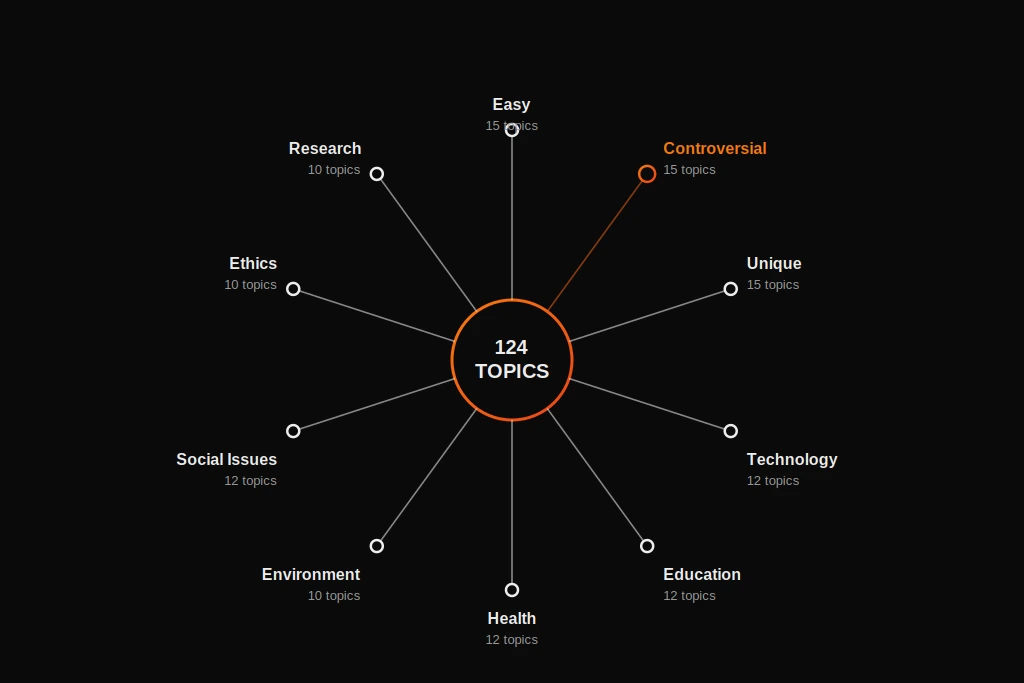
A good argumentative essay topic for college students needs two things: a real opposing view that an informed person could actually defend, and enough research available to support both sides. Below you’ll find topics organized by difficulty, subject, and type, from easy and low-stakes to genuinely controversial, each with a one-line note on why it’s actually arguable, not just a bare title.
If a topic doesn’t have a credible opposing side, it isn’t an argumentative essay topic, it’s just a fact waiting to be explained, and this list only includes topics that pass that test.
What Makes an Argumentative Essay Topic Actually Good?
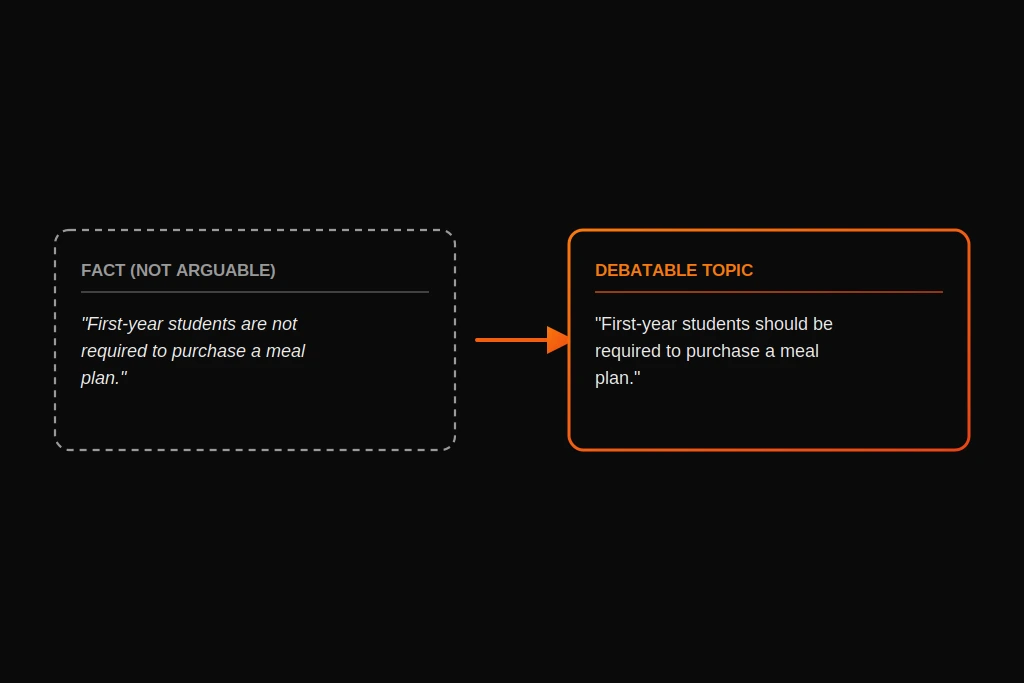
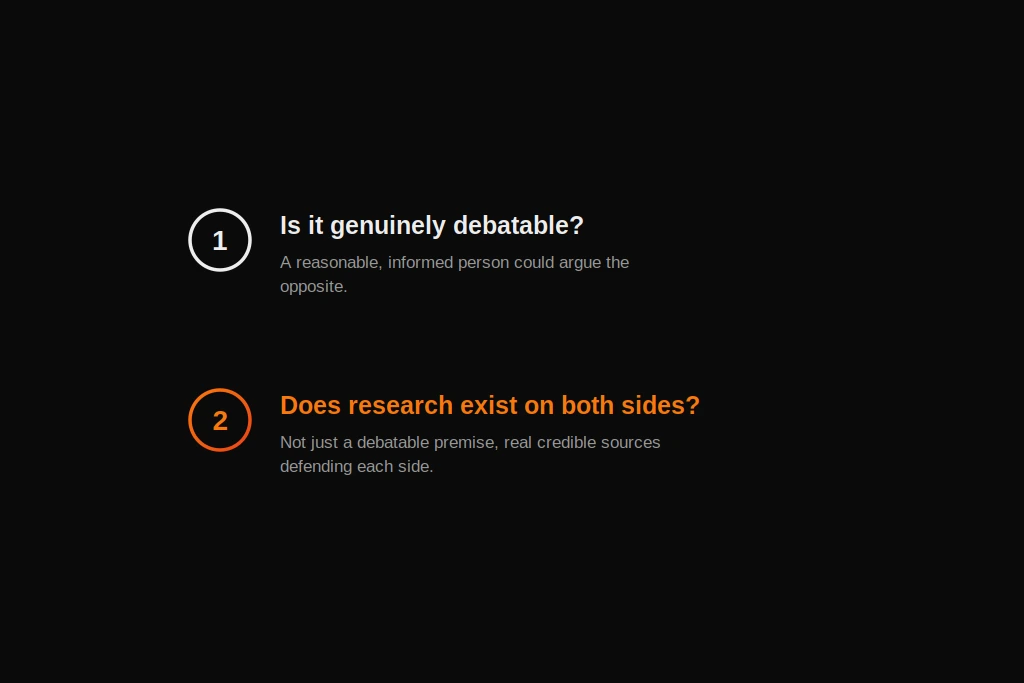
According to the University of Toledo Writing Center, a topic only qualifies as debatable if reasonable people genuinely disagree over it. “First-year students are not required to purchase a meal plan” is a fact. “First-year students should be required to purchase a meal plan” is a debatable topic. The difference matters more than it sounds like it should, since a huge share of weak student essays are built on facts dressed up as arguments.
There’s a second test that’s just as important and gets skipped more often. According to a library guide from Westmoreland County Community College, a good topic needs credible research supporting both sides, not just a debatable premise. “The world is round” has no credible opposing research, so it fails even though people can technically disagree. Before committing to any topic below, do a quick search for sources defending the opposing view specifically. If you can’t find any, the topic needs narrowing or swapping.
If you want a fast way to pressure-test a topic before committing to it, picture writing the argumentative essay counterargument section first. If you can’t imagine a serious, informed person arguing the other side, the topic is too settled to carry a full essay.
How to Narrow a Broad Topic Into Something You Can Actually Argue
Most topics on this list are intentionally broad, since that’s how topic lists work, but a broad topic rarely makes a strong thesis on its own. “College athletes should be paid” is a fine starting point, but “college football players at Division I schools should be classified as university employees eligible for workers’ compensation” is something you can actually defend in a five-page essay.
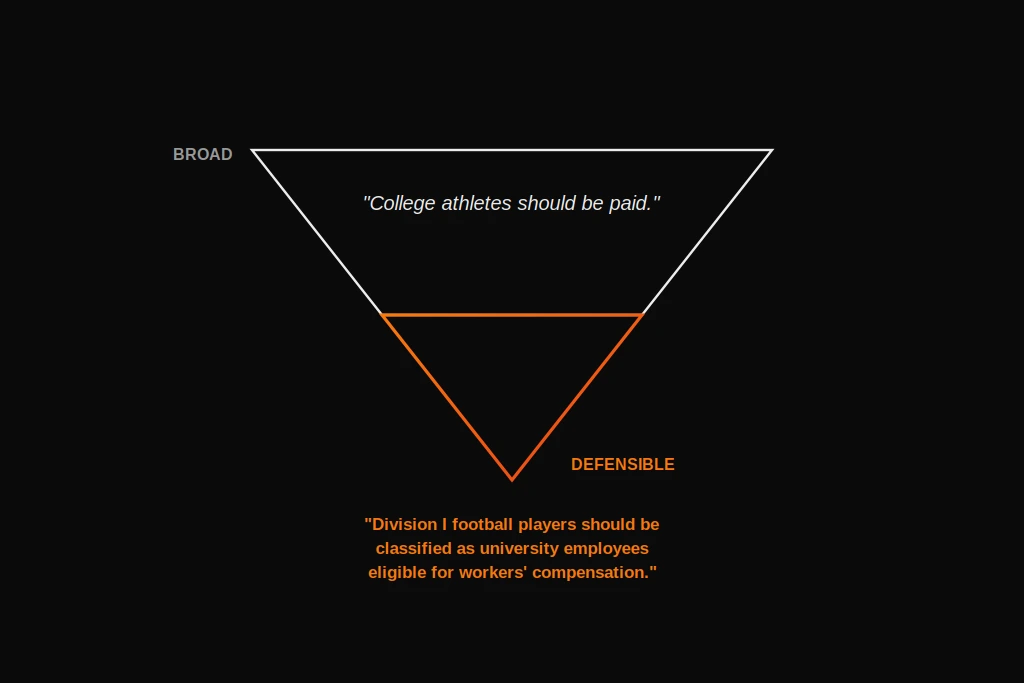
Narrow by adding a specific population, a specific policy mechanism, or a specific context, rather than arguing the broadest possible version of the claim. Once you’ve narrowed a topic this way, turning it into a real thesis statement in argumentative essay and a working argumentative essay outline becomes much more straightforward, since you already know exactly what you’re defending instead of gesturing at a general subject.
Easy Argumentative Essay Topics for College Students
Good starting points if this is your first argumentative essay or you’re short on time. Each one has widely available sources and a clear, easy-to-state opposing view.
- School uniforms should be mandatory in public schools — most people already lean toward dress codes or against them, giving you ready-made reasoning on both sides.
- Students should not be required to take physical education classes — the opposing view (PE builds lifelong healthy habits) is easy to state and easy to respond to with scheduling and inclusivity concerns.
- Homework should be limited to one hour per night in high school — students and parents already hold strong, well-documented opinions on both sides.
- Public libraries should eliminate late fees on borrowed books — the tradeoff between accountability and access is easy to explain in a single paragraph.
- High schools should start later in the morning for teenagers — there’s abundant, easy-to-find sleep research supporting both the benefits and the logistical costs.
- College tuition should be the same regardless of major — it’s an easy entry point into cost-and-value arguments without needing specialized economic data.
- Students should be allowed to use phones during lunch — it’s a low-stakes campus policy with obvious, intuitive reasoning on each side.
- Fast food advertising should be restricted during children’s programming — the health-versus-free-speech tension is already widely discussed and easy to research.
- Plastic water bottles should be banned on college campuses — the convenience-versus-sustainability tradeoff is simple to state and well documented.
- Grading on a curve should be eliminated in college courses — any student can immediately see the fairness argument on both sides.
- Students should be required to complete volunteer hours before graduating — it sets up an easy civic-engagement-versus-coercion tension.
- School vending machines should only sell healthy snacks — it’s a simple health-versus-choice framing most readers already have an opinion on.
- All students should learn a second language starting in elementary school — it’s an approachable education-policy topic with intuitive, well-researched benefits and costs.
- Community service should count toward college course credit — you can argue it from either a motivation angle or an academic-rigor angle, whichever sources support better.
- Public libraries should offer free coding classes for teens — it’s a low-stakes resource-allocation debate with a clear for-and-against structure.
Controversial Argumentative Essay Topics for College Students
Genuinely divisive issues with strong, well-researched positions on both sides. Good for upper-level courses or students who want a topic with real stakes.
- The death penalty should be abolished in the United States — decades of case law, public opinion data, and deterrence research exist on both sides of this one.
- Standardized testing should be eliminated from college admissions — it pits equity arguments directly against measurement-consistency arguments.
- Social media platforms should be held legally liable for user-posted misinformation — the free-speech-versus-platform-responsibility fight is actively playing out in real court cases.
- Affirmative action should be reinstated in college admissions — it’s a live legal and political debate following recent Supreme Court rulings.
- Marijuana should be legalized at the federal level — conflicting state and federal law plus public health research make this genuinely unsettled.
- Students should be allowed to carry concealed weapons on college campuses — it combines safety research, constitutional rights, and campus culture into one flashpoint issue.
- Universal basic income should replace existing welfare programs — it challenges assumptions on both ends of the political spectrum, which keeps the debate genuinely open.
- Religious institutions should lose their tax-exempt status — it raises overlapping constitutional and financial arguments with no clean resolution.
- Zoos and aquariums should be banned entirely — animal rights research and conservation-education research point in opposite directions.
- Immigration quotas should prioritize labor market needs over family reunification — it’s a live, deeply partisan policy debate with real economic data on each side.
- Parents should be legally responsible for their children’s cyberbullying — it raises real, unresolved questions about parental control versus overreach.
- The electoral college should be abolished in favor of a national popular vote — it’s a persistent, high-stakes constitutional debate with strong arguments on both sides.
- Genetic editing of human embryos should be legal for non-medical traits — it’s a bioethics flashpoint where almost no one holds a lukewarm opinion.
- Incarcerated people should retain the right to vote — it splits cleanly across legal, moral, and political lines.
- Companies should pay reparations tied to historical labor exploitation — it’s a highly contested economic and historical justice argument with genuine scholarship on both sides.
Unique and Creative Argumentative Essay Topics for College Students
Less common angles that still meet the two tests above, a real opposing view and real research, just applied somewhere less expected.
- Competitive video gaming should be recognized as a varsity sport in high schools — it reframes an unusual activity as athletics, with real data on physical and cognitive demands to draw from.
- Fictional characters’ choices deserve the same ethical scrutiny as real people’s — it merges literary analysis with moral philosophy in a way most students haven’t tried.
- Astrology content should carry the same disclaimers as other unproven health claims — it’s a quirky consumer-protection angle with a real regulatory parallel.
- Handwriting instruction should remain mandatory in an age of keyboards — cognitive science on handwriting and memory gives this more research backing than it first appears.
- Reality TV producers should be required to disclose which moments are scripted — it’s an unusual media-ethics argument with a clear transparency angle.
- Pets should be legally recognized as beneficiaries in a will — it’s a creative property-law question with real case precedent to research.
- Tipping culture should be replaced with built-in service charges — it combines labor economics with social awkwardness in a way most people have opinions on.
- Colleges should offer a formal course in internet and media literacy — it’s an unusual but increasingly well-supported academic-policy proposal.
- Fan fiction should be legally protected as transformative work — it sits at a genuinely contested intersection of copyright law and fan culture.
- Laugh tracks should be banned from television comedies — there’s real audience-psychology research behind the argument, which most people don’t expect.
- Universities should refund tuition for days canceled due to weather — it’s a practical consumer argument with a slightly unexpected angle.
- Influencers should disclose AI-generated content the same way they disclose paid partnerships — it’s a timely transparency argument without settled regulation yet.
- Colleges should count board games toward general education critical-thinking requirements — it’s an unexpected pairing of leisure and pedagogy with some real learning-science support.
- New public buildings should default to gender-neutral restroom design — it combines architecture, policy, and inclusion in a genuinely debated way.
- Streaming services should be required to preserve canceled shows rather than removing them — it’s a novel media-preservation argument tied to a very current industry practice.
Argumentative Essay Topics by Subject
If your course has a specific focus, these are organized by subject area so you can match your topic to your assignment.
Technology
- Schools should ban smartphones during class time entirely — focus and legitimate safety or communication needs pull in opposite directions.
- AI-generated content should be watermarked by law — it sets free expression against transparency requirements.
- Social media platforms should be required to verify the age of every user — it trades privacy against child-safety enforcement.
- Facial recognition technology should be banned from public surveillance — it’s a direct security-versus-civil-liberties divide.
- Large tech companies should be broken up under antitrust law — innovation arguments and monopoly-power arguments both have real economic research behind them.
- Self-driving cars should be legally allowed without a human backup driver — safety data and public trust are currently pulling in different directions.
- The right to repair should be legally guaranteed for all electronics — manufacturer control and consumer ownership are in direct tension here.
- Online anonymity should be eliminated on major social platforms — accountability and free speech are genuinely at odds on this one.
- Schools should replace physical textbooks entirely with tablets — there’s real cost and access data on both sides of this one.
- Video game loot boxes should be regulated as a form of gambling — consumer protection and industry freedom both have serious advocates.
- Employers should be barred from monitoring employees’ personal social media — privacy concerns and reputational-risk concerns are both well documented.
- Net neutrality rules should be permanently codified into federal law — it’s a recurring regulatory fight with real economic stakes on each side.
Education
- Public college should be tuition-free — affordability and funding-source arguments are both well researched.
- Letter grades should be replaced with standards-based assessment — it’s a genuine measurement-philosophy debate with real data and real tradition pulling in opposite directions.
- Student loan debt should be forgiven for public service workers — fairness arguments and cost-to-taxpayer arguments are both substantial.
- Standardized testing should be optional for college admission — access arguments and consistency arguments pull in different directions.
- Trade school credentials should carry equal weight to a four-year degree in hiring — there’s a real, documented credential bias worth arguing against or defending.
- Schools should eliminate tracking students into advanced versus standard classes — equity arguments and individualized-pace arguments are both well supported.
- Teacher pay should be tied to student performance outcomes — incentive arguments run directly into fairness concerns about factors outside a teacher’s control.
- Financial literacy should be a required high school course — it’s a genuine curriculum-priority argument with real outcome data to cite.
- College athletes should be classified and paid as university employees — labor-rights arguments and amateurism arguments are both actively litigated right now.
- Remote learning options should remain permanently available after the pandemic — access arguments and engagement-quality arguments are both backed by real data.
- Legacy admissions should be banned at federally funded universities — fairness arguments and institutional-autonomy arguments are in direct conflict.
- Universities should publish graduate salary data before enrollment — transparency arguments and institutional-reputation concerns pull in opposite directions.
Health
- Health insurance should not be tied to employment — access arguments and market-structure arguments are both well documented.
- Vaccination should be mandatory for public school enrollment — individual choice and public health protection are in genuine tension.
- Sugary drinks should be taxed like tobacco products — public health arguments and personal freedom arguments both have real research behind them.
- Mental health days should count as excused school absences — it raises a real, unresolved question about how schools recognize invisible illness.
- Fast food chains should be required to post calorie counts nationwide — consumer-information arguments and business-burden arguments are both substantial.
- Assisted suicide should be legal nationwide for terminally ill patients — it’s a deeply personal autonomy-versus-moral-risk debate with no easy resolution.
- College campuses should provide free mental health counseling to all students — funding-priority arguments run into very real demand data.
- Processed foods should carry warning labels similar to cigarette packaging — consumer protection and industry pushback are both well represented in existing research.
- Youth tackle football should be banned before high school age — safety data and tradition arguments are genuinely at odds.
- A universal healthcare system should replace private insurance — this is the defining ongoing health policy debate in the country, with research filling both sides.
- Prescription drug advertising should be banned on television — consumer influence concerns and free speech protections are in direct tension.
- Daily recess should be required through middle school, not just elementary — physical health arguments and instructional-time arguments pull in different directions.
Environment
- Single-use plastics should be banned nationwide — convenience and sustainability are in direct, well-documented tension.
- Corporations should bear more responsibility for carbon emissions than individual consumers — it’s a genuinely contested framing of where climate responsibility actually belongs.
- Nuclear energy should replace fossil fuels as the primary power source — safety perception and emissions data point in different directions.
- Fast fashion brands should disclose environmental impact per garment — transparency arguments and competitive-cost arguments are both substantial.
- A national carbon tax should be implemented — economic impact concerns and environmental urgency are in real tension.
- Zoos should shift entirely toward conservation rather than public exhibition — it’s a genuine mission-conflict debate within the conservation field itself.
- Cities should ban gas-powered leaf blowers and lawn equipment — noise and emissions concerns run into real cost-of-transition arguments.
- Meat consumption should be taxed to reflect its environmental cost — personal choice and collective environmental impact are in direct tension.
- Companies should be required to use recyclable packaging exclusively — cost arguments and environmental-benefit arguments both have real data behind them.
- Airlines should be taxed based on carbon emissions per flight — travel access and climate accountability pull in opposite directions.
Social Issues
- Social media use should be restricted for users under 16 — child development research and free access arguments are genuinely at odds.
- Paid parental leave should be federally mandated for all employers — business cost concerns and family wellbeing research both carry real weight.
- Minimum wage should be tied to regional cost of living, not a flat national rate — fairness arguments and simplicity arguments are both reasonable.
- Juvenile offenders should never be tried as adults — rehabilitation research and accountability arguments are in direct tension.
- Hate speech should be legally distinct from protected free speech — it’s a genuinely unresolved legal and philosophical debate.
- Local rent control policies should be used to slow gentrification — displacement concerns and property rights arguments pull in different directions.
- Cash bail should be eliminated from the pretrial justice system — fairness arguments and public safety arguments are both well represented.
- A four-day work week should become the national standard — productivity data and industry resistance are in real, documented tension.
- Public transportation should be free in major cities — funding-source concerns and access arguments pull in opposite directions.
- Homeless encampments should be relocated to designated, city-managed sites rather than cleared — compassion arguments and public-order arguments are both substantial.
- Non-citizens should be allowed to vote in local elections — civic participation arguments and citizenship-requirement arguments are genuinely at odds.
- Workplace dress codes should be eliminated entirely — self-expression arguments and professionalism arguments both have real support.
Ethics
- Animal testing should be banned in cosmetic product development — welfare concerns and safety-verification requirements are in direct tension.
- Whistleblowers should receive full legal immunity regardless of how they obtained information — accountability arguments and institutional-security arguments pull in opposite directions.
- Lying to protect someone’s feelings should be considered ethically acceptable — it’s a classic philosophy debate with genuinely no clean answer.
- Companies should be ethically obligated to disclose AI’s role in hiring decisions — transparency arguments and competitive-advantage arguments are both real.
- Capital punishment is never ethically justifiable, regardless of the crime — it’s an absolute-versus-conditional morality debate with serious philosophy behind both sides.
- Parents should be ethically required to vaccinate their children — individual liberty and collective welfare are in genuine tension here.
- Organ donation should be opt-out by default rather than opt-in — autonomy concerns and lives-saved data pull in different directions.
- Researchers should be ethically barred from all animal testing, without medical exceptions — it’s a harder-line version of the cosmetics debate above, with its own distinct research base.
- It is ethical for journalists to use deception to expose wrongdoing — it’s a genuine ends-versus-means debate with real case studies to draw from.
- Wealthy nations have an ethical obligation to accept climate refugees — it’s a genuinely unresolved global justice question with growing research attention.
Research-Based Argumentative Essay Topics for College Students
These work especially well for longer, source-heavy assignments, since each one maps onto a real, ongoing body of academic research rather than just public opinion.
- Does standardized testing accurately predict college success? — substantial longitudinal research exists on both sides of this question.
- Does social media use causally increase teen depression rates, or merely correlate with it? — it’s heavily studied but still genuinely unsettled, which makes for strong source material either way.
- Do minimum wage increases cause net job losses in the industries most affected? — decades of conflicting economic research give you real data to cite on both sides.
- Does early exposure to a second language improve long-term cognitive outcomes? — it’s a well-researched but genuinely nuanced developmental question.
- Does the death penalty have any measurable deterrent effect on violent crime? — it’s extensively studied with real, mixed findings worth engaging directly.
- Does remote work increase or reduce overall employee productivity? — it’s a newly rich research area following the shift to hybrid work.
- Do charter schools outperform traditional public schools when controlling for demographics? — it’s a contested but genuinely data-rich education question.
- Does legalizing marijuana measurably affect rates of other drug use? — new state-level data is published every year, giving you current sources to cite.
- Does exposure to violent video games have a measurable effect on real-world aggression? — decades of psychology research exist with conclusions that are still genuinely disputed.
- Does universal basic income reduce poverty more effectively than targeted welfare programs? — active pilot programs are generating real, citable data right now.
Once a topic actually survives both tests above, you’ve done the hardest part of starting this essay. The next steps follow in order: turn your topic into a specific thesis, draft an argumentative essay introduction that frames why the issue matters, build your case through the body, and close with an argumentative essay conclusion that connects back to the stakes you opened with. Having a strong topic doesn’t finish the assignment, but it does mean every step after this one has something solid to build on.
A Quick Note on Essay Subtypes
If your assignment names a specific type of argument rather than just “argumentative essay,” the topic lists above still work, you just need to frame the angle accordingly. A causal argument claims one thing leads to another, which fits the research-based questions above especially well. A definitional argument claims something does or doesn’t meet the criteria for a category, useful for ethics topics like whether a given act counts as deception or harm. A narrative argument builds its case through a structured personal or illustrative story rather than pure evidence. A persuasive argument leans more on emotional appeal than an argumentative essay typically does, with a lighter evidentiary bar. Check your assignment sheet for which type is expected before assuming the standard evidence-based structure applies.
Common Mistakes When Choosing a Topic
- Picking a topic that’s already settled, with no credible opposing research to build a real counterargument from.
- Choosing something so broad it can’t be defended within the assigned length, rather than narrowing it first.
- Picking a topic so narrow or niche that almost no research exists on either side.
- Choosing a topic purely for personal interest without checking it fits the specific argument type your assignment requires.
- Assuming a topic is ready to write about without testing whether it survives a real counterargument.
- Sticking with the first topic that comes to mind instead of comparing two or three candidates for which one has stronger sources available.
How EssaysHelper Can Help You
If you’ve narrowed your options down to two or three topics and you’re still not sure which one actually has enough research behind it, you don’t have to guess. EssaysHelper connects students with tutors who can help you stress-test a topic before you commit hours to it, checking that real sources exist on both sides. For students who want the entire essay handled once a topic is chosen, our argumentative essay writing service can take you from topic selection straight through a polished final draft.
Frequently Asked Questions
What makes a good argumentative essay topic for college students?
A good topic has a real opposing view that an informed person could defend, and credible research available supporting both sides. If either of those is missing, the topic is either a settled fact or too thin to research properly.
What are some easy argumentative essay topics for college?
Easy topics are ones with widely available sources and an opposing view that’s simple to state, like school start times, homework limits, or campus phone policies. They’re a good starting point if this is your first argumentative essay or you’re working under a tight deadline.
What are good controversial argumentative essay topics?
Strong controversial topics include issues like the death penalty, affirmative action, or universal basic income, since they have decades of research and genuinely divided public opinion on both sides. These work well for upper-level courses where a safer, easier topic might feel underdeveloped.
How do I narrow a broad argumentative essay topic?
Add a specific population, policy mechanism, or context to the broad version of your topic. “College athletes should be paid” becomes much more defensible as “Division I football players should be classified as university employees eligible for workers’ compensation.”
What are good argumentative research essay topics?
Research-based topics work best when they’re phrased as an open empirical question with real academic literature on both sides, like whether standardized testing predicts college success or whether remote work affects productivity. These give you substantial, citable sources to draw from in a longer paper.
How many topics should I consider before picking one?
Compare at least two or three candidates before committing. Quickly check whether credible sources exist defending the opposing view for each one, and pick whichever has the strongest research available on both sides, not just the one you find most interesting.
Can I write an argumentative essay about a topic I feel strongly about?
Yes, as long as real opposing research exists and you’re willing to represent that opposing view fairly. Strong personal interest can make the writing process easier, but it shouldn’t replace checking that the topic is genuinely debatable.
What’s the difference between a controversial topic and an easy topic?
An easy topic has a clear, simple opposing view and widely available sources, often lower-stakes campus or lifestyle issues. A controversial topic has deeply divided public opinion and often carries political, legal, or moral weight, which usually means more research but also a more compelling essay.
Should I choose a unique topic to stand out, or a common one that’s easier to research?
Unique topics can make an essay more memorable, but only if real research still exists on both sides, check that before committing. If you’re short on time, a common topic with abundant sources is usually the safer choice.
What should I do if I can’t find research supporting the opposing side of my topic?
That’s a sign the topic may be too settled to argue, or framed too narrowly. Either broaden the framing slightly or swap to a different topic where genuine, credible disagreement actually exists.
Final Thoughts
The best argumentative essay topic isn’t the most interesting one, it’s the one where real, credible people actually disagree and real research exists to back up both sides. Use the lists above as a starting point, but always run your final choice through the two tests covered at the top: is it genuinely debatable, and can you find credible sources defending the opposing view. Pass both, and you’re not just picking a topic, you’re setting up an essay that will actually be worth arguing.