
An argumentative essay thesis statement is a single sentence, usually placed at the end of your introduction, that states the specific, debatable claim your entire essay will argue for. A strong one does two things at once: it takes a clear position that a reasonable person could disagree with, and it’s specific enough that your reader knows roughly what evidence or reasoning is coming next. “Social media is bad for teenagers” isn’t a thesis, it’s an opinion floating with nothing to grab onto. “Schools should restrict smartphone use during class because it measurably improves attention and reduces cyberbullying incidents” is, because it takes a specific stance and hints at the reasons you’re about to defend.
What Is an Argumentative Essay Thesis Statement?
A thesis statement is the one sentence your entire essay exists to support. Every body paragraph, every piece of evidence, every rebuttal to a counterargument should trace back to proving this single claim. According to the University of Idaho Writing Center, a thesis works like a road map, it tells your reader what they’ll find in the rest of the paper before they’ve read a word of it.
This is different from a topic. A topic is what your essay is about, “the effects of remote work on employee productivity.” A thesis is your specific position on that topic, “remote work increases measurable productivity for individual tasks but reduces the collaborative output teams need for complex projects.” The first tells a reader the subject. The second tells them exactly what you’re going to argue and, implicitly, what kind of evidence they should expect you to bring.
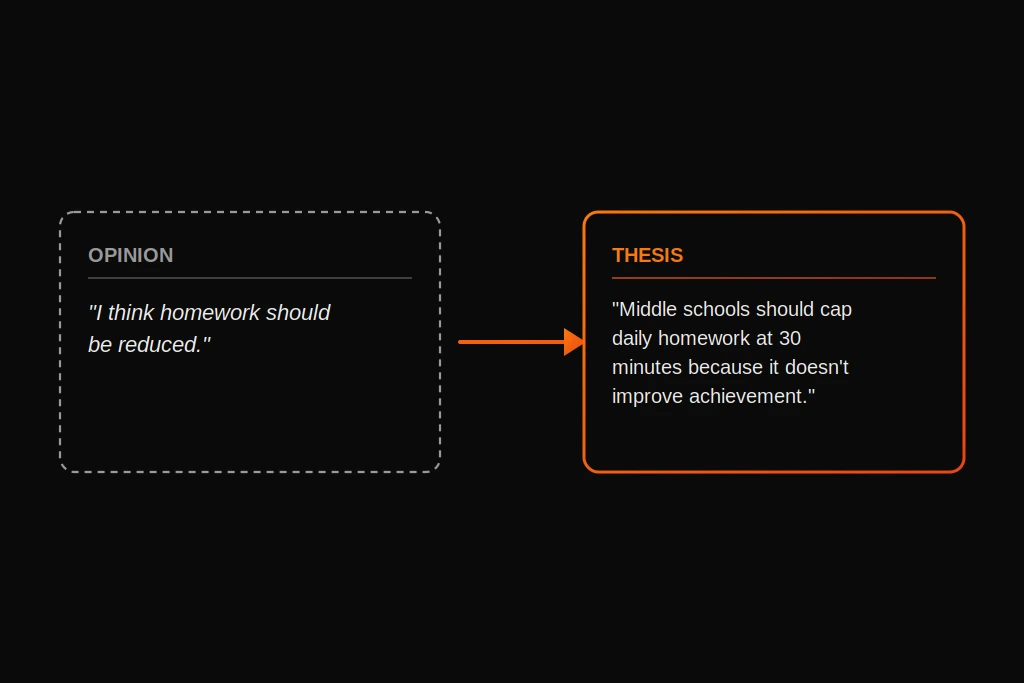
It’s worth being precise about one more distinction too: a thesis is not the same as an opinion, even though it often starts as one. “I think homework should be reduced” is an opinion. “Middle schools should cap daily homework at 30 minutes because research consistently links excessive homework to lower engagement, not higher achievement” is a thesis, the same underlying belief, but stated as a defensible claim with a reason attached rather than a personal feeling. That shift, from feeling to claim, is most of what separates a rough draft thesis from a finished one.
The Parts of a Thesis Statement
Most argumentative thesis statements are built from two components, whether or not a student ever thinks of it in these terms: a claim and support. The claim is your actual position. The support previews the reasoning that backs it up, without fully making that argument yet, that’s what the body paragraphs are for.
- Claim: the specific, debatable position you’re taking. This is the part a reader could disagree with.
- Support or reasons: a brief preview of why, often just a clause or two naming your main lines of argument, not the full evidence itself.
Not every thesis needs to spell out its reasons explicitly in the sentence itself, some instructors prefer a cleaner, single-clause claim with the reasoning saved entirely for the argumentative essay outline and body paragraphs. Check your assignment’s specific expectations, but when in doubt, including a short reasons clause tends to read as more organized and is rarely marked down.

A quick way to check whether your draft actually has both parts: cover up everything after the first comma or “because.” What’s left should still be a complete, standalone claim. If it isn’t, the reasoning and the claim have gotten tangled together in a way that makes the sentence harder to follow than it needs to be.
Types of Claims: Fact, Value, and Policy
Not every argumentative thesis makes the same kind of claim, and knowing which type you’re actually writing helps you figure out what evidence you’ll need before you start drafting body paragraphs.
Claims of fact argue that something is true, is happening, or caused something else, when that truth is genuinely disputed rather than settled. Example: “Standardized test scores are a weaker predictor of college success than high school GPA.” This isn’t a fact everyone agrees on, so it needs evidence, usually data or studies, to defend.
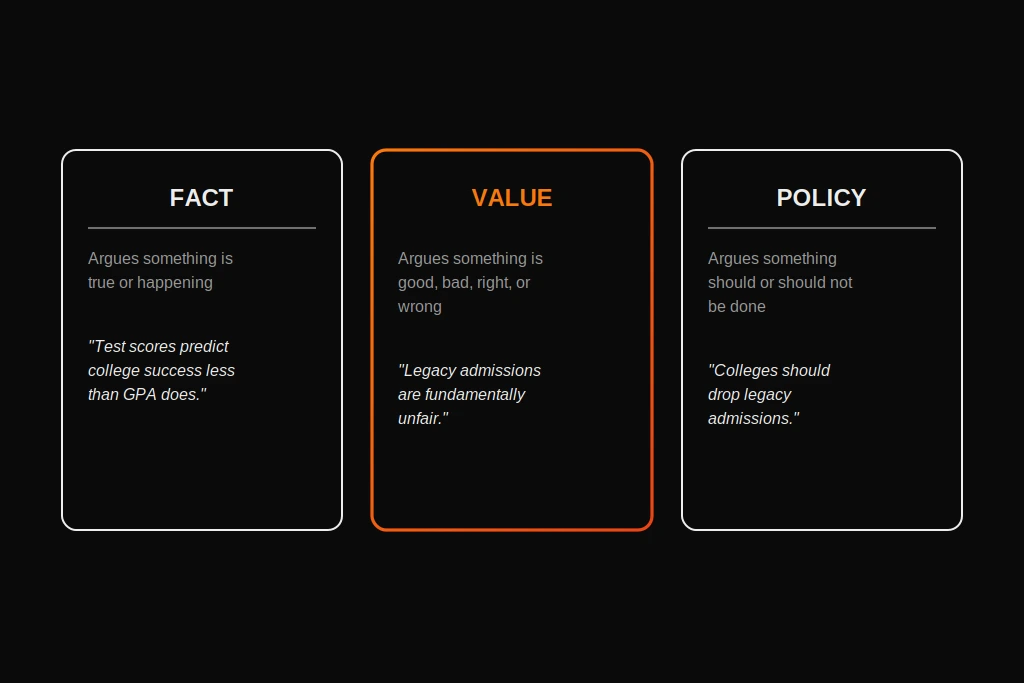
Claims of value argue that something is good, bad, right, wrong, better, or worse than an alternative. Example: “Community college transfer pathways are a more equitable route to a four-year degree than direct admission programs.” These claims need criteria, you have to define what “equitable” means before you can argue something meets that standard.
Claims of policy argue that something should or should not be done, usually the most common type in student argumentative essays. Example: “Universities should eliminate standardized testing requirements for admission.” These claims need both a problem and a proposed solution, simply saying something is bad isn’t enough, you have to argue for a specific action.
Most strong argumentative theses actually blend a claim of value or fact with a claim of policy, arguing both that something is a problem and that a specific response is warranted. Knowing which type or combination you’re working with early on makes it much easier to figure out what kind of evidence your body paragraphs will actually need to gather.
This distinction also explains why some thesis drafts feel unsatisfying even when the writer can’t say exactly why. A thesis that states a value claim, “legacy admissions are unfair,” without ever committing to a policy claim about what should change instead often reads as incomplete, since the reader is left wondering what the writer actually wants done about it. Pairing the two, the problem and the proposed response, tends to produce a more complete-feeling thesis than either type alone.
What Makes a Thesis Statement Strong or Weak
The single biggest reason a thesis statement gets marked down has nothing to do with grammar or polish, it’s that the sentence isn’t actually arguable. If no reasonable person would disagree with your thesis, you’ve written a fact or an observation, not an argument.
Broadness is the second most common problem, and it’s sneakier than an unarguable claim because a broad thesis often feels appropriately ambitious while you’re writing it. The test is practical, not theoretical: could you actually defend this specific claim, with real evidence, in the page count or word count your assignment gives you? If defending it properly would take three times the space you have, the fix usually isn’t better writing, it’s a narrower claim.
| Weak Thesis | Why It’s Weak | Stronger Version |
| Climate change is a serious problem. | States an already widely accepted fact, nothing to argue. | Local governments should mandate solar panels on new residential construction to meaningfully cut regional emissions. |
| This essay will discuss the pros and cons of homework. | Announces a topic, takes no actual position. | Elementary schools should eliminate homework because it widens the achievement gap between students with and without support at home. |
| Social media is bad for teenagers. | Too broad and vague to defend in a single essay. | Instagram’s algorithm-driven feed design contributes more to teen anxiety than screen time alone, and platforms should be required to offer a chronological-only mode for under-18 users. |
Notice the pattern across every “stronger” version: a specific, debatable claim, narrow enough to actually defend in the space of one essay, and phrased so a reader immediately knows what kind of evidence is coming.
It’s worth noticing what the stronger versions have in common beyond just being debatable. Each one names something specific, a policy, a population, a mechanism, rather than gesturing vaguely at a large topic. “Solar panels on new residential construction” is something a reader can picture and a writer can research. “Climate change is a problem” gives neither the reader nor the writer anywhere concrete to go.
What Makes a Thesis Statement Correct? A Quick Checklist
If you’re trying to double check whether a specific thesis statement you’ve drafted actually qualifies as a strong argumentative thesis, run it through this short checklist before you move on to drafting body paragraphs.
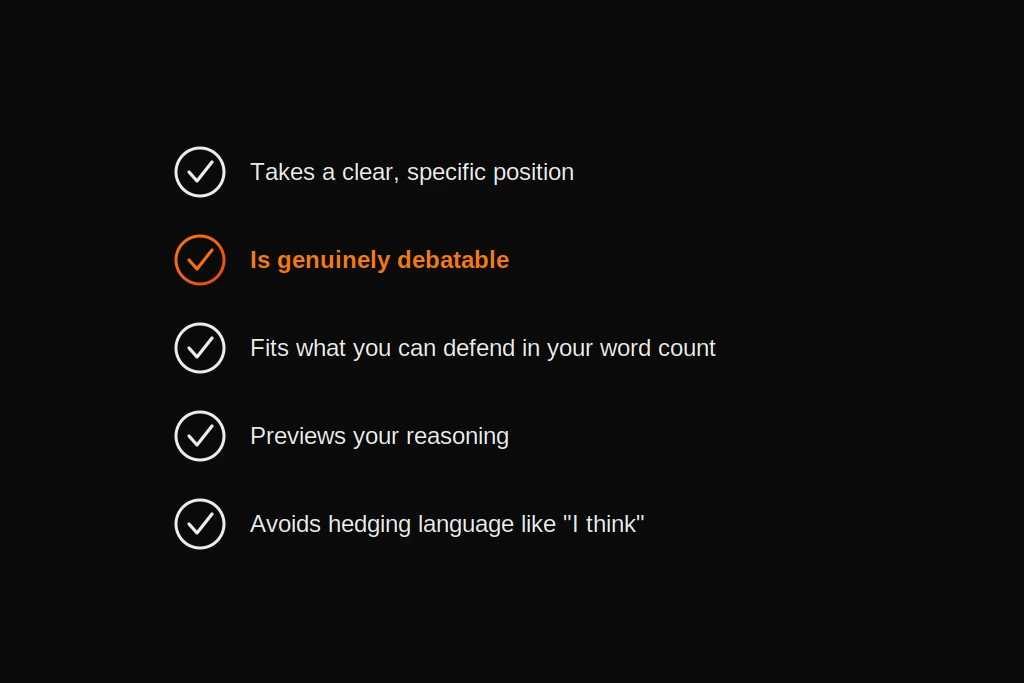
It takes a clear position. A reader could restate your stance in one sentence after reading it once.
It’s debatable. A thoughtful person could reasonably argue the opposite, or at least a meaningfully different position.
It’s specific enough to defend. You could realistically support it with the evidence and length you actually have.
It previews your reasoning, even briefly. A reader has some sense of what’s coming, not just what you believe.
It avoids first-person opinion language like “I think” or “I believe.” State the claim directly instead.
According to the University of Central Florida Writing Center, a strong thesis takes a stand on the subject and justifies discussion, while a weak one uses vague language that never actually commits to a position. If your draft thesis fails more than one item on this list, it’s worth revising before you build an outline around it.
Where Does the Thesis Statement Go?
In most academic essays, the thesis statement is the final sentence of the introduction, after your hook and any necessary background context, right before the essay transitions into its first body paragraph. This placement matters for a practical reason: by the time a reader hits your thesis, they already have enough context to understand exactly what you’re claiming and why it matters, without you having to explain the whole topic first.
A full argumentative essay introduction does more work than the thesis sentence alone, hooking the reader and establishing context before the claim ever appears, which we cover in a dedicated guide. But at minimum, know that your thesis shouldn’t be the very first sentence of your essay. It needs a little runway first, even if that runway is only two or three sentences long.
There are exceptions worth knowing about, even if they’re less common in standard student assignments. Some longer or more exploratory essays use a delayed thesis, where the full claim doesn’t appear until the end of the essay after the evidence has been laid out, letting the argument build before the position is stated outright. This structure shows up more often in professional or literary argumentative writing than in a typical class assignment, and most instructors specifically expect the standard end-of-introduction placement unless they’ve told you otherwise. When your assignment doesn’t specify, the safe default is always the conventional placement covered above.
How to Write an Argumentative Essay Thesis Statement, Step by Step
Step 1: Start With a Question, Not a Statement
Turn your assignment or topic into a genuine question first. “Should schools require uniforms?” is easier to work with than trying to jump straight to a polished claim, since answering a question naturally produces a position.
Step 2: Write a Rough, Honest Answer
Answer your own question in plain language, even if it’s clumsy. “Yes, because it reduces bullying and cuts down on morning decision fatigue” is a completely fine working thesis at this stage, even though it isn’t polished yet.
Don’t edit yourself during this step. The goal is capturing your actual position honestly, editing too early often produces a vague, hedged sentence that’s technically safer but far less useful to build an essay around.
Step 3: Test Whether It’s Actually Arguable
Ask yourself whether a reasonable, informed person could disagree. If the honest answer is no, your claim is probably too safe or too obvious, and it’s worth sharpening or narrowing until real disagreement becomes possible.
A useful trick here: try writing the opposite claim in one sentence. If you can’t imagine anyone seriously defending that opposite position, your original thesis probably isn’t arguable enough yet either.
Step 4: Narrow the Scope to What You Can Actually Prove
If your claim would require a book to defend properly, narrow it. Adding a specific population, timeframe, or condition, “for public high schools,” “in the last decade,” “specifically for group projects,” usually turns an unmanageable claim into a defensible one.
Step 5: Add a Reasons Clause
Attach a brief “because” clause previewing your main lines of argument. This single addition often does more to make a thesis feel organized and complete than any amount of separate polishing.
Step 6: Revise the Wording, Not Just the Idea
Cut hedging language like “I think” or “in my opinion,” and cut vague intensifiers like “very” or “extremely” that don’t actually add precision. State the claim directly, as a fact you’re prepared to defend rather than a feeling you’re sharing.
Read the sentence out loud once you’re done. If it sounds like something you’d say confidently to someone who disagreed with you, rather than something you’re apologizing for in advance, it’s probably in good shape.
Argumentative Essay Thesis Statement Examples
Seeing several examples across different topics is usually more useful than studying one example closely, since the pattern becomes clearer once you see it repeated in different contexts.
Education: Standardized testing should not be the primary factor in college admissions because it measures test-taking skill more reliably than it measures actual academic potential.
Technology: Companies should be legally required to disclose when a customer service interaction is being handled by an AI system, since transparency measurably affects how much trust customers place in the outcome.
Public Policy: Cities should replace parking minimums for new apartment buildings with public transit investment, since minimum parking requirements drive up housing costs without meaningfully reducing traffic.
Health: Health classes should teach media literacy alongside nutrition, since misleading wellness content online now shapes more student behavior than traditional health curricula do.
Environment: Grocery stores should be required to price food based partly on carbon footprint, since voluntary labeling alone has not measurably changed consumer purchasing habits.
Notice that each example follows the same underlying shape: a specific claim, narrowed to something defensible, with a reason clause that previews the argument without fully making it yet. That consistency is the actual skill being tested here, not clever phrasing.
A Reusable Thesis Statement Formula
If you’re staring at a blank page, this fill-in-the-blank formula works as a starting point for most argumentative topics. It won’t produce your most elegant possible sentence, but it reliably produces something arguable, which is the harder problem to solve.
[Specific subject] should/should not [specific action or position] because [primary reason], and [secondary reason].
For example: “Public universities should eliminate legacy admissions preferences because they disadvantage first-generation applicants, and because they don’t correlate with any measurable academic outcome.” Once you have a working version like this, it’s fine to loosen the sentence structure and make it sound less like a formula in later drafts, the formula is scaffolding, not a final answer.
A second, slightly different formula works better for claims of fact or value rather than policy: “Although [common assumption], [specific counter-claim], because [primary reason].” For example: “Although social media is often blamed broadly for teen mental health decline, the specific design choice of infinite scroll drives far more measurable harm than screen time itself, because it removes any natural stopping point during use.” This version works well when your argument is partly correcting a common misconception rather than proposing a new action.
Are Thesis Statement Generators Worth Using?
Free thesis statement generators and builder tools exist all over the web, and they’re genuinely useful for one narrow purpose: breaking through a blank page when you have a topic but no idea where to start. Typing in a topic and getting three or four rough claim options back can jumpstart the brainstorming step covered above.
Where they fall short is arguability and specificity, the two qualities that actually make a thesis strong. Generator tools tend to produce safe, generic claims that technically state a position but rarely commit to anything genuinely debatable, since the tool has no idea what evidence you actually have access to or what your specific assignment requires. Treat generated output as a rough draft to sharpen, narrow, and fact-check against your actual sources, never as a finished thesis to drop into your essay unchanged.
The same caution applies to using a general AI chatbot to write your thesis outright. It can produce something grammatically correct in seconds, but it can’t know whether the claim is actually defensible with the specific sources you’ve gathered, and an instructor reading dozens of essays a semester often recognizes the particular flavor of generic confidence these tools produce. Use any tool, generator or chatbot, as a brainstorming partner for rough options, then do the narrowing and arguability testing yourself.
Thesis Statement Checklist Before You Submit
Before you finalize your essay, run your thesis through this last check alongside the correctness checklist covered earlier.
- The thesis appears at the end of your introduction, not buried mid-paragraph or missing entirely.
- It matches what your body paragraphs actually argue, not an earlier draft’s version of your position.
- It contains no first-person hedging language like “I think” or “in my opinion.”
- A reader unfamiliar with your topic could state your claim back to you after one read.
- It’s specific enough that you could point to exactly which body paragraph defends each part of it.
How Your Topic Shapes Your Thesis
A thesis is only as strong as the topic underneath it. If you’re still choosing what to write about, some topics simply generate more genuinely arguable theses than others, an already-settled issue makes every version of your thesis feel obvious, no matter how you phrase it. We cover how to pick strong argumentative essay topics for college students, along with a full list of argumentative essay prompts, in separate guides, but the short version: pick a topic where you can name a real opposing view in one sentence before you commit to it.
Common Mistakes When Writing a Thesis Statement
A handful of mistakes account for most of the thesis revisions instructors ask for, and nearly all of them are easy to catch once you know to look for them.
- Stating a fact instead of a claim. If a quick search confirms your thesis is simply true, it isn’t arguable.
- Writing a thesis so broad it would need a full book to defend properly, rather than the length your assignment actually allows.
- Confusing a topic sentence with a thesis statement. A topic sentence supports one paragraph, a thesis governs the entire essay.
- Hedging with phrases like “I believe” or “in my opinion,” which weakens a claim that should be stated with confidence.
- Writing a thesis with no real counterargument possible, which leaves nothing for your argumentative essay counterargument section to actually push back against later in the essay.
- Forgetting to revise the thesis after the outline or draft reveals your argument actually went in a slightly different direction than planned.
- Packing too many separate claims into a single thesis, so the essay ends up trying to argue three different things instead of building one focused case.
- Burying the actual claim inside a long sentence full of throat-clearing context, so a reader has to hunt for the position rather than seeing it immediately.
How EssaysHelper Can Help You
If you’ve got a topic but every thesis draft you write feels either too obvious or too broad to actually defend, you don’t have to sort it out alone. EssaysHelper connects students with tutors who can work through several thesis drafts with you, checking arguability and scope before you build an outline around a claim that won’t hold up. For students who want the entire essay handled end to end, our argumentative essay writing service can take you from a rough topic straight through a polished final draft, thesis included.
Frequently Asked Questions
What is a good thesis statement for an argumentative essay?
A good thesis statement takes a specific, debatable position and briefly previews the reasoning behind it. It should be narrow enough to defend within your assignment’s length, not a broad claim that would need far more space to actually prove.
What should the thesis statement of an argumentative essay do?
It should state a clear, arguable claim that the rest of the essay will support with evidence and reasoning. It also functions as a road map, giving the reader a sense of what argument is coming before they read the body paragraphs.
How do you write a thesis statement for an argumentative essay?
Start by turning your topic into a question, answer it honestly in plain language, then narrow and sharpen that answer until it’s specific and genuinely debatable. Adding a brief reasons clause at the end usually strengthens the final version.
What’s the difference between a thesis statement and a topic sentence?
A thesis statement governs your entire essay and usually appears at the end of the introduction. A topic sentence only governs a single body paragraph and states that paragraph’s specific claim.
Can a thesis statement be a question?
No, a thesis statement needs to be a declarative claim, not a question. Questions are useful for brainstorming your position, but the thesis itself should state your actual answer directly.
How long should an argumentative essay thesis statement be?
Most thesis statements are one sentence, occasionally two if your instructor allows a claim plus a separate reasons sentence. Length matters less than whether the sentence is specific and arguable.
Is it okay to use a thesis statement generator?
Generators can help you get past a blank page by suggesting rough starting claims, but their output is usually too generic to submit as is. Always narrow and sharpen a generated thesis before using it in your actual essay.
Where should the thesis statement go in an argumentative essay?
It typically belongs at the end of the introduction paragraph, after a hook and any necessary background context. Placing it too early, before the reader has any context, usually makes the claim feel abrupt.
What makes a thesis statement too weak or too broad?
A weak thesis either states an obvious fact no one would argue with, or it’s phrased so broadly that no single essay could realistically defend it. Both problems are usually fixed by narrowing the claim to a specific population, timeframe, or condition.
Does a thesis statement need to mention the counterargument?
Not usually. The thesis states your position, while addressing the opposing view is typically handled in its own body paragraph later in the essay, not packed into the thesis sentence itself.
Final Thoughts
A strong argumentative thesis statement isn’t about clever phrasing, it’s about committing to a specific, defensible claim and saying so plainly. Test your draft against a simple question: would a reasonable, informed person actually disagree with this? If yes, and if you can defend it in the space you have, you’ve got a thesis worth building an essay around. Once it’s solid, the rest of the writing process, from outline through your argumentative essay conclusion, gets noticeably easier, since every paragraph now has a clear job: proving that one sentence.
From here, the natural next step is turning that thesis into a full draft. If you want the complete process, from expanding your introduction through drafting body paragraphs and a real conclusion, that’s covered in our full guide on how to write an argumentative essay.
One last piece of encouragement worth holding onto: almost no one writes a strong thesis on the first try, including experienced writers. The process described in this guide, question, rough answer, arguability test, narrowing, reasons clause, revision, is meant to be repeated, sometimes two or three times, before a thesis actually earns its place at the top of an essay. Treating your first draft as a working thesis rather than a finished one takes the pressure off, and it usually produces a stronger final sentence than trying to get it perfect in one attempt.