
An argumentative essay conclusion needs to do three things: restate your thesis in new words, briefly pull your main points together, and leave the reader with a bigger reason to care. It’s usually one paragraph, three to five sentences, sitting at the very end of your essay. The biggest mistake students make is copying their thesis almost word for word instead of restating it, and the second biggest is sneaking in a brand new argument that never had room to be proven. Skip both of those, and a conclusion is actually one of the easier paragraphs to write, since by this point you already know exactly what your essay argued.
What Is an Argumentative Essay Conclusion?
A conclusion is the final paragraph of your essay, and its job is to close the argument, not summarize it like a book report. According to the UNLV Writing Center, a conclusion should stress the importance of your thesis and give the essay a sense of closure while leaving the reader with a clear final impression, one that keeps them thinking about your topic after they’ve stopped reading.
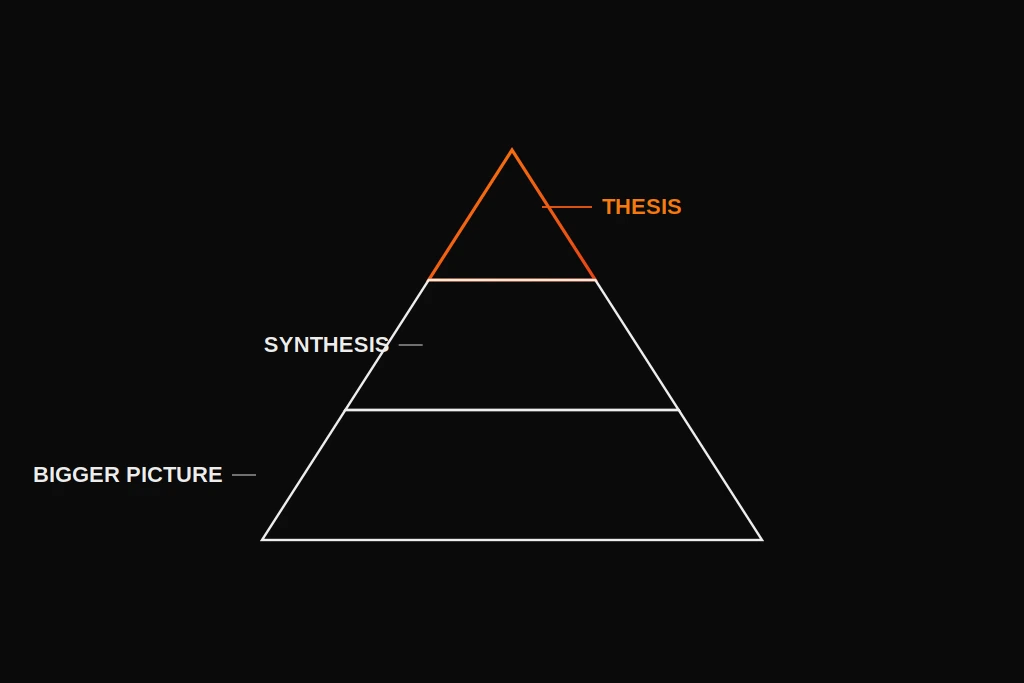
That last part is easy to miss. A conclusion isn’t just restating what you already said, it’s making the reader feel like the essay was worth reading. That’s a different job than the summary paragraph you might write for a book report, and treating it the same way is why so many student conclusions feel flat.
It also helps to know what a conclusion isn’t. It isn’t a place to introduce new evidence, it isn’t a second chance to argue a point you forgot earlier, and it isn’t required to address every single point your essay made. It’s a closing move, not a second essay, and the tighter you keep it, the more effective it tends to be.
Why Your Conclusion Matters More Than You Think
There’s a real psychological reason your conclusion carries more weight than its short length suggests. Memory researchers call it the serial position effect, first documented by psychologist Hermann Ebbinghaus in 1885: when people read or hear a sequence of information, they remember the first and last parts far better than anything in the middle. According to a breakdown of the effect from TechTarget, the last items in a sequence stay in short-term memory right up until recall, which is exactly why they stick.
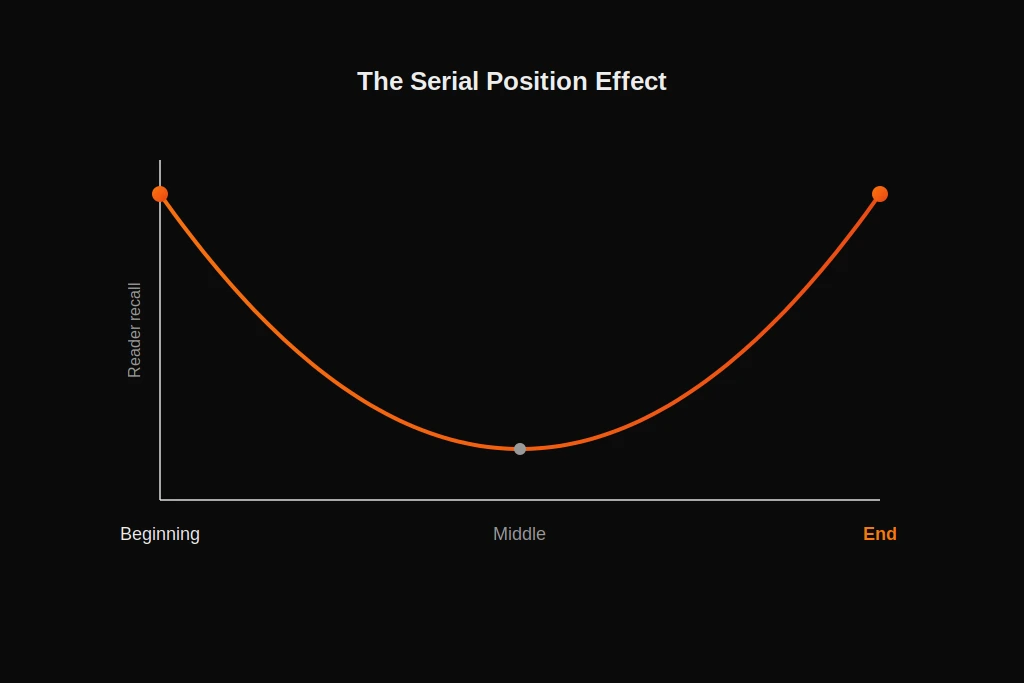
For an essay, that means your grader’s impression of your entire argument is shaped disproportionately by your introduction and your conclusion, even though those two paragraphs might make up less than fifteen percent of your total word count. Your strongest body paragraph evidence can genuinely get lost in the middle if your conclusion doesn’t actively bring it back. This isn’t a reason to panic about your body paragraphs, it’s a reason to stop treating your conclusion as an afterthought you dash off in the last five minutes.
This is also exactly why a rushed, copy-pasted thesis restatement does real damage beyond just looking lazy. If the last thing your reader processes is a sentence they already read verbatim two pages ago, you’ve handed the most memorable slot in your entire essay to something that adds nothing new. A conclusion that actually does its job, restating, synthesizing, and widening out, uses that same memory advantage to reinforce your strongest thinking instead of wasting it on a repeat.
What Must an Argumentative Essay Conclusion Include? A Quick Checklist
Run your draft against this list before you consider your essay finished.
- It restates your thesis in different words, not the same sentence copied from your introduction.
- It briefly pulls your main points together, without re-explaining each one in full.
- It answers “so what”, telling the reader why your argument actually matters.
- It introduces no new evidence, examples, or arguments that weren’t already in your body paragraphs.
- It’s a single paragraph that reads as one connected idea, not a list of leftover thoughts.
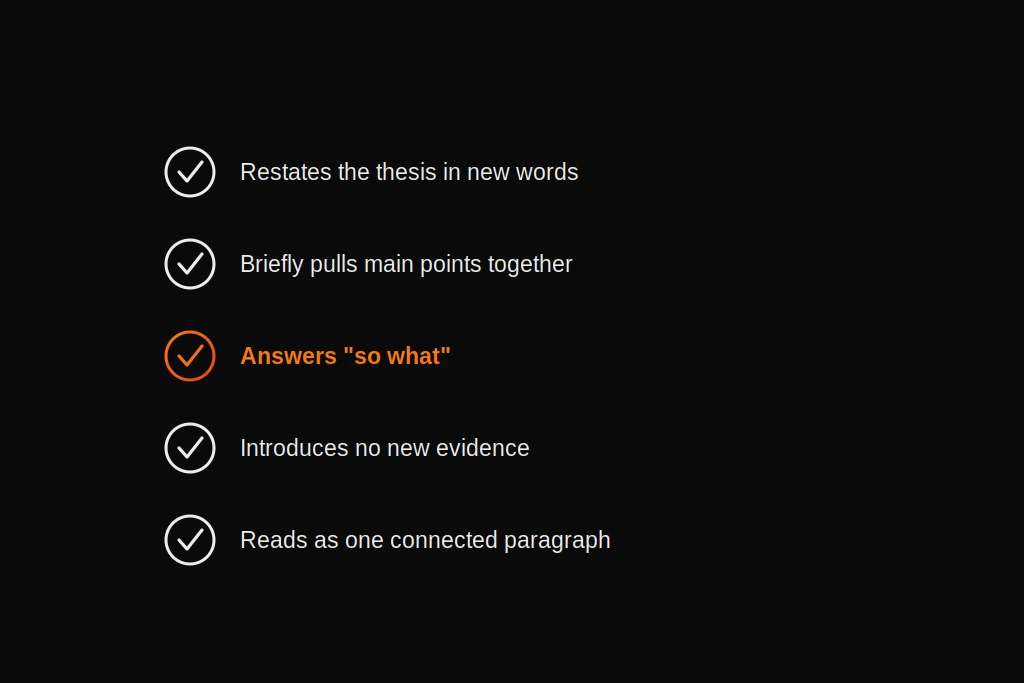
If your draft is missing more than one of these, it’s usually faster to rebuild the paragraph from scratch using the structure below than to patch what’s already there. This same five-point list also works as a quick way to check a classmate’s draft, or to sanity-check a sample conclusion you find online before assuming it’s a good model to follow.
The Three Parts of a Strong Conclusion
Most effective conclusions break into three moves, done in order.
- Restated thesis: your original claim, reworded, not copy-pasted.
- Brief synthesis: a sentence or two pulling your main points together, showing how they worked as one argument rather than three separate ones.
- The bigger picture: a closing thought that answers “so what” and gives the argument a reason to matter beyond the essay itself.
One useful trick from the University of Idaho Writing Center is to echo the hook from your argumentative essay introduction: rather than narrowing toward your thesis the way your introduction did, your conclusion widens back out from it, showing how the specific argument you made connects to something bigger. If you opened with a statistic, returning to that same statistic with new context at the end gives the whole essay a sense of coming full circle.
If you built a full argumentative essay outline before drafting, your conclusion’s three parts should already be sitting there in rough form, a thesis line, a note on your main claims, and often a significance point you sketched out early on. Writing the conclusion at that point is less about generating new ideas and more about translating what you already planned into finished sentences.
How to Restate Your Thesis Without Just Repeating It
This is the step students struggle with most, mainly because “restate” gets misread as “repeat.” Restating means expressing the same core claim with different words, different sentence structure, and often a slightly different angle, not swapping out a synonym here and there.
If your original thesis statement in argumentative essay followed a claim-plus-reason structure, a useful trick for the restatement is flipping the order, leading with the reason or significance instead of the claim itself. That small structural shift alone is often enough to make the sentence feel genuinely different, even when the underlying position hasn’t moved at all.
| Original Thesis | Weak Restatement | Strong Restatement |
| High schools should shift start times to no earlier than 8:30 a.m. to align with teenage sleep cycles. | High schools should shift start times to no earlier than 8:30 a.m. to align with teenage sleep cycles. | Aligning school schedules with how teenage sleep actually works isn’t a scheduling preference, it’s a change backed by measurable gains in grades, mood, and safety. |
| Schools should teach structured AI literacy instead of imposing blanket bans. | Schools need to teach AI literacy instead of banning AI. | Banning a tool students will use for the rest of their careers teaches them nothing, structured AI literacy actually prepares them for it. |
Notice that the weak restatement in the first row is nearly identical to the original, just reordered slightly. The strong version keeps the same underlying claim but reframes it, in this case by naming what the change isn’t before stating what it is, a simple pattern you can reuse on almost any thesis.
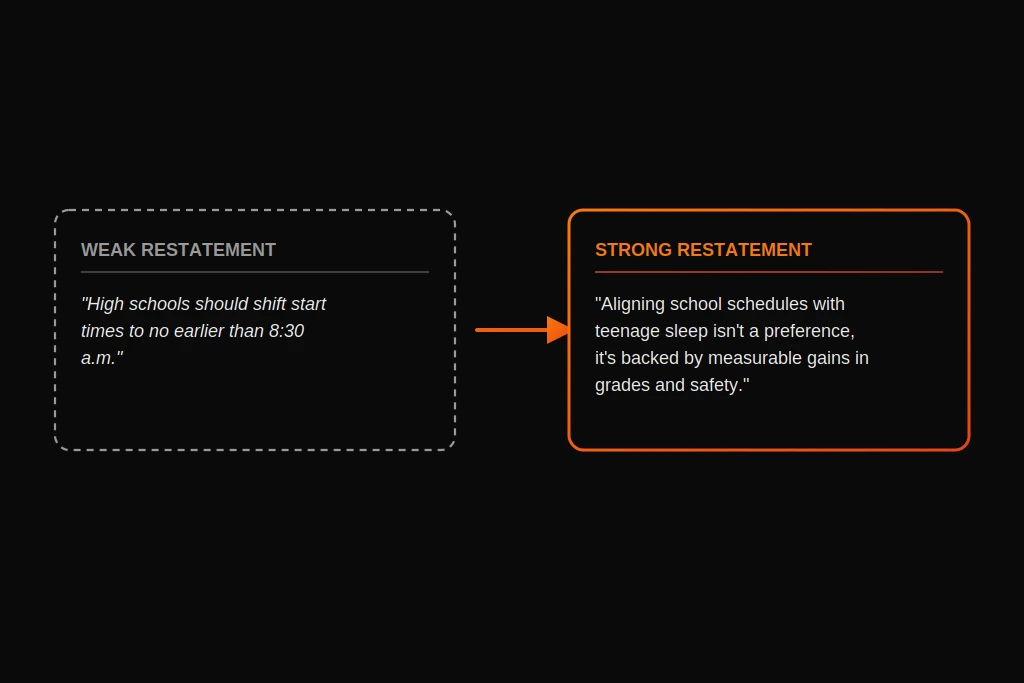
A few reliable reframing moves worth trying when a restatement feels stuck: lead with the consequence instead of the claim (“the cost of doing nothing is…” before naming the solution), name what the position isn’t before stating what it is, or shift from a policy statement to the outcome that policy produces. Any one of these changes the sentence’s shape enough that it stops reading like a copy of the original.
Transition Words and Sentence Starters for Your Conclusion
“In conclusion” isn’t wrong, but it’s the most overused opener in student writing, and it signals nothing about what’s actually coming. These alternatives do more work while still clearly marking the shift into your closing paragraph.
- Ultimately, … / In the end, …
- Taken together, these points show …
- What this evidence makes clear is …
- The case for [your position] comes down to …
- None of this means … [use when addressing a lingering objection], but it does mean …
- Looking beyond this specific issue, …
Pick one that actually fits the tone of your closing thought rather than defaulting to the same phrase every time. A conclusion that opens with a genuine synthesis phrase like “taken together” signals to the reader that you’re about to connect ideas, not just restate one of them.
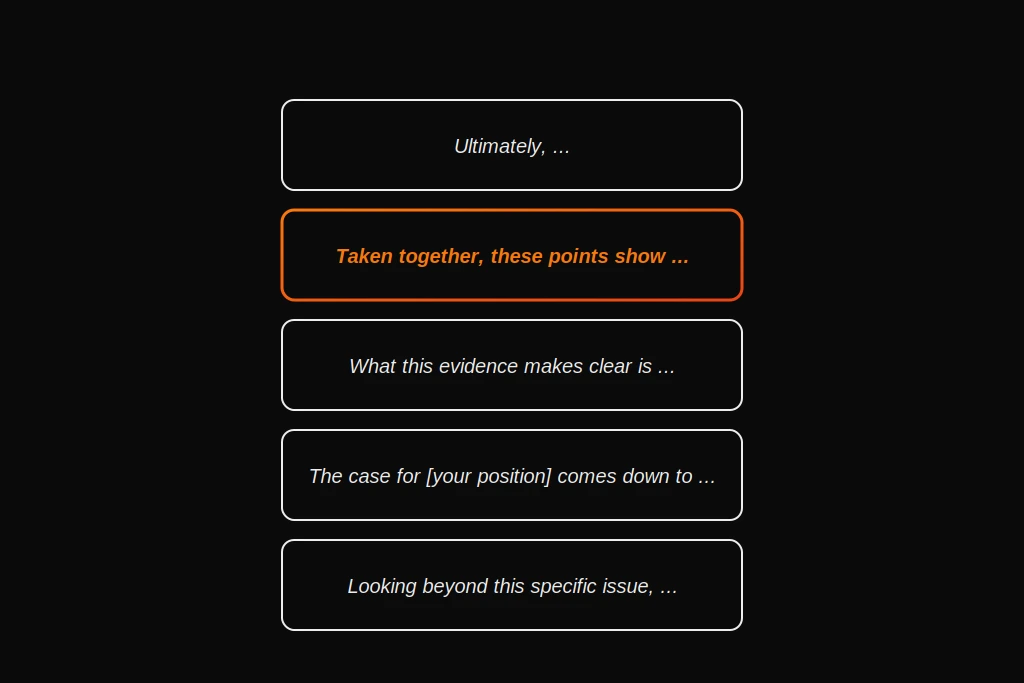
It’s worth noting that “in conclusion” isn’t actually banned by most instructors, and using it once won’t sink your grade. The real issue is relying on it as a crutch that lets the rest of the sentence stay generic. If you can swap in one of the alternatives above and the sentence that follows still says something specific about your actual argument, the transition phrase itself matters far less than what comes right after it.
How Long Should an Argumentative Essay Conclusion Be?
For a standard student essay, three to five sentences is the right range, roughly the same length as your introduction. Longer research papers can run a bit more, but a conclusion that’s noticeably longer than your body paragraphs usually means you’ve drifted into re-explaining evidence rather than closing the argument.
According to a University of Washington writing center handout, concision matters more here than almost anywhere else in the essay, since the conclusion isn’t the place to ramble or introduce new information. If you’re consistently running long, the fix is usually cutting content that re-explains a body paragraph’s evidence in detail, rather than trying to write more efficiently within a bloated structure.
A useful proportion to keep in mind: your conclusion shouldn’t need more real estate than your introduction did to do a comparable job. If your introduction ran four sentences and your conclusion is stretching to eight, that’s usually a sign the closing paragraph picked up work that belongs somewhere else in the essay, most often a body paragraph that got cut too short earlier in the draft.
How to Write an Argumentative Essay Conclusion, Step by Step
Step 1: Reread Your Thesis and Body Paragraphs First
Before writing a single sentence of your conclusion, reread your introduction’s thesis and skim each body paragraph’s main claim. This refreshes exactly what you’re pulling together, rather than relying on a vague memory of what you argued twenty minutes ago.
Jot down each body paragraph’s claim as a single short phrase while you skim. Having all three or four claims in front of you in one place makes the synthesis step in step three much faster.
Step 2: Draft a Restated Thesis
Write your thesis again, in new words, without looking directly at the original sentence while you do it. Working from memory rather than the original text naturally produces something that sounds different, not just reordered.
If what you write ends up nearly identical to the original anyway, that’s a useful signal, not a failure. It usually means your thesis was already tightly worded, and the fix is changing the sentence’s structure or starting point rather than hunting for synonyms.
Step 3: Add One Sentence of Synthesis
Pull your main points together in a single sentence that shows how they worked as one connected argument, not a list. Avoid re-explaining each body paragraph’s evidence individually, that level of detail already lives in the body of your essay.
Step 4: Write Your “So What” Sentence
Answer the question directly: why should the reader care about this argument beyond the essay itself? This is often the hardest sentence to write and the one that separates a flat conclusion from a memorable one.
If you’re stuck, try finishing this sentence out loud: “This matters because if nothing changes, …” Whatever naturally follows is usually close to your real closing thought, even if the final wording ends up more polished.
Step 5: Check for New Arguments
Read back through and flag anything that introduces evidence, an example, or a claim that wasn’t already in your body paragraphs. If you find one, either move it into a body paragraph in your next revision or cut it entirely.
Step 6: Read the Whole Essay Start to Finish
Read your introduction and conclusion back to back. They should feel like they belong to the same essay, echoing each other in tone and topic, without the conclusion simply repeating the introduction’s wording.
This final check is worth doing even when you’re confident the conclusion is finished. Essays drift during drafting, a body paragraph you added late can shift the argument slightly, and this is the moment to catch a conclusion that no longer quite matches what the essay actually ended up proving.
A Conclusion Template You Can Copy
Here’s a generic, fill-in-the-blank structure that works for most argumentative essays. Swap in your own thesis and main points.
[Restated thesis in new words, not copied from your introduction.] [One sentence connecting your main points together as a single case, not a list.] [One closing sentence answering “so what”, why this argument matters beyond the essay itself.]
If your assignment allows a slightly longer conclusion, you can add one more sentence acknowledging a limitation or a next question the argument raises, without introducing new evidence to support it. That’s different from a full argumentative essay counterargument section, which belongs earlier in the essay with room for a real rebuttal, not squeezed into the closing paragraph.
Argumentative Essay Conclusion Examples
Seeing full conclusions across different topics makes the pattern click faster than one example studied closely.
Topic: School start times
Aligning school schedules with how teenage sleep actually works isn’t a scheduling preference, it’s a change backed by measurable gains in grades, mood, and even car accident rates among student drivers. The data from schools that have already made the shift shows the benefits outweigh the logistical hassle of adjusting bus routes and after-school programs. If districts are serious about student wellbeing rather than just talking about it, an 8:30 start time is one of the few changes backed by consistent, repeatable evidence.
Topic: AI in the classroom
Banning a tool students will use for the rest of their careers doesn’t prepare them for anything, it just delays the moment they have to figure it out alone. Structured AI literacy, taught deliberately rather than left to chance, gives students the judgment to use these tools responsibly instead of either avoiding them out of fear or misusing them out of ignorance. Schools that get ahead of this now will graduate students genuinely ready for a workplace already built around these tools, not just students who know how to avoid getting caught.
Topic: Public transit funding
A subway line moving twenty-five times more people per hour than a highway lane isn’t a minor efficiency gap, it’s a fundamental mismatch between how cities actually move and where their money goes. Cities that keep expanding highways while starving transit budgets aren’t solving congestion, they’re just spending more to move it around. Redirecting even a modest share of highway funding toward transit is one of the rare policy shifts that pays for itself in reduced congestion within a single decade.
Topic: Four-day school week
A four-day week isn’t a shortcut around funding problems, it’s a structural change that happened to fix a few of them along the way. Districts that made the switch didn’t just save money, they saw real gains in attendance and teacher retention that budget cuts alone never delivered. Before assuming a shorter week means a worse education, districts facing hard choices owe it to their students to actually run the pilot rather than ruling it out on assumption.
Notice that none of these simply restate the thesis and stop. Each one connects the restated claim to a slightly bigger point, using data already established earlier in the essay, without introducing anything new. Also notice the length, each one is three sentences, well within the range covered above, and each closes on a specific, concrete idea rather than a vague call to keep thinking about the issue.
Conclusion Checklist Before You Submit
- One last pass before you call the essay finished.
- The thesis is restated in genuinely different words, not copied or lightly reworded.
- Your main points are connected as one case, not listed out individually again.
- The closing sentence answers “so what” with something specific, not a vague call to “think about this issue.”
- No new evidence, statistics, or examples appear that weren’t already in your body paragraphs.
- Reading the introduction and conclusion back to back, they feel like they belong to the same essay.
Common Mistakes When Writing a Conclusion
A handful of mistakes account for most of the conclusion rewrites instructors ask for, and nearly all of them are easy to catch with one careful read-through before submitting.
- Copying the thesis almost word for word instead of genuinely restating it.
- Introducing a brand new argument, statistic, or example that never appeared in the body paragraphs, where it has no chance to be properly supported.
- Ending on a flat restatement with no larger point, missing the “so what” entirely.
- Writing a conclusion so short it feels like an afterthought, or so long it starts re-explaining evidence in detail.
- Opening with “In conclusion” and nothing else distinctive, a phrase so overused it barely registers with a reader anymore.
- Apologizing for the argument (“this is just my opinion, but…”) instead of standing behind the claim the whole essay just spent paragraphs proving.
- Treating the conclusion as the place to address the counterargument for the first time, when that job belongs earlier, in its own body paragraph.
How EssaysHelper Can Help You
If you’ve written a strong essay but your conclusion still feels like it’s just repeating your introduction, you don’t have to fix it alone. EssaysHelper connects students with tutors who can work through your closing paragraph with you, checking that it actually earns the reader’s attention rather than trailing off. For students who want the entire essay handled from outline through final draft, our argumentative essay writing service can take you from a rough topic straight through a polished conclusion.
Frequently Asked Questions
What must an argumentative essay conclusion include?
It needs a restated thesis in new words, a brief synthesis of your main points, and a closing thought that explains why the argument matters. All three usually fit into one paragraph of three to five sentences.
How do you restate a thesis without repeating it?
Write your thesis again from memory rather than copying the original sentence, using different word order and often a slightly different angle. The underlying claim stays the same, but the wording and structure should feel genuinely different.
Can you introduce a new point in the conclusion?
No, a conclusion should never introduce evidence, examples, or arguments that weren’t already covered in your body paragraphs. New material dropped in at the end has no chance to be properly supported, which weakens the argument rather than strengthening it.
How long should an argumentative essay conclusion be?
Most conclusions run three to five sentences, roughly the same length as the introduction. A conclusion noticeably longer than your body paragraphs is usually a sign it’s re-explaining evidence instead of closing the argument.
What are good transition words for an argumentative essay conclusion?
Phrases like “ultimately,” “taken together,” or “what this evidence makes clear” work better than the overused “in conclusion.” Pick one that actually matches the tone of your closing thought rather than defaulting to the same phrase every time.
What is the best way to end an argumentative essay?
End with a sentence that answers “so what”, connecting your specific argument to a bigger reason it matters. Echoing the hook from your introduction, if you used one, also gives the essay a sense of coming full circle.
Should the conclusion address the counterargument?
Not in detail. Addressing the opposing view belongs in its own body paragraph earlier in the essay, where there’s room to respond to it properly, not introduced for the first time in the closing paragraph.
What’s a good example of an argumentative essay conclusion?
A strong example restates the thesis in new words, briefly connects the main points as one case rather than a list, and closes with a sentence on why the argument matters beyond the essay itself. It never repeats the introduction word for word or adds new evidence.
Why does my conclusion feel repetitive?
This usually happens when the thesis is restated too close to its original wording instead of genuinely reworded. Try writing the restatement from memory, without looking at your original thesis, to force different phrasing.
Is it okay to end with a question in an argumentative essay?
It can work if the question genuinely extends the argument rather than just restating the topic vaguely. Used carefully, it can leave the reader thinking, but it shouldn’t replace an actual closing statement of why your argument matters.
Final Thoughts
A strong argumentative essay conclusion isn’t complicated once you know what it’s actually for: restate your claim in new words, connect your points as one case rather than a list, and give the reader a reason the argument matters beyond the page. Skip the new evidence, skip the word-for-word thesis copy, and skip the flat “in conclusion” opener, and you’re most of the way to a closing paragraph that actually sticks with the reader, exactly the outcome the serial position effect predicts a well-built ending can earn.
With the outline, thesis statement, introduction, and conclusion all covered, the next natural step is putting the whole process together. Our complete guide on how to write an argumentative essay walks through the full arc from start to finish, along with separate guides on the counterargument section, choosing strong argumentative essay topics for college students, and a full list of argumentative essay prompts if you’re still deciding what to write about.
One last thought worth keeping in mind: a conclusion you’re genuinely proud of usually takes two passes, not one. Write it quickly the first time to get the three parts down, then come back after a short break and read it fresh. The gap between an adequate closing paragraph and a memorable one is almost always found on that second read, not the first.