
The AP Lang argument essay is Free-Response Question 3 on the AP English Language and Composition exam. You write an evidence-based argument in response to a given topic, and it is scored on a 6-point rubric: one point for a defensible thesis, up to four points for evidence and commentary, and one point for sophistication. Because four of the six points reward evidence and commentary, the essays that score best use specific examples and explain how each one supports a line of reasoning. This guide breaks down every rubric row, shows an annotated example and a score ladder, and gives you steps to practice with.
What the AP Lang Argument Essay Is
The argument essay is one of three free-response questions. According to the College Board’s exam overview, the free-response section has three questions and lasts 2 hours and 15 minutes, including a 15-minute reading period, and the exam is fully digital. The argument question gives you a short piece of background and asks you to argue a position on it. Nobody hands you the evidence. You supply it yourself.
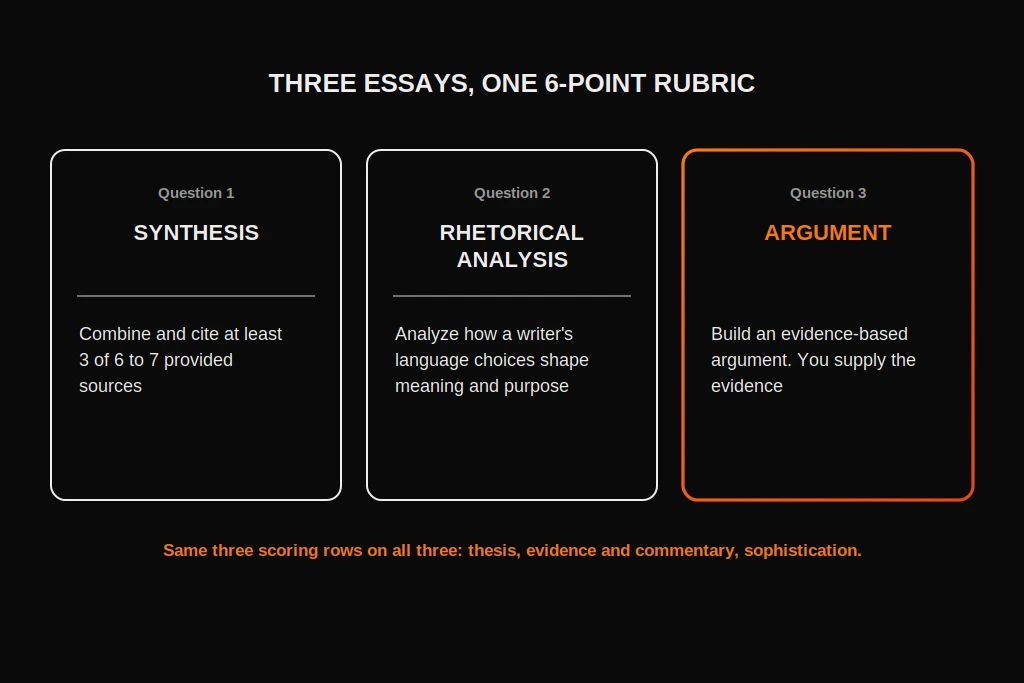
If you want the general writing process that sits behind any argumentative essay, our guide on how to write an argumentative essay covers it from start to finish. This guide focuses on what is specific to AP Lang, starting with how the argument question differs from the other two.
| Synthesis (Question 1) | Rhetorical analysis (Question 2) | Argument (Question 3) | |
| What you write | An argument that combines and cites at least 3 of the provided sources | An analysis of how a writer’s language choices shape meaning and purpose | An evidence-based argument that responds to a given topic |
| Where the evidence comes from | 6 to 7 provided texts, plus your own reasoning | The text you are given | You supply it |
| How it is scored | 6 points: thesis, evidence and commentary, sophistication | 6 points: thesis, evidence and commentary, sophistication | 6 points: thesis, evidence and commentary, sophistication |
That last row matters. All three essays use the same three scoring rows, so the skills you build on the argument essay carry over, especially the habit of explaining your evidence instead of just naming it.
How the Exam Essay Differs From a Classroom Essay
A classroom argumentative essay usually lets you research, revise over several days, and cite sources. The AP argument essay is timed, typed, has no source packet, and is scored against the rubric rows below. That changes your priorities. You cannot look up a statistic, so your evidence bank carries more weight. You cannot revise at length, so a clear position and a short plan matter more. And you are scored on what the rubric rewards, so a beautiful sentence that earns no rubric point is a poor use of limited time.
The AP Lang Argument Essay Rubric, Row by Row
The College Board’s 2024 scoring guidelines for the argument essay use three rows: Row A for the thesis, Row B for evidence and commentary, and Row C for sophistication. The table below sums up each row. The sections after it show you how to earn every point.
| Row | Points | What earns it | What usually loses it |
| A: Thesis | 1 | A defensible position that responds to the prompt and clearly takes a stand | Restating the prompt, listing pros and cons, or answering a different question |
| B: Evidence and commentary | 0 to 4 | Specific evidence, with commentary that explains how it supports a line of reasoning | Vague examples, summary instead of explanation, or reasoning that jumps around |
| C: Sophistication | 1 | Complexity that is part of the argument, such as nuance, tension, or a stated limit | A single “however” sentence or fancy vocabulary with no real nuance |
Row A: Thesis (1 Point)
The thesis point goes to a response that presents a defensible position and responds to the prompt. The College Board’s guidelines say a thesis must clearly take a position rather than just state that there are pros and cons, and a thesis that only restates the prompt does not earn the point, according to its scoring guidelines. The 2024 guidelines add that a thesis may set up a line of reasoning but does not have to in order to earn the point.
Here is how that looks with an original prompt: “Write an essay that argues your position on the extent to which lasting change depends on ordinary people rather than on great leaders.”
- Does not earn the point: “Lasting change depends on both ordinary people and great leaders.” This names both sides and commits to neither.
- Does not earn the point: “This essay will discuss whether ordinary people or leaders matter more.” This announces a topic instead of answering the question.
- Earns the point: “Lasting change depends mainly on ordinary people acting together, though leaders matter when they turn scattered effort into a shared goal.” This takes a clear position, answers the “extent to which” question, and leaves room for nuance.
A defensible position can be qualified. You do not need an all-or-nothing claim. You just need one a reasonable person could argue against. For a deeper look at writing the claim itself, see our guide to the thesis statement in argumentative essay writing.
Row B: Evidence and Commentary (Up to 4 Points)
This row is worth four of the six points, so it deserves most of your attention. It rewards two things working together: specific evidence and commentary that explains how that evidence supports your line of reasoning. A line of reasoning is the logical path that connects your claims, with each paragraph building on the one before it.
At the low end of the row, the evidence is general or missing, or the essay just restates the thesis. In the middle, there is some specific evidence, but the explanation is thin or the line of reasoning is unclear, and the guidelines describe some reasoning as faulty. At the top, specific evidence supports the claims and the commentary consistently explains how that evidence supports a line of reasoning. The exact wording is in the College Board’s guidelines, which are worth reading once in full.
Students often ask how many pieces of evidence they need. For the argument essay, the rubric language focuses on how specific the evidence is and how well you explain it, not on a count. As practice advice, not a College Board rule, two or three well-explained examples in a timed essay usually beat five thin ones, because every example has to be followed by commentary and time is short.
What a Line of Reasoning Looks Like
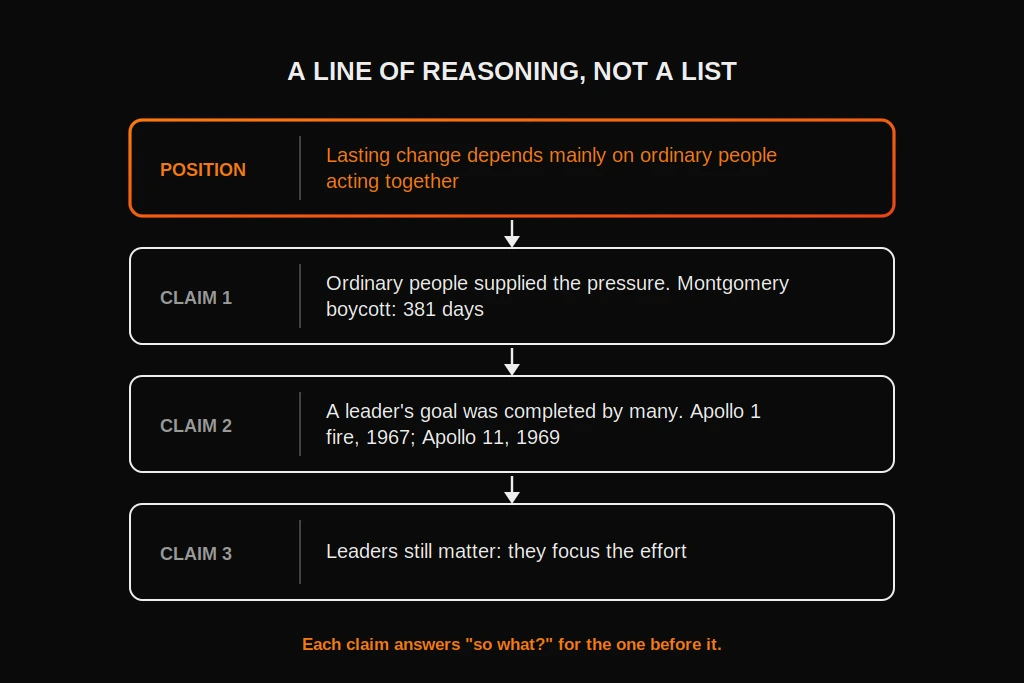
A line of reasoning is not a list of examples. It is a chain where each claim builds on the one before it. Here is the difference using the sample prompt about ordinary people and great leaders.
- A list: Example one is the Montgomery Bus Boycott. Example two is the Apollo program. Example three is penicillin. Each one is true, but nothing connects them, so the reader has to guess how they add up.
- A line of reasoning: Claim one says ordinary people supplied the pressure that ended bus segregation in Montgomery. Claim two says even a goal announced by a leader, like Apollo, was completed by the work of many. Claim three says leaders still matter, but as the force that focuses effort. Each claim answers “so what?” for the one before it and sets up the next.
The scoring guidelines describe some reasoning as faulty. That usually means claims that contradict each other or examples that do not prove what the paragraph says they prove. A quick check is to read only your topic sentences, in order. If they read like a short argument, your line of reasoning is working. If they read like a list of topics, rebuild them.
Row C: Sophistication (1 Point)
The sophistication point is for essays that show a more complex understanding of the issue. The scoring guidelines list several ways to show it, including explaining nuance or tensions and articulating the implications or limitations of an argument by placing it in a broader context, along with making effective rhetorical choices and keeping a consistently vivid and persuasive style.
There is an important decision rule. The point is awarded only when the complexity is part of your argument, not just a passing phrase, and complicated sentences or fancy vocabulary do not earn it on their own. A single “however” sentence added at the end rarely counts. A qualification that shapes your thesis and shows up in your reasoning does.
One reliable way to show nuance is to engage honestly with the strongest opposing view. The rubric has no separate row for an opposing view, but dealing with one can strengthen your commentary and support this point. Our argumentative essay counterargument guide shows how to state an objection fairly and answer it. Two other simple moves also work: qualify your claim (“mainly” instead of “always”) and define a key term in the prompt before you argue about it.
How to Build Evidence That Scores
Specific evidence names something a reader could check. Compare “Many scientists made discoveries by accident” with “In 1928, Alexander Fleming noticed that mold on a petri dish had killed the bacteria around it.” The first is a vague claim. The second is an example, and an example is something you can explain.
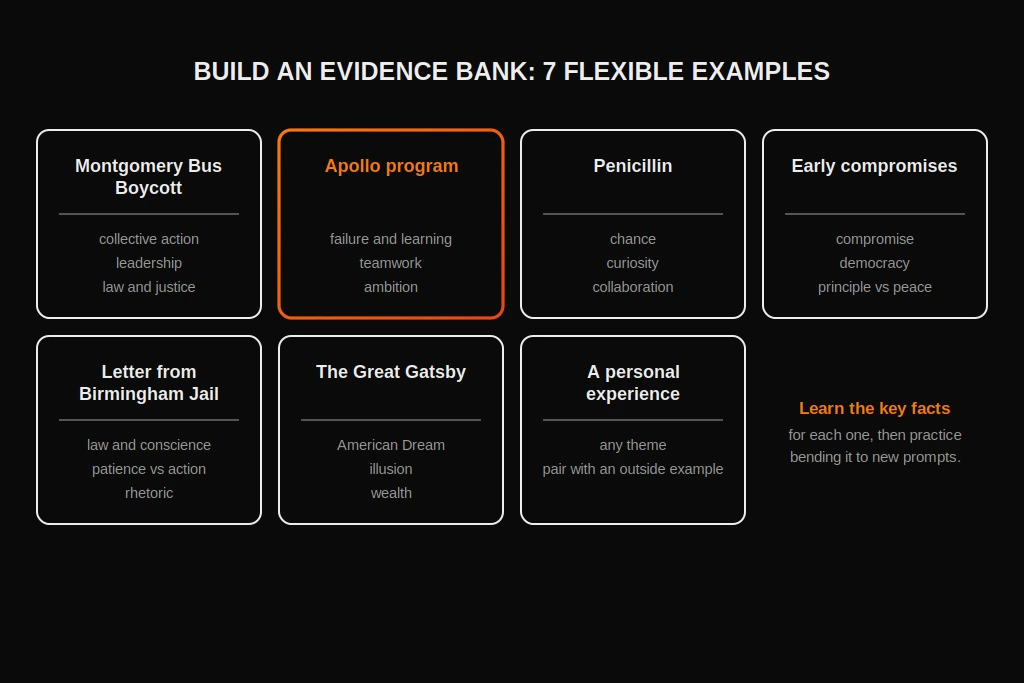
The best way to be ready for any prompt is to build an evidence bank before the exam. Pick six to eight flexible examples from history, literature, science, and your own life, learn the key facts for each, and practice bending each one to fit different themes. The table shows seven examples with facts that were checked against reliable sources.
| Example | Facts to use | Themes it can serve | How to bend it |
| Montgomery Bus Boycott | Began December 5, 1955, after Rosa Parks’s arrest; lasted 381 days; ended after the courts ruled bus segregation unconstitutional in Browder v. Gayle | Collective action, leadership, protest, law and justice, persistence | Use it for ordinary people versus leaders, for sacrifice, or for when laws should change |
| The Apollo program | Kennedy set the Moon goal in a May 25, 1961 speech to Congress; the Apollo 1 fire killed three astronauts on January 27, 1967; Apollo 11 landed on July 20, 1969 | Ambition, failure and learning, teamwork, government’s role, risk | Use it for learning from failure, for the value of a shared goal, or for big projects |
| The discovery of penicillin | Fleming noticed in 1928 that mold killed nearby bacteria; Florey and Chain later developed it into a usable drug; all three shared the 1945 Nobel Prize | Chance, curiosity, observation, collaboration | Use it for accidents and discovery, or to show that an idea needs many people to finish |
| Early American compromises | The Great Compromise (July 16, 1787) set a House based on population and an equal-vote Senate; the Missouri Compromise (1820) admitted Missouri as a slave state and Maine as a free state | Compromise, democracy, principle versus peace | Use the first to praise compromise and the second to show its moral cost |
| Letter from Birmingham Jail | Written April 16, 1963, by Martin Luther King Jr. in reply to eight white clergymen; argues for a moral responsibility to disobey unjust laws | Law and conscience, patience versus action, nonviolence, persuasion | Use it for civil disobedience, for the limits of waiting, or as a model of rhetoric |
| The Great Gatsby | A 1925 novel by F. Scott Fitzgerald about Jay Gatsby’s pursuit of an idealized dream | The American Dream, illusion versus reality, wealth, nostalgia | Use it for dreams that outrun reality or for the cost of reinvention |
| A personal experience | One concrete moment from your own life, with real details | Almost any theme | Pair it with an outside example a reader can verify instead of relying on it alone |
Check every fact before it goes into your bank, since a wrong date weakens an argument. The facts above come from the National Archives’ Browder v. Gayle record, the National Archives’ Apollo program overview and History.com’s moon landing timeline, PBS NewsHour’s history of penicillin, the Senate’s Great Compromise page, the National Archives’ Missouri Compromise record, and the Clio entry on the Letter from Birmingham Jail.
If you need more debatable issues to attach your examples to, browse our list of argumentative essay topics for college students. Each one shows the real tension behind the issue, which is the same tension a prompt will ask you to weigh.
One Example, Three Prompts
A strong example earns its place in your bank because you can bend it. Take the Apollo program and three different prompts.
- A prompt about learning from failure: “The Apollo 1 fire killed three astronauts in January 1967, and the problems that were fixed afterward made later missions possible, which shows how a failure can force a program to improve.”
- A prompt about ambitious goals: “Kennedy set the Moon goal in 1961, when NASA had only just put its first person into space, which shows how a bold target can organize effort long before the means exist.”
- A prompt about teamwork: “Armstrong’s first step in July 1969 rested on years of work by thousands of people who never appeared on television.”
The facts stay the same. Your job is to choose the fact that fits the claim and explain it. As practice advice, try this with every example in your bank until you can bend it to a new prompt in about a minute.
How to Write Commentary That Earns Points
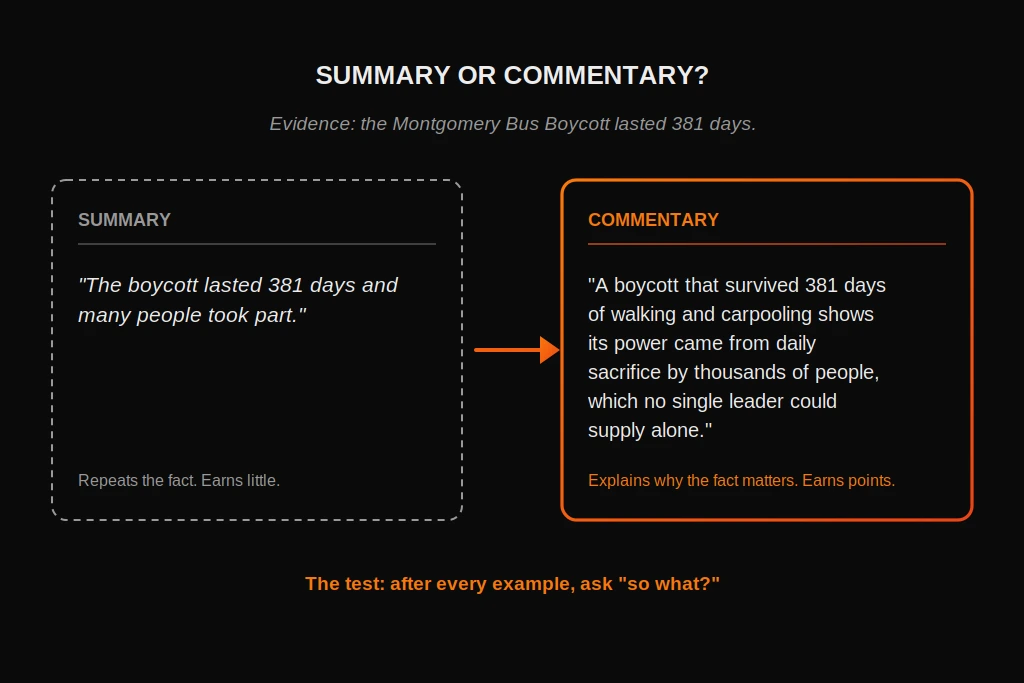
Commentary is your explanation of how a piece of evidence supports your claim. It is the part of the essay that only you can write, and it is where most Row B points are won or lost. The test is simple: after every example, ask “so what?” The answer to that question is your commentary.
Here is the difference. Take the evidence that the Montgomery Bus Boycott lasted 381 days.
- Summary, which earns little: “The boycott lasted 381 days and many people took part.”
- Commentary, which earns points: “A boycott that survived 381 days of walking and carpooling shows that its power came from daily sacrifice by thousands of people, which no single leader could have supplied alone.”
The first sentence repeats the fact. The second explains why the fact matters and ties it to the argument. Three moves help you write the second kind.
- Explain: say why the evidence matters, using words like “which means,” “this matters because,” or “that detail shows.”
- Connect: tie the point back to your claim and to the paragraph before it, so the reader can follow your line of reasoning.
- Qualify: when it is true, name a limit, such as “this holds when” or “even so,” to show you see the complexity.
Watch out for commentary that only restates the evidence in different words. “This shows that the boycott was important” is a summary dressed up as an explanation. Ask what the detail proves, and write that instead.
How to Write an AP Lang Argument Essay, Step by Step
These steps are built around the rubric rows, so each one earns something specific. For a minute-by-minute split of the whole exam section, use the timed workflow in the guide linked above.
Step 1: Read the Prompt and Commit to a Position
Find the claim you are asked to take a position on, and watch for scope words like “the extent to which.” Choose the side you can support with the best examples, even if it is not the side you personally prefer. Write your position as one sentence that answers the question. This is Row A.
Step 2: Build a Line of Reasoning
Decide on two or three claims that, taken in order, prove your position. A short plan is enough. If you want a template, our argumentative essay outline guide has an AP Lang section with a stripped-down timed plan. Each claim should build on the last, so the essay moves forward instead of listing examples.
Step 3: Pick Your Evidence
Choose one specific example for each claim, ideally from your evidence bank. Pick examples you can explain, not just examples you recognize. If you can only say “this is a famous example,” you do not know it well enough to use it.
Step 4: Open With Your Position
Keep the opening short and direct. A sentence or two of context, then your position. Do not restate the prompt. Our argumentative essay introduction guide shows how to set up a claim quickly, which is exactly the skill a timed essay needs.
Step 5: Write Body Paragraphs With Commentary
Give each body paragraph one claim, one specific example, and real commentary. The same four-part pattern works here: claim, evidence, analysis, and a link back to your position. Write more commentary than feels necessary, because that is what Row B rewards.
Step 6: Add Complexity Inside the Argument
Somewhere in the essay, name a limit, a tension, or a condition that shapes your claim. Put it inside your reasoning, not in a sentence tacked onto the end. This is your best shot at Row C.
Step 7: Finish With a So What
End by restating your position in new words and saying why it matters. Do not introduce a new example at the end. Our argumentative essay conclusion guide explains why endings carry extra weight. If you are running out of time, a short, clear final sentence beats an unfinished paragraph.
A Full Annotated AP Lang Argument Essay Example
Reading a finished essay is the fastest way to see how the rows fit together. The prompt and the essay below are both original. They are written to meet the rubric’s descriptors, and they are illustrative, not an officially scored response. For official samples, use the College Board’s past exam questions page, covered later in this guide.
Prompt (original): Some historians credit great leaders for major turning points, while others point to the combined actions of ordinary people. Write an essay that argues your position on the extent to which lasting change depends on ordinary people rather than on great leaders.
Great leaders make better stories than crowds do, which is why textbooks tend to remember a name instead of a movement. But the record of lasting change shows something different. Lasting change depends mainly on ordinary people acting together, even though leaders matter when they turn scattered effort into a shared goal.
Annotation: Row A. The opening states a defensible, qualified position that answers the prompt’s “extent to which” wording. It also previews the line of reasoning: ordinary people do the main work, and leaders focus it.
The Montgomery Bus Boycott shows how this works. After Rosa Parks was arrested on December 1, 1955, the Women’s Political Council distributed about 50,000 flyers calling for a one-day boycott. The boycott began on December 5, and instead of ending after a day it lasted 381 days, until bus segregation was struck down in court. That length is the point. For more than a year, thousands of ordinary riders walked or carpooled and gave up convenience, which means the boycott’s power came from daily sacrifice that no single leader could have supplied. Leaders such as Martin Luther King Jr. gave the movement direction, yet the pressure on the bus system came from the people who kept refusing to ride.
Annotation: Row B. The evidence is specific: dates, a number, and a named organization. The commentary does the real work. The sentence beginning “That length is the point” explains why the 381 days matter and ties the detail to the claim. The last sentence also hints at the complexity that comes later.
The same pattern appears in the Apollo program, even though it is usually told through a few famous names. President Kennedy set the goal of landing a person on the Moon in a 1961 speech to Congress, and Neil Armstrong took the first step in July 1969. But in between, the program depended on thousands of engineers, technicians, and workers, and it survived a disaster only because they kept going. After the Apollo 1 fire killed three astronauts in January 1967, the people who built and tested the spacecraft had to find and fix the problems before another crew could fly. A goal announced by one leader was achieved by the steady work of many, which suggests that leadership starts a change but participation completes it.
Annotation: Row B again. This is a second example that builds on the first rather than repeating it. The commentary ends on a general claim, “leadership starts a change but participation completes it,” which moves the line of reasoning forward.
Leaders still matter, and an honest argument has to say how. A goal without a leader can stay scattered, and a leader without followers is only a speaker. The Montgomery boycott needed organizers to turn anger into a plan, and Apollo needed a clear target before thousands of workers could aim at it. Even so, in both cases the leader’s role was to direct effort, while the effort itself was what changed the world. That is why lasting change depends mainly on ordinary people, with leaders serving as the force that focuses them.
Annotation: Row C and the ending. The paragraph names what leaders contribute and where they fall short, so the complexity is part of the argument, not an add-on. The final sentence restates the position in new words and says why it matters, without adding a new example.
The Score Ladder: One Prompt, Three Levels
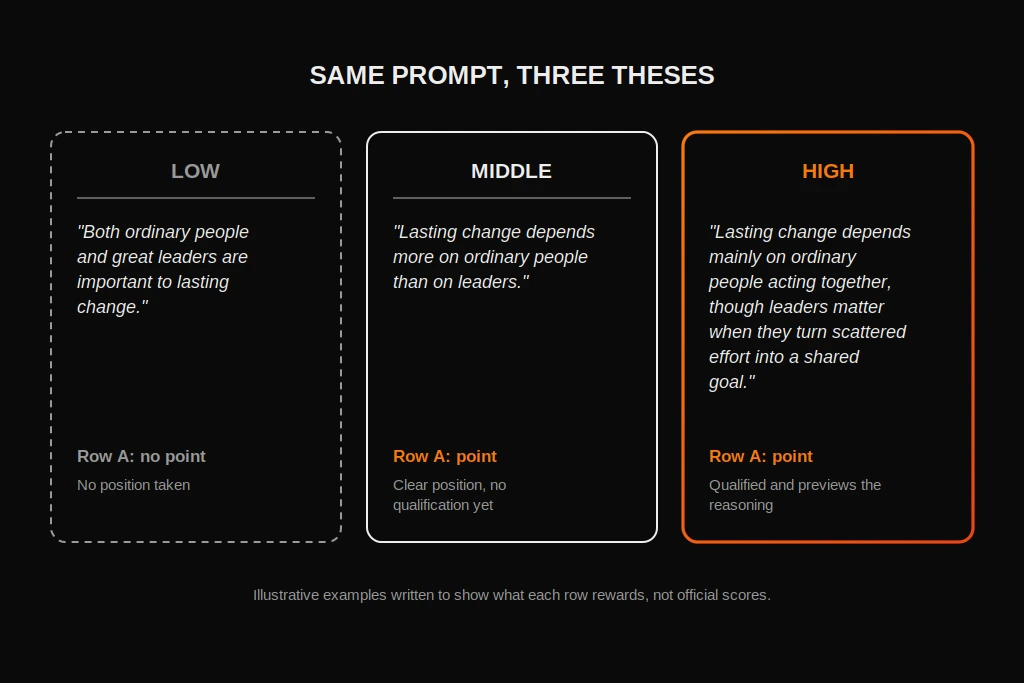
The fastest way to see what separates a weak response from a strong one is to compare three versions of the same writing. Below is the thesis and one body paragraph for the same prompt at three levels. These are original, illustrative examples that show what each row rewards. They are not official scores.
Low
Thesis: “Both ordinary people and great leaders are important to lasting change.”
Body paragraph: “There are many leaders in history who changed things, like Martin Luther King Jr. People also help with change. For example, many people took part in the Montgomery Bus Boycott. This shows that change needs everyone.”
What is wrong: The thesis does not take a position, so it would not earn Row A. The evidence is general, with no dates, numbers, or details. The commentary (“This shows that change needs everyone”) just repeats the thesis.
Middle
Thesis: “Lasting change depends more on ordinary people than on leaders.”
Body paragraph: “The Montgomery Bus Boycott shows this. After Rosa Parks was arrested, thousands of people stopped riding the buses. The boycott helped end bus segregation in Montgomery, so ordinary people can make big changes.”
What changed: The thesis takes a clear position, so it would earn Row A. The evidence is more specific. But the commentary only says what happened, and the claim has no qualification or line of reasoning that points toward complexity.
High
Thesis: “Lasting change depends mainly on ordinary people acting together, though leaders matter when they turn scattered effort into a shared goal.”
Body paragraph: “The Montgomery Bus Boycott began on December 5, 1955, and lasted 381 days. That length shows that its power came from thousands of ordinary riders who walked or carpooled day after day, which no single leader could have supplied. Organizers such as Martin Luther King Jr. gave the effort direction, but the pressure on the bus system came from the people who kept refusing to ride.”
What changed: The thesis is qualified and previews the reasoning. The evidence includes exact details. The commentary explains why the detail proves the claim, and the final sentence sets up the complexity that the rest of the essay can develop.
How to Revise a Middle Paragraph Into a High One
The gap between the middle and high paragraphs looks big, but you can close it in three small passes. Start with the middle paragraph: “The Montgomery Bus Boycott shows this. After Rosa Parks was arrested, thousands of people stopped riding the buses. The boycott helped end bus segregation in Montgomery, so ordinary people can make big changes.”
- Pass 1, add exact details. Replace “thousands of people stopped riding” with the dates and length: the boycott began on December 5, 1955, four days after Parks’s arrest, and lasted 381 days.
- Pass 2, swap the summary for commentary. Replace “so ordinary people can make big changes” with an explanation: that length shows the pressure came from thousands of riders who sacrificed daily, which no single leader could supply.
- Pass 3, add the complexity. Add a sentence that names what leaders contributed, such as organizers giving the effort direction, so the paragraph supports a qualified position instead of an absolute one.
Each pass is small, so even a rough first paragraph can be lifted in a few minutes of revision. Use the same three passes on your own practice essays: details first, then commentary, then complexity.
Where Students Lose Points, Row by Row
Row A problems
- Restating the prompt as the thesis. Fix: answer the question the prompt asks, and add a short “because” to preview your reasoning.
- Listing pros and cons. Fix: choose a side, then qualify it if you need to.
- Answering a nearby question. Fix: underline the exact claim after “argues your position on,” and check that your thesis answers it.
Row B problems
- Vague examples. Fix: add a name, a date, or a number to every example.
- Evidence with no commentary. Fix: write at least one sentence of explanation after every example.
- Examples that do not connect to the claim. Fix: reread the example and ask what it actually proves. If it proves something else, change the claim or the example.
- A line of reasoning that jumps around. Fix: order your claims so each one builds on the last, and use a link sentence between paragraphs.
Row C problems
- Chasing sophistication with vocabulary. Fix: use plain words and put the effort into nuance instead.
- Adding one “however” sentence at the end. Fix: build the qualification into your thesis and your commentary.
- Ignoring a scope word in the prompt. Fix: if the prompt says “the extent to which,” your answer should say how far you agree, not just yes or no.
Which Row to Fix First
If you only have time to improve one thing, work in this order. Fix Row A first, because it is one point that depends mostly on a habit: always write a position that answers the prompt. Then spend the most time on Row B, because it is worth four points and responds well to practice. Leave Row C for last. It tends to show up in essays that are already strong, so you earn it by building real nuance into your reasoning, not by chasing it directly.
A simple way to decide is to score three of your practice essays and mark which row lost points most often. That row is your next practice target.
How to Practice and Where to Find Real Samples
The best practice material is the real thing. The College Board’s past exam questions page offers free-response questions from past exams with scoring guidelines, sample responses from exam takers, and scoring distributions. The page lists the 2018 and 2019 questions as rescored with updated scoring information, so use those versions when you practice with older questions. Read the scoring commentary after you write, not before, so it does not shape your first attempt.
For prompts to practice on and a four-week practice plan, use our argumentative essay prompts guide. It includes a decoder for reading any prompt, which is the first step of every essay in this guide. Between sessions, keep adding to your evidence bank, because a bigger bank means fewer blank moments on exam day.
Quick Tips for Your Next Practice Essay
- Write your position as a full sentence before you write anything else.
- Choose the side where your best examples live, not the side you like best.
- Use two or three examples, each followed by real commentary.
- Put a name, date, or number in every example.
- After each example, ask “so what?” and write the answer down.
- Qualify your claim with a word like “mainly” or “when,” and mean it.
- Do not add a new example in your final paragraph.
- Since the exam is typed, practice typing your timed essays.
How EssaysHelper Can Help You
An AP exam essay is timed and written by you alone, so the most useful help comes before test day. EssaysHelper connects students with tutors who can read your practice essays, point to the rubric row that is costing you points, and help you build an evidence bank that actually fits the prompts you will see. If you also have a classroom argumentative essay to finish, our argumentative essay writing service can support you with that assignment.
Frequently Asked Questions
What is the AP Lang argument essay?
It is Free-Response Question 3 on the AP English Language and Composition exam. You write an evidence-based argument in response to a given topic, and it is scored on a 6-point rubric.
How is the AP Lang argument essay scored?
It is scored on a 6-point rubric with three rows: thesis for 1 point, evidence and commentary for up to 4 points, and sophistication for 1 point. Four of the six points depend on how specific your evidence is and how well you explain it.
What is a defensible position on the AP Lang argument essay?
It is a position that responds to the prompt and clearly takes a stand a reasonable person could argue against. Restating the prompt or listing pros and cons does not count, but a qualified position does.
How many pieces of evidence do you need for the AP Lang argument essay?
The rubric language focuses on how specific your evidence is and how well you explain it, not on a count. As practice advice, two or three well-explained examples usually work better in a timed essay than five thin ones.
What counts as evidence on the AP Lang argument essay?
Specific examples count, whether they come from history, literature, science, current events, or your own experience. What matters is that the example is specific and that you explain how it supports your reasoning.
How do you get the sophistication point on the AP Lang argument essay?
Show complexity as part of your argument, such as explaining a nuance or tension or stating a limit or implication of your claim. A passing phrase or fancy vocabulary is not enough.
What is the difference between the synthesis essay and the argument essay?
The synthesis essay gives you 6 to 7 sources and asks you to cite at least three of them. The argument essay gives you no sources, so the evidence comes from you. Both are scored on the same three rubric rows.
Does the AP Lang argument essay need an opposing view?
The rubric has no separate row for one. Dealing honestly with a strong opposing view can still strengthen your commentary and help you earn the sophistication point, as long as it is part of your reasoning.
How long should an AP Lang argument essay be?
The rubric describes the quality of your thesis, evidence, and commentary, not a length. Aim for enough developed paragraphs to carry your line of reasoning in the time you have.
Can I use personal experience as evidence on the AP Lang argument essay?
Yes, if it is specific and tied to your claim. Many students pair a personal example with at least one outside example, because a reader can check an outside example against what they know.
Final Thoughts
The AP Lang argument essay looks open-ended, but it is scored on three clear rows, and each one rewards something you can practice. Take a clear position, support it with specific examples, explain every example, and let your qualifications show up inside your reasoning.
If you build an evidence bank, practice writing commentary, and score your own essays against the rubric, you will know exactly where your points are coming from. That knowledge is worth more than any template.