
An argumentative essay prompt is the assignment instruction that tells you to take a position and defend it with evidence. It usually has two parts: a short bit of context and a directive, such as “argue whether” or “write an essay that argues your position on.” To respond to one, find the claim you must answer, notice any limiting words like “to what extent,” pick the side you can defend best, and build your essay around reasons, not around the topic in general. Below you will find 62 original prompts, each with a one-line decode, plus a full AP Lang section.
What Is an Argumentative Essay Prompt?
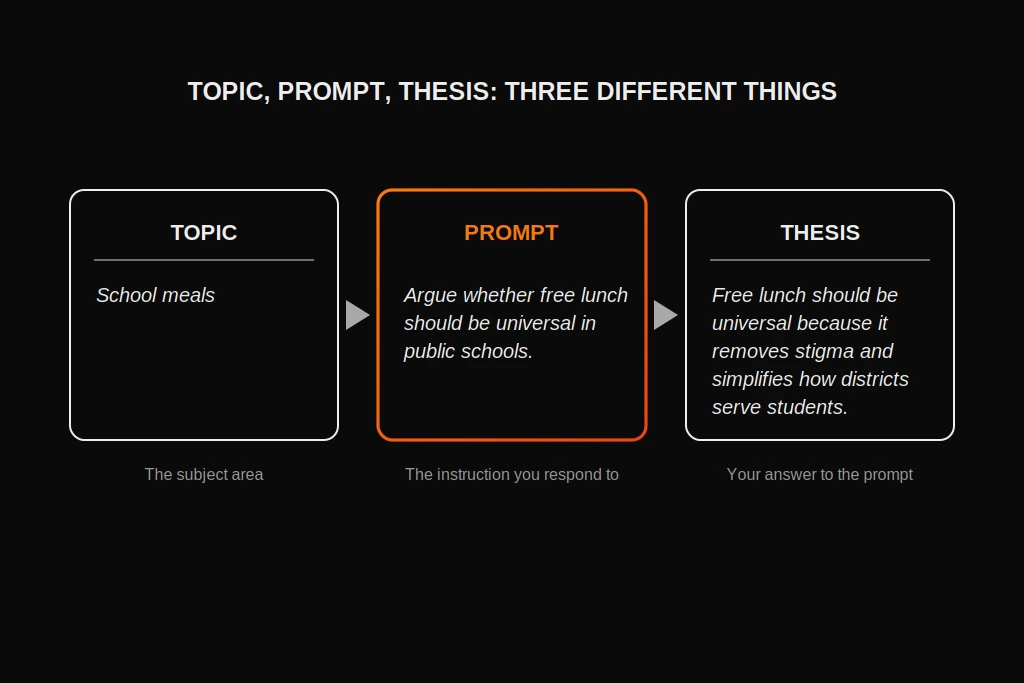
A prompt is not the same thing as a topic or a thesis, and mixing them up is one of the most common ways students lose time. A topic is the subject area. A prompt is the instruction you respond to. A thesis is your answer. If you are still choosing a subject, start with our list of argumentative essay topics for college students. If you were handed a prompt, the first job is understanding what it asks.
| Topic | Prompt | Thesis | |
| What it is | A subject area or a debatable claim | The assignment instruction you respond to | Your answer to the prompt |
| Who writes it | You or your instructor | Your instructor or the exam writers | You |
| Example | School meals | Many districts offer free lunch to every student, while others limit it to families who qualify. Argue whether free lunch should be universal in public schools. | Free lunch should be universal in public schools because it removes stigma and simplifies how districts serve students. |
Notice that the prompt contains a question you must answer, while the thesis is a sentence that answers it. A strong response never restates the prompt. It commits to an answer.
How to Read and Decode Any Argumentative Prompt
Most prompts hide their instructions in a few small words. The University of North Carolina Writing Center points out that the key verbs in an assignment tell you what kind of thinking is expected. “Argue” means take a side and defend it with evidence. “Evaluate” and “respond” mean give your judgment with examples and reasons. In both cases, an opinion alone is not enough. It has to be supported.
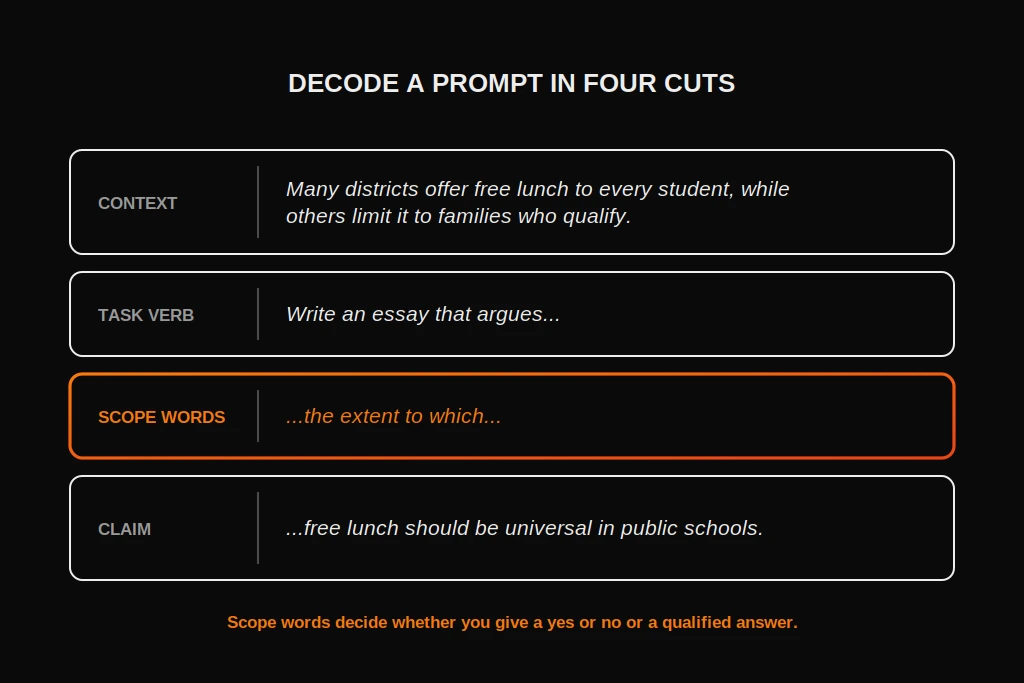
Here is a method that works on nearly any argumentative prompt. Read the prompt once, then cut it into five parts.
| Part of the prompt | What to look for | Example |
| Context | The background that tells you what the debate is about | Many districts offer free lunch to every student, while others limit it to families who qualify. |
| Task verb | What you are being asked to do: argue, defend, challenge, evaluate, or qualify | Write an essay that argues… |
| Scope words | Words that limit the answer, such as “to what extent,” “should,” “whether,” “always,” or “never” | …the extent to which… |
| Claim or question | The statement you must take a position on | …free lunch should be universal in public schools. |
| Constraints | Length, audience, required sources, or required evidence | None stated here, so check the assignment sheet. |
The scope words matter most, and they are easy to skip. “The extent to which” is not a yes or no question. It invites a qualified answer, such as “free lunch should be universal in high-poverty districts and optional elsewhere.” A prompt that says “whether” is closer to a clean yes or no. Reading these words correctly changes your whole essay.
Once you have decoded the prompt, write your answer as one sentence. Our guide to the thesis statement in argumentative essay writing shows how to sharpen it. Three common misreadings are restating the prompt as your answer, writing about the topic instead of responding to the claim, and missing a scope word that changes what a good answer looks like.
Which Topic Would Prompt an Argumentative Essay?
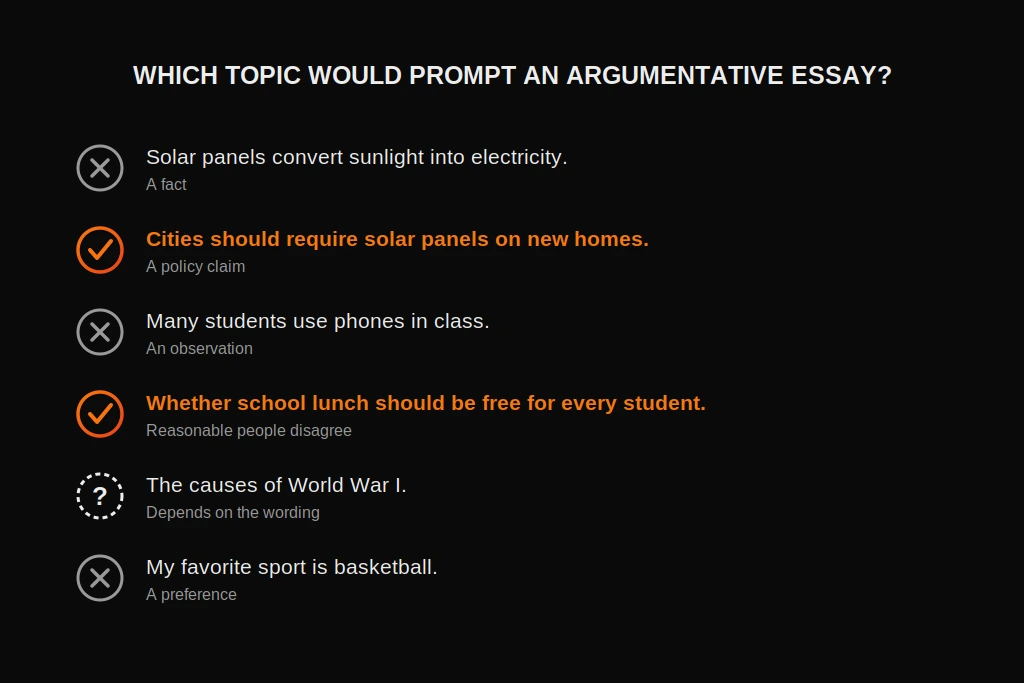
A topic prompts an argumentative essay when reasonable people disagree about it and a position can be supported with evidence. If a question on a test asks you to choose which topic fits, pick the one that has an arguable claim, not a fact, a preference, or a plain observation. Here is a quick test on six statements.
- Solar panels convert sunlight into electricity. This is a fact. You can explain it, but there is nothing to argue.
- Cities should require solar panels on new homes. This is a policy claim, and real evidence exists on both sides.
- Many students use phones in class. This is an observation. It becomes arguable only after you add a position, such as whether phones should be banned.
- Whether school lunch should be free for every student. Reasonable people disagree, and cost and benefit evidence exists on both sides.
- The causes of World War I. It depends on the wording. Asking you to explain the causes is expository. Asking which cause mattered most is argumentative.
- My favorite sport is basketball. This is a preference, and there is no opposing view to answer.
A fast check for any topic is to state the strongest opposing view in one sentence. If you can, you probably have an arguable claim. That habit is the heart of the argumentative essay counterargument section of an essay, and it is also the quickest way to test a prompt before you commit to a side.
Argumentative Essay Prompts by Level
Every prompt below is original and written the way an assignment would be written, with context and a directive. Each one ends with a decode line that names what the prompt is really asking. Teachers can adapt them freely. If you need the whole writing process behind any prompt, our guide on how to write an argumentative essay walks through it step by step.
Middle School Prompts
- Some schools set aside 20 minutes each day for silent reading. Argue whether every middle school should require daily silent reading.
- Decode: You are defending a school rule. The tension is building a habit versus protecting choice and enjoyment.
- Your school is deciding whether students may eat lunch outside on nice days. Write a letter to the principal that argues for or against the change. Decode: The reader is the principal, so lead with safety and supervision, not just fun.
- Should students be allowed to choose their own seats in class? Write an essay that argues your position.
- Decode: A classroom rule with two fair sides. Examples from real school life will carry this one.
- Some people say video games waste time. Others say they build useful skills. Argue which view is closer to the truth.
- Decode: “Closer to the truth” invites a middle position, so you are judging two claims, not just picking one.
- A town plans to turn an unused parking lot into a skate park. Write an argument for or against the plan.
- Decode: A tradeoff prompt: recreation for some people against noise and cost for others.
- Should students be paid for earning good grades? Write an essay that argues your position.
- Decode: The strongest opposing view is about motivation, so decide what you believe pay does to it.
- Should every student learn to cook a few basic meals before finishing middle school? Argue your position.
- Decode: A life-skill claim up against limited class time, so say what could be shortened to make room.
- Your class can have either a class pet or a class garden. Argue which would be the better choice.
- Decode: A comparison prompt. Judge both options by the same criteria, such as cost, care, and learning.
- Should students be allowed to retake a test to improve their grade? Argue your position.
- Decode: Fairness versus learning. Expect the objection that retakes reward waiting instead of studying.
- Some neighborhoods have little free libraries where anyone can take or leave a book. Argue whether your school should set one up.
- Decode: A small, concrete proposal. Strong answers cover who uses it and who keeps it running.
- Should a student council vote be able to change a school rule? Write an essay that argues your position.
- Decode: Student voice versus adult authority. Decide how much power “be able to change” really means.
- Think of a rule at your school that you would change. Argue why it should change and what should replace it.
- Decode: An open prompt. It only works if you propose a replacement, not just a complaint.
High School Prompts
- Many high schools require a senior project before graduation. Write an essay arguing whether a senior project should be a graduation requirement.
- Decode: A requirement claim. Weigh the value of the project against workload and unequal access to resources.
- Some colleges accept a portfolio of work in place of an application essay. Argue whether this change helps or hurts applicants from different backgrounds.
- Decode: “Helps or hurts” asks for a judgment about fairness, so define fair before you argue.
- A city council is considering a curfew for people under 16 after 10 p.m. Argue for or against the curfew.
- Decode: The audience is a council, so safety evidence and effects on families matter more than personal freedom alone.
- Is it acceptable for a student to use an AI tool to brainstorm ideas for an assignment? Argue where the line between help and cheating should be. Decode: “Where the line should be” calls for a definition of cheating and a qualified position.
- Some high schools let students graduate early if they finish every requirement. Argue whether early graduation should be open to all students. Decode: Flexibility against readiness. You need a view on who decides when a student is ready.
- A local company offers to pay a district to place ads on school buses. Argue whether schools should accept advertising to fund programs. Decode: Funding need against commercial influence on students. The strongest opposing view is about neutrality.
- Should every high school student take a public speaking course? Write an essay that argues your position.
- Decode: Skill value against a crowded schedule. Name concrete outcomes, not just “confidence.”
- Some places let 16-year-olds vote in school board elections. Argue whether the voting age for local elections should be lowered to 16.
- Decode: A policy claim about maturity and civic habits. Define “local” so the scope stays clear.
- Professional athletes often earn far more than teachers. Is this a problem society should address? Argue your position.
- Decode: “Should address” means you either propose a fix or argue there is nothing to fix.
- Should schools be allowed to search student lockers without a specific reason? Argue your position.
- Decode: Safety against privacy. Strong responses explain what “without a reason” risks.
- Many teens spend more time with online friends than with local ones. Does this make friendships stronger or weaker? Argue your view. Decode: A value claim that needs criteria for “stronger,” such as support, trust, or time together.
- Some cities charge a small fee for plastic bags at checkout. Argue whether a bag fee is an effective way to change behavior.
- Decode: “Effective” is the key word. You need a measure of success and evidence to match it.
- Should high school athletes be required to keep a minimum grade point average to play? Argue your position.
- Decode: Academics against participation. Consider who is helped and who is shut out by the rule.
- Is it better for a teenager to take a gap year before college or to go straight in? Argue your position.
- Decode: A comparison where “better” is vague. Pick your criteria, such as money, maturity, or momentum.
- Some teachers assign the same books to every student, while others let students choose their own reading. Argue which approach builds stronger readers.
- Decode: “Stronger readers” needs a measure. Weigh shared knowledge against engagement.
College Prompts
- Many universities require every first-year student to take a writing course. Argue whether the requirement is worth the credit hours.
Decode: Value for time. Compare transferable skills against what a student could learn in their own major. - Some professors ban laptops in lectures. Argue whether laptop bans improve learning.
Decode: A causal claim, so look for evidence on note-taking and distraction, and consider accessibility needs. - A university moves to digital-only communication to save costs. Argue whether this is fair to all students.
Decode: Efficiency against access. The strongest objection concerns students with limited internet or devices. - Should colleges publish the average grade for every course? Write an essay that argues your position.
- Decode: Transparency against grade shopping. Decide whether students choosing easier classes is a real harm.
- Many campuses charge every student a fee that funds student organizations. Argue whether mandatory activity fees are justified.
- Decode: Shared benefit against individual choice. Who benefits, and who pays without using it?
- An honor code asks students to report cheating they see. Argue whether students should be required to report academic dishonesty.
- Decode: Duty against trust. Define “required” and what happens to students who stay silent.
- Is a four-year residential experience essential to a college education? Argue whether online or commuter paths can deliver the same value. Decode: Define “value” first: learning, networks, cost, or personal growth.
- Some universities limit how many credits students may earn through exams such as AP or CLEP. Argue whether such limits are justified. Decode: Acceleration against breadth. Think about who benefits from credit by exam and who is held back.
- Should universities divest from industries that conflict with the values of their students and faculty? Argue your position.
- Decode: A moral claim against a financial duty. You need a clear rule for which industries count.
- Many instructors use software to detect plagiarism or AI-written text. Argue whether these tools are a fair way to judge student work.
- Decode: Accuracy and due process drive this one. Look for evidence on false positives.
- Should universities guarantee housing for every enrolled student? Write an essay that argues your position.
- Decode: Equity against cost, with the local housing market as the missing context.
- Should participating in a college sport earn academic credit? Argue your position.
- Decode: Credit for work versus credit for learning. Decide what a course credit is meant to certify.
- Should student course evaluations help determine a professor’s promotion or pay? Argue your position.
- Decode: Accountability against bias in ratings. Strong responses use research on how evaluations behave.
- A campus debates whether guest speakers invited by student groups should be screened by the administration. Argue where the line between free expression and campus responsibility belongs.
- Decode: A boundary argument. Pick a principle for the line, then test it on a hard case.
- Some universities let students design their own major. Argue whether self-designed majors serve students better than established ones. Decode: Freedom against structure. Consider how employers view the degree as part of your evidence.
Argumentative Essay Prompts Based on Literature
Literature prompts ask you to argue about meaning, character, or an author’s message, and your evidence comes from the text. A good literary prompt has more than one defensible reading, so your job is to choose one and prove it with specific scenes.
Animal Farm
- At the end of Animal Farm, the pigs and the humans are hard to tell apart. Argue whether the novel shows that power inevitably corrupts or that corruption depends on the choices of those who allow it. Decode: Two causes compete: power itself or the other animals’ passivity. Specific scenes will decide it.
- Is Snowball a better leader than Napoleon, or does the novel suggest the gap is smaller than it first seems? Decode: A comparison with a built-in twist. Judge their methods and results, not just their personalities.
The Crucible
- Is John Proctor a hero, or a flawed man who redeems himself too late? Argue your position using his choices in the final act. Decode: You must define “hero” first. His final refusal and his earlier choices both count as evidence.
- Who bears more responsibility for the tragedy in Salem: Abigail Williams or the adults who believe her? Argue your position. Decode: Individual against system. You will need to answer for the side you rank lower.
To Kill a Mockingbird
- Is Atticus Finch a model of moral courage, or does his faith in the legal system blind him to its flaws? Argue your position. Decode: A character judgment with two readings. The trial and its outcome are your best evidence.
- Does the novel suggest that empathy alone can change a community? Argue to what extent. Decode: “To what extent” invites a qualified answer. Show what empathy achieves and where it falls short.
Romeo and Juliet
- Who is most responsible for the deaths of Romeo and Juliet: the feud, Friar Laurence, or the lovers themselves? Argue for one and explain why the others matter less. Decode: A ranking prompt. Your reasons for the winner double as your answer to the other two.
- Is Romeo and Juliet a story about true love or about rash decisions? Argue which reading is stronger. Decode: Two readings of the same events. The speed of the plot is evidence for both.
Frankenstein
- Who is more to blame for the tragedies in Frankenstein: Victor or the creature? Argue your position. Decode: Both make choices, so you must show why one set of choices weighs more.
- Does Frankenstein argue that scientific ambition should be limited, or that scientists must take responsibility for what they create? Decode: The two claims sound close but are not. Pick one and show the difference in the text.
Macbeth
- Is Macbeth destroyed by fate or by his own choices? Argue which the play emphasizes more. Decode: A classic either-or with room for a middle answer. Track what the prophecies actually force.
- Is Lady Macbeth more ambitious than Macbeth, or does she push him toward what he already wanted? Decode: An interpretation of motive. The scene where she persuades him is the place to start.
Of Mice and Men
- At the end of Of Mice and Men, George makes a painful choice. Argue whether it is an act of mercy, an act of betrayal, or something the novel leaves unresolved. Decode: Three positions are allowed. The earlier scene with Candy’s dog is a key parallel.
- Does the novel suggest the American Dream is out of reach for people like George and Lennie, or that it was lost through one mistake? Decode: Structure against individual choice. Look at what the other workers’ lives suggest.
AP English Language and Composition Argument Essay Prompts
What an AP Argument Prompt Looks Like
On the AP English Language and Composition exam, the argument essay is Free-Response Question 3. According to the College Board’s course and exam description materials, students are asked to write an essay that argues their position using evidence, and the directions ask for a thesis that presents a defensible position. The prompt itself usually gives a short piece of background, often a claim about a broad idea, and then tells you to argue your position on it. The directions repeat what the rubric rewards: a defensible thesis, evidence, and an explanation of how that evidence supports your reasoning.
One difference from the other two essays matters a lot. The synthesis question comes with 6 to 7 texts, according to the College Board’s exam overview. The argument question does not come with a source packet. The evidence has to come from you, from history, current events, your reading, and your experience.
Because the thesis point depends on responding to the prompt, it helps to open by answering the prompt directly instead of restating it. Our argumentative essay introduction guide shows how to set up a claim in a few sentences, which is exactly the skill a timed essay needs.
Six Original AP-Style Practice Prompts
These prompts are original. They are written in the style of an AP argument question and are not College Board questions.
- Some thinkers claim that easy access to information makes people less curious, because answers arrive before questions have time to form. Write an essay that argues your position on the claim that easy access to information reduces curiosity. Decode: You can defend, challenge, or qualify the claim. Define “curiosity” first, then choose examples that fit your definition.
- A common saying holds that people learn more from failure than from success. Write an essay that argues your position on the extent to which failure teaches more than success. Decode: “The extent to which” asks for a qualified position. Name when failure teaches more and when it does not.
- Supporters of public art argue that murals and sculptures improve shared spaces, while critics argue that the money is better spent on basic services. Write an essay that argues your position on the value of public funding for art. Decode: “Value” is the pivot word. Decide what counts as value, such as beauty, identity, or economic return.
- In an age of constant news, some believe that staying informed is a civic duty, while others believe that limiting news is healthier. Write an essay that argues your position on whether citizens have a responsibility to stay constantly informed. Decode: Duty against wellbeing. “Constantly” is a scope word that makes room for a middle answer.
- Many leaders have called compromise the foundation of democracy, while others warn that compromise can mean giving up principles. Write an essay that argues your position on the value of compromise. Decode: Pick examples where compromise worked and where it failed, then explain what separates them.
- People often say that technology brings people together, yet many report feeling lonelier despite constant connection. Write an essay that argues your position on the claim that technology connects people more than it separates them. Decode: A comparison claim. Choose a standard for “connects” before you weigh the two sides.
How to Find and Use Past AP Lang Argument Prompts
People often search for past prompts by year, and the best place to get them is the source. The College Board’s past exam questions page offers free-response questions from past exams along with scoring guidelines, sample responses from exam takers, and scoring distributions. For some years the page shows a selection and points to AP Classroom for the full set, so ask your teacher for access if a year is missing. This post does not reproduce released prompts, because they belong to the College Board.
Use past prompts in a specific order. Decode the prompt and plan first. Write the essay second. Read the scoring guidelines and sample responses last, so the answers do not shape your first attempt.
A Four-Week Practice Plan
This plan is a suggestion built from common practice, not a College Board program. It covers 10 prompts and 7 full essays. Adjust it to your schedule.
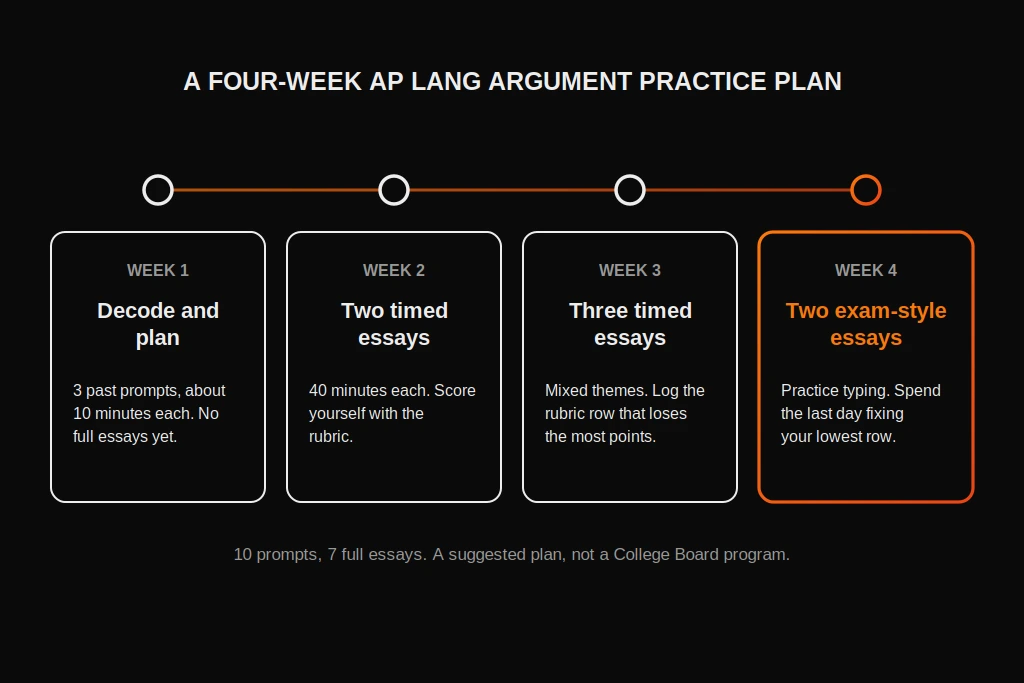
- Week 1: decode and plan only. Take three past prompts and spend about ten minutes on each. Decode the prompt, write a one-sentence answer, and list two or three reasons with one specific example for each. Do not write full essays yet.
- Week 2: two timed essays. Write each in 40 minutes, then score yourself with the rubric below. Our argumentative essay outline guide has an AP Lang section with a stripped-down timed plan if you want a template.
- Week 3: three timed essays on mixed themes. Use two specific examples in every essay, each followed by a sentence of commentary. Write down which rubric row loses you the most points.
- Week 4: two essays under exam conditions. The exam is fully digital, so practice typing. Spend the last day fixing your lowest rubric row, not rereading everything.
How to Score Yourself
The College Board’s scoring guidelines use a 6-point rubric. The thesis point goes to a response that takes a defensible position and responds to the prompt, and the guidelines say the thesis must clearly take a position rather than just state pros and cons. A thesis that only restates the prompt does not earn the point. Up to four points reward evidence and commentary, which means specific examples plus an explanation of how they prove your claim. One more point rewards sophistication, such as dealing with a complication or limit.
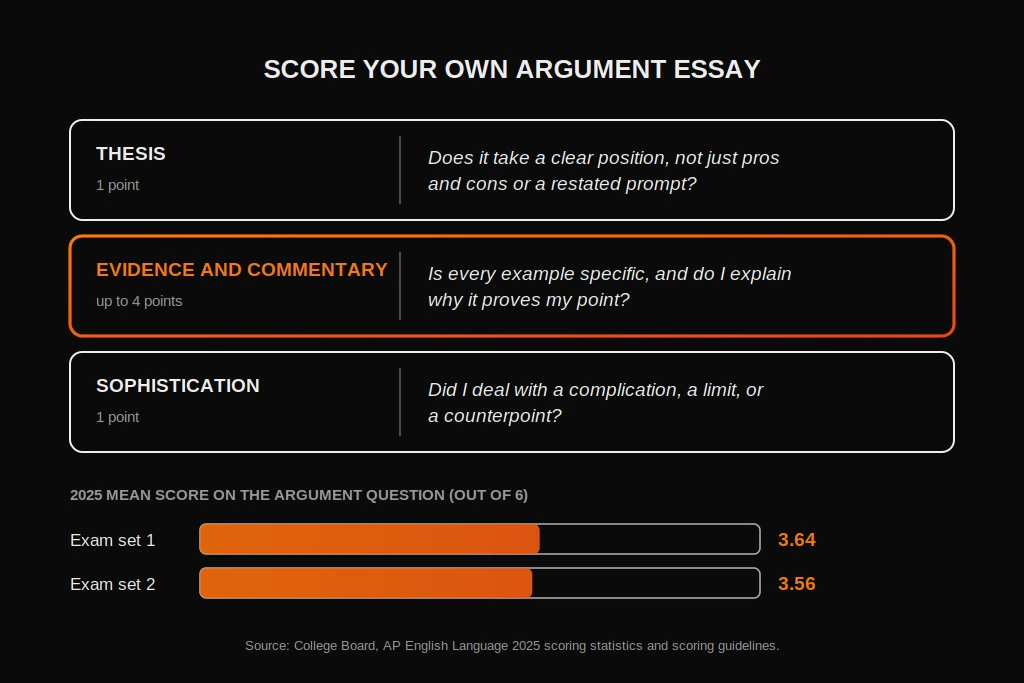
For a sense of where students land, the College Board’s 2025 scoring statistics list the mean score on question 3, the argument essay, as 3.64 out of 6 in one exam set and 3.56 out of 6 in the other. That is a little over half the available points, which suggests that a clear thesis and specific commentary are where a typical response can gain the most.
A Note on AP Gov
AP U.S. Government and Politics has its own argument essay. The College Board’s AP Gov exam page lists four free-response questions in 1 hour and 40 minutes, with one asking you to develop an argument using evidence from required foundational documents and course concepts. Those prompts name the documents you must draw on, so practice with released AP Gov questions instead of general prompts. The skills in this post still carry over: a defensible claim, specific evidence, and clear reasoning.
Prompts With Sources or Passages
Some prompts come with a reading packet or a passage. The prompt still asks for an argument, but the evidence is partly handed to you, and the mistake to avoid is summarizing the sources instead of using them.
For example, the Texas Education Agency says STAAR reading and writing tests now include an essay based on a reading passage, and students write in one of three modes: informational, argumentative, or correspondence, according to the TEA’s STAAR redesign overview. The same page notes that the essay has shifted away from stand-alone prompts, so older “STAAR prompts” you find online may not match the current test.
A reliable way to handle any source-based prompt has four steps. Read the prompt before the sources, so you know what you are looking for. Mark where the sources agree and disagree. Choose a position the sources can actually support. Then use specific details from the sources as evidence and add your own explanation of why they matter. On the AP Lang synthesis question, the College Board asks students to cite at least three of the sources, so always check how many your prompt requires.
Prompts on Other Tests
Test formats change, so use the official guide for your exam. Here is what the major tests asking about argumentative prompts look like right now.
- Praxis Core Writing: The test has two 30-minute essays, one argumentative and one informative or explanatory, according to the ETS study companion. The argumentative topic asks you to support a position with specific reasons and examples drawn from personal experience, observation, or reading.
- GRE: Since September 2023, the Analytical Writing section has one 30-minute task, “Analyze an Issue,” and the old “Analyze an Argument” task is gone, as reported when ETS announced the shorter test. That means prep material built around “Analyze an Argument” prompts no longer matches the current test.
- STAAR: As noted above, the essay is based on a reading passage. Practice by reading carefully and tying every claim to the passage.
For the ACT, ISAT, and other state tests, check the current official test guide, since writing sections and prompt types are revised from time to time.
How to Respond to Any Prompt in Five Steps
When you have a prompt in front of you, work in this order.
- Decode it. Cut the prompt into context, task verb, scope words, claim, and constraints.
- Choose the side you can defend best. This is not always the side you believe. Pick the one where you have the strongest evidence.
- Find two or three reasons. Write each as a full sentence and note one specific example for it.
- Draft your main claim. One sentence that answers the prompt and takes a position.
- Plan the ending too. Know what point you want the reader to leave with, because the last lines of an essay stay with a reader. Our argumentative essay conclusion guide explains how.
Then write. The sections above give you the prompts, and the guides linked in this post cover each stage in depth.
Common Mistakes When Responding to a Prompt
- Restating the prompt as your thesis. The College Board’s guidelines say a thesis that only restates the prompt does not earn the point.
- Writing a pros and cons list without taking a position.
- Answering a related question instead of the one asked.
- Ignoring a scope word, such as treating “to what extent” as a simple yes or no.
- Missing a constraint, such as the audience, length, or required evidence.
- Choosing the side that sounds more impressive but has less evidence behind it.
- Writing about the topic in general instead of responding to the prompt.
How EssaysHelper Can Help You
If a prompt still feels confusing after you decode it, or you cannot decide which side you can defend, a second pair of eyes helps. EssaysHelper connects students with tutors who can read a prompt with you, test your claim against the strongest opposing view, and show you where an answer drifts off the question. If you would rather hand off the whole assignment, our argumentative essay writing service can take you from prompt to final draft.
Frequently Asked Questions
What is an argumentative essay prompt?
It is the assignment instruction that asks you to take a position and defend it with evidence. It usually has a short context and a directive such as “argue whether” or “write an essay that argues your position.”
What is the difference between a prompt and a topic?
A topic is a subject area, such as school meals. A prompt is the instruction that tells you what to do with it, such as arguing whether free lunch should be universal.
How do I decode an argumentative essay prompt?
Cut it into context, task verb, scope words, the claim, and any constraints. Pay the most attention to scope words like “to what extent,” since they decide whether you give a yes or no or a qualified answer.
Which topic would prompt an argumentative essay?
The one where reasonable people disagree and each side can be supported with evidence. Facts, preferences, and plain observations do not prompt an argumentative essay.
Where can I find past AP Lang argument essay prompts?
The College Board posts free-response questions from past exams, with scoring guidelines and sample responses, on its AP Central past exam questions page. For some years it shows a selection and points to AP Classroom for the full set.
How many AP Lang argument prompts should I practice?
There is no official number. A realistic goal is about ten prompts over four weeks, with several full timed essays, and the most important habit is scoring each one against the rubric.
Do I have to choose the side I believe?
No. On most prompts you can defend either side, so choose the one you can support best with evidence. A well-supported position you do not personally hold usually beats a heartfelt one with little proof.
How do I use a prompt that comes with sources or a passage?
Read the prompt first, mark where the sources agree and disagree, and choose a position they can support. Then use specific details as evidence and explain why they matter, instead of just summarizing them.
Are GRE and STAAR essays the same as a school argumentative essay?
Not exactly. The GRE now has one 30-minute “Analyze an Issue” task, and STAAR essays respond to a reading passage. The core skill of taking and supporting a position carries over, but check each test’s official guide.
What are good argumentative essay prompts for middle school students?
Good middle school prompts are concrete and close to student life, such as whether students should choose their own seats or whether tests can be retaken. Our middle school list above gives twelve with a decode line for each.
Final Thoughts
A prompt is a small instruction with a lot hidden in it. Learn to cut it into its parts, pay attention to the scope words, and commit to a position you can support, and most of the work of the essay is already done before you write a sentence.
Use the prompts above for practice, change the details to fit your class, and return to the decoder whenever an assignment feels unclear. The better you read the question, the better your answer will be.