

To write an argumentative essay, choose a debatable topic, research both sides, plan your structure, state your main claim clearly, support it with evidence in focused body paragraphs, answer the strongest opposing view, close the argument, and revise for argument before grammar. A strong argumentative essay takes a clear position that a reasonable person could disagree with, then proves it with specific evidence and reasoning instead of repeating opinions. The steps below follow that order, with a complete annotated sample essay, a time budget, and a section for AP Lang students.
What Is an Argumentative Essay?
The Purdue Online Writing Lab describes an argumentative essay as writing where you investigate a topic, gather and weigh evidence, and then take a position you can defend. In plain words, you pick a side and prove it. The word that matters is prove. A strong feeling with nothing behind it is an opinion, and an opinion alone does not make an argument.
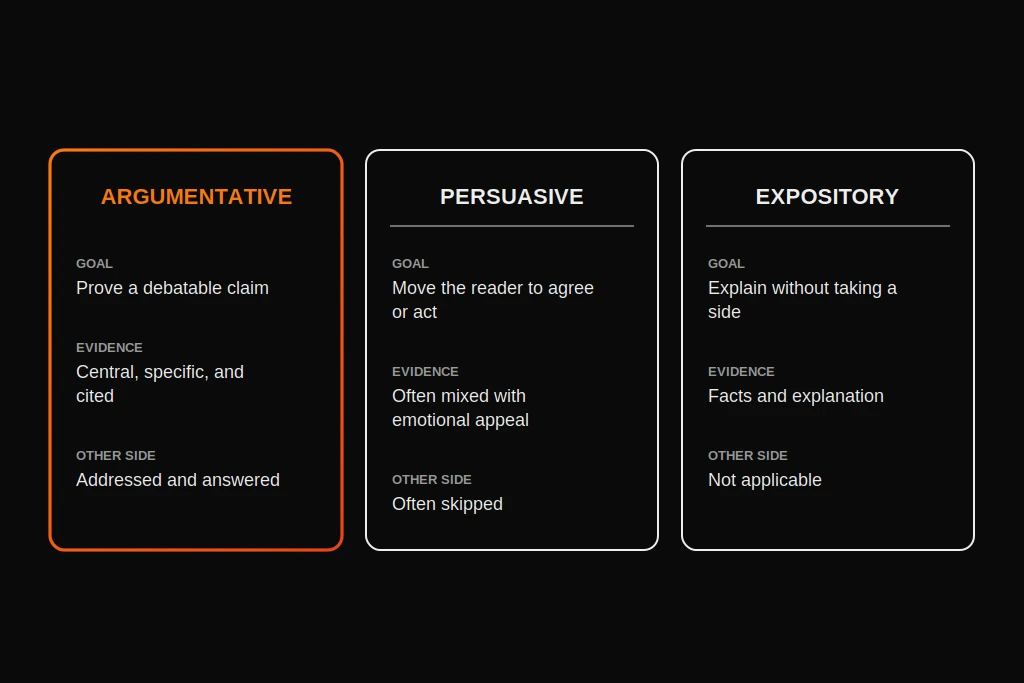
Two features set this kind of essay apart from most school writing. The claim has to be debatable, which means a thoughtful person could take the other side. And the essay has to deal with that other side honestly instead of pretending it does not exist. If your topic has no real opposing view, it is a fact, and a fact can be explained but not argued.
People often mix up argumentative, persuasive, and expository essays, so here is a quick comparison.
| Argumentative | Persuasive | Expository | |
| Main goal | Prove a debatable claim with evidence | Move the reader to agree or act | Explain a topic without taking a side |
| Evidence | Central, specific, and cited | Often mixed with emotional appeal | Facts and explanation |
| Opposing view | Addressed and answered | Often skipped | Not applicable |
| Tone | Reasoned and fair | Can be more emotional | Neutral |
These labels overlap in practice, and some instructors use “persuasive” and “argumentative” to mean the same thing. When in doubt, read your assignment sheet for words like “evidence,” “sources,” and “opposing view,” because those point toward a true argumentative essay.
Before You Start: Read the Assignment and Choose a Topic
Most wasted effort on this assignment happens before the first sentence is written. Read the assignment sheet twice and write down four things:
- The required length and the due date.
- The number and type of sources allowed, such as peer-reviewed articles or websites.
- The citation style, such as APA or MLA.
- Whether the question is assigned or you choose the topic yourself.
If you choose your own topic, use two tests before you commit. First, reasonable people must disagree about it. Second, credible research must exist on both sides. A topic that fails either test will stall halfway through the draft. Our list of argumentative essay topics for college students includes a one-line note on why each topic is arguable, which makes the first test quick to check.
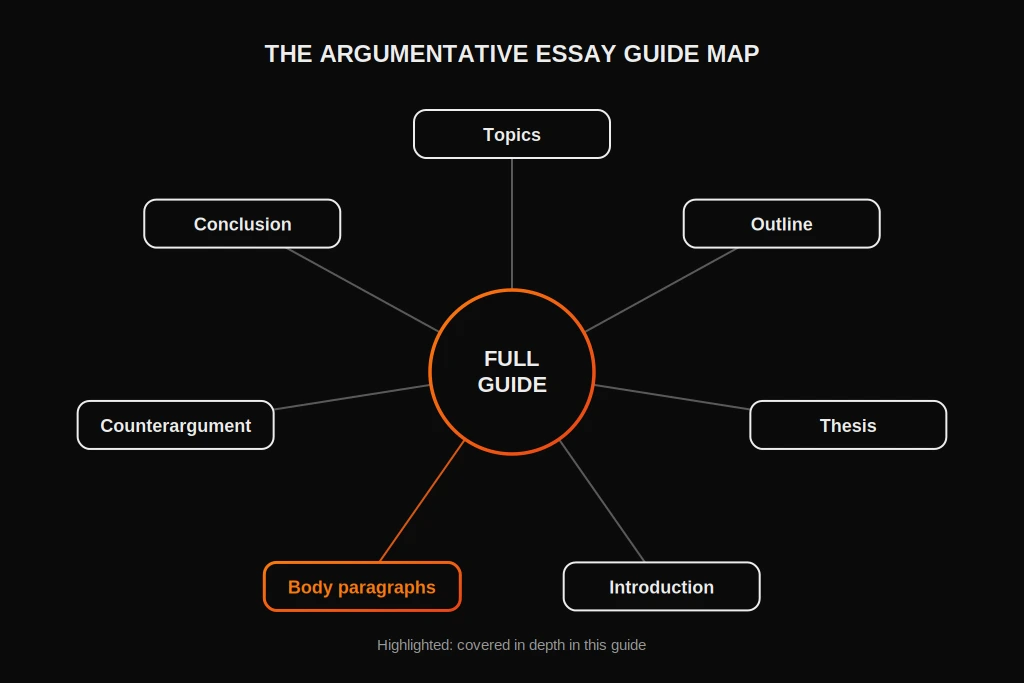
Some instructors give a prompt instead of a topic. A prompt is a question or claim you respond to, so your first job is deciding which side you can defend best, which is not always the side you personally prefer. We cover argumentative essay prompts in a separate guide. Either way, narrow a broad subject before you research it. “Social media” is a subject. “Whether schools should limit phone use during class” is something you can argue in five pages.
Step 1: Take a Position and Research Both Sides
Start with a working position written as a full sentence, such as “Schools should require a financial literacy course.” Treat it as a draft. Good research often changes the position, and that is a sign the process is working. Once you are confident in the position, turning it into one precise sentence is a skill of its own, which we cover in our guide to the thesis statement in argumentative essay writing.
Next, research both sides, and spend real time on the side you disagree with. You cannot answer an objection you have not read. A simple method is to keep two columns of notes, one for support and one for objections, and record the source and one line of what it says each time.
Not every source deserves a place in your essay. The CRAAP test, designed by librarian Sarah Blakeslee at California State University, Chico, gives you five quick questions to ask about any source. Is it current enough (currency)? Does it fit your question (relevance)? Who wrote it and what are their credentials (authority)? Is it backed by evidence (accuracy)? Why does it exist (purpose)? A short walkthrough is in this library guide to the CRAAP test.
Look for specific evidence: statistics, studies, expert testimony, real examples, and historical cases. A phrase like “studies show” is not evidence until you can name the study. If every source you find agrees with you, treat that as a warning sign and search for the opposite view directly, for example by adding “criticism” or “evidence against” to your search terms.
Step 2: Plan Your Structure
A plan takes about a tenth of your total time and saves much more than that. Before drafting, write down your main claim, the two to four reasons that support it, the evidence for each reason, the strongest objection you expect, and the point you want the reader to leave with.
Order matters. Readers tend to remember the first and last things they read, so put a strong point first and your strongest point last, and avoid burying your best reasoning in the middle. If you want a fill-in template and a worked example, our argumentative essay outline guide also explains the classical, Toulmin, and Rogerian structures, three argument patterns that show up often in college writing courses.
Organize by reason, not by source. A common mistake is to write one paragraph about each source you found, which turns the essay into a book report. Each paragraph should prove one reason, and sources should serve the reason.
Step 3: Set Up Your Argument
The opening paragraph has three jobs: get the reader’s attention, give just enough background to make your claim make sense, and state your main claim as the last sentence. Keep it short. Three to five sentences is plenty for a standard essay, and everything in it should lead to that final sentence.
Many writers find this paragraph easier to write after the body exists, because only then do they know exactly what they are arguing. Draft a rough version now so you have something to aim at, then rewrite it at the end. Our argumentative essay introduction guide covers six ways to open, the funnel and direct structures, and four full examples.
One rule of thumb: your first sentence should say something the reader could not have guessed. Openers like “Since the beginning of time” or a dictionary definition tell the reader nothing and are among the most overused in student writing.
Step 4: Build Your Case With Strong Body Paragraphs
This is where an argument is won or lost, and it is the stage students ask about most. Body paragraphs are where evidence meets reasoning. Each one should prove a single reason that supports your main claim.
The Four-Part Body Paragraph Formula
A handout from the APSU Writing Center calls this the MEAL method: Main idea, Evidence, Analysis, and Link. The four moves are the same under any name. Here they are as claim, evidence, analysis, and link.
- Claim: one sentence that makes one specific, arguable point. This is your topic sentence.
- Evidence: the fact, statistic, study, example, or quotation that supports the claim. Introduce it so the reader knows where it comes from.
- Analysis: your explanation of how the evidence proves the claim. This is the part students skip, and it is where most of the credit is.
- Link: a closing sentence that ties the paragraph back to your main claim and, when needed, leads into the next paragraph.
Here is a short example. The evidence sentence is general on purpose. In a real essay it would name a source.
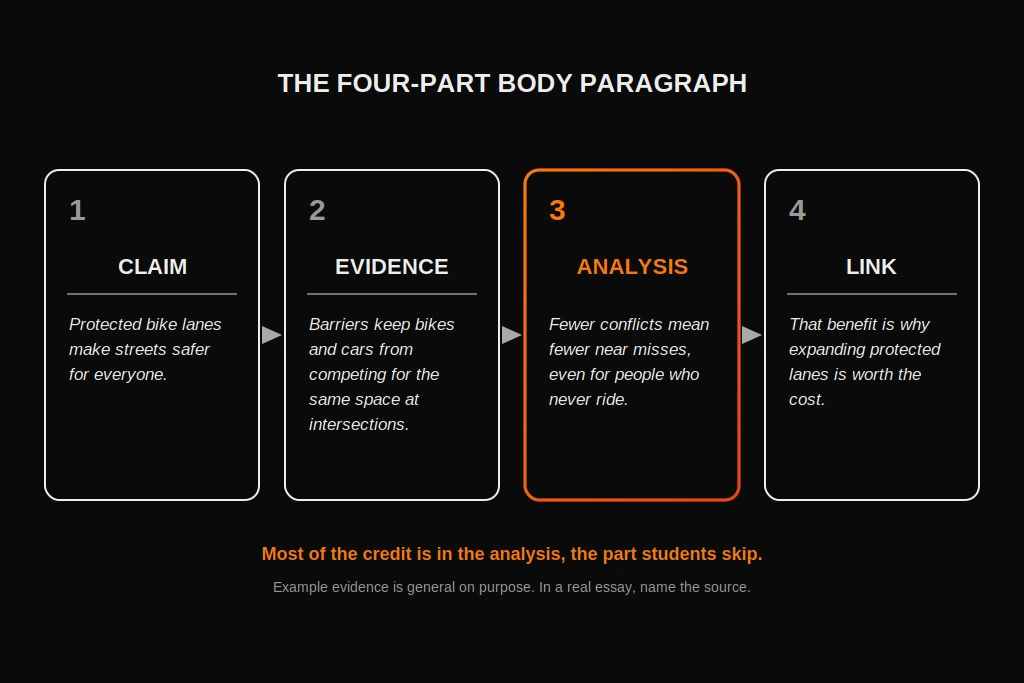
Protected bike lanes make streets safer for everyone, not just cyclists. When a city separates bikes from traffic with a physical barrier, drivers and cyclists stop competing for the same narrow space at intersections. Fewer points of conflict mean fewer near misses, which is why safety gains show up even for people who never ride a bike. That wider benefit is a central reason the cost of expanding protected lanes is worth paying.
The first sentence is the claim, the second is the evidence, the third is the analysis, and the last is the link back to the larger argument that cities should expand protected bike lanes.
Paragraph Claims and Your Main Claim
Students often confuse the two. Your main claim is the single position the whole essay defends. A paragraph claim is a smaller reason that makes the main claim more believable. A useful test is to ask whether proving this paragraph’s claim makes your main claim easier to accept. If not, the paragraph is off topic. A second test is to ask whether someone could reasonably disagree with the paragraph claim. If not, it is a fact, and it needs to be turned into a reason.
For example, with a main claim that schools should require a financial literacy course, “Many students graduate with loans” is a fact. “Learning how interest works before borrowing prevents costly mistakes” is a claim you can prove.
Topic Sentences and Transitions
A good topic sentence tells the reader the point of the paragraph, not just the subject. “This paragraph is about school costs” names a subject. “Free tuition would open college to students who now rule it out on price alone” makes a claim. Start each paragraph with the claim version.
Transitions show how paragraphs connect, and short phrases do the job when they match the relationship between ideas. “A second reason is…” adds a point. “Even so…” introduces a limit. “This is why…” shows a result. “Beyond cost…” shifts to a new angle. Use them to guide the reader through your reasoning, not to fill space.
How Much Evidence Is Enough
One or two strong pieces of evidence with real analysis beat four pieces with none. A reliable rule is to write at least one sentence of analysis for every piece of evidence. Paraphrase more than you quote, and when you do quote, keep only the words you need. Most body paragraphs in a standard essay run roughly five to eight sentences, though your assignment and your instructor’s preferences come first.
A Weak Paragraph and Its Rewrite
Seeing a weak paragraph fixed is often clearer than any rule. Here is a typical first draft for an essay arguing that schools should limit homework.
Weak: Homework is a problem for many students. Some students have a lot of homework every night. Teachers give assignments in every class. Students get tired and stressed. This is why homework should be limited.
Every sentence is vague, nothing is proven, and the last line just repeats the claim. Now the same paragraph with the four-part formula.
Stronger: Heavy homework loads cut into the sleep teenagers need. A student who finishes assignments near midnight and wakes before dawn for school loses hours of rest, and sleep is when the brain strengthens the memory and attention that learning depends on. That means extra problem sets late at night can leave a student learning less, not more. Limiting homework protects the sleep that makes studying worth doing.
The rewrite makes one specific claim, explains the mechanism behind it, and links back to the argument. In a real essay, the sleep sentence would cite a named study.
Step 5: Answer the Other Side
Every strong argument deals with its best objection. In this paragraph you state the strongest opposing view fairly, then explain why your position still holds. It usually comes after your supporting paragraphs and before the final paragraph, though some structures place it earlier. Our argumentative essay counterargument guide covers placement, how much to concede, and four worked examples.
The most common error is choosing a weak objection because it is easy to knock down. If you cannot picture a smart, informed person making the objection you wrote, you have picked a strawman. The second most common error is stating the objection and never answering it. Your answer needs its own reasoning or evidence, not just a louder version of your original claim.
Step 6: Close the Argument
The final paragraph restates your main claim in new words, pulls your reasons together, and tells the reader why the argument matters. It should add no new evidence, because new material at the end has no room to be proven. Write the restatement from memory instead of copying your first paragraph, which forces different wording. Our argumentative essay conclusion guide explains why endings carry extra weight and includes four examples.
Finally, give the essay a title that names your topic and your side, such as “Why Every High School Should Require a Financial Literacy Course.” Clear beats clever, and a plain title tells your reader what you will argue before the first line.
Step 7: Revise for Argument First, Grammar Second
Writing centers recommend revising in two passes. A handout from Smith College’s Jacobson Center sorts concerns into higher order (focus, audience, development, and organization) and lower order (editing and proofreading), and says to finish the higher order work first. The reason is simple. There is no point polishing a sentence you may end up deleting.
For the first pass, ask four questions. Is my main claim clear in one sentence? Does every paragraph prove a reason that supports it? Is each piece of evidence specific and explained? Did I answer the strongest objection? A quick way to check is to write one line summarizing each paragraph, then read only those lines in order. If they do not add up to an argument, the structure needs work, no matter how clean the sentences are.
For the second pass, fix sentence clarity, grammar, citations, and formatting. Reading the essay out loud catches awkward phrasing, and asking a classmate to say your main claim back to you after one read shows you quickly whether it came across. If you can, leave at least a few hours between drafting and revising. Fresh eyes find problems that tired ones skip.
What to Do When You Get Stuck
Almost everyone stalls somewhere in this process. These are the most common sticking points and a way through each.
- You do not know where to start. Write your main claim and three reasons on one sticky note, then draft the body paragraphs first. The opening paragraph is easier once the body exists.
- You run out of reasons at two. Check whether one of your reasons is really two, or whether the topic is too narrow. Two strong reasons can be enough for a short essay.
- Your evidence does not support your claim. Change the claim, not the evidence. A position that shifts after research is research doing its job.
- Your answer to the objection feels weak. The objection may be stronger than your claim as written. Narrow the claim to a version the objection cannot defeat, or concede part of the objection and explain why the rest still holds.
- You are over the length limit. Cut your weakest reason before you trim the analysis from every paragraph.
- You are under the length limit. Add analysis that explains your evidence, not filler or extra background.
How Long Does It Take to Write an Argumentative Essay?
It depends on the length and the amount of research, but most students underestimate two stages: research and revision. A short essay with a few sources commonly takes several sessions spread across days, not one long evening. The table below shows a suggested split of your total time. These numbers are a planning guide based on common teaching practice, not research findings, so adjust them to your assignment.
| Stage | Multi-day essay (share of total time) | 40-minute timed essay |
| Read the assignment and choose a position | 5% | 3 minutes |
| Research both sides | 25% | 0 minutes (use what you already know) |
| Plan structure and evidence | 10% | 6 minutes |
| Draft the full essay | 35% | 26 minutes |
| Revise for argument | 15% | 3 minutes |
| Proofread | 10% | 2 minutes |
If you are short on time, protect planning and revision first and shorten research last, since a plan prevents rewrites and revision is where most of the improvement happens. For a timed essay there is no research stage, so the plan has to do that work. List your claim, two or three reasons, and one specific example for each before you start writing.
How to Write an Argumentative Essay for AP Lang and AP Gov
What the Exam Asks
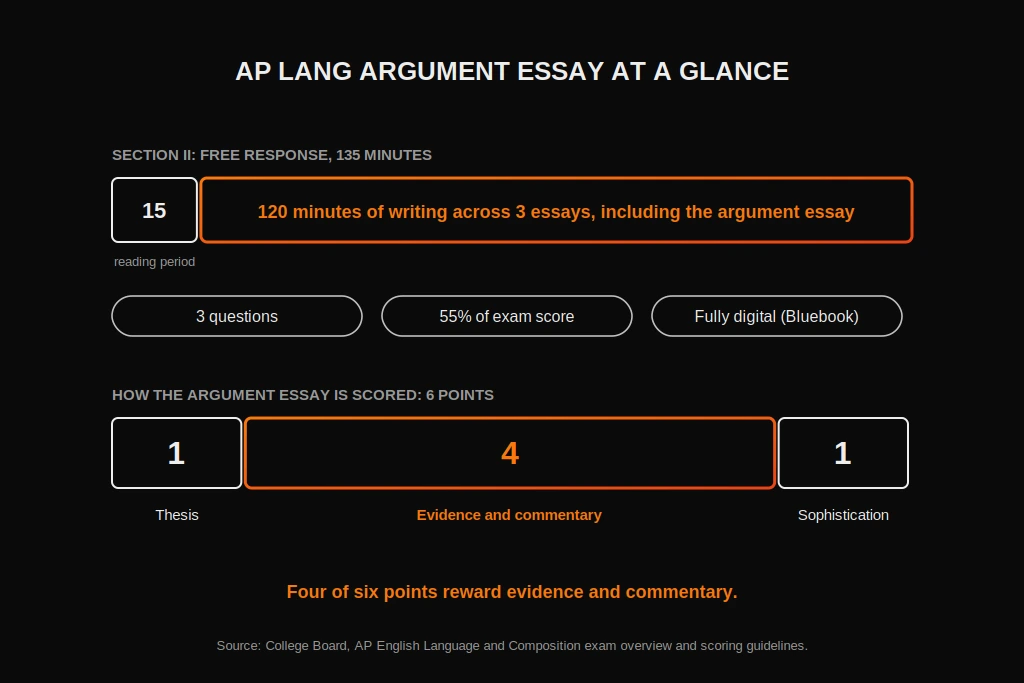
On AP English Language and Composition, the argument essay is one of three free-response questions. According to the College Board’s exam overview, Section II has three questions, lasts 2 hours and 15 minutes including a 15-minute reading period, and counts for 55 percent of the exam score. The argument question asks you to build an evidence-based argument in response to a given topic. The exam is fully digital and taken in the Bluebook app.
How the Essay Is Scored
The College Board’s scoring guidelines use a 6-point rubric with three rows: one point for the thesis, up to four points for evidence and commentary, and one point for sophistication. Four of the six points come from evidence and commentary, so time spent on specific examples and on explaining them pays off more than polishing your opening line. Sophistication usually means showing nuance, such as acknowledging a complication or a limit to your claim.
A Timed Workflow
The exam does not require a fixed split, but a common planning guideline is about 40 minutes per essay. Here is the timed column from the table above in order:
- 3 minutes: read the prompt and choose the side where you have the strongest examples. It is not always the side you believe.
- 6 minutes: plan a claim that responds to the prompt, two or three reasons, and one specific example per reason.
- 26 minutes: write in order, with analysis after every example.
- 5 minutes: reread for argument problems first, then fix errors.
A few habits separate strong timed essays. Use specific examples from history, current events, and your reading, with names and dates, because “many people” earns little. Write a claim that answers the prompt instead of restating it. Explain how each example proves your point. And leave enough time to finish your last paragraph, since an unfinished essay loses the ending readers remember. Our outline guide has an AP Lang section with a stripped-down timed plan if you want a ready template.
Common AP Argument Essay Errors
- Restating the prompt as a claim instead of taking a position.
- Listing examples with no commentary explaining why they prove the point.
- Arguing one side with no complication, which makes it hard to earn the sophistication point.
- Running out of time before the final paragraph.
A Note on AP Gov
AP U.S. Government and Politics has its own argument essay question with a different rubric, and it expects evidence drawn from required course content. Practice with released questions and check the current course and exam description for the exact format. The core skills in this guide carry over: a clear claim, specific evidence, reasoning, and a fair answer to the other side.
A Full Annotated Sample Essay
Seeing a finished essay is the fastest way to understand how the steps fit together. The sample below is short on purpose, and each paragraph is followed by an annotation naming its job. One honest note: the evidence here is illustrative and general. In your own essay, every piece of evidence should name a real, citable source.
Why Every High School Should Require a Financial Literacy Course
Most students will sign their first loan agreement, open their first credit card, or start their first job before anyone has taught them how interest works. Schools spend years preparing students for exams, yet leave them to learn money by trial and error, where mistakes cost real money. Every high school should require a one-semester financial literacy course, because early instruction prevents costly borrowing mistakes and gives every student, not just the well-advised ones, the same footing.
Annotation: Opening paragraph. A concrete hook, one sentence of context, and the main claim last. The claim takes a position (“should require”) and previews two reasons: prevention and fairness.
The first reason is that money mistakes made young are expensive and hard to undo. Interest on an unpaid credit card balance compounds, which means a small balance left alone grows faster each month. A student who learns this at sixteen can avoid it at nineteen, while a student who learns it from a collections notice cannot. Teaching interest, budgeting, and credit scores before students borrow turns a painful lesson into a preventable one, and that prevention is the most direct way a school can protect its graduates after they leave.
Annotation: Body paragraph 1 follows the four-part formula. The claim opens the paragraph, the evidence is how compounding works, the analysis contrasts learning early with learning late, and the last sentence links back to the main claim. In a real essay, the evidence sentence would cite a source.
The second reason is fairness. Right now, financial skills are mostly taught at home, which means students with financially knowledgeable parents reach adulthood with an advantage that has nothing to do with their own effort. Offering personal finance only as an elective does not fix this, because electives tend to attract students who already have support and interest, leaving out the students who would benefit most. A required course is the only version that reaches everyone, which makes this an issue of equal opportunity as much as education.
Annotation: Body paragraph 2 makes a second, separate claim. The evidence is an observation about how electives work, and a finished essay would back it with enrollment data from a real district or state. The final sentence links the point back to the main claim.
Critics argue that school days are already full, and a new required course means something else gets cut. This is a fair concern, because every addition has a cost. But the answer is not to leave the subject out. It is to build it into time that already exists. Many districts can fold the material into an existing math or economics course for a semester, which adds no new class period. A crowded schedule is a reason to plan carefully, not a reason to skip a subject that affects every graduate’s life.
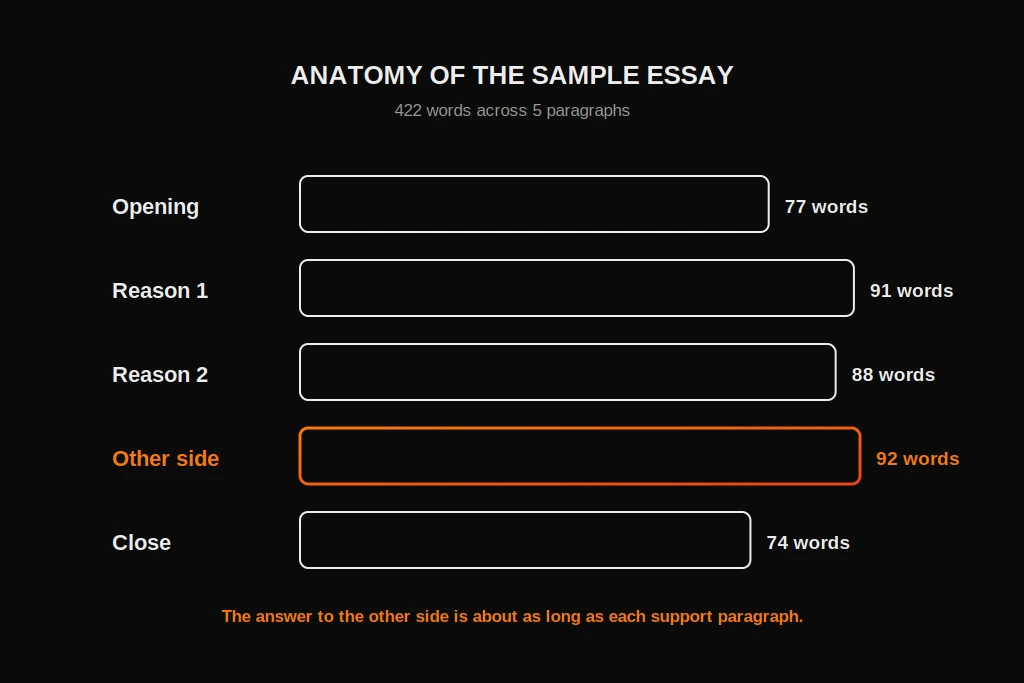
Annotation: Answering the other side. It states the strongest practical objection fairly, concedes part of it (“a fair concern”), and answers with a specific alternative instead of repeating the claim. The paragraph is about as long as the support paragraphs, so the objection does not overshadow the argument.
A financial literacy requirement will not make every graduate wealthy, but it can stop avoidable mistakes before they happen and give every student the same basic tools. The argument comes down to two simple points: prevention is cheaper than repair, and a skill every adult needs should not depend on the luck of one’s household. Schools already decide that reading and math are too important to leave optional. Managing money belongs on that list.
Annotation: Final paragraph. The main claim is restated in new words, the two reasons are pulled together, and the last lines widen to a larger point. No new evidence appears.
Notice what the sample leaves out. It does not dwell on background, it adds no new evidence in the final paragraph, and its objection paragraph is about as long as its support paragraphs.
Writing an Argumentative Research Essay
An argumentative research essay follows the same steps but leans harder on sources. Start with a research question, such as “Does remote work raise or lower productivity?”, then let the evidence shape your claim instead of choosing the claim first. Expect to spend a larger share of your time on research than the 25 percent in the table above, and keep notes that record each source, the page or section, and which of your reasons it supports.
Follow the citation style your assignment names, and cite as you draft, not at the end. Organize the essay around your reasons, with sources as support, rather than summarizing one source after another. And keep the objection paragraph honest. Use a real source for the opposing view where you can, since quoting a credible opponent is stronger than describing a vague one.
Tips for a Stronger Argumentative Essay
- Write your main claim before drafting the body, and revise it once the draft is finished.
- Prefer specific names, dates, and numbers to vague phrases like “studies show” or “many experts agree.”
- Make one point per paragraph. If a paragraph makes two, split it.
- State claims directly. Cut “I think” and “in my opinion.”
- Argue with reasons, not volume. Words like “obviously” and “everyone knows” signal a gap in the reasoning.
- Describe the other side the way its supporters would, even when you disagree.
- Read the essay out loud once before you submit it.
- Start earlier than feels necessary, because revision works best with a gap between drafts.
Common Mistakes When Writing an Argumentative Essay
Most marks lost on this assignment come from a short list of mistakes.
- Writing an opinion with no evidence behind it.
- Choosing a topic so broad or so settled that there is nothing to argue.
- Stacking evidence without analysis, so the reader has to guess why it matters.
- Picking a weak objection or ignoring the other side entirely.
- Putting two or more points in one paragraph.
- Adding new evidence in the final paragraph.
- Proofreading sentences before the structure works.
- Leaving too little time for revision.
How EssaysHelper Can Help You
If you know the steps but get stuck on one of them, such as a claim that will not come out right or body paragraphs that read like lists, you do not have to work it out alone. EssaysHelper connects students with tutors who can look at a single stage with you, from planning to revision, and show what to fix. If you would rather hand off the whole assignment, our argumentative essay writing service can take you from topic to final draft.
Frequently Asked Questions
What are the steps to write an argumentative essay?
Choose a debatable topic, research both sides, plan your structure, set up your claim, build body paragraphs with evidence and analysis, answer the strongest opposing view, close the argument, and revise. Take them in that order so each stage has something solid to build on.
How long does it take to write an argumentative essay?
A short essay with a few sources usually takes several sessions spread over a few days. Most students underestimate research and revision, so plan roughly a quarter of your time for research and an equal share for revising and proofreading together.
How do you write a body paragraph for an argumentative essay?
Start with a one-sentence claim, add specific evidence, explain how the evidence proves the claim, and end by linking back to your main argument. Aim for one point per paragraph and at least one sentence of analysis for every piece of evidence.
How do you write a good claim for an argumentative essay?
A good claim makes one specific point that a reasonable person could dispute, and it gives a reason the main argument is true. If the sentence is simply a fact everyone accepts, turn it into a reason you can prove.
How do you write an argumentative essay for AP Lang?
Plan quickly, choose the side where you have the strongest examples, and write a claim that answers the prompt. Spend most of your time on specific examples with commentary, since four of the six rubric points reward evidence and commentary.
How long should an argumentative essay be?
It depends on the assignment, so follow your instructor’s page or word count first. Class essays range from a few paragraphs to several pages, and the right length is whatever lets you prove each reason with evidence and analysis.
What is the difference between an argumentative essay and a persuasive essay?
An argumentative essay proves a debatable claim with evidence and answers the opposing view. A persuasive essay leans more on emotional appeal and often skips the other side, though some instructors use the two terms interchangeably.
How many body paragraphs should an argumentative essay have?
Most standard essays have two to four body paragraphs, one for each distinct reason, plus a paragraph that answers the other side. Add a paragraph only when you have a new reason to prove, not to reach a length.
How do you write an argumentative research essay?
Start with a research question, let the evidence shape your claim, and organize the essay around your reasons rather than your sources. Cite as you draft and give research a larger share of your time than you would for an essay without sources.
Can I use “I” in an argumentative essay?
Check with your instructor, since rules vary by course. Even where it is allowed, avoid hedges like “I think” or “in my opinion” and state your claims directly, because your evidence should carry the argument.
Final Thoughts
An argumentative essay is a series of small, checkable decisions: a debatable claim, honest research, a plan, body paragraphs that explain their evidence, a fair answer to the other side, and a revision that fixes the argument before the grammar. Take them in order, and the assignment becomes much less intimidating.
The stage guides linked above go deeper on each part, and a separate guide on argumentative essay prompts will help if you are still deciding what to write about. Come back to the sample essay whenever you want to see how the pieces fit together.