
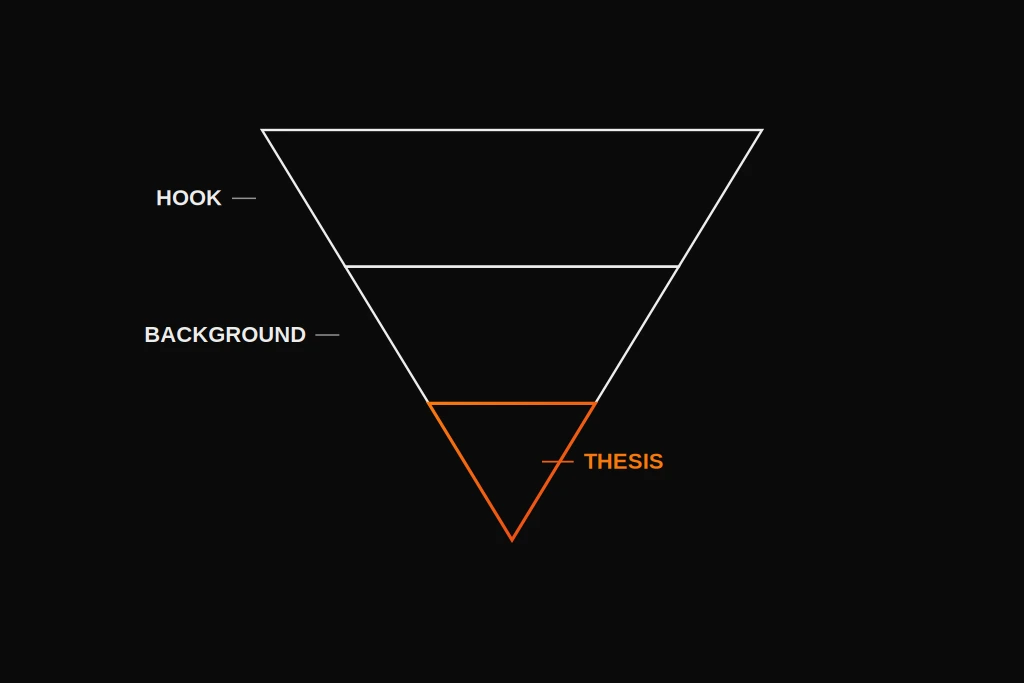
An argumentative essay introduction needs three things: a hook that grabs the reader’s attention, a bit of background that explains why the topic matters, and a thesis statement that tells the reader exactly what you’re going to argue. It usually runs three to five sentences and sits in a single opening paragraph. The hook comes first, the background comes next and connects the hook to your topic, and the thesis comes last, right before your first body paragraph starts. Get those three pieces in the right order, each one doing its own job, and you have a working introduction, even before you polish the wording.
What Is an Argumentative Essay Introduction?
Every academic essay needs an introduction, but an argumentative one has a specific extra job compared to, say, a narrative or descriptive essay: it has to signal from the very first paragraph that a real argument is coming, not just a description or a story. A reader should be able to tell within the first few sentences that you’re about to take a side on something, even before they reach your exact thesis.
An introduction is the first paragraph of your essay, and its job is simple even though writing it rarely feels simple: make the reader want to keep reading, and tell them what you’re about to argue. Nothing else. It doesn’t need to summarize your evidence, it doesn’t need to cover every point you’ll make, and it definitely doesn’t need to be long. Its only job is to set up the rest of the essay.
A lot of students overload their introduction because it feels like the place to prove they did the research. Resist that. Save your evidence for the body paragraphs, where it actually has room to breathe. The introduction’s job is orientation, not proof.
There’s also a reason introductions feel disproportionately hard to write compared to how short they are. You’re trying to do three different jobs, attention, context, and claim, in the space of a few sentences, while also setting the tone for everything that follows. That difficulty is normal, not a sign you’re doing something wrong. Most experienced writers draft their introduction last or come back to rewrite it once the rest of the essay actually exists, which is a strategy worth trying if you’re stuck.
Two Common Introduction Structures: Funnel and Direct
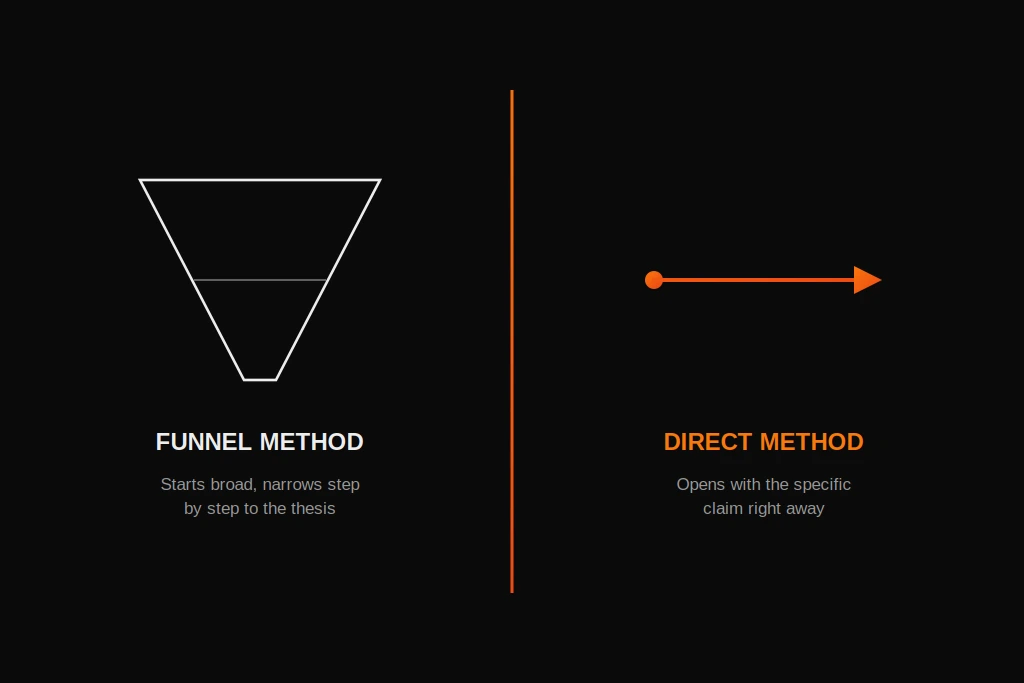
Most argumentative introductions follow one of two shapes, and knowing which one you’re using helps you catch structural problems faster.
| Structure | How It Works | Best For |
| Funnel Method | Starts broad, then narrows step by step down to the specific thesis | Topics where the reader needs some general context before the specific issue makes sense |
| Direct Method | Opens immediately with the specific issue or claim, no broad windup | Topics the reader is likely already somewhat familiar with, or timed essays where speed matters |
The funnel method is what most students learn first, and it works well, as long as the broad opening stays genuinely relevant rather than turning into a generic statement about “society” or “history.” The direct method is faster to write and often stronger for timed essays like AP Lang’s argument prompt, since there’s no broad opening to accidentally let sprawl out of control.
Neither is more correct than the other, pick whichever fits your topic and your time constraints.
The Three Parts of a Strong Introduction
According to a writing center handout from The Catholic University of America, most introductions break into three sections: a hook, an explanation of why the topic matters, and the thesis statement. This structure works for almost any argumentative essay, no matter the subject.
- Hook: one or two sentences that catch the reader’s attention right at the start.
- Background: a few sentences of context that connect the hook to your specific topic and explain why it’s worth arguing about.
- Thesis: your specific, debatable claim, placed at the very end of the paragraph. If you haven’t nailed this part down yet, our guide on writing a thesis statement in argumentative essay covers exactly what makes one strong.
Each part sets up the next one. The hook earns attention, the background turns that attention into understanding, and the thesis turns understanding into a clear expectation for what’s coming.
What Must an Argumentative Essay Introduction Include? A Quick Checklist
If you want a fast way to check whether your draft introduction actually works, run it against this list before moving on to your body paragraphs.
- It opens with something specific, not a broad, generic statement about life or history in general.
- It includes enough background that a reader unfamiliar with the topic can follow your thesis.
- It ends with a clear, arguable thesis statement, not a vague statement of topic.
- Every sentence connects to the next one, the hook leads into the background, the background leads into the thesis.
- It’s a single paragraph, not spread across two or three.
If your draft is missing more than one of these, it’s worth rebuilding rather than patching. A quick rebuild using the structure above usually takes less time than trying to fix a paragraph that’s missing a piece.
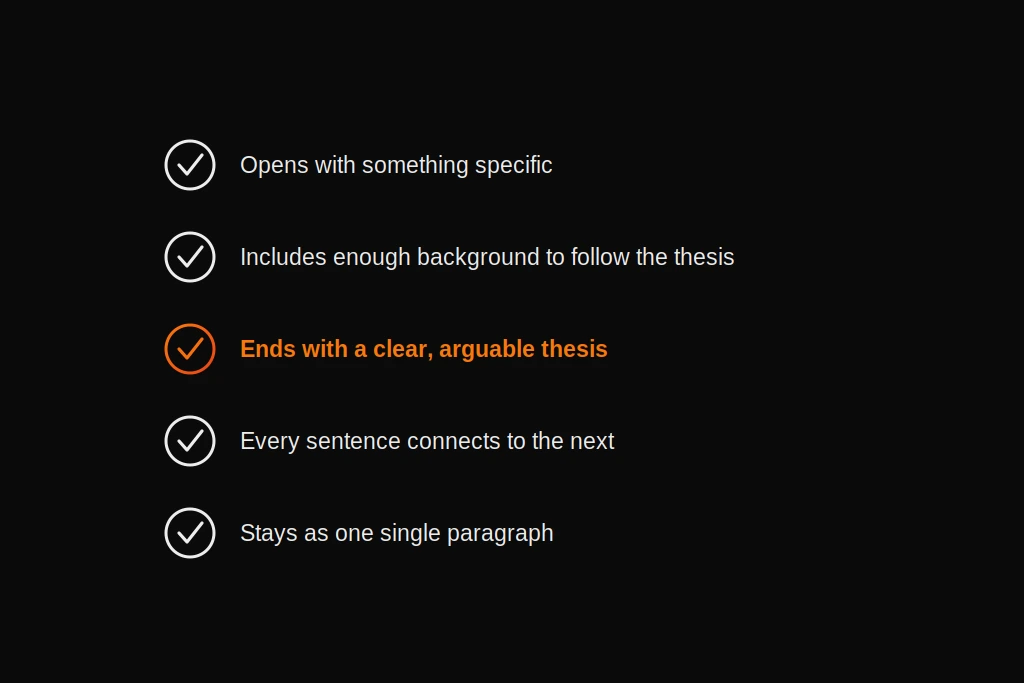
This checklist also doubles as a quick way to evaluate someone else’s introduction, useful if you’re reviewing a classmate’s draft or checking a sample against your own assignment’s requirements. Run any introduction, yours or someone else’s, through these five points and you’ll usually spot the weak link within a minute.
Hook Strategies That Actually Work
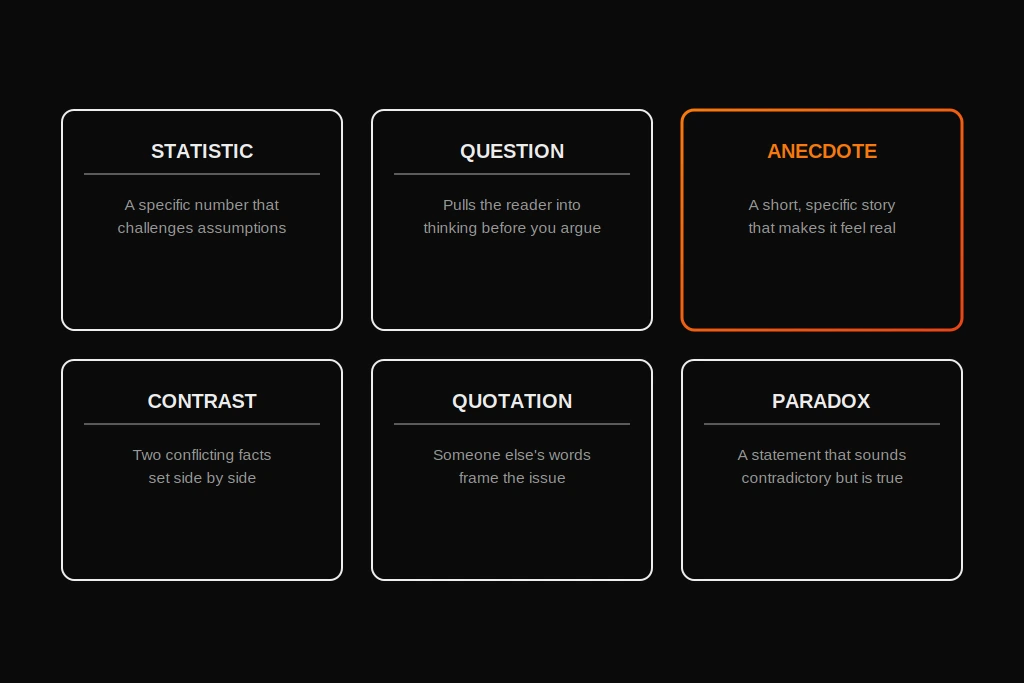
The hook is the part students get stuck on most, mainly because “grab the reader’s attention” is vague advice on its own. Here are specific techniques that actually do it, based on common approaches taught across university writing centers.
| Hook Type | What It Does | Example Opening |
| Surprising statistic | Uses a specific number that challenges what most readers assume | Nearly a third of teenagers report checking their phone within five minutes of waking up. |
| Short question | Pulls the reader into thinking about the issue before you state your view | What happens to a classroom when every student is silently scrolling instead of listening? |
| Brief anecdote | Uses a short, specific story to make an abstract issue feel real | When Maria’s school banned phones for a single semester, her grades improved for the first time in three years. |
| Vivid contrast | Sets up two conflicting ideas or facts to create tension | Parents buy smartphones to keep their kids safe, yet the devices are linked to rising rates of teen anxiety. |
| Relevant quotation | Uses someone else’s words to frame the issue, works well when discussing a specific text or public figure | A former surgeon general once called social media use among teens “a public health crisis we can no longer ignore.” |
| Paradoxical statement | States something that sounds contradictory but is actually true, creating curiosity | The safest cities in the country often have the strictest gun laws, yet remain some of the most heavily armed. |
A Washington State University Writing Center handout recommends the personal anecdote specifically because it makes readers care about a topic before you’ve made a single argument, since a short story about a real person is easier to connect with than a statistic alone. Whichever hook you pick, keep it to one or two sentences. A hook that runs a full paragraph on its own stops being a hook and starts eating into space your background and thesis actually need.
One hook to avoid almost entirely: the dictionary definition opener (“Webster’s dictionary defines honesty as…”). It’s one of the most overused openings in student writing, and most instructors notice it immediately.
If you’re genuinely stuck picking a hook, try this shortcut: write your thesis first, then ask what fact or moment would make a stranger care about that specific claim. Working backward from the thesis toward the hook, rather than forward from a blank page, usually produces something far more specific than staring at an empty first line and hoping for inspiration.
Writing Background Information Without Padding
Background is where introductions most often go wrong, not because students skip it, but because they write too much of it. The background’s only job is to connect your hook to your thesis, giving the reader just enough context to understand why your claim matters. It is not a mini history lesson and it is not a preview of your evidence.
A useful test: read your background sentences and ask whether each one is setting up your thesis or just filling space. If you could delete a sentence and your thesis would still make complete sense to a new reader, that sentence probably belongs in a body paragraph instead, or not in the essay at all.
Background also isn’t the place to preview your counterargument. Some students try to acknowledge the opposing side right in the introduction, but that job usually belongs to its own body paragraph later in the essay, where there’s actually room to respond to it properly rather than mentioning it in passing.
A common trap in this section is what’s sometimes called throat-clearing, sentences that technically relate to the topic but don’t actually move the reader anywhere. “This is a topic that many people have different opinions about” is a classic example, it’s true of almost any argumentative topic, so it tells the reader nothing they didn’t already assume. Replace throat-clearing sentences with a specific fact, a brief piece of context, or a direct statement of why the issue matters right now.
Where the Thesis Fits
Your thesis statement is the last sentence of your introduction, after the hook and background have done their work. This placement isn’t just convention, it’s practical: by the time a reader reaches your thesis, they already understand the topic well enough to immediately grasp what you’re claiming and why it’s worth arguing.
Don’t let your thesis surprise the reader. If your hook is about phone use in classrooms and your background discusses attention spans, your thesis needs to land on a claim about phones and attention, not suddenly pivot to an unrelated angle on the same general topic. A mismatch between what the hook promises and what the thesis actually argues is one of the fastest ways to lose a reader’s trust in the first paragraph.
Some instructors allow a thesis to run two sentences instead of one, especially when the claim needs a short reasons clause attached. If your program allows this, keep both sentences at the very end of the paragraph, back to back, rather than splitting them apart with more background in between. The reader should be able to read your claim and its main reasoning as one continuous thought.
How Long Should an Argumentative Essay Introduction Be?
For a standard student essay, three to five sentences is the right range, roughly 75 to 150 words, forming one paragraph. For longer research-based papers, an introduction might run a bit longer, but it should still stay proportional, usually somewhere around 8 to 10 percent of your total essay length, not more.
If your introduction is creeping past half a page for a standard five-paragraph essay, you’re likely including detail that belongs in a body paragraph. The fix is almost always cutting content, not writing more carefully. Trim background sentences that aren’t directly setting up your thesis, and move anything that resembles actual evidence into the body of the essay, where it belongs. Your introduction sets the stage, it doesn’t perform the whole show, and that job continues right through to your argumentative essay conclusion, which will circle back to the promise this opening paragraph makes.
How to Write an Argumentative Essay Introduction, Step by Step
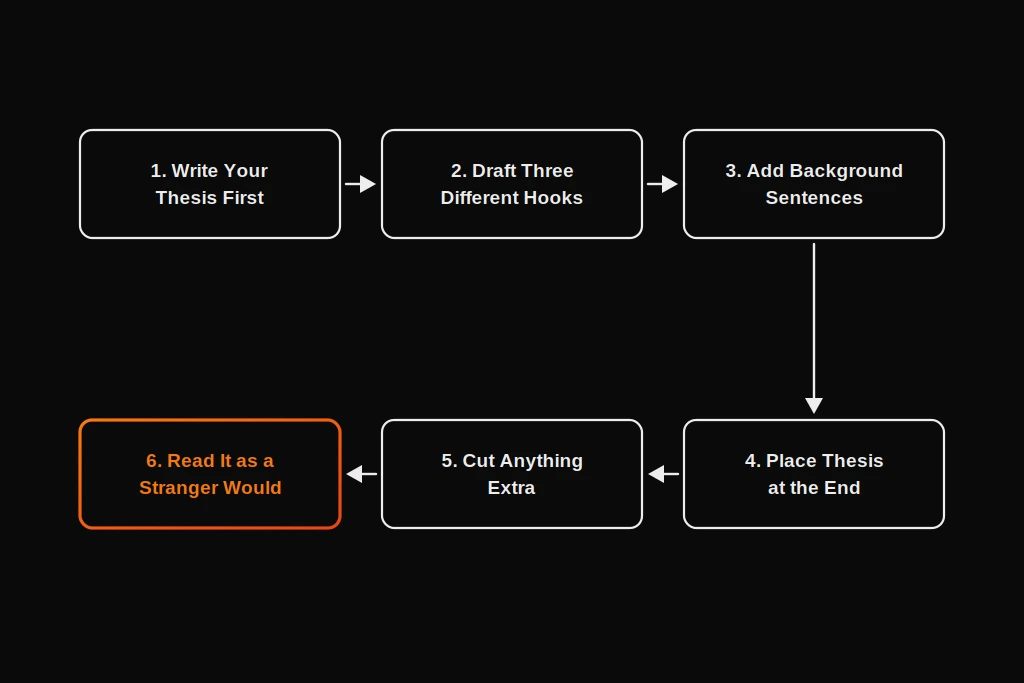
Step 1: Write Your Thesis First
This might sound backward, but knowing your exact claim before you write the hook makes everything else easier. Draft your thesis, then build backward from there toward a hook and background that actually lead into it.
Writing the thesis first also protects you from a common trap: building a great hook, then forcing a thesis to match it later, even if that thesis isn’t actually your strongest possible claim. Decide the argument first, decide how to introduce it second.
Step 2: Draft Three Different Hooks
Try a question, a statistic, and a short anecdote for the same topic, then pick whichever one feels most specific and least generic. Having options makes it much easier to spot which one is actually strong rather than just settling for your first attempt.
Don’t judge each hook the moment you write it. Draft all three quickly, then step back and compare them side by side. The hook that feels strongest in isolation isn’t always the one that connects best to your specific background and thesis.
Step 3: Write One or Two Background Sentences
Add just enough context to connect your hook to your thesis. If you’re not sure whether you’ve added enough, read the paragraph out loud, if the jump from hook to thesis feels abrupt, add one more connecting sentence, not three.
Step 4: Place Your Thesis at the End
Drop your already-drafted thesis in as the final sentence of the paragraph. Read the whole paragraph straight through and check that it flows as one connected idea, not three separate pieces stapled together.
Step 5: Cut Anything That Isn’t Doing a Job
Go back through and remove any sentence that doesn’t clearly serve the hook, the background, or the thesis. If you’re building a full argumentative essay outline for the rest of your essay, this is also a good moment to check that your introduction’s promises actually match what your outlined body paragraphs plan to argue.
Step 6: Read It as a Stranger Would
Read your introduction as though you know nothing about the topic. If a stranger could tell you what the essay argues after one read, your introduction is doing its job.
If you have access to a classmate, tutor, or writing center, this step works even better out loud. Ask them to summarize your thesis back to you after one read, if they can’t, the introduction needs another pass before you move on.
Argumentative Essay Introduction Examples
Seeing a few full introductions across different topics makes the structure click faster than studying just one example closely.
Topic: School start times
Most teenagers are biologically wired to fall asleep later and wake up later than adults, yet high schools across the country still start classes before eight in the morning. This mismatch between school schedules and teenage sleep cycles isn’t just an inconvenience, it measurably affects grades, mood, and even car accident rates among student drivers. High schools should shift start times to no earlier than 8:30 a.m. to align with how teenage sleep actually works.
Topic: AI in the classroom
A teacher grading forty essays can now run each one through an AI detector in under a minute, a shift that would have sounded like science fiction five years ago. But as schools rush to police AI use, many have skipped a harder question: whether banning these tools outright actually teaches students anything about using them responsibly. Schools should teach structured AI literacy instead of imposing blanket bans, since students will use these tools throughout their careers whether their teachers prepare them for it or not.
Topic: Public transit funding
A single lane of highway can move about 2,000 cars an hour. A single subway line can move over 50,000 people in the same time. Despite this enormous difference in efficiency, most American cities still direct far more public funding toward highway expansion than public transit. Cities should redirect a significant share of highway expansion budgets toward public transit if they’re serious about reducing traffic congestion rather than just moving it around.
Topic: Four-day school week
When Jamie’s district switched to a four-day school week to save money, teachers expected chaos. Instead, attendance improved and teacher turnover dropped for the first time in years. Districts facing budget shortfalls should pilot four-day school weeks before cutting programs like art and music, since the schedule change alone has shown measurable benefits with none of the cultural cost of losing entire subjects.
Notice that each example follows the same shape: a specific, concrete hook, one or two sentences of background that narrow the focus, and a thesis that takes a clear position. None of them open with a broad statement about the dawn of time or a dictionary definition, and none of them run longer than four sentences.
Introduction Checklist Before You Submit
One more pass before you move on to your body paragraphs, this time checking tone and flow rather than just structure.
- The hook is specific, not a broad statement that could open almost any essay on any topic.
- Background sentences connect directly to the thesis, with no throat-clearing filler.
- The thesis is the very last sentence, and it matches what the hook and background actually promised.
- The whole paragraph is one connected idea, not three disconnected pieces.
- Reading it out loud, it sounds like something you’d say confidently, not something you’re still figuring out as you go.
Common Mistakes When Writing an Introduction
A handful of mistakes account for most of the introduction rewrites instructors ask for, and nearly all of them are easy to catch with one careful read-through before you submit.
- Opening with an overly broad statement (“Throughout history, people have argued about…”) instead of something specific.
- Using a dictionary or Webster’s definition as the hook, one of the most overused openings in student writing.
- Writing background that summarizes the whole essay instead of setting up the thesis alone.
- Ending on a thesis that doesn’t match what the hook and background actually promised.
- Making the introduction too long relative to the rest of the essay, often by including evidence that belongs in a body paragraph.
- Asking a question as the hook and then never actually answering it anywhere in the essay.
- Writing the introduction first and never revising it after the essay’s actual argument shifted slightly during drafting.
- Trying to squeeze in every angle of the topic instead of trusting the body paragraphs to cover the full argument.
- Using vague intensifiers like “very important” or “extremely controversial” instead of a specific fact that shows why the topic matters.
How EssaysHelper Can Help You
If you’ve got a topic and a rough thesis but every hook you try feels flat or generic, you don’t have to figure it out alone. EssaysHelper connects students with tutors who can work through several hook options with you and check that your introduction actually sets up the essay you’re planning to write. For students who want the whole essay handled from the first sentence to the last, our argumentative essay writing service can take you from a rough topic straight through to a polished final draft.
Frequently Asked Questions
What must an argumentative essay introduction include?
It needs a hook to grab attention, background information that connects the hook to your topic, and a thesis statement that states your specific claim. All three usually fit into one paragraph of three to five sentences.
How do you start an argumentative essay introduction?
Start with something specific, a surprising statistic, a short question, or a brief anecdote, rather than a broad statement about history or life in general. The goal is to earn attention in the first sentence, not ease into the topic slowly.
How long should an argumentative essay introduction be?
Most introductions run three to five sentences, or roughly 75 to 150 words, for a standard student essay. Longer research papers can run a bit more, but the introduction should stay proportional to the whole essay, not balloon on its own.
What are good hooks for an argumentative essay?
Strong hooks include a surprising statistic, a short question, a brief real or hypothetical anecdote, or a vivid contrast between two facts. Avoid dictionary definitions and broad statements that could open almost any essay on any topic.
Where does the thesis statement go in the introduction?
The thesis goes at the very end of the introduction paragraph, after the hook and background. This placement means the reader already has enough context to understand your claim by the time they reach it.
Can you start an argumentative essay with a question?
Yes, a short, specific question can work well as a hook. Just make sure the rest of your essay actually answers it, an unanswered rhetorical question left hanging can feel unresolved to careful readers.
Should the introduction mention the counterargument?
Usually not in detail. The introduction sets up your own claim, while addressing the opposing view is typically handled in its own body paragraph later in the essay, not packed into the opening paragraph.
What’s a good example of an argumentative essay introduction?
A strong example opens with a specific hook, like a statistic or short story, adds one or two sentences connecting that hook to the topic, and ends with a clear, arguable thesis. The whole thing usually reads as one smooth paragraph, not three disconnected ideas.
Why is my argumentative essay introduction too long?
Introductions usually run long when they include evidence or examples that belong in body paragraphs instead. Cut anything that isn’t directly serving the hook, background, or thesis, and move real evidence to where the essay actually argues its points.
Is a dictionary definition a good way to start an argumentative essay?
No, this is one of the most overused hooks in student writing and most instructors notice it right away. A specific statistic, question, or short story almost always works better at actually earning a reader’s attention.
Final Thoughts
A strong argumentative essay introduction isn’t about clever writing, it’s about doing three specific jobs in order: earn attention, give context, and state your claim. Draft your thesis first, test a few different hooks against it, and cut anything in your background that isn’t directly setting up that final sentence. Once your introduction is solid, the rest of the essay has a clear target to aim at, since every paragraph that follows is really just proving the promise your opening paragraph already made.
From here, the natural next step is turning that introduction into a complete essay. If you want the full process, from outlining through body paragraphs, counterargument, and conclusion, that’s covered in our complete guide on how to write an argumentative essay, along with separate guides on choosing strong argumentative essay topics for college students and a full list of argumentative essay prompts if you’re still deciding what to write about.
And if your first attempt still feels flat, that’s normal. Introductions are one of the few paragraphs in an essay that genuinely improve with a second look once you already know how the rest of your argument turned out. Write it, move on, and come back to it once your body paragraphs exist, you’ll usually find the fix is obvious the second time around.