
A counterargument in an argumentative essay is a paragraph where you state the strongest opposing view to your own thesis, then explain specifically why it doesn’t hold up. It usually appears after your main supporting paragraphs and before your conclusion, though some essay structures place it right after the introduction instead. A counterargument only works if you do both halves of the job, stating the opposing view fairly and then actually rebutting it. Stop after the first half, and you’ve just handed your reader a reason to doubt you with no response.
What Is a Counterargument in an Argumentative Essay?
A counterargument is a paragraph that pauses your own case to seriously consider a real objection to it, then explains why your thesis still holds up despite that objection. According to the Writing Center at UNC-Chapel Hill, anticipating and addressing counterarguments is one of the clearest ways to show you understand an issue deeply, since it demonstrates you’ve thought past your own side of the debate.
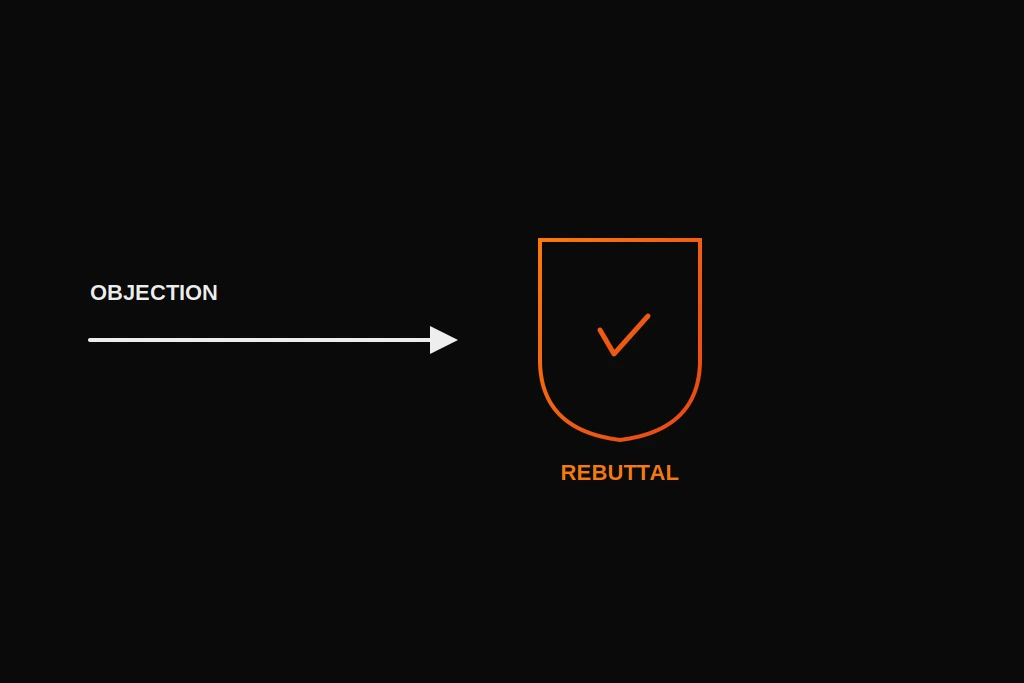
This is different from just mentioning that other opinions exist. A sentence like “some people disagree with this” isn’t a counterargument, it’s a throwaway line. A real counterargument paragraph names the specific objection, explains the reasoning behind it the way someone who actually holds that view would, and then responds to it directly.
It’s also worth being clear about what a counterargument is not. It isn’t a second thesis, it isn’t where you introduce new evidence for your own side, and it isn’t the place to restate what you already said in your argumentative essay introduction. It has one job: represent the opposition honestly, then show why your position survives it.
Terminology varies a bit by curriculum, which causes some genuine confusion. Some middle and high school writing programs call this a “turn-back paragraph” instead, since the paragraph turns the reader’s attention back to the writer’s own side after considering the opposition. The name changes, the job doesn’t: state the objection fairly, then turn back to your thesis with a real answer.
Does Every Argumentative Essay Need One?
In most cases, yes. If you’re writing a standard argumentative essay for a class, a counterargument paragraph is expected, and leaving one out is one of the more common reasons essays get marked down for incomplete argumentation. The exception is very short, timed writing, a tightly timed in-class response or a brief exam answer, where there may not be room for a full paragraph. Even then, a single sentence acknowledging the strongest objection is usually better than ignoring it completely.
Rubrics vary enough that it’s worth checking your specific assignment sheet rather than assuming. Some instructors list the counterargument as a required, separately graded component. Others fold it into a general “develops the argument” criterion without naming it directly. Either way, the safest default is to include one unless your instructions explicitly say not to, since a counterargument that wasn’t required costs you little, while a missing one that was expected can cost a meaningful chunk of your grade.
Why a Counterargument Makes Your Essay Stronger, Not Weaker
Students often worry that including a counterargument hands ammunition to the other side. The opposite is true. A reader who already knows the obvious objection to your thesis is going to think of it whether you mention it or not, the only choice you actually have is whether you address it or leave it hanging. An essay that never acknowledges an obvious objection reads as either unaware of it or afraid of it, neither of which builds confidence in your argument.
A well-handled counterargument does the opposite. It shows the reader you’ve tested your thesis against real resistance and it survived, which is a far more convincing demonstration than simply piling on more evidence for your own side.
There’s also a practical grading reality behind this. Instructors read dozens of essays on the same handful of topics every semester, and they already know the obvious objections to most common theses before they start reading. An essay that pretends those objections don’t exist doesn’t read as confident to someone who’s seen the same argument a dozen times already, it reads as incomplete. Addressing the objection directly is often the single clearest signal that separates a paper that’s merely competent from one that’s genuinely persuasive.
Where Does the Counterargument Go?
In most argumentative essays, the counterargument paragraph sits after your main supporting points and before your conclusion. By that point, your thesis is already well established, so raising an objection doesn’t read as uncertainty, it reads as a writer confident enough to address it head on.
There’s a real exception worth knowing about. If you built your argumentative essay outline around a Rogerian structure rather than the standard classical one, the counterargument actually opens the essay instead of appearing in the middle. That structure presents the opposing view first, in detail and fairly, before introducing your own position as a reasonable response to it, useful for genuinely divisive topics where leading with your own claim might lose a skeptical reader before you’ve made your case.
Outside of that specific structural choice, placing the counterargument too early, right after your introduction, is usually a mistake. It raises doubt before you’ve given the reader any reason to trust your thesis yet.
It’s worth thinking about placement in relation to your whole essay’s arc, not just this one paragraph in isolation. Your introduction opens the case, your body paragraphs build it, your counterargument pressure-tests it, and your argumentative essay conclusion closes it. Each section is doing a distinct job in that sequence, and a counterargument placed out of order disrupts the logic of the whole arc, not just its own paragraph.
Finding the Strongest Opposing View, Not a Strawman
This is where a lot of counterarguments quietly fail. It’s tempting to pick the weakest, easiest version of the opposing view, because it’s simple to knock down. A reader who actually knows the topic will notice immediately, and the whole paragraph ends up undermining your credibility instead of building it.
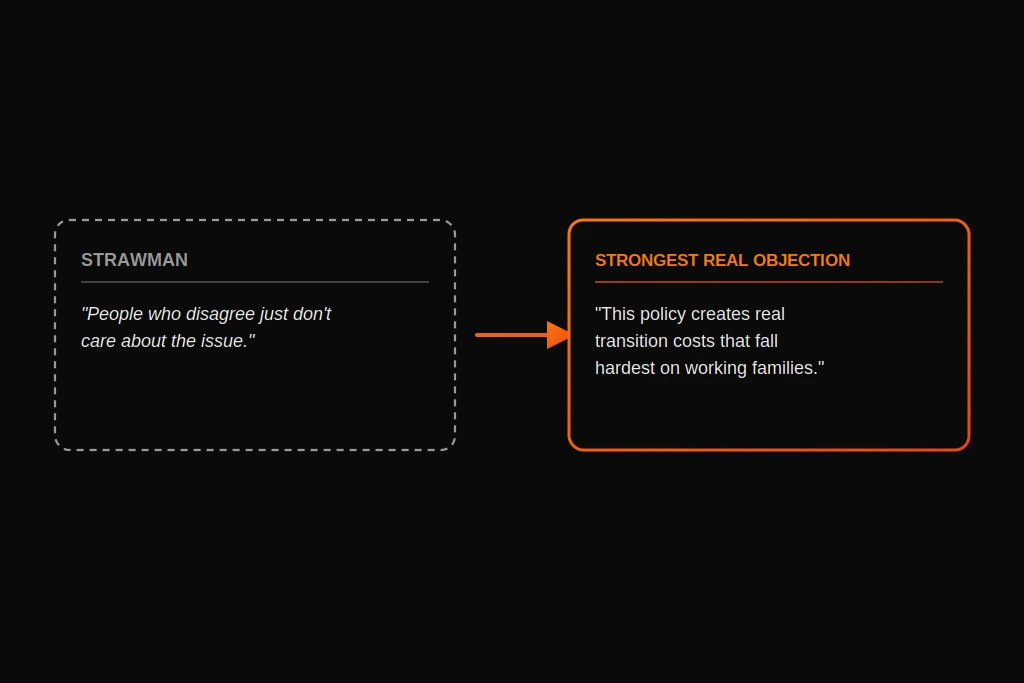
A useful test: if you can’t imagine a thoughtful, informed person actually holding the opposing view you’ve described, you’ve picked a strawman. Go find the version of the objection that a genuine expert or a smart classmate would raise, the one that would actually give you pause if you heard it cold. That’s the one worth rebutting. If your original thesis statement in argumentative essay was specific and genuinely arguable, the strongest opposing view is usually not hard to find, it’s simply the most reasonable version of “no.”
A practical way to find it: imagine your essay is being read by the single most informed skeptic on the topic, a teacher, a researcher, someone who has actually studied the issue rather than just reacted to it on social media. What would that specific person say? That mental exercise almost always surfaces a sharper, more serious objection than brainstorming generic disagreements on your own, because it forces you to argue from expertise rather than from the easiest counterpoint that comes to mind first.
Acknowledging vs. Rebutting: How Much Should You Concede?
Most advice on this topic stops at “acknowledge the other side,” which skips the actual hard part: deciding how much ground to give up without undercutting your own thesis. Concession isn’t all or nothing, it exists on a spectrum, and picking the wrong point on that spectrum is what makes a counterargument paragraph feel either dishonest or self-defeating.
| Concession Level | What It Sounds Like | When to Use It |
| No concession | “This objection is simply incorrect because…” | Rare, use only when the opposing view rests on a factual error you can directly disprove. |
| Partial concession | “This is true in some cases, but it doesn’t apply here because…” | Most common. Grants a real point while showing it doesn’t defeat your specific thesis. |
| Full concession with a pivot | “This is a fair point, and it shows the issue needs a different kind of solution than the one critics assume, which is actually what this essay is arguing for.” | Strong topics where the opposing view is partly right but your thesis reframes the real issue. |
According to the Harvard College Writing Center, a useful move is explaining that a counterargument gets something right, but then showing why it doesn’t actually undermine your overall argument. That’s the partial concession row above, and it’s the safest default for most student essays, since it reads as honest without giving away the case.
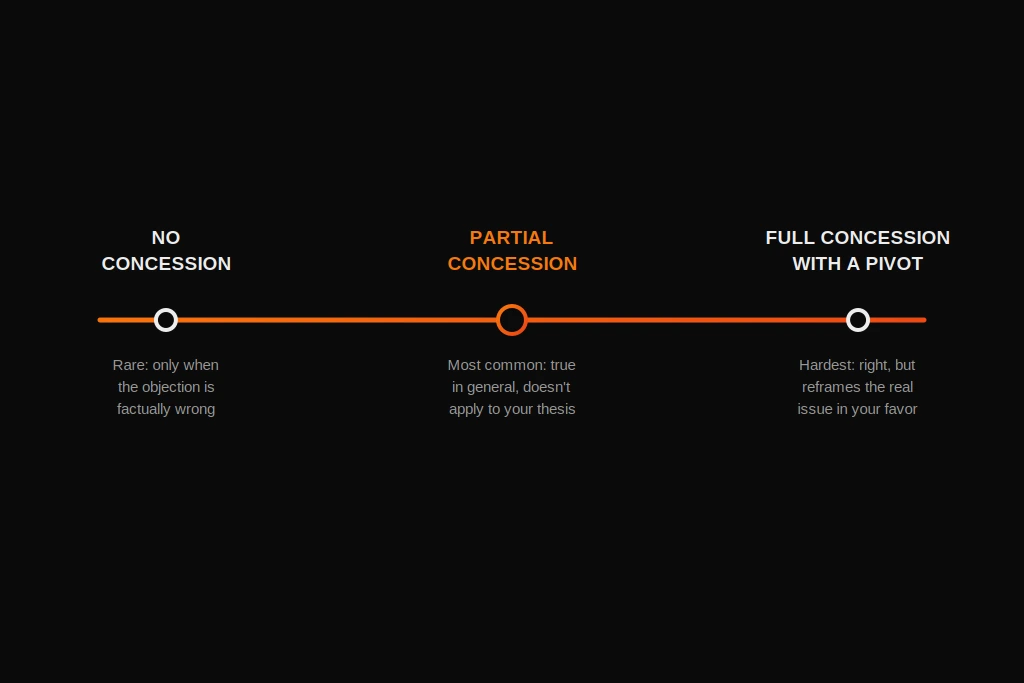
The mistake to avoid is conceding so much that a reader starts wondering why you bothered arguing your thesis at all. If your rebuttal amounts to “you’re right, but still,” with no real counter-reasoning attached, that’s not a partial concession, it’s a collapse.
A quick way to test which row fits your situation: if the objection is based on a factual error, you need no concession at all, correct the record and move on. If the objection is factually accurate but doesn’t apply to your specific thesis’s scope, that’s a partial concession, acknowledge the fact, then show why it doesn’t reach your actual claim. If the objection is both accurate and relevant, but still doesn’t defeat your thesis once reframed, that’s the full concession with a pivot, the hardest to write but often the most persuasive, since it shows you’ve absorbed the strongest version of the opposing case and still landed on your position.
Counterargument Checklist Before You Submit
One last pass before calling the essay finished.
- The objection stated is one a genuinely informed person would actually raise, not a strawman.
- The opposing view is described fairly, not sarcastically or dismissively.
- The rebuttal adds new reasoning or evidence, not just a repeated claim.
- Your chosen concession level matches how strong the objection actually is.
- The paragraph sits in the right place for your essay’s structure, classical or Rogerian.
What a Counterargument Paragraph Must Include: A Quick Checklist
- It states the strongest real opposing view, not a weak version that’s easy to dismiss.
- It represents that view fairly, the way someone who actually holds it would state it.
- It includes a clear rebuttal, not just an acknowledgment that the view exists.
- The rebuttal explains specifically why your thesis still holds, using reasoning or evidence, not just restating your original claim louder.
- It doesn’t run so long that it starts to outweigh your own supporting paragraphs.
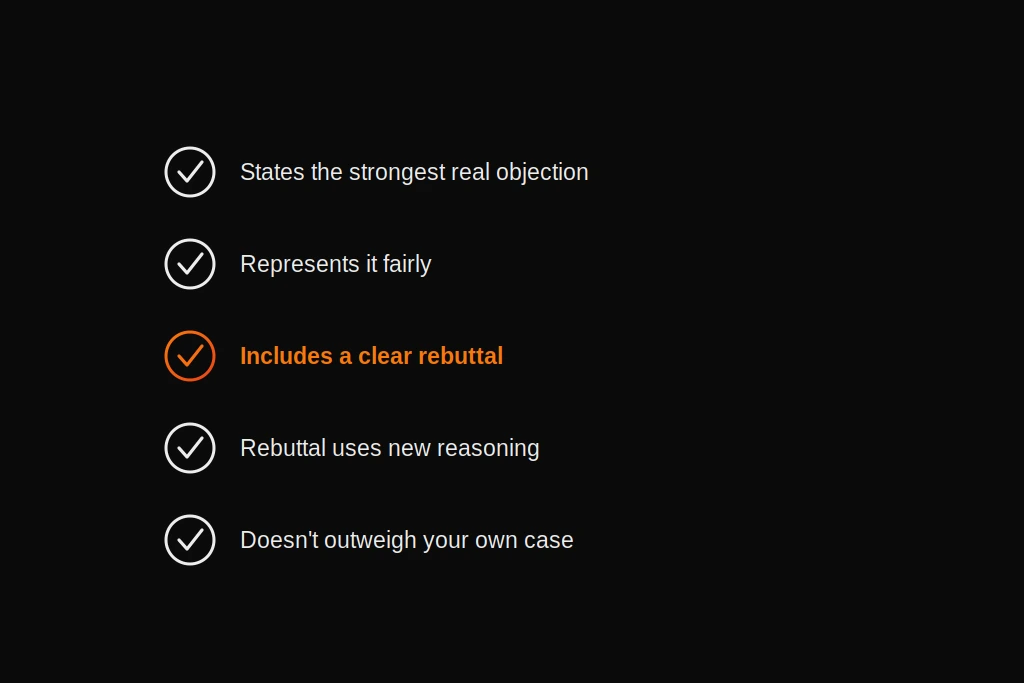
This checklist also works as a fast way to evaluate a counterargument paragraph you’re unsure about, your own draft, a classmate’s, or an example you found online. Run it against these five points before assuming it’s a good model to copy the structure of.
Sentence Starters and Transition Language for Counterarguments
Clear transition language signals to the reader exactly which part of the paragraph they’re in, the objection or the response, which matters more here than almost anywhere else in the essay.
- To introduce the opposing view: “Critics of this position argue that…” / “Some would point out that…” / “It’s reasonable to think that…”
- To pivot into the rebuttal: “However, this overlooks…” / “This argument doesn’t hold up when…” / “While that’s true in general, it doesn’t apply here because…”
- To concede partially before pivoting: “This is a fair concern, but…” / “There’s some truth to this, though…”
Avoid starting the rebuttal with a flat “but” on its own with no further context. The strongest transitions name what specifically is wrong or incomplete about the objection, rather than just signaling that disagreement is coming.
Word choice matters more in this paragraph than almost anywhere else in the essay, since the language you use to describe the opposing view signals whether you’re treating it fairly or setting it up to fail. Words like “merely,” “simply,” or “just” tend to make an objection sound dismissed before you’ve actually responded to it, which undercuts the fairness a strong counterargument depends on. Save the dismissive tone, if any, for after the rebuttal has actually done the work of showing why the objection falls short.
How to Write a Counterargument, Step by Step
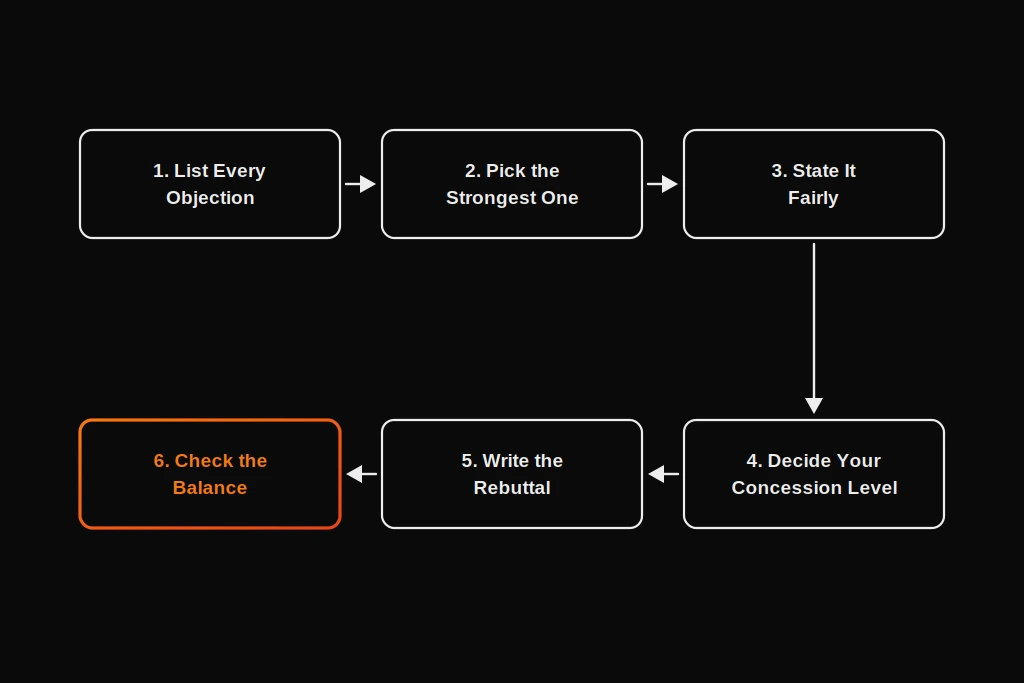
Step 1: List Every Objection You Can Think Of
Brainstorm every possible objection to your thesis, even weak ones, without filtering yet. Getting the full list down first makes it much easier to spot which one is actually the strongest.
Aim for at least four or five before you stop. The first objection that comes to mind is often the most obvious one, not necessarily the strongest, and a short list makes it too easy to settle for whatever surfaced first.
Step 2: Pick the Strongest One
Choose the objection a genuinely informed person would raise, not the easiest one to dismiss. If you’re torn between two, pick the one that would make you personally pause if you heard it from someone else.
Step 3: State It Fairly
Write the opposing view in a sentence or two, as if you were arguing for it yourself. If it sounds like a caricature, rewrite it until it sounds like something a real person would actually say.
A useful check here: would someone who actually holds this view read your sentence and nod along, or would they feel misrepresented? If it’s the second one, keep revising before moving on.
Step 4: Decide Your Concession Level
Using the spectrum above, decide whether you’re conceding nothing, conceding partially, or conceding fully with a pivot. This decision shapes every sentence that follows, so make it before you draft the rebuttal.
Step 5: Write the Rebuttal
Explain specifically why your thesis still holds, using reasoning or evidence, not just a louder restatement of your original claim. A rebuttal that doesn’t add new reasoning isn’t actually responding to the objection.
If you’re stuck, try finishing this sentence: “This objection would be right if …, but that’s not actually the case here because …” Whatever fills that blank is usually close to your real rebuttal, even if the final wording ends up more polished.
Step 6: Check the Balance
Read the paragraph back and check that the rebuttal is at least as substantial as the objection. If the opposing view takes up four sentences and your response takes up one, the paragraph will read as more persuasive for the other side than your own.
Counterargument and Rebuttal Examples
Full paragraphs across different topics, showing the objection stated fairly followed by a real rebuttal.
Topic: School start times
Critics of later school start times point out that shifting schedules creates real logistical problems, bus routes have to be redrawn, after-school sports and jobs get pushed later, and working parents lose flexibility they relied on. These are legitimate operational concerns, not excuses. However, districts that have already made the shift report that these transition costs were one-time adjustments, while the gains in attendance and grades have persisted for years afterward. A short-term scheduling headache is a poor reason to reject a change with long-term, repeatable benefits for student health.
Topic: AI in the classroom
Some teachers argue that any classroom use of AI, even structured and supervised, normalizes a tool that makes plagiarism easier to commit and harder to catch. This concern is not unreasonable given how quickly detection methods have fallen behind generation tools. But banning the technology doesn’t make it disappear from students’ lives outside class, it just removes the one place where its responsible use could actually be taught and modeled. The risk critics are pointing to is real, but it’s an argument for teaching AI literacy carefully, not for pretending the tool doesn’t exist.
Topic: Public transit funding
Opponents of redirecting highway funds toward transit argue that most American cities are built around cars, and this isn’t changing in the near future, so pouring money into transit that relies on specific population densities is asking suburban and rural taxpayers to subsidize a system they won’t use. This is true in sprawling, low-density regions. In the dense urban corridors where most of this funding would actually be spent, however, ridership numbers already outpace what the equivalent highway spending could move, meaning the concern applies to the wrong geography rather than to the policy itself.
Topic: Four-day school week
Skeptics of the four-day school week point out that a shorter week almost certainly means less instructional time overall, and no scheduling change can fully make up for fewer hours in front of a teacher. This is a legitimate concern, especially for subjects where practice time matters as much as instruction. However, districts that adopted the schedule largely extended daily class periods to preserve total instructional hours, meaning the real tradeoff isn’t less teaching, it’s fewer, longer days, a structural change rather than a straightforward loss of learning time.
Notice that none of these rebuttals simply repeat the thesis louder. Each one engages with the specific logic of the objection and explains exactly where that logic breaks down or doesn’t apply.
Common Mistakes When Writing a Counterargument
A handful of mistakes account for most of the counterargument rewrites instructors ask for.
- Picking a strawman instead of the strongest real objection, which undermines credibility with any reader who knows the topic.
- Acknowledging the opposing view but never actually rebutting it, leaving the paragraph half finished.
- Conceding so much ground that the rebuttal reads as an afterthought tacked onto agreement.
- Letting the counterargument run longer and more convincingly than your own supporting paragraphs.
- Placing the counterargument immediately after the introduction in a standard classical structure, before the reader has any reason to trust the thesis yet.
- Responding to the objection with a restated claim instead of new reasoning or evidence.
How EssaysHelper Can Help You
If you know your thesis has an obvious objection but you’re not sure how to respond to it without sounding defensive, you don’t have to work through it alone. EssaysHelper connects students with tutors who can stress-test your argument against its strongest counterpoint, before a professor does it for you in the margins. For students who want the entire essay handled from outline through final draft, our argumentative essay writing service can take you from a rough topic straight through to a polished, well-defended final draft.
Frequently Asked Questions
What is a counterargument in an argumentative essay?
A counterargument is a paragraph that states the strongest opposing view to your thesis and then explains why it doesn’t hold up. It’s different from simply mentioning that other opinions exist, since it requires a real rebuttal.
Where does the counterargument go in an argumentative essay?
It usually appears after your main supporting paragraphs and before the conclusion. The exception is a Rogerian structure, where the counterargument opens the essay instead.
Do all argumentative essays need a counterargument?
Most do, and leaving one out is a common reason essays get marked down for incomplete argumentation. The main exception is very short, timed writing where there isn’t room for a full paragraph.
How do you pick the strongest opposing view?
Pick the objection a genuinely informed person would raise, not the easiest one to dismiss. If you can’t imagine a thoughtful person actually holding the view you’ve described, you’ve likely picked a strawman instead.
What is the difference between acknowledging and rebutting a counterargument?
Acknowledging means stating that an opposing view exists. Rebutting means explaining specifically why that view doesn’t defeat your thesis, using new reasoning or evidence, not just repeating your original claim.
How much should you concede in a counterargument?
It depends on the objection, but a partial concession, agreeing the point has some truth while showing it doesn’t apply to your specific thesis, works for most student essays. Conceding too much can make the rebuttal feel like a collapse rather than a response.
Can a counterargument come at the beginning of an essay?
Yes, in a Rogerian structure the counterargument opens the essay rather than appearing in the middle. This works well for divisive topics where leading with your own claim might lose a skeptical reader early.
What’s a good example of a counterargument and rebuttal?
A strong example states the opposing view the way someone who holds it actually would, then explains with specific reasoning why your thesis still stands despite that objection. It never simply restates the thesis louder as the rebuttal.
How long should a counterargument paragraph be?
Long enough to state the objection fairly and rebut it with real reasoning, typically four to six sentences. It shouldn’t run so long that it outweighs your own supporting paragraphs.
What happens if you don’t include a counterargument?
Your essay can still make a case, but it often reads as unaware of or afraid of the obvious objection to your thesis. Readers who already know that objection will notice it’s missing, which weakens trust in the argument.
Final Thoughts
A counterargument isn’t a concession that your thesis might be wrong, it’s proof that you’ve tested it against real resistance and it held up. Pick the strongest objection you can find, state it the way someone who actually believes it would, and respond with real reasoning rather than a louder version of your original claim. Get that sequence right and the paragraph that once felt like the riskiest part of the essay becomes the one that does the most to earn a skeptical reader’s trust, right before your argumentative essay conclusion brings the whole case home.
With the outline, thesis statement, introduction, conclusion, and counterargument all covered individually, the pieces are in place to write the whole essay start to finish. Our complete guide on how to write an argumentative essay walks through that full process, along with separate guides on choosing strong argumentative essay topics for college students and a full list of argumentative essay prompts if you’re still deciding what to argue.
One last habit worth keeping: the next time you read something you disagree with, whether it’s a news article, a classmate’s argument, or a social media post, try mentally building its strongest counterargument before you build your reaction. That’s the exact skill this section has been asking you to practice, and it gets easier, and sharper, every time you do it deliberately instead of only when an assignment requires it.