
The first sentence of your essay can determine whether a reader continues reading or loses interest immediately. This opening line, commonly called a hook, is designed to capture attention and encourage the reader to engage with your argument. A strong hook makes your essay more compelling and sets the tone for everything that follows.
Many students underestimate the importance of writing a powerful introduction. However, professors and examiners often form their first impression within the opening few lines. If the introduction is dull or vague, even a well-researched essay may fail to make an impact.
Understanding the different types of hooks for essays can help you craft introductions that immediately grab attention. Whether you’re writing a narrative essay, argumentative paper, or a diagnostic essay, the right hook can make your writing stand out.
In this guide, we will explore the most effective essay hooks, when to use them, and how to create introductions that engage readers from the very first line.
What Is an Essay Hook?
An essay hook is the opening sentence or statement designed to capture the reader’s attention. It is the first part of your introduction and serves as a bridge between the reader’s curiosity and the main topic of your essay.
The purpose of a hook is simple: make the reader want to continue reading.
Hooks can take many forms, including questions, statistics, anecdotes, quotes, or bold statements. The type of hook you choose often depends on the topic of your essay and the audience you are writing for.
For example, if you’re learning about the process of writing a hook for an essay, you will notice that successful introductions often begin with a surprising fact or an intriguing question. These techniques spark curiosity and guide readers smoothly into the essay’s thesis.
A good hook does not reveal everything at once. Instead, it introduces the topic in a way that encourages readers to keep exploring the ideas presented in the essay.
Why a Strong Hook Matters in Academic Writing
Academic writing is often perceived as formal and serious, but that does not mean it should be boring. A well-crafted hook adds interest and clarity while maintaining academic credibility.
There are several reasons why a strong hook matters in essay writing.
First, it captures attention. Professors often read dozens of assignments, and an engaging opening line can immediately make your essay stand out.
Second, it establishes context. A strong hook introduces the topic and prepares readers for the discussion that follows. When students learn how to start college essay introductions effectively, they realize that the hook helps shape the direction of the entire paper.
Third, it builds engagement. If readers are intrigued from the beginning, they are more likely to remain interested in the argument or narrative.
Finally, a good hook improves the flow of the introduction. It leads naturally into the background information and thesis statement, making the essay feel structured and cohesive.
Different Types of Hooks for Essays
There are several effective hook styles used in academic writing. Each type serves a different purpose and works best in certain contexts.
Understanding these variations will help you choose the most suitable hook for your essay.
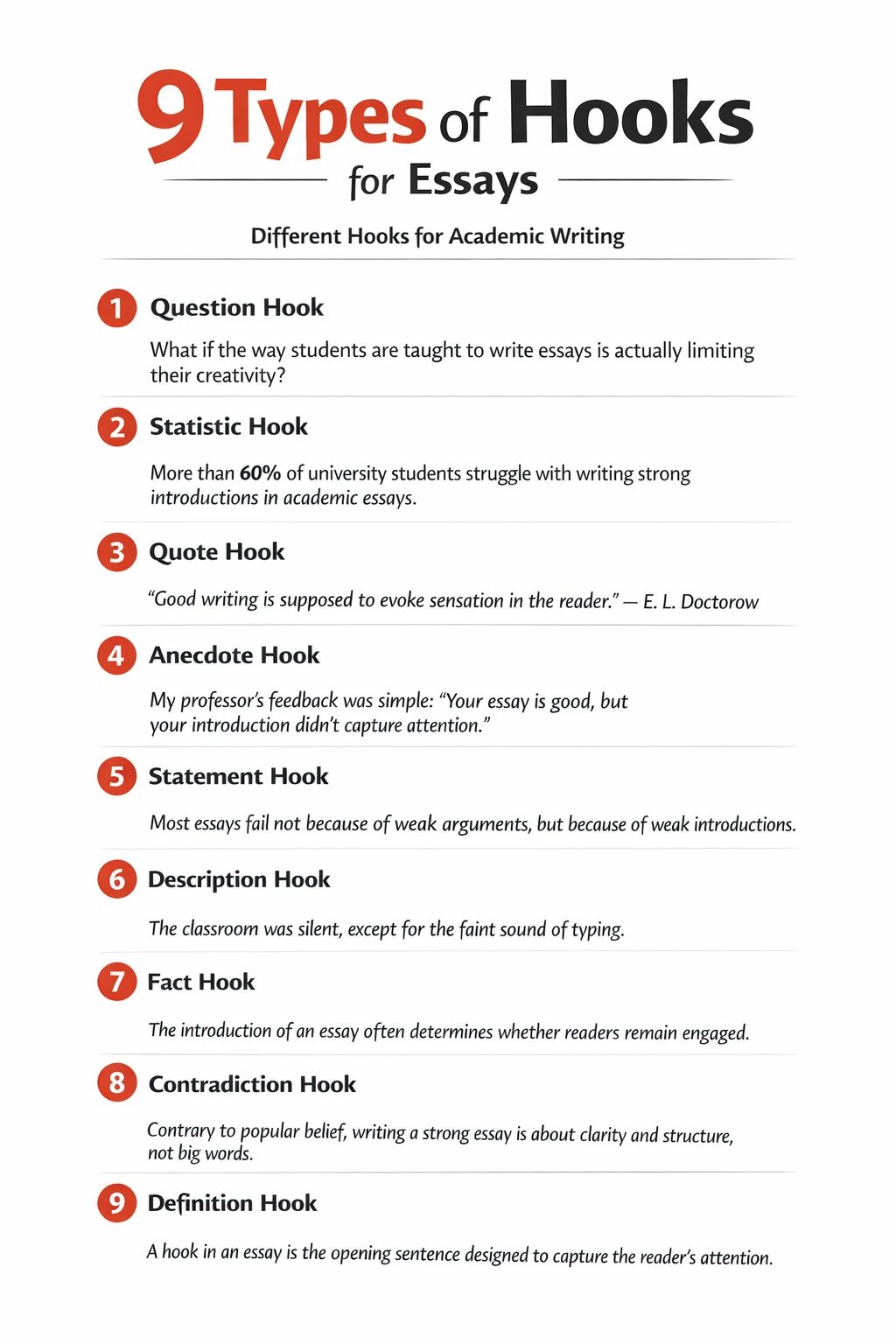
The key is to select a hook that matches the tone, topic, and purpose of your essay. For example, a narrative essay may benefit from a personal anecdote, while a research-based or argumentative essay might work better with a statistic, fact, or bold statement. By learning how each type of hook functions, you can create introductions that not only capture attention but also guide readers smoothly into the main argument of your essay.
Different Types of Hooks for Essays
There are several effective hook styles used in academic writing. Each type serves a different purpose and works best in certain contexts.
Understanding these variations will help you choose the most suitable hook for your essay.
1. Question Hook
A question hook starts with a meaningful question that makes the reader pause and think about the topic. Instead of giving information straight away, it invites the reader into the discussion by making them reflect on their own opinion, experience, or curiosity.
This type of hook works well because people naturally want answers to questions. When a reader sees a question at the beginning of an essay, they are more likely to keep reading to find out how the essay will answer it. A good question hook does not have a simple yes or no answer. It should open the door to a deeper discussion.
For example:
What if the way students are taught to write essays is actually limiting their creativity?
This question works because it challenges the reader to think about a familiar topic in a new way. It also creates curiosity because the essay is likely going to explore whether traditional essay-writing rules help or restrict students.

Question hooks are especially useful in persuasive essays, reflective essays, argumentative essays, and opinion-based writing. They are a good choice when your essay is exploring a problem, debate, or personal experience.
However, the question must be directly connected to your essay topic. Avoid questions that are too obvious, too broad, or too simple. For example, “Do students write essays?” is not a strong hook because the answer is obvious. A better question would make the reader think more deeply.
2. Statistic Hook
A statistical hook uses numbers, percentages, survey results, or research data to create a strong and credible opening. It gives readers the feeling that the essay is based on facts, not just opinions.
Numbers can be very powerful because they make a problem feel real. When readers see a statistic, they immediately understand the scale or importance of the issue. A statistic hook is especially effective when the number is surprising, shocking, or directly related to the essay topic.
For example:
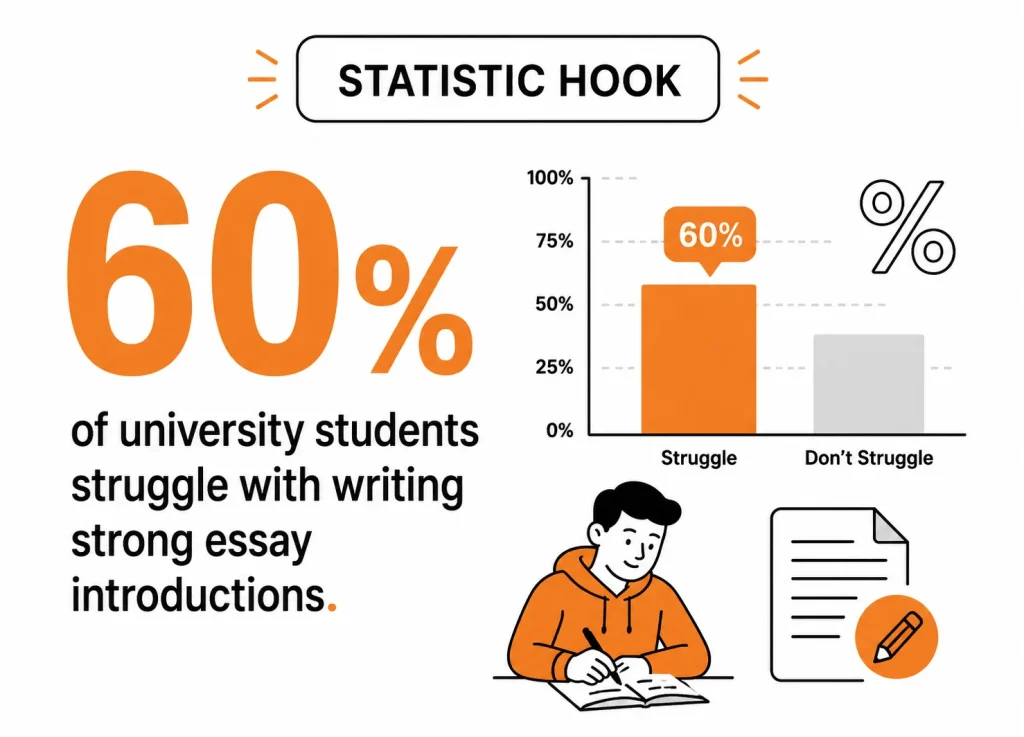
More than 60 percent of university students struggle with writing strong introductions in academic essays.
This hook works because it shows that the problem is common. It tells the reader that essay introductions are not just a small issue for a few students, but a challenge many learners face.
Statistic hooks are a strong choice for research-based essays, analytical essays, reports, argumentative essays, and academic writing. They are useful when you want to support your topic with evidence from the beginning.
However, the statistic should be accurate, relevant, and easy to understand. Do not use random numbers just to make your introduction look impressive. If the statistic comes from a study, report, or survey, it is better to mention the source in your essay.
3. Quote Hook
A quote hook begins with a relevant quotation from a writer, expert, public figure, researcher, or historical personality. It gives your essay a thoughtful and authoritative opening.
Quotes are useful because they connect your topic to a wider idea. A strong quote can make the reader feel that the essay is meaningful before the main argument even begins. It can also create an emotional, intellectual, or reflective tone.
For example:
“Good writing is supposed to evoke sensation in the reader.” – E. L. Doctorow
This quote works well because it explains that writing is not only about grammar or structure. It is also about making the reader feel something. If your essay is about writing strong introductions, this quote naturally connects to the importance of grabbing attention.

Quote hooks are useful in literary essays, reflective essays, argumentative essays, and essays about education, writing, leadership, society, or personal growth.
However, a quote should never replace your own explanation. After using a quote, you should explain what it means and how it connects to your essay topic. Also, avoid using overused quotes that readers have seen many times before unless you can explain them in a fresh way.
4. Anecdote Hook
An anecdote hook starts with a short story, personal experience, or realistic situation related to the essay topic. It helps readers connect emotionally with the subject before moving into the main argument.
Stories are powerful because they feel human. Instead of beginning with a formal explanation, an anecdote creates a moment that readers can imagine. It makes the essay feel more personal, relatable, and engaging.
For example:
During my first university assignment, I spent hours researching my topic but completely overlooked the importance of the opening paragraph. My professor’s feedback was simple: “Your essay is good, but your introduction didn’t capture attention.”
This hook works because many students can relate to the experience of working hard on an assignment but still receiving feedback about structure or presentation. It also introduces the topic naturally by showing why essay introductions matter.

Anecdote hooks work best in narrative essays, reflective essays, personal statements, scholarship essays, and essays that allow a personal tone. They can also be used in blog-style academic writing when you want to make the content more relatable.
The key is to keep the story short. An anecdote hook should introduce the topic, not take over the whole essay. After the short story, you should smoothly connect it to the main point of your essay.
5. Statement Hook
A statement hook begins with a bold, surprising, or confident statement that immediately grabs attention. It does not ask a question or present data. Instead, it makes a strong claim that encourages readers to continue reading.
This type of hook works because it creates impact. A strong statement can make readers think, “Is that true?” or “I want to know more.” It is especially useful when your essay has a clear argument or opinion.
For example:
Most essays fail not because of weak arguments, but because of weak introductions.
This hook works because it challenges what many students might assume. Most students focus heavily on the body paragraphs, evidence, and conclusion, but this statement reminds them that the introduction also plays a major role in how the essay is received.
Statement hooks are commonly used in argumentative essays, persuasive essays, opinion essays, and academic blogs. They are useful when you want to sound confident and direct from the beginning.
However, the statement should not be too extreme unless you can support it later in the essay. A bold claim is powerful only when the rest of the essay explains and proves it clearly.
6. Description Hook
A description hook uses vivid details to create a picture in the reader’s mind. Instead of telling the reader what the essay is about directly, it helps them imagine a scene, place, feeling, or situation.
This hook works well because readers are more likely to stay engaged when they can visualize what is happening. A description hook can make an essay feel more creative, emotional, and immersive.
For example:
The classroom was silent except for the faint sound of typing as students struggled to write the first sentence of their essays.
This hook works because it creates a clear scene. The reader can imagine the quiet classroom, the sound of typing, and the pressure students feel when trying to begin an essay. It introduces the topic in a natural and visual way.

Description hooks are especially effective in narrative essays, descriptive essays, creative writing, reflective assignments, and personal essays. They can also be useful in introductions where you want to create mood or atmosphere.
To write a strong description hook, focus on sensory details such as sound, sight, movement, or feeling. However, do not overdescribe. The goal is to create interest, not to slow down the introduction with too much detail.
7. Fact Hook
A fact hook starts with an interesting and relevant fact about the topic. Unlike a statistic hook, it does not rely mainly on numbers. Instead, it gives the reader useful information that helps introduce the essay.
Fact hooks are effective because they make the reader feel like they are learning something from the first sentence. A good fact can make the topic appear more important, surprising, or worth exploring.
For example:
The introduction of an essay often determines whether readers remain engaged with the entire argument.
This hook works because it explains the importance of introductions in a simple and direct way. It tells the reader that the opening paragraph is not just a formality. It has a real effect on how the rest of the essay is received.
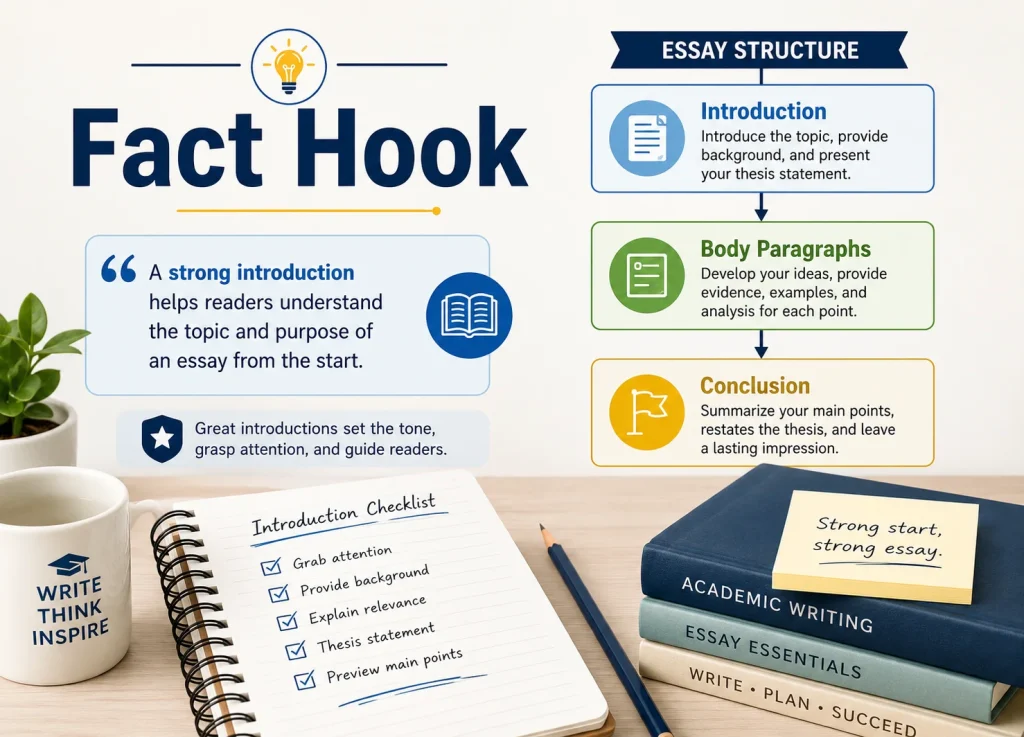
Fact hooks are useful in informative essays, explanatory essays, academic essays, research papers, and educational blog posts. They are a good option when you want to start clearly without sounding too dramatic.
However, the fact should be specific enough to add value. Avoid very general facts that do not create interest. For example, “Essays have introductions” is too basic. A stronger fact explains why the introduction matters.
8. Contradiction Hook
A contradiction hook challenges a common belief, assumption, or expectation. It surprises readers by presenting an idea that goes against what they may usually think.
This type of hook works because it creates curiosity. When readers see a statement that contradicts a popular belief, they want to know why. It makes them more likely to continue reading so they can understand the argument.
For example:
Contrary to popular belief, writing a strong essay is not about complicated vocabulary but about clarity and structure.
This hook works because many students believe that using difficult words makes an essay sound better. The statement challenges that belief and introduces a more useful idea: strong writing depends on clear thinking, good structure, and relevant arguments.

Contradiction hooks are especially useful in argumentative essays, persuasive essays, critical essays, and opinion-based writing. They work well when your essay is trying to correct a misunderstanding or challenge a traditional viewpoint.
However, the contradiction should be reasonable and easy to explain. Do not make a confusing or unrealistic claim just to sound different. The best contradiction hooks are surprising but still believable.
9. Definition Hook
A definition hook begins by explaining a key term or concept related to the essay topic. It helps readers understand the subject before the main discussion begins.
This hook is useful when your essay is based on an important idea, theory, process, or technical term. By defining the term early, you make sure the reader understands what you are discussing.
For example:
A hook in an essay is the opening sentence designed to capture the reader’s attention and introduce the main topic.
This definition works because it is simple, clear, and directly related to the essay topic. It does not sound too formal or dictionary-like. It also naturally prepares the reader for a discussion about different types of hooks.
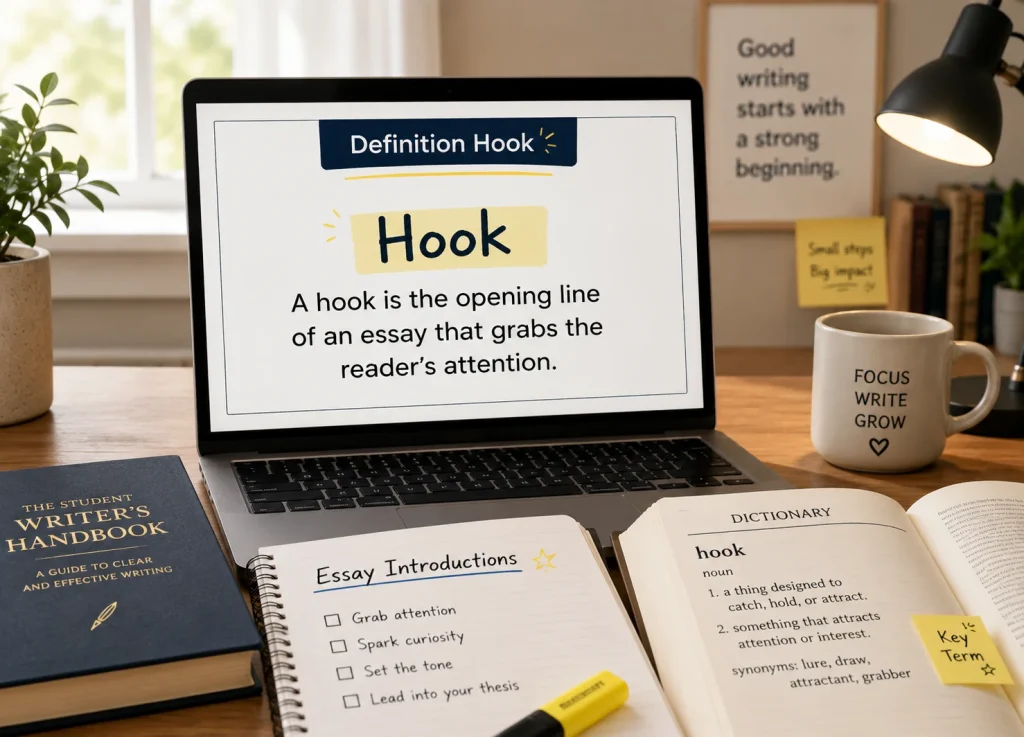
Definition hooks are especially useful in explanatory essays, academic essays, concept-based essays, and research papers. They are often used when writing about theories, academic terms, legal concepts, scientific ideas, or technical subjects.
However, a definition hook should not feel boring. Avoid starting with phrases like “According to the dictionary…” unless there is a specific reason to do so. A better approach is to explain the term in your own words and then connect it to the essay’s purpose.
A strong definition hook does more than define a word. It gives the reader context and prepares them for the argument or explanation that follows.
How to Choose the Right Hook for Your Essay
Selecting the right hook depends on several factors, including the essay topic, audience, and writing style.
For example, a narrative essay may benefit from a story-based hook, while an analytical essay may work better with statistics or facts.
Students often struggle with choosing the appropriate hook because they focus only on the topic. However, it is equally important to consider the different essay formats used in academic writing.
Different essay types require different approaches to introductions.
For instance, a critical essay may begin with a strong statement about the text being analyzed, while a research essay may start with a statistic or fact.
Understanding your essay type will help you choose a hook that aligns with the purpose of the assignment.
Tips for Writing a Powerful Essay Hook
Creating an engaging hook requires practice and thoughtful planning. The following tips can help you write stronger introductions.
- First, keep it relevant. Your hook should always connect directly to the essay topic.
- Second, focus on clarity. Avoid complicated language or confusing statements.
- Third, create curiosity. The hook should encourage readers to learn more about the topic.
- Fourth, connect the hook to the rest of the introduction. A strong introduction usually includes the hook, background information, and the thesis statement.
Many students also forget that formatting matters in academic writing. Ensuring that your essay follows the proper structure, including correct spacing like a double spaced essay, helps maintain readability and professionalism.
Common Mistakes When Writing Essay Hooks
Even experienced writers sometimes make mistakes when crafting essay hooks.
One common mistake is writing a hook that is too general. If the opening line is vague, it will not capture attention.
Another mistake is using overly dramatic statements that do not relate to the essay topic.
Some students also rely heavily on quotes without adding their own explanation. While quotes can be effective, the essay should always focus on your own analysis.
Additionally, students sometimes jump directly from the hook to the thesis without providing a clear transition. Understanding the importance of an understanding essay bridge can help connect the hook smoothly to the main argument.
When to Avoid Certain Types of Hooks
Although hooks are useful, not every type of hook works for every essay.
For example, personal anecdotes may not be appropriate for formal research papers. Similarly, humor may not be suitable for serious academic topics.
When writing analytical or research-based essays, it is often better to begin with facts or statistics rather than storytelling.
Always consider the expectations of your professor and the requirements of the assignment before choosing your hook style.
Getting Help with Essay Writing
Writing strong essays requires practice, research, and attention to structure. Many students struggle with crafting introductions, organizing ideas, or maintaining academic clarity.
Platforms like Essay Helper have become a trusted resource for students who need reliable academic guidance. Whether students need help refining introductions or improving their overall structure, professional essay writing services can provide valuable support.
In addition to writing assistance, students can also benefit from expert academic writing support that focuses on research, formatting, and editing to improve the quality of their assignments.
FAQs
What is a hook in an essay?
A hook is the opening sentence of an essay designed to capture the reader’s attention. It introduces the topic and encourages the reader to continue reading the rest of the essay.
What are the most common types of hooks in essays?
Common essay hooks include questions, statistics, quotes, anecdotes, facts, and bold statements. Each type works best depending on the essay topic and purpose.
How long should an essay hook be?
An essay hook is usually one or two sentences long. Its purpose is to introduce the topic and lead smoothly into the background information of the essay.
Can a question be used as an essay hook?
Yes, a question hook is one of the most effective ways to engage readers. It encourages them to think about the topic before reading the main argument.
What makes a hook effective in academic writing?
An effective hook is clear, relevant to the topic, and engaging. It should create curiosity and guide readers naturally into the introduction.
Should every essay start with a hook?
Most essays benefit from starting with a hook, but the style of hook may vary depending on the academic discipline and essay type.
Can a statistic be used as an essay hook?
Yes, statistics are powerful hooks because they provide credible information and highlight the significance of the topic right from the beginning.