
Have you ever written an essay where your introduction sounded interesting, your thesis was clear, and your body paragraphs had good points, but the whole essay still felt a little disconnected?
This is a common problem for many students. The ideas may be correct, but the writing does not flow smoothly. One paragraph finishes, the next one begins, and the reader feels like something is missing in between. That missing part is often called a bridge.
So, what is a bridge in an essay?
Need Help With This Topic?
Get one-on-one support from an academic expert. Book a free 15-minute call and let’s talk through your assignment.
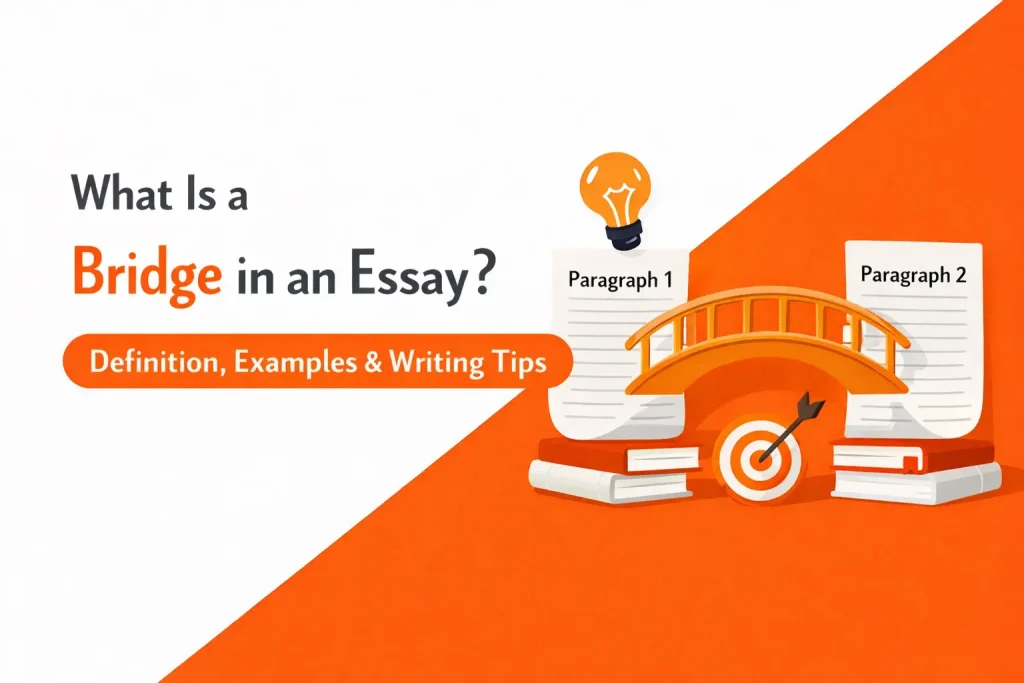
A bridge in an essay is a sentence or short group of sentences that connects one idea to another. It helps the reader move smoothly from the hook to the thesis, from one paragraph to the next, or from evidence to analysis. In simple words, a bridge stops your essay from feeling jumpy.
Think about a real bridge. It connects two places so people can move from one side to the other safely and easily. A bridge in writing works the same way. It connects two ideas so your reader can follow your thinking without confusion.
Many students search for terms like what is a bridge in an introduction paragraph, what is a bridge sentence in an essay, what is the bridge in an essay, or how to write a bridge in an essay because teachers often mention bridges but do not always explain them clearly. Some students also hear this term in ELA classes and wonder, what is a bridge in ELA?
The good news is that a bridge is not difficult once you understand its purpose.
In this guide, you will learn what a bridge means in essay writing, where it appears, how to write one, how it differs from a hook, and how to use bridge sentences in different types of essays. You will also see practical bridge essay examples, bridge sentence examples, and clear explanations that you can apply to your own academic writing.
What Is a Bridge in an Essay?
A bridge in an essay is a connecting sentence or group of sentences that links one part of the essay to another. It helps the reader understand how your ideas are related.
For example, if your essay introduction begins with a hook and then moves to the thesis statement, the bridge explains the background or context between those two parts. If one body paragraph discusses one argument and the next paragraph introduces a new point, the bridge helps connect them logically.
A simple meaning of bridge in an essay is this:
A bridge connects the idea you just introduced with the idea you are about to explain.
Without a bridge, your essay can feel like a list of separate points. With a bridge, the writing feels organized, smooth, and easier to follow.
For example:
Hook: Many students believe that a good essay depends only on strong arguments.
Bridge: However, even the strongest argument can lose impact if the reader struggles to follow how each idea connects.
Thesis: This is why bridge sentences are important in academic writing, as they create flow, improve clarity, and guide readers through the essay.
In this example, the bridge connects the general hook to the thesis. It prepares the reader for the main argument.
So, when someone asks, what is a bridge in a essay or what is bridge in essay, the answer is simple: it is the part that connects ideas and makes the essay flow naturally.
What Is a Bridge Sentence?
A bridge sentence is one sentence that connects two ideas in writing. It can connect a hook to a thesis, one paragraph to another, a topic sentence to evidence, or evidence to analysis.
Students often ask, what is a bridge sentence? A bridge sentence is not just a random transition word like “also” or “next.” It does more than move the essay forward. It explains the relationship between ideas.
For example:
Weak transition: Next, renewable energy is important.
Strong bridge sentence: While fossil fuels have supported industrial growth for decades, renewable energy offers a cleaner and more sustainable path for the future.
The second sentence is stronger because it connects the previous idea about fossil fuels to the next idea about renewable energy. It does not simply announce the next topic. It shows how the two ideas relate.
A bridge sentence should usually do three things:
- It should refer to the previous idea.
- It should introduce the next idea.
- It should show the relationship between both ideas.
Here is another bridge sentence example:
Although social media allows people to communicate more easily, it can also create pressure, distraction, and unrealistic expectations.
This sentence connects the positive side of social media to the negative side. It prepares the reader for a paragraph that may discuss the disadvantages of social media.
Bridge sentences are useful in almost every type of academic writing because they help the reader understand your direction.
What Is a Bridge in an Introduction Paragraph?
A bridge in an introduction paragraph is the sentence or few sentences that connect the hook to the thesis statement.
An introduction usually has three main parts:
- First, the hook grabs the reader’s attention.
- Second, the bridge gives background, context, or explanation.
- Third, the thesis statement presents the main argument or purpose of the essay.
This is one of the most important places to use a bridge because a strong introduction should not jump directly from an interesting hook to the thesis without preparing the reader.
For example:
Hook: Imagine spending weeks on an essay only to lose marks because the ideas feel disconnected.
Bridge: Many students focus on research, grammar, and word count, but they often overlook the role of structure and transitions in academic writing.
Thesis: Bridge sentences are essential because they help connect ideas, improve essay flow, and make arguments easier for readers to follow.
The bridge in this introduction paragraph helps the reader move from the relatable hook to the main thesis. It explains why the topic matters before the essay makes its main claim.
So, if you are wondering what is a bridge in an essay introduction, remember this: the bridge is the middle part of the introduction that connects your opening idea to your thesis.
A good bridge in an introduction paragraph often answers these questions:
- Why is this topic important?
- What background does the reader need?
- How does the hook connect to the thesis?
- What problem, issue, or context leads to the main argument?
If your introduction feels sudden or incomplete, you may need a stronger bridge.
What Is the Bridge in an Essay?
The bridge in an essay is the connecting part that helps readers move from one idea to the next without feeling lost.
It can appear in different places:
- A bridge can appear in the introduction.
- A bridge can appear between body paragraphs.
- A bridge can appear inside a paragraph.
- A bridge can appear before the conclusion.
- A bridge can also appear between evidence and explanation.
- The role of the bridge is always the same: to create a smooth connection.
For example, imagine an essay about online learning. One paragraph discusses flexibility, and the next paragraph discusses lack of student interaction. Without a bridge, the change may feel abrupt. A bridge sentence can solve this problem.
Bridge sentence: Although online learning gives students more flexibility, it can also reduce face-to-face interaction and make learning feel isolating.
This sentence connects the positive point to the negative point. It helps the reader understand why the essay is moving from flexibility to interaction.
This is why teachers often focus on bridge sentences when marking essays. They want to see not only good ideas but also clear links between those ideas.
What Is a Bridge in Writing?
A bridge in writing is any phrase, sentence, or short passage that connects ideas and improves flow. It is not limited to essays. Bridges can appear in articles, reports, speeches, stories, research papers, blog posts, and presentations.
In essay writing, bridges are especially important because academic writing depends on logical structure. Your reader should be able to follow your argument step by step.
A bridge in writing can show many types of relationships, such as:
- Cause and effect
- Comparison
- Contrast
- Addition
- Example
- Explanation
- Problem and solution
- Shift in focus
- Result or consequence
For example:
Cause and effect bridge: Because poor time management often leads to rushed writing, students may struggle to develop clear and well-structured essays.
Contrast bridge: While some students believe longer essays are always better, quality of argument matters more than word count.
Addition bridge: In addition to helping readers follow the argument, bridge sentences also make the writer’s ideas appear more organized.
These examples show that a bridge is not just about using fancy transition words. It is about making the relationship between ideas clear.
What Is a Bridge in ELA?
ELA stands for English Language Arts. In ELA, a bridge is a sentence or group of sentences that connects ideas in reading or writing.
Students often ask, what is a bridge in ELA? or what’s a bridge in ELA? In simple classroom terms, a bridge helps your writing move smoothly from one idea to the next.
In ELA essays, a bridge may connect:
- The hook to the thesis
- A topic sentence to evidence
- A quote to analysis
- One paragraph to another paragraph
- A character discussion to a theme discussion
- A theme to the author’s message
For example, in a literary essay about ambition in Macbeth, a bridge sentence may look like this:
While Macbeth’s ambition first appears as a desire for success, it gradually becomes a destructive force that controls his decisions.
This bridge connects the idea of ambition to the next point about destruction. It helps the reader see how the essay is developing.
In ELA, bridges are important because they show that you understand how ideas connect, not just what the ideas are.
Why Is a Bridge Important in an Essay?
A bridge is important because it improves flow, clarity, and structure. It helps readers understand why one idea follows another.
An essay is not just a collection of paragraphs. It is a connected piece of writing. Every part should lead naturally to the next. A bridge helps create that movement.
Here are the main reasons bridges matter.
1. A Bridge Makes the Essay Easier to Follow
Readers should not have to guess how your ideas are connected. A bridge explains the connection for them.
If one paragraph discusses causes and the next paragraph discusses effects, the bridge shows that relationship. If one paragraph presents a problem and the next paragraph presents a solution, the bridge prepares the reader for that shift.
2. A Bridge Improves Academic Flow
Academic writing should feel logical. Bridge sentences help the essay move smoothly from point to point. This makes your writing sound more mature and organized.
3. A Bridge Connects Evidence and Analysis
Many students add evidence but forget to explain it properly. A bridge can help connect a quote, statistic, or example to your own analysis.
For example:
This evidence shows that the issue is not only personal but also social, as it affects how students experience learning environments.
This sentence bridges evidence and explanation.
4. A Bridge Strengthens Your Argument
In argumentative essays, bridges help show how each point supports the thesis. Without bridges, arguments may feel separate. With bridges, each paragraph builds on the previous one.
5. A Bridge Prevents Abrupt Writing
Abrupt writing feels like jumping from one topic to another without warning. Bridges soften those jumps and make the essay feel more natural.
Difference Between Hook and Bridge
Many students confuse a hook and a bridge, but they are not the same thing.
A hook is the opening sentence or idea that grabs the reader’s attention.
A bridge connects the hook to the thesis statement.
A thesis statement gives the main argument or purpose of the essay.
Here is the difference in a simple way:
Hook: Gets attention.
Bridge: Gives context and connects ideas.
Thesis: States the main argument.
For example:
Hook: Every year, thousands of students lose marks not because their ideas are weak, but because their essays lack flow.
Bridge: Strong academic writing depends on more than research and grammar; it also requires clear connections between ideas.
Thesis: Bridge sentences are important because they improve structure, guide readers, and make essays more persuasive.
In this example, the hook creates interest. The bridge explains the issue. The thesis presents the main argument.
So, the main difference between hook and bridge is purpose. The hook attracts attention, while the bridge creates connection.
What Is a Bridge Background in an Essay?
A bridge background in an essay refers to the background information that connects the hook to the thesis. It gives the reader enough context to understand the topic before the main argument appears.
This is especially useful in academic essays where the topic may need explanation.
For example, if your essay is about artificial intelligence in education, your hook may mention how quickly AI tools are changing classrooms. But before stating your thesis, you may need to explain what kind of AI tools you are discussing and why they matter.
Example:
Hook: Artificial intelligence is changing how students learn, write, and complete academic tasks.
Bridge background: From grammar checkers to AI tutoring platforms, digital tools are now part of everyday education. However, their growing use has created debates about learning, originality, and academic integrity.
Thesis: While AI can support student learning, it must be used responsibly to protect critical thinking and academic honesty.
The bridge background gives context. It prepares the reader for the thesis.
A bridge background is not usually very long. In most essays, two or three sentences are enough. The goal is to guide the reader, not overload them with too much information.
What Is a Bridge Paragraph?
A bridge paragraph is a short paragraph that connects two larger sections of an essay or paper. It is usually longer than a bridge sentence.
Students often ask, what is a bridge paragraph? A bridge paragraph is used when one sentence is not enough to connect two major ideas.
Bridge paragraphs are common in longer essays, research papers, dissertations, reports, and complex argumentative writing. They help readers move from one major section to another.
For example, in a research paper, one section may discuss the causes of a problem, and the next section may discuss solutions. A bridge paragraph can summarize the previous section and introduce the next section.
Example:
The causes discussed above show that poor essay structure often comes from weak planning, unclear paragraph organization, and limited understanding of transitions. However, identifying these causes is only the first step. To improve academic writing, students must also learn practical strategies for connecting ideas clearly and building stronger paragraph flow.
This paragraph bridges the section on causes to the section on solutions.
A bridge paragraph is useful when the shift between sections is big. If the shift is small, one bridge sentence may be enough.
Bridge Sentence vs Transition Sentence: Are They the Same?
A bridge sentence and a transition sentence are very similar, and many teachers use these terms in the same way. Both help connect ideas and improve flow.
However, there can be a small difference.
A transition sentence often focuses on moving from one idea to the next.
A bridge sentence usually does more than move the essay forward. It connects the meaning of two ideas and shows how they relate.
For example:
Simple transition: Next, this essay will discuss the effects of social media.
Bridge sentence: While social media can improve communication, its effects on mental health show that constant online connection can also create serious challenges.
The second sentence is stronger because it connects the previous idea to the next idea. It creates a meaningful link.
So, if your teacher asks for bridge sentences, do not just add words like “next,” “also,” or “finally.” Try to explain the relationship between ideas.
Another Word for Bridge in an Essay
If you are looking for another word for bridge in an essay, there are several terms that may be used depending on the context.
Common alternatives include:
- Transition
- Linking sentence
- Connector
- Connecting sentence
- Transition sentence
- Link sentence
- Bridge sentence
- Context sentence
- Flow sentence
- Lead-in sentence
In an introduction, a bridge may also be called background information or context.
In body paragraphs, it may be called a transition sentence or linking sentence.
In ELA classes, teachers may simply call it a connection between ideas.
Although these terms are slightly different, they all relate to the same writing skill: helping ideas flow logically.
Where Does a Bridge Appear in an Essay?
A bridge can appear in several parts of an essay. It depends on what you are trying to connect.
Bridge in the Introduction Paragraph
This bridge connects the hook to the thesis.
Example:
Hook: Writing an essay can feel difficult when every idea seems important.
Bridge: Without clear structure, even strong ideas can become confusing for the reader.
Thesis: Bridge sentences help students organize their thoughts, connect paragraphs, and create essays that are easier to follow.
Bridge Between Body Paragraphs
This bridge connects one body paragraph to the next.
Example:
While planning helps students organize their main points, strong transitions are needed to show how those points work together.
Bridge Within a Paragraph
This bridge connects evidence to analysis.
Example:
This example shows that the character’s decision is not random but reflects the larger theme of responsibility.
Bridge Before the Conclusion
This bridge connects the final body paragraph to the conclusion.
Example:
After considering the causes, effects, and possible solutions, it becomes clear that stronger writing skills depend on both planning and revision.
Bridge Between Major Sections
This bridge is often used in longer essays or research papers.
Example:
The previous section explained why students struggle with essay flow. The next section focuses on practical strategies that can help improve transitions and paragraph structure.
How to Write a Bridge in an Essay
Learning how to write a bridge in an essay becomes easier when you follow a simple process.
A bridge should not be random. It should be based on the relationship between the idea you just discussed and the idea you are about to introduce.
Identify the Previous Idea
Before writing a bridge, ask yourself: what did I just explain?
For example, maybe your previous paragraph explained that students struggle with essay introductions.
Identify the Next Idea
Then ask: what will I explain next?
Maybe your next paragraph will explain how bridge sentences improve introductions.
Find the Relationship
Now ask: how are these ideas connected?
The relationship may be cause and effect, contrast, comparison, problem and solution, or addition.
Write the Connection Clearly
Now create a sentence that links both ideas.
Example:
Because weak introductions often leave readers confused, bridge sentences are useful for connecting the opening hook to the main argument.
This sentence connects the problem to the solution.
Keep It Natural
A bridge should sound like part of the essay, not like a forced sentence added only because the teacher asked for it.
Avoid writing bridges like:
Now I will talk about another point.
Instead, write:
In addition to improving the introduction, bridge sentences also help body paragraphs flow more smoothly.
The second version sounds more academic and natural.
How to Write a Bridge in an Essay Introduction
Many students specifically want to know how to write a bridge in an essay introduction because the introduction is often the hardest part to write.
A bridge in the introduction should come after the hook and before the thesis statement.
Here is a simple formula:
Hook + Bridge + Thesis
Let’s look at an example.
Hook: Many students can explain their ideas clearly in conversation but struggle to organize those same ideas in an essay.
Bridge: This problem often occurs because academic writing requires more than good ideas; it requires structure, flow, and clear connections between points.
Thesis: Bridge sentences play an important role in essay writing because they connect ideas, guide readers, and strengthen the overall argument.
The bridge explains the issue and prepares the reader for the thesis.
Here is another example for an argumentative essay:
Hook: Should schools reduce homework to protect students’ mental health?
Bridge: While homework can support learning, excessive assignments may increase stress and reduce the time students need for rest, family, and personal development.
Thesis: Schools should limit homework because balanced workloads can improve student well-being, motivation, and long-term academic performance.
This bridge works because it connects the question hook to the argumentative thesis.
When writing a bridge in an introduction, make sure it does not repeat the hook or thesis exactly. It should add context.
What Is a Bridge in an Argumentative Essay?
A bridge in an argumentative essay connects different parts of the argument. It helps the reader understand how one claim leads to another, how evidence supports a point, or how a counterargument relates to the main position.
Students often ask, what is a bridge in an argumentative essay? In simple terms, it is the sentence that connects your reasoning.
Argumentative essays need strong bridges because they are based on logic. If your points do not connect clearly, your argument may feel weak even when your evidence is good.
A bridge in an argumentative essay can connect:
- The hook to the thesis
- One claim to another claim
- A counterargument to a rebuttal
- Evidence to explanation
- A problem to a solution
- A cause to an effect
For example:
Although some people argue that school uniforms limit personal expression, they can also reduce social pressure and help create a more focused learning environment.
This bridge connects the opposing view to the writer’s argument.
Bridge sentences are especially important when writing counterarguments. They help you move from the opposing view back to your own position.
Example:
While this argument raises a valid concern, it overlooks the fact that online learning can still encourage interaction through discussion forums, video meetings, and collaborative digital tools.
This sentence bridges the counterargument to the rebuttal.
Bridge in an Essay Example
Let’s look at a full introduction with a clear bridge.
Essay topic: The importance of time management for students
Hook: Many students do not fail because they lack ability; they struggle because they run out of time.
Bridge: Academic success often depends on how well students plan their tasks, manage deadlines, and balance study with personal responsibilities.
Thesis: Time management is an essential skill for students because it reduces stress, improves productivity, and leads to stronger academic performance.
In this example, the hook grabs attention. The bridge gives context. The thesis presents the main argument.
Now let’s look at a body paragraph bridge.
Paragraph 1 ending: Poor time management often causes students to submit rushed assignments that do not reflect their true ability.
Bridge sentence: Beyond affecting assignment quality, poor time management can also increase stress and reduce motivation.
Paragraph 2 topic: Students who constantly work under pressure may begin to feel overwhelmed by academic responsibilities.
The bridge connects assignment quality to stress and motivation.
This is how bridges help an essay feel connected.
Bridge Sentence Examples Essay Students Can Use
Here are practical bridge sentence examples essay writers can adapt for different topics.
Bridge Sentence for Cause and Effect
Because social media has changed how people communicate, it has also influenced how students build relationships and express themselves.
Bridge Sentence for Contrast
While online learning offers flexibility, it can also make students feel isolated if interaction is limited.
Bridge Sentence for Addition
In addition to improving academic performance, effective time management can also support students’ mental well-being.
Bridge Sentence for Problem and Solution
Although many students struggle with essay structure, learning how to use bridge sentences can make their writing clearer and more organized.
Bridge Sentence for Evidence and Analysis
This example demonstrates that the problem is not only individual but also connected to wider educational expectations.
Bridge Sentence for Counterargument
Although critics argue that technology distracts students, it can also improve learning when used with clear academic guidance.
Bridge Sentence for Conclusion
After examining these benefits and challenges, it is clear that essay structure plays a major role in academic success.
These examples of bridge sentences show how one sentence can create flow and guide the reader.
Examples of a Bridge in an Essay Introduction
Here are more examples of bridges in essay introductions.
Education Essay
Hook: Education is often described as the key to success, but success depends on more than attending classes.
Bridge: Students also need study skills, confidence, clear feedback, and the ability to organize their ideas effectively.
Thesis: Strong academic writing skills are essential because they help students communicate knowledge clearly and perform better in assessments.
Social Media Essay
Hook: Social media has become part of everyday life for millions of students.
Bridge: Although it allows instant communication and access to information, it also creates challenges related to distraction, comparison, and mental health.
Thesis: Social media has a significant impact on students because it affects their focus, relationships, and emotional well-being.
Climate Change Essay
Hook: Climate change is no longer a distant threat; it is already affecting communities around the world.
Bridge: Rising temperatures, extreme weather, and environmental damage show that the issue has social, economic, and ecological consequences.
Thesis: Governments must take stronger action on climate change by investing in renewable energy, reducing emissions, and promoting sustainable development.
Argumentative Essay
Hook: Should university education be free for all students?
Bridge: While higher education can create better career opportunities, rising tuition fees prevent many capable students from accessing those opportunities.
Thesis: University education should be made more affordable because it supports social mobility, economic growth, and equal opportunity.
These examples show how the bridge connects the opening idea to the thesis.
Bridge Examples in Essays for Body Paragraphs
Bridge sentences are not only for introductions. They are also useful between body paragraphs.
From One Benefit to Another
The first benefit of online learning is flexibility. However, flexibility is not the only advantage; online learning can also make education more accessible for students who face geographical or financial barriers.
From Cause to Effect
Poor sleep habits can reduce students’ concentration in class. As a result, lack of sleep may also affect academic performance and long-term motivation.
From Problem to Solution
Although many students struggle with academic pressure, schools can reduce this problem by providing stronger mental health support and realistic workloads.
From Evidence to Analysis
This statistic highlights the seriousness of the issue, but its real importance lies in what it reveals about student learning habits.
From Counterargument to Rebuttal
Some people believe that exams are the fairest way to measure ability. However, this view ignores the fact that exams often reward memorization more than critical thinking.
These bridge examples in essays can help you understand how ideas should connect.
What Is a Bridge Statement?
A bridge statement is a sentence that connects two ideas and prepares the reader for the next part of the essay. It is very similar to a bridge sentence.
The term “bridge statement” is often used when the sentence makes a clear connection between the introduction and the thesis or between two major points.
Example:
Although technology has improved access to education, it has also created new challenges related to distraction and academic honesty.
This bridge statement connects a positive idea to a more critical argument.
A bridge statement can be used in:
- Introductions
- Body paragraphs
- Argumentative essays
- Research essays
- Literary analysis
- Persuasive writing
- Reflective writing
A strong bridge statement should be clear, relevant, and connected to the essay’s main point.
What Is a Bridge in a Paragraph?
A bridge in a paragraph connects sentences or ideas inside the same paragraph. It helps the paragraph feel complete and logical.
Sometimes students only think about bridges between paragraphs, but bridges are also useful within paragraphs.
For example:
Topic sentence: Online learning gives students more control over their schedules.
Evidence: Many students can watch recorded lectures, complete tasks at flexible times, and study from home.
Bridge: This flexibility can be especially helpful for students who work part-time or have family responsibilities.
Analysis: As a result, online learning can make education more accessible for learners with different personal circumstances.
The bridge connects the evidence to the analysis.
Without that bridge, the paragraph may still make sense, but it may not feel as smooth or fully explained.
A bridge in a paragraph is useful when you need to connect:
- A topic sentence to evidence
- Evidence to explanation
- One example to another example
- A quote to analysis
- A claim to a conclusion
This is important because strong paragraphs do not just contain information. They explain how the information fits together.
How to Write a Bridge for an Essay
To write a bridge for an essay, focus on the logic of your argument. Do not simply add transition words. Instead, explain the connection between your points.
Here are practical tips.
1. Read the End of One Paragraph and the Start of the Next
If the two paragraphs feel disconnected, you need a bridge.
Ask yourself:
Does the next paragraph follow naturally?
Does the reader know why I am moving to this point?
Is the relationship between the two ideas clear?
2. Use Key Words from Both Ideas
A good bridge often repeats or refers to key terms from the previous paragraph and introduces key terms from the next paragraph.
Example:
While essay planning helps students organize their ideas, bridge sentences help those ideas connect smoothly on the page.
This sentence uses “essay planning” from the previous idea and introduces “bridge sentences” as the next idea.
3. Show the Relationship
Do not just say “another point is.” Explain whether the next point adds, contrasts, explains, proves, or challenges the previous one.
4. Keep It Clear
A bridge does not need to be complicated. In most essays, one clear sentence is enough.
5. Avoid Repetition
Do not start every bridge with the same phrase. Use varied sentence structures.
Instead of always saying “Another reason is,” try:
A related issue is…
This leads to…
However, this argument also raises…
Beyond this point…
At the same time…
As a result…
Bridge Writing Examples
Here are several bridge writing examples for different essay topics.
Mental Health in Schools
While academic achievement is important, schools must also recognize that students’ emotional well-being affects their ability to learn.
Technology in Education
Although digital tools can improve access to learning, they must be used carefully to avoid distraction and overdependence.
Climate Change
These environmental changes are not only scientific concerns; they also affect economies, communities, and public health.
Social Media
While social media helps people stay connected, it can also create unrealistic comparisons that affect self-esteem.
University Fees
Although higher education can improve career opportunities, expensive tuition fees often prevent students from accessing those benefits.
Essay Writing
Once students understand how to create a strong thesis, they also need to learn how to connect each paragraph back to that central argument.
These bridge writing examples show how you can move from one idea to another without sounding abrupt.
Bridge Examples in Writing
Bridge examples in writing can appear in many forms. Some are short and direct. Others are more developed.
Short Bridge Example
This problem becomes even more serious when students lack proper academic support.
Contrast Bridge Example
However, this benefit also comes with several challenges that should not be ignored.
Cause and Effect Bridge Example
Because students often leave assignments until the last minute, they may struggle to produce clear and well-organized writing.
Comparison Bridge Example
Similarly, both online and traditional learning require discipline, structure, and active participation.
Argument Bridge Example
Although this view seems reasonable, it does not fully consider the long-term consequences of the policy.
Conclusion Bridge Example
Together, these points show why stronger writing skills are essential for academic success.
These examples can be adapted for different essay topics.
Bridge Essay Examples: Full Sample Introduction
Here is a full sample introduction that shows the bridge clearly.
Essay topic: Why students should learn academic writing skills
Many students believe that academic writing is only about grammar, vocabulary, and meeting the required word count. However, strong academic writing also depends on how clearly ideas are connected and developed throughout the essay. Without smooth connections, even well-researched points can feel confusing or incomplete. Bridge sentences are therefore an essential part of essay writing because they help students connect ideas, guide readers, and create more organized arguments.
In this introduction:
- The first sentence is the hook.
- The second and third sentences act as the bridge.
- The final sentence is the thesis.
- This example shows that a bridge does not need to sound complicated. It simply needs to connect the opening idea to the main argument.
Bridge Essay Example: Body Paragraph
Here is a body paragraph example with a bridge sentence.
One reason bridge sentences are important is that they improve the flow of an essay. When paragraphs move from one idea to another without a clear connection, readers may struggle to understand how the points relate. For example, an essay may discuss the causes of climate change in one paragraph and then suddenly move to its effects in the next paragraph. A bridge sentence can connect these ideas by explaining that the causes lead directly to environmental consequences. As a result, the essay becomes easier to follow and more logical.
The bridge appears in this sentence:
A bridge sentence can connect these ideas by explaining that the causes lead directly to environmental consequences.
It links the example to the explanation.
Bridge for Essay Examples by Essay Type
Different types of essays use bridges in slightly different ways.
Argumentative Essay Bridge
Although many people believe that homework improves discipline, excessive homework can increase stress and reduce students’ motivation to learn.
This bridge works because it introduces an opposing view and then shifts toward the writer’s argument.
Analytical Essay Bridge
This scene does more than reveal the character’s fear; it also highlights the wider theme of social pressure.
This bridge connects textual evidence to deeper analysis.
Expository Essay Bridge
After understanding the causes of the issue, it is important to examine the effects it creates for students and teachers.
This bridge connects one explanatory section to another.
Compare and Contrast Essay Bridge
While both methods aim to improve learning, they differ in how they support student independence.
This bridge connects comparison to contrast.
Reflective Essay Bridge
Although the experience was difficult at first, it helped me understand the importance of preparation and clear communication.
This bridge connects personal experience to reflection.
Common Types of Bridge Sentences
Bridge sentences can be used for different purposes. Here are some common types.
1. Addition Bridge
This type adds another related idea.
Example:
In addition to helping students organize their paragraphs, bridge sentences also improve the overall readability of an essay.
2. Contrast Bridge
This type shows a difference or opposing idea.
Example:
While grammar is important, clear structure often has a greater effect on how readers understand an essay.
3. Cause and Effect Bridge
This type shows that one idea leads to another.
Example:
Because weak transitions make essays harder to follow, students may lose marks even when their arguments are relevant.
4. Example Bridge
This type introduces an example.
Example:
This issue can be seen clearly in essays where students move from evidence to analysis without explaining the connection.
5. Problem and Solution Bridge
This type connects a problem to a possible answer.
Example:
Although disconnected paragraphs can weaken an essay, careful use of bridge sentences can create a smoother structure.
6. Summary Bridge
This type summarizes one section before moving to the next.
Example:
These examples show why essay flow matters, but they also raise an important question: how can students create stronger connections in their own writing?
Words and Phrases You Can Use in Bridge Sentences
Bridge sentences often include transition words, but the transition word alone is not enough. You still need to explain the connection.
Useful bridge words and phrases include:
- However
- Although
- While
- In addition
- Similarly
- In contrast
- As a result
- Therefore
- For this reason
- This shows that
- This leads to
- Beyond this point
- At the same time
- On the other hand
- More importantly
- For example
- In other words
- Taken together
- Despite this
- Considering these points
Here are some examples:
However, this argument becomes more complex when student well-being is considered.
As a result, poor planning can affect both essay quality and student confidence.
In addition to improving clarity, bridges also help readers understand the writer’s argument more easily.
Taken together, these points show that essay structure is just as important as content.
Use these phrases carefully. If every sentence begins with “however” or “in addition,” your writing may sound repetitive.
Common Mistakes Students Make When Writing Bridges
Many students understand what a bridge is but still make mistakes when using it. Here are the most common problems.
Skipping the Bridge Completely
Some students move directly from one idea to another. This makes the essay feel abrupt.
Weak example:
Online learning is flexible. Students may feel isolated.
Better version:
Although online learning is flexible, students may still feel isolated when there are limited opportunities for interaction.
The better version connects the two ideas.
Using Only One Transition Word
Words like “also,” “next,” or “therefore” can help, but they are not always enough.
Weak example:
Also, homework causes stress.
Better version:
In addition to taking time away from rest, excessive homework can also increase stress and reduce motivation.
The better version explains the relationship.
Making the Bridge Too Long
A bridge should be clear and focused. If it becomes too long, it may confuse the reader.
Try to keep most bridge sentences to one sentence. Use a bridge paragraph only when connecting large sections.
Repeating the Same Phrase
If every paragraph begins with “another point is,” the essay becomes repetitive.
Use varied transitions and sentence structures.
Creating a Weak Connection
A bridge should connect ideas logically. Do not force a connection that does not make sense.
Before writing a bridge, ask whether the two ideas actually relate to each other.
Weak Bridge vs Strong Bridge
Let’s compare weak and strong bridges.
Example 1
Weak bridge:
Next, I will discuss social media.
Strong bridge:
Beyond its effect on communication, social media also influences how students manage their time and attention.
The strong bridge connects ideas and sounds more academic.
Example 2
Weak bridge:
Another thing is climate change.
Strong bridge:
In addition to affecting global temperatures, climate change also creates serious risks for agriculture, health, and economic stability.
The strong bridge explains the next point clearly.
Example 3
Weak bridge:
This quote is important.
Strong bridge:
This quote is important because it reveals how the character’s fear shapes his decisions throughout the story.
The strong bridge connects evidence to analysis.
Example 4
Weak bridge:
Now the essay will talk about solutions.
Strong bridge:
After examining the causes of the problem, it is important to consider practical solutions that can reduce its impact.
The strong bridge creates a natural transition.
How Long Should a Bridge Be?
A bridge is usually one sentence long. In some cases, it may be two sentences. In longer essays or research papers, it may be a short paragraph.
- The length depends on what you are connecting.
- If you are connecting two simple ideas, one sentence is enough.
- If you are connecting two major sections, you may need a bridge paragraph.
- If you are connecting a hook to a thesis, one or two sentences usually work well.
- The most important thing is clarity. A bridge should not be longer than necessary. It should guide the reader without distracting from the main argument.
Can a Bridge Be More Than One Sentence?
Yes, a bridge can be more than one sentence. This usually happens in introductions or longer academic essays.
For example:
Many students believe that essay writing is mainly about grammar and vocabulary. However, academic writing also depends on structure, organization, and the ability to connect ideas clearly. Without these connections, even strong arguments may feel incomplete or confusing.
This bridge is three sentences long. It provides context before the thesis.
However, in most short essays, one bridge sentence is enough. Use more than one sentence only when the reader needs extra background.
Bridge in Introduction Paragraph: Full Formula
Here is an easy formula for writing a bridge in an introduction paragraph:
Hook + General Context + Specific Context + Thesis
Example:
Hook: Many students find essay introductions harder to write than body paragraphs.
General context: This is because introductions must grab attention, introduce the topic, and prepare the reader for the main argument.
Specific context: The bridge sentence plays an important role in this process because it connects the opening hook to the thesis statement.
Thesis: Learning how to write an effective bridge can help students create clearer, stronger, and more engaging essays.
This formula works well for many academic essays.
You can also use a shorter version:
Hook + Bridge + Thesis
Example:
Hook: A strong essay does not begin with the thesis alone.
Bridge: Before readers can understand the main argument, they need context that connects the opening idea to the essay’s purpose.
Thesis: This is why bridge sentences are essential for creating clear and effective introductions.
How Bridges Improve Essay Structure
Bridges improve essay structure by helping each part connect to the next. They make the essay feel planned rather than random.
A well-structured essay usually follows this pattern:
Introduction
- Thesis statement
- Body paragraph 1
- Body paragraph 2
- Body paragraph 3
Conclusion
However, structure is not only about order. It is also about connection.
For example, your body paragraphs may be in the correct order, but if there are no bridges, the essay may still feel disconnected.
A bridge helps show why paragraph 2 follows paragraph 1. It also helps show how paragraph 3 builds on paragraph 2.
This is especially important in longer essays because readers need guidance. They should always know where they are in the argument and why the next point matters.
How Bridges Improve Reader Engagement
Reader engagement is not only about using exciting hooks or interesting examples. It is also about making the writing easy to follow.
When readers feel lost, they lose interest. When the essay flows smoothly, they are more likely to continue reading.
Bridge sentences help maintain engagement because they guide readers step by step.
For example:
Although the causes of academic stress are important, the effects on student well-being show why this issue needs urgent attention.
This bridge makes the reader want to continue because it shows that the essay is moving from causes to effects.
A good bridge creates direction. It tells the reader, “Here is where we are going next.”
Bridge Meaning in Essay Writing for Students
The bridge meaning in essay writing is simple: it is a connection.
Students sometimes think academic writing is only about using formal words, but strong writing is really about clear thinking. A bridge shows clear thinking because it explains how ideas relate.
If your essay has good bridges, your teacher can see that you understand the topic and the structure of your argument.
A bridge can show that:
- You know how your points connect.
- You understand the relationship between evidence and analysis.
- You can move smoothly from one idea to another.
- You can guide the reader through your argument.
- This is why bridge sentences are often linked to higher-quality academic writing.
Bridge Sentences Examples for Different Academic Levels
School-Level Example
Although homework can help students revise lessons, too much homework may reduce the time they need for rest and hobbies.
College-Level Example
While online education improves access to learning, its effectiveness depends on student motivation, digital resources, and teacher support.
University-Level Example
Although digital learning platforms offer flexibility and accessibility, their long-term impact on student engagement depends on how effectively they support interaction, feedback, and independent learning.
Research Essay Example
These findings suggest that student performance is shaped not only by individual effort but also by institutional support, teaching quality, and access to academic resources.
Each example connects ideas at a different level of complexity.
Examples of Bridges in Essays by Topic
Fast Fashion
While fast fashion makes trendy clothing affordable, it also raises serious concerns about waste, labor conditions, and environmental damage.
Artificial Intelligence
Although artificial intelligence can improve productivity, it also raises ethical questions about privacy, bias, and human decision-making.
Public Health
In addition to affecting individual patients, poor public health systems can place pressure on hospitals, families, and national economies.
Crime and Society
While crime is often discussed as an individual choice, social factors such as poverty, education, and community support also play an important role.
Construction Sustainability
Although sustainable construction may require higher initial investment, it can reduce long-term environmental impact and improve building performance.
Academic Writing
Beyond grammar and vocabulary, academic writing also depends on structure, logical flow, and clear connections between ideas.
These examples of bridges in essays show how flexible bridge sentences can be.
Bridge Sentence Checklist
- Before finalizing your essay, use this checklist to review your bridge sentences.
- Does the bridge connect the previous idea to the next idea?
- Does it explain the relationship between the ideas?
- Does it sound natural?
- Does it avoid repetition?
- Is it clear and concise?
- Does it support the thesis?
- Does it improve the flow of the essay?
- Does it help the reader understand why the next point matters?
- If the answer is yes, your bridge is likely effective.
- If the answer is no, revise the sentence so the connection becomes clearer.
How to Add Bridges When Editing an Essay
Sometimes students write the full essay first and add bridges later. This is a good editing strategy.
Here is how to do it.
- First, read the essay from the beginning.
- Second, stop at the end of each paragraph.
- Third, ask whether the next paragraph follows naturally.
- Fourth, add a bridge sentence where the connection feels weak.
- Fifth, read the essay aloud to check the flow.
For example, you may notice that one paragraph discusses the benefits of exercise and the next paragraph discusses mental health. You can add this bridge:
In addition to improving physical health, regular exercise can also support emotional well-being and reduce stress.
This one sentence makes the connection clearer.
Editing for bridges can make a big difference in essay quality. It helps the essay sound more polished and organized.
How EssaysHelper Can Support Students With Essay Structure
Many students know what they want to say but struggle with how to organize it. This is where academic writing support can be helpful.
EssaysHelper can support students by helping them understand essay structure, improve transitions, edit unclear paragraphs, and make their writing more readable. Instead of simply adding random transition words, students can learn how to connect ideas properly and build stronger academic arguments.
For students who struggle with introductions, bridge sentences, paragraph flow, or thesis development, guidance from an academic writing expert can make the writing process easier. The goal should always be to improve understanding, strengthen writing skills, and produce clearer academic work.
A well-structured essay does not happen by accident. It requires planning, logical organization, and careful editing. Bridge sentences are a small part of the essay, but they can make a major difference in how professional and readable the final work feels.
Frequently Asked Questions About Bridges in Essays
What is a bridge in an essay?
A bridge in an essay is a sentence or short group of sentences that connects ideas, paragraphs, or sections. It helps the reader move smoothly from one point to the next and makes the essay easier to follow.
What is a bridge sentence in an essay?
A bridge sentence in an essay is one sentence that links two ideas together. It may connect a hook to a thesis, one body paragraph to another, or evidence to analysis.
What is a bridge in an introduction paragraph?
A bridge in an introduction paragraph connects the hook to the thesis statement. It gives background or context so the introduction feels smooth and complete.
What is the bridge in an essay introduction?
The bridge in an essay introduction is the middle part between the opening hook and the thesis. It explains the context and prepares the reader for the main argument.
What is a bridge in an argumentative essay?
A bridge in an argumentative essay connects claims, evidence, counterarguments, and rebuttals. It helps the reader understand how each part of the argument supports the thesis.
What is a bridge in an argumentative essay example?
An example of a bridge in an argumentative essay is: “Although some people believe homework improves discipline, excessive homework can increase stress and reduce students’ motivation.” This connects an opposing view to the writer’s argument.
What is a bridge sentence example?
A bridge sentence example is: “While online learning gives students flexibility, it can also create challenges related to isolation and limited interaction.” This sentence connects one idea to another.
What is a bridge paragraph?
A bridge paragraph is a short paragraph that connects two larger sections of an essay or research paper. It is often used when one sentence is not enough to explain the connection.
What is a bridge in a paragraph?
A bridge in a paragraph connects sentences or ideas within the same paragraph. It may link evidence to analysis or connect one example to another.
What is a bridge statement?
A bridge statement is a connecting statement that links one idea to the next. It is similar to a bridge sentence and is often used in introductions or between body paragraphs.
What is another word for bridge in an essay?
Another word for bridge in an essay is transition. Other similar terms include linking sentence, connector, transition sentence, connecting sentence, lead-in sentence, and context sentence.
How do you write a bridge in an essay?
To write a bridge in an essay, identify the previous idea, identify the next idea, and write a sentence that explains how they connect. The bridge should make the relationship clear to the reader.
How to write a bridge in an essay introduction?
To write a bridge in an essay introduction, place it after the hook and before the thesis. Use it to give background, explain the topic, and lead naturally into your main argument.
How long should a bridge sentence be?
A bridge sentence is usually one sentence long. However, it can be two sentences if the connection needs more explanation. In longer essays, a bridge may become a short paragraph.
Is a bridge the same as a transition?
A bridge and a transition are very similar. Both connect ideas and improve flow. However, a bridge often explains the relationship between ideas more clearly than a simple transition word.
What is the difference between hook and bridge?
The hook grabs the reader’s attention, while the bridge connects the hook to the thesis. The hook creates interest, and the bridge gives context.
What is a bridge in ELA?
In ELA, a bridge is a sentence or group of sentences that connects ideas in reading or writing. It helps essays, paragraphs, and analysis flow smoothly.
What is a bridge in English writing?
A bridge in English writing is a connector that links ideas, paragraphs, or sections. It helps readers follow the writer’s argument or explanation clearly.
What does bridge meaning in essay writing refer to?
Bridge meaning in essay writing refers to connection. A bridge connects one idea to another so the essay does not feel disconnected or abrupt.
Can I use bridge sentences in every essay?
Yes, bridge sentences can be used in almost every essay type, including argumentative, analytical, reflective, expository, and compare-and-contrast essays. They are useful whenever you need to connect ideas.
Conclusion
A bridge in an essay may seem like a small detail, but it has a powerful effect on the quality of your writing. It connects ideas, improves flow, and helps readers understand how each part of your essay relates to the next.
Whether you are asking what is a bridge in an essay, what is a bridge sentence, what is a bridge in an introduction paragraph, or how to write a bridge in an essay, the main idea is the same: a bridge creates connection.
Strong essays do not simply present information. They guide the reader through a clear path. The hook creates interest, the bridge gives context, the thesis presents the argument, and the body paragraphs develop that argument with smooth transitions.
If your essay feels disconnected, unclear, or abrupt, adding stronger bridge sentences can make a major difference. With practice, you can use bridges to connect paragraphs, explain evidence, introduce new points, and create writing that feels polished, logical, and easy to read.
A good bridge does not need to be complicated. It only needs to help the reader understand where they have been, where they are going, and why the next idea matters.