
Starting a college essay can feel harder than writing the whole essay. You may know your story, your achievements, and your goals, but the first sentence still feels impossible. Should you begin with a quote? A question? A personal story? A dramatic moment? Or should you keep it simple?
If you are searching for how to start college essay writing without sounding boring, the best answer is this: start with a specific, honest moment that shows something real about you. A strong college essay opening does not need to sound like a movie trailer. It needs to make the reader curious and help them understand who you are.
Many students get stuck because they try too hard to impress. They start with big statements like “Since I was young, I have always wanted to succeed” or “In today’s world, education is very important.” These lines are not wrong, but they are too general. They could belong to almost anyone. A college essay should sound like you.
This guide explains how to start your college essay with practical tips, examples, weak vs strong openings, and common mistakes to avoid. Whether you are writing a college application essay, personal statement, scholarship essay, or first-year college paper, these strategies will help you begin with more confidence. If you need extra guidance at any stage, Essay Helper can support students with essay planning, structure, editing, and academic writing.
Why the Start of Your College Essay Matters
The start of your college essay matters because it creates the first impression. Before the reader knows your full story, they meet your voice through the opening lines. A good opening tells them, “This student has something thoughtful to say.”
This does not mean your first sentence must be shocking or poetic. Many strong college essays begin quietly. What matters is that the opening feels specific, personal, and connected to the rest of the essay.
A strong beginning can do several things at once. It can introduce a meaningful experience, show your personality, create curiosity, and guide the reader toward the main idea. It can also make your essay feel less like a formal report and more like a real student story.
For example, compare these two openings:
Weak opening:
Education has always been important to me.
Stronger opening:
I learned the value of education at our kitchen table, where I translated school emails for my parents before finishing my own homework.
The first opening is clear, but it is too broad. The second opening gives a scene, a responsibility, and a glimpse of the student’s life. That is what makes it more memorable.
College essays are often short, especially application essays. According to the Common App essay prompts and guidance, students usually need to respond within a limited word count, so every sentence should work hard. The opening should not waste space repeating something obvious.
What Is the Best Way to Start a College Essay?
The best way to start a college essay is with a specific moment, personal observation, meaningful problem, short story, or honest reflection that connects to the essay prompt.
The opening should answer three silent questions:
- What is happening?
- Why should the reader care?
- What does this reveal about the student?
You do not need to answer all three fully in the first sentence, but your opening should move in that direction.
Here are a few strong ways to begin:
- Start with a small moment that changes how you think.
- Start with a problem you had to solve.
- Start with a personal detail that reveals your background.
- Start with a contrast between who you were and who you became.
- Start with a reflection that feels honest and mature.
- Start with a scene that places the reader inside your experience.
The best way to start a college essay is not to copy someone else’s opening. It is to find the moment in your own story that carries meaning.
If you are writing under pressure and feel unsure about structure, professional essay help can be useful for understanding how to organize your ideas, but your story should still remain personal and honest.
How to Start a College Essay in 11 Practical Ways
There is no single perfect opening for every student. The right start depends on your essay prompt, your story, your tone, and what you want the reader to understand about you.
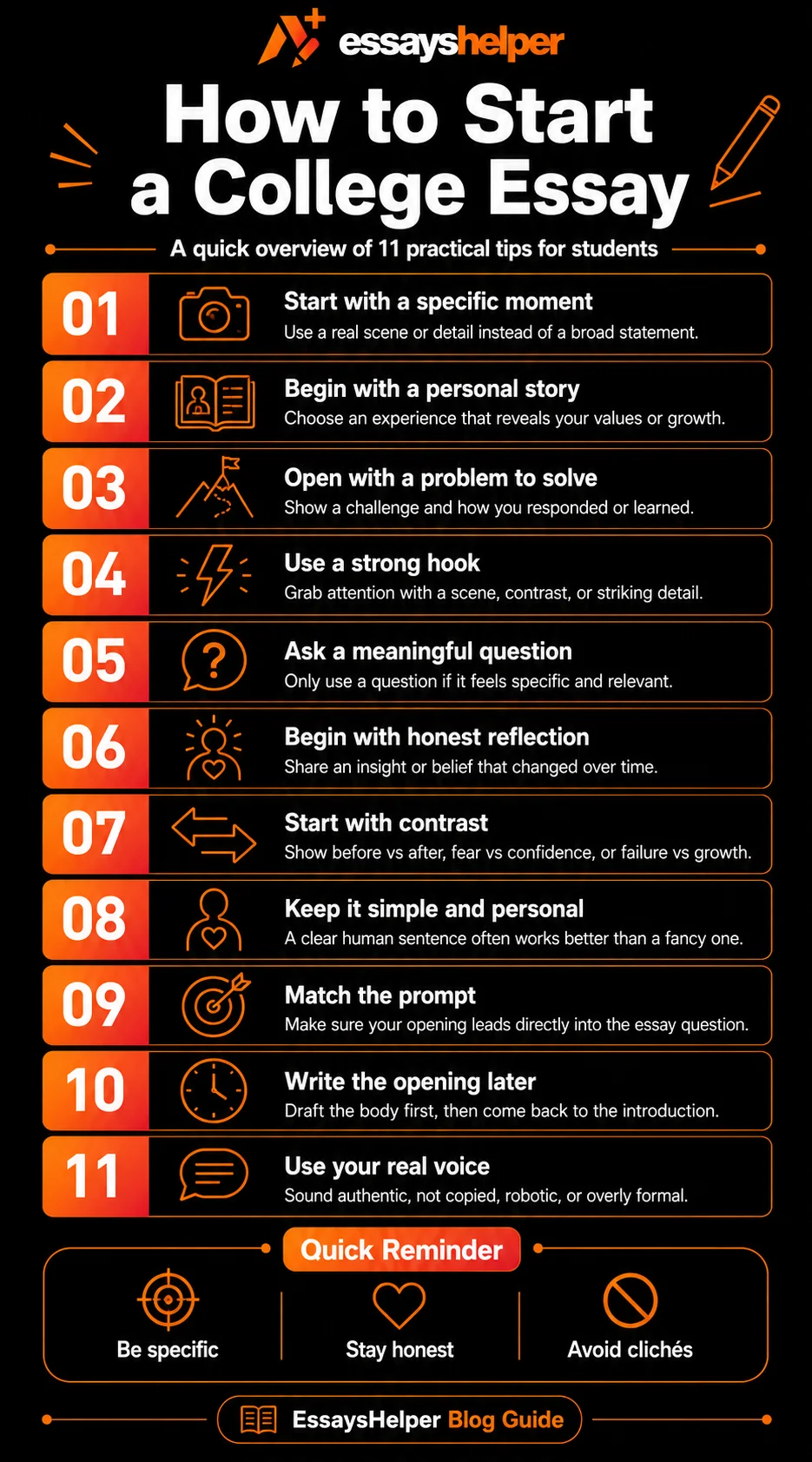
Below are 11 practical ways to start a college essay, with examples and explanations.
1. Start With a Specific Moment
A specific moment is often stronger than a general statement because it helps the reader see your experience instead of just hearing about it.
Weak opening:
I have always wanted to help people.
Stronger opening:
The first time I helped my younger brother read a full page without stopping, I realized patience could change someone’s confidence.
The stronger version works because it shows the student helping someone in a real situation. It does not simply claim that the student is helpful. It gives proof through a small moment.
This approach works well when your essay is about growth, leadership, family responsibility, teaching, service, or personal values.
Try asking yourself:
- Where was I?
- Who was with me?
- What was I doing?
- What did I notice?
- What changed in that moment?
You do not need a dramatic event. A quiet moment can be powerful if it reveals something meaningful.
2. Begin With a Personal Story
College essays work best when they show who you are, not just what you have achieved. A personal story can help the reader understand your values, background, or motivation.
Weak opening:
I am a hardworking student who is interested in science.
Stronger opening:
I kept a notebook beside my bed for questions I could not answer, from why my phone battery died faster in winter to why my grandmother’s medicine had different side effects.
The stronger opening shows curiosity instead of simply saying “I am curious.” This is important because college essays should demonstrate qualities through experience.
A personal story works especially well when you are writing about:
- Academic curiosity
- Family background
- A challenge you overcame
- A community experience
- A turning point
- A personal interest
- A future goal
Keep the story focused. You do not need to explain your whole life in the first paragraph. Start with one scene, then connect it to the larger message.
3. Open With a Problem You Had to Solve
Many good essays begin with a problem. The problem does not need to be huge. It just needs to reveal how you think, act, or grow.
For example:
The robot moved perfectly during practice, then froze three minutes before our school competition began.
This opening creates immediate interest. The reader wants to know what happened next. More importantly, it gives the student a chance to show problem-solving, teamwork, and calm under pressure.
Problem-based openings work well for students in many situations:
- A group project failed.
- A family responsibility affected schoolwork.
- A community issue pushed you to take action.
- A science experiment did not work.
- A personal fear forced you to grow.
- A leadership role became harder than expected.
For first generation college students, a problem-based opening might focus on navigating an unfamiliar education system, understanding applications, or learning academic expectations without family experience. This can be powerful when written honestly and without exaggeration.
The key is to focus on growth. Do not just describe the problem. Show what you learned, changed, or understood because of it.
4. Use a Strong Hook Without Sounding Forced
A hook is the opening idea that grabs the reader’s attention. But a hook should not feel fake or disconnected from the essay. A strong hook leads naturally into your story.
Good hooks can include:
- A short scene
- A surprising detail
- A meaningful question
- A contrast
- A personal statement
- A moment of tension
For example:
I did not expect a broken calculator to teach me more about leadership than a classroom ever had.
My first business failed because I forgot one important thing: customers do not buy effort, they buy solutions.
The room went silent when I admitted I did not understand the question.
These hooks work because they create curiosity and connect to a deeper idea.
A weak hook tries too hard:
Life is a rollercoaster full of ups and downs.
This sentence is familiar, but it does not tell the reader anything specific about you.
If you want to explore more opening styles, this guide on different hooks can help you understand how questions, scenes, facts, contrasts, and statements work in essays.
5. Start With a Question Only If It Adds Meaning
Starting with a question can work, but many student questions are too broad.
Weak question:
Have you ever faced a challenge?
This does not work well because almost everyone has faced a challenge. It feels generic.
Stronger question:
What do you do when the language you speak at home does not match the confidence you need in class?
This question is more specific. It gives a glimpse into the student’s experience and creates emotional meaning.
A question works best when it is personal, focused, and connected to the essay’s main idea. It should not sound like a motivational poster.
Other stronger examples:
How do you explain a dream to someone who sees it as impossible?
What happens when the quietest student in the room becomes the one responsible for leading it?
How do you rebuild confidence after one mistake changes how people see you?
If you start with a question, answer it through the essay. Do not use a question only because you do not know what else to write.
6. Begin With Honest Reflection
A reflective opening can work well for college application essays and personal statements because it shows maturity. It tells the reader that you can think deeply about your experiences.
Example:
I used to think confidence meant speaking first. Over time, I learned that listening carefully can be a stronger kind of leadership.
This opening is not dramatic, but it shows growth. It also gives the essay a clear direction. The reader expects a story about leadership, listening, and personal change.
Reflection-based openings are useful when your essay focuses on:
- Personal growth
- A changed belief
- Leadership
- Failure
- Identity
- Academic direction
- Community involvement
Another example:
For a long time, I measured success by how much I could handle alone. Asking for help taught me a different kind of strength.
This kind of opening feels honest and human. It does not pretend the student was perfect from the beginning.
7. Start With a Contrast
Contrast creates interest because it shows change or tension. A college essay often becomes stronger when the reader can see a before and after.
Types of contrast include:
- Past vs present
- Fear vs confidence
- Expectation vs reality
- Failure vs growth
- Silence vs voice
- Pressure vs purpose
Example:
I entered the debate room hoping not to be noticed. By the end of the semester, I was the person asking for one more round.
This opening works because it shows movement. The student changed from nervous to confident.
Another example:
I thought leadership meant having the loudest voice. My volunteer team taught me it often means asking the quietest person what they think.
This contrast reveals maturity and self-awareness.
If you are interested in topics that help develop argument, confidence, and communication skills, you may also explore debate topics for college students. These can help students practice forming opinions and expressing ideas clearly.
8. Use a Simple Sentence That Feels Personal
Some students think the first sentence must be complicated. It does not. A simple sentence can be powerful if it feels real.
Examples:
- I was twelve when I learned how heavy silence could feel.
- My notebook has always been messier than my room.
- I did not plan to become the person everyone asked for help.
- The first time I failed chemistry, I blamed the subject.
These openings are short, but they create curiosity. They also sound more natural than overdone sentences.
A simple sentence works because it gives the reader space to enter the story. It can feel more confident than a long sentence packed with too many ideas.
If you want to improve sentence variety, learning about types of sentences can help you mix short, direct lines with longer reflective ones.
9. Connect the Opening to the Essay Prompt
A college essay opening should not only sound good. It should answer the prompt.
If the prompt asks about growth, start before the growth happened.
If the prompt asks about community, start with a scene involving people.
If the prompt asks about academic interest, start with curiosity or a question that led you to learn more.
If the prompt asks about a challenge, start with the moment the challenge became real.
For example, if the prompt asks about a lesson learned from failure, this opening fits:
The first time our project failed, I was more embarrassed by the silence in the room than by the broken model on the table.
This opening connects directly to failure, teamwork, and reflection.
But if the prompt asks why you want to study biology, that same opening may not fit unless the broken model connects clearly to biology.
Before finalizing your opening, read the prompt again. Ask:
- Does my first paragraph lead toward the question?
- Will the reader understand why this story matters?
- Am I answering the prompt or just telling an interesting story?
This step can save your essay from feeling disconnected.
10. Write the Opening After Drafting the Body
Many students spend hours on the first sentence and never move forward. A better method is to write the body first, then return to the opening.
This works because you may not know the real message of your essay until you draft it. Sometimes the best opening is hidden in the third paragraph. Sometimes the strongest line comes from your conclusion. Sometimes a small detail you almost skipped becomes the perfect beginning.
Try this process:
- Write a rough version of the story.
- Highlight the most specific moment.
- Find the sentence that sounds most like you.
- Move that idea closer to the beginning.
- Rewrite the first paragraph around it.
This method reduces pressure. You do not need a perfect first line before you start writing. You need a draft you can improve.
Students who feel stuck at this stage may benefit from professional support for college essays, especially when they have a story but cannot shape it into a strong introduction and structure.
11. Start With Your Real Voice
Your college essay should sound like a thoughtful version of you, not like a robot, a dictionary, or someone trying too hard to impress.
Admissions readers and instructors want clarity. They want honesty. They want to understand how you think. A polished essay is good, but an over-polished essay can lose personality.
Weak voice:
My multifaceted intellectual journey has cultivated a profound appreciation for interdisciplinary excellence.
Stronger voice:
I did not understand why I loved both coding and storytelling until I built a website for my school newspaper.
The second version is clearer, more personal, and easier to trust.
Your voice can be serious, warm, reflective, curious, calm, or even lightly humorous if that fits your personality. The key is consistency. Do not begin with a dramatic tone if the rest of the essay is simple and reflective.
For more guidance, this article on personal style for writing can help students understand how to sound natural without becoming too casual.
How to Start a College Application Essay
A college application essay is different from a regular class essay. A class essay often focuses on analyzing a topic, source, or argument. A college application essay focuses more on you: your values, your growth, your background, your curiosity, and your potential.
If you are wondering how to start a college application essay, begin with a moment that reveals something important about your character. Do not begin by listing achievements. Your application already includes grades, activities, and awards. The essay should give the reader a deeper view.
For example, instead of starting with:
I have won several awards in science and have always been interested in medicine.
Try:
I first became interested in medicine while sitting beside my grandmother and trying to understand why one small pill could change the way she felt for an entire day.
The second opening gives a personal reason behind the academic interest.
For US applications, always check the application platform and individual college instructions. For UK applications, personal statement expectations are different. UCAS now gives applicants more structured guidance through questions about course choice, academic preparation, and preparation outside education, as explained in UCAS personal statement guidance. This means students should always match the opening to the actual application format.
A college application essay should usually show:
- Who you are
- What matters to you
- How you think
- What you have learned
- Why the story connects to your future
- The opening should begin that journey.
How to Start Off a College Essay Without Sounding Generic
Many students sound generic because they begin too broadly. They try to make a big statement instead of starting with a real detail.
Here are common generic openings and stronger alternatives.
| Generic Opening | Why It Feels Weak | Stronger Alternative |
| Since I was young, I have always wanted to help people. | Too common and vague | I first understood service when I spent Saturdays helping my neighbor carry groceries after her surgery. |
| In today’s world, education is very important. | Sounds like a school speech | My view of education changed when I had to teach myself algebra from borrowed library books. |
| Everyone faces challenges in life. | Too broad | My biggest challenge began with a missed bus, a late exam, and a choice to stop making excuses. |
| I am passionate about science. | Tells instead of shows | I started asking science questions after my kitchen windowsill became my first plant experiment. |
| Leadership is an important quality. | Sounds like a definition | I learned leadership when my team stopped looking for answers and started looking at me. |
The best openings usually include a person, place, action, or specific detail. If your first sentence could appear in thousands of essays, make it more personal.
A helpful test is to ask: “Could anyone write this sentence?” If the answer is yes, revise it.
How to Start a College Essay Examples
Below are original examples of ways to start a college essay. Use them for inspiration, but do not copy them. Your opening should come from your real experience.
Personal Growth Opening
I used to think being quiet meant I had nothing important to say. Then my history teacher asked me to lead a discussion on a topic I had only whispered about before.
Why it works: It introduces growth from silence to confidence.
Academic Interest Opening
My interest in economics began when I realized the price of bread in our local store changed more often than my school timetable.
Why it works: It connects academic curiosity to everyday life.
Community Service Opening
Every Friday afternoon, I watched the same elderly man sit alone at the community center until I finally asked if he wanted help with his phone.
Why it works: It shows observation, initiative, and human connection.
Leadership Opening
The meeting was supposed to last twenty minutes. An hour later, I was still standing at the whiteboard, trying to turn six different opinions into one plan.
Why it works: It places the reader in a leadership situation.
Failure or Challenge Opening
I failed my first driving test before I even left the parking space.
Why it works: It is specific, slightly surprising, and sets up reflection.
Creative Interest Opening
My first short story was written on the back of a grocery receipt because I was too afraid to call myself a writer.
Why it works: It reveals creativity and vulnerability.
Career Goal Opening
I did not decide to study engineering because I loved machines. I chose it because I hated watching people accept broken systems as normal.
Why it works: It links career interest to problem-solving and purpose.
These examples show that the opening does not need to explain everything. It only needs to invite the reader into the essay.
Best Ways to Start a College Essay by Essay Type
Different essays need different openings. A college application essay does not begin the same way as a research-based class essay or a scholarship essay.
| Essay Type | Best Opening Approach | Example Direction |
| College application essay | Start with a personal moment or reflection | A story that reveals values, growth, or curiosity |
| Personal statement | Start with motivation or identity | A moment that explains your academic or personal direction |
| Scholarship essay | Start with purpose, challenge, or impact | A story showing why support matters |
| Class essay | Start with context and a focused thesis direction | A clear introduction to the topic |
| Reflective essay | Start before the lesson was learned | A moment of change or realization |
| Research-based college essay | Start with a problem, question, or debate | A focused issue that leads to research |
| Capstone or final project introduction | Start with the real-world problem or academic gap | A problem your project aims to address |
For a college application essay, the opening should feel personal. For a research paper, it should feel focused and academic. For a scholarship essay, it should connect your goals to the opportunity. For a capstone project, it should introduce a problem, need, or gap.
If you are working on a larger project, EssaysHelper can also provide capstone project support across every discipline, especially when students need help organizing ideas, developing structure, or presenting their work clearly.
For standard academic essays, learning the best essay format for students can help you understand how introductions, body paragraphs, and conclusions work together.
Ways to Start a College Essay by Academic Interest
Your academic interest can also shape your opening. A student interested in nursing may begin differently from a student interested in business, engineering, or the arts.
Business and Management
Business-focused students can start with a decision, problem, customer experience, or leadership moment.
Example:
My first business lesson came from selling handmade keychains and realizing my best product was not the one I liked most, but the one people actually needed.
This works because business is about people, decisions, value, and problem-solving.
Healthcare and Nursing
Healthcare-focused students can start with care, observation, responsibility, or a moment that made them think differently about people’s needs.
Example:
I learned that care begins before treatment when I watched a nurse explain every step to my frightened cousin.
This opening shows empathy and attention to patient experience.
Engineering and Computer Science
Engineering and computer science students can start with a broken system, a failed project, a technical curiosity, or a problem that needed a solution.
Example:
I became interested in coding when I built a study timer that worked perfectly for everyone except me.
This kind of opening can lead into creativity, testing, and improvement.
Education and Social Sciences
Students interested in education, psychology, sociology, or social sciences can start with a classroom moment, a community issue, or a question about human behavior.
Example:
I first noticed how much seating charts mattered when the quietest student in our class stopped raising her hand.
This opening shows observation and curiosity about learning environments.
Arts and Humanities
Arts and humanities students can begin with a book, performance, image, language moment, or personal interpretation.
Example:
The first poem I loved made no sense to me, which is exactly why I kept reading it.
This opening shows curiosity and a willingness to think deeply.
Science and Research
Science-focused students can start with a question, experiment, observation, or surprising result.
Example:
My first experiment failed because I watered the plants equally, then learned equality and fairness are not always the same thing.
This opening can lead into scientific thinking and personal reflection.
If you are still exploring possible academic directions, reading about research topics can help you see how interests become focused questions.
Common Mistakes Students Make When Starting a College Essay
Starting a college essay is difficult because students often feel pressure to sound impressive. That pressure leads to common mistakes.
- One major mistake is starting too broad. Sentences about society, education, success, or life in general often feel empty because they do not show your personal experience.
- Another mistake is copying the style of sample essays too closely. Samples can help you understand structure, but your essay should not sound like someone else’s story.
- Students also make the mistake of listing achievements in the opening. Achievements matter, but the essay should reveal the person behind them. Instead of saying you were club president, show a moment when leadership tested you.
- A common problem is using clichés. Openings like “hard work pays off” or “everything happens for a reason” are familiar, but they do not feel original.
- Some students begin with a quote from a famous person. This can work occasionally, but it often weakens the essay because the first voice the reader hears is not yours.
Other mistakes include:
- Ignoring the prompt
- Using a dramatic hook that does not connect to the essay
- Trying to sound older or more formal than you are
- Explaining the lesson before telling the story
- Writing a first paragraph that repeats the resume
- Using humor that may not land well
- Starting with a sad story but not showing growth
Choosing the wrong tone can also weaken the opening. If you are unsure whether your essay sounds reflective, confident, formal, or too casual, this guide on different writing tones can help.
How to Make Your College Essay Opening Stronger
A weak opening can usually be improved. You do not have to throw away the whole essay. Often, you only need to make the beginning more specific.
Start by cutting the first two generic sentences. Many students warm up before reaching the real story. The actual opening may begin in sentence three or four.
For example:
Original:
I have always believed that challenges help people grow. Everyone has difficult moments in life. My most important challenge happened during my second year of high school when I had to care for my younger sister after school.
Improved:
During my second year of high school, I learned to finish homework with one hand while holding my younger sister’s storybook in the other.
The improved version starts with the real story. It is more visual and personal.
Another way to strengthen the opening is to add a specific detail. Instead of saying “I was nervous,” show what nervous looked like.
Weak:
I was nervous before my speech.
Stronger:
My note cards shook so badly that I read the first line twice before noticing.
You can also read your opening aloud. If it sounds unlike you, revise it. A college essay should be polished, but it should still sound human.
If your opening feels disconnected, check the rest of the essay. Ask whether the first paragraph leads to the main point. If it does not, rewrite it after finishing the body.
Students who are managing multiple deadlines can use academic assignment support to stay organized, especially when they need feedback on structure, clarity, and formatting.
Quick Checklist Before Finalizing Your Opening
Before you finalize your college essay opening, use this checklist:
- Does it answer or connect to the prompt?
- Does it sound specific rather than general?
- Does it reveal something about you?
- Does it feel honest?
- Does it avoid clichés?
- Does it make the reader want to continue?
- Does it connect to the rest of the essay?
- Does the tone match your personality?
- Does it avoid exaggeration?
- Does it stay within the word limit?
- Does it show a moment, idea, or reflection clearly?
- Does it avoid copying sample essays?
If your answer is yes to most of these questions, your opening is probably on the right track.
FAQs About How to Start a College Essay
How do I start my college essay?
Start your college essay with a specific moment, personal story, honest reflection, or meaningful problem that connects to the prompt. Avoid broad lines like “Since I was young” and begin with something only you could write.
What is the best way to start a college essay?
The best way to start a college essay is with a clear, personal opening that shows your voice and leads into the main story. A small real moment is often stronger than a dramatic or generic statement.
How do you start off a college essay without sounding boring?
Start with a specific detail, action, or personal observation. Instead of saying you are hardworking, show a moment where your effort, curiosity, or growth became visible.
How do I start a college application essay?
To start a college application essay, choose a story that reveals your values, personality, or growth. The opening should make the reader understand something important about you beyond grades and activities.
Can I start a college essay with a question?
Yes, you can start with a question if it is specific and meaningful. Avoid generic questions like “Have you ever faced a challenge?” A stronger question should connect directly to your real experience.
What are good ways to start a college essay?
Good ways to start a college essay include beginning with a personal story, a problem, a moment of change, a contrast, a simple sentence, or an honest reflection. The best opening depends on your essay prompt.
Should I start my college essay with a quote?
It is usually better to start with your own voice rather than a quote from someone else. A quote can work only if it connects deeply to your story, but many quoted openings feel generic.
How long should a college essay introduction be?
A college essay introduction is usually short. In many application essays, one focused paragraph is enough. The opening should introduce the story or idea without taking too much space from the main reflection.
What are some how to start a college essay examples?
Examples include starting with a small personal moment, such as “My notebook has always been messier than my room,” or a reflective line, such as “I used to think confidence meant speaking first.” The best examples feel specific and honest.
What should I avoid in the first sentence of a college essay?
Avoid clichés, broad statements, fake drama, overused quotes, and sentences that could apply to any student. Your first sentence should feel connected to your real story and the essay prompt.
Conclusion
The best college essay openings are specific, honest, clear, and connected to the student’s real experience. You do not need to chase a perfect first sentence or sound more impressive than you are. A strong opening can begin with a small moment, a personal reflection, a problem, a contrast, or a simple sentence that feels true.
If you are stuck, do not spend hours staring at the first line. Draft the body, find the strongest moment, and return to the introduction later. The real goal is not just to grab attention. It is to help the reader understand who you are and why your story matters.
EssaysHelper can support students who need help with college essays, academic writing, editing, and capstone project support across disciplines, especially when they have ideas but need guidance turning them into a clear and polished essay.