

Start here: your formatting help hub
If you want a quick place to bookmark while you learn, EssaysHelper has a growing library of writing guides you can return to whenever you feel stuck.
And if you’re pressed for time or your grading criteria is strict, our essay writing services can help with structure, formatting, and referencing.
Now let’s break everything down in a beginner friendly way.
What is an essay format
An essay format is the layout and style rules your instructor or institution expects. It includes how your document looks (font, spacing, margins, headings, page numbers) and how you credit sources (in text citations and the reference list).
A simple way to think about it is this: formatting is the presentation layer. Your ideas can be strong, but if your format is inconsistent, the whole essay can look less credible.
This matters more than many beginners expect. For example, NAEP writing results reported that only 24% of students performed at the “Proficient” level in writing in 2011, which shows how common it is for learners to struggle with writing basics and presentation habits.
Why different essay formats exist
Different subjects care about different details.
Some fields prioritize how recent research is, so they use systems that highlight dates. Other fields focus more on authors and specific passages, so they use systems that highlight authorship and page numbers. There are also formats designed for detailed source notes, which is useful in subjects like history.
So you are not learning “random rules.” You are learning the communication style your subject expects.
The universal essay structure that works in every format
Most academic essays still follow the same skeleton. Once you understand this, switching between formats becomes much easier because you are only changing the outside layer, not the entire approach.
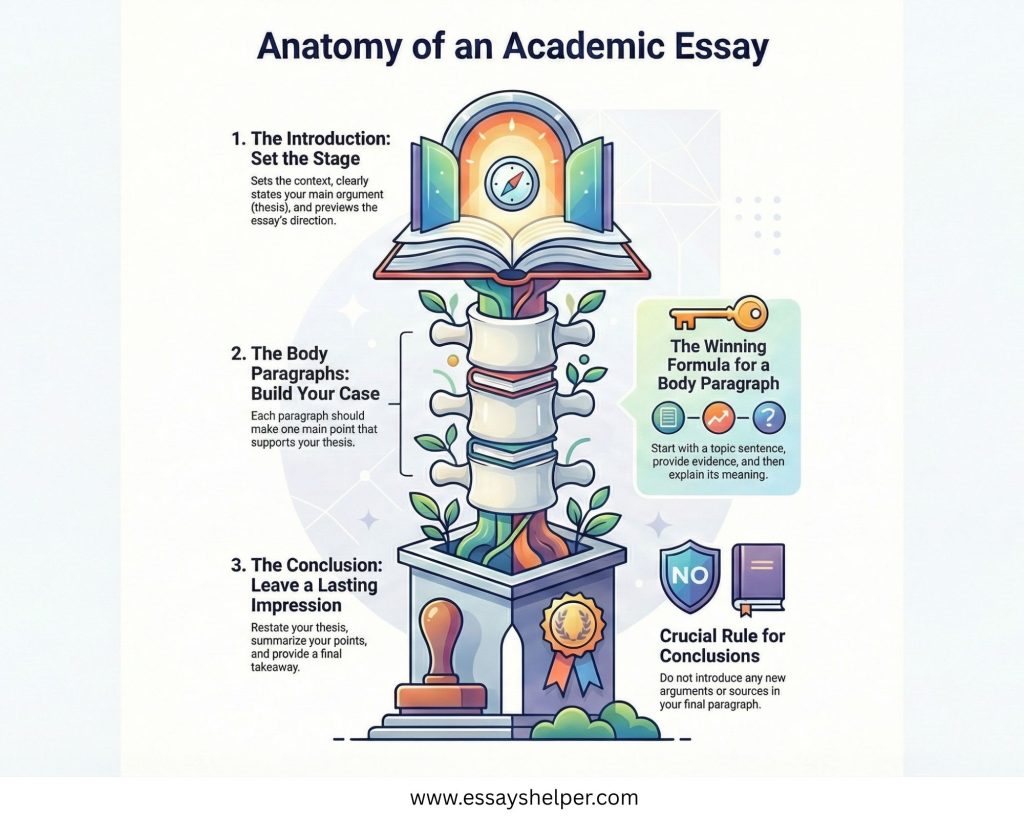
1. Introduction
A good introduction sets context, states your main argument (your thesis), and shows the reader what to expect. You do not need to over explain here. You simply need to make your direction clear.
2. Body paragraphs
Each body paragraph should make one main point that supports your thesis. A clean paragraph usually starts with a topic sentence, then includes evidence (such as a quote, statistic, or example), and then explains the meaning of that evidence. The explanation is the part many beginners skip, but it is often the part that earns the marks.
3. Conclusion
A conclusion restates your thesis in fresh words, summarizes your main points, and leaves the reader with a final takeaway. It should not introduce new sources or brand new arguments.
Formatting basics that apply to most essays
Even though APA, MLA, Chicago, and Harvard have their own rules, many teachers expect the same “clean document” habits.
1. Page layout
Your goal is consistency. Use one font and size throughout, keep spacing consistent, and follow the margin requirements in your assignment brief. Add page numbers if required, and make sure your paragraphs look uniform from start to finish.
2. Headings
Headings help the reader follow your logic, especially in longer essays. If your assignment is over about 1200 words, headings usually make your work easier to read and easier to mark.
3. Citations and references
Citations do two jobs at the same time. They show that your claims are supported, and they protect you from accidental plagiarism. Your chosen format controls how you cite inside the text and how you list sources at the end.
If you are not sure which format to use for your assignment, this guide can help you decide based on subject and context: best essay format
How to choose the right essay format for your assignment
Start with one rule: follow the format your instructor asks for, even if you personally prefer a different one.
If the assignment brief does not specify a format, look at your subject area and the types of sources you are using. Social sciences often lean toward APA. Literature and humanities often use MLA. History and some humanities often use Chicago. Many institutions also use Harvard referencing (author and date), especially in the UK and other international contexts.
A quick extra tip: check the articles and textbooks on your module reading list. The style used there often matches what your instructor expects.
APA essay format explained for beginners
APA is widely used in psychology, education, nursing, and other social sciences. It is designed to make research easy to trace, which is why dates matter so much in APA.
APA essays typically include a clearly formatted title page in many academic settings, consistent headings, and in text citations that show the author and year. At the end, you include a reference list that provides full details of every source you cited.
If you want a full walk through with layout rules and examples, use this guide: APA essay format
Quick APA example
In text, you usually cite like this: (Smith, 2022).
If you quote directly, you often include a page number too: (Smith, 2022, p. 45).
In your references, you provide the full publication details so someone else can find the source.
The beginner goal is not memorizing every punctuation rule on day one. The goal is learning the pattern and applying it consistently.
MLA format essay basics
MLA is common in literature, English, and many humanities subjects. It focuses heavily on authorship and the exact location of the evidence, which is why page numbers matter so much.
MLA essays often begin without a separate title page (unless your instructor requests one). Instead, you start on page one with a heading that includes your details, and you place the title above the first paragraph. In text citations usually include the author’s last name and the page number. At the end, you add a Works Cited page.
For an easy layout guide with examples, see: MLA format essay
Quick MLA example
A typical in text citation looks like this: (Smith 45).
Your Works Cited entry includes full source details so the reader can trace it.
Chicago style essay format made simple
Chicago style is popular in history and some humanities. It is flexible because it offers two different systems, and your instructor will normally tell you which one to use.
One system uses notes and a bibliography, which means you cite sources in footnotes or endnotes and then list full details in a bibliography. The other system uses author and date citations, which can look similar to Harvard referencing.
If you are new to Chicago and want a clean checklist, use this guide: Chicago style essay format
Quick Chicago notes idea
Instead of placing full citation details inside the paragraph, you place a small note number in the text and add the citation details in a footnote or endnote. This keeps paragraphs clean while still giving detailed source information.
Harvard essay format style overview
Harvard referencing is an author and date system used in many universities, especially in the UK and internationally. It is popular because it is straightforward in text and easy to scan.
In your paragraphs, you typically cite the author and year. If you are quoting, you add a page number. At the end, you provide a reference list arranged alphabetically by the author’s surname.
For a beginner friendly guide with examples, see: Harvard essay format style
Quick Harvard example
A simple citation looks like: (Smith, 2022).
A quote citation often looks like: (Smith, 2022, p. 45).
A simple method to switch formats without stress
Most formatting panic happens when students write the entire essay first and then try to “fix” the formatting at the end. A smoother approach is to build a small system you follow every time.
Set up your document before you write
Take two minutes at the start to set spacing, margins, font, and page numbers. If your format needs headings, create a few headings early so your structure is already visible.
Decide your citation style early
Pick your required style before you do heavy research. This changes what information you record while reading.
If you are using APA or Harvard, always capture author and year immediately. If you are using MLA, always capture page numbers for anything you might quote. If you are using Chicago notes, capture full source details so your footnotes are quick to build.
Keep a live reference list while you write
Instead of creating your references at the end, add each source to your reference list as soon as you use it. This habit alone prevents last minute confusion and missing sources.
Essay format examples that make the differences clear
Here is the comforting truth: your argument and paragraph structure can stay mostly the same across formats. The major differences are how you cite and how you build your source list.
Imagine you are using an idea from John Smith published in 2022, and you are referencing page 45.
- In APA, you typically cite author, year, and page for a quote.
- In MLA, you typically cite author and page.
- In Harvard, you typically cite author and year, and add page for a quote.
- In Chicago notes, you often use a footnote number in the text and place source details in the note.
Once you see this, formats stop feeling like separate worlds. They are just different labeling systems for sources.
Common essay formatting mistakes to avoid
Formatting errors are often small, but they create an instant negative impression because they are easy to spot.
Some of the most common issues include mixing styles (like MLA in text citations with an APA reference list), inconsistent spacing and headings, missing page numbers for direct quotes, and reference lists that do not match the citations used in the essay.
If you want a practical checklist of what to scan before you submit, this guide is helpful: essay format mistakes
Formatting tips that instantly make your essay look more professional
Make each paragraph do one clear job
If a paragraph is trying to explain two different points, split it. Your reader should never wonder what your paragraph is “about.”
Place citations right next to the claim
When a sentence is based on a source, cite it in that sentence. Do not leave the reader guessing which sentence belongs to which source.
Use simple transitions to connect ideas
Transitions make your argument feel smooth. You do not need fancy phrases. Simple connectors like “however,” “for example,” and “as a result” are enough.
Proofread formatting like it is its own task
A good final check is to scan only for presentation. Look for consistent spacing, consistent headings, correct citation style, and a reference list that matches your in text citations.
Conclusion
Mastering essay formats is less about memorization and more about building a repeatable process. Once you understand the universal structure, you can apply APA, MLA, Chicago, or Harvard rules with confidence. Set up your document early, track sources as you write, and do a final formatting scan before you submit.
FAQs
1) What are the main essay formats used in universities?
The most common ones are APA, MLA, Chicago, and Harvard. Your department and instructor usually decide which one you should use.
2) Which essay format is easiest for beginners?
Many beginners find APA and Harvard easier because the author and year pattern repeats consistently. MLA can also feel simple once you get used to adding page numbers.
3) Do essay formats change the structure of an essay?
Usually no. The core structure stays the same: introduction, body, and conclusion. Formats mainly change layout rules and referencing style.
4) What happens if I use the wrong citation style?
You can lose marks for referencing and presentation. It can also raise questions about academic integrity if citations are missing or inconsistent.
5) How can I format an essay quickly without missing details?
Set up margins, spacing, and page numbers first. Then cite sources while writing and keep your reference list updated as you go.
6) Do I always need a title page?
Not always. APA often uses a title page in formal academic submissions, while MLA often starts on page one with a heading instead. Your assignment brief is the final rule.
7) How do I avoid messy formatting at the last minute?
Format as you write, not after. Add headings early, cite immediately, and maintain a live reference list throughout your draft.
8) How many sources should I include in my reference list?
It depends on your assignment requirements and essay length. A safe rule is to include enough credible sources to support each key claim, and to ensure every in text citation has a matching full reference.