
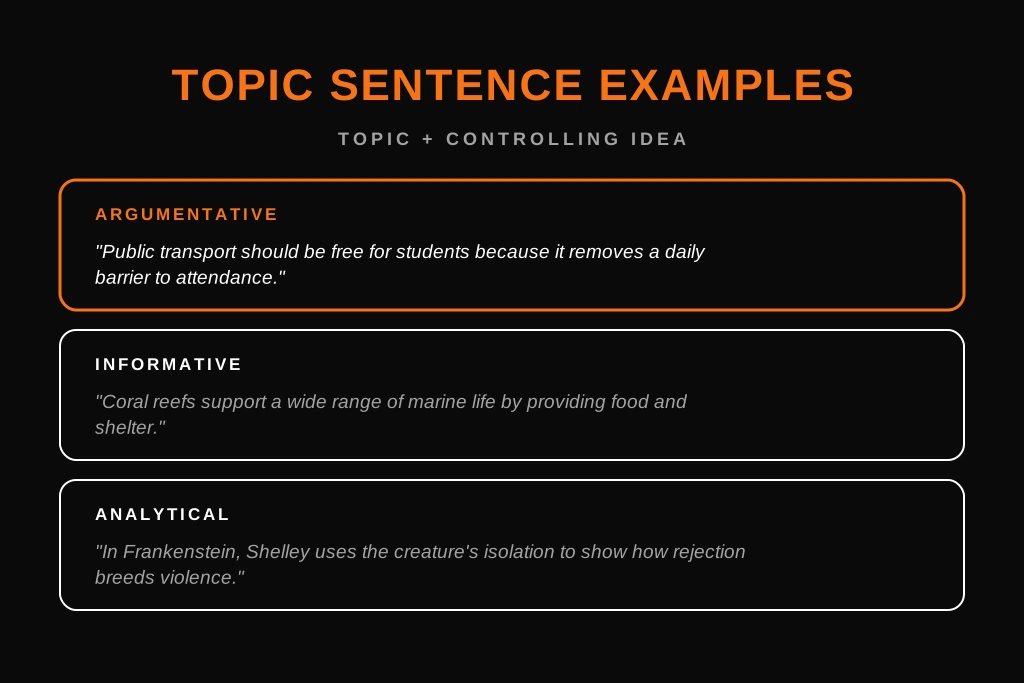
Topic sentence examples show how one sentence can state a paragraph’s main point clearly. A good topic sentence names the topic and the specific point you will prove about it, a pattern often summed up as topic + controlling idea. Here are three quick examples:
- Argumentative: “Public transport should be free for students because it removes a daily barrier to attendance.”
- Informative: “Coral reefs support a wide range of marine life by providing food and shelter.”
- Analytical: “In Frankenstein, Shelley uses the creature’s isolation to show how rejection breeds violence.”
Below you will find more than 60 good topic sentence examples, grouped by essay type, subject, grade level and paragraph job, each with a short note on why it works. Use them as models for your own writing rather than copying them word for word. If you want the full step by step method first, see our guide on how to write a topic sentence.
What Makes a Good Topic Sentence Example
Every strong example in this guide does the same three things: it names one topic, makes a specific point about it, and connects to the essay’s larger argument. Purdue OWL describes a topic sentence as “a sentence that indicates in a general way what idea or thesis the paragraph is going to deal with.” The examples below put that definition into practice.
As you read, notice the controlling idea in each sentence. The UNC Writing Center explains that the controlling idea of a paragraph often appears as the topic sentence, and it is the part that turns a bare topic into a point worth reading. The examples below show how that idea works in different kinds of writing.
A quick test helps you judge any example, including your own. Ask whether the sentence covers one idea, whether someone could question it, and whether one paragraph of evidence could prove it. If the answer to all three is yes, it is a strong model to learn from.
How to use this list of examples
Start with the section that matches your assignment, such as argumentative essays, history or middle school. Read three or four examples and look for what they share, usually a clear subject, a strong verb and a reason or result. Then try writing your own sentence in the same shape before you look at more examples. Reading too many at once can make your writing sound borrowed, so it helps to study a few closely rather than skim them all. The short note after each example explains what makes it work, which is the part you can reuse in your own writing.
Topic sentence vs supporting sentence examples
Students sometimes confuse a topic sentence with the sentences that support it. The topic sentence makes the point, and supporting sentences prove it with facts, quotes or explanation. Compare these two:
- Topic sentence: “Urban trees lower summer temperatures in crowded neighborhoods.”
- Supporting sentence: “Shaded streets can feel noticeably cooler than nearby streets with no trees.”
The first sentence states a claim that needs proof. The second gives a detail that helps prove it. If your opening sentence reads like the second one, it is probably evidence, and you need a broader point above it.
Topic Sentence Examples by Essay Type
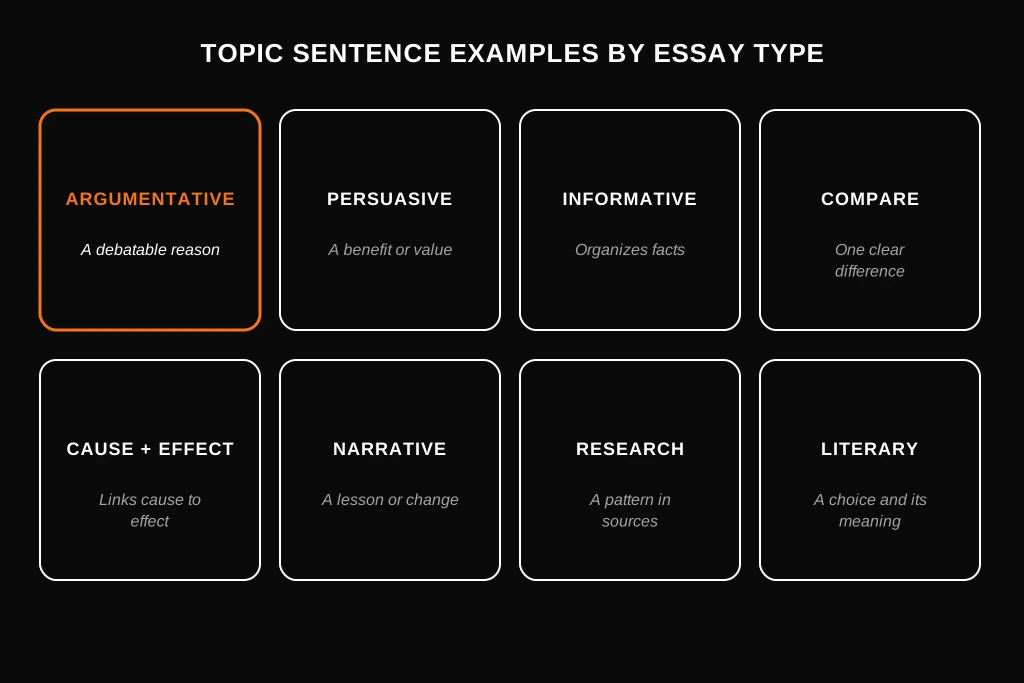
The pattern stays the same across essay types, but the controlling idea changes. Argumentative examples make debatable claims, informative examples organize facts, and analytical examples interpret how a text or event works.
Topic sentence examples for argumentative essays
Argumentative topic sentences state one reason that supports your position and invite the reader to agree or disagree. Each one should connect to your thesis, so a reader who skims only these sentences can still follow your case. Notice how every example below pairs a position with a reason.
- “Cities should ban cars from downtown streets on weekends because pedestrian zones increase spending at local shops.” It gives a clear position and a reason the paragraph can prove.
- “Standardized tests should play a smaller role in college admissions because they reward test preparation more than learning.” It names one reason and makes a claim someone could challenge.
- “Voting should be made compulsory because it would give elected leaders a clearer picture of public opinion.” It is debatable and focused on a single benefit.
- “Schools should teach personal finance as a required course because many students leave school without basic budgeting skills.” It links the claim to a specific, provable problem.
Each of these would sit under a thesis that lists several reasons. For the full structure of that kind of essay, see our guide to writing an argumentative essay.
Topic sentence examples for persuasive essays
Persuasive topic sentences are similar to argumentative ones, but they lean more on the reader’s values and the benefits of acting.
- “Adopting a pet from a shelter saves a life and costs far less than buying from a breeder.” It appeals to values and practical benefit at once.
- “Every household can cut its energy bills by switching to simple habits like unplugging idle devices.” It promises a clear benefit the paragraph will show.
- “Volunteering for just one hour a week can build skills that employers notice.” It is specific and motivating.
- “Libraries deserve longer opening hours because they are often the only quiet study space students can access.” It persuades by naming a real need.
Topic sentence examples for informative essays
Informative topic sentences explain rather than argue. They still need a controlling idea, but that idea organizes information.
- “Volcanoes form where tectonic plates pull apart or push together, releasing magma from deep underground.” It organizes the paragraph around how volcanoes form.
- “The human heart has four chambers, each with a specific role in moving blood through the body.” It sets up a clear explanation with a built in structure.
- “Recycling plastic involves sorting, cleaning, shredding and melting the material into new products.” It previews the steps the paragraph will explain.
- “Sleep happens in cycles, and each cycle includes light, deep and dream stages.” It introduces a process the paragraph will describe.
Topic sentence examples for compare and contrast essays
- “Unlike e-books, printed books let readers rest their eyes from screens.” It sets up one clear difference.
- “Both cats and dogs make loyal pets, but dogs need far more daily attention.” It acknowledges a similarity and focuses on a difference.
- “City life offers more job options than rural life, while rural life offers lower living costs.” It balances two sides fairly.
- “Renting and buying a home both carry costs, but renting offers more flexibility for young workers.” It compares two options on one clear point.
Topic sentence examples for cause and effect essays
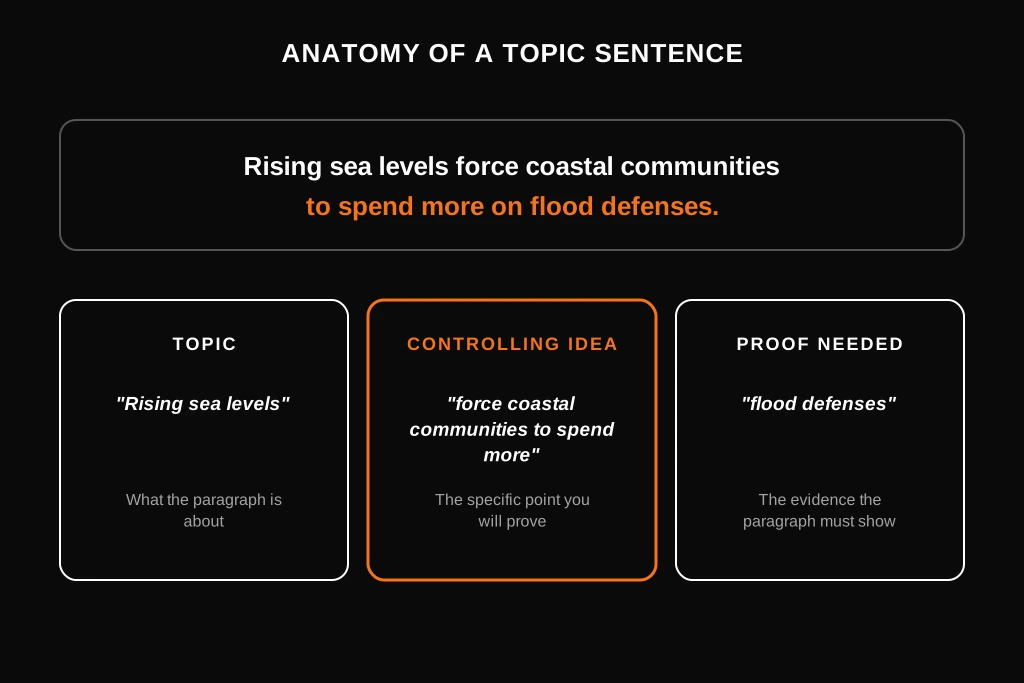
- “Rising sea levels force coastal communities to spend more on flood defenses.” It links a cause to a specific effect.
- “Skipping breakfast often leads to lower concentration in morning classes.” It is a focused cause and effect claim.
- “The invention of the printing press caused literacy rates in Europe to climb over the following centuries.” It connects a historical cause to a long term effect.
- “Long commutes reduce the time workers can spend on exercise and family life.” It names one cause and two related effects.
Topic sentence examples for narrative and personal essays
- “Losing my first job taught me more about resilience than any success had.” It frames the story around a lesson.
- “The summer I worked at my uncle’s bakery showed me how much patience good work requires.” It sets up a story with a clear point.
- “Moving schools in eighth grade forced me to become more confident with strangers.” It focuses the paragraph on one change.
- “Learning to swim as an adult showed me that fear shrinks once you face it daily.” It is personal but still makes a point.
Topic sentence examples for research papers
Research topic sentences usually introduce a theme across sources and use careful language when the evidence is limited.
- “Several studies indicate that green spaces in cities may lower stress levels among residents.” It sums up a pattern across sources and hedges appropriately.
- “Research on online learning points to stronger results when students receive regular feedback.” It keeps the writer in control of the sources.
- “Evidence from public health data suggests that sugar taxes can reduce soft drink sales.” It presents a cautious, evidence based claim.
- “Recent work on bilingual education shows benefits for problem solving as well as language skills.” It previews the findings the paragraph will discuss.
Topic sentence examples for literary analysis
Literary topic sentences name an author’s choice and explain what it reveals, instead of retelling the plot.
- “In Pride and Prejudice, Austen uses Mr Collins’s long speeches to mock the importance of social rank.” It names a device and its purpose.
- “Poe’s narrator in ‘The Tell-Tale Heart’ repeats his claims of calm so often that he exposes his own panic.” It interprets a pattern in the text.
- “In Hamlet, Shakespeare uses the play within a play to show Hamlet’s need for proof before action.” It connects a structural choice to character.
- “Fitzgerald presents Tom Buchanan’s wealth as a shield that protects him from consequences.” It makes an arguable claim about a character.
If you are writing about a novel, poem or play, our guide to the literary analysis essay shows how topic sentences like these fit into a complete essay.
Topic sentence examples for rhetorical analysis
- “In ‘Ain’t I a Woman?’ Sojourner Truth uses repeated questions to challenge her audience’s assumptions.” It names a strategy and its effect.
- “Lincoln’s Second Inaugural Address relies on a calm, humble tone to unite a divided nation.” It connects tone to purpose.
- “Frederick Douglass uses irony in his Fourth of July speech to expose the gap between American ideals and slavery.” It identifies a device and its persuasive goal.
Topic Sentence Examples by Subject
Topic sentences look different from one subject to the next because each subject values a different kind of evidence. History rewards claims about causes, science rewards precise explanations, and English rewards interpretation.
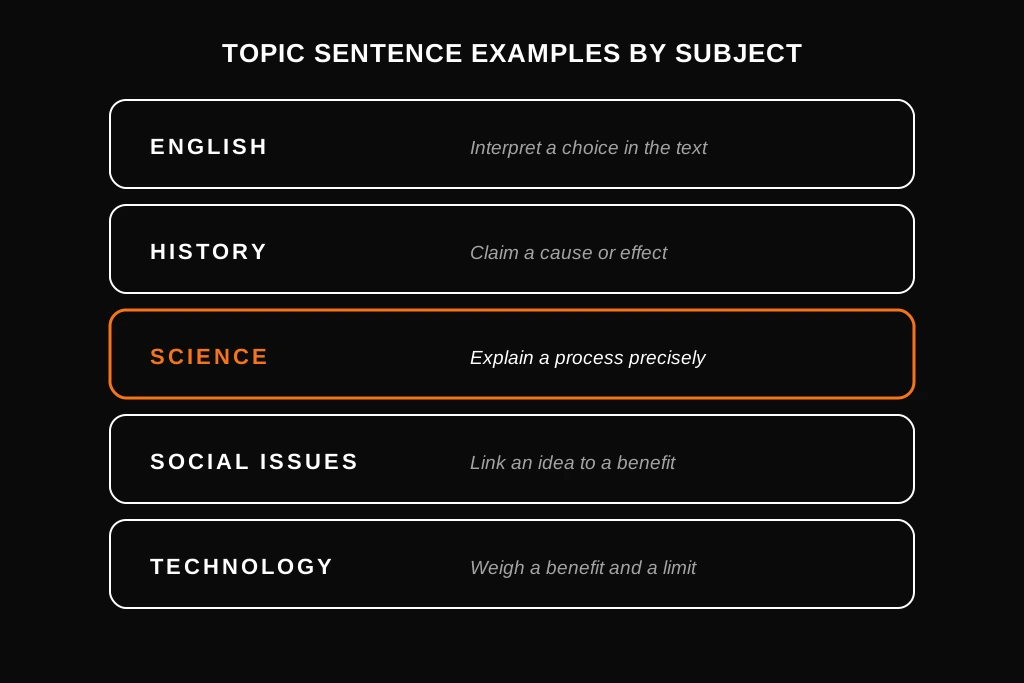
English and literature
- “In Romeo and Juliet, the lovers’ haste reflects how youth can turn passion into tragedy.” It interprets character through a theme.
- “Jane Eyre’s refusal to marry St John shows that she values love over duty.” It explains what a choice reveals.
- “The repeated storms in Wuthering Heights mirror the violent emotions of its characters.” It links setting to meaning.
History
- “The Industrial Revolution reshaped family life by moving work from homes into factories.” It makes a clear historical claim.
- “Trade along the Silk Road spread ideas and technologies as well as goods.” It argues for a wider effect.
- “The Magna Carta mattered less for its immediate effects than for the principle that rulers must follow the law.” It offers a thoughtful interpretation.
Science
- “Photosynthesis allows plants to turn sunlight into chemical energy stored in sugars.” It states a precise scientific process.
- “Vaccines train the immune system to recognize a germ before a real infection occurs.” It explains how something works.
- “Antibiotic resistance grows when bacteria survive treatment and pass on their resistance.” It links a cause to a mechanism.
Social issues
- “Affordable childcare allows more parents to stay in the workforce.” It makes a focused claim about a social issue.
- “Community gardens strengthen neighborhoods by giving residents a shared project.” It connects a local idea to a social benefit.
- “Fast fashion harms the environment through heavy water use and textile waste.” It names a problem and two causes.
Technology
- “Smartphones have changed how teenagers maintain friendships outside school.” It sets up a focused discussion of change.
- “Two step verification protects online accounts even when passwords are stolen.” It explains a clear benefit.
- “Artificial intelligence tools can speed up routine tasks but still need human review for accuracy.” It balances a benefit with a limit.
Topic Sentence Examples by Grade Level
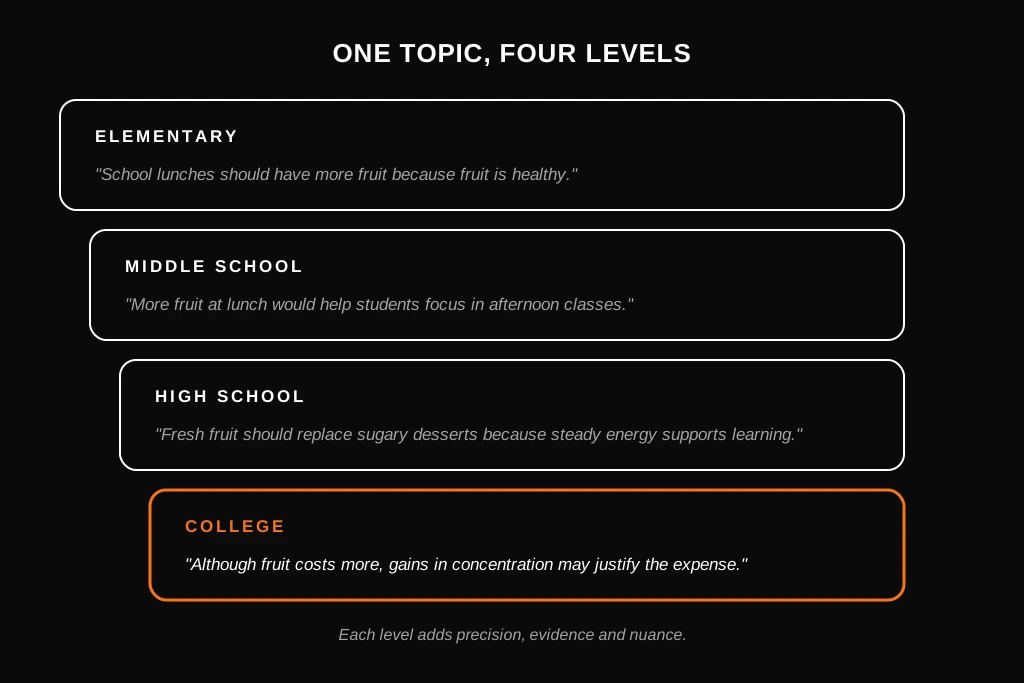
A topic sentence grows more precise and more complex as students move up through school. The table shows the same topic, school lunches, written at four levels.
| Level | Topic sentence example | What changes |
|---|---|---|
| Elementary | School lunches should have more fruit because fruit is healthy. | One topic and a simple reason |
| Middle school | Adding more fruit to school lunches would help students stay focused in afternoon classes. | A clearer reason with a specific effect |
| High school | Schools should replace sugary desserts with fresh fruit because steady energy supports better afternoon learning. | A debatable claim tied to evidence |
| College | Although fresh fruit costs schools more, the gains in student concentration may justify the expense. | Acknowledges a counterpoint and hedges |
Topic sentence examples for elementary students
- “My favorite season is fall because the leaves change color.” It names a topic and gives a reason.
- “Penguins are amazing birds because they can swim but not fly.” It is simple, clear and focused.
Topic sentence examples for middle school
- “Reading for twenty minutes each night helps students build a bigger vocabulary.” It makes a clear point with a benefit.
- “Team sports teach students how to work with people who think differently.” It focuses on one lesson.
- “Field trips make learning stick because students connect lessons to real places.” It explains a reason simply.
Topic sentence examples for high school and AP
- “Social pressure, more than personal ambition, drives Macbeth’s first crime.” It makes an arguable interpretation.
- “Later school start times would improve attendance by matching teenagers’ natural sleep patterns.” It ties a claim to a cause.
- “Douglass’s use of personal stories makes his argument against slavery harder to dismiss.” It analyzes a rhetorical effect, which suits AP Lang.
Topic sentence examples for college
- “Although remote work expands access to jobs, it can widen gaps in mentoring for new employees.” It handles complexity with a counterpoint.
- “Shelley complicates the idea of the monster by showing the creature as more humane than his maker.” It challenges a simple reading.
- “Recent research suggests that spaced practice may outperform cramming, though results vary by subject.” It uses careful academic hedging.
Topic Sentence Examples for Different Paragraph Jobs
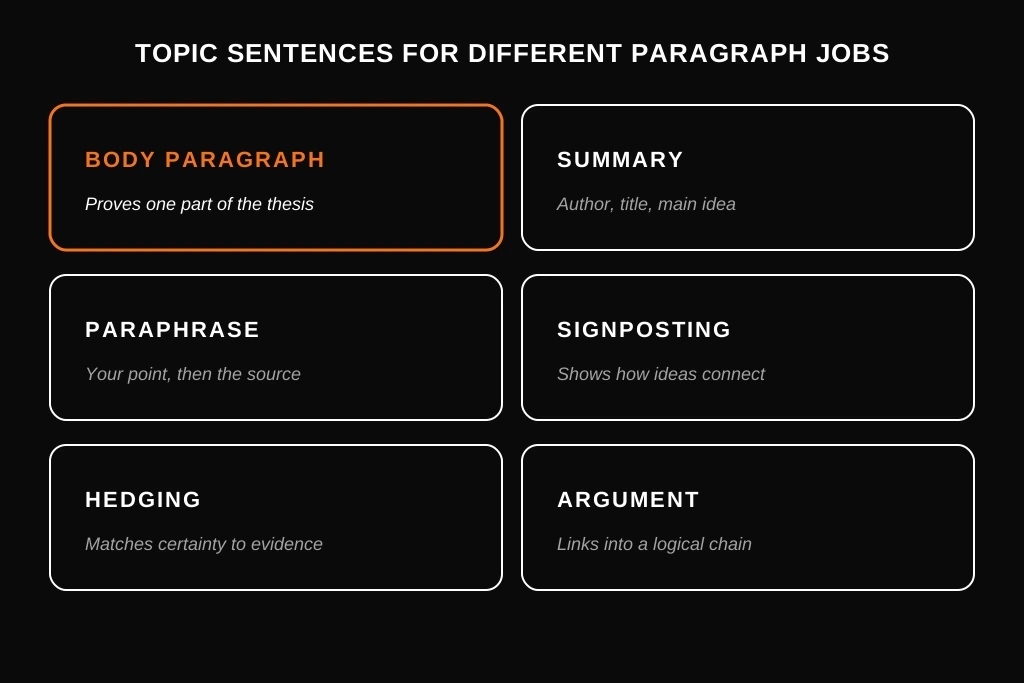
Not every paragraph argues a point. Some summarize, some bring in sources, some guide the reader and some build an argument step by step. These examples show what a topic sentence looks like in each role.
How to write a body paragraph from a topic sentence
If you are learning how to write a body paragraph, start by seeing a topic sentence lead a full paragraph. Each topic sentence should prove one part of a strong thesis statement, and the sentences after it follow a point, evidence, explanation, link pattern. Here is a short model:
Topic sentence: Community gardens improve diets in neighborhoods with few grocery stores.
Evidence: Gardeners often grow vegetables they would otherwise struggle to buy nearby.
Explanation: Easy access to fresh produce makes healthier meals more likely.
Link: This direct benefit is one reason cities should fund more garden plots.
How to write a summary topic sentence
When you learn how to write a summary, the first sentence names the author, the title and the main idea. These examples show the pattern.
- “In ‘Self-Reliance,’ Ralph Waldo Emerson argues that people should trust their own judgment over social expectations.” Author, title and main idea in one line.
- “Mary Wollstonecraft’s A Vindication of the Rights of Woman claims that women deserve the same education as men.” It states the main claim neutrally.
How to paraphrase evidence under a topic sentence
Knowing how to paraphrase lets you support a topic sentence without copying. Your topic sentence stays your own, and the paraphrase follows as evidence.
Original idea: A source says regular reading strengthens a child’s vocabulary over time.
Topic sentence: Daily reading at home gives children a lasting language advantage.
Paraphrase: Over months and years, children who read often tend to learn many more words.
Paraphrasing vs summarizing in topic sentences
The difference in paraphrasing vs summarizing shows clearly when the same source supports two paragraphs. A paraphrase restates one specific point, while a summary condenses the whole source.
- “Lincoln’s claim that the nation was ‘conceived in Liberty’ frames the Civil War as a test of founding ideals.” It builds on one specific passage, the kind of point you would paraphrase or quote.
- “The Gettysburg Address presents the war as a struggle to preserve democracy itself.” It condenses the whole speech, the way a summary does.
Hedging in academic writing: examples
Hedging in academic writing means matching your certainty to your evidence. Compare these pairs.
- Unhedged: “Homework improves test scores.” Hedged: “Moderate homework may improve test scores in older students.” The hedged version is more accurate and defensible.
- Unhedged: “Music helps people study.” Hedged: “Some studies suggest that quiet background music can help certain students focus.” It limits the claim to what evidence supports.
How to build a strong argument in academic writing with topic sentences
To see how to build a strong argument in academic writing, read only the topic sentences of a well planned essay. They should form a logical chain on their own, like these three from an essay arguing for a four day work week:
- A four day work week can raise productivity because rested employees make fewer mistakes.
- Shorter weeks also cut costs for companies through lower energy and office expenses.
- Although some industries need constant coverage, staggered schedules can keep services running.
Types of academic writing and their topic sentences
The main types of academic writing ask different things of a topic sentence. Here is one example for each.
- Descriptive: “The water filtration plant uses three stages to clean river water.” It introduces facts to explain.
- Analytical: “Water shortages in the region stem from both climate patterns and farming practices.” It sorts causes into categories.
- Persuasive: “The city should invest in water recycling before the next drought.” It argues for action.
- Critical: “The council’s report overstates recycling costs because it ignores long term savings.” It evaluates another argument.
Essay heading format vs topic sentences
Essay heading format covers the title and the details at the top of your first page, and in longer papers it can include section headings. A heading names a section, while a topic sentence makes a point. For example, a heading might read “Effects on Wildlife,” while the topic sentence beneath it says: “Plastic waste harms seabirds that mistake small fragments for food.” Even when you use headings, each paragraph still needs its own topic sentence.
Signposting in academic writing: examples
Signposting in academic writing helps readers follow your logic, and topic sentences are where most signposts appear. These examples open with signals that show how each paragraph connects to the last. For more phrases like these, see our list of transition words.
- “A second reason to protect wetlands is their role in absorbing floodwater.” It signals the next reason in a sequence.
- “In contrast, desert ecosystems store very little water and recover slowly from damage.” It signals a shift to a contrasting point.
- “Building on this point, coastal mangroves also shield towns from storm surges.” It shows the paragraph extends the previous one.
Weak vs Strong Topic Sentence Examples
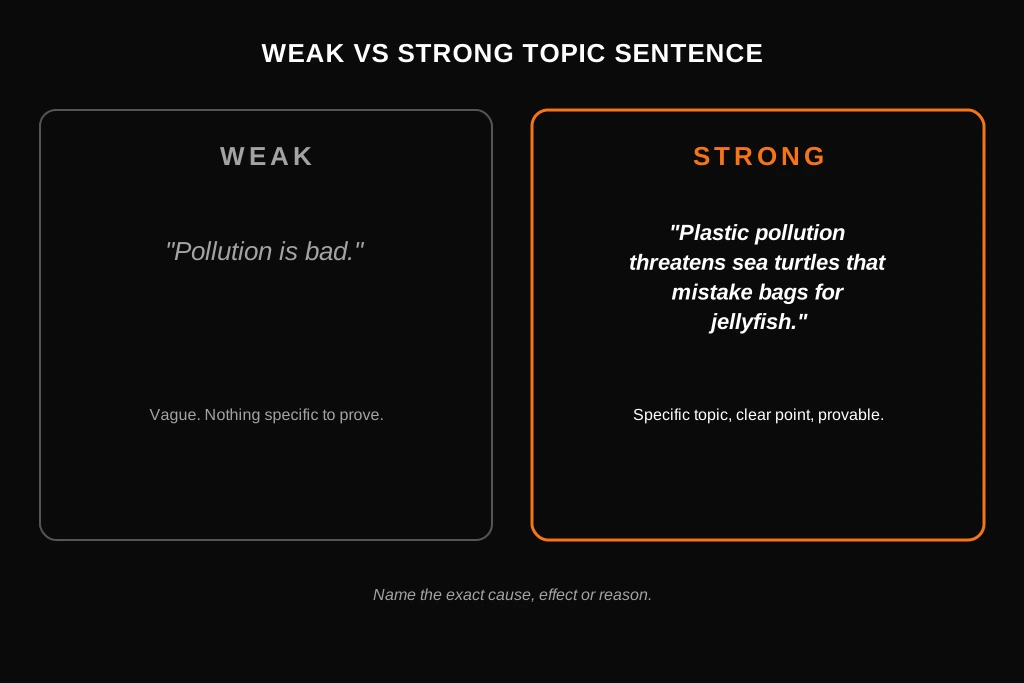
Weak topic sentences usually fail because they are too broad, state a plain fact, announce the paragraph or try to cover too much. The table shows each problem next to a stronger version.
| Weak example | Problem | Strong example |
|---|---|---|
| Pollution is bad. | Too vague | Plastic pollution threatens sea turtles that mistake bags for jellyfish. |
| This paragraph is about exercise. | Announces instead of claiming | Regular exercise improves sleep quality by reducing stress hormones. |
| The Titanic sank in 1912. | A plain fact | Overconfidence in new technology helped turn the Titanic’s collision into a disaster. |
| Video games have good and bad effects on kids, school and family life. | Too many ideas | Puzzle based video games can strengthen planning skills in children. |
| Elizabeth Bennet meets Mr Darcy at a ball. | Plot summary | Elizabeth’s first meeting with Darcy shows how pride shapes her judgment. |
| Many people use social media. | Obvious and unfocused | Social media gives small businesses a cheap way to reach new customers. |
| Climate change is a big topic with many sides. | No position | Planting city trees is one of the cheapest ways to cool hot neighborhoods. |
| There are reasons why reading is important. | Vague and generic | Reading fiction builds empathy by letting readers see through other eyes. |
Look at what changes in each row. The strong versions name a specific subject, use an active verb and point toward evidence the paragraph can supply. None of them is longer than about 15 words, which shows that strength comes from precision, not length. When you revise your own work, cover the right column and try to fix the weak sentence yourself before checking the stronger version.
How to Turn an Example Into Your Own Topic Sentence
To adapt a topic sentence example, keep its pattern, swap in your own topic and point, and then check the result against your evidence. This turns a model into an original sentence that fits your paragraph.
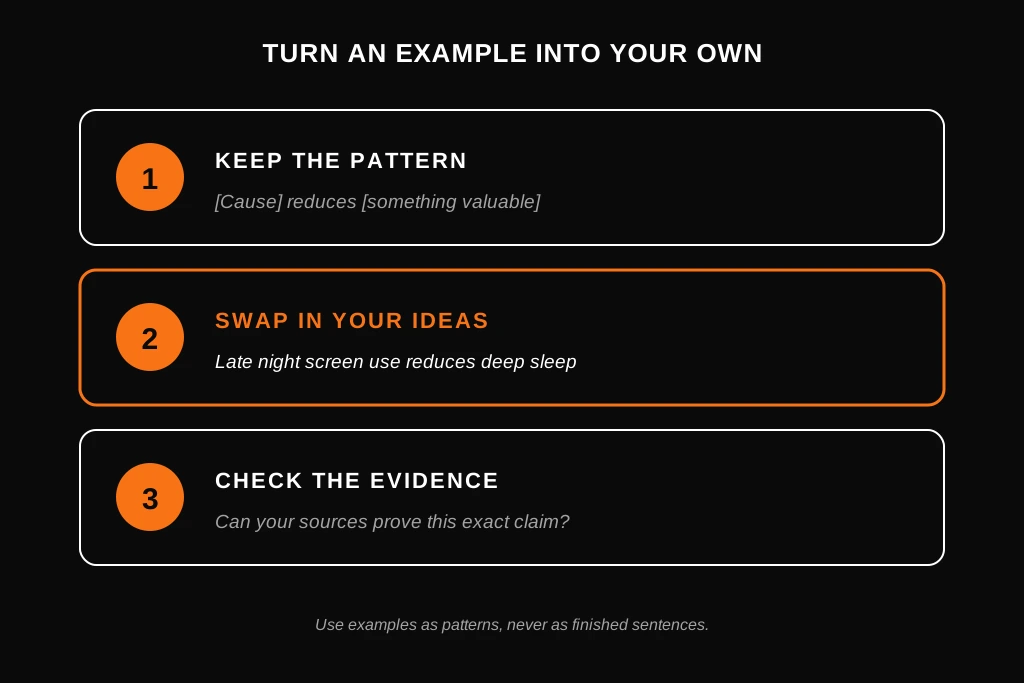
Step 1: Keep the pattern
Notice the structure of an example you like. “Long commutes reduce the time workers can spend on exercise and family life” follows the pattern [cause] reduces [something valuable].
Step 2: Swap in your topic and point
Fill the same pattern with your own ideas. For an essay on screen time, it might become “Late night screen use reduces the time teenagers spend in deep sleep.”
Step 3: Check it against your evidence
Make sure your sources or examples can actually prove the new sentence. If your evidence only covers bedtime delays, adjust the claim to match what you can show.
An example in action
Suppose you are writing about school sports and like the example “Volunteering for just one hour a week can build skills that employers notice.” Keep the pattern of a small commitment leading to a valuable result. Swap in your topic: “Playing on a school team for one season can build leadership skills that colleges notice.” Then check your evidence. If your sources discuss teamwork rather than leadership, change the claim to “teamwork skills.” The final sentence follows a proven shape but says something that is entirely yours.
Why you should never copy an example word for word
Copying a topic sentence from a website can count as plagiarism, and it rarely fits your essay anyway, because the example was written for someone else’s thesis and evidence. At Essays Helper, we always recommend using examples as patterns, not as finished sentences.
Common Student Problems With Topic Sentences
Students often know what a topic sentence is but still struggle to write good ones, and writing in general is a challenge for many. In the 2011 Nation’s Report Card writing assessment, 24 percent of eighth and twelfth graders scored Proficient and 3 percent scored Advanced. Here are the problems students mention most and how to fix them.
“All my topic sentences sound the same”
Vary your openings. Start one with a transition, another with a contrast such as “Unlike” or “Although,” and another with the subject itself. Changing the pattern keeps your essay from sounding mechanical.
“I can’t find an example for my topic”
You do not need an example on your exact topic. Choose an example from the same essay type, keep its structure and fill it with your own subject.
“My topic sentence sounds like a fact”
Add a “because” or “which shows” to push the fact into a claim. “Bees pollinate flowers” becomes “Bees deserve protection because they pollinate many of the crops farmers depend on.”
“My topic sentence is too long”
Cut it to the topic and one point. Move extra details into your evidence sentences. Most of the examples in this guide are between 12 and 25 words.
“I copied an example and it doesn’t fit”
That happens because the example was built for a different argument. Rewrite it using your own thesis and evidence, keeping only the structure.
“My topic sentence doesn’t match my thesis”
Reread your thesis and list its reasons. Each topic sentence should restate one of those reasons in fresh words. If a topic sentence introduces something your thesis never mentions, either revise the topic sentence or add that point to your thesis.
“My topic sentence gives away all my evidence”
A topic sentence should state the point, not list every detail that proves it. Keep the claim in the opening line and save the statistics, quotes and examples for the sentences that follow.
“I don’t know where the topic sentence should go”
In most school and college essays, put it first in the body paragraph. A short transition can come before it, but the main point should appear right at the start so the reader knows what to expect.
“English is my second language and my topic sentences sound awkward”
Keep the structure simple: subject, strong verb, specific point. Patterns like “[Topic] helps [group] by [reason]” are easy to adapt and sound natural. Read your sentence aloud, and if it feels long or tangled, split the extra detail into the next sentence.
“My teacher says my topic sentence is too vague”
Replace general words like “things,” “stuff” or “many ways” with exact ones. Name the specific cause, effect, character or reason the paragraph will discuss.
How EssaysHelper Can Help You
Good examples are a great start, but turning them into a full essay takes practice and time you may not have. If you are stuck on a topic sentence, a paragraph or a whole draft, our team can help you write with confidence, from middle school assignments to graduate papers.
- Writing topic sentences that match your thesis and evidence.
- Revising vague, factual or overloaded sentences into clear claims.
- Building complete body paragraphs around your topic sentences.
- Reviewing full essays for flow, structure and clarity.
Many of the students we work with already understand what a topic sentence is. What they need is feedback on their own sentences, in the context of their own thesis and sources, and a clear explanation of what to change and why.
Share your assignment and deadline through our essay writing services page, and we will suggest the fastest way forward.
Frequently Asked Questions
What is a good example of a topic sentence for an essay?
A good example is “Public transport should be free for students because it removes a daily barrier to attendance.” It names one topic, makes a clear point and gives a reason the paragraph can prove.
Can you give me topic sentence examples for a body paragraph?
Try “Community gardens improve diets in neighborhoods with few grocery stores” or “Long commutes reduce the time workers can spend on exercise and family life.” Each states one point that the rest of the paragraph supports.
What does a strong topic sentence example look like compared to a weak one?
A weak one is vague or factual, like “Pollution is bad.” A strong one is specific and arguable, like “Plastic pollution threatens sea turtles that mistake bags for jellyfish.”
Can I copy a topic sentence example for my essay?
It is better not to. Copying can count as plagiarism, and examples rarely fit your thesis. Keep the pattern and write the sentence with your own topic and point.
What are some topic sentence examples for middle school students?
Try “Reading for twenty minutes each night helps students build a bigger vocabulary” or “Team sports teach students how to work with people who think differently.” Both are clear, simple and focused.
What is an example of a topic sentence in an argumentative essay?
“Standardized tests should play a smaller role in college admissions because they reward test preparation more than learning.” It takes a position and offers one reason to prove.
How many topic sentences should an essay have?
Usually one for each body paragraph. A standard five paragraph essay has three, while longer essays have one for every paragraph that develops a new point.
What is an example of a topic sentence for a research paper?
“Several studies indicate that green spaces in cities may lower stress levels among residents.” It sums up a pattern across sources and uses careful language.
Can a topic sentence start with a transition word?
Yes. Openers like “In contrast” or “A second reason” help connect paragraphs, as long as the sentence still states a clear point after the transition.
How do I know if my topic sentence is as good as the examples?
Check that it covers one idea, makes a point someone could question and can be proven in one paragraph. If it does all three, it matches the examples here.
Final Thoughts
The best topic sentence examples all share the same simple shape: one topic, one specific point and a clear link to the larger argument. Use the examples in this guide to see how that shape changes across essay types, subjects, grade levels and paragraph jobs. Then keep the pattern, swap in your own ideas and check that your evidence can prove the claim. With a little practice, writing strong topic sentences becomes a habit, and every paragraph you write will have a clear purpose.