
A literary analysis essay argues for a specific interpretation of a poem, story, novel or play by examining how the author’s choices, such as imagery, symbolism, structure and characterization, create meaning. To write one, read the text closely, choose a focus, write an arguable thesis, gather quotations, explain how each piece of evidence supports your claim, and revise so the essay analyzes rather than summarizes.
That is the short version. This guide walks through every stage in plain language: how to read and annotate, how to build a thesis, how to plan and write body paragraphs that actually analyze, how to handle poems, novels, plays and comparisons, and how to cite literature correctly. You will also find a full literary analysis essay example with a breakdown of why it works, a table of common mistakes with fixes, and answers to the questions students ask most.
If you have ever been told “this is just summary” or “go deeper” without knowing what that means, you are not alone. Those two comments are the most common feedback on literary essays, and both have clear, practical fixes. By the end of this guide, you will know exactly what your teacher is looking for and how to give it to them.
What Is a Literary Analysis Essay?
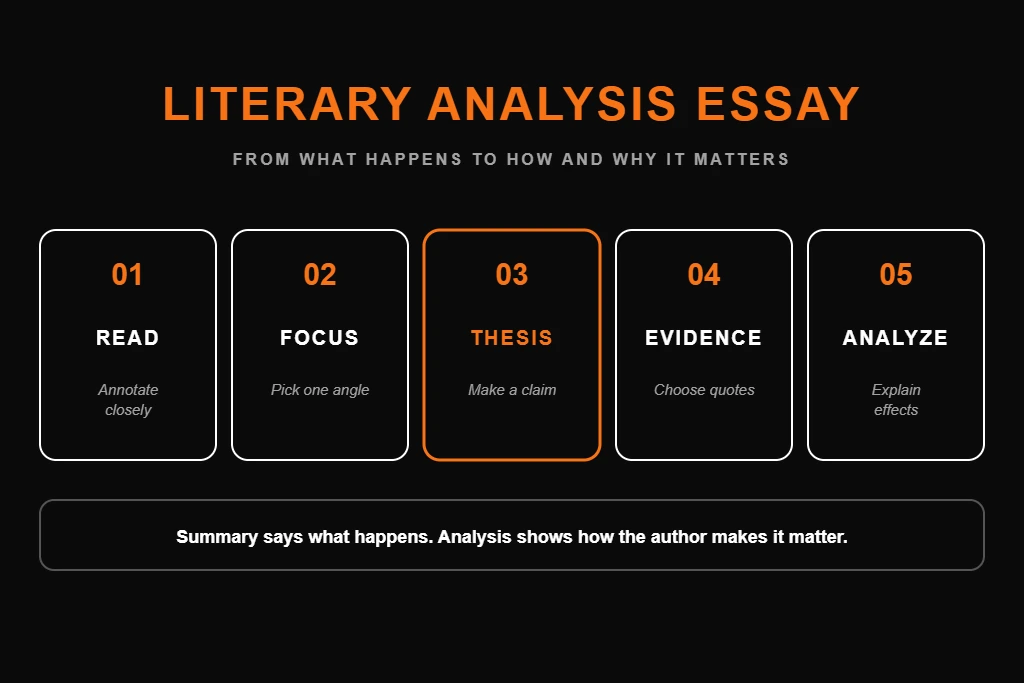
A literary analysis essay is an argument about a literary text. Instead of retelling what happens, you explain how and why the writer’s choices create a certain meaning or effect. The question at the heart of every literary analysis is not “what happens?” but “how does the author make this matter?”
At Essays Helper, we often describe it to students this way: a summary tells your reader the story, while an analysis shows your reader something about the story they might have missed. Purdue OWL makes the same point, noting that a strong literature paper is essentially an argument about your interpretation, supported by evidence from the text.
What a literary analysis essay is not
It is not a book report, which focuses on plot and personal opinion. It is not a review, which judges whether a book is good or bad. And it is not a biography of the author. You may mention context such as when a novel was written, but the focus always stays on the text and the choices inside it.
Literary analysis vs summary vs rhetorical analysis
Students often confuse these three tasks, so here is a quick comparison.
| Type | Main question | Focus | Example claim |
|---|---|---|---|
| Summary | What happens? | Plot and events | Jem and Scout grow up in a small Southern town. |
| Literary analysis | How do the author’s choices create meaning? | Devices, themes, characters, structure | The mockingbird symbol shows how the town destroys innocence. |
| Rhetorical analysis | How does the writer persuade an audience? | Purpose, audience, appeals, strategies | The speaker builds trust through personal experience. |
Why teachers assign it
Literary analysis trains you to read carefully, form an interpretation and defend it with evidence. Those skills carry over to every subject: history essays, research papers and even workplace reports all ask you to make a claim and prove it. It is also central to exams. According to the College Board, the AP English Literature exam includes three free response essays: a poetry analysis, a prose fiction analysis and a literary argument, and together they count for 55 percent of the score.
Before You Write: Read Closely and Take Notes
Good literary analysis starts long before you type a sentence. The quality of your essay depends on the quality of your reading, so give yourself time for at least two passes through the text: one to understand what happens and one to notice how it is written.
How to annotate a text
On your second read, mark anything that surprises you, repeats, or seems to carry extra weight. Underline striking images, circle repeated words, and write short questions in the margin, such as “why the color red again?” or “why does she stop speaking here?” Questions are more useful than labels, because they point you toward an argument. Record page or line numbers as you go so you can cite passages accurately later.
Literary devices worth tracking
You do not need to find every device in a text. Focus on the ones that seem most important to its meaning. These are the most useful to watch for:
- Imagery: sensory details that create mood or suggest ideas.
- Symbolism: objects, colors or places that stand for something larger.
- Tone and mood: the attitude of the narrator and the feeling created for the reader.
- Point of view: who tells the story and how much they know or hide.
- Characterization: how a writer reveals what a character is like.
- Structure: the order of events, stanza breaks, flashbacks and turning points.
- Irony: gaps between what is said, expected or understood.
- Setting: time and place, and how they shape characters and events.

Turn your notes into patterns
After annotating, look for patterns. Do the same images keep returning? Does a character’s speech change over the course of the story? Patterns are the raw material of a thesis, because they show the author making deliberate choices. If you want a refresher on how literary essays differ from other essay types before you start, our guide to understanding literary essay basics covers the foundations in more detail.
Read the prompt as carefully as the text
Many essays lose marks simply because they answer a different question. Underline the key verbs in your prompt, such as analyze, explain or compare, and note any specific focus, like a theme, a character or a device. If the prompt is open, you get to choose the focus, which is freedom but also a responsibility to choose something narrow enough to explore in depth.
How to Write a Literary Analysis Essay Step by Step
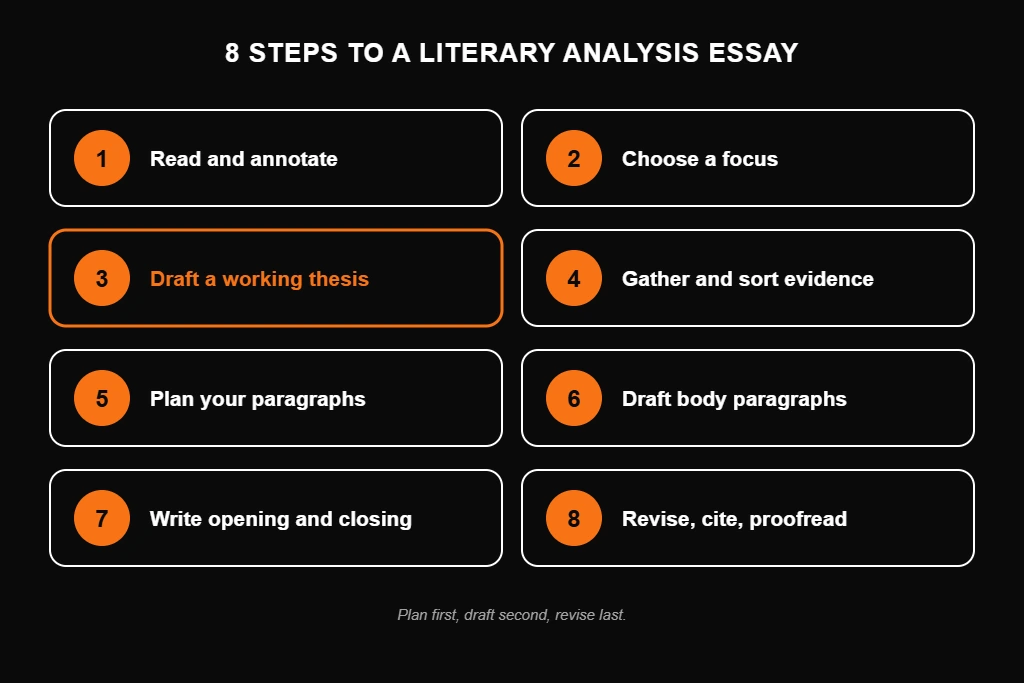
Here is the full process, from first idea to final draft. Each step builds on the one before, so resist the urge to skip ahead to writing before you have a clear focus and evidence.
Step 1: Read and annotate the text
Read once for understanding and again for detail. Mark repeated images, unusual words, shifts in tone and moments that make you pause. Keep a short list of quotations that seem important, with page or line numbers.
Step 2: Choose a focus
Pick one angle you can explore deeply: a symbol, a character’s change, a theme, or the way the structure shapes meaning. A narrow focus almost always produces a stronger essay than a broad one. “Symbolism in The Great Gatsby” is too wide. “How the green light changes meaning across The Great Gatsby” gives you a clear path.
Step 3: Ask a question and draft a working thesis
Turn your focus into a question, such as “Why does the narrator keep insisting he is calm?” Your answer to that question becomes your working thesis. Expect it to change as you gather evidence. The UNC Writing Center recommends treating your first thesis as a draft and sharpening it until it answers the “so what?” question, as explained in its guide to writing about literature.
Step 4: Gather and sort your evidence
Return to your annotations and choose the quotations that best support your thesis. Group them by idea, not by order of appearance. Three strong, well explained quotations are worth more than ten that you only mention in passing.
Step 5: Plan your paragraphs
Decide what each body paragraph will argue. Every paragraph should make one point that supports the thesis, with its own evidence. Order them so the argument builds, often from the most obvious point to the most surprising.
Step 6: Draft the body paragraphs first
Many students find it easier to write the body before the opening, because by then they know exactly what the essay argues. Use the claim, evidence, analysis and link pattern explained later in this guide.
Step 7: Write the opening and closing paragraphs
Open with a hook and brief context, then end the first paragraph with your thesis. In the closing paragraph, show why your interpretation matters rather than repeating the thesis word for word.
Step 8: Revise, cite and proofread
Read your draft and highlight every sentence that only retells the plot. Replace most of them with analysis. Check that each quotation is introduced, cited and explained, that you write in present tense, and that your essay follows the required format.
How long each step usually takes
For a typical 1,000 to 1,500 word essay, reading and annotating often takes as long as drafting. A reasonable split is about a third of your time for reading and planning, a third for drafting and a third for revising. Students who rush the first stage usually spend longer rewriting later, because the essay has no clear focus.
Literary Analysis Thesis: How to Write One
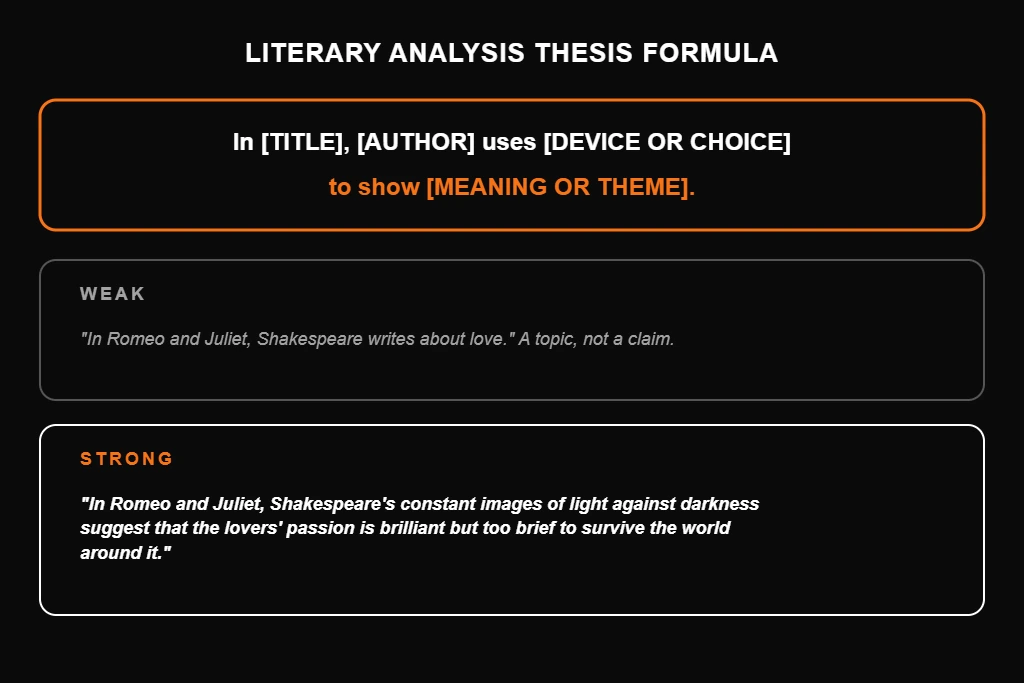
Your thesis is one or two sentences that state your interpretation and hint at how you will prove it. It must be arguable, meaning a thoughtful reader could disagree, and specific enough to guide every paragraph. A simple formula works well: In [title], [author] uses [device or choice] to show [meaning or theme].
Weak: “In Romeo and Juliet, Shakespeare writes about love.” This is a topic, not a claim.
Strong: “In Romeo and Juliet, Shakespeare’s constant images of light against darkness suggest that the lovers’ passion is brilliant but too brief to survive the world around it.” It names a device, an idea and a direction for the essay.
Literary Analysis Essay Outline
A clear plan keeps your argument on track. For a standard five paragraph essay, use one opening paragraph that ends with your thesis, three body paragraphs that each develop one supporting point with evidence and analysis, and one closing paragraph that explains why the interpretation matters.
For longer college essays, keep the same logic but expand it. Each main point may need two or three paragraphs, you may add a paragraph that addresses another reading of the text, and you may bring in secondary sources from critics. Whatever the length, every paragraph should connect back to the thesis.
Writing Body Paragraphs That Analyze
Body paragraphs are where literary analysis essays succeed or fail. The goal is simple: make a claim, prove it with evidence, and explain how the evidence proves it. Most “go deeper” comments come from paragraphs that skip that last step.
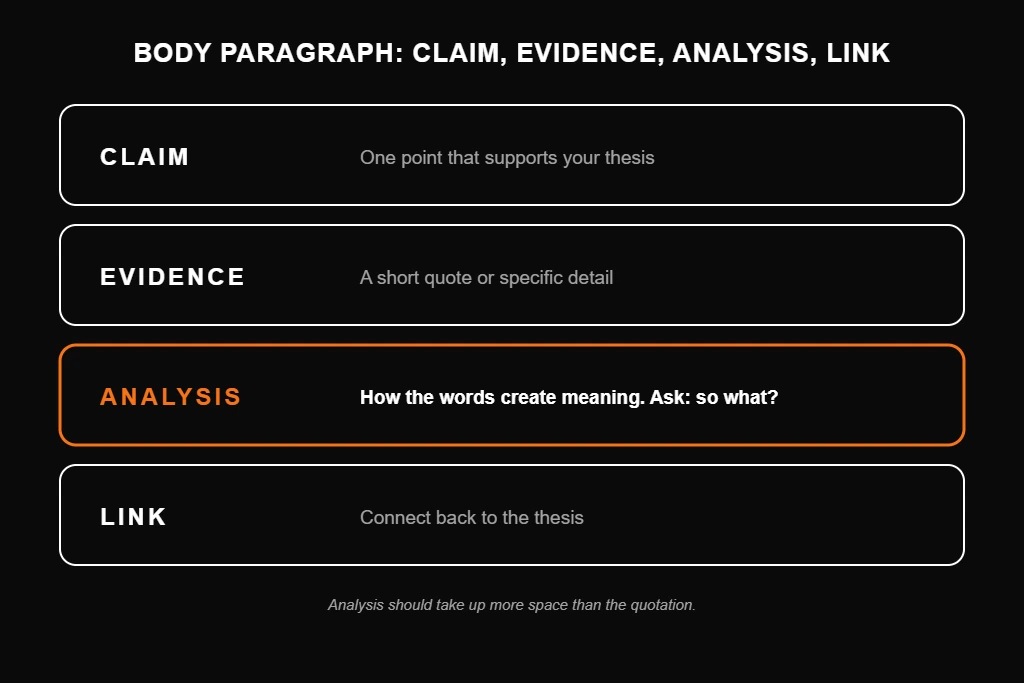
The claim, evidence, analysis, link pattern
Use this four part pattern to build every paragraph:
- Claim: a topic sentence that states one point supporting your thesis.
- Evidence: a short quotation or specific detail from the text.
- Analysis: two to four sentences explaining how that evidence supports the claim, focusing on specific words and their effect.
- Link: a sentence connecting the point back to your thesis or leading to the next paragraph.
Verbs that make analysis sharper
The verbs you choose can make your analysis sound precise or vague. Instead of repeating “shows,” try verbs that describe exactly what a choice does: suggests, emphasizes, reveals, contrasts, foreshadows, undermines, complicates, reinforces or exposes. “The storm imagery foreshadows the family’s collapse” says far more than “the storm imagery shows something bad will happen.” A short list of strong verbs kept beside you while drafting can lift the quality of every paragraph.
How to integrate quotations smoothly
Never drop a quotation into a paragraph on its own. Introduce it with a signal phrase, such as “When the narrator describes the house as,” or blend a short phrase into your own sentence. Short quotations are usually more effective than long ones, because they keep the focus on your analysis. The UNC Writing Center warns students against loading a paper with too much evidence and suggests explaining the significance of every quotation you use.
Analyze the words, not just the idea
Strong analysis zooms in on language. Instead of saying “this quote shows he is angry,” ask which words create that anger and why the author chose them. Look at connotations, sounds, sentence length and repetition. A single verb can carry an entire paragraph if you explain its effect well.
Use the “so what?” test
After every piece of analysis, ask “so what?” If your answer is “it shows the character is sad,” push one step further: why does that sadness matter to the story’s meaning? The more often you ask, the deeper your paragraph becomes. This one habit fixes most essays that feel shallow.
How much quotation and how much analysis
A useful rule is that your own explanation should be at least twice as long as the quotation you use. If you quote a full sentence, follow it with two or three sentences of analysis. If a quotation is longer than about four lines of prose, ask whether you really need all of it, or whether a shorter phrase would let you focus on the words that matter most.
A model body paragraph
Poe’s narrator undermines his own claim to sanity through the very way he speaks. He insists that “the disease had sharpened my senses,” yet the sentence is packed with exclamation and repetition that suggest panic rather than control. By presenting heightened senses as proof of his sanity, the narrator unknowingly describes the paranoia that drives him to murder. Poe lets the speaker’s voice contradict his argument, so readers learn to distrust him long before his confession.
Notice how the paragraph makes a claim, uses a short quotation, explains specific features of the language and links back to the overall argument about an unreliable narrator.
How to write a hook for a literary analysis essay
Your first sentence should make a reader curious about your interpretation, not about the plot. Three hooks work especially well. A striking quotation from the text, followed by a line explaining why it matters. A surprising observation, such as “The most important character in this novel never speaks.” Or a brief question that your essay will answer. Avoid dictionary definitions and broad statements like “Throughout history, people have loved stories,” because they delay your argument and feel generic.
Character Analysis Essay: How to Analyze a Character
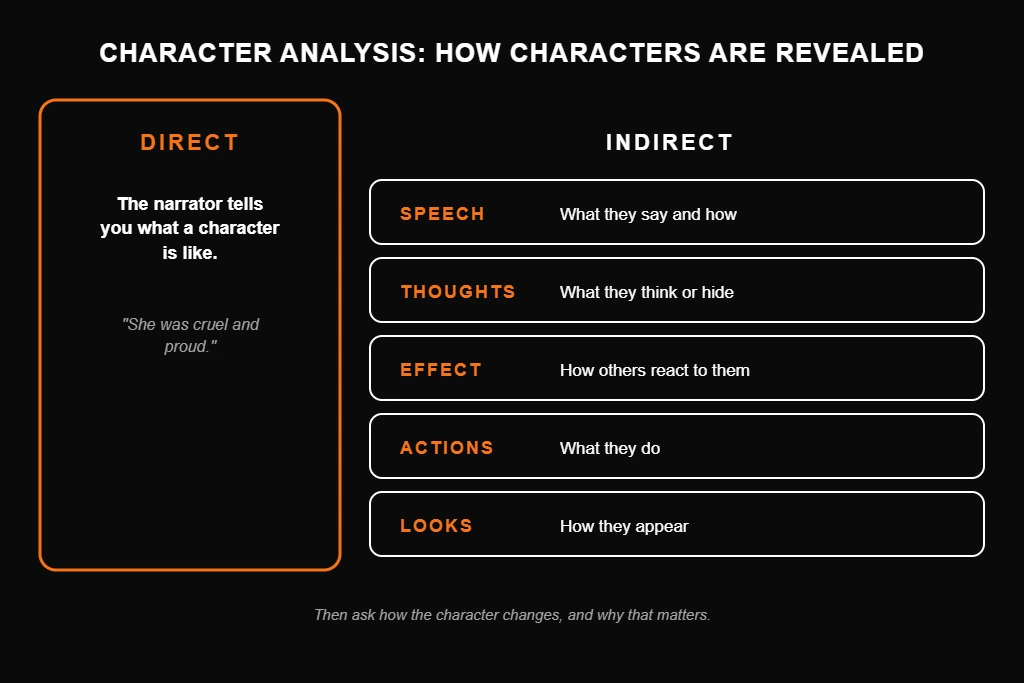
This kind of essay focuses on one character and argues what they reveal about the text’s meaning. Start by separating direct characterization, where the narrator tells us what a character is like, from indirect characterization, where we infer it from their speech, thoughts, actions, appearance and effect on others. Then track how the character changes or stays the same, and why. A strong thesis connects that change to a theme, for example arguing that a character’s growing silence reflects the pressure of the society around them.
Analyzing Different Types of Texts
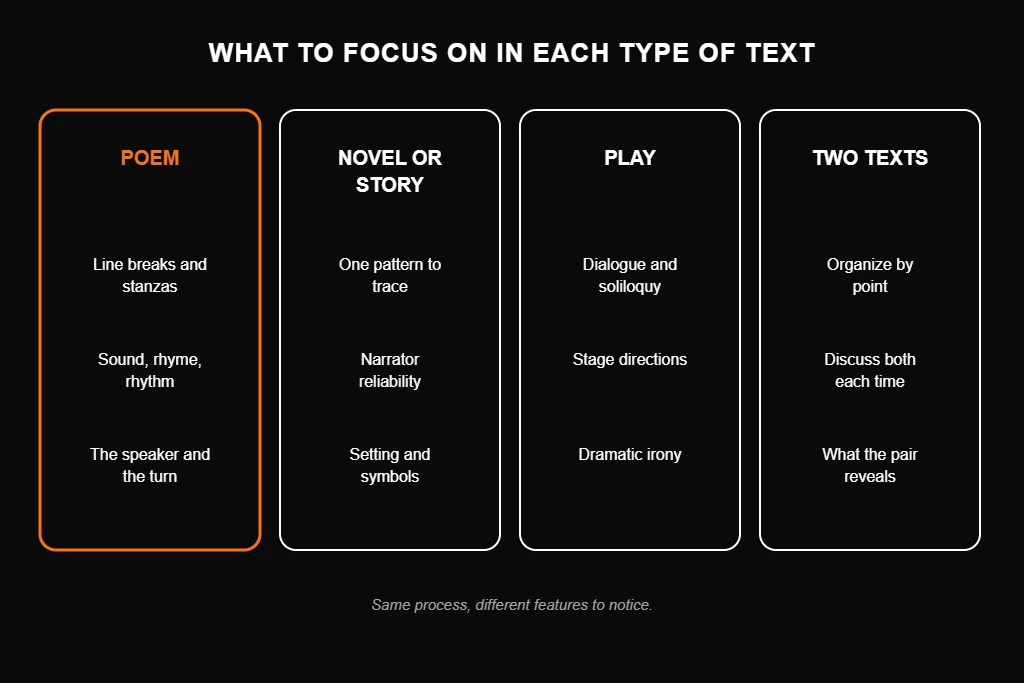
The basic process stays the same for every kind of text, but each form rewards attention to different features. Here is what to focus on for the four types students meet most often.
How to write a literary analysis essay on a poem
Poems are compact, so every word counts. Read the poem aloud at least twice, and notice line breaks, stanza shapes, rhyme, rhythm and sound. Identify the speaker, who is not always the poet, and the situation they describe. Look for a turn or shift, where the tone or argument changes, because it often holds the key to the poem’s meaning. When you quote, use a slash to show line breaks and cite line numbers.
How to write a literary analysis essay on a novel or short story
With longer works, the challenge is choosing what to leave out. Focus on one pattern, such as a symbol, a relationship or a setting, and trace it through key moments rather than the whole plot. Pay attention to narration: is the narrator reliable, limited or all knowing? For short stories, notice how quickly the writer establishes tone and how the ending reframes everything before it.
How to write a literary analysis essay on a play
Plays are written to be performed, so think about what an audience would see and hear. Stage directions, dialogue, soliloquies and dramatic irony are your main tools. Ask what the characters reveal through what they say to others versus what they say alone. When you cite, use act, scene and line numbers rather than page numbers.
How to write a compare and contrast literary analysis essay
When you compare two stories, poems or novels, avoid writing about one text and then the other. Instead, organize by points of comparison, discussing both texts in each paragraph. Your thesis should explain what the comparison reveals that neither text shows alone, such as how two authors treat the same theme in opposite ways. Choose texts or features that have enough in common to make the differences meaningful.
When literary analysis meets rhetorical analysis
Speeches, essays and letters are sometimes studied as literature, which can blur the line between the two essay types. If your assignment asks how a writer persuades an audience rather than how a text creates meaning, our guide on how to write a rhetorical analysis essay explains that approach step by step.
Literary Analysis Essay Example
Here is a short model essay on Edgar Allan Poe’s “The Tell-Tale Heart,” a public domain story from 1843. It shows the full structure in action: a thesis, two body paragraphs built on close reading and a closing paragraph that explains why the interpretation matters. Real assignments are usually longer, but the same moves apply.
Sample essay: The unreliable voice in “The Tell-Tale Heart”
Few narrators work as hard to prove their sanity as the speaker of Edgar Allan Poe’s “The Tell-Tale Heart.” From the opening line, he demands to know “why will you say that I am mad?” and spends the rest of the story offering evidence of his calm and careful mind. Yet Poe turns every argument against its speaker. Through the narrator’s frantic voice and his obsession with the old man’s eye, Poe shows that the harder a person insists on reason, the more clearly their loss of it is revealed.
The narrator’s own style is the first witness against him. He claims to be calm, but his sentences are broken by exclamations, repetitions and sudden questions. He tells the reader, “You fancy me mad. Madmen know nothing. But you should have seen me,” as though careful planning proves stability. The short, insistent sentences sound less like a confident explanation and more like someone arguing with himself. Poe uses this contrast between what the narrator says and how he says it to build dramatic irony: readers understand what the speaker cannot. The more he explains, the less we trust him.
The narrator’s motive exposes his instability even further. He admits that “Object there was none. Passion there was none. I loved the old man.” The only reason he offers is the old man’s pale eye, which he describes as the eye of a vulture. By reducing a whole person to a single feature, the narrator reveals how completely his fear has taken over his judgment. The eye becomes a symbol of being watched and judged, and his decision to destroy it suggests a desperate attempt to escape his own guilt. Ironically, the murder brings no peace, because the imagined beating of the heart returns to torment him until he confesses.
In the end, “The Tell-Tale Heart” is less a story about a crime than a study of a mind convincing itself. Poe gives his narrator every chance to make his case, then lets the voice itself deliver the verdict. The story suggests that guilt cannot be argued away, and that the effort to appear rational can become the clearest sign of a mind coming apart.
Why this example works
The thesis makes an arguable claim about how Poe creates meaning, not just what happens. Each body paragraph focuses on one choice, first the narrator’s voice and then the symbol of the eye, and supports it with short quotations. The analysis explains specific words and their effect, and the closing paragraph moves beyond summary to state what the story suggests about guilt. If you are writing your own literary analysis essay example for practice, try copying this structure with a story you know well.
Expectations by Level: Middle School, High School and College
The core skills stay the same at every level, but what teachers expect grows as you move up. Knowing the standard for your level helps you aim your effort in the right place.
| Level | Typical length | What teachers look for |
|---|---|---|
| Middle school | 3 to 5 paragraphs | A clear claim, a few quotations and an explanation of what they show. |
| High school | 5 paragraphs or 800 to 1,200 words | An arguable thesis, embedded quotations, analysis of devices and theme. |
| AP Literature | Timed essays of several paragraphs | A defensible thesis, specific evidence and line of reasoning, plus sophistication. |
| College | 1,200 to 3,000 words or more | An original interpretation, close reading, and sometimes engagement with critics. |
How to write a literary analysis essay in middle school
At this stage, the main goal is moving from summary to explanation. Focus on one clear idea, such as how a character changes, and support it with two or three quotations. After each quotation, write at least two sentences explaining what it shows and why it matters.
How to write a literary analysis essay in high school
High school teachers expect a debatable thesis and analysis of how specific devices create meaning. The five paragraph essay is a useful starting structure, but stronger essays let the argument shape the paragraphs rather than forcing exactly three points. Integrate quotations smoothly and write in present tense.
How to write a literary analysis essay in college
College essays reward original interpretations and close attention to language. You may need to engage with secondary sources, explaining how your reading agrees with or challenges published critics. Paragraphs become longer and more complex, and your thesis may develop as the essay progresses.
Using secondary sources in college essays
When your instructor asks for critical sources, use them to sharpen your own argument, not to replace it. Introduce a critic’s view, then explain whether your reading supports, extends or challenges it. Keep the text itself at the center: a paragraph built mostly on quotations from critics usually needs more of your own close reading. Library databases are the best place to find reliable literary criticism.
Common Mistakes Students Make and How to Fix Them
Most weak literary analysis essays fail in the same predictable ways. The good news is that each problem has a simple fix you can apply while revising.
| Mistake | Why it hurts | How to fix it |
|---|---|---|
| Summarizing the plot | Your teacher already knows the story | Keep plot to one sentence of context, then analyze |
| A vague or obvious thesis | Gives the essay nothing to prove | Make a claim someone could reasonably disagree with |
| Dropping quotations without comment | Leaves the reader to do the analysis | Explain every quotation in at least two sentences |
| Listing many devices | Spreads analysis too thin | Focus on two or three choices and go deep |
| Skipping the “so what?” | Makes analysis feel shallow | Explain why each point matters to the theme |
| Switching tenses | Confuses the reader | Write about events in the text in present tense |
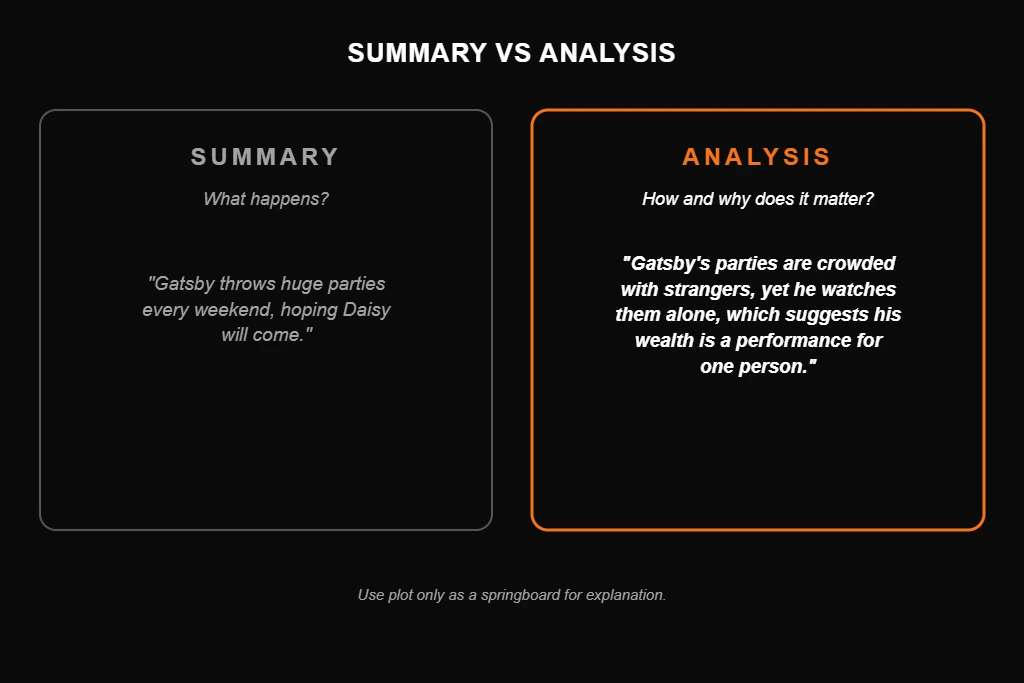
Summary versus analysis, side by side
Summary: “Gatsby throws huge parties every weekend, hoping Daisy will come.”
Analysis: “Gatsby’s parties are crowded with strangers, yet he watches them alone, which suggests that his wealth is a performance meant for one person rather than a source of real connection.”
The second sentence uses a detail from the plot, but it explains what the detail reveals. That is the shift teachers want to see.
Writing about the author instead of the text
It is tempting to explain a story through the author’s life, but unless your assignment asks for biographical criticism, keep the focus on the words on the page. Phrases like “the author must have felt” are guesses. Stick to what the text shows and what readers can observe.
Using “I think” and “I feel”
Your entire essay is your interpretation, so you rarely need to announce it. Phrases like “I think” weaken your claims. Some teachers allow first person, but most prefer confident statements such as “The ending suggests” rather than “I feel the ending shows.”
Real Problems Students Face and How to Solve Them
Even when you know the steps, specific problems can stop you in your tracks. These are the situations students describe most often, with practical ways through each one.
“I don’t really understand the text”
Start by separating confusion about the plot from confusion about meaning. For plot, a short chapter summary or a second read is fine, as long as you do not quote it. For meaning, slow down and read one passage at a time, asking what each sentence is doing. Discussing the text with a classmate or rereading the passages your teacher highlighted in class often unlocks the rest. You do not need to understand everything to write a strong essay, only the part you choose to analyze.
“I can’t think of anything to say”
Blank pages usually come from looking for big themes too early. Go back to small details instead. Pick one passage that caught your attention and list everything you notice about its words, sounds and images, without worrying whether it is important. Then ask why the author might have made each choice. Ideas grow out of details, not the other way around, and a single well chosen passage can generate a whole thesis.
“My essay is too short”
Short essays rarely need more quotations. They need more analysis. Look at each quotation and ask what individual words suggest, how they connect to other moments in the text and why they matter to your thesis. Adding one more layer of explanation to each paragraph can easily add a few hundred words while also making the essay stronger. Avoid padding with plot summary, because it lowers the quality even as it raises the word count.
“My essay is over the word limit”
Start by cutting summary and repeated points. Then check your quotations: long block quotes can often be trimmed to the few words you actually analyze. If you still need to cut, remove your weakest body paragraph rather than shortening every paragraph, so the strongest parts of your argument keep their depth.
“I have to write it in a timed exam”
Timed essays, such as the free response questions on the AP Literature exam, reward a clear thesis and focused analysis more than length. Spend the first few minutes reading the passage and marking two or three key choices. Write a one sentence thesis that answers the prompt directly, then build two or three body paragraphs around your marked evidence. Leave a minute or two at the end to reread your thesis and check that every paragraph supports it.
“I disagree with my teacher’s reading”
That can be a strength. Literary analysis rewards original interpretations, as long as you support them with evidence from the text. Acknowledge the more common reading in a sentence, then explain what the evidence suggests instead. A well supported alternative reading usually earns more credit than a safe repetition of class notes.
“My teacher says my analysis is too general”
General analysis talks about whole scenes or ideas. Specific analysis talks about individual words. If your paragraph says “this scene shows his anger,” choose one verb or image from the scene and explain exactly how it creates that anger. Naming the device helps, but explaining its effect on the reader is what makes the analysis specific.
Formatting and Citing Literature
Literary essays follow a few conventions that can cost marks if you miss them. Most English classes use MLA style, so check your assignment instructions and follow these basics.
Write in the literary present tense
Describe events in a text in the present tense: “Gatsby reaches toward the green light,” not “Gatsby reached.” Vanderbilt University’s Writing Studio explains that literary works exist in an “eternal present,” so past tense is reserved for historical facts, such as when a book was published. You can read more in its handout on writing in literary present tense.
Cite prose, poetry and drama correctly
In MLA style, cite prose with page numbers, poetry with line numbers and plays with act and scene numbers, and line numbers when available. Purdue OWL’s guide to MLA in-text citations gives examples such as a page number in parentheses for a novel and “lines 5-6” for a poem.
- Prose: Gatsby “believed in the green light” (180).
- Poetry: the speaker asks what “dread hand” could shape the tiger (line 12).
- Drama: the act and scene, then the lines, such as (2.2.33-36).
Titles, names and formatting
Italicize the titles of novels, plays and long poems, and put the titles of short stories and short poems in quotation marks. Refer to authors by full name the first time and by last name afterward. Include a Works Cited page listing every text you quote.
A final checklist before you submit
- Your thesis makes an arguable claim, not a statement of fact.
- Each body paragraph makes one point and supports the thesis.
- Every quotation is introduced, cited and explained.
- Plot summary is limited to brief context.
- Events in the text are described in present tense.
- Titles are formatted correctly and a Works Cited page is included.
Reading your essay aloud is one of the quickest ways to catch awkward sentences, missing words and places where your argument jumps ahead too fast.
How EssaysHelper Can Help You
Literary analysis gets easier with practice and feedback, but deadlines do not always leave time for either. If you are stuck on a thesis, unsure whether your paragraphs analyze enough, or juggling several assignments at once, our essay support services can help you move forward with confidence. Our writers work with students at every level, from high school to graduate school.
- Finding a focused, arguable thesis for your text and prompt.
- Reviewing drafts and showing where summary can become analysis.
- Checking quotation use, present tense and MLA citations.
- Model essays and feedback on poems, novels, plays and comparisons.
Share your assignment details and deadline, and we will suggest the quickest next step.
Frequently Asked Questions
How long should a literary analysis essay be?
It depends on your assignment. Middle and high school essays are usually five paragraphs or about 800 to 1,200 words, while college essays often run 1,200 to 3,000 words. Always follow your teacher’s guidelines first.
Can I use “I” in a literary analysis essay?
Most teachers prefer third person, because confident statements sound more persuasive than “I think.” Some instructors allow first person, so check your assignment instructions if you are unsure.
Why do literary analysis essays use present tense?
Literary works are treated as existing in an ongoing present, so you write “the narrator explains” rather than “explained.” Use past tense only for historical facts, such as when a text was published.
How many quotes should I use in a literary analysis essay?
Aim for two or three well chosen quotations per body paragraph. Short quotations that you explain in depth are more effective than many long ones with little analysis.
How do I start a literary analysis essay without summarizing?
Open with a hook tied to your interpretation, such as a striking quote or surprising observation, give one or two sentences of context, then state your thesis. Keep plot details for later, and only when they support analysis.
How many paragraphs does a literary analysis essay need?
A standard essay has five paragraphs: an opening paragraph, three body paragraphs and a closing paragraph. Longer essays add more body paragraphs, with each one developing a single point.
What is the difference between a literary analysis and a summary?
A summary retells what happens, while a literary analysis explains how and why the author’s choices create meaning. Analysis makes an arguable claim and proves it with evidence.
Is analyzing a poem different from analyzing a novel?
The process is the same, but poems reward closer attention to sound, line breaks and word choice, while novels require choosing one pattern to trace across many pages.
How do I choose a good topic for a literary analysis essay?
Look for something in the text that puzzles or interests you, such as a repeated image, a character’s change or a surprising ending. Turn it into a question you can answer with evidence.
What do teachers look for when grading a literary analysis essay?
Most rubrics reward a clear, arguable thesis, relevant evidence, analysis that explains how evidence supports the claim, logical organization and correct grammar and citations.
Final Thoughts
Writing a literary analysis essay comes down to one shift: moving from what happens to how and why it matters. Read closely, choose a narrow focus, build an arguable thesis and support it with short quotations that you explain in depth. Keep the “so what?” question in mind for every paragraph, write in present tense and cite carefully. With practice, analysis stops feeling like guesswork and becomes a reliable process you can use for any poem, story, novel or play your teacher assigns.