
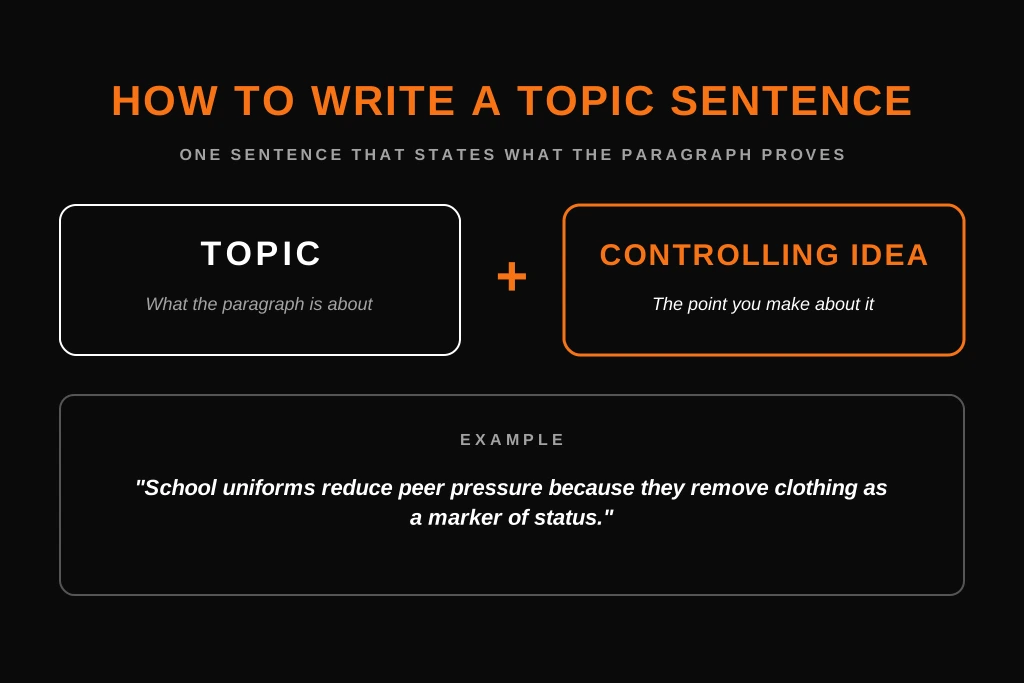
Here is how to write a topic sentence: state the paragraph’s topic and the specific point you will make about it in one clear sentence, then place it at the start of the paragraph. A simple formula is topic + controlling idea. For example: “School uniforms reduce peer pressure because they remove clothing as a marker of status.” The topic is school uniforms, and the controlling idea is that they reduce peer pressure for a clear reason.
That is the short answer. The rest of this guide shows you exactly how to write a good topic sentence for any paragraph: what it needs to do, a step by step method, a formula and five templates, examples for different essay types and grade levels, and fixes for the mistakes students make most often. You will also see how topic sentences connect to wider academic writing skills like signposting, hedging and paraphrasing.
If your paragraphs tend to wander, or your teacher keeps writing “what is your point here?” in the margin, the topic sentence is usually where the fix begins.
What Is a Topic Sentence?
A topic sentence is the sentence that tells the reader what a paragraph is about and what point it will make. Purdue OWL describes it as “a sentence that indicates in a general way what idea or thesis the paragraph is going to deal with.” Every other sentence in the paragraph should support, explain or prove it.
At Essays Helper, we often describe the topic sentence as a promise. It promises the reader one idea, and the rest of the paragraph keeps that promise. When a paragraph drifts into a second idea, it breaks the promise, and readers get lost.
What a topic sentence does
A topic sentence does three jobs at once. It introduces the subject of the paragraph, it states the specific claim or angle you will take on that subject, and it connects the paragraph back to your larger argument. When all three are present, a reader can skim only your topic sentences and still follow the logic of your whole essay.
Where the topic sentence goes
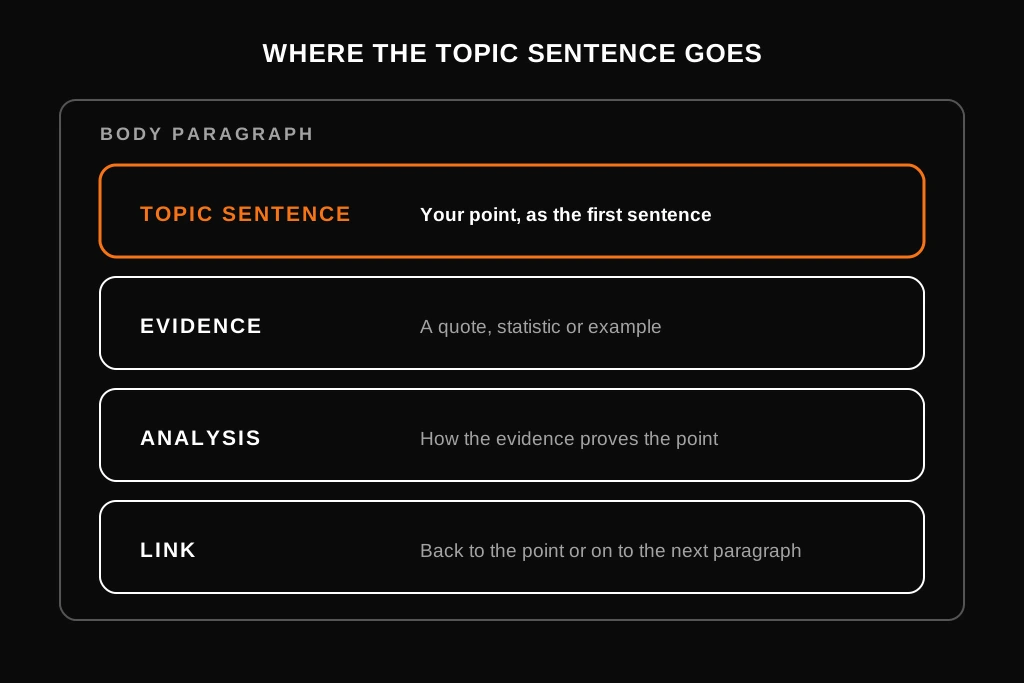
In most academic writing, the topic sentence is the first sentence of a body paragraph. Sometimes a short transition phrase comes before it, such as “However” or “Beyond cost,” but the main point still arrives in the opening line. Placing it first helps the reader know what to look for in the evidence that follows.
Experienced writers occasionally place the topic sentence second, after a linking sentence, or even last in a paragraph that builds toward a reveal. These choices work in creative or journalistic writing, but in school and college essays the first position is the safest and clearest choice.
Topic sentence vs main idea and controlling idea
The main idea is what the paragraph is about. The controlling idea is the specific point you make about that main idea, and it controls what belongs in the paragraph. The UNC Writing Center notes that the controlling idea of a paragraph often appears in the form of a topic sentence. In other words, the topic sentence is where you put the main idea and the controlling idea into words.
Topic sentence vs thesis statement
Your thesis states the argument of the whole essay. A topic sentence states the argument of one paragraph. Think of the thesis as the destination and topic sentences as the stops along the way. Each one proves a single piece of the thesis, which is why your thesis should be settled before you draft topic sentences.
| Feature | Thesis statement | Topic sentence |
|---|---|---|
| Scope | The whole essay | One paragraph |
| Where it goes | End of the opening paragraph | Start of each body paragraph |
| How many | One per essay | One per body paragraph |
| Job | States the main argument | States one reason or part of that argument |
| Example | Schools should adopt uniforms because they reduce pressure, cost and distraction. | Uniforms reduce peer pressure by removing clothing as a status marker. |
What Makes a Good Topic Sentence
A good topic sentence is focused, specific and provable within one paragraph. It names a clear topic, makes a point about it that needs support, and links back to your thesis. It should be easy to understand on a first read.
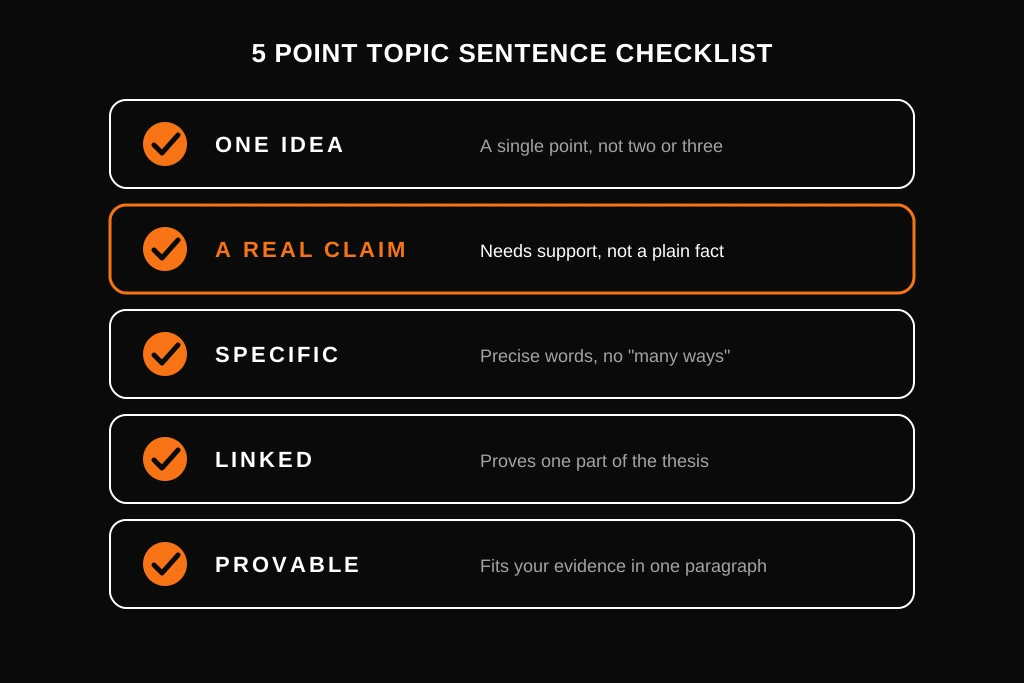
The five point topic sentence checklist
Before you move on to your evidence, test your topic sentence against these five questions:
- One idea: Does it focus on a single point rather than two or three?
- A real claim: Does it make a point that needs support, not just state a fact?
- Specific: Does it use precise words instead of “things,” “aspects” or “many ways”?
- Linked to the thesis: Can you see which part of your thesis it proves?
- Provable here: Can you support it with the evidence you have in one paragraph?
Clear vs vague topic sentences
A vague topic sentence leaves the reader guessing. “Social media affects teenagers in many ways” could lead anywhere. A clear one commits to a point: “Social media harms teenagers’ sleep because late night scrolling delays bedtime.” The second version tells the reader exactly what evidence to expect.
Too general vs too specific
A topic sentence that is too general tries to cover the whole essay, which makes it sound like a second thesis. One that is too specific is just a detail, such as a statistic, that leaves nothing to develop. The sweet spot is a claim broad enough to need three or four sentences of support but narrow enough to finish in one paragraph.
How to Write a Topic Sentence Step by Step
Writing a strong topic sentence takes six steps: start from your thesis, choose one supporting point, gather the evidence, state the point as a claim, link it to the thesis, and revise once the paragraph is written.
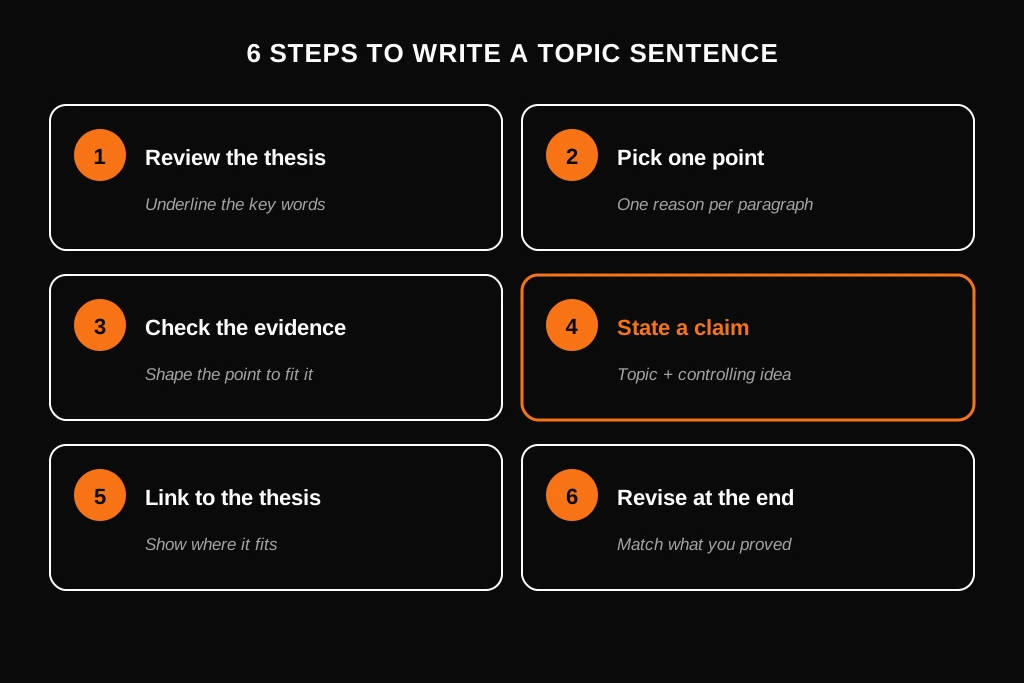
Step 1: Look at your thesis or prompt
Every topic sentence grows out of your main argument, so it helps to have a strong thesis statement in place first. Reread your thesis, or the essay question if you have not written a thesis yet, and underline the key words. These words tell you what each paragraph needs to prove.
Step 2: Choose one point for this paragraph
List the reasons, examples or parts of your argument, then assign one to each paragraph. If your thesis says uniforms reduce pressure, cost and distraction, you have three paragraphs and three topic sentences waiting to be written.
Step 3: Gather the evidence first
It sounds backwards, but looking at your evidence before writing the topic sentence prevents a common problem: a topic sentence that promises something your evidence cannot deliver. Check which quotes, data or examples you have, then shape the point to fit them.
Step 4: State the point as a claim
Turn your point into a full sentence that makes a claim. Use the formula topic + controlling idea. “Cost” becomes “Uniforms lower the yearly cost of school clothing for most families.” Now the sentence makes a statement someone could question, which means it needs proof.
Step 5: Link it to your thesis
Add a word or phrase that shows how this paragraph connects to the bigger argument or to the previous paragraph. “Beyond reducing pressure, uniforms also lower the yearly cost of school clothing for most families” tells the reader this is the second reason in a sequence.
Step 6: Revise after you write the paragraph
Once the paragraph is drafted, reread the topic sentence. Paragraphs often drift as you write, and your evidence may have proved something slightly different. Adjust the topic sentence so it matches what the paragraph actually shows.
How to write a topic sentence from a thesis
Break your thesis into its parts. A thesis such as “Remote learning works best for self motivated students because it offers flexibility, self pacing and fewer distractions” gives you three topic sentences, one for flexibility, one for self pacing and one for distractions. Each topic sentence restates one reason in fresh words and adds the specific angle that paragraph will prove.
How to write a topic sentence from a question
If your teacher gives you a prompt, turn each part of the answer into a topic sentence. For the question “Was the printing press the most important invention of its era?”, one paragraph might begin: “The printing press transformed learning by making books affordable outside monasteries and universities.” That sentence answers part of the question directly, which is exactly what a marker wants to see.
A worked example from start to finish
Imagine your thesis is: “Cities should invest in bike lanes because they improve health, reduce traffic and boost local business.” For the second paragraph, you choose traffic. Your evidence includes a city traffic report and examples of commuters switching from cars. A first draft might be “Bike lanes and traffic.” That is a topic, not a claim. Adding a controlling idea gives you “Bike lanes reduce traffic.” That is better but bare. Linking it to the thesis and evidence gives you the final version: “Bike lanes also reduce traffic by giving short distance commuters a faster option than driving.” It is focused, specific, linked and provable.
Topic Sentence Formula and Templates
The most reliable topic sentence formula is topic + controlling idea, often with a reason attached. Templates give that formula a shape you can adapt for different paragraphs. Use them as a starting point, then reword the result so it sounds like you.
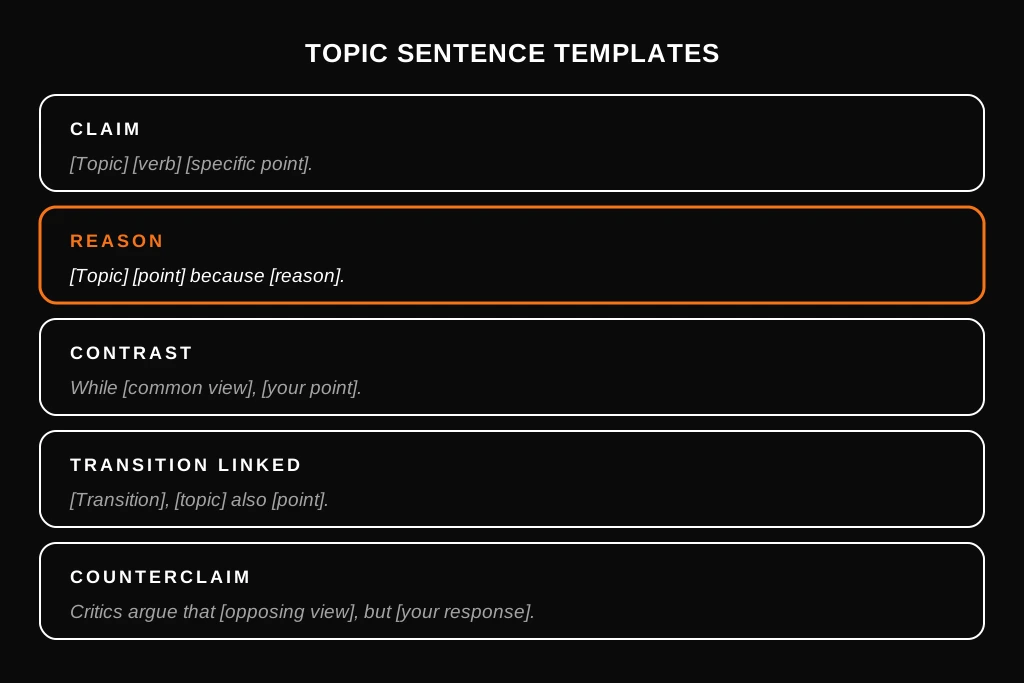
Template 1: The claim
Template: [Topic] [verb] [specific point].
Example: Daily reading improves vocabulary faster than memorizing word lists.
Template 2: The reason
Template: [Topic] [point] because [reason].
Example: Homework should be limited in primary school because young children learn more through play.
Template 3: The contrast
Template: While [common view], [your point].
Example: While many people see video games as a waste of time, strategy games can strengthen problem solving skills.
Template 4: The transition linked sentence
Template: [Transition], [topic] also [point].
Example: In addition to saving money, cooking at home also gives families more control over nutrition.
Template 5: The counterclaim
Template: Critics argue that [opposing view], but [your response].
Example: Critics argue that a four day school week reduces learning time, but longer school days can make up the difference.
The counterclaim template is especially useful in persuasive writing, where one paragraph usually addresses the other side. Our guide to writing a counterargument paragraph shows how to develop that paragraph fully once the topic sentence is in place.
How to keep templates from sounding robotic
Templates are scaffolding, not the finished building. After you fill one in, swap generic verbs like “shows” or “is” for precise ones like “weakens,” “reveals” or “transforms.” Vary how your topic sentences begin so they do not all start the same way, and read them aloud. If it sounds like you filling in a form, keep revising.
Topic Sentence Examples
The best way to learn the pattern is to see it in action. Here are ten examples across different essay types, each with a short note on why it works.
- Argumentative: “Schools should start later in the morning because teenagers’ sleep cycles shift during adolescence.” It makes a debatable claim with a clear reason.
- Persuasive: “Banning single use plastic bags is the simplest way for cities to cut street litter.” It takes a firm position the paragraph can defend.
- Informative: “Bees pollinate a large share of the crops people rely on for food.” It states a focused fact that the paragraph will explain.
- Literary analysis: “In Macbeth, Shakespeare uses blood imagery to show guilt spreading through Macbeth’s mind.” It names a device and its meaning.
- Character: “Elizabeth Bennet’s quick judgments of Darcy reveal that her pride is as strong as his.” It makes a claim about character, not plot.
- History: “Frederick Douglass presents literacy as the key that opened his path to freedom.” It links a source to a historical argument.
- Research paper: “Recent studies suggest that short breaks during study sessions may improve memory.” It is hedged appropriately for research evidence.
- Compare and contrast: “Unlike online classes, in person lessons give students instant feedback from teachers.” It sets up a clear comparison.
- Rhetorical analysis: “In the Gettysburg Address, Lincoln uses repetition to unite his audience around a shared purpose.” It names a strategy and its effect.
- Personal or reflective: “Moving to a new country taught me that confidence grows from small daily risks.” It makes a reflective point the paragraph will develop.
Topic Sentences for Different Essay Types
The basic formula stays the same across essay types, but the controlling idea changes. Argumentative topic sentences make claims, informative ones focus on explaining, and analytical ones interpret how something works.
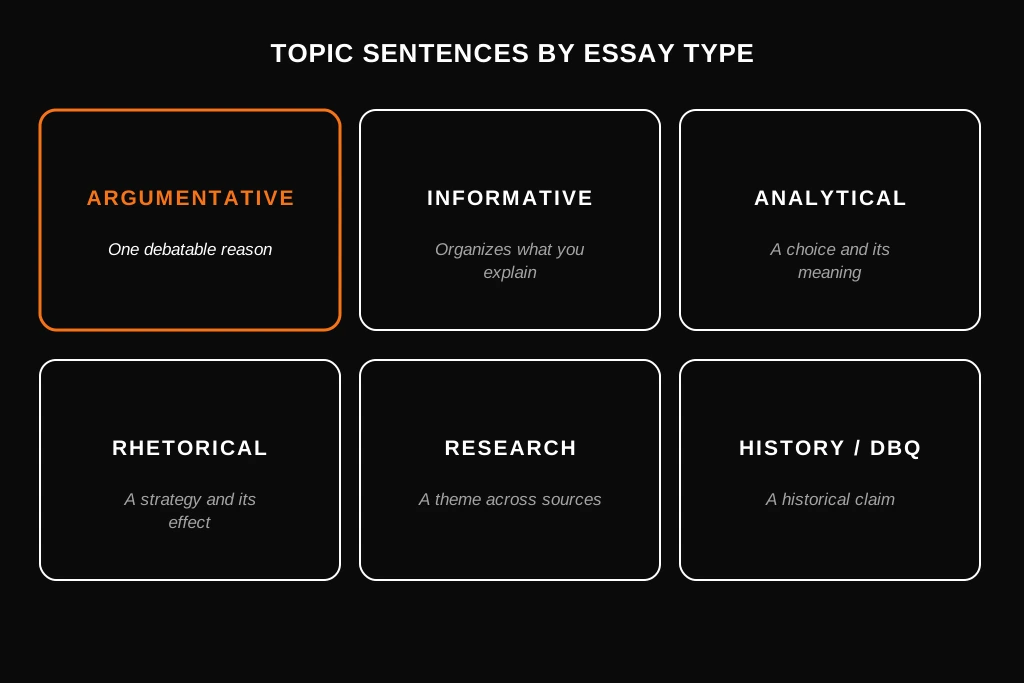
Argumentative and persuasive essays
In an argumentative essay, each topic sentence should state one reason that supports your position. Make it debatable and tie it to your thesis. “Public libraries deserve more funding because they provide free internet access to families who cannot afford it” gives the reader a clear reason to accept or challenge.
Informative essays
An informative topic sentence explains rather than argues. It still needs a controlling idea, but that idea organizes information instead of defending a claim. “The water cycle has four main stages, each driven by changes in temperature” sets up a paragraph that explains a process clearly.
Analytical and literary essays
In analysis, your topic sentence should name an author’s choice and what it reveals. Avoid summarizing plot. “In The Great Gatsby, Fitzgerald uses the green light to show how Gatsby’s hopes depend on distance” is analytical, while “Gatsby looks at a green light” is only summary.
Research papers
In a research paper, topic sentences often introduce a theme from your sources rather than a single source. Write “Studies on remote work point to a clear rise in productivity for focused tasks” instead of “Smith found that remote workers are productive.” This keeps you in control of the argument while your sources provide the support.
History essays and DBQs
For history essays and document based questions, a topic sentence should make a historical claim and hint at the evidence. “Economic hardship, more than political ideas, drove many farmers to support reform movements in the 1890s” sets up a paragraph that analyzes documents rather than listing them.
Rhetorical analysis essays
Rhetorical analysis topic sentences focus on how a speaker or writer persuades an audience. Name the strategy, such as an appeal, repetition or tone, and explain its effect on the audience. Our full guide to the rhetorical analysis essay shows how these topic sentences fit into the complete essay.
Counterclaim paragraphs
A counterclaim topic sentence introduces the opposing view fairly, then signals your response. Words like “Some argue,” “Critics claim” or “Although” work well. The key is to make clear that the paragraph will answer the objection, not simply agree with it.
How to write a summary
When you write a summary, the first sentence works as a topic sentence for the whole piece. It should name the author, the title and the source’s main idea in one line. For example: “In Narrative of the Life of Frederick Douglass, Douglass argues that education is the path from slavery to freedom.” After that opening, each sentence covers one key point in your own words, in the order the source presents them, without your opinion. A strong summary topic sentence makes the rest of the summary easy to organize, because every following sentence simply explains part of that main idea. Keep it short and neutral, and avoid copying the author’s phrasing.
Topic Sentences by Grade Level
What counts as a good topic sentence grows more demanding as students move from elementary school to college. The table below shows what teachers usually expect at each level.
| Level | What a good topic sentence does | Example |
|---|---|---|
| Elementary | Names the topic and one main idea | Dogs make great pets because they are loyal. |
| Middle school | States a clear point with a reason | Recess helps students focus because it gives their brains a break. |
| High school, AP Lang and GCSE | Makes an arguable claim linked to the thesis | Later start times would raise grades by giving teenagers more sleep. |
| College | Makes a precise, nuanced claim that may engage other views | Although remote work boosts focus, it can weaken the informal learning that happens in offices. |
Elementary and middle school
Younger students do well with a simple frame: “[Topic] is [point] because [reason].” Teachers often use the image of a hamburger, where the topic sentence is the top bun that holds the paragraph together. As confidence grows, students can drop the frame and use their own wording.
High school, AP Lang and GCSE
High school teachers and exam markers expect topic sentences that make a claim, not a summary. In AP Lang and GCSE English, a topic sentence that answers the question directly helps examiners see your line of argument quickly, which matters when they read many essays in a short time.
College
College instructors look for precise, nuanced topic sentences. You might acknowledge a complication or engage another writer’s view. A college level topic sentence often carries more information, but it should still focus on one idea that the paragraph can fully develop.
Topic Sentences in Academic Writing
Topic sentences are one of the main tools that make academic writing clear. They guide readers through complex arguments, show how evidence connects and signal the level of certainty behind each claim.
Types of academic writing
The four main types of academic writing are descriptive, analytical, persuasive and critical, and each one asks something slightly different of a topic sentence. In descriptive writing, the topic sentence introduces facts or information to explain. In analytical writing, it organizes ideas into categories or relationships, such as causes and effects. In persuasive writing, it states a claim and a reason. In critical writing, it evaluates another writer’s argument and states your own position on it. Knowing which type your assignment requires helps you choose the right verb for each topic sentence: “describes” and “explains” for descriptive work, “compares” and “connects” for analytical work, “argues” for persuasive work and “challenges” or “extends” for critical work.
Signposting in academic writing
Signposting in academic writing means using words and phrases that tell the reader where your argument is going. Topic sentences are the biggest signposts in any essay, because they announce what each paragraph will do and how it connects to the last one. Phrases such as “A second reason,” “In contrast” or “Building on this point” at the start of a topic sentence help readers follow your logic without rereading. Good signposting is subtle. Instead of writing “In this paragraph I will discuss cost,” write “Cost is another reason families favor uniforms.” If you want a bank of linking phrases, our guide to transition words lists options for adding, contrasting and concluding ideas, and the Manchester Academic Phrasebank offers more examples for academic contexts.
Hedging in academic writing
Hedging in academic writing means using cautious language to show how certain a claim is. In research papers and science essays, a topic sentence that says a study “proves” something often overstates the evidence. Words like “suggests,” “indicates,” “may” or “is likely to” keep the claim accurate. For example, “Regular exercise may improve exam performance by reducing stress” is more defensible than “Exercise improves exam performance.” Hedging is not weakness. It shows the reader that you understand the limits of your evidence. Use it when your sources are limited, findings are mixed or the claim goes beyond what the data shows, but avoid hedging every sentence, which makes your writing sound unsure.
How to build a strong argument in academic writing
Learning how to build a strong argument in academic writing starts with a clear thesis and continues with topic sentences that each prove one part of it. Picture your argument as a chain. The thesis is the claim, the topic sentences are the links and the evidence holds each link in place. If you read only your thesis and topic sentences, they should form a short, logical case on their own. A strong argument also addresses the other side, uses credible evidence and explains why that evidence matters instead of letting quotes speak for themselves. When a reader can trace your reasoning from one topic sentence to the next, your argument feels convincing even before they reach the details.
Essay heading format
Essay heading format usually refers to the information at the top of the first page, such as your name, your instructor’s name, the course and the date, plus the title. In MLA style, short essays normally use this heading instead of section headings, so topic sentences do the work of guiding the reader through the body. Longer reports and APA papers may add section headings, but even then, each paragraph under a heading still needs its own topic sentence. A heading names a section, while a topic sentence makes a point. Never rely on a heading to replace a topic sentence, because the heading tells readers what the section covers, not what you are arguing about it.
Building the Paragraph Around Your Topic Sentence
Once your topic sentence is in place, the rest of the paragraph supports it with evidence, explanation and a final link back to the point. Paraphrasing and summarizing help you bring sources into that support without losing your own voice.
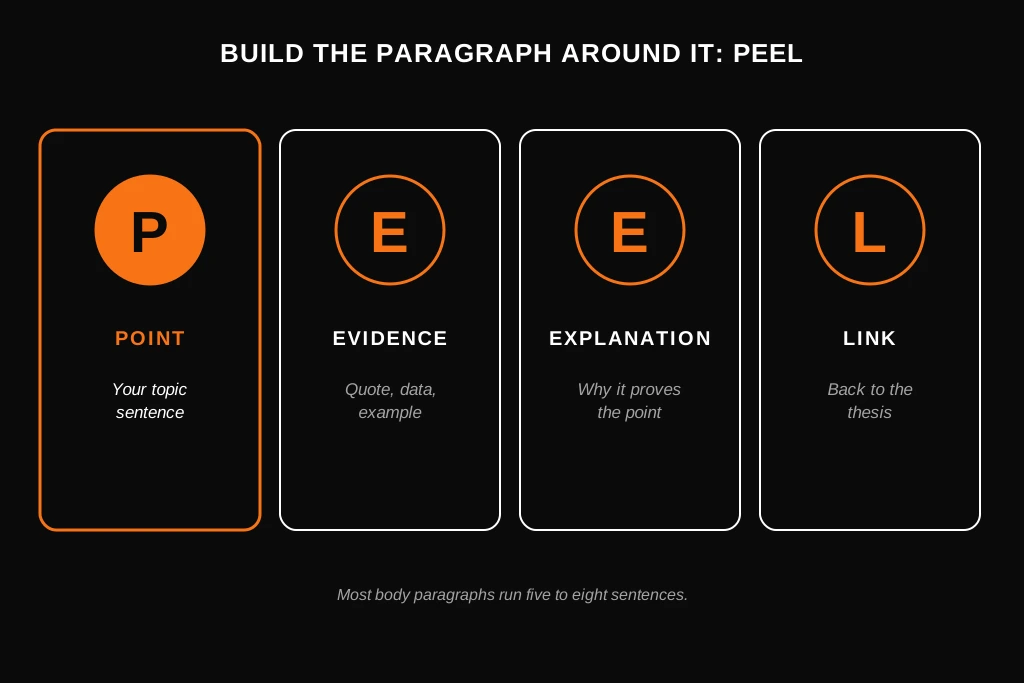
How to write a body paragraph
Knowing how to write a body paragraph starts with the topic sentence and follows a simple pattern. First, state your point in the topic sentence. Next, add evidence, such as a quote, statistic or example. Then explain how that evidence supports your point, which is where most of your marks come from. Finally, end with a sentence that links back to the topic sentence or leads into the next paragraph. Many students know this as PEEL: point, evidence, explanation, link. Most body paragraphs run five to eight sentences, and you repeat this structure for each main reason in your thesis.
How to paraphrase
Learning how to paraphrase helps you support a topic sentence with source material while keeping the writing your own. To paraphrase, read the passage until you understand it, put it away, then write the idea in your own words and sentence structure. Compare your version with the original to make sure you have kept the meaning without copying phrases. Always cite the source, because a paraphrase still uses someone else’s idea. Your topic sentence should never be a paraphrase of a source. It should be your own point, and the paraphrased material comes afterward as evidence. This keeps you in charge of the paragraph and stops your writing from becoming a string of borrowed ideas.
Paraphrasing vs summarizing
The difference between paraphrasing vs summarizing comes down to length and focus. A paraphrase restates a specific passage in your own words and is usually about the same length as the original. A summary condenses a longer text into its main ideas, so it is much shorter. In a body paragraph, paraphrasing works best when you need one precise piece of evidence for your topic sentence, while summarizing works best when you need to give quick background on a whole source. Both need a citation. A useful rule is to paraphrase for detail and summarize for context, then use your own analysis to show how either one supports the topic sentence.
Weak vs Strong Topic Sentences: Revision Examples
Most weak topic sentences fail for one of a few reasons: they are too broad, they state a plain fact, they announce instead of argue, or they summarize instead of analyze. The table shows how to fix each one.
| Weak topic sentence | Problem | Revised topic sentence |
|---|---|---|
| Social media has many effects. | Too broad and vague | Social media harms teenagers’ sleep because late night scrolling delays bedtime. |
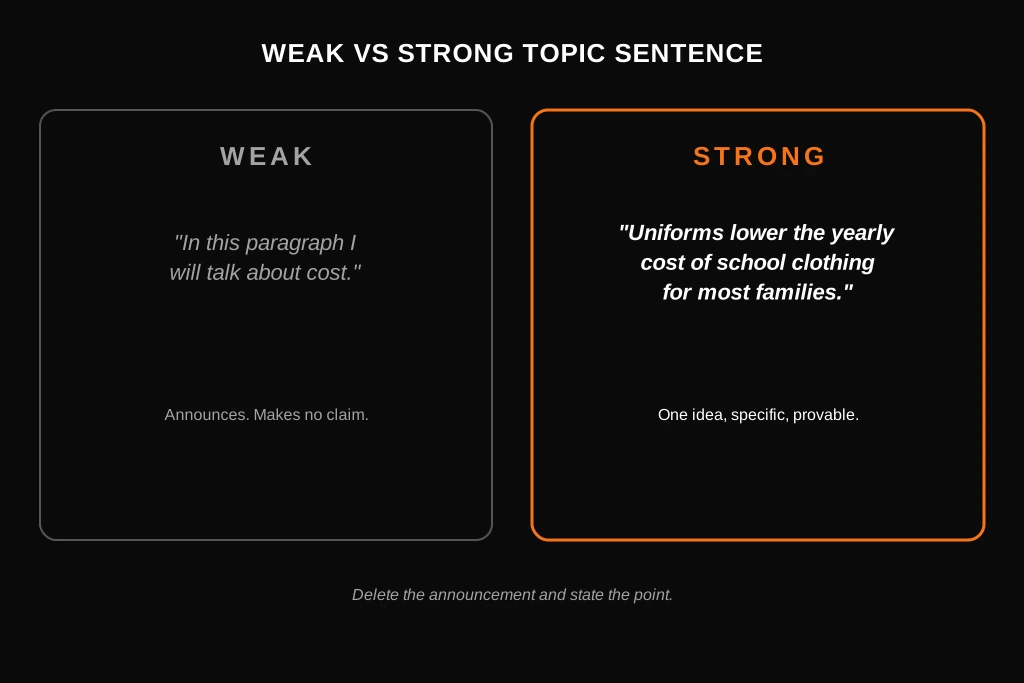
| In this paragraph I will talk about cost. | Announces instead of claiming | Uniforms lower the yearly cost of school clothing for most families. |
| Macbeth kills King Duncan. | Plot summary | Macbeth’s murder of Duncan shows how quickly ambition overrides loyalty. |
| Water boils at 100 degrees Celsius. | A fact with nothing to prove | Boiling water is the simplest way to make water safe in an emergency. |
| Bike lanes are good and also help the economy and the environment. | Too many ideas | Bike lanes boost local business by bringing more foot traffic to shops. |
| There are lots of reasons homework is bad. | Vague and generic | Too much homework reduces the time children spend on sleep and exercise. |
Notice that every revised version focuses on one idea. In a five paragraph essay, that focus matters even more, because each of the three body paragraphs should cover a different, narrower reason from your thesis.
Common Student Problems and How to Fix Them
Topic sentences cause trouble for a lot of students, and that matches the wider picture. In the 2011 Nation’s Report Card writing assessment, only about 27 percent of eighth and twelfth graders scored at or above Proficient (24 percent Proficient plus 3 percent Advanced). Here are the problems students raise most often and how to solve them.
“My topic sentence is too broad”
If your topic sentence could describe the whole essay, it is too broad. Narrow it to one reason, example or part of your argument. “Technology changes education” becomes “Online quizzes help teachers spot learning gaps faster than paper tests.”
“My topic sentence is just a fact”
A fact gives you nothing to prove. Ask what the fact suggests or why it matters, then turn that into the topic sentence. “Many students work part time” becomes “Part time jobs teach students time management skills that classes rarely cover.”
“I keep writing ‘In this paragraph I will'”
Announcing your plan wastes the sentence. Delete the announcement and state the point directly. “In this paragraph I will discuss pollution” becomes “Car pollution is the main cause of poor air quality in most large cities.”
“My topic sentence just repeats my thesis”
Each topic sentence should prove one part of the thesis, not restate all of it. Pick the specific reason that paragraph covers and build the sentence around that reason alone.
“My topic sentence is too long”
If it runs past two lines, it is probably doing the job of the whole paragraph. Keep the core point in the topic sentence and move the details into your supporting sentences. Most strong topic sentences are 15 to 30 words.
“Can I start a paragraph with a quote?”
It is better not to. A quote is evidence, and evidence should support your point rather than replace it. Start with your own claim, then bring in the quote as the second or third sentence.
“My evidence does not match my topic sentence”
This happens when you write the topic sentence before checking your evidence. Either find evidence that fits the claim or change the claim to match what your evidence shows. Usually the second option is faster and produces a more honest paragraph.
“I want my topic sentence to be catchy”
Clarity matters more than catchiness. A vivid word or a surprising angle can help, but never at the cost of a clear point. A topic sentence that sounds clever but leaves readers unsure what you are arguing does more harm than good.
“Can a topic sentence be a question?”
Generally no. A question can lead into a point, but the topic sentence itself should answer it. Readers need to know your claim, not wonder about it.
“Can a topic sentence be two sentences?”
Occasionally, in longer college writing, a short linking sentence comes first and the main point follows. In most school essays, keep it to one sentence so your point is easy to find.
How EssaysHelper Can Help You
Topic sentences hold every paragraph together, and getting them right can lift the clarity of a whole essay. If you are stuck turning a thesis into paragraph claims, or your paragraphs keep drifting off point, our team can help you move forward with confidence. Our writers work with students from middle school through graduate programs.
- Turning your thesis into clear, focused topic sentences.
- Revising vague or factual topic sentences into strong claims.
- Building body paragraphs that match your evidence.
- Reviewing full essays for flow, signposting and structure.
Share your assignment, prompt and deadline through our essay writing services page, and we will suggest the fastest way forward.
Frequently Asked Questions
What is the difference between a topic sentence and a thesis statement?
A thesis statement gives the main argument of the whole essay, while a topic sentence gives the main point of one paragraph. Each topic sentence should prove one part of the thesis.
Does a topic sentence always have to be the first sentence of a paragraph?
Not always, but in most school and college essays it should be. Placing it first tells the reader what the paragraph will prove before they reach the evidence.
How long should a topic sentence be?
Most strong topic sentences are about 15 to 30 words. That is long enough to state a topic and a specific point, but short enough to read quickly.
Can a topic sentence be a question?
It is best to avoid it. A question can lead into your point, but the topic sentence itself should state the claim the paragraph will support.
Can I start a paragraph with a quote instead of a topic sentence?
It is better to start with your own point and bring in the quote afterward as evidence. Opening with a quote lets the source speak for you instead of supporting your argument.
How do I write a topic sentence for an argumentative essay?
State one reason that supports your position and make it debatable. A pattern like “[Topic] [claim] because [reason]” keeps it focused and tied to your thesis.
How do I write a topic sentence from my thesis?
Break your thesis into its separate reasons or parts. Turn each part into its own sentence with a specific angle, and use one per body paragraph.
What makes a topic sentence too broad or too narrow?
It is too broad if it could describe the whole essay, and too narrow if it is a single fact with nothing left to explain. Aim for one point that needs a full paragraph to prove.
Do research papers need topic sentences?
Yes. Research papers rely on topic sentences to organize sources around your argument, often with cautious words like “suggests” or “may” to reflect the evidence.
How do I know if my topic sentence is strong enough?
Check that it covers one idea, makes a claim that needs support, uses specific words and links to your thesis. If your paragraph proves it fully, it is strong enough.
Final Thoughts
Learning how to write a topic sentence is one of the quickest ways to make your essays clearer. A strong topic sentence tells the reader exactly what one paragraph will prove. Start from your thesis, pick one point, check your evidence, then write a clear claim using the topic plus controlling idea formula. Link it to your larger argument, keep it to one focused idea, and revise it once the paragraph is written. Use the templates and examples here as a starting point, and you will find that clear topic sentences make every paragraph easier to write and every essay easier to follow.