
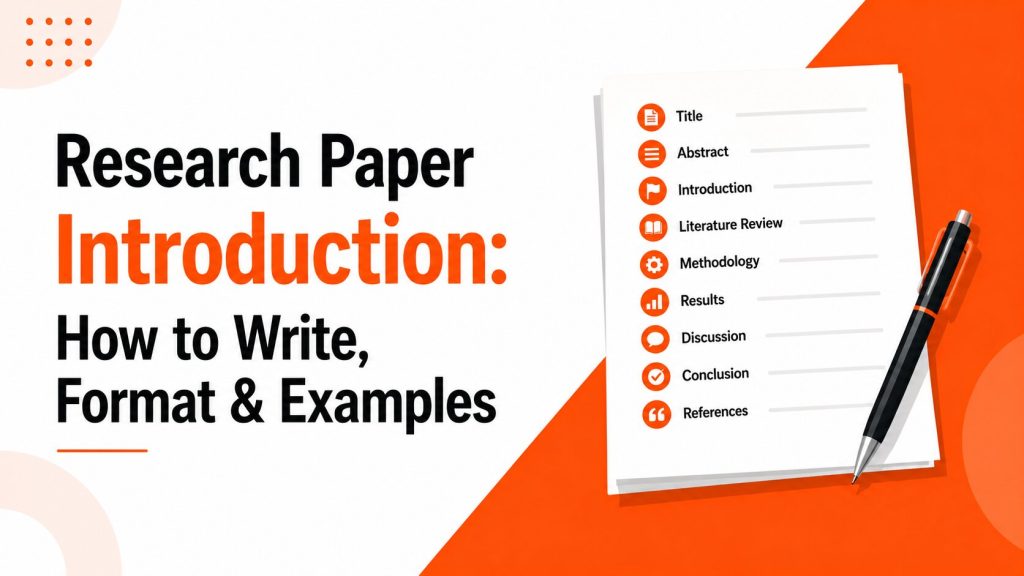
You have a blank page, a blinking cursor, and a research paper due that has to somehow open with something better than a dictionary definition. The introduction is often the last thing students want to write and the first thing a reader actually judges, which is exactly why it feels so much harder than it should.
This guide walks through exactly how to write an introduction for a research paper, how long it should be, what has to be in it, and where students consistently go wrong. If you have not yet nailed down the rest of your paper, it helps to get comfortable with how to write a research paper first, since a strong introduction is much easier to write once the paper underneath it actually has a clear shape.
How Long Should a Research Paper Introduction Be
The quick answer: most research paper introductions run about 10 to 15 percent of the total paper length. For a 2,000 word paper, that is roughly 200 to 300 words. For a longer research paper in the 4,000 to 6,000 word range, expect something closer to 500 to 800 words.
This is not a guess. A large-scale analysis of over 61,000 published research papers found that the median introduction ran 553 words, roughly 21 sentences across four paragraphs, and that 90 percent of introductions fell between 245 and 1,245 words. The same analysis found the introduction is consistently the shortest major section of a paper, at about 14.6 percent of total length, well under the methodology, results, and discussion sections.
| Total Paper Length | Typical Introduction Length | Rough Paragraph Count |
| 1,000 to 2,000 words | 150 to 300 words | 1 to 2 paragraphs |
| 2,000 to 4,000 words | 300 to 500 words | 2 to 3 paragraphs |
| 4,000 to 8,000 words | 500 to 900 words | 3 to 5 paragraphs |
These numbers are a strong starting point, not a hard rule. If your assignment sheet or rubric gives you a specific structure or word count, that always overrides a general convention like this one.
What a Research Paper Introduction Actually Needs to Do
A lot of students think the introduction exists to summarize the paper. It does not, that is closer to what a research paper conclusion does at the other end. The introduction has a narrower, more specific job: orient the reader, narrow down to your exact question, and tell them what position or approach you are taking.
Every sentence in your introduction should be doing one of those three jobs. If a sentence is not orienting the reader, narrowing the topic, or stating your direction, it is probably padding, and padding is one of the easiest things for a reader, or a grader, to spot immediately.
Think of it less as an essay and more as a piece of navigation. A reader who has never seen your topic before should be able to finish your introduction and answer three questions without hesitation: what is this paper about, why does it matter, and what exactly is being argued or investigated. If any of those three answers feels fuzzy after reading your draft out loud, that is usually a sign one of the core components below needs more work.
The Core Components of a Strong Introduction
Almost every research paper introduction, regardless of discipline, is built from the same five moving parts, usually in this order.

The hook and context
Open with something that earns attention without overselling. A striking statistic, a real world example, or a clear statement of why the topic matters right now all work better than a sweeping claim about the history of humankind. Avoid dictionary definitions as an opener, they read as filler to most readers.
Background
Give just enough context for a reader unfamiliar with your specific topic to follow along. This is not the place for a full writing a literature review style survey of every related study, that level of depth belongs in its own section or a dedicated literature review. Here, you only need enough background to make the gap you are about to identify make sense.
The gap or problem
State clearly what is missing, unresolved, or under explored in existing work or understanding. This is the pivot point of your introduction, the moment where you move from what is already known to what your paper is actually going to add.
Thesis statement or research question
This is the single most important sentence in your introduction. It should be specific enough that a reader knows exactly what you are arguing or investigating, not a vague statement of topic. Compare a weak version, this paper will discuss climate policy, against a strong one, this paper argues that municipal level carbon pricing has outperformed state level mandates in reducing emissions since 2015. The second version tells the reader exactly what to expect.
Here is another pair worth comparing. A weak thesis reads, this paper looks at social media and mental health in teenagers. A stronger version reads, this paper argues that platform design features, specifically infinite scroll and notification frequency, are more strongly associated with teenage anxiety symptoms than total screen time alone. Notice the strong version names a specific relationship, not just a general subject area. That specificity is what actually makes a thesis arguable, and an arguable thesis is what gives the rest of your paper something concrete to prove.
A roadmap of what follows
A short closing sentence or two previewing the structure of the paper helps orient the reader before they dive into the body. This does not need to list every section by name, a general sense of the path ahead is usually enough.
Types of Hooks You Can Use, Categorized
The opening line gets more anxiety than almost any other single sentence in academic writing, largely because students feel like it needs to be clever. It does not. It needs to be relevant and specific. A few categories consistently work well across disciplines.
- Statistic or data point. A specific, sourced number related to your topic, used to establish scale or urgency before you narrow in.
- Real world example or case. A brief, concrete situation that illustrates the problem your paper addresses, before you generalize outward to the research question.
- Direct statement of relevance. A plain sentence explaining why this topic matters right now, useful when your subject does not lend itself to a striking statistic or anecdote.
- Contrast or tension. Two seemingly conflicting facts or findings placed next to each other, which naturally sets up the gap your paper is about to address.
What does not belong on this list is a dictionary definition, a sweeping claim about the history of civilization, or a rhetorical question with an obvious answer. All three are common defaults when students feel stuck, and all three read as filler to an experienced reader, including most instructors grading a stack of similar papers.
How to Write a Research Paper Introduction Step by Step
Most instructors expect you to write the introduction last, even though it appears first on the page. Once your paper is drafted and you have a clear research paper outline to work from, writing the introduction becomes far less intimidating, since you already know exactly what you are introducing.
Start by writing your thesis statement first, even before the hook. Once you know precisely what you are arguing, everything else in the introduction exists to build toward that one sentence, which makes the rest of the writing much more directed.
Next, draft your background and gap in plain, simple language. Do not worry about a polished opening line yet. Get the logical sequence down first: here is what is known, here is what is missing, here is what I am doing about it.
After that, go back and write the hook. It is genuinely easier to write an attention grabbing opening once you already know exactly what the paper is about, rather than trying to invent a hook in a vacuum before you have written anything else.
Finally, read the whole introduction out loud, on its own, without the rest of the paper next to it. If someone who had never seen your topic could read just this section and understand what you are investigating, why it matters, and what you are arguing, it is doing its job.
This same hook, background, and thesis structure applies whether you’re writing a full research paper or a shorter argumentative essay, though the shorter version usually compresses each part. If that’s closer to what you’ve been assigned, our guide on writing an argumentative essay introduction walks through the scaled-down version with its own examples.
Research Paper Introduction Examples
Here is a short example introduction for a hypothetical paper, broken down piece by piece so you can see the structure in action.
“Online learning platforms have become a permanent fixture in higher education since 2020, yet student engagement on these platforms remains difficult to measure consistently. [Hook and context] Existing research has focused heavily on course completion rates, while relatively little attention has gone to how engagement varies by course format within the same platform. [Background and gap] This paper argues that live, synchronous sessions produce measurably higher engagement scores than pre-recorded lecture formats, even when course content is otherwise identical. [Thesis statement] The sections that follow examine engagement data across three universities, compare formats directly, and consider what these differences suggest for course design going forward. [Roadmap]”
Notice that every sentence is doing real work. There is no throat clearing about the importance of education in general, and the thesis statement is specific enough that a reader knows exactly what claim is being tested.
A shorter example, for a briefer paper
Not every introduction needs four distinct sentences doing four separate jobs. For a shorter paper, the same components can compress into fewer, denser sentences.
“Nearly a third of college students report skipping meals to afford textbooks, yet most financial aid calculations do not account for course material costs separately from tuition. This paper argues that universities should require professors to report estimated material costs before registration, giving students the information they need to budget accurately before a semester begins.”
This version folds the hook, the gap, and the thesis into two sentences total, which is often exactly right for a shorter assignment where a full four paragraph introduction would feel disproportionate to the rest of the paper.
Common Mistakes That Weaken an Introduction
Opening with a dictionary definition or an overly broad claim about human history.
- Writing a vague thesis statement that states a topic instead of an actual position or question.
- Front loading too much background, effectively writing a mini literature review instead of a focused introduction.
- Introducing evidence or data that belongs in the body of the paper rather than the introduction itself.
- Writing the introduction first, before the paper’s argument has fully taken shape, then never revising it once the paper changes direction.
- Ending without any sense of direction, leaving the reader unsure what the paper is actually going to do next.
Two of these are worth slowing down on, since they are the ones that show up most often even in otherwise well written papers. The first is front loading too much background. Students who are genuinely knowledgeable about their topic often want to demonstrate that knowledge early, which leads to introductions that read like a condensed literature review rather than a focused setup. If your background section is running longer than your thesis and gap combined, it is usually a sign some of that material belongs later in the paper instead.
The second is a vague thesis dressed up in academic sounding language. Phrases like this paper will explore or this paper examines the complexities of can sound sophisticated while actually saying very little. A reader should be able to underline your thesis sentence and know, specifically, what you are claiming or asking, not just what general territory you are operating in.
How the Introduction Fits Into the Rest of Your Paper
The introduction does not work alone. It sets up expectations that the rest of the paper has to deliver on. Your research paper methodology section explains exactly how you investigated the question your introduction raised. Your research paper results section reports what you actually found. Your research paper discussion section interprets what those results mean in light of the gap you identified at the start. And your research paper conclusion circles back to the thesis statement from your introduction and confirms whether, and how, your paper answered it.
It also helps to understand exactly how the introduction differs from how to write an abstract that sits before it. An abstract is a compressed, standalone summary covering your entire paper in a single short paragraph, written after everything is finished. An introduction is part of the paper itself, has room to build context gradually, and its job is to set up the argument rather than summarize the outcome.
Building On Your Introduction Later in the Research Process
The compression and framing skills you use in an introduction show up again and again elsewhere in academic writing, just applied slightly differently each time.
If you ever need to know how to summarize a research paper, whether your own or someone else’s for a literature review, you are doing a version of the same job: identifying the background, the gap, and the core claim, just working backward from a finished paper instead of forward into one.
An annotated bibliography asks for something similar in miniature, a short summary and evaluation of a single source’s relevance, which is close cousin work to writing an introduction’s background section. If you have never done one, learning how to write an annotated bibliography is genuinely useful practice for the same compression skill.
And if you are earlier in the process and still need to know how to write a research proposal, a solid research proposal outline uses nearly the same background, gap, and thesis structure covered here, just aimed at convincing someone your project is worth doing rather than reporting what you already found.
How EssaysHelper Can Help With Your Research Paper
Even once you understand the structure, it is genuinely hard to see your own introduction clearly after staring at the same paragraph for an hour. A second set of eyes, someone who was not in your head while you were writing it, is often the fastest way to catch a vague thesis or a background section that has quietly turned into a full literature review.

EssaysHelper works with students on exactly this kind of writing, offering reliable, expert support for research papers and capstone projects across every discipline, from a first draft introduction through the final polished version. Whether you need someone to sanity check whether your thesis is specific enough, help tightening a background section that has run too long, or full feedback across the rest of your paper once the introduction is set, that kind of support can make the difference between an introduction that gets skimmed and one that actually earns a close read.
FAQs About Research Paper Introduction
How long should a research paper introduction be?
Most introductions run about 10 to 15 percent of the total paper length, which works out to roughly 150 to 300 words for a short paper and 500 to 900 words for a longer one. Always check your assignment sheet first, since a specific rubric or word count always overrides a general convention.
Should I write the introduction before or after the rest of my paper?
Write it after, or at least plan to revise it heavily once your paper is done. Your argument and findings often shift while you write, and an introduction drafted too early usually needs a significant rewrite by the end anyway.
What is the difference between a research paper introduction and an abstract?
An abstract is a short, standalone summary of the entire paper, written last and read independently of the rest of the text. An introduction is part of the paper itself, builds context gradually, and sets up the argument rather than summarizing the outcome.
How specific does my thesis statement need to be in the introduction?
Specific enough that a reader knows exactly what you are arguing or investigating, not just the general topic. A thesis like this paper discusses renewable energy is too vague, while a thesis naming a specific claim, comparison, or relationship gives the reader something concrete to expect.
Can I include citations in my research paper introduction?
Yes, citations are appropriate in the background and gap sections of an introduction, since you are referencing existing research to establish context. Just avoid opening with a citation or quote as your hook, since it rarely makes for a strong first sentence.
What makes a good hook for a research paper introduction?
A specific statistic, a real world example, or a clear statement of present day relevance usually works better than a broad historical claim or a dictionary definition. The goal is to earn attention without overselling or wandering away from your actual topic.
How do I write an introduction paragraph for a research paper if I do not have a strong hook yet?
Write your thesis statement and background first, then come back to the hook once you already know exactly what the paper is about. It is much easier to write an attention grabbing opening line when the rest of the introduction already exists.
Does a research paper introduction need to preview the rest of the paper?
Most instructors expect at least a short roadmap sentence near the end of the introduction, giving the reader a general sense of what follows. It does not need to list every section by name, just enough to orient the reader before they move into the body.
How many paragraphs should a research paper introduction have?
For shorter papers, one to two paragraphs is typical. Longer research papers, especially those in the 4,000 word range and up, often run three to five paragraphs to properly cover background, gap, and thesis.
What is the most common mistake students make in a research paper introduction?
Writing a vague thesis statement that states a general topic instead of a specific position or question. A reader should finish the introduction knowing exactly what claim the paper is testing, not just what subject it touches on.
Final Thoughts
A research paper introduction has a small, specific job: orient the reader, narrow the topic, and tell them exactly what you are arguing or investigating. It does not need to be clever, and it does not need to cover everything, it just needs to do those three things clearly and then get out of the way.
Write your thesis first, build the background and gap around it, and save the hook for last. Once you treat the introduction as a structural exercise rather than a creative writing challenge, it stops being the part of the paper you dread and becomes one of the more mechanical, manageable sections to write.