
Writing a research paper can feel overwhelming when you are staring at a blank document and do not know where to begin. The good news is that a research paper becomes much easier when you break the process into manageable stages.
A strong research paper is not simply a collection of information from different websites and books. It uses credible research to investigate a focused question, develop an argument or explanation, and support ideas with appropriate evidence. University writing centers commonly emphasize the importance of understanding the assignment, developing a focused research question, planning the paper, using reliable sources, and revising before submission.
In this guide, you will learn how to write a research paper from beginning to end. You will learn each of the steps of a research paper: how to choose and narrow a topic, formulate a research question, find credible sources, create an outline, write each major section, cite your sources, revise your draft, and prepare the final paper for submission.
You can also learn more about what a research essay is if you are unsure how a research essay differs from a research paper.
What Is a Research Paper?
A research paper is a structured piece of academic writing that investigates a specific topic or question using research and evidence. Depending on the discipline and assignment, a research paper may analyze existing scholarship, develop an argument, report original research, evaluate evidence, or combine several of these purposes.
Most research papers are built from a set of standard sections, and each section takes up a different share of the total word count.
| Section | Purpose | Typical share of word count |
| Abstract (when required) | Summarizes the problem, method, findings, and conclusion in one short paragraph | Separate: 150–250 words, not counted in the body |
| Introduction | Sets out the context, the research problem, and the thesis or research question | 10–15% |
| Literature review | Explains what existing research says and where the gap is | 15–20% |
| Methodology | Describes how the data or sources were collected and analyzed | 10–15% |
| Results | Reports the findings without interpreting them | 15–20% |
| Discussion | Explains what the findings mean and how they relate to earlier research | 20–25% |
| Conclusion | Answers the research question and states why it matters | 5–10% |
These shares are typical for an empirical research paper. In a humanities or argument-based paper, the introduction and conclusion usually take about 10% each and the body sections about 80%. Not every paper needs every section, so follow your assignment instructions.
These percentages are common rule-of-thumb ranges, not from a published standard. The note under the table frames them as typical, but check them against your own guidance if you want a source.
A research paper also differs from a book report. A book report might primarily explain what a book says, while a research paper normally requires you to investigate a broader question and support your analysis with multiple appropriate sources.
The exact structure varies by discipline. For example, an empirical psychology paper may use sections such as Introduction, Method, Results, Discussion, and References, while a history paper may use a more argumentative structure.
How to Write a Research Paper: The Process at a Glance
Writing a research paper is easier when you break the process into smaller, manageable tasks. The steps in making a research paper run from understanding your assignment and choosing a focused topic to researching credible sources, developing your argument, and polishing the final draft, and each stage plays an important role in producing a strong paper.
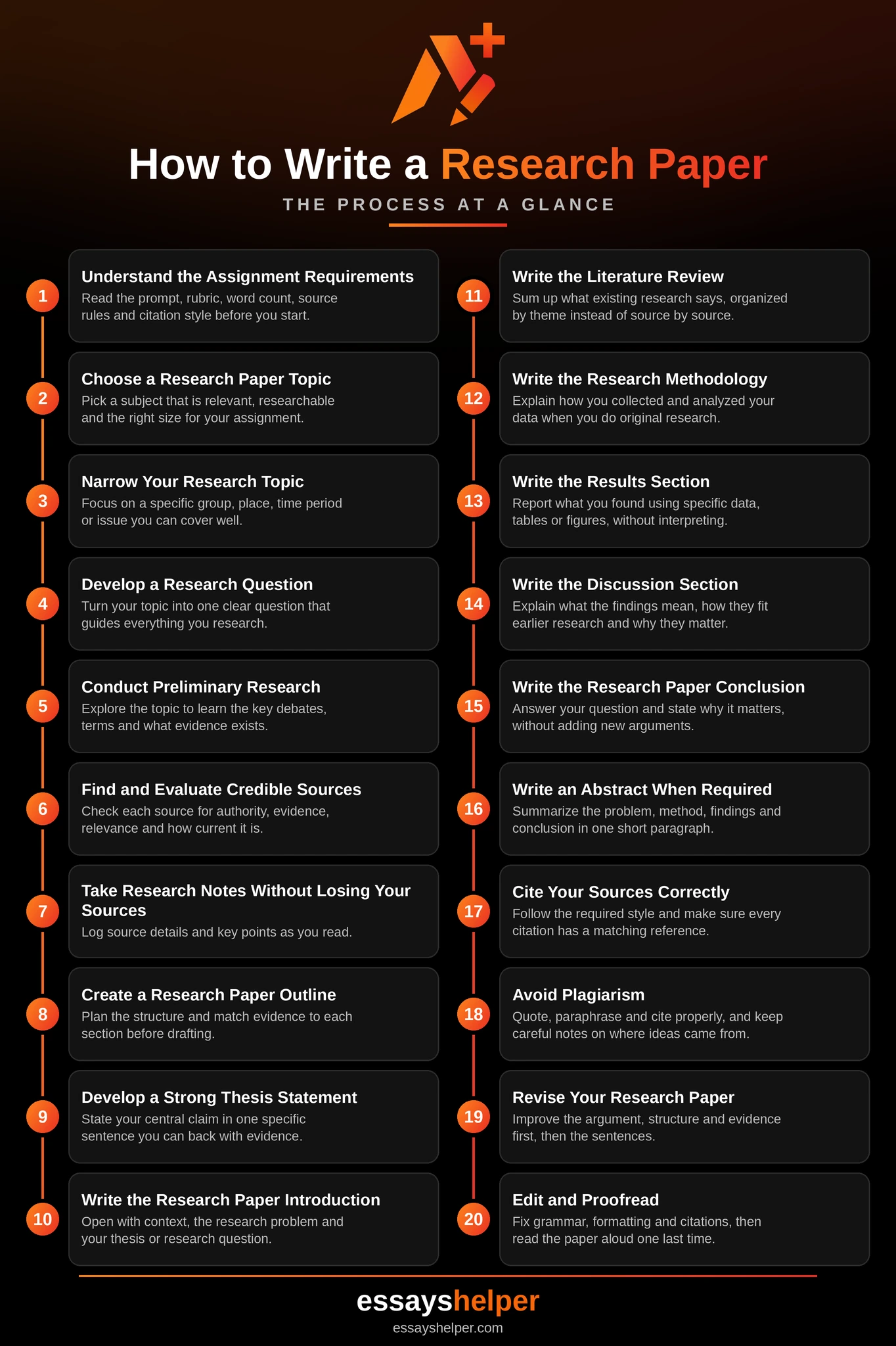
The process may look different depending on your subject, academic level, and assignment requirements, but the following steps provide a practical framework you can adapt to most research papers. Use them as a roadmap, and adjust your approach as your research develops.
- Understand the assignment requirements.
- Choose a manageable topic.
- Narrow the topic.
- Develop a research question.
- Conduct preliminary research.
- Find and evaluate credible sources.
- Take organized research notes.
- Create a research paper outline.
- Develop a thesis or central argument.
- Write the introduction.
- Develop the main sections and evidence.
- Write the literature review when required.
- Explain the methodology when required.
- Present and analyze findings when applicable.
- Write the discussion and conclusion.
- Add citations and references.
- Revise, edit, and proofread.
- Complete a final submission check.
The most important point is that research paper writing is not necessarily a perfectly linear process. You may discover during your research that your original question is too broad, your evidence is insufficient, or your argument needs to change. Good researchers adjust their approach when the evidence requires it.
Step 1: Understand the Assignment Requirements
Before searching for sources or writing your first paragraph, read the assignment carefully.
Many students immediately begin researching because they think “research paper” means “find information about the topic.” That can create problems later if the instructor actually expects a particular research method, source type, citation style, argument, or structure.
Look for requirements such as:
- Required topic or topic restrictions
- Research question requirements
- Word count or page limit
- Number or type of sources
- Publication-date requirements
- Required citation style
- Required sections
- Research methodology
- Formatting requirements
- Due date
- Assignment rubric
If the instructions say that you must use peer-reviewed sources, for example, do not build your paper primarily around general websites. If the professor specifies APA 7th edition, follow that requirement rather than choosing MLA simply because you are more familiar with it.
When instructions are unclear, ask your instructor before investing significant time in the wrong direction.
Step 2: Choose a Research Paper Topic
Choosing a topic is one of the most important early decisions because your topic determines what sources you can find, how much research you need, and how manageable the final paper will be.
A good research paper topic should usually be:
- Relevant to the assignment
- Specific enough to investigate
- Broad enough to provide sufficient evidence
- Researchable using available sources
- Appropriate for your academic level
- Interesting enough to sustain your attention
Avoid choosing a topic simply because it sounds impressive.
For example, “Climate Change” is far too broad for many short research papers. A more focused direction might be “The effect of extreme heat on urban public health.” You could narrow it further by examining a particular population, region, time period, or policy.
The goal is not to choose the biggest topic. The goal is to choose a topic that you can investigate meaningfully within the limits of your assignment.
Step 3: Narrow Your Research Topic
A broad subject gives you a starting point, but a focused topic gives you something you can actually research.
Consider this progression:
| Level | Example |
| Broad subject | Social media |
| Narrower topic | Social media and university students |
| Focused issue | Social media use and academic concentration |
| Research question | How does frequent social media use affect students’ ability to maintain academic concentration? |
You can narrow a topic by considering:
- A specific population
- A particular location
- A specific time period
- One cause or effect
- A particular policy
- A specific theoretical perspective
- A comparison between two groups
- A particular problem or debate
A common student mistake is trying to cover everything about a subject. A narrower paper often produces stronger analysis because you have enough space to examine the evidence properly.
Step 4: Formulate a Research Question
To formulate a research question, turn your narrowed topic into one specific question that gives your paper direction.
Instead of researching everything you can find about a subject, you research information that helps answer a specific question.
A useful research question is focused, clear, researchable, and appropriate for the assignment.
For example:
Too broad:
How does technology affect education?
More focused:
How does the use of AI-assisted learning tools affect undergraduate students’ academic engagement?
Potentially more researchable:
What factors influence undergraduate students’ use of AI-assisted learning tools for academic work?
The best question depends on your discipline and assignment. A history paper, scientific study, and literature analysis may all require very different types of questions.
A research question can also evolve. Preliminary research may show that your original question is too broad or that there is not enough evidence available. Refining the question is a normal part of research rather than a sign that you have failed.
Step 5: Conduct Preliminary Research
Before committing to a final thesis, explore the topic.
Preliminary research helps you discover:
- What scholars already know
- What major debates exist
- Which terms researchers use
- What evidence is available
- Which issues remain unclear
- Whether your topic is manageable
- Which sources might be useful for deeper research
Start with broad searches to learn the vocabulary surrounding your subject. Then move toward scholarly articles, books, academic databases, government publications, institutional reports, and other sources appropriate to your discipline.
Do not immediately copy information into your paper. At this stage, your main goal is to understand the research landscape.
Step 6: Find and Evaluate Credible Sources
A research paper is only as strong as the evidence supporting its claims.
That does not mean every source must be perfect or that every paper requires the same type of evidence. Source requirements vary by discipline and assignment. However, you should be able to explain why your sources are appropriate.
When evaluating a source, consider:
Authority: Who wrote or published it?
Evidence: Does the source support its claims with appropriate evidence?
Relevance: Does it directly help answer your research question?
Currency: Is the publication date appropriate for your topic?
Methodology: If it reports research, how was the research conducted?
Purpose: Is the source informing, analyzing, persuading, selling, or advocating?
Citations: Does the author engage with other credible research?
A university library, government agency, peer-reviewed journal, or recognized professional organization may provide stronger evidence for many academic claims than an anonymous website.
For citation and academic writing guidance, the Purdue Online Writing Lab provides extensive student writing resources.
Step 7: Take Research Notes Without Losing Your Sources
Research becomes much harder when you cannot remember where a piece of information came from.
Create a simple system for recording sources while you research.
For each useful source, record:
- Author
- Title
- Publication
- Publication date
- URL or DOI when applicable
- Page numbers for relevant material
- Main argument (in one or two sentences, in your own words)
- Important findings
- Useful quotations
- Your own paraphrases
- How the source relates to your research question
Clearly distinguish your own ideas from material taken from a source.
This is particularly important when paraphrasing. Changing a few words in another author’s sentence does not automatically make the material your own. Read the source, understand the idea, close the source if appropriate, and explain the idea in your own words while still providing the required citation.
Writing a short summary of each source as you read is the fastest way to keep your notes usable. For a step-by-step method, see our guide on how to summarize a research paper, which shows how to condense each source into a few clear sentences.
Good notes can save significant time during the writing stage.
Step 8: Create a Research Paper Outline
Once you understand your research question and have collected useful evidence, create an outline.
An outline gives your paper a logical structure before you begin writing full paragraphs. It also helps you identify missing evidence and prevents individual sections from becoming disconnected.
A basic research paper outline might include:
Introduction
- Background
- Research problem
- Research question
- Thesis or central argument
- Overview of the paper
Literature Review
- Major themes
- Existing research
- Areas of agreement
- Areas of disagreement
- Research gaps
Main Analysis or Research Sections
- Major argument
- Evidence
- Analysis
- Counterarguments where relevant
- Connection to research question
Methodology
- Research design
- Participants or data
- Materials or sources
- Procedures
- Analysis method
Results
- Findings
- Tables or figures where appropriate
Discussion
- Meaning of findings
- Relationship to previous research
- Implications
- Limitations
Conclusion
- Main answer
- Key findings
- Final implications
- Future research where appropriate
Not every research paper needs every section. Your discipline and assignment determine the appropriate structure.
For more detailed planning, see the research paper outline.
You may also find the different parts of a research paper useful when planning the structure.
Step 9: Develop a Strong Thesis Statement
A thesis statement expresses the central claim or position of a paper when the assignment requires an argumentative thesis.
A strong thesis is specific enough to guide the paper and defensible enough to require evidence.
For example:
Weak:
Social media affects students.
Stronger:
Frequent social media interruptions can reduce students’ ability to maintain sustained academic attention, particularly when social media use occurs during study sessions.
The exact form of a thesis varies by discipline. Some research papers are exploratory rather than argumentative, while empirical studies may use a research question and hypotheses instead of a conventional argumentative thesis.
Do not force a traditional thesis statement into a paper if your assignment requires a different research design.
Step 10: Write the Research Paper Introduction
The introduction establishes the context for the research and helps the reader understand why the topic matters.
A strong introduction often moves from a broader context toward the specific research problem.
Depending on the assignment, it may include:
- Background information
- Context
- Existing research
- Research problem
- Research question
- Thesis or central argument
- Purpose of the paper
Avoid beginning with unnecessary generalizations.
For example, a sentence such as “Since the beginning of time, humans have always used technology” rarely adds useful context to a focused academic paper.
Instead, begin with information that directly establishes the subject of your research.
For more detailed guidance, see the research paper introduction.
If you are also working on general academic writing, our complete essay writing guide can provide additional guidance.
Step 11: Write the Literature Review
A literature review explains and evaluates what previous researchers have said about your topic.
One of the most common mistakes students make is turning the literature review into a list of summaries:
“Researcher A said this. Researcher B said this. Researcher C said this.”
That approach may show that you read several sources, but it does not necessarily demonstrate synthesis.
Instead, organize research around themes, arguments, methods, findings, or debates.
For example:
Theme 1: Researchers generally agree that X.
Theme 2: Studies disagree about Y.
Theme 3: Recent research has begun examining Z.
Then explain how these findings relate to one another.
A good literature review asks questions such as:
- What do researchers agree about?
- Where do they disagree?
- Which methods have been used?
- What limitations exist?
- What has not been adequately investigated?
- How does the existing literature relate to your research question?
You can learn more about how to write a literature review and use a literature review outline to organize the section.
Step 12: Write the Research Methodology
If your paper involves original research, the methodology explains how the research was conducted.
The methodology section may describe:
- Research design
- Participants or population
- Data sources
- Sampling
- Instruments
- Procedures
- Data collection
- Data analysis
- Ethical considerations where applicable
Quantitative research may involve numerical data and statistical analysis. Qualitative research may involve interviews, observations, textual analysis, or other approaches. Mixed-method research combines quantitative and qualitative approaches.
Do not describe a method simply because it sounds academically impressive. Your method should be appropriate for the research question and follow your assignment or discipline’s requirements.
For more guidance, see research paper methodology.
Step 13: Write the Results Section
If your research produces findings, the results section presents what you found.
The results section should generally focus on reporting findings rather than providing an extended interpretation of what those findings mean.
Depending on the discipline, this might involve:
- Statistical findings
- Themes from interviews
- Experimental observations
- Document analysis
- Survey results
- Tables
- Figures
- Other relevant evidence
Use tables or figures when they make information easier to understand, not simply because you can include them.
A useful distinction is:
Results: What did the research find?
Discussion: What do those findings mean?
For more guidance, see the research paper results section.
Step 14: Write the Discussion Section
The discussion interprets your findings.
This is where you explain what the results mean and how they relate to your research question and existing literature.
You may discuss:
- What the findings suggest
- Whether they support or challenge previous research
- Why the findings matter
- Practical or theoretical implications
- Unexpected findings
- Limitations
- Opportunities for future research
Avoid simply repeating your results.
Instead of saying, “The study found that students reported increased engagement,” explain what that finding means in the context of the research question and previous scholarship.
You can learn more about the research paper discussion section.
Step 15: Write the Research Paper Conclusion
The conclusion brings the research together.
A strong conclusion should answer the central question or reinforce the main argument without simply copying the introduction.
Depending on the assignment, include:
- The main conclusion
- The most important findings
- The significance of the research
- Implications
- Limitations
- Suggestions for future research
Do not introduce an entirely new argument in the final paragraph.
A useful conclusion leaves the reader with a clear understanding of what your research established and why it matters.
For additional guidance, see research paper conclusion.
Step 16: Write an Abstract When Required
Not every research paper requires an abstract, so check the assignment instructions first.
When an abstract is required, it provides a concise overview of the paper. Depending on the discipline and paper type, it may summarize the research problem, method, major findings, and conclusion.
The abstract should represent the actual paper. Do not write an abstract containing claims or findings that do not appear in the research paper.
For additional guidance, see how to write an abstract.
Step 17: Cite Your Sources Correctly
Citations show readers where your evidence and ideas came from.
Common academic citation systems include APA, MLA, Chicago, and discipline-specific styles.
APA Style, for example, provides guidelines for scholarly communication, including citations, references, paper elements, and formatting. It is widely used in psychology and other social sciences.
APA papers generally use in-text citations and a reference list. MLA uses in-text citations alongside a Works Cited page, while Chicago can use systems involving notes and bibliography or author-date citations depending on the requirements.
The correct style depends on your assignment and discipline.
Always follow your instructor’s requirements if they differ from a general style guide.
One of the biggest citation mistakes is adding a source to the reference list but never citing it in the paper, or citing a source in the paper without including the required reference entry.
Keep your citations consistent from the beginning instead of trying to reconstruct them at the end.
Step 18: Avoid Plagiarism
Plagiarism can occur when you present another person’s words, ideas, structure, or intellectual contribution as your own without appropriate acknowledgment.
You can reduce the risk by:
- Keeping careful research notes
- Recording source details immediately
- Using quotation marks for exact quotations
- Citing paraphrased ideas
- Avoiding overly close paraphrasing
- Checking your references before submission
A citation does not automatically make a copied sentence acceptable. If you reproduce someone else’s exact words, use the quotation format required by the relevant citation style.
If you are working with many sources, an annotated bibliography can also help you organize and evaluate them before writing the final paper.
You can learn more about how to write an annotated bibliography if your assignment requires one.
Step 19: Revise Your Research Paper
Finishing your first draft does not mean the paper is finished.
Revision focuses on the quality of your ideas and organization rather than just correcting spelling mistakes.
During revision, ask:
- Does the paper answer the research question?
- Is the central argument clear?
- Does every major section contribute to the purpose?
- Is the evidence relevant?
- Have I explained the evidence rather than simply presenting it?
- Are ideas logically connected?
- Are there unsupported claims?
- Are any sections repetitive?
- Does the conclusion follow from the research?
A useful approach is to revise in stages.
First examine the argument and structure. Then improve paragraphs and transitions. Finally, correct sentence-level problems.
Step 20: Edit and Proofread
Editing and proofreading are different from revision.
Editing improves clarity, wording, sentence structure, and consistency.
Proofreading focuses on smaller errors such as:
- Spelling
- Grammar
- Punctuation
- Formatting
- Typographical errors
- Citation consistency
- Heading consistency
- Reference-list errors
Do not rely entirely on automated grammar tools. Read the paper yourself, preferably after taking a break from writing.
Reading the paper aloud can also reveal awkward sentences, repeated words, and missing transitions.
Research Paper Example: A Short Annotated Sample
If you are wondering how to make a research paper example of your own, the short sample below shows how the parts of a paper fit together. The labels on the left mark each part. The sample is illustrative and was written for this guide, not drawn from a real study, so replace each “(Author, Year)” placeholder with a real source when you write your own.
| Label | Sample text |
| Introduction | Many college students check their phones dozens of times a day, including while they study. As short-form social media has grown, educators have raised concerns about how this habit affects learning. Research suggests that frequent interruptions may weaken sustained attention (Author, Year), yet less is known about students who use these platforms deliberately for coursework. |
| Thesis | Frequent social media interruptions can reduce students’ ability to concentrate during study sessions, but intentional, limited use of educational content can support learning. |
| Body paragraph (topic sentence) | The most direct way social media affects concentration is by interrupting study time, especially when students keep their phones within reach. |
| Evidence | Studies of student study habits link notifications and app switching to shorter periods of focused work (Author, Year). Students often describe losing their place after checking a single message (Author, Year). |
| Analysis | Each interruption forces the student to refocus, which makes demanding tasks such as close reading and problem solving harder to complete. Over a semester, those small losses of focus can add up. However, not all use is harmful. Students who join course-related groups or follow educational channels report finding explanations and peer support they would not otherwise have (Author, Year). |
| Conclusion | Social media is neither purely harmful nor purely helpful for academic work. The evidence suggests that when and how students use it matters more than whether they use it at all. Students can protect their focus by silencing notifications while studying, and instructors can point them toward educational uses. Future research should test whether these patterns hold over a full academic term. |
Notice three things in this sample. The thesis comes at the end of the introduction, so the reader knows the argument before the evidence begins. The body paragraph follows the pattern of topic sentence, evidence, and analysis. The conclusion answers the question without adding a new argument. For more detail on each part, see our guides to the research paper introduction, research paper outline, and research paper conclusion.
How to Format a Research Paper
Research paper formatting depends on the assignment and citation style.
For example, APA 7 student papers have specific requirements for elements such as the title page, page numbers, headings, spacing, references, tables, and figures. APA also advises students to check instructor or institutional requirements because an assignment may impose additional rules.
Common formatting considerations include:
- Font
- Margins
- Line spacing
- Page numbers
- Headings
- Title page
- In-text citations
- Reference page
- Tables and figures
Do not assume that one format applies to every research paper.
For example, APA is common in psychology and many social sciences, MLA is widely used in humanities, and IEEE is common in engineering and related fields.
When in doubt, follow the assignment instructions first.
How Long Should a Research Paper Be?
There is no universal length for a research paper.
A short undergraduate research paper might be several pages, while a major research project, thesis, or graduate-level paper may be substantially longer.
Your required length depends on:
- Academic level
- Course
- Discipline
- Research question
- Assignment requirements
- Research design
- Instructor expectations
Do not add unnecessary information just to reach a word count.
A well-focused 2,500-word paper can be stronger than a poorly organized 5,000-word paper filled with repetition.
How Many Sources Should a Research Paper Have?
The number of sources depends on your assignment.
Some instructors specify a minimum number, while others focus more on the quality and relevance of the evidence.
Instead of asking only, “How many sources do I need?”, ask:
Do I have enough credible evidence to support my major claims and answer my research question?
A paper with many weak or irrelevant sources is not necessarily better than one with fewer, highly relevant sources.
Your sources should collectively provide sufficient evidence for the claims, analysis, and conclusions you make.
Research Paper Topics by Academic Discipline
The best research paper topic depends heavily on your discipline.
Business Research Paper Topics
Possible directions include:
- The effect of remote work on employee productivity
- Consumer responses to sustainable packaging
- Factors influencing small-business adoption of digital payments
- The relationship between employee engagement and organizational performance
Narrow a business topic by choosing a specific industry, organization type, geographic market, or consumer group.
Education Research Paper Topics
Possible directions include:
- The effect of formative assessment on student learning
- Technology use in secondary education
- Factors affecting student engagement in online learning
- Teacher professional development and classroom practice
Define the educational level and population to prevent the topic from becoming too broad.
Psychology Research Paper Topics
Possible directions include:
- Academic stress among university students
- Sleep and cognitive performance
- Social media use and psychological well-being
- Factors associated with student motivation
Psychology papers often require careful attention to research design, measurement, and ethical considerations.
Sociology Research Paper Topics
Possible directions include:
- Social inequality and educational access
- Changing family structures
- Social effects of remote work
- Community responses to urban development
A sociological question becomes more manageable when you identify a population, location, or social process.
Nursing and Healthcare Research Paper Topics
Possible directions include:
- Patient education and treatment adherence
- Factors affecting healthcare access
- Nurse-patient communication
- Preventive health education
Healthcare research often requires particularly careful use of authoritative and current sources.
Computer Science and Information Technology
Possible directions include:
- Cybersecurity awareness among university students
- Usability factors in educational software
- Machine learning applications in healthcare
- Accessibility in mobile application design
Technical papers should clearly define the technology, application, dataset, or system being examined.
Engineering Research Paper Topics
Possible directions include:
- Energy efficiency in building systems
- Sustainable engineering materials
- Traffic-management technologies
- Renewable energy integration
Engineering topics should generally identify a measurable problem, technology, process, or design challenge.
Environmental Science
Possible directions include:
- Urban heat and public health
- Plastic waste management
- Renewable energy adoption
- Water conservation strategies
Environmental topics benefit from clearly defining location, population, environmental factor, or time period.
History
Possible directions include:
- Causes of a specific political transformation
- Economic effects of a historical policy
- Social consequences of a particular conflict
- Changes in public opinion during a defined historical period
Avoid choosing an entire century or civilization unless the assignment is specifically designed for such broad coverage.
Political Science
Possible directions include:
- Voter participation among young adults
- Effects of political communication on public opinion
- Policy responses to a specific social problem
- Factors influencing political participation
Define the political system, population, policy, or time period being studied.
Economics and Finance
Possible directions include:
- Inflation and household spending
- Interest rates and consumer borrowing
- Financial literacy among university students
- Economic effects of a specific government policy
Use reliable economic data and clearly define the variables being examined.
Literature
Possible directions include:
- Representation of identity in a specific novel
- Narrative perspective in selected works
- Symbolism in a particular literary text
- Comparative analysis of two authors
Literature research often depends heavily on close textual analysis combined with relevant scholarly criticism.
Common Research Paper Mistakes and How to Fix Them
Choosing a Topic That Is Too Broad
Problem: You try to discuss an entire subject rather than investigate one specific issue.
Solution: Narrow the topic by population, location, period, cause, effect, or debate.
Using Sources Without Analyzing Them
Problem: The paper becomes a sequence of summaries.
Solution: Explain how sources support, challenge, or expand your argument.
Writing Without a Research Question
Problem: You collect information without knowing what you are trying to discover.
Solution: Develop a focused question before conducting extensive research.
Relying on Weak Sources
Problem: Your claims are supported by sources that lack authority or evidence.
Solution: Prioritize sources appropriate to your discipline and assignment.
Adding Citations at the Last Minute
Problem: You cannot remember which source supports which claim.
Solution: Record citation information while researching.
Confusing Summary With Analysis
Problem: You explain what sources say but not why their information matters.
Solution: After presenting evidence, explain its significance and connection to your research question.
Ignoring the Assignment Rubric
Problem: The paper may be well written but fail to satisfy the grading criteria.
Solution: Use the rubric as a checklist while planning, drafting, and revising.
Writing the Introduction First No Matter What
Problem: Your introduction describes an argument that changes substantially during research.
Solution: It is perfectly acceptable to draft the introduction after you understand the paper’s final direction.
Trying to Sound Overly Academic
Problem: Complicated vocabulary makes the paper difficult to understand.
Solution: Prefer precise, clear language over unnecessarily sophisticated wording.
Failing to Revise
Problem: The first draft contains structural and logical problems that proofreading cannot fix.
Solution: Revise the argument and organization before correcting grammar and punctuation.
What Is the Difference Between a Research Paper and a Research Proposal?
A research paper usually presents the results of research, analysis, or investigation.
A research proposal explains what you plan to investigate and how you intend to conduct the research.
A proposal may include:
- Research topic
- Problem statement
- Research question
- Objectives
- Literature background
- Proposed methodology
- Expected contribution
- Timeline or other requirements
If you need to prepare one, see how to write a research proposal and research proposal outline.
How to Make a Research Paper More Analytical
One of the easiest ways to improve a research paper is to move beyond reporting information.
Consider this basic pattern:
Evidence → Explanation → Analysis → Connection
For example, do not stop after reporting that a study found a particular relationship.
Explain what the study found, identify why the finding matters, compare it with other research, discuss limitations, and connect it to your research question.
This creates a stronger relationship between evidence and argument.
A useful question to ask after every important piece of evidence is:
“So what does this tell my reader?”
If you cannot answer that question, the evidence may need more analysis or may not belong in the paper.
How to Organize Research Paper Paragraphs
A strong paragraph usually has one main purpose.
A practical structure is:
Topic sentence: Introduce the paragraph’s main idea.
Evidence: Provide research, data, examples, or textual evidence.
Explanation: Explain what the evidence shows.
Analysis: Connect the evidence to your argument or research question.
Transition: Lead naturally into the next idea when appropriate.
Not every paragraph needs exactly five sentences. Academic writing is not a formula where every paragraph must have the same length.
The important thing is that each paragraph contributes something meaningful to the paper.
How to Finish a Research Paper When You Are Running Out of Time
If your deadline is approaching, prioritize the elements that most directly affect the quality and completeness of the paper.
First, make sure the research question and central argument are clear.
Next, check that every major claim has appropriate evidence.
Then review the structure and remove unnecessary repetition.
After that, complete citations and references.
Finally, proofread the document and compare it against the assignment instructions.
Do not spend your final hour changing individual words while your conclusion is still incomplete or several major claims remain unsupported.
Final Research Paper Checklist
Before submitting your research paper, check the following:
- Is the topic focused enough?
- Does the paper answer a clear research question?
- Is the thesis or central argument clear where appropriate?
- Does every major section serve a purpose?
- Are the sources credible and relevant?
- Have you analyzed rather than merely summarized evidence?
- Are quotations and paraphrases properly cited?
- Does every in-text citation have the appropriate reference entry?
- Does the reference list contain only sources actually used?
- Does the paper follow the required citation style?
- Does the formatting match the assignment requirements?
- Have you addressed the rubric?
- Have you revised the structure and argument?
- Have you checked grammar and spelling?
- Have you proofread the final version?
- Is the file format correct?
- Is the correct document uploaded before the deadline?
A final check can catch surprisingly small problems that become costly after submission.
When You Need Additional Academic Support
Research papers can become particularly challenging when the assignment involves extensive research, unfamiliar methodology, a complex topic, or a large project such as a capstone or dissertation.
Students who need additional academic writing assistance can explore essay help for support with research and academic writing. EssaysHelper can also provide academic support for students working on larger research projects, including capstone project support across different disciplines.
For advanced research projects, students can also explore dissertation support.
Academic support should complement your learning and help you understand the research and writing process rather than replace your responsibility to follow your institution’s academic-integrity requirements.
FAQs About Writing a Research Paper
How do I start a research paper if I do not know what topic to choose?
Start by reading the assignment requirements and identifying subjects that fit the course. Then conduct preliminary research to find a specific issue that has enough credible evidence but is narrow enough to investigate within your word limit.
What is the easiest way to narrow down a research paper topic?
Start with a broad subject and narrow it by choosing a specific population, location, time period, problem, cause, effect, or debate. For example, instead of researching “social media,” focus on a specific question about social media use among a defined student population.
How many sources should I use in a research paper?
There is no universal number because source requirements vary by assignment, academic level, and discipline. Follow your instructor’s requirements and focus on having enough high-quality evidence to support your research question and major claims.
What should the introduction of a research paper include?
The introduction should provide enough context for readers to understand the topic and research problem. Depending on the assignment, it may also introduce the research question, thesis or central argument, purpose, and direction of the paper.
What is the difference between a research question and a thesis statement?
A research question identifies what your research is trying to investigate or answer. A thesis statement, when required, presents the central claim or position that your paper will develop and support with evidence.
How do I know whether a source is credible for a research paper?
Check the author’s expertise, publisher or institution, evidence, publication date, methodology, citations, purpose, and relevance to your topic. Your instructor’s requirements should also determine which types of sources are acceptable.
How long should a college research paper be?
The required length depends on the course and assignment. Instead of aiming for a universal word count, follow your instructor’s requirements and make sure the paper provides enough evidence and analysis to answer the research question thoroughly.
How do I write a research paper without accidentally plagiarizing?
Keep detailed source notes, clearly distinguish quotations from your own writing, paraphrase ideas in your own words, and cite information that comes from another source. Do not assume that changing a few words is enough to make a source’s wording your own.
What is the best way to organize a research paper?
Start with the assignment requirements, research question, and central argument, then organize the evidence into logical sections. A research paper outline can help you determine what each section needs to accomplish before you begin writing full paragraphs.
Should I write the introduction or conclusion first?
You can write either one first, but many students find it easier to draft the introduction and conclusion after the main argument and evidence are established. Writing them later allows you to accurately reflect what the completed paper actually argues and demonstrates.
Conclusion
Learning how to write a research paper becomes much easier when you treat it as a process rather than one enormous writing task.
Start by understanding the assignment, then choose and narrow a manageable topic. Develop a focused research question, find credible evidence, organize your research, and create a clear outline before drafting. As you write, make sure your evidence does more than fill paragraphs: explain what the evidence means and how it helps answer your research question.
Finally, leave enough time for revision, citation checks, formatting, and proofreading. A strong research paper is not simply a long document containing many sources. It is a focused, organized, evidence-based piece of academic writing that gives the reader a clear answer, argument, interpretation, or explanation.