
If you have ever stared at a blank page titled “Abstract” after finishing a fifteen page research paper, you already know the strange part. The paper is done. The hard thinking is behind you. And yet this short paragraph, sometimes only 150 to 250 words, can feel harder to write than the paper itself. That is not a coincidence. An abstract asks you to compress everything you just spent weeks on into a handful of sentences, and most students were never actually taught how to do that.
This guide walks through exactly how to write an abstract for a research paper, step by step, with real examples, APA formatting rules, and the specific problems students run into at every stage. Whether you are drafting your first one for an undergraduate class or polishing an abstract for a thesis, you will find a clear structure to follow here.
What Is an Abstract in a Research Paper, and Why It Actually Matters
An abstract is a short, standalone summary of a research paper that tells a reader what the study was about, how it was done, what was found, and why it matters. It sits at the very beginning of the paper, right after the title page, but it is almost always the last thing you write, because you cannot summarize work that is not finished yet.
| If you have searched for an “abstract paper,” you most likely mean the abstract of a research paper: the short summary at the front of the paper, not a separate kind of paper. |
Here is the part students underestimate. Nobody reads a research paper the way it was written, from introduction straight through to conclusion.
| In a 2024 online survey of science and health researchers published in PLOS ONE, 98.6 percent of respondents said they read the abstract first, mainly because it gives an overview and helps them decide whether the rest of the paper is worth their time. |
Your abstract is not a formality tacked onto the front of your paper. For most readers, including your professor skimming a stack of submissions, it is the only part of your paper they read closely before deciding how much attention the rest deserves.
That is exactly why learning the mechanics of writing a research paper properly from the start makes the abstract so much easier later. If your paper has a clear structure, your abstract almost writes itself, because you are just compressing sections that already exist rather than inventing a summary from scratch.
The Real Problems Students Run Into When Writing an Abstract
Before getting into structure and formatting, it helps to name the actual friction points, because most students hit the same handful of walls.
- The first is timing. Many students try to write the abstract before the paper is finished, thinking it will act as a roadmap. It usually backfires, because the abstract ends up describing what you planned to argue rather than what you actually found, and you have to rewrite it anyway once the paper changes direction.
- The second is confusing an abstract with an introduction. An introduction can take a page or more to set up context, define terms, and build toward a thesis. An abstract has to do a version of that same job in a few sentences, with zero room for scene-setting. Students who treat the two the same way end up with abstracts that are vague on results and heavy on background.
- The third is word count anxiety. Most instructors expect somewhere between 150 and 250 words, and it is genuinely difficult to fit a purpose, a methodology, results, and a conclusion into that space without either cutting something important or writing in a shorthand that reads like a checklist instead of a paragraph.
- The fourth is not knowing what to leave out. Every study has details that felt important while you were doing the work. An abstract only has room for what a reader needs to decide whether to keep reading, and figuring out that line takes practice.
The Core Structure of a Strong Abstract
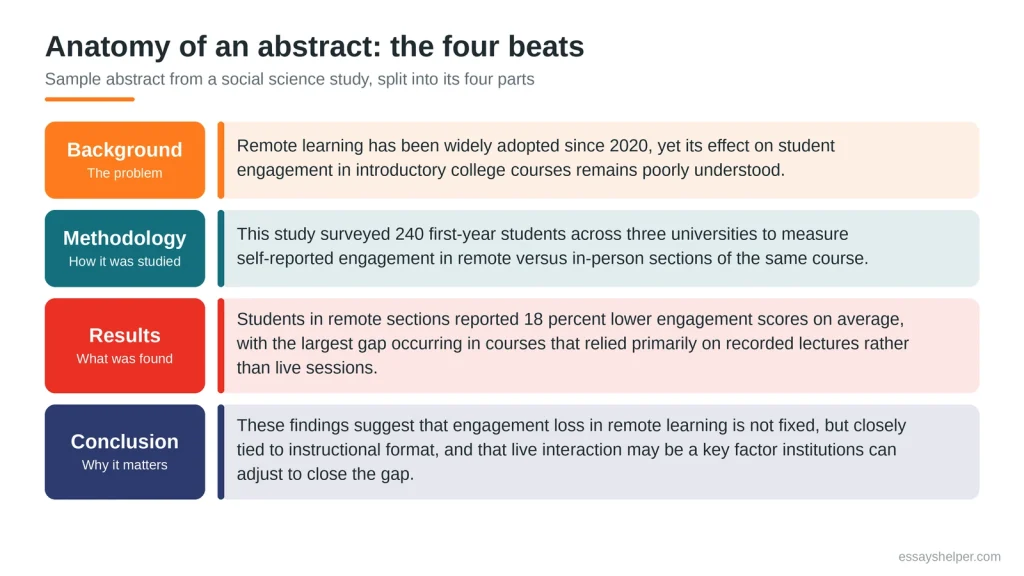
Almost every abstract, regardless of discipline, is built from four moving parts. Think of them less as sections with headers and more as beats your summary needs to hit, usually in this order.
Background and Purpose
Open with one or two sentences that establish the problem or gap your research addresses. This is not the place for a long literature review or historical context. State the question your paper answers and, briefly, why it matters.
Methodology
Next, describe how you approached the question. This does not need the level of detail found in your full research paper methodology section, but a reader should be able to tell, in one or two sentences, whether you ran an experiment, conducted interviews, analyzed existing data, or built a theoretical argument.
Results
This is usually the part students shrink the most, and it is the part readers care about the most. State your key finding directly. If you have a number, a statistically significant result, or a clear pattern, this is where it goes. Vague phrases like “the results were analyzed” tell the reader nothing, and a strong research paper results section deserves a summary that actually says what was found.
Conclusion
Close with what the finding means. This is where you connect back to the purpose stated at the start and, if relevant, note the broader implication or application. Keep it to a sentence or two. Your abstract is not the place to introduce a new argument that is not in your full research paper conclusion.
How Long Should a Research Paper Abstract Be
For most undergraduate and graduate assignments in APA format, the standard range is 150 to 250 words, based on official APA guidance. That said, requirements shift depending on the citation style and the type of paper, so it is always worth checking your assignment sheet before assuming APA defaults apply.
| Style | Typical abstract length | Notes |
| APA (7th ed.) | 150 to 250 words | Single paragraph, block format, no indent on first line |
| MLA | No fixed standard | MLA papers rarely require an abstract unless specified by the instructor |
| Chicago | Varies by field | Often follows journal-specific guidelines rather than one fixed rule |
APA Format Guidelines for Abstracts
If your instructor has asked for APA formatting specifically, the rules are fairly mechanical once you know them. According to the Purdue Online Writing Lab, an APA abstract should follow these formatting rules:
- Start the abstract on its own page, immediately after the title page.
- Center and bold the word “Abstract” at the top, with no italics or quotation marks.
- Write the summary as a single paragraph, double spaced, with no first-line indent.
- Keep it to 150 to 250 words unless your instructor specifies otherwise.
- If keywords are required, list three to five terms in italics on the line below the abstract, indented like a new paragraph.
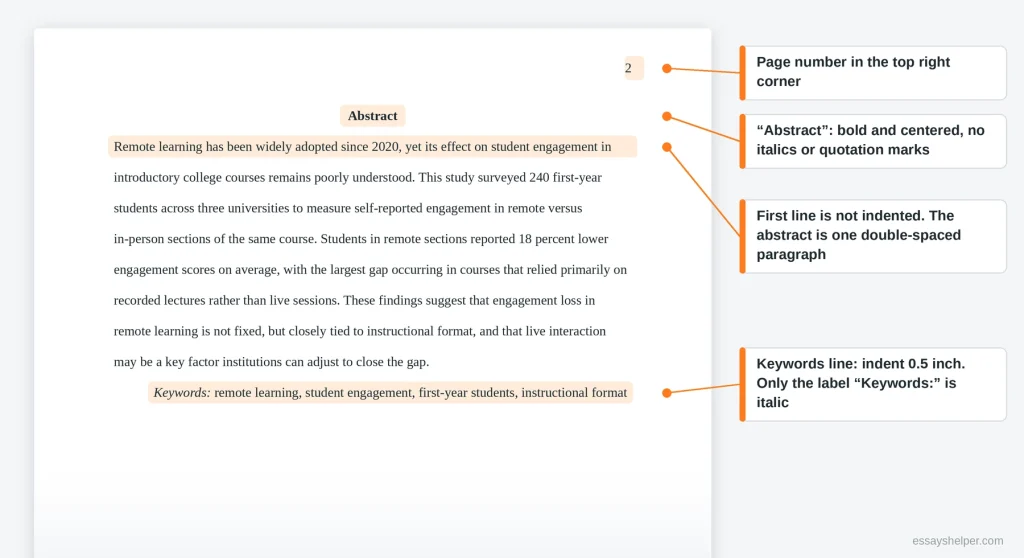
| Where does the abstract go in an APA paper?
In an APA paper, the abstract goes on its own page directly after the title page, so it is usually page 2. Type the word “Abstract” at the top of the page, centered and in bold, and begin the summary on the next line. The main text of the paper then starts on a new page after the abstract, with the paper’s title repeated at the top. |
One detail that trips students up: many instructors do not actually require an abstract for standard undergraduate papers, since APA guidance treats it as optional for student work unless specifically assigned. If your syllabus does not mention one, it is worth a quick email to confirm before you spend an evening perfecting a page you did not need.
| Does an essay need an abstract?
Usually not. Most essays and standard course papers do not need an abstract unless your instructor asks for one, so check the assignment sheet or send a quick email before you add it. A paper with an abstract is more common for longer research papers, theses, lab reports and journal submissions, where readers need a quick summary before deciding whether to read on. If your instructor does ask for an abstract on an essay, use the same beats in fewer words. Here is an essay with abstract example for an argumentative essay on school start times (hypothetical), kept short because essay abstracts are often shorter than research paper abstracts: Many high schools begin classes before 8:00 a.m., even though sleep research suggests that teenagers need later mornings. This essay argues that districts should move start times to 8:30 a.m. or later. Drawing on published studies of sleep, attendance and academic performance, it shows that later start times are associated with more sleep, fewer late arrivals and modest gains in alertness. The essay also considers objections about transportation costs and after-school activities and concludes that both can be managed through scheduling changes. Overall, it holds that later start times are a practical, low-cost reform that districts can test through a one-year pilot. Follow the length your instructor gives you. If no limit is stated, aim for roughly 100 to 150 words. |
Structured vs Unstructured Abstracts
Not every abstract looks the same, and the format you use often depends on your field. It helps to know the difference before you start writing, so you are not fighting the wrong format.
| Type | What it looks like | Where it is common |
| Structured | Uses labeled subsections such as Background, Methods, Results, Conclusion | Clinical research, lab sciences, some social science journals |
| Unstructured | One flowing paragraph with no internal headers | Humanities, most undergraduate assignments, many social science papers |
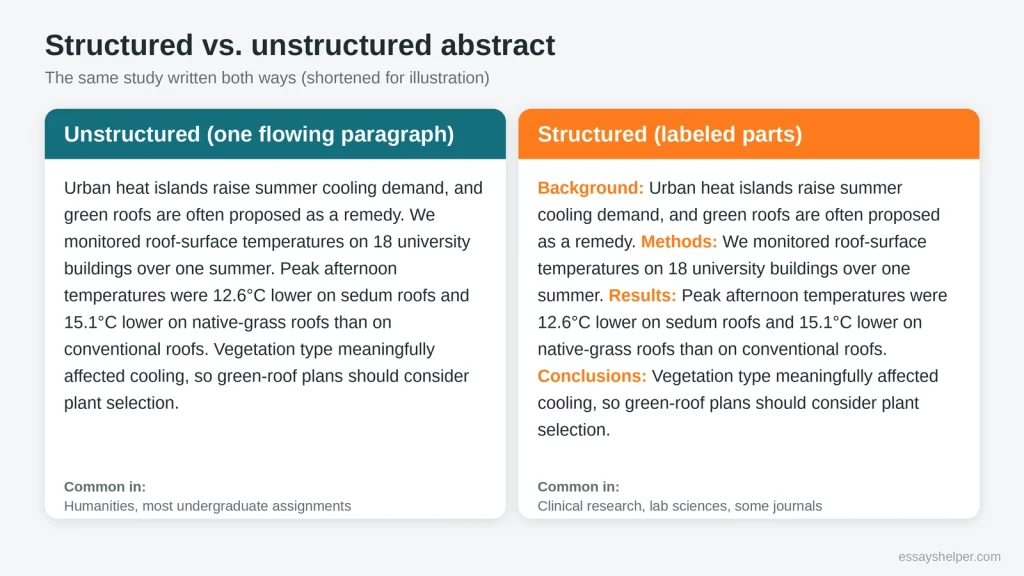
If your assignment does not specify which one to use, unstructured is the safer default for a standard course paper. Save the structured format for lab reports, clinical studies, or when a journal or professor explicitly asks for labeled sections.
Step by Step: How to Write Your Abstract
Once your paper is complete, or close to it, writing the abstract becomes a matter of extraction rather than invention. If you already worked from a solid research paper outline, this process moves faster, because each section of your outline maps almost directly onto a sentence or two of the abstract.
Start by writing your paper first. Resist the urge to draft the abstract early. Your findings, and sometimes even your argument, tend to shift as you write, and an early abstract almost always needs a full rewrite by the end anyway.
Next, pull one sentence from each major section. Go through your finished paper and, for the background, methodology, results, and conclusion, write a single sentence that captures the core idea of that section. Do not worry about flow yet; just get the raw material down.
Then combine those sentences into a paragraph. Read them together and smooth the transitions so it reads as one coherent summary rather than four disconnected facts stitched together.
After that, cut ruthlessly. Most first drafts of an abstract run long. Remove any sentence that explains why something matters in general terms rather than what you specifically found or did. Background context earns one sentence, not three.
Finally, read it completely on its own, separate from your paper. Ask yourself honestly whether someone who never saw your research paper would understand what you studied, how, and what you found. If the answer is no, that is usually a sign a key result got compressed out.
Research Paper Abstract Examples (APA)These three examples of an abstract for a research paper in APA format show how the same four-part structure adapts to different fields. Each one is a single block paragraph with no first-line indent, followed by an indented keywords line. The studies are hypothetical and the data are invented for illustration. Social Science Abstract Example Here is a short abstract for a hypothetical study, with each part labeled so you can see how the structure plays out in practice. “Remote learning has been widely adopted since 2020, yet its effect on student engagement in introductory college courses remains poorly understood. [Background] This study surveyed 240 first-year students across three universities to measure self-reported engagement in remote versus in-person sections of the same course. [Methodology] Students in remote sections reported 18 percent lower engagement scores on average, with the largest gap occurring in courses that relied primarily on recorded lectures rather than live sessions. [Results] These findings suggest that engagement loss in remote learning is not fixed, but closely tied to instructional format, and that live interaction may be a key factor institutions can adjust to close the gap. [Conclusion]” Keywords: remote learning, student engagement, first-year students, instructional format.
Notice that every sentence earns its place. There is no throat-clearing sentence about how important education is in general, and no extra example that does not move the summary forward. That density is what makes an abstract work. STEM Abstract Example (Structured) Structured abstracts use labeled parts, and they are common in lab reports, clinical research and many science journals. Here the labels are bold and run into a single paragraph, so the abstract still follows the APA block format. Your instructor or journal may want each label on its own line, so check the submission guidelines. Background: Urban heat islands raise summer cooling demand, and green roofs are often proposed as a low-cost way to reduce it, but evidence on whether the type of vegetation matters is mixed. Methods: We monitored roof-surface temperatures on 18 flat-roofed university buildings over one summer. Six buildings had sedum green roofs, six had native-grass green roofs, and six had conventional membrane roofs. Sensors recorded temperature every 15 minutes, and daily afternoon peaks were compared across roof types using a one-way ANOVA. Results: Peak afternoon surface temperatures were 12.6°C lower on sedum roofs and 15.1°C lower on native-grass roofs than on conventional roofs (both p < .001). Native-grass roofs were also 2.5°C cooler than sedum roofs (p = .02). Conclusions: Vegetation type meaningfully affected roof cooling in this sample, suggesting that green-roof plans aimed at reducing cooling demand should consider plant selection, not only whether a roof is green. Longer monitoring across seasons would show whether the difference holds in winter. Keywords: urban heat island, green roofs, vegetation type, roof surface temperature, cooling demand Humanities Abstract Example Humanities abstracts center on an argument and an interpretive approach rather than data. This one is unstructured, and the labels show where each beat falls. If your humanities course uses MLA or Chicago, ask whether an abstract is required at all. The way you write it stays the same. Toni Morrison’s Beloved (1987) is often read as a ghost story about the trauma of slavery, but critics disagree about what the haunting is meant to accomplish. [Background] This paper offers a close reading of Morrison’s concept of “rememory,” tracing how key scenes, including Sethe’s recollections of Sweet Home and Denver’s encounters with Beloved, present memory as a shared, almost physical force rather than a private recollection. [Approach] It argues that this reframing lets Morrison do what conventional historical accounts of slavery could not: give voice to experiences that were excluded from the historical record and show that the past continues to act on the present. [Argument] Reading the haunting as a narrative strategy rather than a supernatural device, the paper suggests, clarifies why the novel resists a tidy resolution and why remembering, for Morrison, is an act with consequences for the present. This reading also invites further work on how other novels about slavery use haunting to challenge the historical record. [Significance] Keywords: Toni Morrison, Beloved, memory, slavery, narrative |
OPTIONAL REPLACEMENT FOR SAMPLE 1
| “Remote learning has been widely adopted since 2020, yet its effect on student engagement in introductory college courses remains poorly understood, particularly for first-year students who are still adjusting to college expectations. [Background] This study surveyed 240 first-year students across three universities to measure self-reported engagement in remote versus in-person sections of the same course, using a 20-item engagement scale completed in the final month of the semester. [Methodology] Students in remote sections reported 18 percent lower engagement scores on average, with the largest gap occurring in courses that relied primarily on recorded lectures rather than live sessions. Remote sections with weekly live discussions scored close to their in-person counterparts. [Results] These findings suggest that engagement loss in remote learning is not fixed, but closely tied to instructional format, and that live interaction may be a key factor institutions can adjust to close the gap. Future research should test whether the pattern holds beyond introductory courses and in other disciplines. [Conclusion]” |
Common Mistakes That Weaken an Abstract
A handful of mistakes show up again and again in student abstracts, and most are easy to fix once you know to look for them.
- Writing it before the paper is finished, which leads to a summary of intentions rather than results.
- Starting with broad, generic statements instead of your specific research question.
- Leaving out actual findings and replacing them with vague phrases like “results are discussed.”
- Introducing citations or quotes, which most style guides discourage in an abstract.
- Going over the word limit because every sentence tries to do too much at once.
- Copying sentences directly from the introduction instead of writing fresh, compressed versions.
Writing Abstracts Across Disciplines
The core structure holds across fields, but what counts as a strong abstract shifts depending on your subject area. Here is how the emphasis tends to change.
Sciences and Engineering
Expect more emphasis on methodology and measurable results. Numbers, sample sizes, and statistical significance often belong directly in the abstract rather than being saved for the body. Structured abstracts with labeled sections are common in lab reports and clinical research.
Social Sciences
Social science abstracts tend to balance a research question with methodology, often survey based or qualitative, and results framed around patterns in behavior or attitudes rather than lab measurements. If your paper builds on prior studies, it can help to first get comfortable with how to write a literature review, since summarizing existing research well makes it much easier to summarize your own contribution afterward.
Humanities
Humanities abstracts, for papers in literature, history, or philosophy, usually center on an argument rather than a data-driven result. Instead of methodology in the scientific sense, you are summarizing your interpretive approach and your central claim. Because many humanities papers open with a review of existing scholarship, working from a clear literature review outline before you write can make it far easier to state, in one sentence, exactly where your argument departs from what has already been written.
Business and Management
Business research abstracts often lean practical, framing the study around a real organizational problem and closing with an applied recommendation rather than a purely academic conclusion. Case studies and mixed-methods research are common, so the methodology sentence needs to clarify quickly whether you are working from company data, interviews, or a broader industry analysis.
How Your Abstract Connects to the Rest of Your Paper
An abstract does not exist in isolation. It is a compressed map of decisions you made throughout your paper, which is why it is worth thinking about how it relates to the other pieces you are already writing.
Your research paper introduction sets up the same background your abstract touches on, just in far more detail. Your research paper discussion section is usually where your abstract’s conclusion sentence originates, since that is where you interpret what your results actually mean. And if you are ever asked how to summarize a research paper you did not write, for a class assignment or a literature review, you are essentially doing the same compression exercise in reverse: reading someone else’s full paper and pulling out its background, methods, results, and conclusion.
This same skill shows up elsewhere in academic writing, too. An annotated bibliography asks you to summarize a source and evaluate its relevance in a short paragraph, which is close cousin work to writing an abstract. If you have never done one, learning how to write an annotated bibliography is good practice for the same kind of compression. Similarly, if you are further back in the process and still need to know how to write a research proposal, a solid research proposal outline uses many of the same background, methodology, and expected-outcome beats you will eventually condense into your abstract.
Getting Feedback and Support When You Are Stuck
Even with a clear structure, it is genuinely hard to see your own writing objectively after spending weeks buried in one topic. A second set of eyes, ideally someone who was not involved in the research, is often the fastest way to catch a vague sentence or a missing result before you submit.
This is where getting outside feedback earns its keep, especially for longer projects. EssaysHelper works with students who need reliable, expert support on exactly this kind of writing, including capstone projects across every discipline, from lab-based science capstones to humanities theses. If you are deep into a larger project and need someone to sanity-check your structure or tighten a draft before a deadline, that kind of support can save you from submitting an abstract that undersells the work you actually did.
Quick Checklist Before You Submit
- Is it within your required word count, typically 150 to 250 words in APA format?
- Does it state your actual finding, not just that results were analyzed?
- Is it a single paragraph with no first-line indent, if APA formatted?
- Does it avoid citations, quotes, and abbreviations that are not defined?
- Can someone who has not read your paper understand what you studied and found?
If you are running low on time and want a second opinion before you submit, research paper support from an experienced editor can be the difference between an abstract that gets skimmed and one that actually earns a closer read.
Frequently Asked Questions
Should I write my abstract before or after finishing my research paper?
Write it after. Your findings and conclusions often shift while you write the full paper, so an abstract drafted early usually needs a complete rewrite anyway. Treat the abstract as the very last section you finalize.
What tense should I use when writing a research paper abstract?
Most style guides recommend past tense for what you did and found, since the research is already complete by the time you write the abstract. Present tense is generally reserved for statements about ongoing or general facts, not your specific results.
How many words should a research paper abstract be?
Most APA-formatted papers expect 150 to 250 words, though the exact number depends on your instructor or the journal you are submitting to. Always check your assignment guidelines first, since some fields allow shorter or longer abstracts.
Do I need keywords under my abstract?
Only if your instructor or journal specifically asks for them. When required, APA style calls for three to five keywords or short phrases listed in italics directly below the abstract paragraph, indented like a new line.
Do you indent an abstract?
No. In APA 7, the abstract is written as a single block paragraph with no first-line indent, which makes it the one paragraph in your paper that starts flush with the left margin.
The only indented line on the abstract page is the keywords line, if your instructor asks for keywords. Indent that line 0.5 inches, italicize only the label Keywords:, then list the keywords in plain lowercase text, separated by commas, with no period at the end. Word processors often indent new paragraphs automatically, so check that the first line of your abstract starts at the margin.
Do you indent an abstract?
No. In APA 7, the abstract is a single paragraph with no first-line indent. Only the keywords line is indented, by 0.5 inches, and only the label “Keywords:” is italicized. Check your assignment sheet if your instructor has different formatting requirements.
What is the difference between an abstract and an introduction?
An abstract is a complete, standalone summary covering background, methods, results, and conclusion in a few sentences each. An introduction is part of the paper itself and can spend a full page building context before it even states the research question.
Can I include citations in my abstract?
Generally, no. Most style guides, including APA, recommend avoiding citations and direct quotes in an abstract, since it needs to function as a self-contained summary that does not depend on outside sources to make sense.
What is a structured abstract, and do I need one?
A structured abstract uses labeled subsections like Background, Methods, Results, and Conclusion instead of one flowing paragraph. It is common in clinical and lab sciences, but most undergraduate humanities and social science papers use the unstructured, single-paragraph format instead.
Why does my abstract feel too short to cover everything?
That feeling usually means you are trying to include background detail that belongs in the introduction instead of the abstract. An abstract only needs the single most important sentence from each section of your paper, not a comprehensive overview.
Is an abstract required for every research paper?
Not always. Many standard undergraduate assignments do not require one unless specifically requested, since APA guidance treats it as optional for student papers. Check your assignment sheet or ask your instructor before assuming you need one.
How do I know if my abstract is actually good?
Read it completely on its own, without looking at your paper, and ask whether someone unfamiliar with your research would understand what you studied, how you studied it, and what you found. If any of those three pieces are missing or vague, it needs another pass.
Final Thoughts
An abstract is small, but it is doing a disproportionate amount of work for how little space it takes up. It is often the only part of your paper a busy reader engages with closely, which means a vague or rushed abstract can undersell genuinely strong research. The good news is that once you understand the four beats it needs to hit, background, methodology, results, and conclusion, and you write it only after your paper is finished, it becomes far more mechanical and far less intimidating than it feels the first time you try.
Give yourself the same care on this one paragraph that you gave the rest of your paper. It is often the difference between work that gets skimmed and work that gets read.