
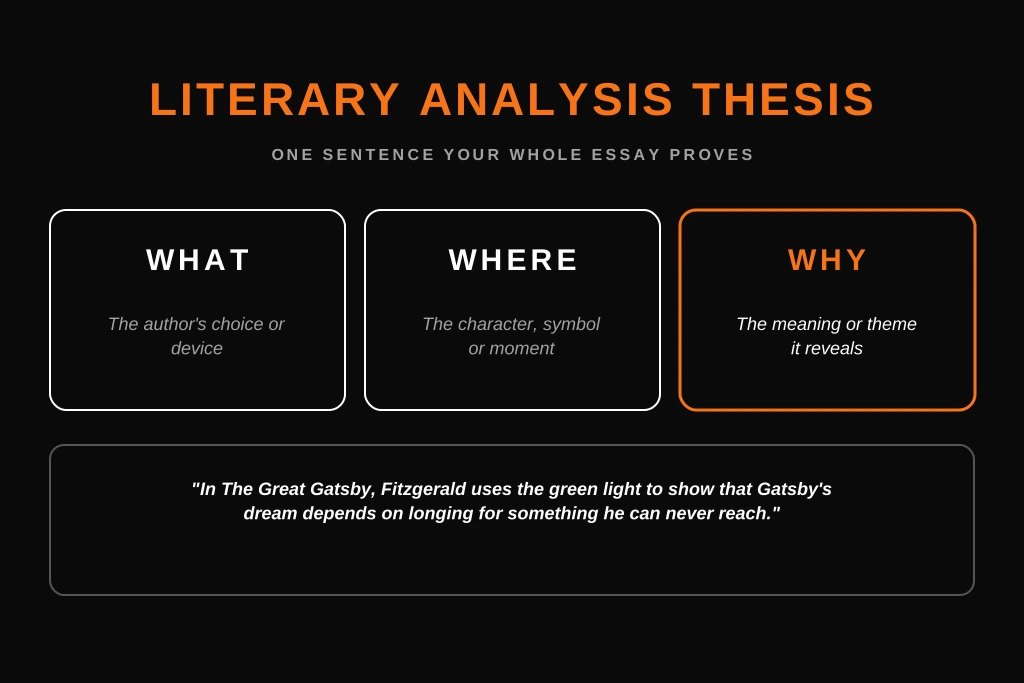
A literary analysis thesis is a one or two sentence claim that explains how an author’s choices create meaning in a text, in a way a thoughtful reader could debate. It usually appears as the last sentence of your opening paragraph. For example: “In The Great Gatsby, Fitzgerald uses the green light to show that Gatsby’s dream depends on longing for something he can never reach.”
That is the short answer. This guide shows you exactly how to write one: what separates a strong thesis from a weak one, a simple formula and five fill in templates, more than 30 literary analysis thesis examples organized by theme, symbol, character, poetry, drama and more, and a revision table that turns weak statements into strong ones. You will also find honest advice on thesis generators and fixes for the problems students run into most.
If you have ever stared at a blank page wondering what you are supposed to argue, you are in the right place. The thesis is the hardest sentence in a literary essay to write, but it becomes much easier once you know what it needs to do.
What Is a Literary Analysis Thesis?
A literary analysis thesis is the central argument of your essay. It names the text, points to the author’s choices you will analyze, and states what those choices reveal. Everything else in the essay exists to prove it.
At Essays Helper, we describe the thesis as an answer to a “how” or “why” question about a text. Not “what happens in Hamlet?” but “why does Hamlet keep delaying, and what does Shakespeare suggest through that delay?” The UNC Writing Center puts it clearly: “A thesis is an interpretation of a question or subject, not the subject itself.”
What a literary analysis thesis explains
A strong thesis explains three things at once: what the author does (a device, choice or pattern), where or in whom it happens (a character, symbol or moment), and why it matters (the meaning, theme or effect). If your thesis covers all three, your reader knows exactly what you will prove and why it is worth reading.
Where the thesis goes
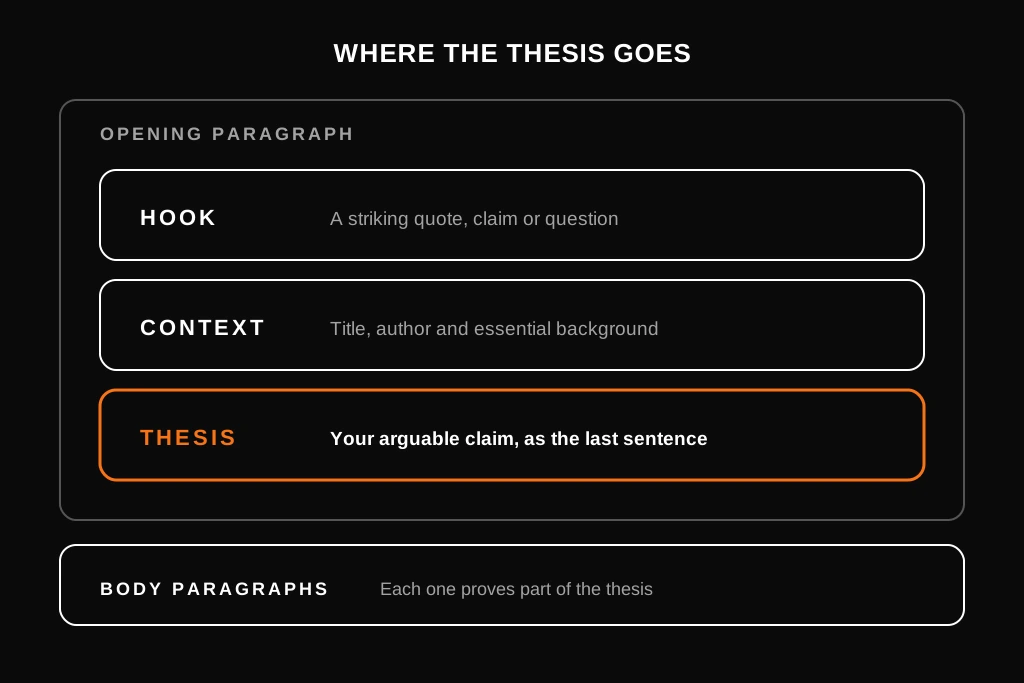
In most essays, the thesis is the last sentence of your opening paragraph. Your hook and brief context lead the reader toward it, and your body paragraphs follow from it. Some longer college essays place it slightly later, but if you are unsure, the end of the first paragraph is the safest choice.
How long a literary analysis thesis should be
Most literary analysis thesis statements are one sentence of roughly 25 to 40 words. That is long enough to name the text, the author’s choice and its meaning, but short enough for a reader to hold in mind. If your thesis runs past 50 words, it is usually trying to do too much, and splitting it into a claim plus a short preview sentence often helps.
Thesis vs topic sentence
Your thesis is the argument for the whole essay. A topic sentence is the claim for a single body paragraph. Each topic sentence should prove one part of the thesis, so if you cannot see how a paragraph’s topic sentence connects back to your thesis, one of them needs revising.
Topic vs summary vs thesis
Students often confuse these three. Here is how they differ, using the same story.
| Type | Example | Why it is or is not a thesis |
|---|---|---|
| Topic | Guilt in “The Tell-Tale Heart” | Names a subject, makes no claim |
| Summary | The narrator kills an old man and confesses to the police. | Retells events, nothing to argue |
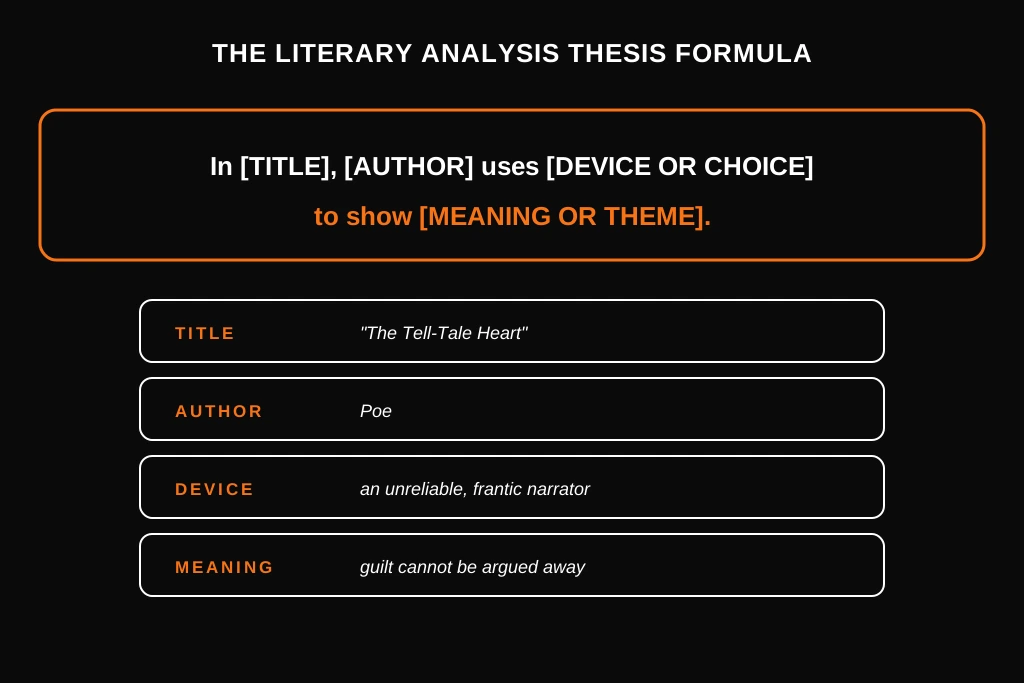
| Thesis | Poe uses the narrator’s frantic voice to show that the harder he insists on his sanity, the more clearly his guilt is revealed. | Makes an arguable claim about how meaning is created |
What Makes a Good Literary Analysis Thesis
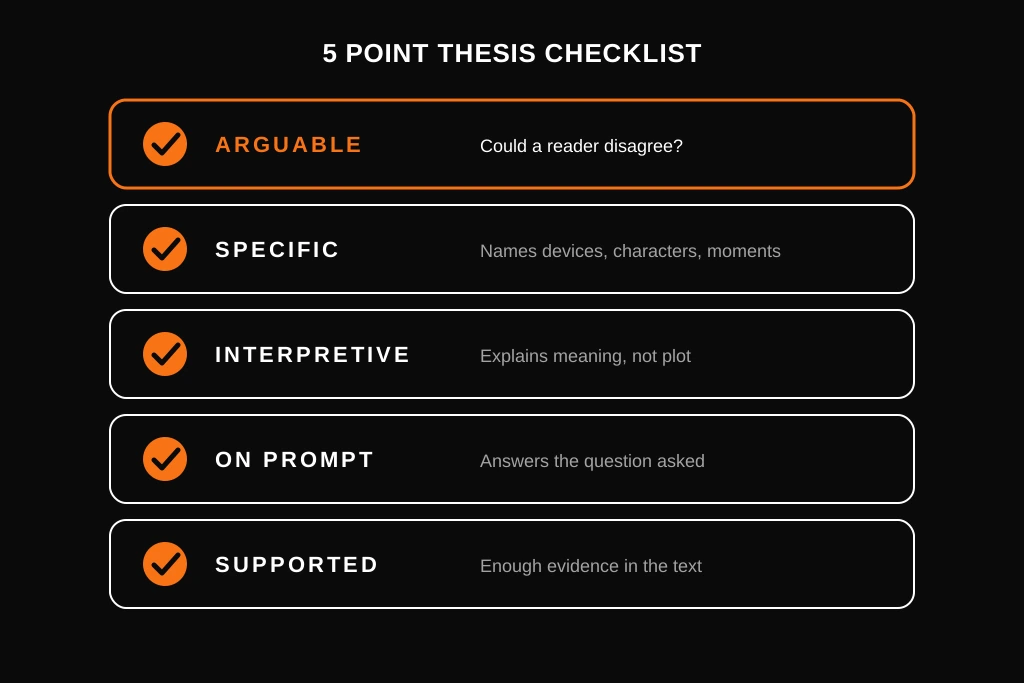
A good literary analysis thesis is arguable, specific and interpretive. It makes a claim someone could reasonably disagree with, focuses on particular choices in the text, and explains what those choices mean rather than simply describing them.
The five point checklist
Before you commit to a thesis, check it against these questions:
- Is it arguable? Could a thoughtful reader disagree or see it differently?
- Is it specific? Does it name particular devices, characters or moments rather than “many techniques”?
- Is it interpretive? Does it explain meaning, not just report what happens?
- Does it answer the prompt? If you were given a question, does the thesis respond to it directly?
- Can the text support it? Is there enough evidence to prove it across several paragraphs?
Match the thesis to the length of your essay
A thesis should be sized to fit your assignment. A 600 word essay cannot prove a sweeping claim about every theme in a novel, while a 3,000 word paper can handle a more layered argument. Before you settle on a thesis, think about how many paragraphs you have and whether each part of the claim can be supported in the space available. Narrowing the scope is almost always the right move for shorter essays.
Open vs closed thesis statements
A closed thesis lists the points your essay will cover, such as “Through imagery, symbolism and tone, Poe shows…” An open thesis states the claim without listing every supporting point. Closed theses are common in high school because they create a clear roadmap. Open theses are often preferred in college because they sound more natural and allow the argument to develop. Both are acceptable, so follow your teacher’s preference.
Why vague words weaken a thesis
Words like “interesting,” “important” and “effective” tell the reader nothing. Replace them with what the choice actually does. “Shakespeare uses effective imagery” becomes “Shakespeare’s images of blood turn Macbeth’s guilt into something he can see and cannot wash away.” If you want a refresher on how literary essays work more broadly, our guide to understanding literary essay basics covers the foundations.
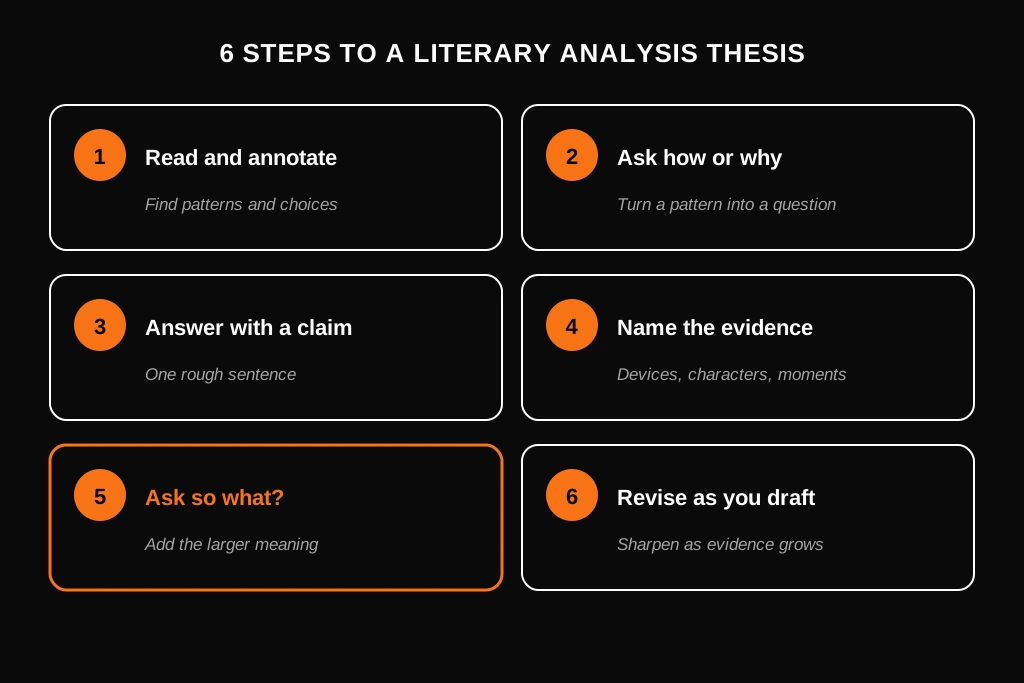
How to Write a Literary Analysis Thesis Step by Step
Writing a thesis is a process, not a single moment of inspiration. These six steps will take you from a blank page to a strong, arguable claim.
Step 1: Read closely and annotate
Read the text at least twice. Mark repeated images, unusual word choices, shifts in tone and moments when a character makes a decision. Patterns are the raw material of a thesis, because they show the author making deliberate choices.
While you annotate, keep a short list of moments that surprise or confuse you. Confusion is useful: if a scene does not make sense at first, the author may be doing something deliberate there, and explaining it often leads straight to an original thesis.
Step 2: Ask a “how” or “why” question
Turn one pattern into a question. Why does the narrator keep insisting he is calm? How does the weather change as the story darkens? Why does the poem’s speaker sigh at the end? A good question already points toward an argument.
If you are working from a prompt, rewrite it as a question first. A prompt that says “Analyze how the author develops the theme of isolation” becomes “How does the author develop isolation, and what does it suggest?” Your thesis is simply the best answer to that question.
Step 3: Answer the question with a claim
Write a one sentence answer. Do not worry about polish yet. “The narrator insists he is calm because he is trying to convince himself” is a rough but real claim you can sharpen later.
Step 4: Name the evidence or devices
Add the specific choices that support your answer. Which images, words, characters or structural features prove it? Naming them makes your thesis specific and gives your body paragraphs a direction.
You do not need to list every piece of evidence in the thesis itself. Naming one or two key choices, such as “repeated images of blood” or “the shifting narrator,” is enough to show the reader what kind of evidence is coming.
Step 5: Apply the “so what?” test
Ask why your claim matters. If your thesis says Gatsby is obsessed with the past, so what? Perhaps his obsession shows how the American Dream traps people in longing. That extra layer of meaning is what turns a decent thesis into a strong one.
Putting the steps together: a worked example
Imagine you are writing about “The Story of an Hour.” While annotating, you notice that Mrs Mallard’s room fills with signs of spring right after she hears her husband has died. Your question becomes: why does Chopin surround a moment of grief with images of new life? Your rough answer: because Mrs Mallard is not only grieving, she is waking up to freedom. Next, name the evidence: the open window, the “new spring life,” and her repeated whisper of “free.” Finally, ask so what: the story suggests that marriage in Chopin’s time could quietly confine women even in loving households. Put it together and you have a thesis: “In ‘The Story of an Hour,’ Chopin surrounds Mrs Mallard’s grief with images of spring to reveal that her husband’s death brings not only loss but an unexpected sense of freedom, exposing how marriage confined women of her time.”
Notice how each step added something. The question gave the thesis a direction, the evidence made it specific and the “so what?” gave it significance.
Step 6: Revise as you draft
Treat your first thesis as a working draft. As you gather evidence, you may find a sharper or more surprising claim. Update the thesis, then check that every body paragraph still supports it. For the full writing process around your thesis, see our guide on how to write a literary analysis essay.
Literary Analysis Thesis Formula and Templates
A simple literary analysis thesis formula is: In [title], [author] uses [device or choice] to show [meaning or theme]. The templates below adapt that formula for different kinds of essays. Use them as scaffolding, then reword the result so it sounds like you.
Template 1: Device and meaning
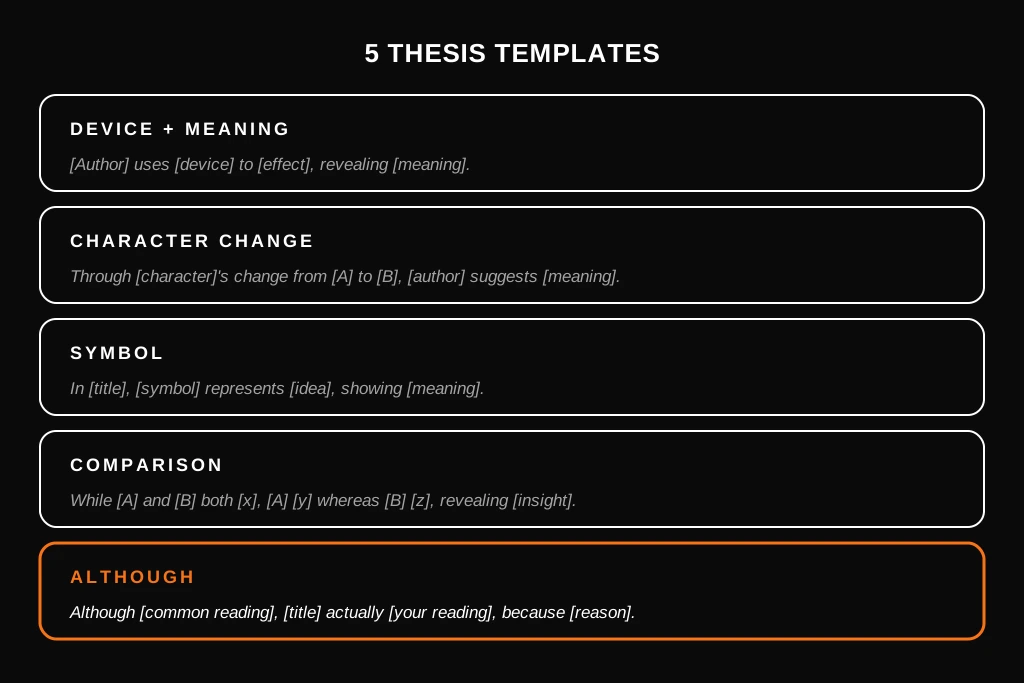
Template: In [title], [author] uses [device] to [effect], revealing [meaning].
Example: In “The Fall of the House of Usher,” Poe uses decaying imagery to mirror Roderick Usher’s collapsing mind, revealing how isolation destroys both a family and a home.
Template 2: Character change
Template: Through [character]’s change from [starting point] to [ending point], [author] suggests [meaning].
Example: Through Scrooge’s change from isolated miser to generous friend, Dickens suggests that compassion is a choice anyone can make, no matter how late.
Template 3: Symbol
Template: In [title], [symbol] represents [idea], showing [larger meaning].
Example: In “The Yellow Wallpaper,” the wallpaper represents the narrator’s confinement, showing how the rest cure imposed on her deepens the illness it claims to treat.
Template 4: Comparison
Template: While [text A] and [text B] both [shared feature], [text A] [difference], whereas [text B] [difference], revealing [insight].
Example: While both of Poe’s narrators in “The Tell-Tale Heart” and “The Cask of Amontillado” confess to murder, one is undone by guilt while the other feels none, revealing two very different ways the mind justifies violence.
Template 5: The “although” counterclaim
Template: Although [common reading], [title] actually [your reading], because [reason].
Example: Although “The Road Not Taken” is often read as a celebration of individuality, Frost’s poem actually questions whether our choices are as meaningful as we later claim.
The “although” template is especially powerful because it shows you know the obvious reading and are offering something more thoughtful. Teachers and exam readers tend to reward that kind of complexity.
Choosing the right template
Pick the template that matches your assignment. If the prompt asks about a technique, start with device and meaning. If it focuses on a person, use character change. If you are tracing an object or image, use the symbol template. Comparison prompts need the comparison template, and the “although” template works for almost any essay when you want to push beyond the obvious reading. You can also combine templates, for example by adding an “although” opening to a symbol thesis.
Literary Analysis Thesis Statement Examples
Here are more than 30 literary analysis thesis examples, grouped by focus. All are based on public domain works so you can read the texts freely. Study how each one names a choice and explains its meaning, then adapt the pattern to your own text rather than copying the wording.
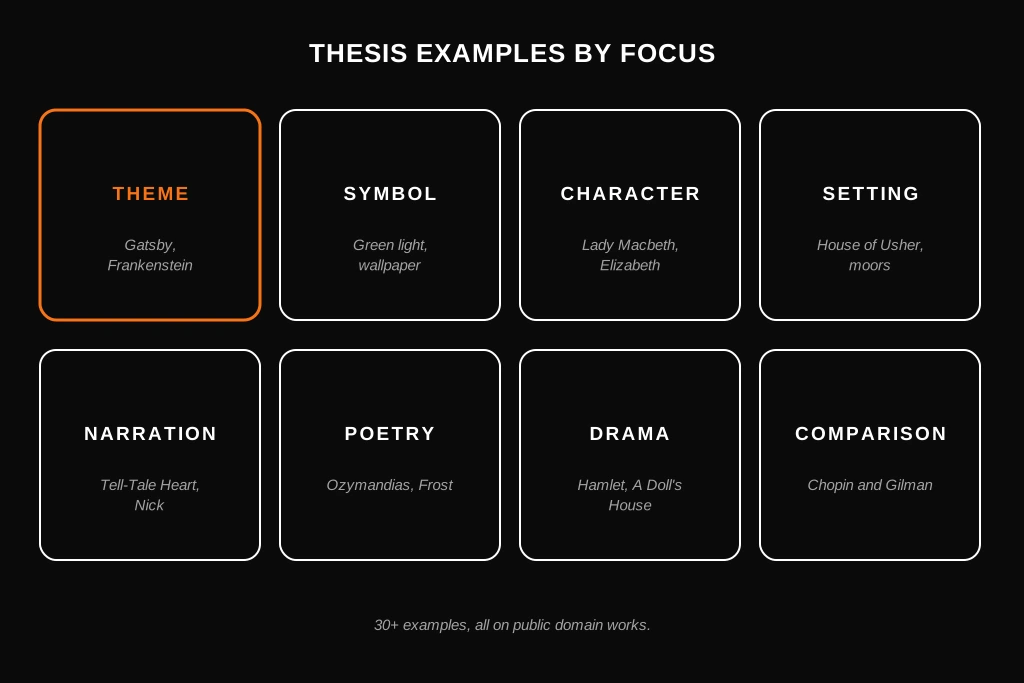
To adapt an example, keep its structure and replace the details with choices from your own text. Then ask whether the new sentence makes a claim someone could argue with. If it does, you are ready to start gathering evidence.
Thesis examples about theme
- In The Great Gatsby, Fitzgerald suggests that the American Dream depends on longing for something always out of reach, as Gatsby’s wealth never brings him closer to Daisy.
- In Frankenstein, Mary Shelley argues that the pursuit of knowledge becomes dangerous when it is separated from responsibility for what that knowledge creates.
- In Pride and Prejudice, Austen shows that first impressions are often shaped more by pride and social status than by truth.
- In “The Gift of the Magi,” O. Henry suggests that the value of a gift lies in sacrifice rather than in the object itself.
Why the first one works: it names the text and author, makes a debatable claim about the American Dream, and points to the evidence the essay will use.
Thesis examples about symbolism
- In The Great Gatsby, the green light symbolizes Gatsby’s unreachable dream, and its fading importance mirrors the collapse of his hopes.
- In “The Yellow Wallpaper,” Gilman turns the wallpaper into a symbol of the narrator’s confinement, suggesting that enforced rest worsens the illness it claims to cure.
- In “The Raven,” Poe uses the bird as a symbol of grief that will not leave, showing how loss can trap a mind in endless mourning.
- In The Scarlet Letter, Hawthorne transforms the letter from a mark of shame into a symbol of strength, criticizing a community that punishes rather than forgives.
Why the second one works: it does more than identify the symbol. It explains what the symbol suggests about the story’s larger argument.
Thesis examples about character
- Lady Macbeth’s attempt to suppress her conscience ultimately destroys her, showing that ambition cannot erase guilt.
- Elizabeth Bennet’s growth from confident judge to self aware partner shows Austen’s belief that true understanding begins with admitting one’s own prejudice.
- Victor Frankenstein’s refusal to care for his creation suggests that the real monster in Shelley’s novel is the scientist’s pride.
- Mrs Mallard’s brief joy at her husband’s death in “The Story of an Hour” reveals how deeply marriage confined women in Chopin’s time.
Why the first one works: it argues how the character develops and connects that change to a theme. If your assignment focuses on one character, our guide to writing a character analysis essay shows how to build the whole essay around a thesis like these.
Thesis examples about setting and mood
- In “The Fall of the House of Usher,” Poe makes the crumbling house a reflection of the family’s decline, blurring the line between place and person.
- In Wuthering Heights, Emily Bronte uses the wild moors to mirror the untamed passions of Heathcliff and Catherine.
- In “The Cask of Amontillado,” the carnival setting creates a grim irony, as celebration above ground contrasts with murder in the catacombs below.
Why the third one works: it explains how the setting creates an effect, irony, and why that effect matters to the story.
Thesis examples about narration and point of view
- In “The Tell-Tale Heart,” Poe’s unreliable narrator undermines his own claims of sanity, inviting readers to judge him by how he speaks rather than what he says.
- By telling Gatsby’s story through Nick Carraway, Fitzgerald creates a narrator whose admiration and disapproval shape how readers see Gatsby.
- In Jane Eyre, Charlotte Bronte’s first person narration lets readers experience Jane’s struggle for independence from the inside.
Why the first one works: it connects a technique, unreliable narration, to a specific effect on the reader.
Thesis examples for poetry
- In “Ozymandias,” Shelley uses the ruined statue to show that political power, however grand, cannot survive time.
- In “Because I could not stop for Death,” Dickinson presents death as a polite companion, suggesting a calm acceptance of mortality.
- In “Stopping by Woods on a Snowy Evening,” Frost uses the quiet, repetitive ending to suggest the pull between rest and responsibility.
- In “The Road Not Taken,” Frost undercuts the idea of a bold choice, implying that people invent meaning for their decisions after the fact.
Why the first one works: it links a central image to a clear idea about power and time, which the essay can prove line by line.
Thesis examples for drama and Shakespeare
- In Hamlet, Shakespeare suggests that excessive thought can be as destructive as rash action, as Hamlet’s delay spreads tragedy to everyone around him.
- In Romeo and Juliet, the constant imagery of light against darkness suggests that the lovers’ passion is brilliant but too brief to survive.
- In Macbeth, Shakespeare uses blood imagery to show guilt growing from a single act into an inescapable state of mind.
- In A Doll’s House, Ibsen uses Nora’s final exit to challenge the idea that a woman’s duty to her family outweighs her duty to herself.
Why the third one works: it traces how a pattern of imagery develops across the play, giving the essay a clear structure.
Thesis examples for short stories
- In “The Story of an Hour,” Chopin uses a twist ending to expose the hidden cost of a marriage that looked happy from the outside.
- In “The Necklace,” Maupassant shows how Mathilde’s desire to appear wealthy costs her the comfortable life she already had.
- In “The Cask of Amontillado,” Poe uses layered irony to show how polished manners can hide cold cruelty.
Why the first one works: it explains how a structural choice, the twist ending, creates meaning about the story’s theme.
Thesis examples comparing two texts
- While both “The Story of an Hour” and “The Yellow Wallpaper” depict women confined by marriage, Chopin’s heroine finds a moment of freedom, whereas Gilman’s narrator escapes only through madness.
- Although both Victor Frankenstein and Ebenezer Scrooge isolate themselves from others, only Scrooge chooses connection, revealing different views of whether people can change.
- Poe’s narrators in “The Tell-Tale Heart” and “The Cask of Amontillado” both confess to murder, but the contrast between guilt and its absence shows two ways the mind justifies violence.
Why the first one works: it identifies a shared theme, a key difference and the insight the comparison reveals.
Weak vs Strong Thesis: Revision Examples
Most weak thesis statements fail for one of a few reasons: they are too broad, they state a fact, they list devices without meaning, or they summarize the plot. Here is how to fix each one.
| Weak thesis | Problem | Revised thesis |
|---|---|---|
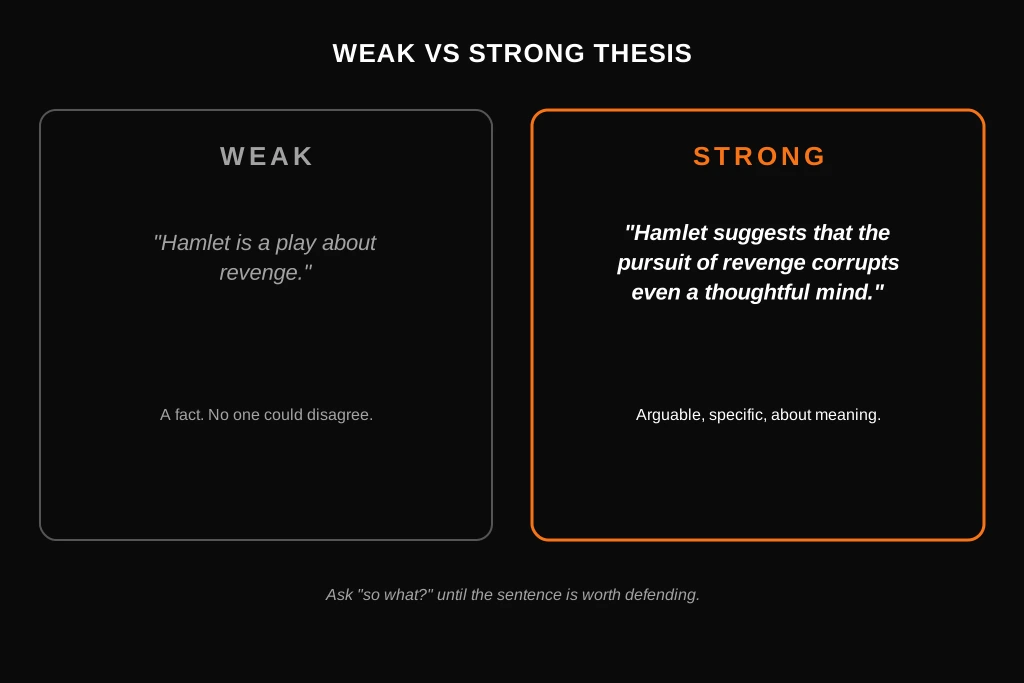
| Hamlet is a play about revenge. | A fact, not a claim | Hamlet suggests that the pursuit of revenge corrupts even a thoughtful mind. |
| Poe uses symbolism, imagery and tone in his stories. | A list with no meaning | Poe uses decaying imagery to mirror his characters’ collapsing minds. |
| Gatsby throws parties to attract Daisy. | A plot summary | Gatsby’s crowded parties reveal a loneliness his wealth cannot cure. |
| Frankenstein is about science. | Too broad | Shelley warns that knowledge without responsibility creates monsters. |
| The Road Not Taken has a good message. | Vague and evaluative | Frost questions whether our choices are as meaningful as we later claim. |
| Scrooge changes at the end. | Obvious and unexplained | Scrooge’s change suggests that compassion is a choice, not a fixed trait. |
Test your thesis with a partner
Read your thesis to a classmate and ask them to argue against it. If they cannot find anything to disagree with, your thesis is probably a fact. If they immediately misunderstand what you mean, it may be too vague. A two minute conversation like this often reveals exactly what needs to change.
Fixing a thesis that is too broad
Narrow the focus to one character, symbol or pattern, and one specific meaning. “Frankenstein is about science” becomes manageable when you choose a particular angle, such as responsibility, ambition or isolation.
Fixing a thesis that states a fact
Ask “so what?” A fact like “Hamlet is about revenge” becomes a claim when you say what the play suggests about revenge. If no one could disagree with your sentence, it is not yet a thesis.
Fixing a thesis that lists devices
Listing “imagery, symbolism and tone” tells the reader what you will look at, not what you will prove. Choose the most important device and explain the meaning it creates.
Fixing a thesis that summarizes the plot
Replace the event with what it reveals. Instead of saying what a character does, explain what the action shows about them or the story’s theme. Once your thesis is solid, it becomes the top line of your plan; our guide to building a literary analysis essay outline shows how to turn it into body paragraph claims.
Thesis Statements for Different Assignments and Levels
What counts as a strong thesis grows more demanding as you move from middle school to college. Matching your thesis to your level and assignment helps you meet your teacher’s expectations.
| Level | What a strong thesis looks like | Example focus |
|---|---|---|
| Middle school | A clear claim about a character or theme with a reason | How a character changes and why |
| High school | An arguable claim naming specific devices and their meaning | How a symbol develops a theme |
| AP Literature | A defensible interpretation that responds directly to the prompt | How choices convey a complex experience |
| College | An original, nuanced claim, often engaging other readings | How a text complicates a common interpretation |
Middle school thesis statements
At this level, a thesis should make one clear claim and give a reason. “In A Christmas Carol, Scrooge becomes kinder because the spirits show him how his choices hurt others” is a strong middle school thesis: simple, specific and supportable.
Middle school students often find it helpful to use sentence frames, such as “In [title], [character] learns that [lesson] because [reason].” As confidence grows, they can replace the frame with their own wording and add specific details from the text, which is the first step toward the more analytical theses expected in high school.
High school thesis statements
High school teachers expect an arguable claim that names specific choices and explains their meaning. A closed thesis that previews two or three points is often welcome, as long as each point connects to the central claim.
AP Literature thesis statements
On the AP English Literature exam, the thesis is scored separately. The College Board’s scoring guidelines award the thesis point for a defensible interpretation that responds to the prompt, and note that restating the prompt or simply describing the text’s features does not earn it. The guidelines also allow the thesis to span more than one sentence if those sentences are close together. In timed conditions, a clear, direct thesis beats an elaborate one.
College thesis statements
College instructors look for original interpretations and nuance. An “although” thesis that acknowledges a common reading before offering your own is a reliable way to show sophistication. You may also need to position your claim against literary critics when your assignment requires research.
Thesis statements for research papers on literature
When your essay uses outside sources, your thesis should still be your own interpretation. Critics can support or challenge your reading, but they should not replace it. A useful pattern is to acknowledge a critical view in your thesis and then state how your reading extends or complicates it.
Thesis statements for timed essays
In timed writing, aim for a thesis you can write in under two minutes. Use the device and meaning template, name one or two choices you have already spotted in the passage and state what they reveal. A clear thesis written quickly leaves more time for the analysis that earns most of the marks.
Do Thesis Generators and Templates Actually Help?
Templates can help you get started, but thesis generators rarely produce a thesis worth submitting. A template gives you structure while you supply the thinking. A generator tries to supply the thinking for you, and the result is usually generic.
The problem with thesis generators
Online thesis generators fill your inputs into a fixed sentence pattern. Because they cannot read the text, they cannot judge whether your claim is interesting, accurate or arguable. The result often sounds like “In [title], [author] uses symbolism to show the theme of love,” which is exactly the kind of vague thesis teachers mark down. Many schools also have academic integrity policies about automated writing tools, so check your rules before using one.
How to use a template without sounding formulaic
Use the template to draft, then revise. Replace generic verbs like “shows” with precise ones like “exposes,” “undermines” or “complicates.” Add a specific detail from the text. Read the sentence aloud and ask whether it sounds like a person making an argument or a form being filled in. If it sounds like a form, keep revising.
A better shortcut: the question method
If you are stuck, skip the generator and write three “why” questions about the text. Answer each in one sentence. Usually one of those answers is surprisingly close to a real thesis, and it will be far more original than anything a generator can produce.
For example, three questions about Hamlet might be: Why does Hamlet delay? Why does he pretend to be mad? Why does the play end with so many deaths? Answering the first might give you a thesis about thought paralyzing action, while the third might lead to a claim about revenge spreading beyond its target. Either is more specific than anything a generator would offer.
Literary vs rhetorical analysis thesis statements
If your thesis is about how a speech or essay persuades an audience rather than how a story or poem creates meaning, you need a different kind of claim. Our guide to the rhetorical analysis thesis explains how to focus on purpose, audience and appeals instead.
Common Student Problems and How to Solve Them
Even with a formula, students run into the same problems again and again. Here are the most common ones and how to get past them.
“My thesis is too broad”
If your thesis could describe the whole book, it is too broad. Choose one character, symbol or pattern and one specific meaning. A narrow thesis does not limit you; it gives your essay depth.
“My thesis is just a fact”
If no one could disagree with it, it is a fact. Add an interpretation by asking what the fact suggests or why the author made that choice. “Macbeth kills Duncan” becomes “Macbeth’s decision to kill Duncan shows how quickly ambition can override loyalty.”
“I don’t know what I’m arguing yet”
That is normal. Start writing body paragraphs about the moments you find interesting, then look at what they have in common. Your thesis often appears in the patterns you notice while drafting. Go back and write it at the end.
“Can my thesis be two sentences?”
Yes, if your argument needs it and your teacher allows it. A two sentence thesis can state the claim and then preview the reasoning. Just make sure both sentences work together as one argument rather than two separate ideas.
“My thesis changed while I was writing”
That usually means your thinking improved. Revise the thesis to match your stronger argument, then reread your body paragraphs to make sure they still support it. A thesis that evolves during drafting is a sign of real analysis, not failure.
“My teacher wants a three point thesis”
Follow the instruction, but make the three points serve one claim. “Through imagery, dialogue and setting, Poe shows that guilt cannot be hidden” works because all three points support the same idea. Avoid three unrelated points stitched together.
“My thesis sounds boring”
Boring theses are usually safe ones. Try the “although” template to challenge an obvious reading, or focus on a surprising detail that most readers overlook. Purdue OWL’s guide to writing about literature stresses that a literature paper is an argument, and an argument needs a position worth defending.
“My thesis sounds too much like the prompt”
Restating the prompt is one of the most common reasons a thesis loses marks. If the prompt asks how an author develops a theme, your thesis must say what the author suggests about that theme and how. Add your own interpretation and specific choices, and avoid copying the prompt’s wording.
“I have to write about a text I didn’t enjoy”
You do not need to like a text to analyze it well. Focus on what the author is trying to do and how the choices work, not whether you found them appealing. Sometimes frustration with a text points to a strong thesis, because it shows you noticed something the author did deliberately.
“My thesis is too long”
If your thesis stretches past two lines, it is probably trying to cover every point in the essay. Keep the core claim and the key choice, and move the supporting details into your topic sentences. A focused thesis is easier for readers to remember and for you to prove.
“My thesis does not match my evidence”
If your quotations do not support your claim, either change the evidence or change the claim. Often the evidence is telling you what your real argument is. Rewrite the thesis around what the text actually shows.
How EssaysHelper Can Help You
The thesis is the sentence your whole grade depends on, and it is often the hardest to get right under pressure. If you are struggling to find an argument, sharpen a vague claim or connect your thesis to strong evidence, our essay support services can help you move forward with confidence. Our writers work with students from middle school through graduate programs.
- Turning a topic or question into an arguable thesis.
- Revising vague, broad or factual statements into strong claims.
- Checking that your thesis matches your prompt and evidence.
- Building body paragraphs and full essays around your thesis.
Share your assignment, text and deadline, and we will suggest the fastest way forward.
Frequently Asked Questions
What should a literary analysis thesis explain?
It should explain what the author does, such as a device or choice, where it appears, and what it reveals about the text’s meaning or theme. Together, these tell the reader what you will prove.
Where does the thesis go in a literary analysis essay?
It usually goes at the end of your opening paragraph, after the hook and brief context. That placement lets the rest of the essay follow directly from your claim.
How long should a literary analysis thesis be?
Most are one sentence of about 25 to 40 words. Longer essays or complex arguments may need two sentences, as long as they work together as a single claim.
Can a literary analysis thesis be two sentences?
Yes. Many teachers accept a two sentence thesis, and the AP Literature scoring guidelines allow a thesis to span more than one sentence if those sentences are close together.
Should I include the author and title in my thesis?
Usually yes. Naming the title and author makes your thesis clear and complete, especially if the essay discusses more than one work.
Is a three point thesis better than an open thesis?
Neither is always better. Three point theses give a clear roadmap and suit many high school essays, while open theses often sound more natural in college writing. Follow your teacher’s preference.
Can I use “I” in a literary analysis thesis?
Most teachers prefer that you avoid “I think” or “I believe.” A confident claim like “Shelley argues” sounds stronger, and your reader already knows the thesis is your interpretation.
Can a thesis statement be a question?
No. A question can lead into your thesis, but the thesis itself must be a claim that answers it. Your reader needs to know what you are arguing.
Are thesis generators okay to use for a literary analysis?
They are risky. Generators produce generic claims and may break your school’s rules on automated tools. A template plus your own close reading produces a far stronger thesis.
How do I know if my literary analysis thesis is arguable?
Ask whether a thoughtful reader could disagree or interpret the text differently. If your sentence is a plain fact or something everyone accepts, it needs a sharper claim.
Final Thoughts
A strong literary analysis thesis is specific, arguable and focused on meaning. Start with a “how” or “why” question about the text, answer it with a clear claim, name the choices that support it and ask “so what?” until the claim feels worth defending. Use the formula and templates to get started, study the examples to see what works, and revise freely as your argument develops. Once your thesis is solid, the rest of the essay has a clear direction to follow.