
A literary analysis essay outline is a plan that maps your argument before you write. It includes an opening paragraph with a hook, context and thesis, three or more body paragraphs that each state a claim with evidence and analysis notes, and a closing paragraph that explains why your interpretation matters.
That is the short answer. This guide shows you how to build one from scratch: what to gather before you start, how to turn a thesis into body paragraph claims, a fill in template you can copy, the difference between a five paragraph plan and a longer college structure, and four complete sample outlines on well known stories and a poem. You will also find fixes for the problems students hit most often, such as outlines that turn into plot summaries or points that overlap.
If you have ever started an essay with a blank page and no idea where it was going, an outline is the fix. Twenty minutes of planning can save hours of rewriting, and it is the single habit that most clearly separates focused essays from ones that drift.
What Is a Literary Analysis Essay Outline?
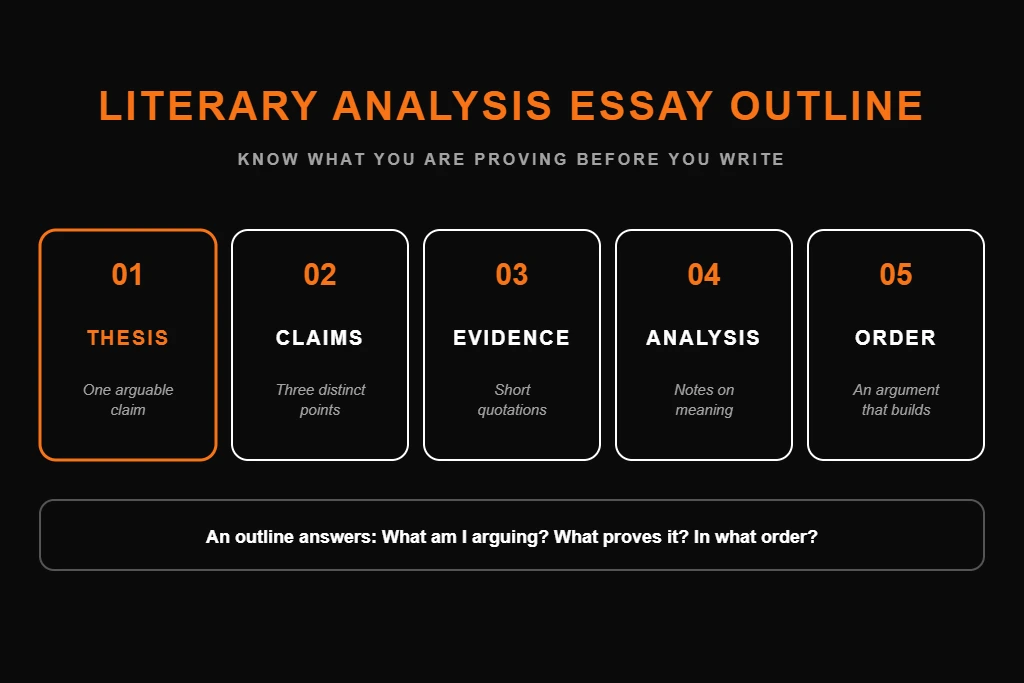
A literary analysis essay outline is a short, structured plan of your argument. It lists your thesis, the main claim of each body paragraph, the quotations you will use as evidence and a note on how each quotation supports your point. It is not the essay itself, but the skeleton that holds it together.
At Essays Helper, we often tell students that an outline answers three questions before they draft: What am I arguing? What will prove it? In what order will I prove it? If your outline answers all three, the essay almost writes itself.
Why outlines matter in literary analysis
Literary analysis asks you to build an argument about a text, not to retell it. Without a plan, it is easy to slide into summary or to pile up quotations without explaining them. An outline forces you to decide what each paragraph proves before you start writing sentences, which keeps the essay focused and the analysis deeper.
The real benefits of outlining
Outlining saves time overall, even though it feels like an extra step. Students who plan first tend to write faster because they are never stuck wondering what comes next. Outlines also make revision easier, since you can see the whole argument on one page and spot weak or repeated points before they turn into full paragraphs. And when deadlines pile up, a finished outline means you can draft in short sessions without losing your train of thought.
Informal and formal outlines
An informal outline is a quick list of your thesis, claims and evidence, written in whatever shorthand makes sense to you. A formal outline follows a set numbering system and is often submitted for a grade. Both serve the same purpose. Start informally while you think, then convert to a formal format only if your teacher requires it.
Outline vs notes vs summary
Notes are everything you noticed while reading. A summary is a retelling of the plot. An outline is a selection: it keeps only the evidence that supports your thesis and arranges it into a logical argument. If your outline could describe the story to someone who has not read it, it is probably a summary in disguise.
What teachers look for in a submitted outline
Many teachers ask students to hand in an outline before the full essay. They usually check for an arguable thesis, distinct body paragraph claims that each support it, specific evidence with page or line numbers, and some sign of analysis rather than only plot points. A clear outline also makes it easier for your teacher to give useful feedback before you draft.
Some teachers also grade the outline on its own, using a simple checklist. Even when it is not graded, handing in a clear plan shows that you have thought through your argument, and it gives your teacher a chance to redirect you before you invest hours in a draft that misses the prompt.
Before You Outline: Gather Your Material
A strong outline depends on good raw material. Before you start arranging points, spend time reading closely, choosing a focus and collecting evidence. This preparation is where most of the thinking happens.
Read and annotate with a purpose
Read the text at least twice. On the second read, mark repeated images, important words, shifts in tone and moments where a character makes a choice. Write short questions in the margin, such as “why does the narrator keep insisting he is calm?” Those questions often become your thesis.
It also helps to keep a short running list of patterns as you read. If the same color, object or phrase appears three times, write it down. Repetition is one of the clearest signs that an author is making a deliberate choice, and deliberate choices are exactly what a literary analysis outline is built around.
Choose a focus that fits the prompt
Underline the key verbs in your assignment, such as analyze, explain or compare, and note any required focus like a theme, symbol or character. Then choose one angle narrow enough to explore in depth. If you need a refresher on what makes literary essays different from other essay types, our guide to understanding literary essay basics is a good place to start.
Collect quotations with page numbers
Make a list of quotations that relate to your focus. Record the page number for prose, line numbers for poems, or act, scene and line for plays as you go. Searching for a quote’s location after you have drafted wastes time and often leads to citation mistakes.
Build a quick evidence chart
A simple three column chart speeds up outlining. In the first column, write the quotation. In the second, record the page or line number. In the third, note in a few words what the quotation suggests. When you sit down to outline, you can move the strongest rows straight into your plan without searching through the text again.
Group your evidence by idea
Sort your quotations into two to four groups based on what they show, not where they appear in the text. Each group often becomes a body paragraph. If one group has only a single weak quote, consider merging it with another or dropping it.
Literary Analysis Thesis
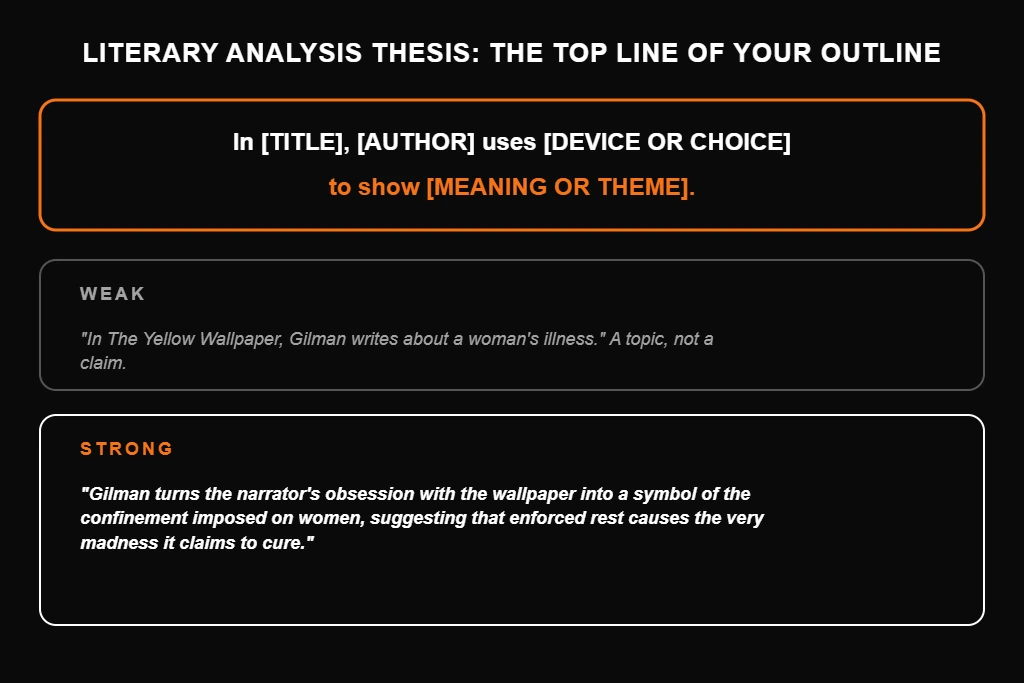
Every outline starts with a thesis, a one or two sentence claim about how the text creates meaning that a thoughtful reader could debate. A reliable formula is: In [title], [author] uses [device or choice] to show [meaning or theme]. A weak thesis such as “In The Yellow Wallpaper, Gilman writes about a woman’s illness” only names a topic. A stronger one says “In The Yellow Wallpaper, Gilman turns the narrator’s obsession with the wallpaper into a symbol of the confinement imposed on women, suggesting that enforced rest causes the very madness it claims to cure.” Write your thesis at the top of the outline, then make sure every claim below it supports this exact sentence.
How to Write an Outline for a Literary Analysis Essay Step by Step
Once your material is ready, building the outline takes seven steps. Work through them in order and your plan will be ready in less than an hour for most assignments.
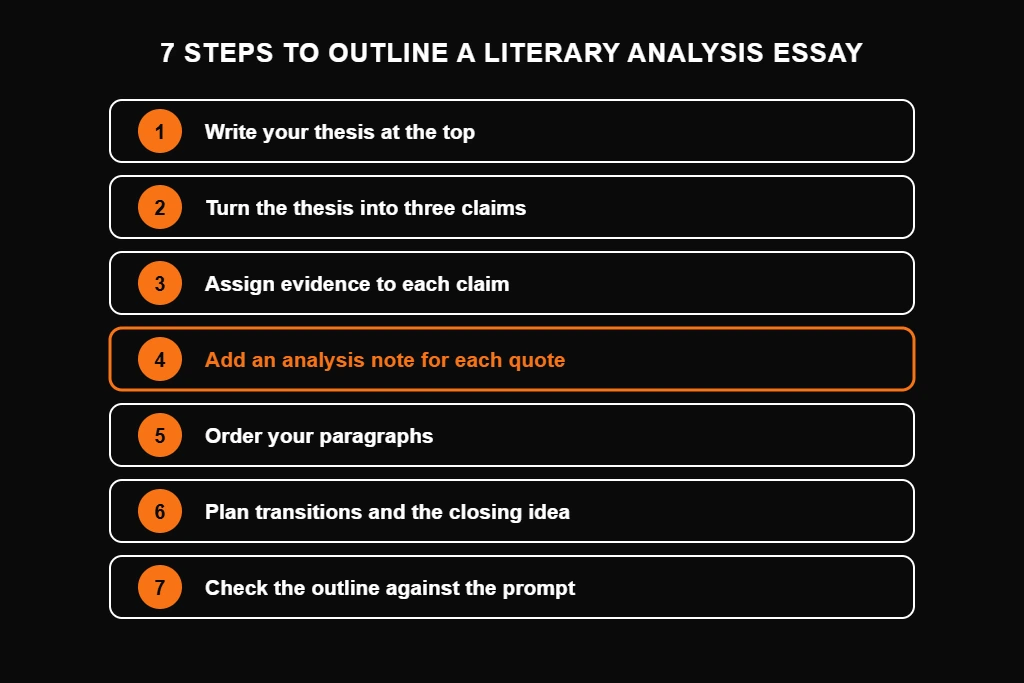
Step 1: Write your thesis at the top
Start with your working thesis. It can change later, but every other line of the outline depends on it, so it needs to be in place first.
Step 2: Turn the thesis into three claims
Ask what three things must be true for your thesis to hold. Each answer becomes the main claim of a body paragraph. For example, if your thesis says a narrator is unreliable, your claims might cover his voice, his motive and his confession.
Write each claim as a complete, arguable sentence rather than a single word. “Voice” tells you nothing when you start drafting, but “The narrator’s frantic voice contradicts his claim to be calm” gives the paragraph a clear direction and becomes your topic sentence almost unchanged.
Step 3: Assign evidence to each claim
Under each claim, list two or three short quotations or specific details with their page numbers. Choose evidence you can analyze in depth rather than the longest or most dramatic passages.
Step 4: Add a short analysis note for each quote
Next to each piece of evidence, write a few words explaining what it shows, such as “repetition suggests panic, not calm.” These notes are the seeds of your analysis and the part most students skip.
Step 5: Order your paragraphs
Arrange the claims so the argument builds. Common orders include following the text chronologically, moving from the most obvious point to the most surprising, or tracing a character’s change from beginning to end.
Step 6: Plan transitions and the closing idea
Write one line describing how each paragraph connects to the next, and one line for the larger point your closing paragraph will make. This prevents the essay from feeling like three separate mini essays.
Step 7: Check the outline against the prompt
Reread the assignment and confirm that your thesis answers it directly and that every claim supports the thesis. If you want to see how the outline fits into the full writing process, our complete guide on how to write a literary analysis essay walks through every stage from reading to revision.
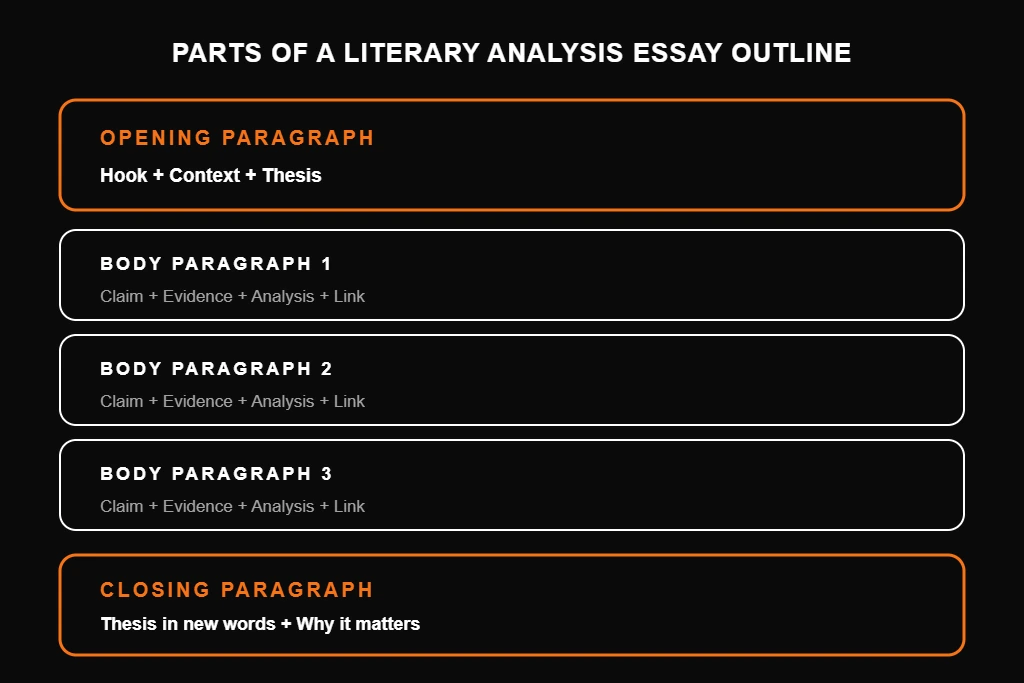
Literary Analysis Essay Outline Template
Use this fill in template for most high school and college assignments. Copy it into your document and replace each bracket with your own content. Keep entries short: phrases and key quotations, not full paragraphs.
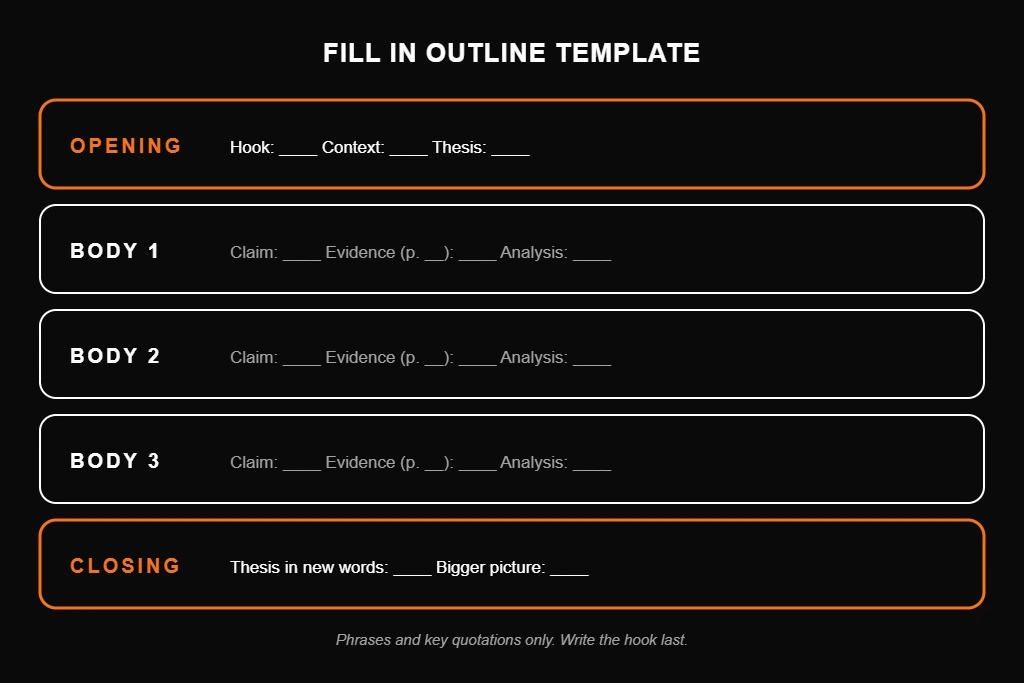
Opening paragraph
- Hook: [a striking quote, surprising claim or focused question about the text]
- Context: [title, author and one sentence of essential background]
- Thesis: [your arguable claim about how the text creates meaning]
Body paragraph 1
- Claim: [first point that supports the thesis]
- Evidence: [quotation or detail with page or line number]
- Analysis: [what specific words reveal and why they matter]
- Link: [how this point supports the thesis]
Body paragraph 2
- Claim: [second point, building on the first]
- Evidence: [quotation or detail with citation]
- Analysis: [explanation of the evidence]
- Link: [connection to the thesis]
Body paragraph 3
- Claim: [strongest or most surprising point]
- Evidence: [quotation or detail with citation]
- Analysis: [explanation of the evidence]
- Link: [connection to the thesis]
Closing paragraph
- Restated thesis: [the thesis in new words]
- Bigger picture: [why the interpretation matters for the text or its themes]
How to use the template well
Fill in the thesis first, then the three claims, then the evidence. Leave the hook for last, because it is much easier to find a good opening once you know exactly what you are arguing. If a body paragraph has evidence but no analysis note, that paragraph is not ready yet. Finally, read the completed template from top to bottom and check that it tells one clear, connected story about the text.
Formal outline formats
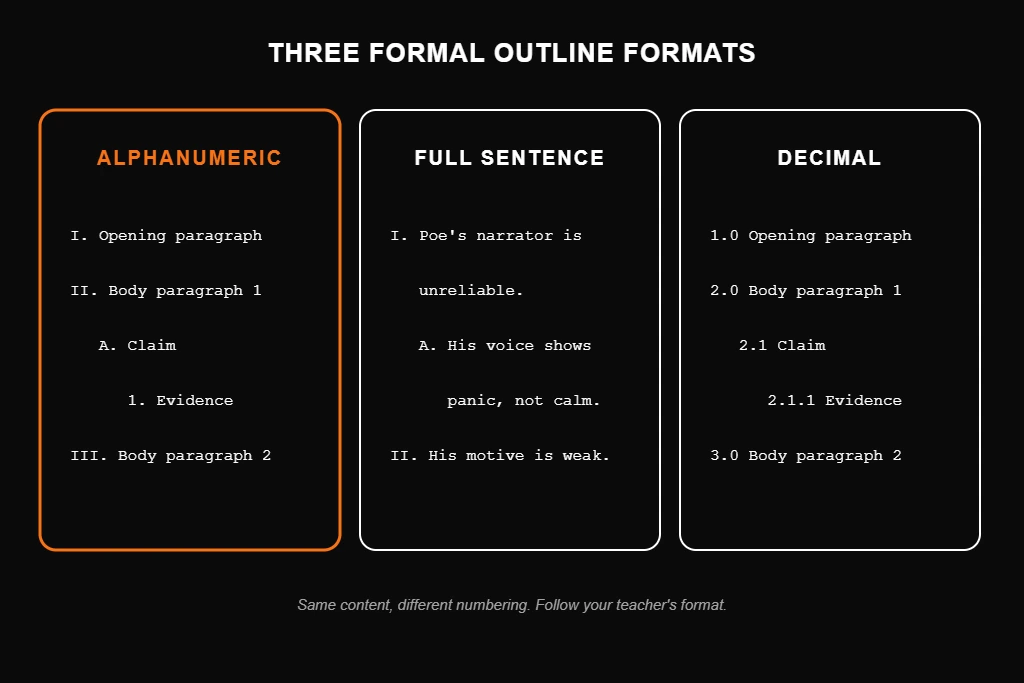
Some teachers require a formal outline with numbering. Purdue OWL describes three common types of outlines: alphanumeric outlines that use Roman numerals, capital letters and numbers; full sentence outlines that follow the same pattern but use complete sentences at every level; and decimal outlines that number each level as 1.1, 1.2 and so on. In an alphanumeric outline, the opening paragraph would be I, each body paragraph II to IV, and the closing paragraph V, with claims and evidence as lettered and numbered points beneath them.
The 5 Paragraph Outline vs Longer Essay Structures
The five paragraph structure is the most common starting point, but it is not the only option. Longer essays need more flexible outlines. Choose the structure that fits your assignment’s length and expectations.
| Structure | Typical length | Body paragraphs | Best for |
|---|---|---|---|
| 5 paragraph | 500 to 1,000 words | 3 | Middle and high school essays, short assignments |
| Extended | 1,200 to 2,000 words | 4 to 6 | Upper high school, AP and first year college |
| College research | 2,000 words or more | 6 or more, grouped by claim | Upper level courses with secondary sources |
When the 5 paragraph outline works best
It works well for short essays, timed writing and students learning to structure an argument. Its strength is clarity: one thesis, three claims, one closing paragraph. Its weakness is rigidity, since some arguments naturally have two main points or five.
What about a four paragraph essay?
Not every argument needs three body paragraphs. If your assignment is short or your thesis rests on two strong points, a four paragraph structure with two well developed body paragraphs can be more effective than stretching the material across three. Check with your teacher first, and make sure each of the two paragraphs is substantial enough to carry real analysis.
Outlining a longer essay
For longer essays, organize the outline by major claims rather than by paragraphs. Each claim might need two or three paragraphs, and you might add a section that responds to another reading of the text. Number your claims and list paragraph topics beneath each one, so you can see how the argument develops across several pages.
Adding secondary sources to a college outline
If your assignment requires literary criticism, add a line under each claim for any critic you will use, with a note on whether you agree, extend or challenge their reading. Keep your own close reading at the center: a critic should support or sharpen your argument, not replace it.
Literary Analysis Essay Outline Examples
Here are four complete sample outlines on public domain texts. Each one shows a thesis, three claims with evidence and analysis notes, and a closing idea. Use them as models for structure, not as content to copy.
Example 1: Unreliable narration in “The Tell-Tale Heart”
Thesis: Through the narrator’s frantic voice and his obsession with the old man’s eye, Poe shows that the harder a person insists on reason, the more clearly their loss of it is revealed.
Body paragraph 1: The narrator’s voice contradicts his claim of sanity
- Evidence: he asks, “why will you say that I am mad?” in the first lines.
- Analysis: exclamations and repetition suggest panic rather than control.
Body paragraph 2: His motive exposes his instability
- Evidence: “Object there was none. Passion there was none.”
- Analysis: with no reason except the “eye of a vulture,” fear has replaced judgment.
Body paragraph 3: The confession proves his guilt cannot be reasoned away
- Evidence: “It is the beating of his hideous heart!”
- Analysis: the imagined sound shows guilt overpowering his careful planning.
Closing idea: Poe lets the narrator’s own voice deliver the verdict, suggesting that guilt cannot be argued away.
Example 2: Symbolism in “The Yellow Wallpaper”
Thesis: Charlotte Perkins Gilman turns the yellow wallpaper into a symbol of the narrator’s confinement, showing how the “rest cure” imposed on women causes the breakdown it claims to prevent.
Body paragraph 1: The wallpaper reflects the narrator’s frustration
- Evidence: she describes its “sprawling flamboyant patterns committing every artistic sin.”
- Analysis: her disgust with the pattern mirrors her frustration with the rules controlling her.
Body paragraph 2: Her husband dismisses her concerns
- Evidence: “John laughs at me, of course, but one expects that in marriage.”
- Analysis: the casual tone shows how normal her lack of power has become.
Body paragraph 3: The woman behind the pattern becomes her own reflection
- Evidence: she sees a figure “stooping down and creeping about behind that pattern.”
- Analysis: the trapped woman symbolizes the narrator, and by the end they merge.
Closing idea: The story remains a powerful critique of medical and social control over women. You can read the full text free on Project Gutenberg.
Example 3: Irony in “The Cask of Amontillado”
Thesis: Poe uses layers of irony in “The Cask of Amontillado” to show how Montresor’s polished manners disguise a cold and calculated cruelty.
Body paragraph 1: Situational irony in the setting
- Evidence: the murder takes place during carnival, with Fortunato dressed in motley and a cap and bells.
- Analysis: the festive costume makes his fate grimly comic and highlights his foolishness.
Body paragraph 2: Dramatic irony in the conversation
- Evidence: Fortunato toasts “the buried that repose around us,” and Montresor answers, “And I to your long life.”
- Analysis: readers sense the threat that Fortunato misses, building suspense.
Body paragraph 3: Verbal irony in the ending
- Evidence: Montresor closes with “In pace requiescat!”
- Analysis: wishing peace on his victim shows his lack of remorse.
Closing idea: The irony invites readers to see through Montresor’s charm and question how reliable his version of events really is.
Example 4: Theme in “The Road Not Taken” (poem)
Thesis: In “The Road Not Taken,” Robert Frost undercuts the idea of a bold, individual choice, suggesting that people often invent meaning for decisions after the fact.
Body paragraph 1: The roads are nearly identical
- Evidence: the passing had “worn them really about the same.”
- Analysis: the speaker admits there was little real difference between the paths.
Body paragraph 2: The speaker imagines retelling the story
- Evidence: “I shall be telling this with a sigh.”
- Analysis: the future tense shows the meaning is created later, not at the moment of choice.
Body paragraph 3: The famous ending is ambiguous
- Evidence: “I took the one less traveled by, / And that has made all the difference.”
- Analysis: read in context, the line sounds more like self justification than triumph.
Closing idea: Frost’s poem is less a celebration of individuality than a reflection on how people shape their own life stories.
If you are working with a short story, notice how few quotations each outline needs. Two well chosen pieces of evidence per paragraph, each with a clear note, give you more than enough material for a strong essay. Adding more quotes rarely improves the analysis; explaining the ones you have in more depth almost always does.
Example 5: Comparing two Poe narrators
Thesis: Although both narrators in “The Tell-Tale Heart” and “The Cask of Amontillado” confess to murder, Poe contrasts a narrator overwhelmed by guilt with one who feels none, showing two very different ways the mind can justify violence.
Body paragraph 1: Motive
- Tell-Tale Heart: no real motive beyond the old man’s eye.
- Cask of Amontillado: revenge for “the thousand injuries of Fortunato.”
- Analysis: one acts from irrational fear, the other from cold calculation.
Body paragraph 2: Voice
- Tell-Tale Heart: frantic exclamations and questions.
- Cask of Amontillado: calm, polished narration.
- Analysis: the contrast in tone reveals panic versus control.
Body paragraph 3: Guilt and confession
- Tell-Tale Heart: he breaks down and confesses to the police.
- Cask of Amontillado: he tells the story decades later without regret.
- Analysis: Poe shows guilt destroying one narrator while the other escapes it entirely.
Closing idea: Read together, the stories suggest that the most frightening narrator may be the one who feels nothing at all.
Notice how each body paragraph discusses both stories instead of covering one and then the other. That point by point structure is what makes a comparison outline work.
What these examples have in common
Each outline starts with a thesis that makes a debatable claim, gives every body paragraph one clear job, pairs each quotation with a note on what it reveals, and ends with a closing idea that looks beyond the plot. Notice how short the entries are. An outline is a plan, so phrases and key quotations are enough.
Outlines for Different Types of Literary Essays
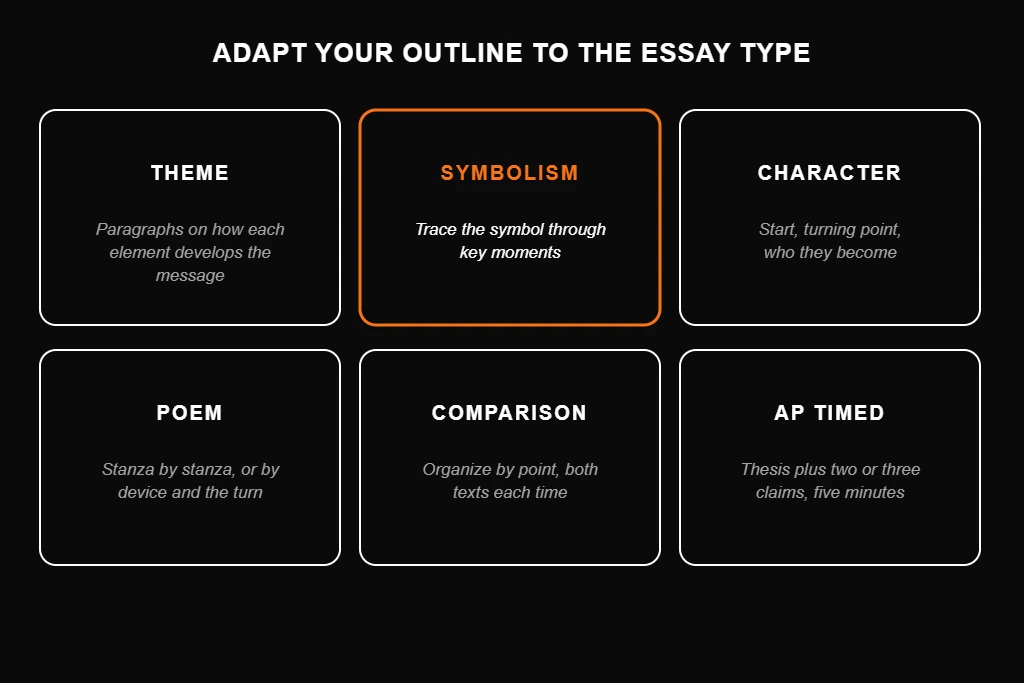
The basic structure stays the same, but the focus of each body paragraph changes depending on the kind of essay you are writing. Here is how to adapt your outline for the most common assignments.
Theme analysis
Organize body paragraphs around the different ways the author develops the theme, such as through a character, a symbol and the ending. Each claim should explain how a specific element contributes to the larger message.
Symbolism analysis
Trace the symbol through key moments, often in chronological order, and show how its meaning grows or changes. The Yellow Wallpaper example above follows this pattern.
Character analysis
Organize claims around a character’s traits, conflicts and change. A common structure is one paragraph on who the character is at the start, one on the turning point and one on who they become. Our guide to the character analysis essay covers this approach in depth, including hooks and full examples.
Poetry analysis
Poem outlines often follow the poem’s structure, stanza by stanza, or focus on devices such as imagery, sound and the turn. Remember to cite line numbers and to note where the speaker’s tone shifts.
Novels and longer works
With a full novel, the challenge is choosing what to leave out. Pick three or four key moments that best support your thesis, such as an early scene, a turning point and the ending, and build each body paragraph around one of them. Resist the urge to cover the whole book; a focused outline produces a sharper essay.
Comparing two texts
Avoid outlining one text and then the other. Instead, organize by points of comparison, with each body paragraph discussing both texts. Your thesis should explain what the comparison reveals that neither text shows alone.
AP Literature timed essays
On the AP English Literature exam, the College Board’s exam overview lists three free response questions: a poetry analysis, a prose fiction analysis and a literary argument. In timed conditions, spend a few minutes on a quick outline: a one sentence thesis, two or three claims with the line references you will use, and nothing more. A short plan keeps the essay focused under pressure.
What Teachers Expect at Each Level
Outlines grow more detailed and more flexible as you move from middle school to college. Knowing what your teacher expects helps you put effort where it counts.
| Level | Typical outline | What teachers look for |
|---|---|---|
| Middle school | 5 paragraph template with key quotes | A clear claim, matching evidence, basic explanations |
| High school and AP | 5 paragraphs or more, with analysis notes | An arguable thesis, distinct claims, specific citations |
| College | Claim based, often full sentence | Original interpretation, logical progression, sources if required |
Middle school outlines
Focus on matching each claim with clear evidence and a one line explanation. A simple template with an opening paragraph, three body paragraphs and a closing paragraph is usually exactly what teachers want.
High school and AP outlines
Teachers expect a debatable thesis and claims that each make a distinct point. Analysis notes become essential, since they show you understand how the evidence works. Short, well chosen quotations matter more than long ones.
College outlines
College instructors often prefer full sentence outlines, especially for longer papers. Claims may build on each other more subtly, and you may need to show where secondary sources fit. Flexibility matters more than following a fixed paragraph count.
When your teacher provides a template
If your class uses a specific outline template or graphic organizer, follow it exactly, even if it differs from the one in this guide. Fill in the same core elements: a thesis, distinct claims, evidence with citations and analysis notes. Teachers often grade outlines on whether each required box is complete, so leaving a section blank can cost marks even if the rest is strong.
Common Outline Mistakes and How to Fix Them
Most weak outlines fail in a handful of predictable ways. Fixing them at the planning stage is far easier than repairing a full draft.
| Mistake | Why it hurts | How to fix it |
|---|---|---|
| Outlining the plot | Leads straight to a summary essay | Write claims that make arguments, not events |
| A vague thesis | Gives the outline nothing to prove | Make a debatable claim about how meaning is created |
| Overlapping claims | Paragraphs repeat each other | Give each paragraph a distinct job |
| Evidence without notes | Analysis gets skipped in the draft | Add a short note on what each quote reveals |
| Too much detail | Outline becomes a rough draft | Use phrases and key quotes only |
“My outline is just plot”
If your body paragraph claims read like “Gatsby throws a party” or “Montresor leads Fortunato into the cellar,” you have outlined events, not arguments. Rewrite each claim to say what the event reveals, such as “Montresor’s politeness disguises his cruelty.” The evidence can stay the same; the claim needs to change.
“I can’t find three points”
Return to your annotations and look at the thesis from different angles: a character, a symbol, the setting, the ending or the narrator’s voice. If you still have only two strong points, two well developed paragraphs are better than three thin ones. Ask your teacher whether a four paragraph essay is acceptable.
“My points overlap”
Overlapping claims usually mean you have organized by evidence rather than by idea. Test each claim by asking, “What does this paragraph prove that the others do not?” If two answers sound the same, merge them and find a new angle for the third paragraph.
“My teacher wants a formal outline”
Use the alphanumeric format described earlier: Roman numerals for major sections, capital letters for claims and numbers for evidence. Keep the content the same as your informal plan. Formal outlines are about consistent formatting, not extra content.
“I outlined, but my essay still drifts”
This usually happens when the outline lacks analysis notes or transitions. Before drafting each paragraph, reread its claim and the thesis together. If a sentence you are writing does not support both, it probably belongs somewhere else or not at all.
“My outline is too long”
If your outline is nearly as long as the essay, you are drafting rather than planning. Cut each entry down to a phrase, keep only the quotations you will actually analyze, and remove any sentence that explains plot. A good outline for a five paragraph essay usually fits on a single page.
Literary analysis vs rhetorical analysis outlines
Students sometimes mix up these two plans. A literary analysis outline organizes claims around how a text creates meaning, through devices like symbolism, character and structure. A rhetorical analysis outline organizes claims around how a writer persuades an audience. If your assignment asks about purpose, audience and appeals, our rhetorical analysis essay outline guide shows that structure instead.
Turning Your Outline Into a Draft
A good outline makes drafting much faster, because the hardest decisions are already made. Each line of the plan maps directly onto a part of the essay.
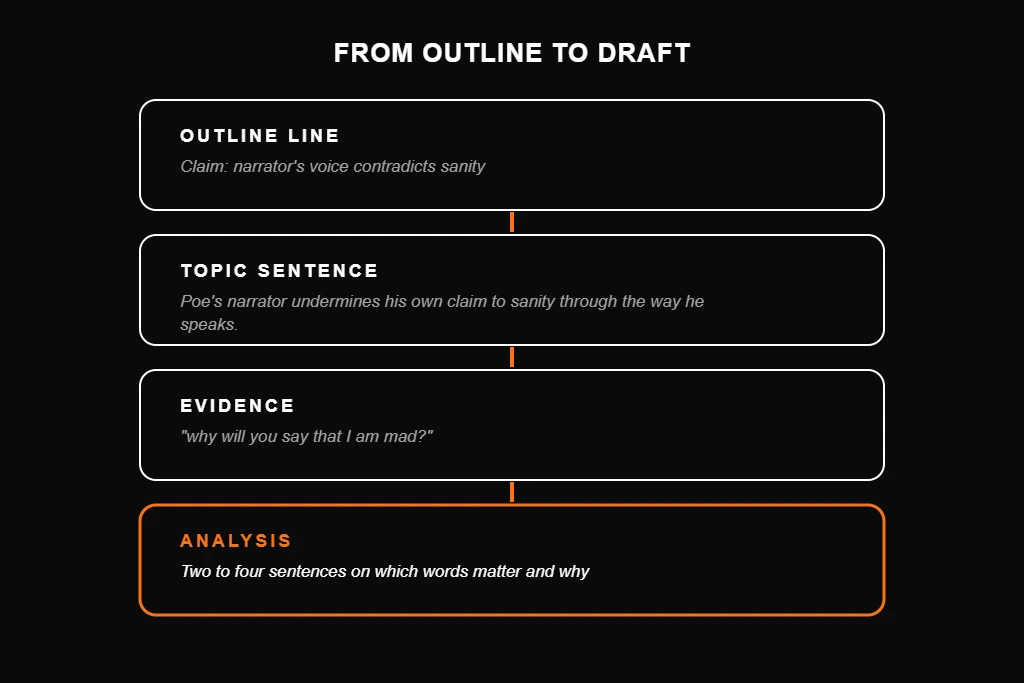
From claim to topic sentence
Each body paragraph claim becomes the paragraph’s topic sentence. Polish the wording, but keep the idea exactly the same so the paragraph stays focused.
From evidence and notes to analysis
Introduce each quotation with a short signal phrase, then expand your analysis note into two to four sentences. Explain which words matter, what they suggest and how they support the claim. This is where your outline’s notes pay off.
Drafting order that saves time
Many students find it easiest to draft the body paragraphs first, then the opening paragraph and finally the closing paragraph. By the time you write the opening, you know exactly what the essay argues, which makes the hook and context much easier to write.
Citing as you draft
Add citations while you write rather than at the end. Use page numbers for prose, line numbers for poems and act, scene and line for plays. Purdue OWL’s guide to MLA in-text citations shows the exact format for each type of text.
Use your outline to write transitions
The connection notes in your outline become your transitions. If your note says paragraph two builds on paragraph one by moving from voice to motive, your transition might begin, “The narrator’s voice is not the only clue to his instability; his motive reveals even more.” Transitions written this way show your reader how the argument develops instead of just signaling that a new paragraph has started.
Plan your word count from the outline
Divide your target length across the outline before you draft. In a 1,000 word essay, for example, you might give the opening paragraph about 150 words, each body paragraph about 220 words and the closing paragraph about 150. Planning this way stops you from spending half your word count on the first paragraph and rushing the rest.
Reverse outlining after you draft
Once your draft is finished, try a reverse outline. Read each paragraph and write a one line summary of its main point in the margin. Then compare those lines with your original plan. If a paragraph’s summary does not match its claim, or two paragraphs say the same thing, you have found exactly where to revise. This simple check catches problems that rereading alone often misses.
Get feedback before you draft
Share your outline with a teacher, tutor or classmate before writing the full essay. Ask them two questions: Is my thesis arguable? Does each body paragraph prove something different? Feedback at this stage takes minutes and can save hours, because it is much easier to change a line in an outline than to rewrite a finished paragraph.
Paper or digital outlines
Use whatever tool helps you see the whole argument at once. Some students prefer paper and colored pens to group evidence by idea. Others use a document with headings they can drag and reorder. The format matters less than the habit of finishing the plan before you start drafting.
When to change your outline
Outlines are plans, not contracts. If you discover a stronger point while drafting, update the outline and check that the thesis still fits. As the UNC Writing Center notes in its guide to writing about literature, a working thesis is expected to evolve as you develop your evidence.
How EssaysHelper Can Help You
Outlining is the step that makes or breaks a literary analysis essay, and it is also the step students most often rush. If you are struggling to find a thesis, organize your evidence or turn your plan into a strong draft, our essay support services can help you move forward with confidence. Our writers support students from middle school through graduate programs.
- Building an arguable thesis and three distinct claims.
- Choosing the strongest evidence and writing analysis notes.
- Reviewing outlines before you draft, so problems are fixed early.
- Turning outlines into polished, well cited essays.
Share your assignment, text and deadline, and we will suggest the fastest way forward.
Frequently Asked Questions
What should a literary analysis essay outline include?
It should include an opening paragraph plan with a hook, context and thesis, body paragraphs each with a claim, evidence and an analysis note, and a closing paragraph that explains why the interpretation matters.
How long should a literary analysis essay outline be?
Most outlines fit on one page for a five paragraph essay and two pages for longer papers. Use short phrases and key quotations rather than full paragraphs.
Should my outline use full sentences or bullet points?
Either works unless your teacher specifies. Bullet points are faster for planning, while full sentence outlines are common in college and help when claims are complex.
How many body paragraphs should a literary analysis essay have?
Three is standard for a five paragraph essay. Longer essays often have four to six, organized around major claims rather than a fixed number.
Do I need to include quotes in my outline?
Yes. Including short quotations with page or line numbers saves time while drafting and helps you check that every claim has real evidence behind it.
What is the format for a formal literary analysis outline?
Most formal outlines use the alphanumeric system: Roman numerals for major sections, capital letters for claims and numbers for supporting evidence. Some teachers prefer a decimal format.
How do I outline an AP Literature essay in timed conditions?
Spend about five minutes writing a one sentence thesis and two or three claims with the line references you plan to use. Keep it short so most of your time goes to writing.
What is the difference between a thesis and an outline?
The thesis is your single main argument. The outline is the full plan showing how you will prove that argument, paragraph by paragraph.
Can I change my outline while I am writing?
Yes. If you find a stronger idea while drafting, update the outline and make sure your thesis and claims still match. Outlines guide your writing; they do not lock it in place.
How do I outline an essay comparing two literary works?
Organize by points of comparison, discussing both texts in each body paragraph, and write a thesis that explains what the comparison reveals about both works.
Final Thoughts
A literary analysis essay outline turns a pile of notes into a clear argument. Start with an arguable thesis, break it into distinct claims, pair each claim with short quotations and a note on what they reveal, and order your paragraphs so the argument builds. Whether you use a five paragraph template, a formal alphanumeric outline or a flexible college plan, the goal is the same: know what you are proving before you write. With a solid outline, drafting becomes faster, clearer and far less stressful.