
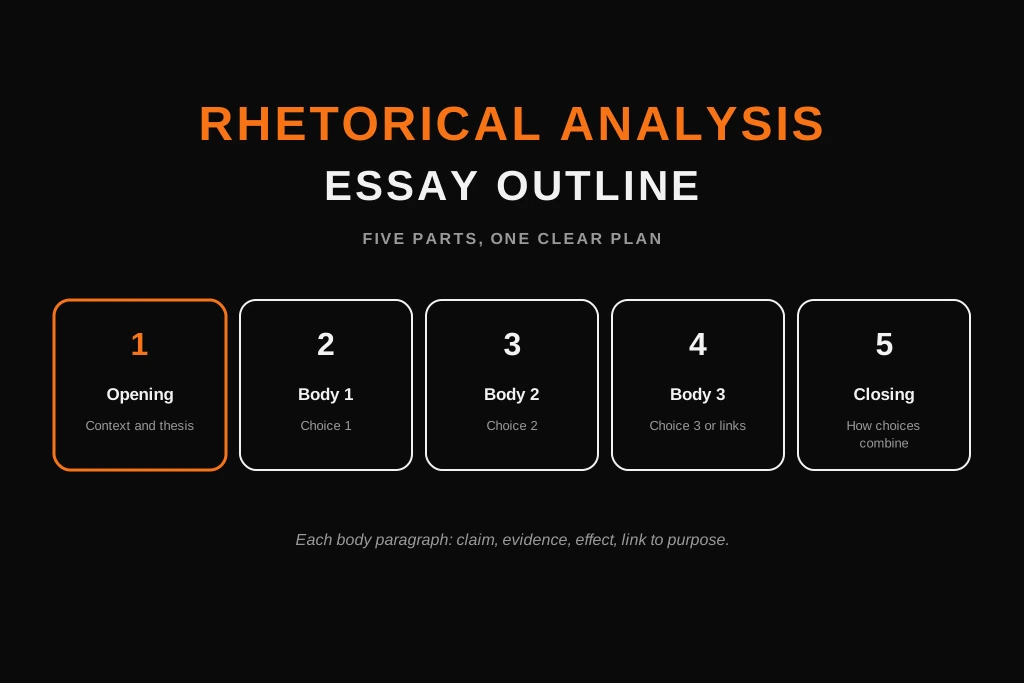
A rhetorical analysis essay outline usually has five parts. First, an opening paragraph with brief context and a thesis that names the writer’s purpose and main choices. Then two or three body paragraphs, each with a claim about one rhetorical choice, one or two short quotations, notes on their effect on the audience and a link back to the purpose. Last, a closing paragraph that shows how the choices work together. You can organize the body by choice or by following the text in order.
That is the skeleton. This guide from Essays Helper fills it in with a copy ready template, a fully worked outline example, three ways to organize the body, a four minute plan for AP Lang and a method for checking your draft once it is written.
Students usually struggle with outlines in the same ways. The outline turns into a summary of the text, the body paragraphs are just a list of devices, or there is no time to plan in a timed exam. A good outline fixes all three, because it forces you to decide what each paragraph argues before you write a word of it.
What Is a Rhetorical Analysis Essay Outline?
An outline is a short plan of your essay, written before you draft. For a rhetorical analysis, it records three things: your thesis, the choice each body paragraph will analyze and the evidence you will use. It does not need full sentences, except for the thesis and the main claim of each paragraph.
Why outlining matters for this essay
A rhetorical analysis asks you to explain how a text persuades, which is easy to lose sight of once you start writing. Without a plan, most students drift into retelling what the writer said. An outline keeps every paragraph pointed at a choice and its effect. It also makes timed writing faster, because the hard thinking is already done.
What goes in an outline
At minimum, your outline needs the thesis, one claim per body paragraph, one or two short quotations under each claim, a few words on the effect of each quotation and a note on how the choices connect. That is enough to write a full essay without stopping to think about what comes next. Anything else, such as background on the writer or the wider debate, can stay out of the outline unless it supports a specific claim.
How detailed should your outline be?
It depends on the time you have. For a homework essay or a college paper, a fuller outline for a rhetorical analysis essay is worth the effort: full claim sentences, two quotations per paragraph and a sentence on each effect. For a timed exam, a skeleton of short notes is enough, as long as the thesis is written in full. The rule of thumb is simple. If you could hand your outline to a classmate and they could explain your argument, it is detailed enough.
When to write it
Write the outline after you have read and annotated the text, but before you draft a single paragraph. Many students try to plan while they read, which leads to outlines that follow the text line by line. Reading first and planning second keeps you focused on the writer’s choices, not on the content. If you change your mind while drafting, update the outline too, so it stays a reliable guide to the essay you are actually writing.
Outlines for different assignments
The same structure works for a speech, a letter, an editorial or an advertisement. What changes is the evidence. For a visual text, your quotations become descriptions of images, colours or layout. For a spoken text, you may analyze pauses, repetition or how the speaker addresses the crowd. The outline still needs a claim, evidence, an effect and a link for every paragraph.
Before You Outline: Map the Text
You cannot outline until you know what you are analyzing. Three quick steps come first. Map the rhetorical situation using SOAPS: speaker, occasion, audience, purpose and subject. Annotate the text for choices and their effects. Then pick the two or three choices you can explain most strongly. Our full guide on how to write a rhetorical analysis essay walks through each of these steps in detail, so here we focus on what you do once they are done.
The sample text used in this guide
To show a real outline, we will use a short, invented open letter from a park ranger, posted at the entrance to a popular trail.
“I have walked these hills for fifteen years, and I know how tempting the shortcut across the meadow looks at the end of a long hike. But every spring, I watch that meadow try to heal. One careless step crushes plants that took years to grow, and a single new path can take a decade to disappear. You will save perhaps two minutes. The meadow will lose far more. So please, stay on the trail, and help the next visitor see what you saw today.”
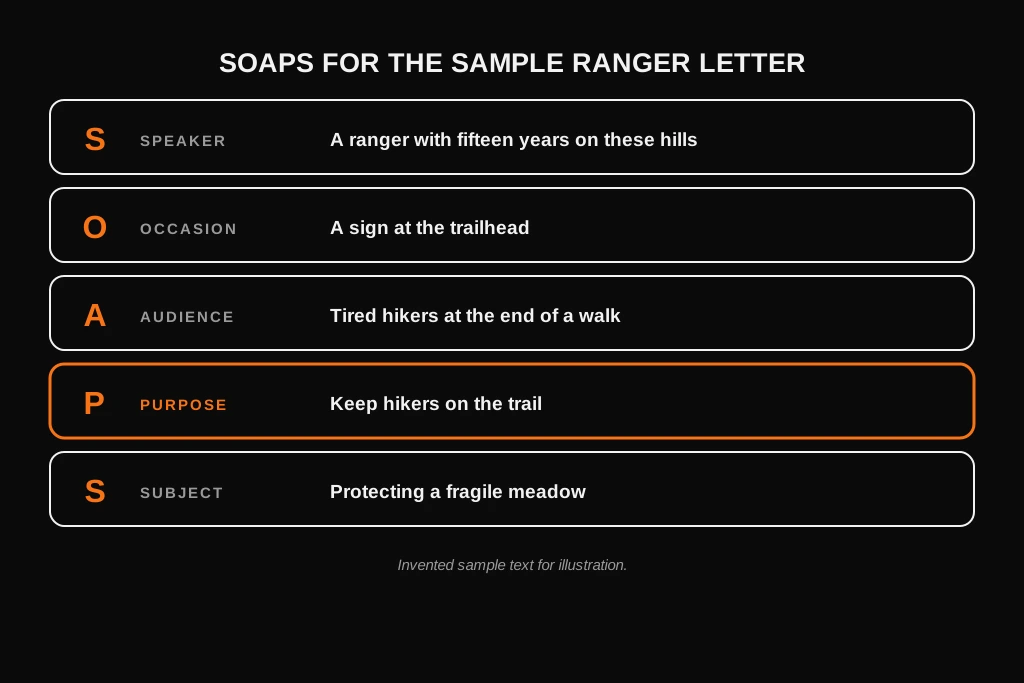
The letter and its claims are invented for this guide. Its SOAPS are simple: the speaker is an experienced ranger, the occasion is a sign at a trailhead, the audience is tired hikers, the purpose is to keep them on the trail and the subject is protecting a fragile meadow.
The Basic Outline Structure
Most rhetorical analysis essays follow the same basic shape. The table shows what goes in each part and roughly how much space it takes.
| Part | What goes in it | Rough share of the essay |
|---|---|---|
| Opening paragraph | Brief context (writer, text, occasion), then the thesis | About 10 to 15 percent |
| Body paragraph 1 | Claim about one choice, 1 or 2 quotations, effect, link to purpose | About 25 percent |
| Body paragraph 2 | Same pattern, next choice or next section | About 25 percent |
| Body paragraph 3 | Same pattern, or how the choices work together | About 25 percent |
| Closing paragraph | Thesis in fresh words, how the choices combine, why it matters | About 10 percent |
These shares are a planning guide, not a rule. In a timed exam, two strong body paragraphs can be better than three weak ones. What matters most is that the body paragraphs carry the analysis, because that is where the marks are.
The opening paragraph in your outline
In your outline, the opening paragraph needs just two lines: one sentence of context and the full thesis. Write the thesis out completely, because it decides everything else.
The body paragraphs in your outline
Each body paragraph needs a claim, a quotation or two and a note on effect. Write the claim as a full sentence, and keep the rest as short notes.
The closing paragraph in your outline
A single line is enough: how the choices work together and why that matters for this audience.
Three Ways to Organize the Body
There is more than one good way to order your body paragraphs. Texas A&M University’s Writing Center notes that paragraphs can be organized by technique, by effectiveness or chronologically. Here is how the three most common approaches compare.
| Approach | How it works | Best for | Watch out for |
|---|---|---|---|
| By choice | Each paragraph analyzes one main strategy, such as credibility, imagery or contrast | Texts with two or three clear, separate strategies | Becoming a list; show how choices connect |
| In text order | Paragraphs follow the text’s opening, middle and ending | Texts that build or shift tone as they go | Drifting into summary; lead with a claim, not a retelling |
| By appeal | One paragraph each for credibility, emotion and reason | Short persuasive texts with balanced appeals | Labelling appeals without explaining effects |
When to choose each one
Choose by choice when the writer uses a few distinct strategies throughout. Choose text order when the writer’s approach changes, for example from calm to urgent, because tracking that shift is itself good analysis. Use the appeals structure only if you will explain each appeal’s effect in depth, because it is the easiest structure to do badly.
The ranger letter, organized three ways
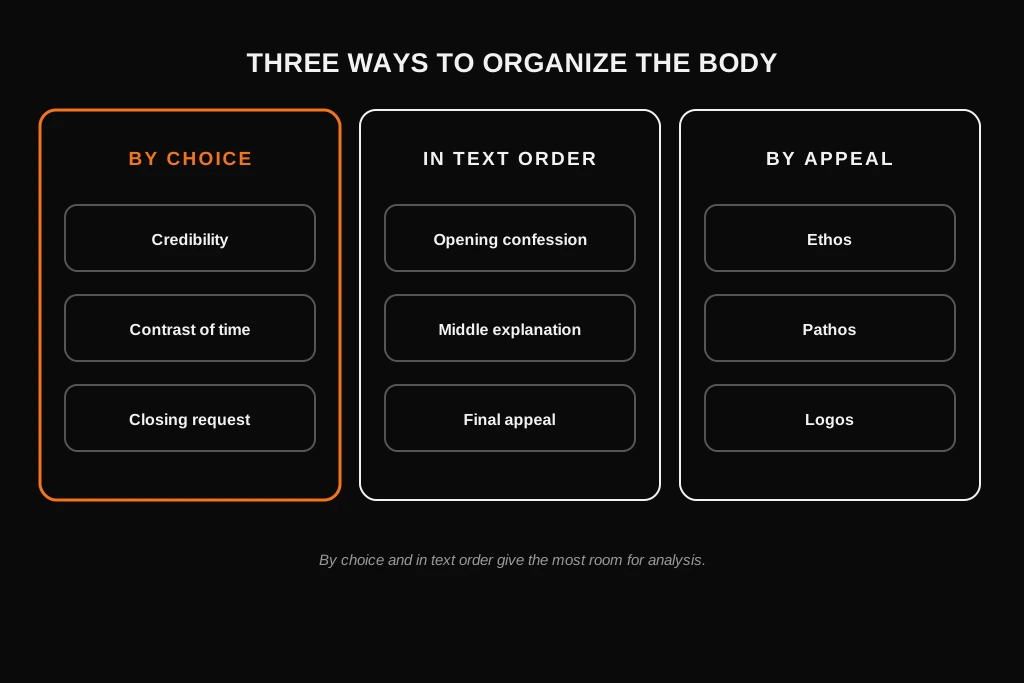
By choice: credibility, the contrast between minutes and years, and the closing request. In text order: the opening confession, the middle explanation and the final appeal. By appeal: credibility in “fifteen years”, emotion in the meadow trying to heal and reason in “a decade to disappear”. All three would work, but the first two give more room for real analysis.
Rhetorical Analysis Essay Outline Example
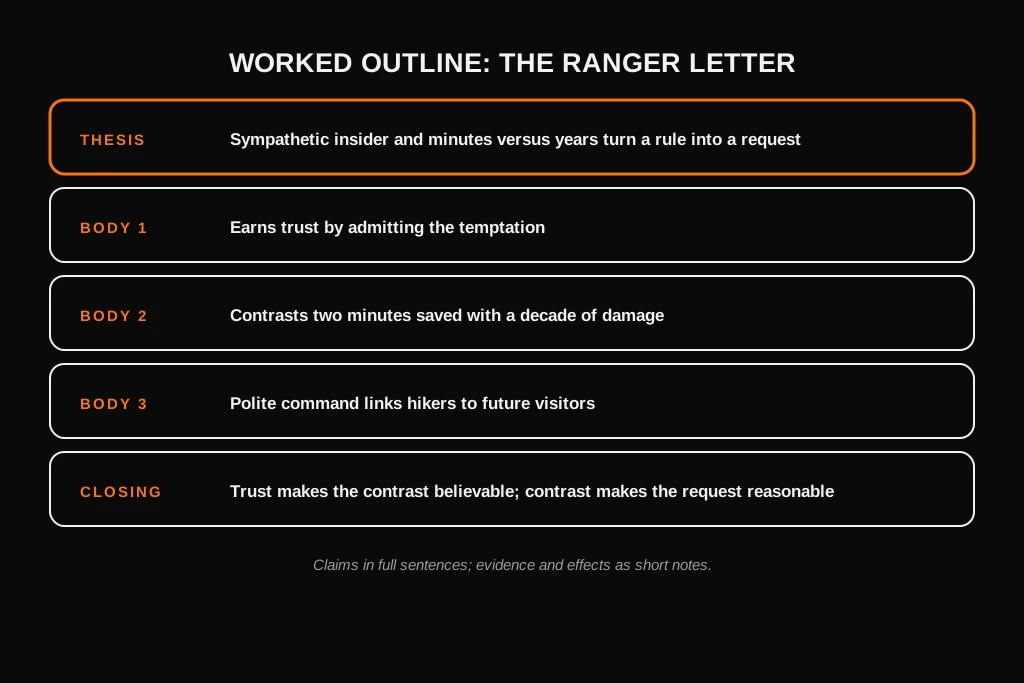
Here is a complete outline for the ranger letter, organized by choice. Notice that the claims are full sentences, while the evidence and effects are short notes.
Opening paragraph
- Context: an open letter from a park ranger, posted at a trailhead, asking hikers to stay off a meadow.
- Thesis: The ranger persuades tired hikers to stay on the trail by presenting herself as a sympathetic insider and by contrasting the minutes they save with the years the meadow loses, which turns a rule into a personal request.
Body paragraph 1: credibility and empathy
- Claim: The ranger first earns trust by admitting she understands the temptation.
- Evidence: “I have walked these hills for fifteen years”; “I know how tempting the shortcut… looks”.
- Effect: experience gives authority; admitting the temptation removes any sense of scolding.
- Link: hikers are more likely to follow a request from someone who sounds like one of them.
Body paragraph 2: contrast of time
- Claim: She reframes the shortcut by contrasting a tiny personal gain with a long, shared loss.
- Evidence: “You will save perhaps two minutes. The meadow will lose far more.”; “a decade to disappear”.
- Effect: short sentences make the contrast blunt; the shortcut now looks selfish, not clever.
- Link: changes what hikers think the decision is really about.
Body paragraph 3: the closing request
- Claim: She ends with a polite command that connects each hiker to future visitors.
- Evidence: “So please, stay on the trail”; “help the next visitor see what you saw today”.
- Effect: “please” keeps it a request; “the next visitor” gives hikers a role as protectors.
- Link: completes the move from rule to personal choice.
Closing paragraph
- How the choices combine: trust makes the contrast believable, and the contrast makes the final request feel reasonable rather than bossy.
A fill in template you can copy
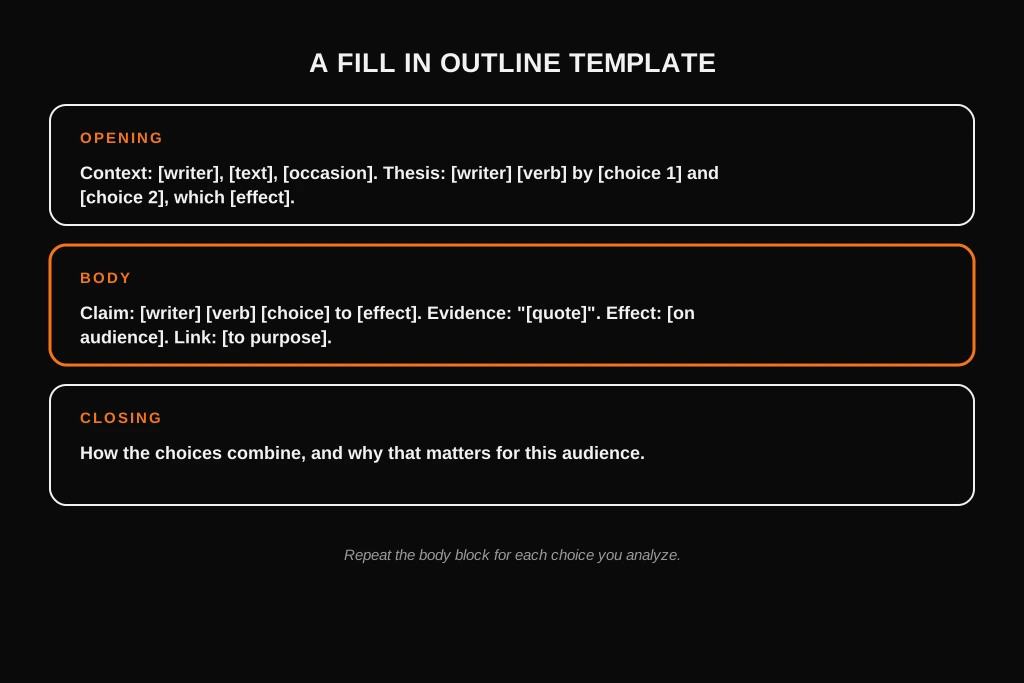
Use this template for any rhetorical analysis. Replace the brackets with your own notes.
Opening paragraph
- Context: [writer], [text type], [occasion], [audience].
- Thesis: [Writer] [purpose verb] by [choice 1] and [choice 2], which [effect on audience].
Body paragraph 1
- Claim: [Writer] [verb] [choice 1] in order to [effect].
- Evidence: “[short quotation]”; “[short quotation]”.
- Effect: [what it does to the audience].
- Link: [how it serves the purpose].
Body paragraph 2
- Claim, evidence, effect and link for [choice 2].
Body paragraph 3 (optional)
- Claim, evidence, effect and link for [choice 3], or how choices 1 and 2 work together.
Closing paragraph
- How the choices combine, and why that matters for this audience.
AP Lang Rhetorical Analysis Essay Outline
On the AP English Language and Composition exam, the rhetorical analysis is one of three free response questions. The College Board’s AP Lang exam page says the free response section has a time limit of 2 hours and 15 minutes, which includes a 15 minute reading period. That leaves about 40 minutes per essay if you split the writing time evenly, so your outline has to be quick.
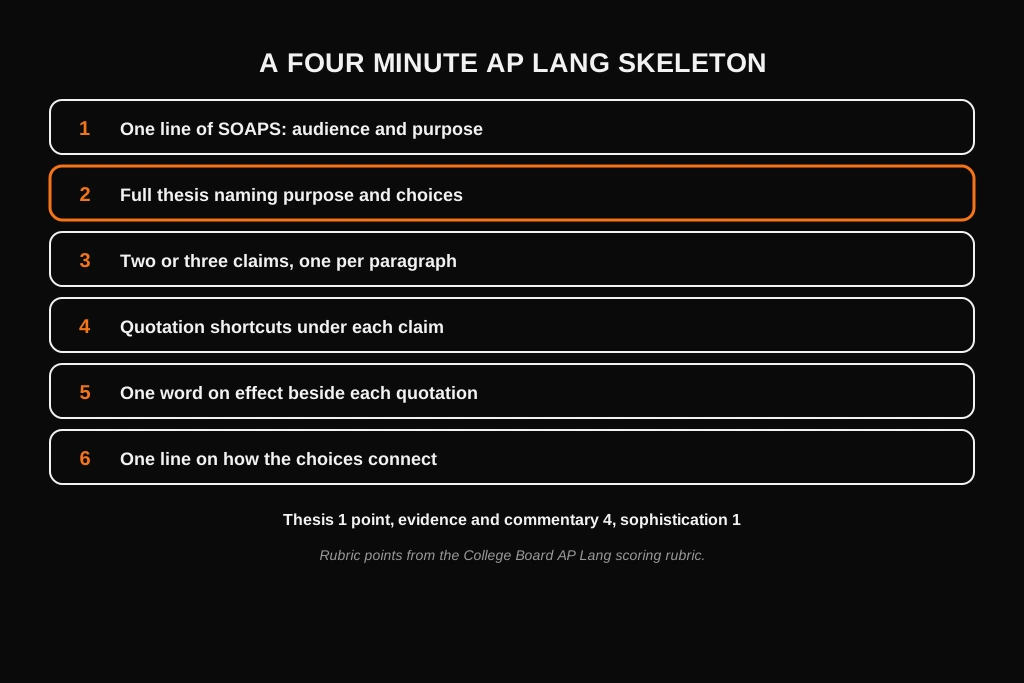
A four minute skeleton
After you read and annotate the passage, spend about four minutes on a skeleton like this.
- One line of SOAPS, focused on audience and purpose.
- Your thesis, written in full.
- Two or three claims, one per body paragraph, as short sentences.
- One or two quotation shortcuts under each claim, such as line numbers or the first few words.
- One word on effect beside each quotation.
- One line on how the choices connect, which you will use in the closing paragraph.
Mapping the outline to the rubric
The College Board’s scoring rubric gives six points: one for a defensible thesis that analyzes the writer’s rhetorical choices, up to four for evidence and commentary, and one for sophistication. Your outline can target each row.
| Rubric row | Points | What your outline should include |
|---|---|---|
| A: Thesis | 1 | A full thesis naming the purpose and the rhetorical choices, not a restatement of the prompt |
| B: Evidence and commentary | 4 | Specific quotations for every claim and a note on how each choice serves the purpose |
| C: Sophistication | 1 | A line on why the choices fit this audience and moment, or how they work together |
The rubric’s top score in the evidence and commentary row asks you to explain how multiple rhetorical choices contribute to the writer’s purpose, and to consistently explain how your evidence supports a line of reasoning. That is exactly what the claim, evidence, effect and link pattern in your outline sets up.
Shortcuts for timed outlines
In a timed exam, abbreviations save time. Many students use C for claim, E for evidence, Eff for effect and L for link, and write line numbers instead of copying quotations. Use whatever shortcuts you will understand at a glance, because the outline is only for you.
How to Turn Your Outline Into Paragraphs
An outline only helps if it converts easily into writing. Each line of a body paragraph outline becomes one or two sentences.
From notes to a full paragraph
Take body paragraph 2 from the example outline. The claim becomes the topic sentence. The evidence is woven into a sentence. The effect note becomes two sentences of commentary. The link becomes the last sentence. Here is the result.
The ranger then reframes the shortcut by contrasting a tiny personal gain with a long, shared loss. Her blunt pair of sentences, “You will save perhaps two minutes. The meadow will lose far more,” leaves no room for argument, and their shortness mirrors how little the hiker gains. By adding that a new path can take “a decade to disappear,” she stretches the cost far beyond the moment of the hike. The shortcut no longer looks clever but selfish, and that shift in how the choice feels is what makes her final request so hard to ignore.
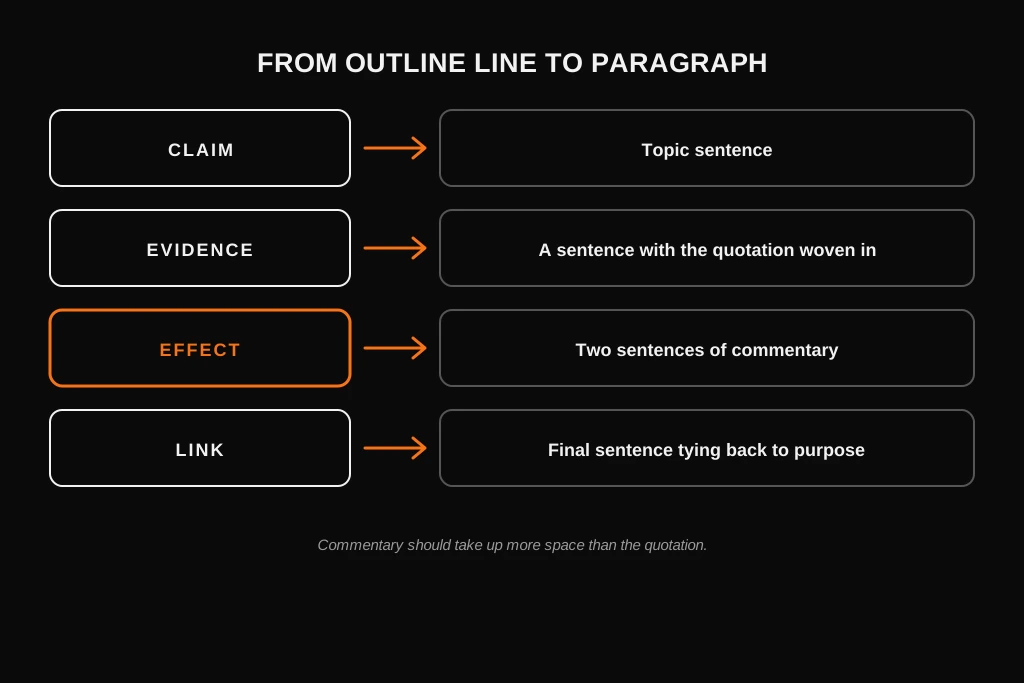
Notice that the paragraph spends far more words on commentary than on quotation. That balance is what turns an outline into analysis rather than summary.
Keep the outline beside you
While you draft, tick off each line as you use it. If you find yourself writing something that is not in the outline, ask whether it supports the claim. If not, cut it or move it.
Where Each Piece Fits in Your Outline
Three elements cause the most questions when students plan. Here is where each one belongs.
Rhetorical Analysis Thesis
Your thesis is the first thing you write in the outline and the last line of the opening paragraph in the essay. It names the writer, the purpose and the main choices, and says how they work on the audience. Draft it before the body notes, because the body paragraphs follow from it. For the ranger letter: “The ranger persuades tired hikers to stay on the trail by presenting herself as a sympathetic insider and by contrasting the minutes they save with the years the meadow loses.” Three points help. Make it a claim someone could dispute. Name the choices you will analyze, in the order you will analyze them. And include the effect. Tip: if your body claims do not match the thesis, rewrite the thesis, not the body.
Ethos Pathos Logos Examples
Credibility, emotion and reason can become body paragraph headings, but only if each is tied to a specific moment in the text. In the ranger letter, ethos appears in “I have walked these hills for fifteen years”, which gives the request authority. Pathos appears in the image of a meadow trying to heal, which makes the damage feel almost personal. Logos appears in “a decade to disappear”, which gives the harm a measurable scale. Three points help. Pair each appeal with a quotation in your outline. Add an effect note beside it. And note how the appeals support each other. Tip: in your outline, write the choice, such as “admits temptation”, rather than only the label ethos.
Rhetorical Analysis Examples
Scored sample essays are the best way to see how strong outlines turn into strong essays. The College Board publishes real student responses with scores and commentary, such as its 2025 rhetorical analysis samples. Three points help. Reverse outline a high scoring sample to see its structure. Compare it with a low scoring one on the same passage. And notice how much of each paragraph is commentary. Tip: copy the shape of the strongest sample’s outline, not its words, and test it on a new passage. Repeat this with two or three samples from different years, so you see more than one way a strong essay can be built.
Reverse Outlining: Check Your Draft
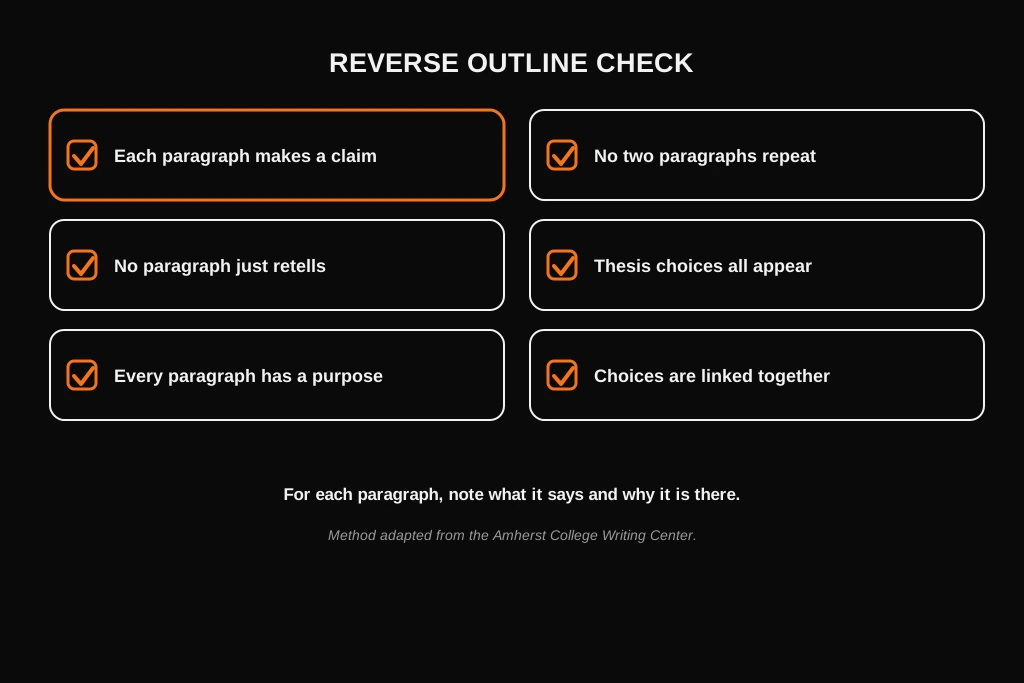
A reverse outline is an outline of what you have already written, made after you draft. Amherst College’s Writing Center describes it as an outline not of what you plan to write, but of what you have already written, and suggests listing what each paragraph says and why it is there.
How to reverse outline a rhetorical analysis
Number each paragraph of your draft. Beside each, write one sentence saying what the paragraph claims and one saying why it is in the essay. Then compare the list with your thesis and your original outline.
What to look for
- A paragraph whose “what” is a retelling of the text: rewrite it as a claim about a choice.
- A paragraph with no clear “why”: cut it or merge it.
- Two paragraphs making the same claim: combine them.
- A choice named in the thesis but missing from the body: add it or remove it from the thesis.
- No sentence on how choices connect: add one to the last body paragraph or the closing paragraph.
Common Outline Mistakes and Fixes
- Outlining the text, not your argument. Write claims about choices, not summaries of sections.
- Listing devices with no effect. Add an effect note beside every quotation.
- Too many body paragraphs. Plan two or three, and explain them fully.
- A vague thesis. Name the purpose, the choices and the effect.
- Long quotations in the outline. Use line numbers or the first few words.
- No link between choices. Add one line on how the choices work together.
- Skipping the outline under time pressure. Four minutes of planning usually saves more than four minutes of writing.
How Essays Helper Can Help You
If you want feedback on your plan before you write, our academic writing support can help without taking over your work:
- Reviewing your outline and thesis.
- Helping you choose the best structure for a passage.
- Practising timed AP Lang skeletons.
- Giving feedback on drafts with reverse outlines.
Send us your passage, your outline and your deadline, and we will point you to the quickest next step.
Frequently Asked Questions
How do you outline a rhetorical analysis essay?
Map the rhetorical situation, write your thesis, then plan two or three body paragraphs with a claim, short quotations, an effect note and a link to the purpose. Add one line for the closing paragraph.
How many body paragraphs should a rhetorical analysis outline have?
Two or three is usual. Each should focus on one choice or one section of the text and leave room for detailed commentary.
Should I organize my outline by ethos, pathos and logos?
You can, but it is the easiest structure to do badly. Organizing by specific choice or by the order of the text usually gives more room for real analysis.
What does an AP Lang rhetorical analysis outline look like?
A short skeleton: one line of SOAPS, a full thesis, two or three claims, quotation shortcuts under each and a one word effect note beside each quotation.
How long should I spend outlining on the AP Lang exam?
About three to five minutes after reading and annotating is enough for most students. It keeps the essay focused without eating into writing time.
Where does the thesis go in a rhetorical analysis outline?
At the top, as part of the opening paragraph plan. Write it in full first, because every body paragraph follows from it.
Do I need full sentences in my outline?
Only for the thesis and the main claim of each paragraph. Evidence and effects can be short notes.
Can I organize a rhetorical analysis in the order of the text?
Yes. It works well when the writer’s approach builds or shifts. Start each paragraph with a claim about a choice, so it does not turn into summary.
How do I turn my outline into an essay?
Turn each claim into a topic sentence, weave the quotations into sentences, expand each effect note into commentary and end each paragraph with the link to the purpose.
What should the closing paragraph of my outline include?
One line on how the choices work together and why that matters for the audience. You do not need to list every device again.
Final Thoughts
A strong rhetorical analysis essay outline is short, focused and built around a claim. Write the thesis first, give each body paragraph one clear claim about a choice, add short quotations and a note on their effect, and finish with a line on how the choices work together. Pick the structure that fits the text, whether that is by choice or in text order. In timed exams, a four minute skeleton is enough. Once you have drafted, reverse outline to check your work. With practice, the outline becomes the fastest part of writing a sharp analysis.