
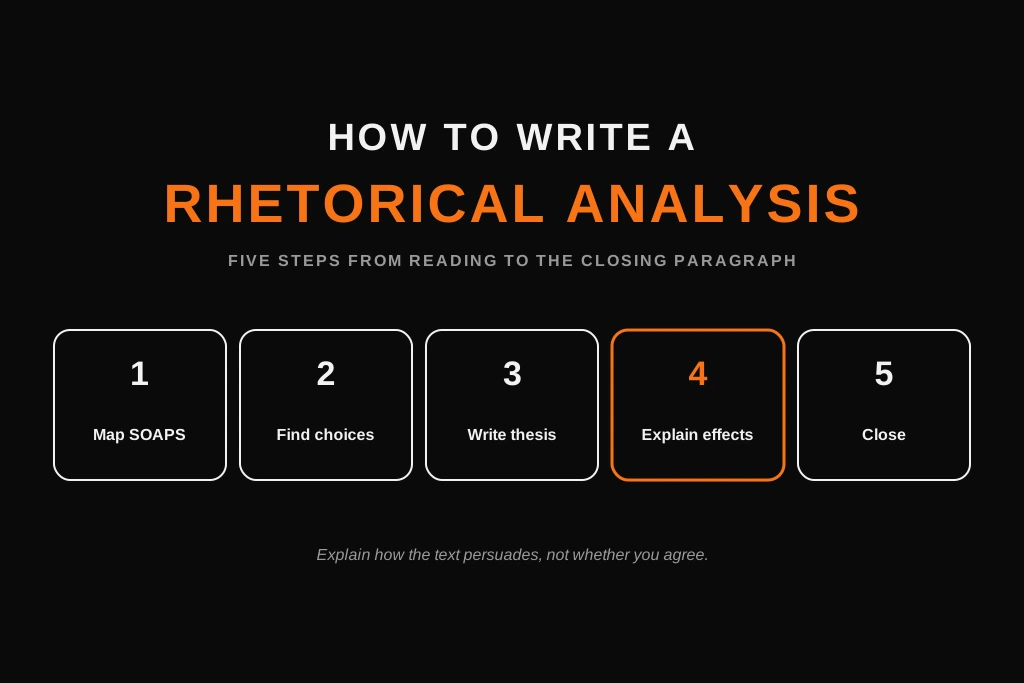
To write a rhetorical analysis essay, read the text and map its rhetorical situation: the speaker, occasion, audience, purpose and subject. Then find the main choices the writer makes, such as appeals, word choice, structure, imagery and tone. Write a thesis that names the writer’s purpose and those choices, and in each body paragraph explain how one choice works on the audience, using evidence and commentary. Close by explaining why those choices matter. A rhetorical analysis explains how a text persuades, not whether you agree with it.
That is the whole method in one paragraph. The rest of this guide from Essays Helper shows you how to do each step well, using one short sample speech all the way through, so you can see a full analysis take shape. You will also find a thesis formula, a choice to effect cheat sheet, an annotated body paragraph, two closing paragraph examples and a full section on the AP Lang version of the task.
Most students struggle with the same things: summarizing the text instead of analyzing it, naming devices without saying what they do, writing “this shows” commentary, and running out of time in timed exams. Each of those is covered below with a fix you can use straight away.
What Is a Rhetorical Analysis Essay?
A rhetorical analysis essay explains how a writer or speaker tries to influence an audience. Texas A&M University’s Writing Center describes it as an essay that breaks a work of nonfiction into parts and explains how those parts work together to create an effect, such as persuading, entertaining or informing. The text can be a speech, an article, a letter, an advertisement or even a cartoon.
The key word is how. You are not deciding whether the writer is right. You are explaining the choices they made and why those choices suit their audience and purpose. Texas A&M puts it plainly: focus on how the writer makes the argument, not on whether you agree with it.
Rhetorical analysis vs summary vs argument essay
Students often drift into one of the other two essay types without noticing. The table shows the difference.
| Feature | Rhetorical analysis | Summary | Argument essay |
|---|---|---|---|
| Main question | How does the writer persuade? | What does the text say? | What do I believe, and why? |
| Your role | Analyst of the writer’s choices | Reporter of content | Arguer of your own position |
| Evidence | Quotations from the text, explained | Paraphrase of main points | Facts, examples and reasoning |
| Opinion on the issue | Not needed | Not included | Central |
| Typical verbs | Emphasizes, evokes, frames, contrasts | States, describes, explains | Argues, proves, shows |
If a sentence in your draft only tells the reader what the writer said, it is summary. If it tells the reader what you think about the issue, it is argument. If it tells the reader what a choice does to the audience, it is analysis.
The sample text used in this guide
Here is a short, invented speech we will analyze throughout. It is given by a town librarian at a council meeting where councillors are considering cutting the library’s evening hours.
“I have stood behind that front desk for twenty years, and I have never seen it busier than it is after six o’clock. Last winter, a twelve year old boy sat on the steps outside, doing his homework under the streetlight, because we had closed early for repairs. Since we added evening hours, visits have risen by nearly a fifth. Those visitors are nurses after a shift, parents after work and students without a quiet place at home. Cutting these hours saves a small sum this year. It costs a great deal more in the years that follow. So I ask you: who will tell that boy the doors are closed again?”
The speech and the figures in it are invented for this guide. We will use it to build a SOAPS map, a thesis, a body paragraph and a closing paragraph.
The Rhetorical Situation: SOAPS
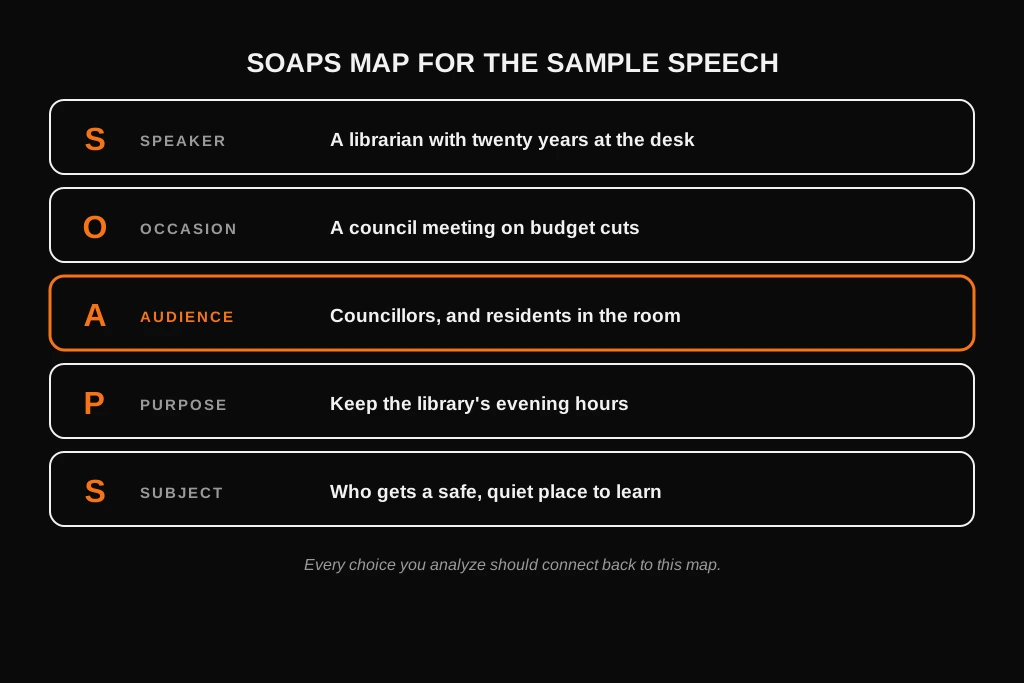
Before you analyze any choice, you need to understand the situation the text was written for. A common way to remember the parts is SOAPS: speaker, occasion, audience, purpose and subject. Every choice you analyze later should connect back to one of these.
Speaker
Who is speaking, and what gives them authority? In the sample, the speaker is a librarian with twenty years at the front desk. That experience is a resource she uses deliberately.
Occasion
What prompted the text, and when and where is it delivered? Here, it is a council meeting at which a budget cut is on the table. The occasion is formal, public and urgent.
Audience
Who is the text aimed at, and what do they care about? The primary audience is the councillors, who care about budgets and their reputation with voters. The secondary audience is the residents in the room. Strong analysis notices when a writer speaks to more than one audience at once.
Purpose
What does the speaker want the audience to think, feel or do? The librarian wants the council to reject the cut to evening hours. Purpose is the anchor of every paragraph you will write.
Subject
What is the text about? On the surface, library opening hours. Underneath, it is about who has access to a safe, quiet place to learn. Naming the deeper subject often leads to the most interesting analysis.
Rhetorical Choices to Look For
Rhetorical choices are the decisions a writer makes to move an audience. The AP Lang rubric uses exactly this phrase, so it is worth using too. Here are the choices you will see most often.
Appeals to credibility, emotion and reason
Texas A&M’s Writing Center describes three appeals: ethical, based on credibility and character; pathetic, based on emotion; and logical, based on reason and evidence. Most texts combine all three. The point is not to label them, but to explain what each one does for this audience.
Diction and tone
Diction is word choice, and tone is the attitude it creates. In the sample, plain words such as “doors are closed” make the speaker sound honest and grounded, not like a lobbyist. Look for words with strong connotations and ask why the writer chose them over neutral alternatives.
Syntax and structure
Syntax is how sentences are built, and structure is how the whole text is ordered. Short sentences can create emphasis. Parallel lists, such as “nurses after a shift, parents after work and students without a quiet place at home”, show breadth. The order matters too: the sample moves from personal experience to a story, to a number, to a final question.
Imagery and anecdote
Concrete images, such as the boy under the streetlight, turn an abstract budget decision into a human scene. Anecdotes are short stories that make an issue feel personal and memorable.
Contrast and rhetorical questions
The sample contrasts “a small sum this year” with “a great deal more in the years that follow”, which reframes the saving as a loss. The closing rhetorical question shifts responsibility onto the audience. Questions like this are rarely meant to be answered. They are meant to be felt.
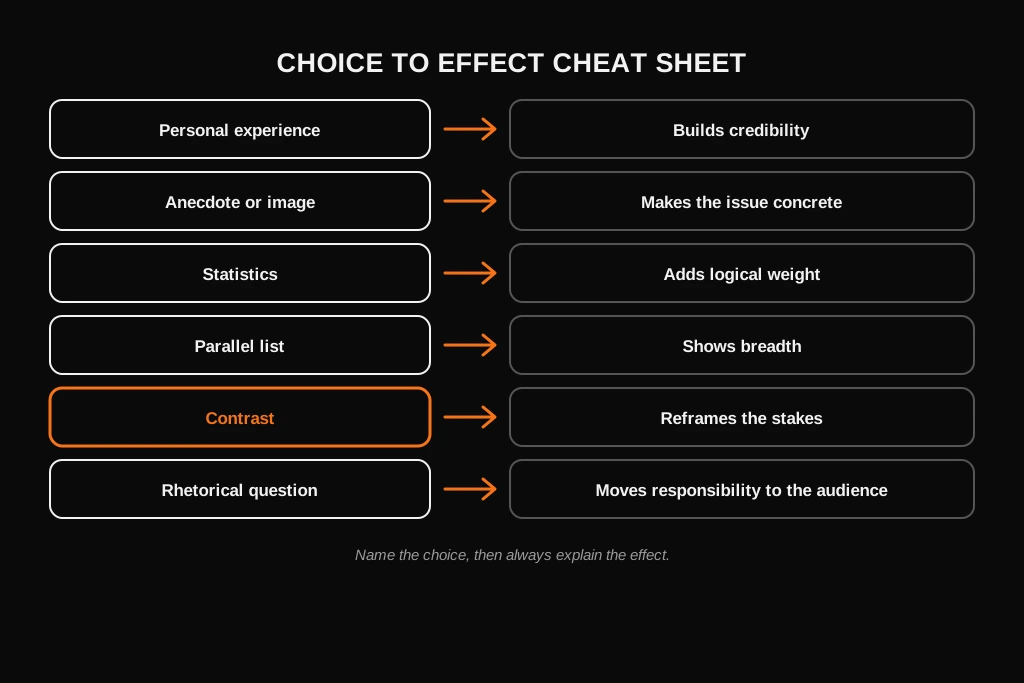
Use this cheat sheet when you get stuck on what a choice does.
| Choice | What it often does | Verbs to use |
|---|---|---|
| Personal experience | Builds credibility and trust | establishes, positions, grounds |
| Anecdote or image | Creates emotion and makes the issue concrete | evokes, humanizes, dramatizes |
| Statistics or facts | Adds logical weight and seriousness | reinforces, quantifies, substantiates |
| Parallel lists | Shows breadth and builds rhythm | accumulates, broadens, emphasizes |
| Contrast | Reframes the issue and sharpens stakes | juxtaposes, reframes, exposes |
| Rhetorical question | Moves responsibility to the audience | challenges, implicates, provokes |
| Shift in tone | Signals a turn in the argument | pivots, escalates, softens |
Ethos Pathos Logos Examples
Ethos, pathos and logos are the three classic appeals: credibility, emotion and reason. In the sample, ethos appears in “I have stood behind that front desk for twenty years”, which tells councillors the speaker knows the library first hand. Pathos appears in the boy doing homework under the streetlight, an image that makes the cut feel unkind. Logos appears in “visits have risen by nearly a fifth”, which gives the argument a measurable basis. Three points help. Name the appeal only if you explain its effect. Connect it to the audience. And show how appeals work together, since the image is more powerful because the number makes it believable. Tip: write “the speaker establishes credibility by” rather than “the speaker uses ethos”, because the first forces you to explain.
How to Write a Rhetorical Analysis Essay, Step by Step
Here is the full process, from first reading to final check.
Step 1: Read the text twice
Read once for meaning, so you know what the writer is saying. Read again for method, so you notice how they are saying it. On the second reading, slow down at the start, the turns and the ending, because writers often place their strongest choices there.
Step 2: Annotate as you read
Underline striking words, images, numbers and questions. In the margin, write a few words on the effect, such as “makes cut feel cruel” or “sounds trustworthy”. Effects are what your essay will be built on, so capture them early.
Step 3: Map the SOAPS
Write one line for each part of the rhetorical situation. Keep it beside you while you write. If you cannot say who the audience is or what the purpose is, read the text again before you go further.
Step 4: Pick two or three key choices
You cannot analyze everything. Texas A&M suggests choosing the techniques you can argue most strongly, focusing on those that are most prevalent or interesting. Two or three well explained choices beat six that are only named.
Step 5: Draft your thesis
Write one or two sentences that name the writer, the purpose and the main choices, and say how they work on the audience. The thesis section below gives a formula.
Step 6: Organize your paragraphs
Decide whether to follow the text in order or group your paragraphs by choice. Both work. The organization section below explains when to use each.
Step 7: Write evidence and commentary
For each paragraph, choose short quotations and explain how each one affects the audience and serves the purpose. Commentary is where the marks are, so it should take up more of the paragraph than the quotations.
Step 8: Revise for analysis
Reread every sentence and ask whether it summarizes, argues or analyzes. Change summary sentences into analysis by adding why and how. Check that every paragraph links back to the purpose.
How to Write a Rhetorical Analysis Thesis
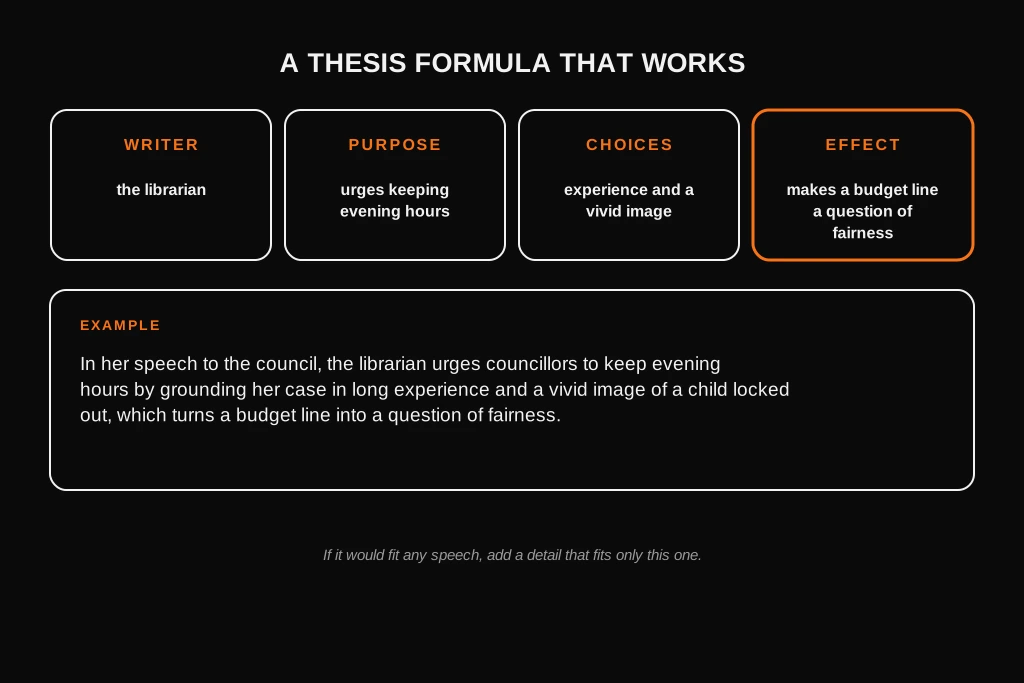
Your thesis is one or two sentences that name the writer, their purpose and the main choices they make, and say how those choices work on the audience. A useful formula is: In [text], [writer] [purpose verb] by [choice one] and [choice two], which [effect on audience]. Applied to the sample: “In her speech to the council, the librarian urges councillors to keep evening hours by grounding her case in long experience and a vivid image of a child locked out, which turns a budget line into a question of fairness.” Three points help. Make a claim someone could dispute. Name choices, not just appeals. And include the effect. Tip: if your thesis would fit any speech, it is too general, so add a detail that belongs only to this one.
How to Organize Your Essay
Most rhetorical analysis essays have a short opening paragraph with the thesis, two or three body paragraphs and a short closing paragraph. The real decision is how to order the body.
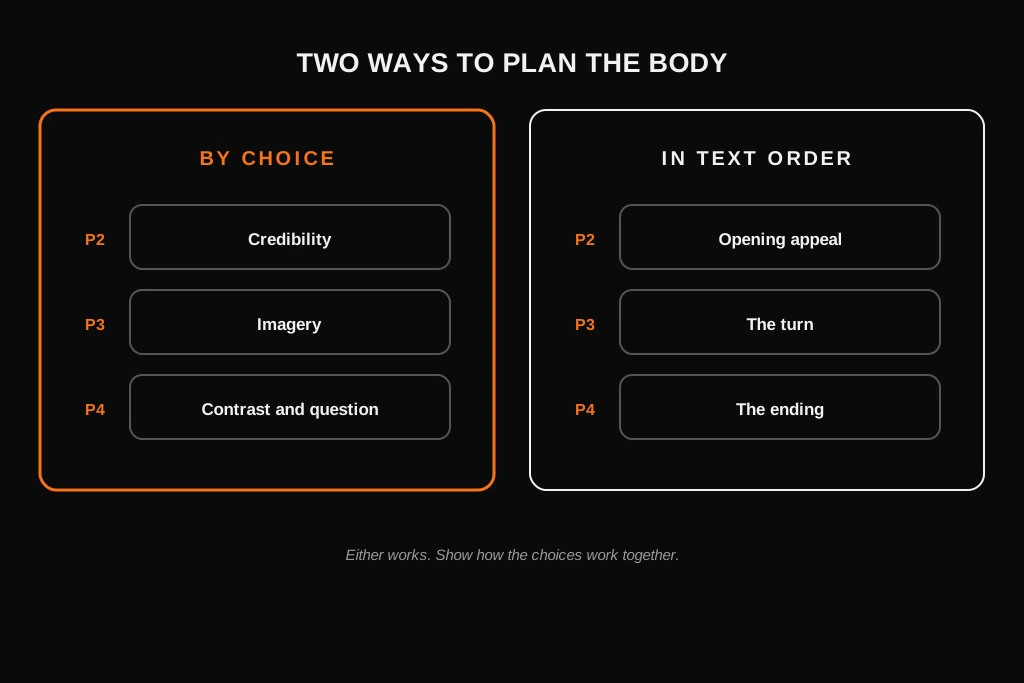
Following the text in order
Chronological organization follows the text from beginning to end, often in sections, such as the opening appeal, the turn and the ending. It works well for texts that build steadily, because you can show how the writer’s choices change as the argument develops. The risk is drifting into summary, so start each paragraph with a claim about a choice, not a description of a section.
Grouping by choice
Organizing by choice gives each paragraph one main strategy, such as credibility, imagery or contrast. Texas A&M notes that paragraphs can be organized by technique, by effectiveness or chronologically. Grouping by choice is clear and easy to plan, but make sure you also show how the choices work together, or the essay can feel like a list.
Starting the opening paragraph
Keep the opening paragraph short. Give the context in a sentence or two, name the writer and occasion, and end with your thesis. In timed essays you can skip a hook entirely. In untimed essays, one sharp opening sentence helps, and our guide to types of hooks gives options that work for analytical essays too.
Rhetorical Analysis Essay Outline
This is the plan of your paragraphs before you write. A simple five paragraph version has an opening paragraph with context and thesis, three body paragraphs on one choice each and a short closing paragraph. A by section version has body paragraphs that follow the text’s opening, middle and ending. Three points help. Write the claim for each paragraph first. Add two short quotations under each claim. And note the effect you will explain beside each quotation. Tip: in a timed exam, spend three or four minutes on a skeleton like this, because it saves far more time later and keeps every paragraph focused.
Writing Body Paragraphs That Earn Marks
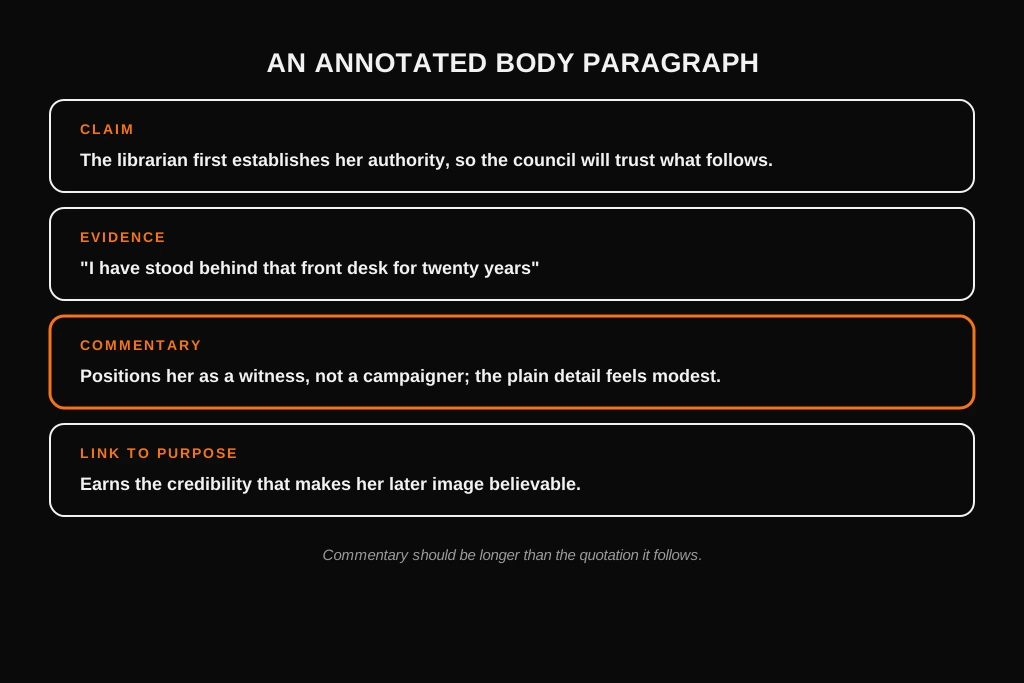
Body paragraphs carry most of your marks. A reliable pattern has four parts: a claim about one choice, a short quotation as evidence, commentary on its effect on the audience, and a link back to the writer’s purpose.
An annotated body paragraph
The librarian first establishes her authority, so that the council will trust what follows. Opening with “I have stood behind that front desk for twenty years” positions her not as a campaigner but as a witness, someone who has seen the library’s evenings first hand. The plain, physical detail of the “front desk” makes the claim feel concrete and modest rather than boastful. This matters because councillors weighing a budget are wary of emotional pleas; by presenting herself as a reliable observer, she earns the credibility that makes her later image of the boy under the streetlight believable rather than manipulative.
What each part does: the first sentence is the claim about a choice and its purpose. The second gives evidence and begins the commentary. The third zooms in on a specific word. The fourth links the choice to the audience and to the rest of the speech, which is what turns a good paragraph into a strong one.
Weak vs strong commentary
Weak commentary: “The librarian uses pathos when she talks about the boy. This shows that she wants the council to feel sad.” It names an appeal and states an obvious feeling.
Strong commentary: “The image of a child working under a streetlight makes the cut visible. Councillors are no longer voting on hours in a spreadsheet but on whether a particular child is left outside, which makes the saving harder to defend in public.” It explains how the choice works on this audience and why it matters for the purpose.
Strong analysis verbs
Swap “shows” and “uses” for verbs that describe an effect: emphasizes, evokes, frames, reframes, juxtaposes, undercuts, reinforces, heightens, humanizes, implicates, positions and invites. A strong verb pushes you to explain what is happening, which is exactly what graders reward.
How much to quote
Use short quotations, often just a phrase, and build them into your own sentences. Long quotations take time and leave less room for commentary. A good rule of thumb is that your explanation should be longer than the quotation it follows.
How to Write a Conclusion for a Rhetorical Analysis
The closing paragraph of a rhetorical analysis does not need to repeat everything. It should restate your thesis in fresh words, show how the choices work together, and say why they matter for this audience or beyond. Texas A&M suggests restating your main argument briefly and then explaining why it matters. In a timed exam, two or three strong sentences are enough.
Closing paragraph example 1: short and timed
By speaking first as a witness and only then as an advocate, the librarian makes her emotional appeal hard to dismiss. Her experience, her image of the boy and her final question work together to turn a line in the budget into a test of the council’s fairness.
Closing paragraph example 2: untimed, with wider significance
The librarian’s speech succeeds because it never asks the council to choose between money and feeling. Instead, it shows that the cheaper choice carries hidden costs, and it makes those costs visible in a single child. Her strategy reminds us that persuasive public speech often works best not by adding more evidence, but by changing what the audience believes the decision is really about.
Both examples avoid simply listing the devices again. They explain how the choices combine and why that matters, which is what makes a closing paragraph feel earned.
How to Write a Rhetorical Analysis Essay for AP Lang
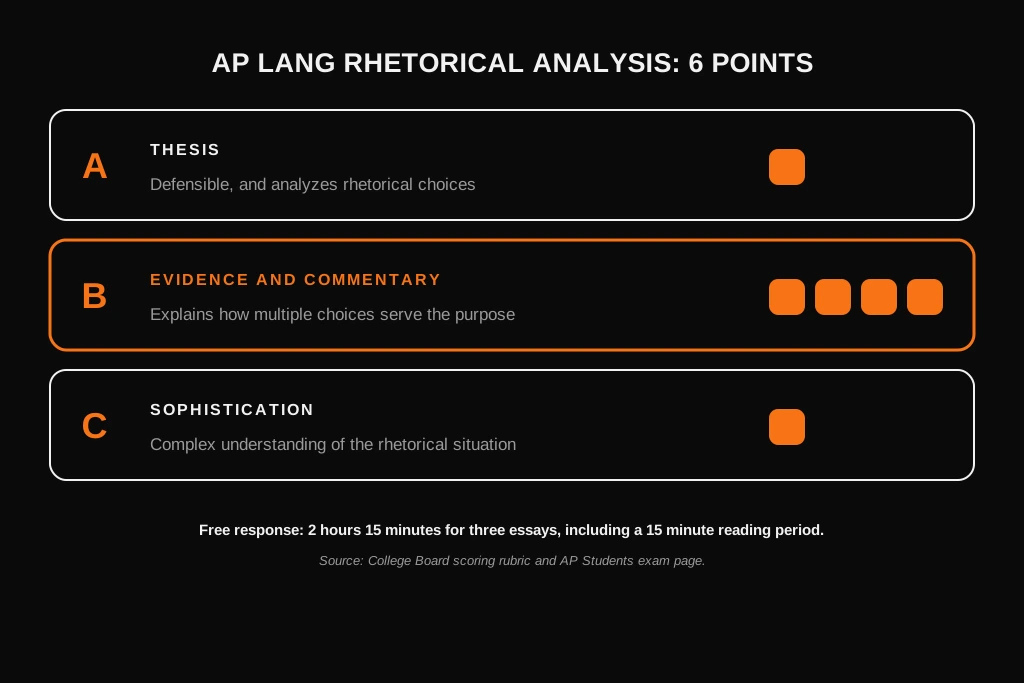
On the AP English Language and Composition exam, the rhetorical analysis is the second of three free response questions. According to the College Board’s AP Lang exam overview, the free response section has three questions, is worth 55 percent of the score and has a time limit of 2 hours and 15 minutes, which includes a 15 minute reading period. The exam is fully digital and taken in the Bluebook app. In the rhetorical analysis question, you read a nonfiction text and analyze how the writer’s language choices support the text’s intended meaning and purpose.
How the rhetorical analysis is scored
The College Board’s scoring rubric gives the rhetorical analysis six points across three rows.
| Row | Points | What earns the points |
|---|---|---|
| A: Thesis | 0 to 1 | A defensible thesis that analyzes the writer’s rhetorical choices, not one that only restates the prompt or describes the passage |
| B: Evidence and commentary | 0 to 4 | At 4 points: specific evidence for all claims, commentary that consistently explains how the evidence supports a line of reasoning, and explains how multiple rhetorical choices contribute to the writer’s purpose |
| C: Sophistication | 0 to 1 | Sophistication of thought or a complex understanding of the rhetorical situation, shown as part of the argument |
Notice where the marks sit. Four of the six points are for evidence and commentary, which is why explaining effects matters far more than naming devices. The rubric also notes that grammar or mechanics errors that interfere with communication cannot earn the fourth point in that row.
A timed plan for the exam
The free response section gives you two hours of writing time after the reading period for three essays, so about 40 minutes per essay if you split it evenly. A workable plan for the rhetorical analysis is about 8 to 10 minutes reading and annotating, 3 to 5 minutes for SOAPS, thesis and a skeleton, about 25 minutes writing and a few minutes checking. Use the reading period to annotate the rhetorical analysis passage as well as the synthesis sources if you can.
What a thesis needs on AP Lang
The rubric is specific: the thesis must be defensible and must analyze the writer’s rhetorical choices. It does not earn the point if it only restates the prompt, fails to address rhetorical choices or simply describes the passage. Your thesis can sit anywhere in the essay, but putting it at the end of the opening paragraph makes it easy for readers to find.
How to Write a Good Rhetorical Analysis Essay: What Graders Reward
Whether you are writing for AP Lang or a college class, graders tend to reward the same things: a clear line of reasoning, specific evidence, commentary that explains effects and an understanding of the situation the text was written in.
A line of reasoning
Your paragraphs should build an argument about the text, not just list observations. Each paragraph should move the reader closer to your thesis, and the order should make sense. If you can swap your paragraphs around without losing anything, your line of reasoning may be weak.
Showing sophistication
The College Board rubric lists three ways to earn the sophistication point: explaining the significance or relevance of the writer’s choices given the rhetorical situation, explaining a purpose or function of the passage’s complexities or tensions, and employing a style that is consistently vivid and persuasive. It also says the point is not earned for only examining individual choices without their relationships, oversimplifying, sweeping generalizations or complex language that does not help the analysis.
In practice, the most reliable route is the first one. Explain why the writer’s choices are especially fitting for this audience at this moment. In the sample, that might mean noting that a librarian speaking to councillors who fear looking cruel to voters chooses an image that would be hard to defend against in public.
Connecting choices across the text
Strong essays show how choices work together. The librarian’s credibility makes her image believable, and the image makes her number feel human. Pointing out relationships like these is one of the clearest ways to move from a list of devices to real analysis.
Common Mistakes and How to Fix Them
- Summarizing instead of analyzing. Start each paragraph with a claim about a choice, and follow every quotation with an explanation of its effect.
- Listing devices without effect. For every device you name, add what it does to this audience and why it serves the purpose.
- “This shows” commentary. Replace “shows” with a precise verb such as reframes, evokes or implicates, then explain how.
- Ignoring the audience. Name the audience in your thesis and mention it in every paragraph.
- Judging the argument. Do not say whether the writer is right. Explain how they try to persuade.
- Too many choices. Choose two or three and explain them fully.
- Long quotations. Quote phrases, not paragraphs, and build them into your own sentences.
- No link to purpose. End each paragraph by connecting the choice back to what the writer wants.
Rhetorical Analysis Examples
Model essays and paragraphs show how a skilled writer analyzes a text, and the most useful ones are scored samples. The College Board publishes real student responses with scores and commentary, such as its 2025 rhetorical analysis samples. Three points help when you read them. Compare a high scoring and a low scoring response to the same passage. Look at how much of each paragraph is commentary. And note how top responses connect choices to the rhetorical situation. Tip: highlight every sentence that explains an effect in a strong sample, then try to match that proportion in your own draft.
Practice Plan
Rhetorical analysis improves quickly with focused practice. You do not need to write a full essay every day.
A seven day practice plan
- Day 1: read one past prompt and passage, and write only the SOAPS map.
- Day 2: annotate the same passage for choices and effects.
- Day 3: write three possible theses and pick the strongest.
- Day 4: write one body paragraph with the claim, evidence, commentary and link pattern.
- Day 5: read a scored sample and compare its commentary with yours.
- Day 6: write a full essay in 40 minutes.
- Day 7: score it with the checklist below and rewrite the weakest paragraph.
How to self score
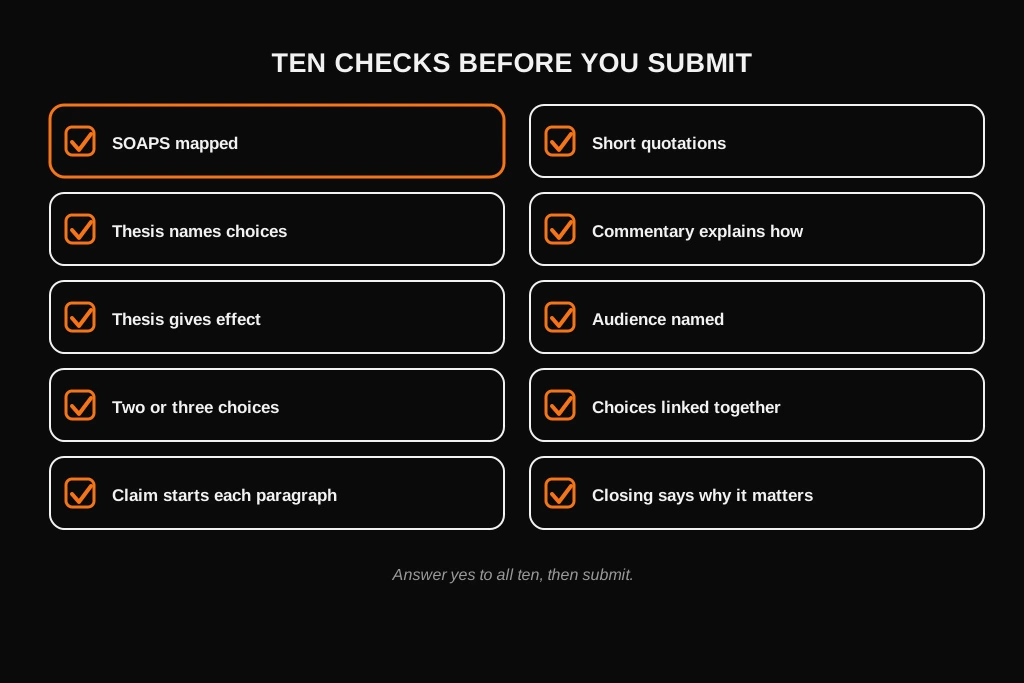
Use the AP rubric as a mirror even if you are not taking the exam. Does your thesis analyze choices, not just restate the topic? Does every claim have specific evidence? Does your commentary explain how each choice serves the purpose? Do you show how choices relate? If you can answer yes to all four, your essay is in strong shape.
How Essays Helper Can Help You
Rhetorical analysis takes practice, and feedback speeds it up. If you want a second pair of eyes, our academic writing support can help you without taking over your work:
- Reviewing your SOAPS map and thesis before you write.
- Giving feedback on whether your commentary analyzes or summarizes.
- Helping you plan timed essays for AP Lang.
- Editing drafts for clarity, line of reasoning and strong verbs.
If you have a passage and a deadline, send them over and we will point you to the quickest next step.
Frequently Asked Questions
How do you write a rhetorical analysis essay?
Map the rhetorical situation, pick two or three key choices, write a thesis naming the purpose and those choices, then explain in each body paragraph how one choice affects the audience. Close by showing why the choices matter.
What should the thesis of a rhetorical analysis include?
It should name the writer, their purpose and the main choices they make, and say how those choices work on the audience. It should make a claim someone could dispute, not just describe the text.
How many body paragraphs should a rhetorical analysis have?
Two or three is usual. Each should focus on one choice or one section of the text and explain it in depth rather than listing many devices.
Do I organize my rhetorical analysis by appeals or in order?
Either works. Following the text in order suits texts that build steadily, while grouping by choice is clearer to plan. Whichever you choose, show how the choices work together.
How do I write commentary instead of summary?
After each quotation, explain what the choice does to the audience and why it serves the writer’s purpose. Use verbs such as evokes, reframes or implicates instead of shows.
How long should a rhetorical analysis essay be?
It depends on the assignment. A timed AP essay is often four or five paragraphs, while college assignments usually set a word or page count. Depth of commentary matters more than length.
How is a rhetorical analysis scored on AP Lang?
It is scored out of six: one point for the thesis, up to four for evidence and commentary, and one for sophistication, according to the College Board rubric.
How do I get the sophistication point in AP Lang rhetorical analysis?
The most reliable way is to explain why the writer’s choices are especially fitting for the audience and moment. Showing how choices relate to each other, or the tensions in the passage, also helps.
What should go in a rhetorical analysis conclusion?
Restate your thesis in fresh words, show how the choices work together and say why they matter. Avoid repeating every device or adding new evidence.
Can I use first person in a rhetorical analysis essay?
It depends on your teacher or instructor. Many prefer third person, such as “the speaker emphasizes”, because it keeps the focus on the text, so check your assignment guidelines.
Final Thoughts
Learning how to write a rhetorical analysis essay is really about one shift: from what a text says to how it works. Map the speaker, occasion, audience, purpose and subject. Choose two or three choices that matter most. Write a thesis that names them and their effect, then spend most of every paragraph explaining how each choice moves the audience. Close by showing how the choices work together. Practice with real prompts, compare your work with scored samples, and your analysis will grow sharper with every essay you write.