
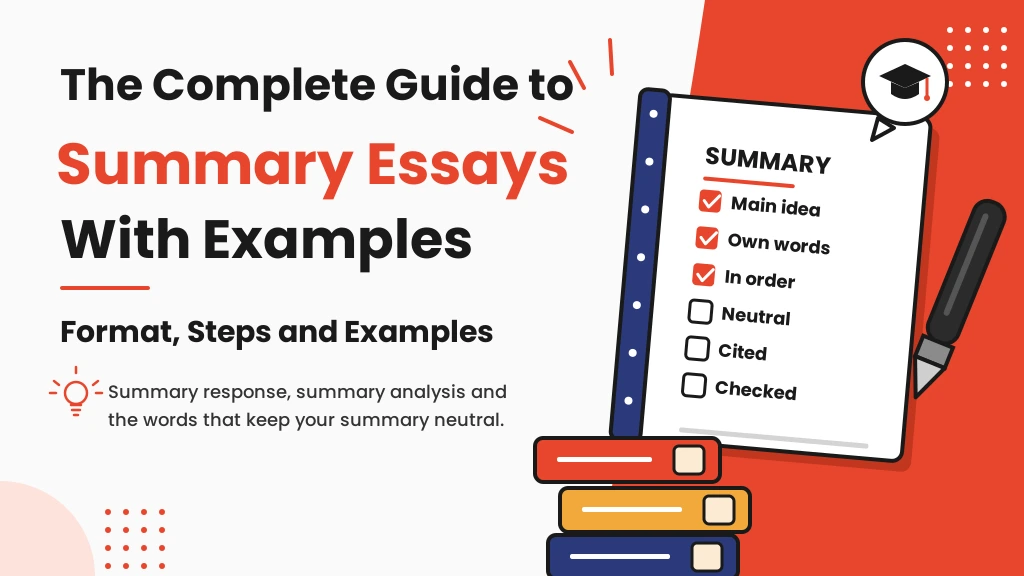
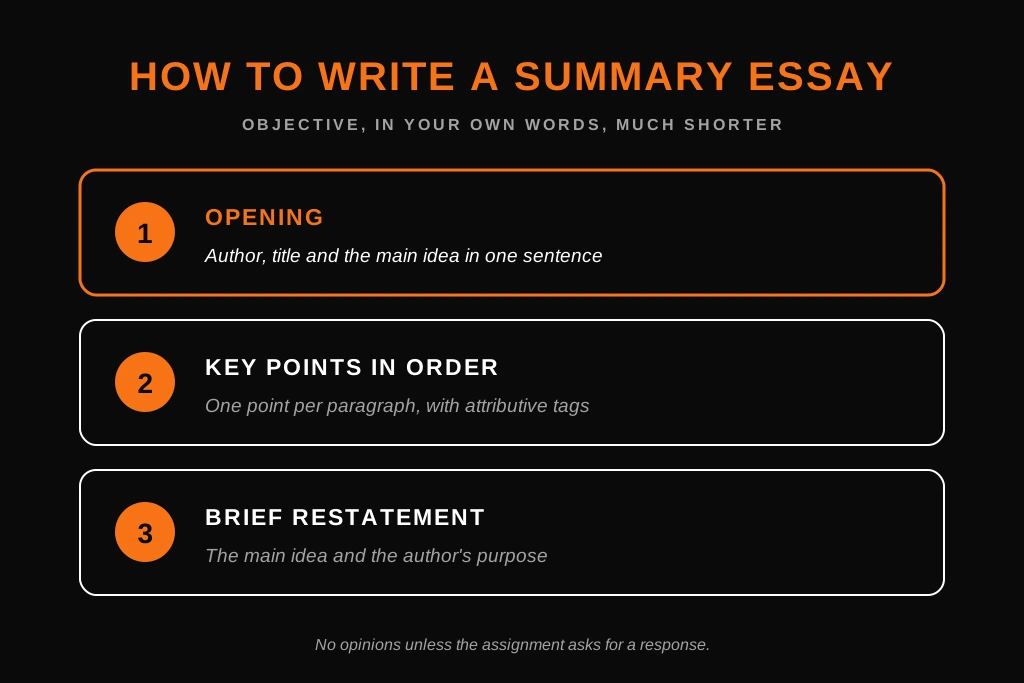
A summary essay restates the main ideas of a text in your own words, objectively and in a much shorter form. To write a summary essay, open with one sentence naming the author, the title and the text’s main idea, then cover the key supporting points in body paragraphs in the order the author presents them, and close with a brief restatement of the main idea. Leave out your own opinion unless the assignment asks for a response.
That is the short answer. This guide shows you how to write a summary essay step by step, the correct format, a full annotated summary essay example, how to write summary response and summary analysis essays, useful summary words and fixes for the problems students run into most.
What Is a Summary Essay?
A summary essay is a short piece of writing that condenses another text, such as an article, essay, speech or book chapter, into its main ideas. Purdue OWL explains that “summarizing involves putting the main idea(s) into your own words, including only the main point(s).” A summary essay applies that skill to a whole text, organized into clear paragraphs.
At Essays Helper, we see summary essays assigned more often than students expect, especially in first year writing, social science and English courses. They test whether you truly understand what you read, which is why teachers use them before asking for analysis or argument.
What a summary essay does and does not do
A summary essay identifies the author’s main idea, explains the key points that support it and presents them fairly and in order. It does not evaluate the text, agree or disagree with it, add new examples or include your personal reactions. Think of yourself as a reporter describing someone else’s argument as accurately as possible, not as a critic judging it.
Summary vs analysis vs response
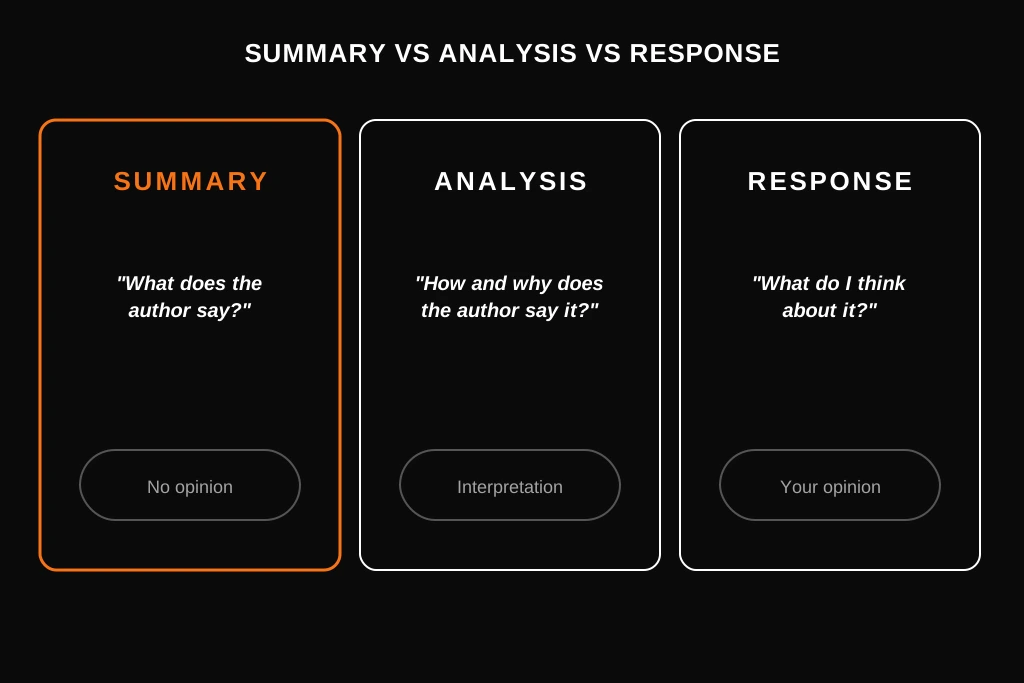
These three tasks are often confused. A summary explains what the author says. An analysis explains how the author says it and why those choices work. A response explains what you think about it. Many assignments combine them, so read your prompt carefully to see which one, or which mix, you are being asked to write.
| Type | Question it answers | Includes your opinion? |
|---|---|---|
| Summary | What does the author say? | No |
| Analysis | How and why does the author say it? | Interpretation, not personal opinion |
| Response | What do I think about it? | Yes |
| Summary response | What does the author say, and what do I think? | Yes, in the response section only |
How long a summary essay should be
A common rule of thumb is that a summary should be about a quarter to a third of the original’s length, though your instructor’s word count always comes first. A summary of a five page article might be one to two pages, while a summary of a long book chapter might still be only a page. The goal is to include every main idea while leaving out examples, repetition and minor details.
Summary Essay Format
Most summary essays follow a simple three part format: an opening paragraph that names the source and states its main idea, body paragraphs that cover the key points in order, and a short final paragraph that restates the main idea. The table shows what goes in each part.
| Part | What goes in it | Example sentence |
|---|---|---|
| Opening paragraph | Author, title, type of text and the main idea in one or two sentences | In his essay “Self-Reliance,” Ralph Waldo Emerson argues that people should trust their own judgment rather than conform to society. |
| Body paragraphs | One key point per paragraph, in the author’s order, with attributive tags | Emerson next explains that conformity makes people hide their true thoughts to please others. |
| Final paragraph | A brief restatement of the main idea and the author’s overall purpose | Overall, Emerson urges readers to value their own inner voice above public opinion. |
Summary essay format for an article
For a short article, one opening paragraph and one to three body paragraphs are usually enough. Group the article’s points into two or three main sections, give each its own paragraph and keep the final paragraph to two or three sentences.
Summary essay format for a book or chapter
Longer texts need more selection. Focus on the main argument or storyline and the most important turning points or sections, not every event or example. Some instructors prefer one body paragraph per chapter or section, which keeps the summary organized and easy to follow.
MLA and APA basics for a summary essay
In MLA, include the author’s full name and the title in your opening sentence, then use the last name afterward. Add page numbers in parentheses when you quote or paraphrase a specific part. In APA, include the year of publication and use past or present perfect tense when reporting what the author found. If you are summarizing a scientific study rather than an essay, our guide to the research paper summary explains the structure scientists and instructors expect.
Summary essay format for a speech, lecture or video
Speeches, lectures and documentaries follow the same format, with a few adjustments. Name the speaker or director, the title, the date and the occasion in your opening sentence, because context matters more for spoken texts. Then summarize the main points in the order they are presented. Since you cannot cite page numbers, some styles use timestamps for videos or paragraph numbers for published speech transcripts. Avoid describing visuals, music or delivery unless your assignment asks for analysis, because a summary focuses on what is said, not how it is presented.
How to Write a Summary Essay Step by Step
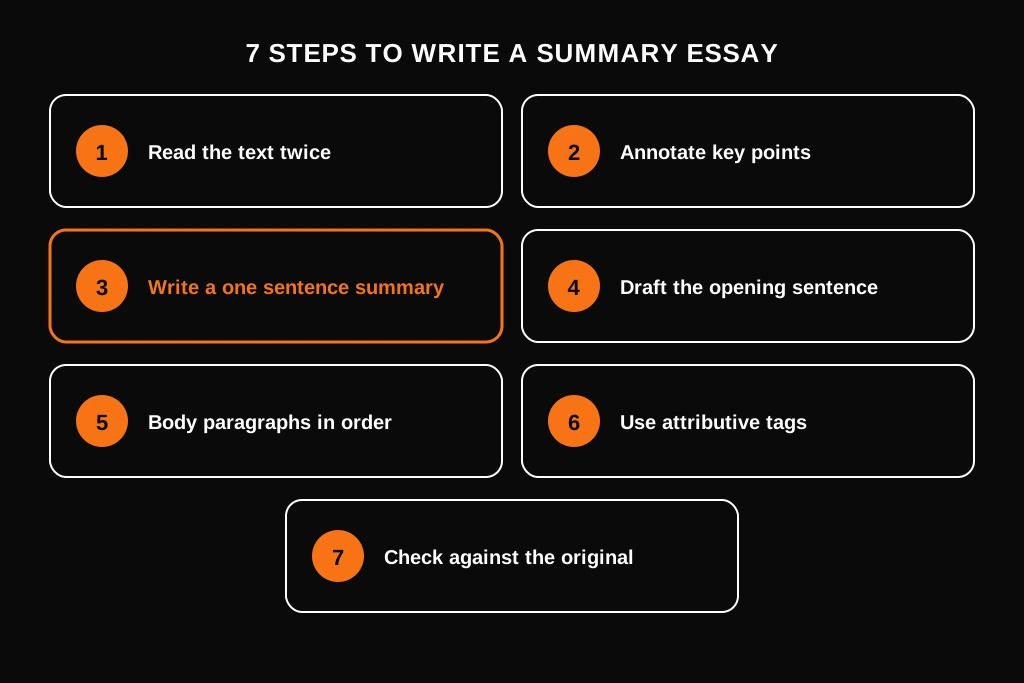
To write a summary essay, read the text twice, mark the main idea and key points, write a one sentence summary, draft an opening sentence, write body paragraphs in the author’s order, use attributive tags throughout and check your draft against the original.
Step 1: Read the text twice
Read once quickly to understand the overall point, then read again slowly with a pen. Many students skip the second reading, which is why their summaries miss the author’s actual argument. If the text is long or difficult, read it in sections and pause after each one to say its point out loud.
Step 2: Annotate the main idea and key points
Underline the thesis or main claim, then number each major supporting point in the margin. Look for topic sentences, headings and repeated ideas, which usually signal what the author thinks matters most. Write a few words in the margin beside each section saying what it does, such as “gives example” or “answers objection.” These notes make it much easier to separate main points from supporting details later.
Step 3: Write a one sentence summary
Before drafting, try to capture the whole text in one sentence. If you cannot, you probably need to reread. This sentence becomes the core of your opening paragraph.
Step 4: Draft the opening sentence
Name the author, the title, the type of text and the main idea. For example: “In A Vindication of the Rights of Woman, Mary Wollstonecraft argues that women deserve the same education as men because reason, not gender, should guide society.”
Step 5: Write body paragraphs in the author’s order
Give each key point its own paragraph or group of sentences, following the order of the original. Start each paragraph with a sentence that names the point, then explain it briefly in your own words. Keep the proportions of the original in mind. If the author spends half the text on one idea, that idea deserves more space in your summary than a point mentioned only once.
Step 6: Use attributive tags
Remind the reader that these are the author’s ideas, not yours, with phrases like “Emerson argues,” “the author explains” or “according to Douglass.” Use them every few sentences, especially when you move to a new point.
Step 7: Check against the original
Compare your summary with the text. Make sure you have included every main idea, kept the author’s meaning, added no opinions and used no copied phrases without quotation marks.
How to start a summary essay
The best way to start a summary essay is with a single, clear sentence that names the author, title and main idea, sometimes followed by one sentence of context about when or why the text was written. Avoid opening with your own opinion or a dramatic statement. That first sentence works like a topic sentence for the whole summary, so if you want help phrasing it, see our guide on how to write a topic sentence.
How to write a summary for an essay assignment
Sometimes you need a short summary inside a larger essay rather than a full summary essay. In that case, keep it to two to four sentences, name the author and title, state the main idea and include only the points that matter for your argument. Then move straight into your own analysis. A short summary like this is common in research papers, literature reviews and argumentative essays, where you need to explain a source before you build on it or challenge it.
From notes to a first draft: a quick walkthrough
Imagine you are summarizing Frederick Douglass’s 1852 speech “What to the Slave Is the Fourth of July?” Your annotations might show four main sections: praise for the founders, a turn to the present, the charge that celebrating liberty while allowing slavery is hypocrisy and a closing note of hope. Your one sentence summary could read: “Douglass argues that Independence Day celebrations are hypocritical while slavery continues, though he ends with hope for change.” From there, your opening sentence names Douglass, the speech, the date and that main idea. Each body paragraph then covers one section in order, using tags like “Douglass first acknowledges” and “he then argues.” Finally, your last paragraph restates the main idea and his purpose. Working from notes this way keeps your summary organized and stops you from copying the speech’s language. It also makes revision easier, because you can check each paragraph against one section of your notes and see immediately if anything important is missing.
Summary Essay Example
Here is a short, annotated summary essay example based on Ralph Waldo Emerson’s “Self-Reliance,” a public domain essay first published in 1841. Each paragraph is labeled to show what it does. Emerson’s original essay is long and full of examples, so the summary below keeps only his main claims and drops almost all of his illustrations. Read it once for the content and once more to notice the structure, the attributive tags and how each paragraph covers one stage of his argument.
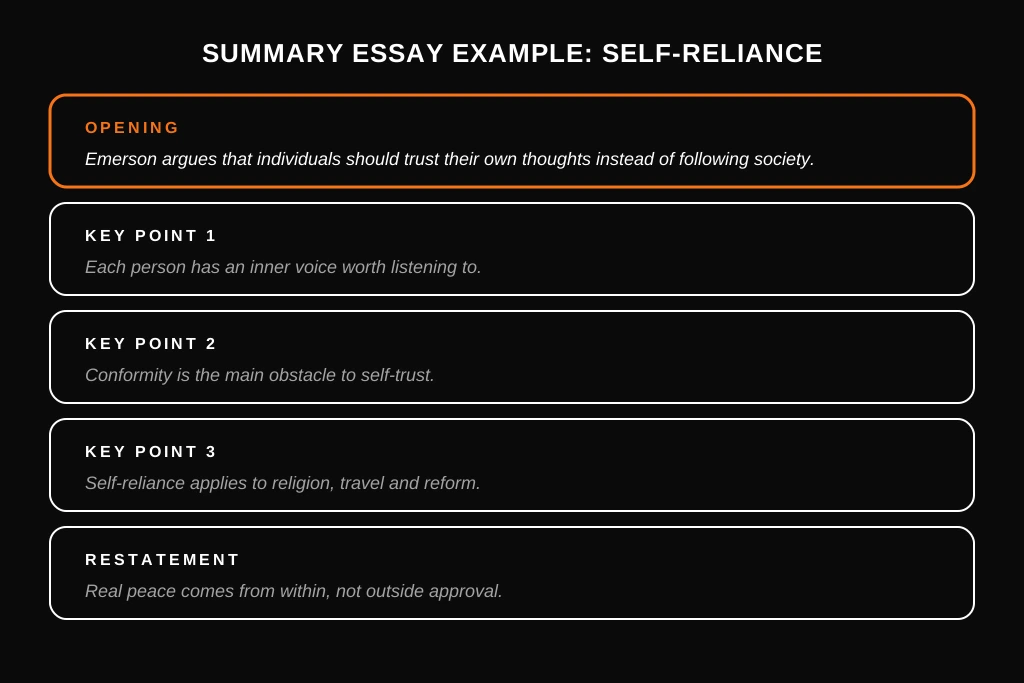
Opening paragraph: In his 1841 essay “Self-Reliance,” Ralph Waldo Emerson argues that individuals should trust their own thoughts and instincts instead of following society’s expectations. He presents self-trust as the source of genius, integrity and personal freedom.
Body paragraph 1: Emerson begins by claiming that each person has an inner voice worth listening to. He explains that people often dismiss their own ideas, only to hear them later from someone else, and he encourages readers to value their thoughts while they are still their own.
Body paragraph 2: Next, Emerson describes conformity as the main obstacle to self-trust. According to Emerson, society rewards people who imitate others and punishes those who think independently, which leads many to hide their true opinions. He also warns against rigid consistency, famously calling “a foolish consistency” the “hobgoblin of little minds,” and argues that people should be willing to change their views.
Body paragraph 3: Emerson then applies self-reliance to wider areas of life, including religion, travel and social reform. He suggests that relying on outside authorities or traditions weakens individuals, while confidence in one’s own judgment makes them stronger and more original.
Final paragraph: Overall, Emerson urges readers to value their inner voice above public opinion. He ends by insisting that real peace comes from within, not from outside approval or circumstances.
Notice that every paragraph opens with a clear point, uses attributive tags like “Emerson argues” and “according to Emerson,” and avoids any personal opinion. The opening sentence works much like the models in our list of topic sentence examples, because it states one clear main idea that the rest of the summary develops.
What makes this example work
The example keeps the author’s order, uses only one very short quotation, stays neutral throughout and covers every main idea without retelling every example Emerson gives. It is roughly 220 words, a small fraction of the original essay, which is exactly what a summary should be.
Summary essay topics you might be assigned
Instructors usually choose texts that have a clear argument and a manageable length. Common choices include opinion essays and newspaper editorials, chapters from course textbooks, famous speeches, journal articles in your field and classic essays such as Emerson’s “Self-Reliance” or Thoreau’s “Civil Disobedience.” If you get to choose, pick a text with a clear thesis and well organized sections. Texts that wander or rely heavily on images and data are harder to summarize well. Whatever you choose, make sure you can identify the main idea in one sentence before you commit, because that sentence is the foundation of the whole essay.
Summary Response Essay
A summary response essay has two parts: an objective summary of a text, followed by your own response to it. The summary shows that you understand the author, and the response shows what you think and why.
What a summary and response essay asks you to do
In the summary section, you follow all the rules of a summary essay: neutral language, the author’s order and no opinions. In the response section, you switch to your own voice. You might agree, disagree, agree in part or explain how the text connects to your experience or to other readings. The key is to keep the two sections clearly separate so your reader knows when you are reporting and when you are arguing.
Structure of a summary response essay
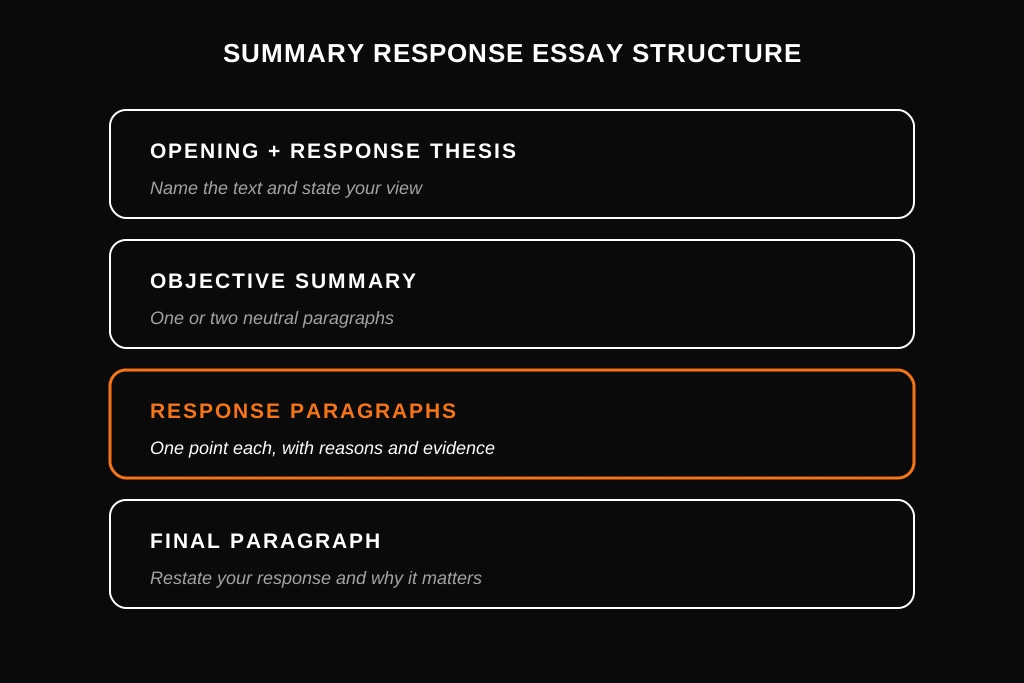
Most summary response essays follow this pattern:
- An opening paragraph that names the text and author and states your response thesis.
- One or two paragraphs that summarize the text objectively.
- Two or three response paragraphs, each making one point about the text with reasons and evidence.
- A final paragraph that restates your response and its significance.
How to write the response part
Your response should make a clear claim, not just share feelings. Instead of “I liked this essay,” try “Emerson’s call for self-trust is persuasive for individuals but overlooks how communities depend on cooperation.” Support that claim with reasons, examples from the text and, where appropriate, outside evidence. A response that weighs the text’s strengths and weaknesses is close to a critical essay, so the same evaluation skills apply.
Summary response essay example
Here is a short example of a response section that follows the Emerson summary above:
Response thesis: Emerson’s argument for self-reliance offers a valuable challenge to blind conformity, but it underestimates how much individuals depend on others to grow.
Response paragraph 1: Emerson is right that people often silence their own ideas to fit in. Students, for example, may avoid sharing an original reading of a text because it differs from the class discussion. His essay reminds readers that independent thinking is a strength, not a risk.
Response paragraph 2: However, Emerson’s dismissal of outside influence goes too far. Most original ideas grow out of conversations, teachers and earlier books. Self-trust works best when it is combined with openness to learning from others.
Final paragraph: Emerson’s essay remains a powerful call to think for oneself, but its message is strongest when balanced with a recognition that independence and community can support each other.
How to keep the summary and response separate
The most common mistake in summary response essays is letting opinions slip into the summary section. Write the summary first, in neutral language, before you plan your response. Then mark the shift clearly with a transition paragraph or a sentence such as “While Emerson makes a strong case for independence, his argument has important limits.” Some instructors also accept headings for each section. Whatever method you use, your reader should never wonder whether a sentence reports the author’s view or yours.
Summary and Analysis Essay
A summary and analysis essay first summarizes a text and then explains how the author builds the argument, focusing on techniques, structure and evidence rather than personal opinion. It is common in English, rhetoric and first year writing courses.
How analysis differs from response
A response asks what you think about the author’s ideas. An analysis asks how the author makes those ideas persuasive or meaningful. In an analysis section, you might examine word choice, repetition, tone, examples or structure, and explain their effect on readers. Your opinion of the ideas matters less than your explanation of how the writing works.
Analytical summary essay example
Summary sentence: In “Self-Reliance,” Emerson argues that individuals should trust their own judgment rather than conform to social expectations.
Analysis paragraph: Emerson persuades readers mainly through short, forceful statements that sound like rules, such as his line about “a foolish consistency.” These memorable phrases make his ideas easy to repeat and give the essay the authority of a set of principles. By writing in confident declarations rather than cautious arguments, Emerson models the very self-trust he recommends.
Each analysis paragraph in a full essay would follow the same pattern of claim, evidence and explanation. If you want to strengthen those paragraphs, our guide on how to write a body paragraph breaks the structure down step by step.
Summary Words and Phrases for an Essay
Summary words, often called attributive verbs or signal phrases, show that you are reporting someone else’s ideas. Choosing the right verb also shows how strongly the author makes a point.
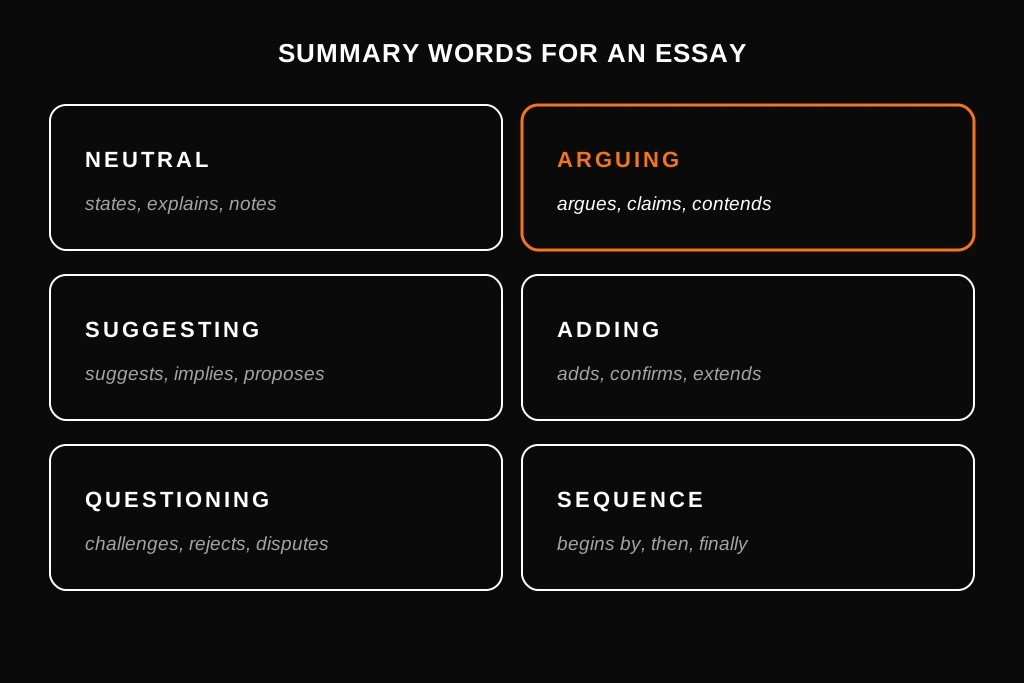
- Neutral reporting: states, explains, describes, notes, observes, reports
- Making an argument: argues, claims, contends, maintains, insists
- Suggesting or implying: suggests, implies, proposes, hints
- Agreeing or adding: adds, agrees, confirms, extends
- Disagreeing or questioning: challenges, questions, rejects, disputes
- Sequence: begins by, then, next, later, finally, concludes by
Vary these verbs so your summary does not repeat “says” in every sentence, but choose carefully. “Emerson suggests” and “Emerson insists” give readers very different impressions of how strongly he holds a view. A good habit is to match the verb to the author’s tone. If the author writes cautiously, use verbs like “suggests” or “proposes.” If the author writes forcefully, “argues” or “insists” is more accurate. This small choice makes your summary more faithful to the original.
Summaries in Academic Writing
Summarizing is a core academic skill that connects to paraphrasing, citing, signposting and building your own arguments. These related skills help you use summaries well in any kind of assignment.
How to paraphrase while summarizing
Learning how to paraphrase is essential for summary writing, because every sentence of your summary should be in your own words. Purdue OWL defines paraphrasing as putting a passage from source material into your own words. To paraphrase, read the sentence until you understand it, look away from the source, write the idea using your own vocabulary and sentence structure, and then compare the two to make sure you kept the meaning without copying phrases. For example, Wollstonecraft’s argument that women are denied reason because they are denied education could become “Wollstonecraft claims that women appear less rational only because society refuses to educate them.” Changing a few words is not enough. A real paraphrase rebuilds the sentence from the idea up.
Paraphrasing vs summarizing
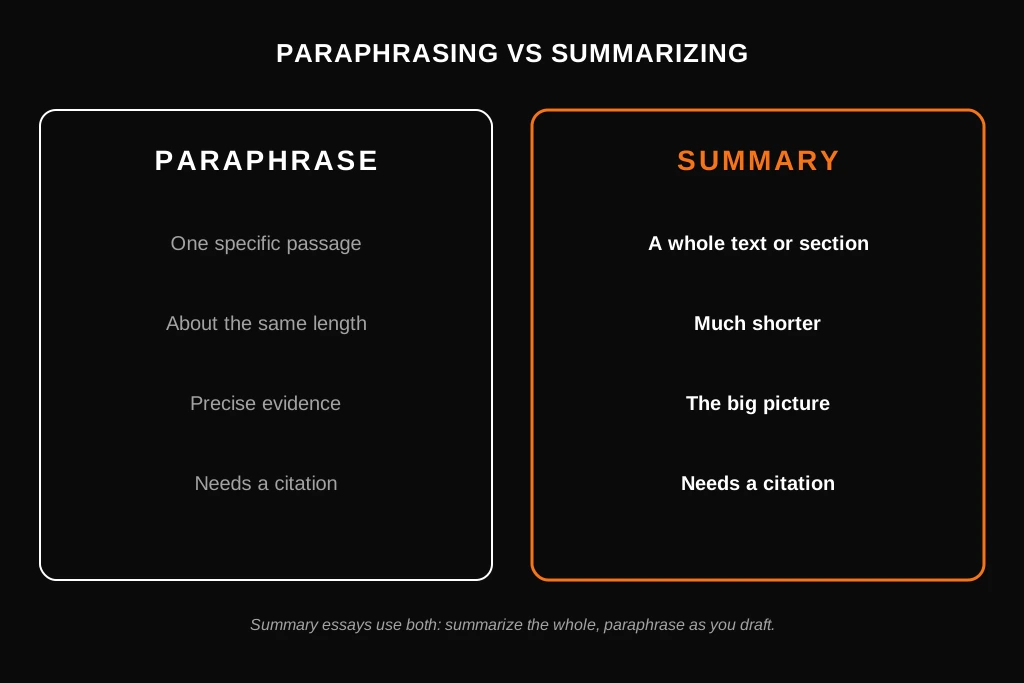
The difference between paraphrasing vs summarizing comes down to scope and length. A paraphrase restates one specific passage in your own words and is usually about as long as the original. A summary condenses a whole text or a large section into its main ideas, so it is much shorter. You paraphrase when you need one precise point as evidence, and you summarize when you need the big picture. In a summary essay, you use both: you summarize the text overall, and you paraphrase individual sentences as you draft. Both always need a citation.
Signposting in academic writing
Signposting in academic writing means using words that guide readers through your text, and in a summary it keeps the author’s argument easy to follow. Attributive tags like “Douglass argues” show whose ideas are being presented, while sequence words such as “first,” “next” and “finally” show how the author’s points connect. In a summary response essay, signposts also mark the shift from summary to response, for example “Having summarized Emerson’s argument, this essay now considers its limits.” Clear signposts stop readers from confusing the author’s views with yours, which is one of the most common problems in summary writing.
Hedging in academic writing
Hedging in academic writing means matching your language to the strength of the evidence, and in a summary it helps you report an author’s claims accurately. If an author says a study suggests a link, your summary should not say the author proves it. Words like “suggests,” “proposes” or “argues” keep your summary faithful to the original’s level of certainty. For example, “The author suggests that homework may help older students” reflects a cautious source more accurately than “The author proves homework helps students.” Overstating a source’s claims is a subtle but serious summary mistake.
How to build a strong argument in academic writing
Knowing how to build a strong argument in academic writing often starts with summarizing other people’s views fairly. When you summarize an opposing argument accurately before answering it, readers trust you more, because you have shown you understand the debate. A strong argument then adds a clear thesis, focused paragraphs that each prove one point and evidence that a skeptical reader would accept. Summaries give you the foundation, and your own claims build on it. Our guide to writing a strong thesis statement shows how to turn your response into a clear central claim.
Types of academic writing
The four main types of academic writing are descriptive, analytical, persuasive and critical. A summary essay is mostly descriptive, because it reports what a text says without judging it. Summary and analysis essays move into analytical writing by explaining how the text works. Summary response essays add persuasive or critical writing, where you argue for your own view of the text. Knowing where your assignment sits on this scale tells you how much of your own voice to include.
Essay heading format
Essay heading format for a summary essay usually follows your course’s style guide. In MLA, place your name, instructor’s name, course and date on separate lines at the top left of the first page, then center your title. In APA, student papers typically use a title page with the paper title, your name, course, instructor and date. In both styles, the text you are summarizing should be named in your opening sentence and listed on a works cited or reference page.
How to Title a Summary Essay
A summary essay title should tell readers which text you are summarizing. Keep it simple and informative rather than clever. Three reliable patterns are:
- “A Summary of [Title] by [Author]”
- “[Author]’s [Title]: A Summary”
- “Summary and Response: [Title] by [Author]” for summary response essays
Follow your instructor’s style guide for capitalization and whether to italicize or use quotation marks around the original title.
Common Student Problems and How to Fix Them
Summarizing looks simple, but it is a demanding reading and writing skill. In the 2011 Nation’s Report Card writing assessment, 24 percent of eighth and twelfth graders scored Proficient and 3 percent scored Advanced. Here are the summary problems students raise most often and how to solve them.
“I keep adding my opinion”
Reread each sentence and ask whether the author would agree it describes their view. Delete words like “good,” “convincing” or “wrong,” and save your reactions for a response section if the assignment includes one.
“My summary is too long”
Cut examples, statistics and repetition. Keep only the main idea and the key points that support it. If your summary is close to the length of the original, you are retelling, not summarizing.
“I don’t know what counts as a main idea”
Look at the title, the opening and closing paragraphs, headings and topic sentences. The main idea is the point everything else supports. Ask yourself what the author would want readers to remember if they forgot everything else.
“I’m copying the author’s words”
Close the text before you write each paragraph. Write from your notes, then compare with the original. Put any phrase you keep in quotation marks and cite it.
“My summary sounds like a list”
Use transitions and attributive tags to show how the author’s points connect, such as “Building on this idea, Emerson argues…” Grouping related points into paragraphs also helps.
“I’m not sure how much detail to include”
Include enough detail that someone who has not read the text understands the argument, but not so much that they could skip the original entirely. One or two sentences per key point is usually right.
“Can I use a summarizer tool?”
Check your school’s academic integrity policy first, because many treat submitted AI output as misconduct. Even where tools are allowed, they often miss the author’s main argument or flatten important nuance. Reading and summarizing the text yourself is also what the assignment is testing.
“I don’t understand the text”
Break it into sections and summarize each one in a sentence before attempting the whole. Look up unfamiliar terms, read any background your instructor provides and ask for help early rather than guessing.
“I don’t know how to end my summary”
Keep the final paragraph short. Restate the author’s main idea in fresh words and, if helpful, mention the author’s overall purpose. Do not add new points or your own judgment in a pure summary.
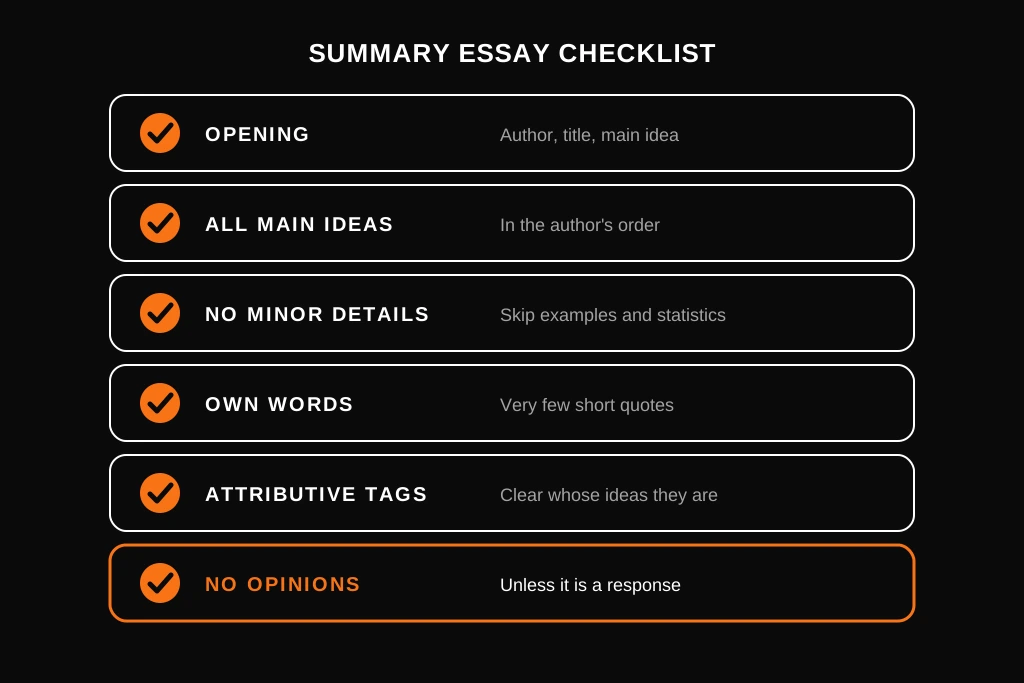
Summary Essay Checklist
Before you submit, run your summary essay through this quick checklist:
- The opening sentence names the author, the title and the main idea.
- Every main idea from the original is included, in the author’s order.
- Examples, statistics and minor details are left out.
- The writing is in your own words, with very few short quotations.
- Attributive tags make it clear whose ideas are being reported.
- There are no personal opinions outside a response section.
How EssaysHelper Can Help You
Summary essays look short, but they demand careful reading, accurate paraphrasing and a neutral voice, and summary response essays add an argument on top. If you are stuck on a difficult text or unsure whether your summary is accurate, our writers can help, from first year composition to graduate seminars.
- Identifying the main idea and key points of complex texts.
- Drafting accurate, neutral summaries in your own words.
- Building strong response or analysis sections with clear theses.
- Reviewing drafts for accuracy, citations and flow.
Share your assignment, the text and your deadline through our essay writing services page, and we will suggest the fastest way forward.
Frequently Asked Questions
What is the difference between a summary essay and a response essay?
A summary essay reports what an author says without your opinion. A response essay explains what you think about the text. A summary response essay combines both, with the summary first.
How long should a summary essay be compared to the original text?
A common rule of thumb is about a quarter to a third of the original’s length, but always follow your instructor’s word count. The key is covering every main idea while leaving out minor details.
Can I include my own opinion in a summary essay?
Not in a pure summary. Keep it neutral and objective. If you want to share your view, the assignment needs to be a summary response or summary analysis essay.
How do I start a summary essay?
Begin with one sentence that names the author, the title and the text’s main idea. You can add a sentence of context, but avoid opening with your own opinion.
Do I need a thesis statement in a summary essay?
A pure summary does not argue, but its opening sentence should state the author’s main idea clearly, which works like a thesis. Summary response essays need your own thesis for the response.
Should a summary essay use quotes?
Use very few. A summary should be mostly in your own words, with at most one or two short quotations for key phrases that cannot be paraphrased well.
What tense should a summary essay be written in?
Use the present tense in MLA style, for example “Emerson argues.” APA style often uses past or present perfect tense for research findings. Follow your instructor’s guidelines.
How many paragraphs should a summary essay have?
Short summaries can be one paragraph. A full summary essay usually has an opening paragraph, two or three body paragraphs and a brief final paragraph.
Is it okay to use a summarizing tool for a summary essay?
Check your school’s policy first, since many treat AI generated work as misconduct. Tools also tend to miss nuance, so writing the summary yourself is safer and more accurate.
How do I cite the text I am summarizing?
Name the author and title in your opening sentence, add page numbers for specific points if your style requires them and list the full source on your works cited or reference page.
Final Thoughts
Learning how to write a summary essay builds one of the most useful skills in academic writing: understanding a text well enough to explain it in your own words. Read carefully, identify the main idea, follow the author’s order and stay neutral throughout. Use attributive tags so readers always know whose ideas they are reading, and keep quotations to a minimum. When your assignment asks for a response or analysis, write the summary first and then add your own voice in a clearly separate section.