
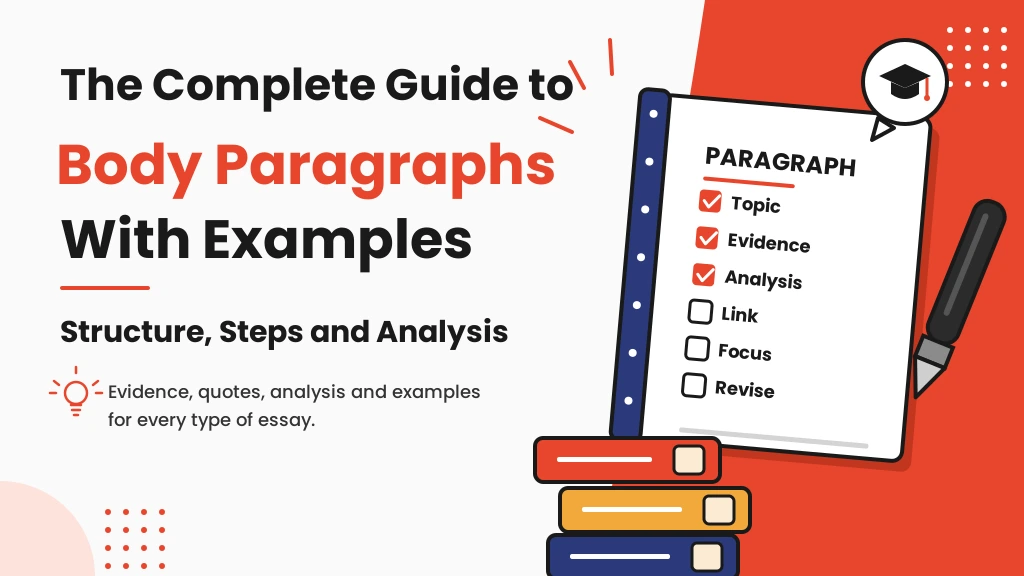
Here is how to write a body paragraph: open with a topic sentence that states one point, add evidence such as a quote, fact or example, explain how that evidence proves your point, and finish with a sentence that links back to your argument or leads into the next paragraph. Most body paragraphs run five to eight sentences and focus on a single idea that supports your thesis.
That is the short answer. This guide walks you through each part of a body paragraph, a step by step method, how to use quotes without losing your own voice, how to write analysis that earns marks, annotated examples for different essay types, and fixes for the problems students run into most.
If your teacher keeps writing “needs more analysis” or “what is your point?” in the margins, the body paragraph is where those comments can be fixed. At Essays Helper, these are the comments students bring to us most often, and they almost always come down to how body paragraphs are built.
What Is a Body Paragraph?
A body paragraph is any paragraph between the opening and the final section of an essay that develops one main point in support of your thesis. Purdue OWL’s guide to paragraphs explains that a strong paragraph has unity, focusing on one main idea, and that is exactly what a body paragraph does: it takes one reason, example or part of your argument and proves it fully.
We think of body paragraphs as the engine of an essay. Your thesis makes a promise, and the body paragraphs do the work of keeping it. If one paragraph is weak, the whole argument feels weaker, even when the rest of the essay is strong.
What a body paragraph does
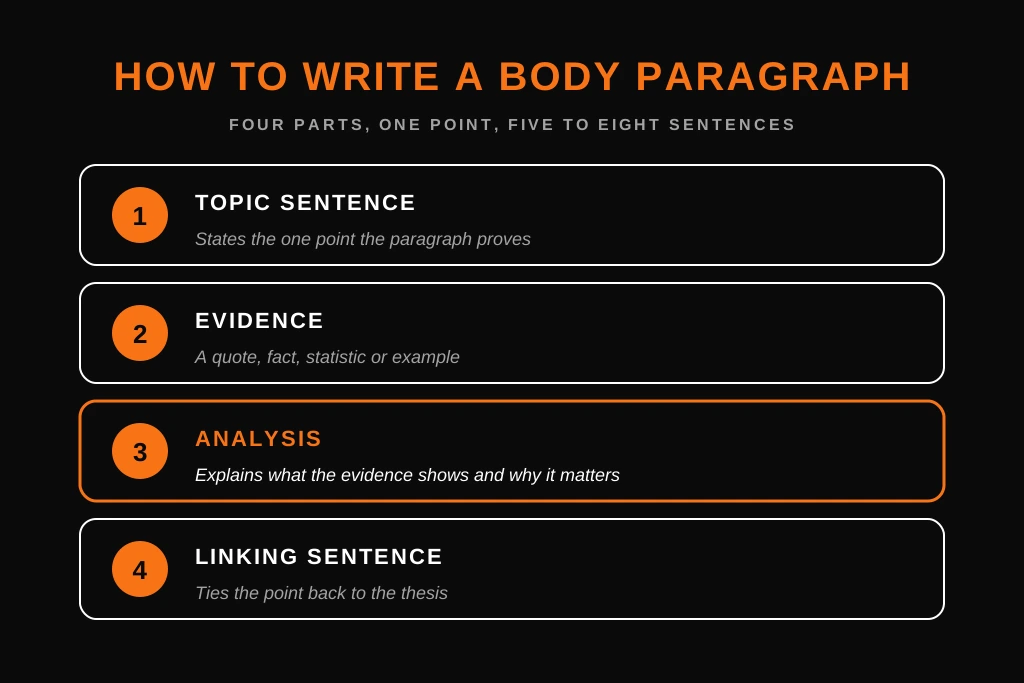
A good body paragraph does four jobs. It states a clear point, supports that point with evidence, explains why the evidence matters and connects the paragraph back to the larger argument. When a paragraph skips any of these jobs, readers notice. A paragraph without evidence sounds like opinion, and a paragraph without explanation sounds like a list of facts. A paragraph that drifts between two points leaves readers unsure which one matters.
Body paragraphs vs the other paragraphs in an essay
An essay usually has three kinds of paragraphs. The opening paragraph sets up the topic and states the thesis. The final paragraph pulls the argument together and reminds the reader why it matters. Everything in between is a body paragraph, and this is where the actual proving happens. The opening and final paragraphs make promises and reflections, but only the body paragraphs contain the evidence and analysis that make an argument convincing. That is why teachers often spend most of their marking time on the body of an essay, and why improving your body paragraphs usually has the biggest effect on your grade.
How many body paragraphs an essay needs
The number depends on the length of the assignment and the number of points in your thesis. A short school essay often has three body paragraphs, one for each main reason. A 1,500 word college essay might have five or six, and a research paper can have many more, grouped under section headings. A useful rule is one body paragraph for each distinct point you need to prove.
How long a body paragraph should be
Most body paragraphs are five to eight sentences, or roughly 100 to 200 words. That is long enough to state a point, present evidence and explain it, but short enough to stay focused. College paragraphs often run longer because the analysis goes deeper. If a paragraph passes 250 words, check whether it actually contains two points that should be split. Length also depends on the subject. History and English paragraphs often need more room for quotes and close reading, while science and business writing tends to favor shorter, tighter paragraphs that get to the point quickly.
The Structure of a Body Paragraph
Every body paragraph follows the same basic structure: a topic sentence, evidence, analysis and a closing or linking sentence. Teachers call this structure by different names, but the parts are almost identical.
Topic sentence or claim
The topic sentence states the one point the paragraph will prove. It usually comes first and links to your thesis. For example: “Later school start times would improve student safety by reducing early morning driving in the dark.” For a full guide on writing this sentence, see our post on how to write a topic sentence.
Evidence
Evidence is the proof for your point. It can be a quotation from a text, a statistic, a fact from a reliable source, a historical document or a specific example. Choose evidence that supports your exact claim, not just your general topic. One or two strong pieces of evidence are usually better than four weak ones.
Analysis
Analysis explains how your evidence proves your point. This is where you show your thinking, and it is usually where most of the marks come from. Good analysis answers the questions “What does this show?” and “Why does it matter?” It should be at least as long as your evidence, and often longer.
Closing or linking sentence
The final sentence wraps up the paragraph’s point and connects it to your thesis or to the next paragraph. It should not simply repeat the topic sentence. Instead, it shows what the paragraph has added to your argument, for example: “Safer commutes are one clear reason later start times deserve support.”
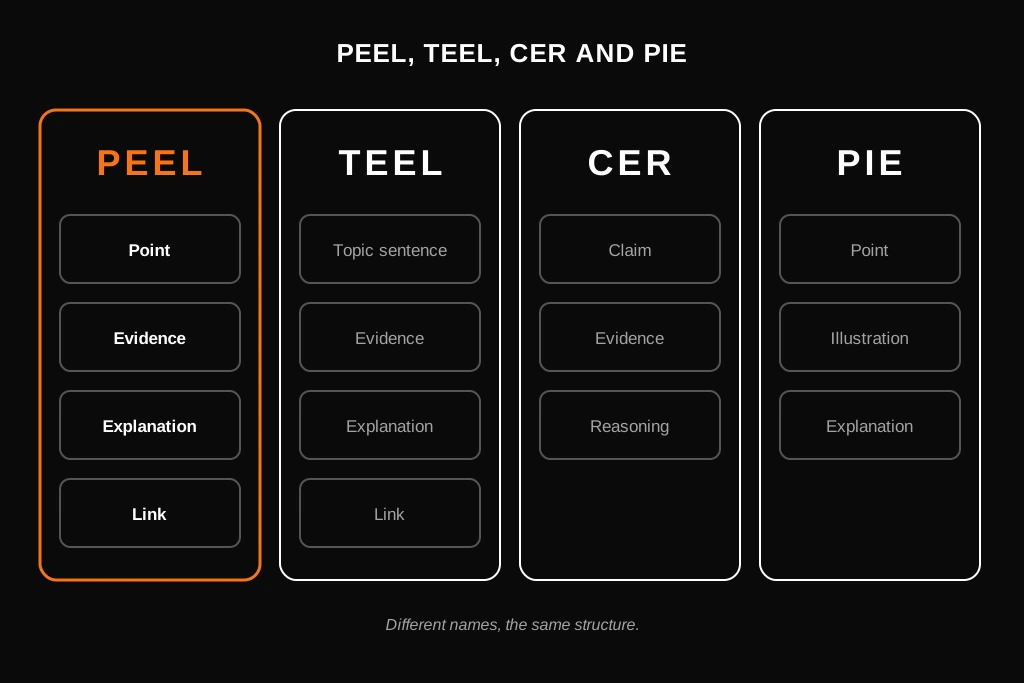
PEEL, TEEL and CER: the same structure with different names
You may have learned a body paragraph structure under one of these acronyms. They describe the same basic pattern.
| Model | Stands for | Best for |
|---|---|---|
| PEEL | Point, Evidence, Explanation, Link | Most essays in UK, Australian and US schools |
| TEEL | Topic sentence, Evidence, Explanation, Link | English and humanities essays |
| CER | Claim, Evidence, Reasoning | Science and middle school argument writing |
| PIE | Point, Illustration, Explanation | Short paragraphs and timed writing |
How to Write a Body Paragraph Step by Step
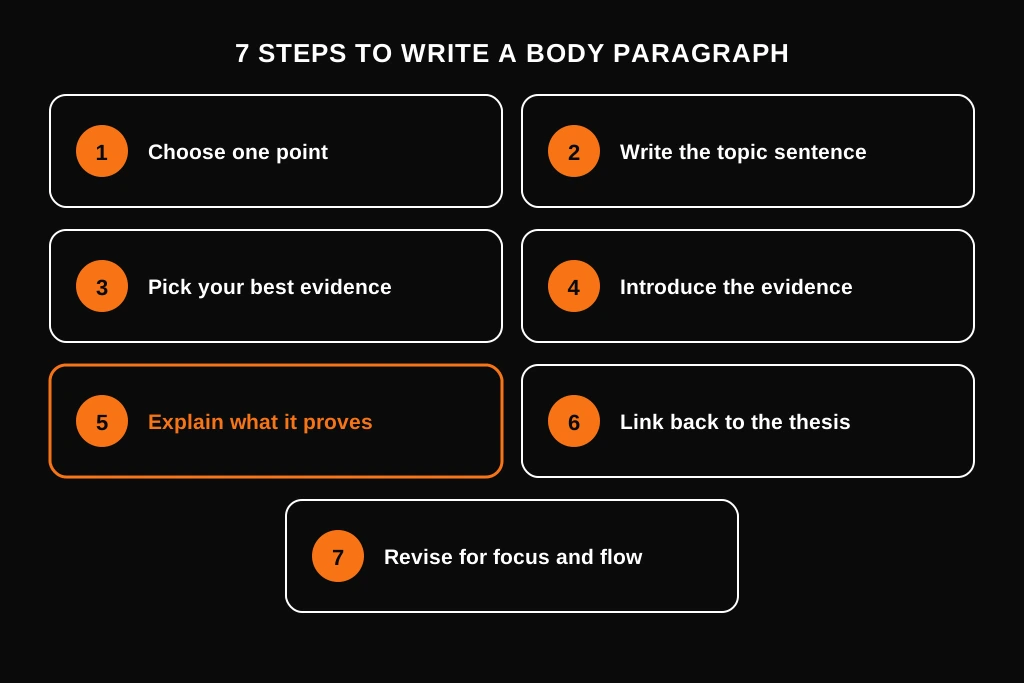
To write a body paragraph, choose one point from your thesis, write a topic sentence, select your best evidence, introduce it smoothly, explain what it proves, link back to your argument and then revise. These seven steps work for almost any essay.
Step 1: Choose one point from your thesis
Look at your thesis and pick one reason or part of your argument. Each body paragraph should cover only one. If your thesis says a policy saves money, improves health and reduces traffic, you have three paragraphs, each with a single focus.
Step 2: Write your topic sentence
State that point clearly in one sentence. Make it specific enough that a reader knows what evidence to expect.
Step 3: Choose your strongest evidence
Go through your notes and pick the evidence that best supports this exact point. Ask yourself whether the evidence would convince a reader who disagrees with you. If it would not, keep looking.
Step 4: Introduce the evidence
Never drop a quote or statistic into a paragraph without setting it up. Name the source and give a little context, such as “In his 1852 speech, Frederick Douglass asks…” or “According to the city’s transport department…” A smooth lead in helps the reader understand why the evidence is there.
Step 5: Explain what the evidence proves
Write two to four sentences of analysis. Explain what the evidence shows, why it matters and how it supports your topic sentence. This step is the heart of the paragraph.
Step 6: Link back to your argument
Finish with a sentence that ties the paragraph’s point to your thesis or sets up the next paragraph.
Step 7: Revise for focus and flow
Read the paragraph aloud. Remove any sentence that does not support the topic sentence, check that each sentence leads naturally to the next and make sure your analysis is at least as long as your evidence.
How to start a body paragraph
The best way to start a body paragraph is with a clear topic sentence, sometimes preceded by a short transition. You might open with “Another reason,” “In contrast” or “Beyond the cost savings” to show how this paragraph connects to the last. Avoid starting with a quote, a question or “In this paragraph I will,” because these delay your point. If you need models for opening lines, our list of topic sentence examples shows dozens of strong starts for different essay types.
A worked example from start to finish
Imagine your thesis is: “Schools should replace paper textbooks with digital ones because they cost less, stay up to date and lighten students’ bags.” For the second point, you choose “stay up to date.” Your topic sentence becomes: “Digital textbooks can be updated quickly when facts or methods change.” Your evidence is an example of a science textbook that needed a new edition after a major discovery. Your analysis explains that paper books stay outdated until schools can afford new copies, while digital books can be corrected for every student at once. Your linking sentence ties it together: “Because accurate information matters in every subject, easy updates give digital textbooks a clear advantage.” Together, those sentences form a complete, focused body paragraph.
How to Use Evidence and Quotes in a Body Paragraph
Use evidence that directly supports your topic sentence, introduce it with context, keep quotes short and always follow them with your own explanation. Quotes, paraphrases and summaries each have a place, depending on how much detail you need.
Choosing the right evidence
Strong evidence is relevant, specific and credible. Relevant evidence proves your exact point, specific evidence gives concrete details rather than general statements, and credible evidence comes from a source your reader can trust, such as the primary text, a respected publication or official data. If your evidence could support almost any argument, it is probably too general.
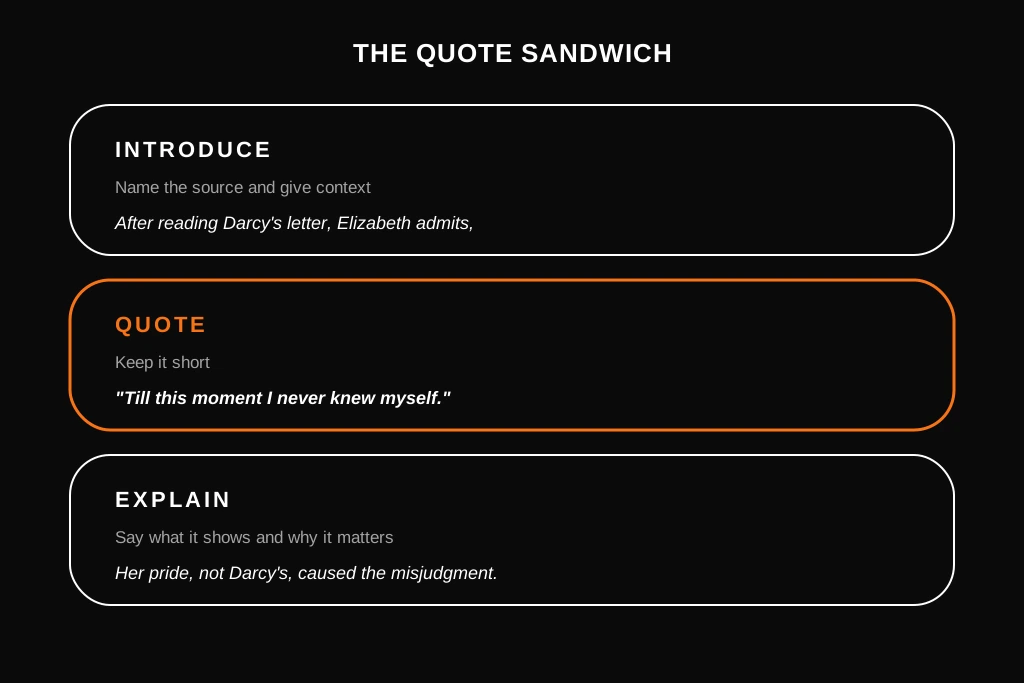
The quote sandwich
The quote sandwich is a simple way to use quotations well. The top slice introduces the quote with context. The filling is the quote itself, kept as short as possible. The bottom slice explains what the quote shows and how it supports your point. For example: In Pride and Prejudice, Elizabeth admits her own blindness after reading Darcy’s letter, saying, “Till this moment I never knew myself.” This moment matters because it shows Elizabeth recognizing that her pride, not Darcy’s, caused her misjudgment.
How to paraphrase evidence in a body paragraph
Learning how to paraphrase helps you bring sources into a body paragraph without filling it with long quotations. To paraphrase, read the passage until you understand it, close the source and write the idea in your own words and sentence structure, then compare it with the original to check that you have kept the meaning without copying phrases. Always cite the source, because a paraphrase still uses someone else’s idea. Paraphrasing works best in the middle of a paragraph, after your topic sentence and before your analysis, especially when the original wording is long or technical. A good paraphrase is usually shorter and clearer than the source, which leaves more room in the paragraph for your own explanation.
How to write a summary as background evidence
Knowing how to write a summary is useful when your paragraph needs quick background on a whole source rather than one specific detail. A summary condenses the main idea of a text, article or event into a sentence or two in your own words. In a body paragraph, it usually appears early, right after the topic sentence, to give readers the context they need before your more specific evidence. For example: “Douglass’s Narrative traces his journey from enslavement to freedom, showing how learning to read changed his view of his own situation.” Keep summaries neutral and brief, cite the source and never let a summary replace your analysis.
Paraphrasing vs summarizing in a body paragraph
The choice between paraphrasing vs summarizing depends on what your paragraph needs. Paraphrase when you need one precise point from a source as evidence. Summarize when you need to give the gist of a whole source as background. A paraphrase is about the same length as the original passage, while a summary is much shorter than the full source. Both need citations. Many strong body paragraphs use both: a one sentence summary for context, a paraphrase or short quote for specific evidence and then several sentences of analysis.
How to Write Analysis That Earns Marks
Analysis explains how and why your evidence proves your point. It goes beyond saying what the evidence says and shows what it means, why it matters and how it connects to your thesis.
Explain the “so what”
After each piece of evidence, ask “So what?” The answer is your analysis. If your evidence shows that a character lies three times, the “so what” might be that the lies reveal fear rather than cruelty. Keep asking until your explanation connects back to your thesis.
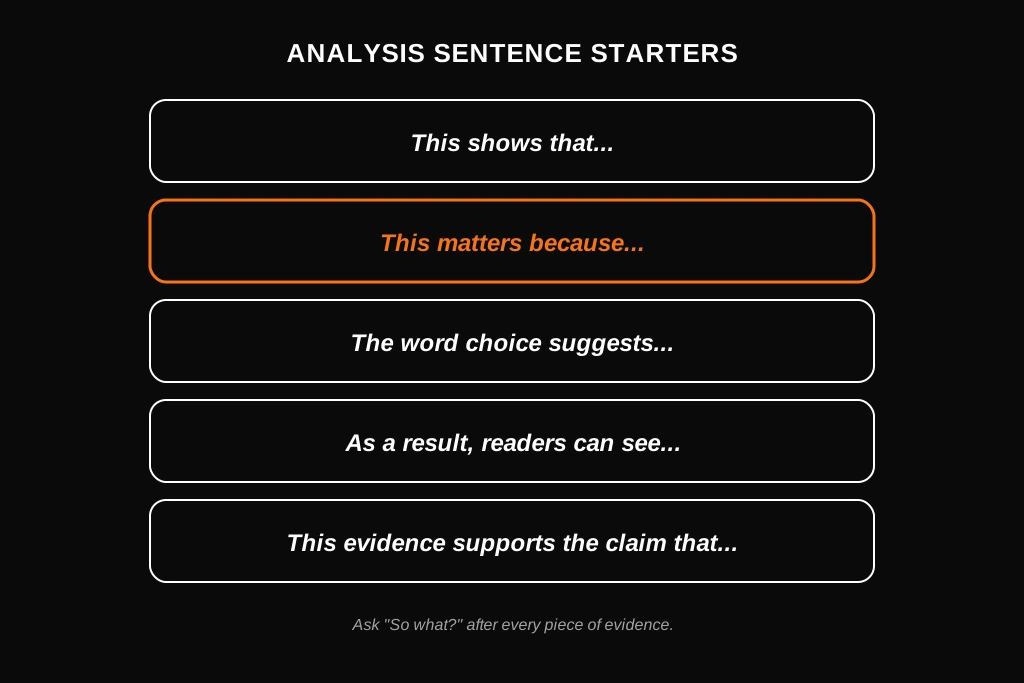
Analysis sentence starters
If you are not sure how to begin your explanation, these starters can help:
- This shows that…
- This matters because…
- The word choice suggests…
- As a result, readers can see…
- This evidence supports the claim that…
Use them as training wheels. Once you are comfortable, vary your wording so your analysis sounds natural.
Summary vs analysis
The most common reason teachers mark down body paragraphs is too much summary and too little analysis. Summary tells the reader what happens or what a source says. Analysis tells the reader what it means. “Gatsby throws large parties” is summary. “Gatsby’s parties are crowded but lonely, showing that wealth cannot buy the connection he wants” is analysis. Aim for at least as much analysis as evidence in every paragraph.
Body Paragraph Examples
Seeing a full paragraph broken into parts is the quickest way to understand how they work together. Each example below labels the topic sentence, evidence, analysis and linking sentence.
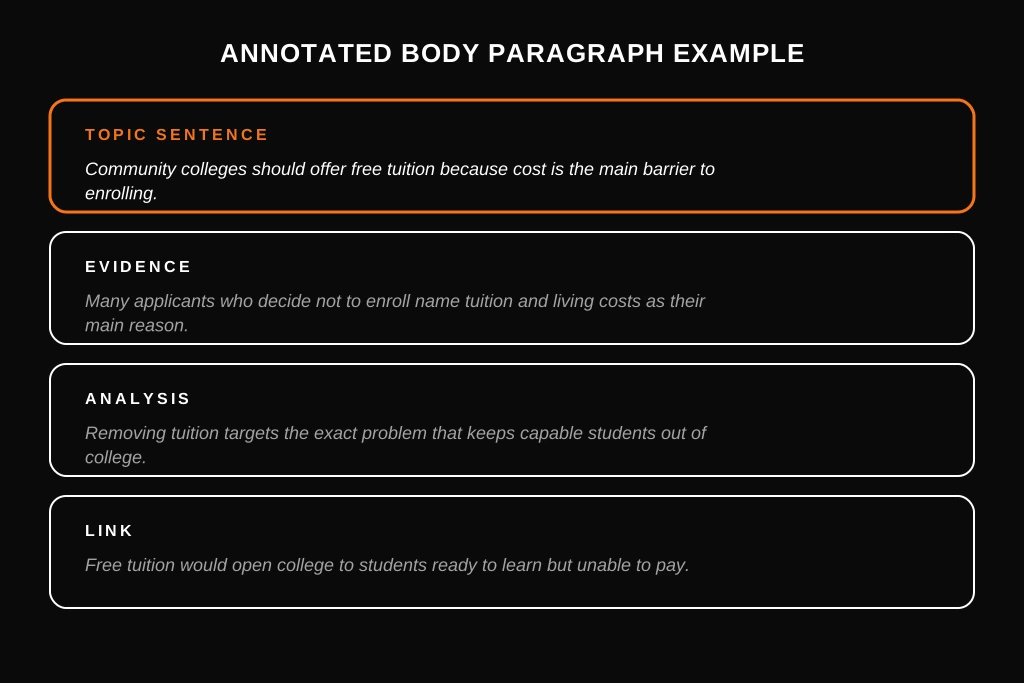
Argumentative essay body paragraph example
Topic sentence: Community colleges should offer free tuition because cost is the main barrier stopping many students from enrolling.
Evidence: In student surveys, many applicants who decide not to enroll name tuition and living costs as their main reason.
Analysis: If cost is the deciding factor, removing tuition directly targets the problem that keeps capable students out of higher education. It also helps students who would otherwise take on debt for a two year qualification, which makes finishing more likely.
Linking sentence: By removing the largest obstacle to enrollment, free tuition would open college to students who are ready to learn but unable to pay.
Informative essay body paragraph example
Topic sentence: Honeybees communicate the location of food through a movement known as the waggle dance.
Evidence: A forager bee returning to the hive moves in a figure eight pattern, and the angle of the straight run shows the direction of the food relative to the sun.
Analysis: This system allows thousands of bees to find the same flowers quickly without any of them seeing the source first. It turns one bee’s discovery into information the whole colony can use.
Linking sentence: The waggle dance is one of several ways bees cooperate to keep the colony fed.
Literary analysis body paragraph example
Topic sentence: In Frankenstein, Victor’s repeated illnesses show that his guilt affects his body as well as his mind.
Evidence: After the creature comes to life, Victor falls into a nervous fever that lasts for months, and he collapses again after later deaths.
Analysis: Shelley links each collapse to a moment when Victor avoids responsibility, which suggests that the guilt he refuses to face finds another way out. His body admits what his words will not.
Linking sentence: These physical breakdowns reinforce Shelley’s warning about the cost of creating without accepting responsibility.
History and DBQ body paragraph example
Topic sentence: Many abolitionists used personal testimony to persuade Northern audiences that slavery was a moral crisis.
Evidence: In his 1845 Narrative, Frederick Douglass describes the violence he witnessed as a child in direct, personal language.
Analysis: Douglass wrote for Northern readers who had never seen slavery firsthand, so his eyewitness account made the cruelty harder to dismiss as rumor. His purpose was to turn distant readers into committed opponents of slavery.
Linking sentence: Testimony like Douglass’s helped move abolition from a political debate to a moral cause.
Notice that the analysis explains the author’s audience and purpose, not just the content. In a DBQ essay, that kind of explanation is what turns document content into real evidence for your argument.
Research paper body paragraph example
Topic sentence: Research on sleep suggests that teenagers may perform better in school when classes start later.
Evidence: Several districts that moved start times later have reported improvements in attendance and fewer late arrivals.
Analysis: These results suggest that later schedules may fit teenagers’ natural sleep patterns, although the size of the effect appears to vary between schools. The pattern is strong enough to justify further trials.
Linking sentence: Together, these findings make later start times a practical option for schools trying to raise attendance.
These are model paragraphs. When you write your own, replace general evidence like “student surveys” with specific, cited sources.
Body Paragraphs for Different Essay Types
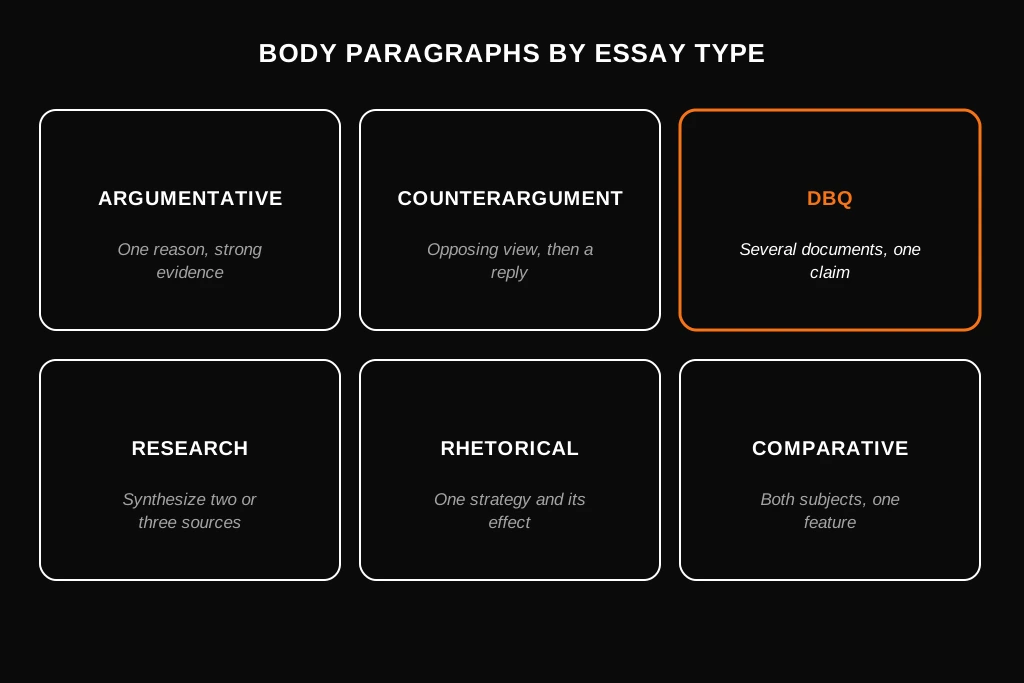
The four part structure stays the same across essay types, but what counts as evidence and what your analysis focuses on changes. Argumentative paragraphs defend claims, history paragraphs interpret sources and research paragraphs synthesize findings.
Argumentative and persuasive essays
In an argumentative essay, each body paragraph presents one reason for your position, backed by evidence a skeptical reader would accept. Persuasive essays follow the same structure but often lean more on values and benefits. In both, your analysis should explain why the evidence should change the reader’s mind.
Counterargument paragraphs
A counterargument paragraph presents the strongest opposing view fairly, then answers it with evidence and reasoning. Start with a topic sentence like “Critics argue that…” and finish by showing why your position still holds.
DBQ and APUSH body paragraphs
In a DBQ, each body paragraph should group several documents around one argument rather than describing them one by one. The College Board’s AP US History DBQ scoring guidelines award the top evidence point for supporting an argument using at least four documents, and a separate point for explaining how a document’s point of view, purpose, historical situation or audience is relevant to your argument. Simply quoting or listing documents does not earn these points. Structure each paragraph with a claim, two or three documents as evidence, an explanation of their context and a link back to your thesis.
Research papers
Research paper body paragraphs usually synthesize several sources around one idea instead of summarizing one source per paragraph. Open with your own claim, bring in two or three sources that support or complicate it and explain how they fit together. Use careful language when the evidence is limited. A good test is whether your paragraph would still make sense if one source were removed. If it would collapse, you are leaning on that source instead of building your own argument.
Rhetorical analysis and synthesis essays
In a rhetorical analysis body paragraph, focus on one strategy the author uses, quote an example and explain its effect on the audience. In a synthesis essay, combine several sources to support one point, showing how they agree, disagree or build on each other. In both, the analysis matters more than the quotes.
Comparative essays
Comparative body paragraphs can be organized point by point, where each paragraph compares both subjects on one feature, or subject by subject, where each paragraph covers one subject. Point by point usually leads to stronger analysis because the comparison happens inside each paragraph.
First, second and third body paragraphs
Your first body paragraph usually presents your strongest or most foundational point, because it sets the tone for your argument. The second body paragraph builds on it with a related or contrasting point, often opening with a transition like “Beyond this.” The third can address a different angle, a counterargument or your most complex point. In a five paragraph essay, these are your three body paragraphs, and their order shapes how convincing the whole essay feels. Order your paragraphs so each one prepares the reader for the next.
Body Paragraphs in Academic Writing
In academic writing, body paragraphs do more than present points. They guide the reader through your reasoning, show how certain your claims are and fit together into a single argument.
Signposting in academic writing
Signposting in academic writing inside a body paragraph means using small signals that show how each sentence relates to the last. Phrases such as “For example,” “This suggests,” “However” and “As a result” tell readers when you are giving evidence, explaining it or shifting direction. Signposts are especially useful between your evidence and your analysis, where readers need to know you are moving from what the source says to what it means. Use them sparingly, though. One clear signal per move is enough, and too many make writing feel mechanical.
Hedging in academic writing
Hedging in academic writing means matching how certain your language sounds to how strong your evidence is. In a body paragraph, hedging matters most in the analysis sentences, where you interpret what the evidence shows. Words like “suggests,” “may,” “appears to” and “is likely to” keep your claims accurate when the evidence is limited or mixed. For example, “This finding suggests that shorter lessons may improve focus” is more defensible than “This proves shorter lessons improve focus.” Hedging does not weaken your argument. It shows readers that you understand the limits of your evidence. Use firm language for what you can prove and hedged language for what you are inferring.
How to build a strong argument in academic writing
Knowing how to build a strong argument in academic writing depends on how your body paragraphs work together. Each paragraph should prove one part of your thesis, and together they should form a logical chain. Order them deliberately, often from the most foundational point to the most complex, or from the strongest evidence to the most debatable claim. Include a paragraph that addresses the opposing view, and make sure each paragraph’s linking sentence prepares the reader for the next. If you read only your topic sentences in order, they should make a convincing case on their own. That is the test of a well built argument.
Types of academic writing
The four main types of academic writing are descriptive, analytical, persuasive and critical, and body paragraphs look slightly different in each. In descriptive writing, body paragraphs present facts or information clearly. In analytical writing, they organize ideas into categories, causes or relationships. In persuasive writing, each paragraph argues one reason for a position. In critical writing, paragraphs evaluate another writer’s argument, weighing its strengths and weaknesses before stating your view. Most university assignments mix these types, so a single essay might include descriptive background paragraphs followed by analytical and critical ones. Knowing which type a paragraph needs helps you choose the right evidence and depth of analysis.
Essay heading format
Essay heading format refers to the information at the top of your first page and, in longer papers, the section headings that divide the body. In MLA format, short essays use a simple heading with your name, instructor, course and date, then continuous body paragraphs without section headings. Each paragraph is indented half an inch and double spaced. In APA format, longer papers often use section headings such as “Method” or “Results,” but every paragraph under those headings still needs its own topic sentence, evidence and analysis. Headings organize sections, while body paragraphs carry the argument, so never rely on a heading to do the work of a topic sentence.
Common Student Problems and How to Fix Them
Body paragraphs are where most essay marks are won or lost, and many students find them difficult. In the 2011 Nation’s Report Card writing assessment, 24 percent of eighth and twelfth graders scored Proficient and 3 percent scored Advanced. Here are the problems students describe most often and how to solve them.
“My paragraph just summarizes”
Cut the summary down to one sentence of context and add at least two sentences explaining what the evidence means. Ask “So what?” after every piece of evidence and write the answer.
“I don’t know how to explain my quote”
Look at specific words in the quote and ask what they suggest. Then connect that meaning to your topic sentence. Starters like “The word … suggests” or “This shows that…” can get you going.
“My paragraphs don’t connect”
Use your linking sentences and transitions. End each paragraph by showing what it adds to the argument, and start the next with a phrase that shows the relationship, such as “Building on this” or “In contrast.” Our list of transition words gives you options for adding, contrasting and showing cause and effect.
“My paragraph is too short”
Short paragraphs usually lack analysis. Add another layer of explanation, a second piece of evidence or a sentence about why the point matters to your overall argument. A three sentence paragraph with a topic sentence, a quote and a single comment is rarely enough to convince a reader, even when the point itself is strong.
“My paragraph is too long”
Long paragraphs usually contain two ideas. Find the point where the focus shifts and split the paragraph there, giving the second half its own topic sentence. Two focused paragraphs are almost always clearer than one crowded paragraph trying to prove two different things.
“I have too many ideas in one paragraph”
Choose the strongest idea and move the others to their own paragraphs. One paragraph, one point is the most reliable rule in essay writing.
“My evidence doesn’t really prove my point”
This usually means the evidence fits your topic but not your exact claim. Reread your topic sentence and ask whether the evidence would convince a skeptical reader of that specific point. If not, either find sharper evidence or narrow the claim so it matches what your evidence actually shows.
“I always start with a quote”
Move the quote to the second or third sentence and open with your own topic sentence. The reader needs your point first so they know why the quote matters.
“My teacher says I need more analysis”
Aim for at least as many sentences of analysis as evidence. Explain what the evidence shows, why it matters and how it supports your thesis. If you can delete your analysis and the paragraph still makes sense, you need more.
“My analysis just repeats the evidence”
If your explanation restates the quote in different words, it is paraphrase, not analysis. Push further by explaining what the evidence reveals, why the author made that choice or what would change if it were missing.
“I don’t know how many body paragraphs to write”
Count the main points in your thesis and write one paragraph for each. A short school essay usually needs three, while longer essays simply add more points, each with its own paragraph.
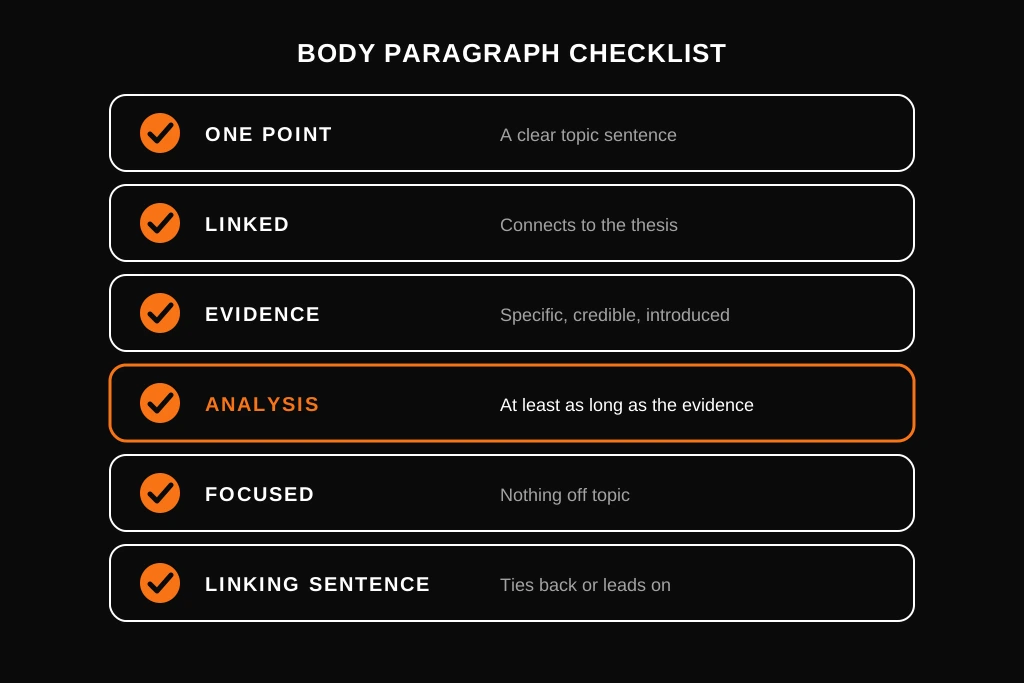
Body Paragraph Checklist
Before you hand in your essay, check every body paragraph against this list. It takes a few minutes per paragraph and catches most of the problems teachers comment on.
- It opens with a clear topic sentence that states one point.
- The point links directly to your thesis.
- It includes specific, credible evidence that is introduced with context.
- The analysis is at least as long as the evidence and explains why it matters.
- Every sentence supports the topic sentence, with nothing off topic.
- The final sentence links back to the argument or leads into the next paragraph.
How EssaysHelper Can Help You
Body paragraphs carry the weight of every essay, and getting them right can raise your grade more than any other change. If you are struggling to explain evidence, keep paragraphs focused or connect them into a strong argument, our writers can help, from middle school assignments through graduate papers.
- Turning your thesis into focused, well ordered body paragraphs.
- Choosing and integrating strong evidence and quotes.
- Deepening analysis so every paragraph earns marks.
- Reviewing full drafts for structure, flow and clarity.
Many students we work with already know the PEEL structure. What helps most is detailed feedback on their own paragraphs, showing exactly where the analysis is thin, where evidence does not fit and how to connect each paragraph to the thesis.
Share your assignment and deadline through our essay writing services page, and we will suggest the fastest way forward.
Frequently Asked Questions
How many sentences should a body paragraph have?
Most body paragraphs have five to eight sentences: a topic sentence, one or two pieces of evidence, two to four sentences of analysis and a linking sentence. College paragraphs are often longer.
How do I start a body paragraph without sounding repetitive?
Vary your openings with transitions like “Beyond this,” “In contrast” or “Another reason,” and make sure each topic sentence states a new, specific point rather than repeating your thesis.
What should go at the end of a body paragraph?
End with a linking sentence that shows what the paragraph has added to your argument or leads into the next paragraph. Avoid simply repeating the topic sentence.
Can a body paragraph start with a quote?
It is better not to. Start with your own topic sentence so readers know your point, then introduce the quote as evidence in the second or third sentence.
How many body paragraphs should a five paragraph essay have?
Three. A five paragraph essay has an opening paragraph, three body paragraphs and a final paragraph, with each body paragraph covering one main point from the thesis.
How do I write a body paragraph for an argumentative essay?
State one reason for your position in the topic sentence, support it with credible evidence, explain why that evidence should persuade a skeptical reader and link it back to your thesis.
What is the difference between evidence and analysis in a body paragraph?
Evidence is the proof, such as a quote, fact or example. Analysis is your explanation of what that proof shows and why it supports your point.
How do I write a DBQ body paragraph?
Make one argument per paragraph, support it with several documents, explain the context or purpose of at least some of them and connect everything back to your thesis.
Can a body paragraph have more than one quote?
Yes, as long as each quote supports the same point and gets its own explanation. Two short, well explained quotes are better than several long ones.
How do I know if my body paragraph is strong enough?
Check that it covers one point, uses specific evidence, explains that evidence in depth and links to your thesis. If removing it would weaken your argument, it is doing its job.
Final Thoughts
Learning how to write a body paragraph is one of the most useful skills in academic writing. Start with a clear topic sentence, support it with specific evidence, explain what that evidence shows and finish by linking back to your argument. Keep each paragraph focused on one point, give your analysis at least as much space as your evidence and revise for flow. Once this structure becomes a habit, every essay you write will feel more organized, more convincing and easier to finish.