
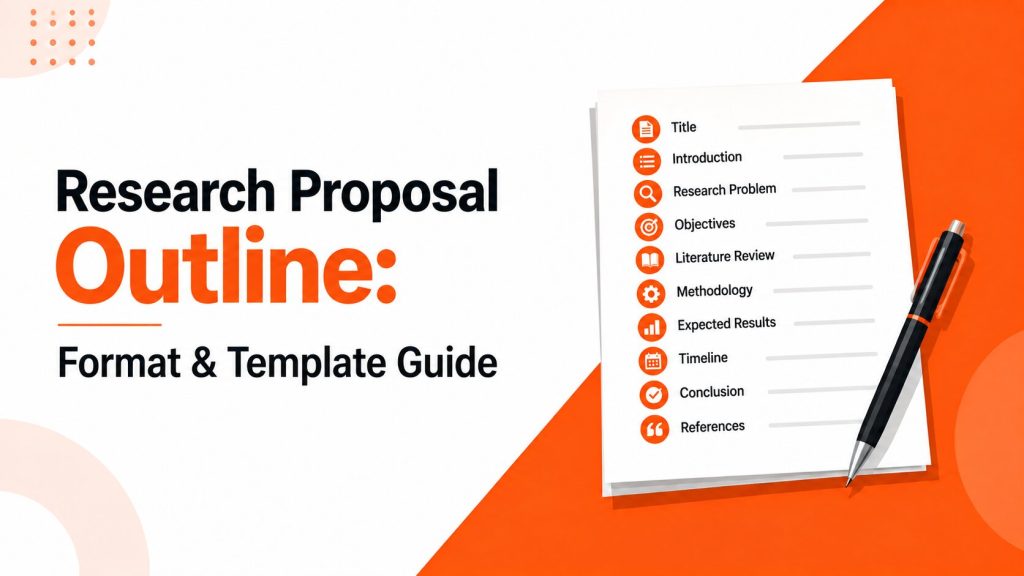
A research proposal outline is a skeleton version of your proposal, a list of the sections you’ll need and a few bullet points under each one, built before you write a single full paragraph. It maps out your title, problem statement, research questions, literature context, methodology, timeline, and references in rough form, so you know the shape of the whole document before you start drafting sentences. Building one first saves you from the most common proposal-writing trap: spending hours polishing an introduction before realizing your methodology doesn’t actually support your research question. Get the outline right and the full draft comes together far faster.
What Is a Research Proposal Outline?
Think of it as the framing stage of a house before anyone worries about paint colors. A research proposal outline isn’t the proposal itself, it’s the structural plan that makes writing the actual proposal faster and more coherent. Instead of full paragraphs, each section gets a handful of short notes: what goes here, roughly how much space it needs, and what it has to accomplish before the next section can make sense.
This is a distinct step from writing the research proposal itself. If you haven’t worked through what a full proposal needs to include yet, it’s worth reading that guide first, since this outline stage assumes you already know the components and just need help organizing them before you draft.
How an Outline Differs From the Full Proposal
Students often skip outlining entirely and jump straight to drafting, then get stuck halfway through the methodology section because they never actually decided how the literature review and the methodology were supposed to connect. An outline forces that decision early, when it’s cheap to fix, rather than late, when it means rewriting finished paragraphs.
The logic here isn’t unique to proposals. A research paper outline does the same job for a finished paper, and a literature review outline does it specifically for the literature synthesis stage. In every case, the outline is disposable scaffolding, useful for organizing your thinking, not something that gets submitted or graded on its own merits.
The confusion usually shows up in a specific way: a student submits what they call an “outline” and it’s actually a full first draft with headers, or they submit a bare list of section titles with nothing underneath them. Neither is quite right. A useful outline sits in between, specific enough that someone else could tell what your project actually is, brief enough that you haven’t committed to exact wording yet.
Why Outlining Before You Draft Actually Saves Time
It feels slower to stop and outline instead of just starting to write, but the opposite is usually true. According to guidance from the University of Nevada, Las Vegas Writing Center, a strong proposal has to demonstrate a clear connection between your research question, your methodology, and your stated significance, and that connective logic is much easier to check in a five-line outline than in three finished pages.
Outlining also protects you from the specific failure mode that sinks a lot of student proposals: writing a compelling introduction, a thorough literature review, and then bolting on a methodology section that doesn’t actually answer the question you spent two pages building up. Sketch the whole shape first and that mismatch shows up while it still costs you five minutes to fix, not an entire afternoon.
There’s a psychological benefit too, separate from the structural one. A blank page with no plan is intimidating in a way that a page of section headers with a few bullet points isn’t. Students who skip outlining often report the same experience: staring at an empty introduction section for far longer than it should take, simply because they’re trying to solve the whole document’s structure and its wording at the same time. Splitting those two problems into separate stages makes each one easier on its own.
The Core Sections a Research Proposal Outline Should Map Out
Requirements shift by field and institution, but according to a research proposal handout from the Utah Valley University Writing Center, most proposals share the same backbone. Your outline should have a line, or a short block of notes, for each of these.

- Title: a working title, even a rough one, forces you to state your topic in a single sentence.
- Problem statement and research question: what you’re investigating and why it’s still an open question, the same groundwork that becomes your paper’s introduction for a research paper later on.
- Literature context: a few bullet points on the two or three studies your project most directly builds on or departs from, which is a compressed version of what a full how to write a literature review eventually expands into.
- Methodology: your planned method in outline form, sample, instrument, procedure, analysis, enough detail that you could hand it to someone else and they’d understand the plan. This is the skeleton version of what eventually becomes a full research paper methodology section once the study is complete.
- Significance: a line on why the answer matters, which previews the argument your eventual research paper conclusion will need to circle back to once the study is done.
- Timeline and references: rough phases and dates, plus a placeholder list of sources you already know you’ll cite.
Does a Research Proposal Outline Need an Abstract?
Usually not at the outline stage, even if your final proposal will need one. An abstract is a compressed summary of the entire finished document, which is awkward to write honestly before the document itself exists in even rough form. Most students find it easier to sketch every other section first, then come back and write the abstract last, once there’s an actual plan to summarize.
If your program does require an abstract as part of the proposal itself, our guide on writing an abstract covers the format and length expectations. Treat that section as the very last thing you draft, not the first, even though it appears at the top of the finished document.
How to Build a Research Proposal Outline, Step by Step
Step 1: List Every Section You’ll Need Before Writing Anything
Write down the section headers first, with nothing under them yet. This gives you a visual sense of the whole document’s shape and makes it obvious if you’re missing something, like a timeline or a significance statement, before you’ve invested any real drafting time.
Step 2: Add One or Two Bullet Points Per Section
Under each header, jot down the specific content for your project, not generic placeholder text. “Methodology: survey, 150 students, regression analysis” is useful. “Methodology: describe how I’ll collect data” is not, since it doesn’t actually capture your plan.
Resist the urge to write in complete sentences at this stage. Fragments and short phrases are faster to rearrange than full paragraphs, and rearranging is exactly what you’ll be doing in the next step.
Step 3: Check That Sections Connect to Each Other
Read straight down your outline and confirm each section logically feeds the next. Your literature context should point directly at the gap your research question fills. Your methodology should be capable of actually answering that question. If a section feels disconnected from its neighbors, that’s the outline doing its job by catching the problem early.
Step 4: Estimate Length for Each Section
Assign a rough proportion of your total word count to each section based on your assignment’s overall length requirement. This keeps you from writing four pages on background and then realizing you have half a page left for methodology and timeline combined.
As a rough starting split for a typical undergraduate proposal, background and literature context often take up close to a third of the total length, methodology another third, and everything else, title, significance, timeline, and references, fills the remainder. Adjust for your specific field, since a heavily quantitative project usually needs more space for methodology than this split assumes.
Step 5: Fill In Your Working Title and Draft From the Outline
Once your outline holds together, start drafting full paragraphs directly from your notes, section by section, rather than trying to write the whole thing in one linear pass. Drafting from an outline is faster precisely because you’ve already made the structural decisions and just need to write sentences now.
Draft in whatever order feels easiest, not necessarily the order the sections will appear in the final document. Many students find methodology easier to write first, since it’s the most concrete section, and save the framing work of the introduction for last, once they know exactly what they’re introducing.
A Research Proposal Outline Template You Can Copy
Here’s a generic, ready-to-use skeleton. Copy it directly and fill in your own project details under each heading.
Title
[Working title, revise later]
Problem Statement and Research Question
[What you’re investigating. One sentence stating the specific research question.]
Background and Literature Context
[Two to three bullet points on the key studies your project builds on or departs from, and the specific gap you’re addressing.]
Methodology
[Sample or data source, instrument or procedure, planned analysis method.]
Significance
[One or two sentences on why the answer matters, to your field or a broader audience.]
Timeline
[Rough phases with target dates: literature review, data collection, analysis, writing.]
References
[Placeholder list of sources you already know you’ll cite, in your required citation style.]
Research Proposal Outline Example
Here’s the same template filled in with a sample topic, so you can see how brief and note-like each section should actually be at the outline stage.
Title: Late-Night Social Media Use and Sleep Quality Among First-Year College Students
Problem Statement: Does late-night social media use predict poor sleep quality independent of total daily screen time?
Background: Prior studies link total screen time to sleep disruption but rarely isolate timing of use. Gap: no study has separated late-night use from daytime use as distinct predictors.
Methodology: Survey, 150 first-year students, one semester. Validated sleep-quality and social media use scales. Regression analysis.
Significance: Would help residence life programs design targeted guidance around device timing rather than blanket screen-time rules.
Timeline: Weeks 1 to 6, data collection. Weeks 7 to 9, analysis. Weeks 10 to 13, writing.
References: 3 to 5 placeholder sources on screen time and sleep, to be finalized during drafting.
Notice how little of this reads like finished prose. That’s intentional, an outline that already sounds like a polished paragraph usually means you skipped the planning stage and started drafting too early, which defeats the purpose of outlining at all.
How Long or Detailed Should a Research Proposal Outline Be?
There’s no fixed length, since an outline scales with the length of the proposal it’s organizing, not with any independent standard of its own. As a rough guide, most outlines fit comfortably on a single page regardless of how long the final proposal will be, since the point is compression, not completeness.
| Outline Type | Typical Detail Level |
| Class assignment outline | One page, a few bullets per section |
| Thesis or dissertation proposal outline | One to two pages, more detail under methodology and literature context |
| Grant or funding application outline | Follows the funder’s own template exactly, when one is provided |
If your outline is running longer than a page and starting to read like full paragraphs, you’ve likely moved from outlining into drafting without noticing, which isn’t a problem exactly, just a sign it’s time to start treating it as a first draft rather than a planning document.
Grant and funding applications are the one clear exception to all of this. If a funder provides their own template with specific section labels and character limits, follow that exactly rather than adapting your own outline structure to fit it. Reviewers at funding agencies read hundreds of applications and expect the format they specified, so a beautifully organized outline that ignores their template usually counts against you rather than for you.
Common Mistakes Students Make When Outlining a Proposal
Most outlining mistakes come from treating the outline as either too casual to matter or too formal to revise. Both extremes cause problems.
- Writing full paragraphs at the outline stage instead of short notes, which defeats the speed advantage of outlining in the first place.
- Only outlining the sections that are easy to write, usually the introduction and background, while leaving methodology and timeline blank until the last minute.
- Treating the outline as fixed once it’s written, instead of revising it when the methodology section reveals a problem with the research question.
- Copying a generic template without adjusting section weight for the specific project, so a methodology-heavy study still gets only one bullet point under methodology.
- Skipping the timeline entirely because it feels like the least important section, when it’s often the first thing a reviewer checks for feasibility.
- Outlining alone without showing it to a supervisor or peer, missing an early chance to catch a structural problem before hours go into drafting.
How EssaysHelper Can Help You
If you’ve got a research idea but staring at a blank page is making it hard to even get to the outline stage, you don’t have to sort it out alone. EssaysHelper connects students with tutors who can work through a proposal outline with you section by section, checking that your methodology actually answers your research question before you spend hours drafting. Once your outline holds together, our research paper writing guide and our research paper writing service can support you through the full drafting process and beyond, once your proposal is approved and the actual research begins.
Frequently Asked Questions
What is the difference between a research proposal and a research proposal outline?
A research proposal outline is a brief, note-form skeleton of the sections you’ll need. The full research proposal is the finished document with complete paragraphs, written from that outline once the structure is settled.
What should be included in a research proposal outline?
Most outlines need a working title, a problem statement and research question, a brief literature context, a methodology sketch, a significance statement, a timeline, and a placeholder reference list.
How long should a research proposal outline be?
Most outlines fit on a single page, regardless of how long the final proposal will be. If it’s running longer and reading like full paragraphs, you’ve likely started drafting rather than outlining.
Is there a free research proposal outline template I can use?
Yes, a simple template with headers for title, problem statement, background, methodology, significance, timeline, and references works for most assignments. Copy the structure and fill in your own project’s specifics under each heading.
Do I need a literature review section in my proposal outline?
Yes, though it’s much shorter than a full literature review chapter. A few bullet points on the key studies your project builds on or departs from is usually enough at the outline stage.
How detailed should the methodology section be in an outline?
Detailed enough that someone else could understand your basic plan: your sample or data source, your instrument or procedure, and your planned analysis method. Full paragraphs aren’t necessary yet, just the specifics.
Can a research proposal outline change after I start drafting?
Yes, and it often should. If drafting a section reveals a gap or mismatch with another part of the outline, revise the outline rather than pushing through with a plan that no longer holds together.
Do research proposal outlines differ by degree level?
The core sections stay the same, but depth increases with degree level. An undergraduate outline might have one bullet per section, while a PhD proposal outline often needs several detailed points under methodology and literature context alone.
Should I outline my proposal before or after choosing my research question?
After you have at least a rough research question, since the outline’s job is to organize how you’ll answer it. A completely open topic with no question yet usually needs more narrowing before outlining is useful.
What’s the fastest way to turn an outline into a full proposal draft?
Draft section by section directly from your outline notes rather than trying to write the whole document in one pass. Expand each bullet into full sentences, then move to the next section instead of jumping around.
Final Thoughts
A research proposal outline isn’t extra work standing between you and your actual proposal, it’s the fastest way to get to a finished draft you don’t have to tear apart and rebuild halfway through. Spend twenty minutes mapping out your sections honestly, checking that each one actually connects to the next, before you write a single full paragraph. The draft that follows will come together faster, and it’ll hold together better, than anything written straight through without a plan.
The habit generalizes well past this one assignment too. Once outlining before drafting feels natural for a proposal, the same instinct carries over to every other piece of research writing you’ll do afterward, the paper itself, the thesis chapters that follow it, even a grant application years down the line. Twenty minutes of planning has a way of paying for itself many times over.