
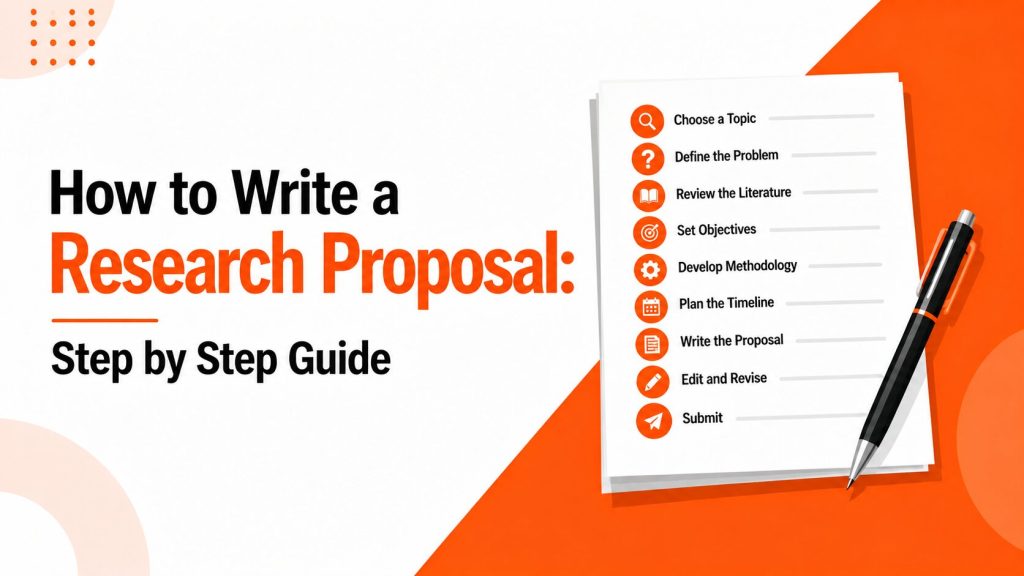
A research proposal is a short document that explains what you plan to study, why it matters, and how you intend to go about it, submitted before you’re given approval to start the actual research. It typically covers your research question, a brief review of existing work on the topic, your planned methodology, and a realistic timeline, all written to convince a professor, committee, or funding body that your project is focused, feasible, and worth doing. Unlike the research paper that eventually follows it, a proposal doesn’t present findings, since the research hasn’t happened yet. It presents a plan and makes the case that the plan is sound.
What Is a Research Proposal?
A research proposal is essentially a pitch. You’re not reporting results, you’re asking for permission, funding, or supervisor buy-in to go find them. That shift in purpose changes the tone of the whole document: instead of arguing that your findings matter, you’re arguing that your question matters and that your plan for answering it is realistic given your timeline, skills, and resources.
Almost every research project that involves original data collection, whether it’s a class assignment, a senior thesis, or a funded PhD study, starts with some version of this document. If you’re working toward the paper that eventually follows, it’s worth having a research paper writing guide open alongside this one, since a surprising amount of what belongs in a strong proposal, the research question, the methodology, the framing of significance, carries directly into the paper’s own opening sections once your research is actually done.
Who actually requires this document varies more than students expect. Graduate programs almost always require one before a thesis or dissertation begins. Funding bodies and scholarship committees require them as part of an application. Some undergraduate courses require a short version before a major research paper, mainly to catch an unworkable topic before you’ve invested weeks into it. If your assignment sheet doesn’t say explicitly, it’s worth asking your instructor directly whether they expect a formal proposal or just a brief topic approval, since the two are treated very differently even though students often assume they’re the same thing.
How a Research Proposal Differs From the Paper It Leads To
Students confuse these two documents constantly, mostly because they cover overlapping ground, research question, background, methodology, but they’re doing fundamentally different jobs. A proposal is forward-looking and persuasive. A paper is backward-looking and evidentiary. One argues a plan is worth funding, the other reports what actually happened once you ran it.
| Document | Written | Contains Results? | Main Purpose |
| Research Proposal | Before research begins | No | Convince a reader the plan is sound |
| Research Paper | After research is complete | Yes | Report and interpret what was found |
| Research Paper Summary | After reading someone else’s paper | Yes, condensed | Summarize an existing source |
| Annotated Bibliography | While gathering sources | No | Evaluate sources before writing begins |
That last row matters more than it looks. If you’re gathering sources to support your proposal’s background section, the same evaluation skill covered in our guide to writing an annotated bibliography is exactly what you’re doing informally as you decide which sources are strong enough to cite. And once your actual research is done and you’re summarizing prior studies inside your own paper, that’s the same skill covered in how to write a research paper summary, just applied to someone else’s work instead of a whole document of your own.
The Core Components of a Research Proposal
Requirements vary somewhat by discipline and institution, but according to widely used graduate research proposal guidance from the University of Glasgow, most strong proposals contain the same core elements, just weighted differently depending on the field.
- Title: a clear, descriptive title that states your topic without needing an explanation.
- Problem statement and research question: exactly what you’re investigating and why it’s an open question worth answering.
- Background and literature context: a compressed version of what a full how to write a literature review covers, enough to show you know the field and where your project fits into it.
- Methodology: how you’ll actually collect and analyze your data, detailed enough that a reader could evaluate whether it’s realistic.
- Significance: why the answer matters, to your field, to a broader audience, or both.
- Timeline and, where relevant, budget: a realistic plan for completing the work within the time and resources you actually have.
A few components are optional depending on your field. Empirical social science and lab-based work often expect a short section on ethical considerations, especially if your study involves human participants, while theory-heavy humanities proposals may expect a distinct theoretical framework section instead of a methodology section in the traditional sense. When in doubt, mirror the structure used in recently approved proposals from your own department rather than a generic template, since discipline norms vary more here than almost anywhere else in academic writing.
Before you draft any of these sections, it helps to sketch a research paper outline for the paper you’re eventually aiming to write. Seeing the full shape of the final paper makes it much easier to judge how much detail your proposal actually needs in each section, rather than guessing.
If your program requires a formal outline structure specifically for the proposal itself, that’s a related but distinct document, a research proposal outline, which breaks the proposal’s own sections down before you draft full paragraphs for each one. We’ll cover that structure in more depth in a dedicated guide, but the short version is that it follows the same component list above, just in skeleton form. It’s a similar relationship to how a literature review outline breaks a full literature review down into themes before you draft it in prose, just applied one level up to the proposal as a whole.
Does a Research Proposal Need an Abstract?
Usually not for a class assignment, but often yes for a funding application, scholarship, or formal thesis proposal submitted to a graduate committee. When one is required, it functions the same way an abstract does for a finished paper, a compressed, standalone summary placed at the very top, except here it’s summarizing your plan rather than your results. If you’re not sure whether your specific submission needs one, our guide on writing an abstract covers the format and length expectations, which apply with only minor adjustment to a proposal’s forward-looking version of the same section.
How to Write a Research Proposal, Step by Step
Step 1: Narrow Your Topic Into a Real Question
Start broader than you need to, then narrow until you have a question specific enough to actually answer within your timeline. “Social media and mental health” isn’t a research question. “Does daily Instagram use predict anxiety symptoms in first-year college students” is.
Step 2: Check What’s Already Been Answered
Skim recent literature on your narrowed topic before committing to it. If your exact question has already been answered clearly, you’ll need to adjust it, maybe a different population, a different variable, or a gap the existing research hasn’t addressed yet.
Step 3: Draft Your Problem Statement and Significance
Write one or two paragraphs stating the problem and why it matters. This section does double duty: it’s the same groundwork your paper’s eventual introduction for a research paper will need, so getting it right now saves you rewriting it later.
Keep the significance argument grounded in what your specific study can plausibly show, not what you hope the broader implications might eventually be. Overclaiming here is one of the fastest ways to make an otherwise solid proposal read as naive to an experienced reviewer.
Step 4: Write Your Methodology Section
Describe exactly how you’ll collect and analyze your data: sample size, instruments, procedure, and analysis plan. This is the section reviewers scrutinize hardest, since a great question with a vague or unrealistic plan usually gets sent back before it gets approved.
If you’re not yet sure which method fits your question, it helps to look at how completed studies in your field structure this section. Reading a handful of published methodology sections in your area, even informally, will usually teach you more about realistic scope than any general writing guide can.
Step 5: Build a Realistic Timeline
Break your project into phases, literature review, data collection, analysis, writing, and assign rough dates or durations to each. A proposal with no timeline reads as though you haven’t actually thought through whether the project is doable.
Build in buffer time for the phases most likely to run long, usually data collection and revision, rather than dividing your total time evenly across every phase. A timeline that looks tidy on paper but ignores where projects typically slip is a common reason proposals get flagged for revision even when the research idea itself is strong.
Step 6: Revise for Length and Tone
Cut anything that doesn’t directly support your question, your plan, or your significance argument. A tight, well-organized proposal reads as more credible than a long one padded with background that doesn’t clearly connect to what you’re actually planning to do.
As a final check, read your proposal as if you were the reviewer deciding whether to approve it, not as the person who wrote it. If a stranger to your topic couldn’t summarize your question, method, and timeline back to you after one read, another editing pass is worth the time before you submit.
Research Proposal Example: What a Strong Draft Looks Like
Here’s a condensed, generic version of how these pieces fit together, built around a fictional project so the structure is easy to see clearly.
Title: Late-Night Social Media Use and Sleep Quality Among First-Year College Students
This study investigates whether late-night social media use predicts poor sleep quality among first-year college students, independent of total daily screen time. Prior research has established a general link between screen exposure and sleep disruption, but has rarely isolated timing of use as a distinct variable. This project will survey 150 first-year students over one semester, using validated sleep-quality and social media use scales, then analyze the relationship using regression analysis. Findings would help residence life programs design more targeted guidance around device use rather than blanket screen-time recommendations. Data collection is planned for weeks one through six, analysis for weeks seven through nine, and writing for the remaining four weeks of the term.
Notice that every sentence is doing a specific job, stating the question, showing awareness of prior work, describing the method, arguing significance, and outlining a timeline, without spending space on results that don’t exist yet. That discipline is what separates a strong proposal from a rough draft of the eventual paper’s research paper methodology section.
It’s worth noticing what’s absent too. There’s no findings section, no interpretation of results, and nothing resembling a research paper conclusion, because none of that exists yet. A proposal that accidentally drifts into writing about expected outcomes as though they were confirmed findings is a common tell that a student is thinking in paper mode rather than proposal mode, and it’s worth watching for in your own draft.
How Long Should a Research Proposal Be?
Length varies enormously depending on the level of study and the specific requirement, so always check your assignment sheet or program guidelines first. As a general benchmark, published graduate guidelines from NUS Faculty of Arts and Social Sciences put Masters-level proposals at up to roughly 2,000 words and PhD-level proposals at up to roughly 4,000 words, which lines up with what most programs expect in practice.
| Context | Typical Length |
| Undergraduate class assignment | 500 to 1,500 words, or as specified |
| Masters thesis or dissertation proposal | Up to about 2,000 words |
| PhD dissertation proposal | Up to about 4,000 words |
| Funding or grant proposal | Varies widely by funder, always check guidelines |
If your specific program or scholarship has its own format requirements, those override any general benchmark. According to guidance from Ontario Tech University’s writing center, supervisor and department expectations should always be treated as the primary source of truth, with general guides like this one filling in the gaps rather than overriding anything specific you’ve been told.
Common Reasons Research Proposals Get Rejected or Sent Back
Most rejected proposals aren’t rejected because the topic is uninteresting. They’re rejected because the plan for investigating it doesn’t hold up under a closer read. These are the patterns that show up most often.
- The research question is too broad to answer within a realistic timeline, or too narrow to say much of anything once it’s answered.
- The methodology is vague about how data will actually be collected or analyzed, leaving a reviewer unable to judge whether the plan works.
- The literature review section reads as unrelated background rather than building a specific case for why this exact question is still open.
- The timeline is missing entirely or is clearly unrealistic given the scope of the project.
- The significance section overstates the project’s impact without grounding it in what the study can actually show.
- Formatting or length requirements were ignored, which can get a proposal rejected before the content is even evaluated.
- The proposal was written for the wrong audience, using highly technical language for a general committee or, less often, oversimplifying for a specialist reviewer who expected more precision.
How EssaysHelper Can Help You
If you’re stuck narrowing a topic into an actual research question, or your methodology section keeps coming out vague no matter how many times you rewrite it, you don’t have to work through it alone. EssaysHelper connects students with tutors who can walk through proposal drafts with you, section by section, until the plan is genuinely convincing rather than just technically complete. Our research paper writing service can also support you further down the line, once your proposal is approved and you’re ready to move from planning the research to actually writing it up.
Frequently Asked Questions
What is the difference between a research proposal and a research paper?
A research proposal is written before the research happens and argues that your plan is worth pursuing. A research paper is written after the research is complete and reports what you actually found.
How long should a research proposal be?
It depends heavily on your level of study and specific assignment. As a general guide, Masters proposals often run up to about 2,000 words and PhD proposals up to about 4,000 words, but always follow your program’s specific requirements first.
What should be included in a research proposal?
Most proposals need a title, a problem statement and research question, a brief literature review, a methodology section, an argument for significance, and a timeline. Some also require a budget, depending on the field and funding source.
How do you write a strong research question for a proposal?
Start with a broad topic and narrow it until it’s specific enough to answer within your timeline and resources. A strong research question names a specific population, variable, or relationship rather than a general area of interest.
Does a research proposal need a literature review?
Yes, though it’s usually shorter than a full literature review chapter. Its job is to show you know the existing research well enough to explain why your specific question is still worth asking.
Why do research proposals get rejected?
The most common reasons are a vague methodology, an unrealistic timeline, or a research question that’s either too broad to answer or too narrow to matter. Reviewers are mainly checking whether the plan is actually doable, not just whether the topic is interesting.
Is a research proposal the same as a thesis proposal?
A thesis proposal is a specific type of research proposal written for a thesis or dissertation committee rather than a class or funding body. The core components are the same, though the expectations around length and formality are usually higher.
How detailed should the methodology section of a proposal be?
Detailed enough that someone unfamiliar with your specific project could evaluate whether your plan is realistic. Vague statements like “I will collect data through surveys” without specifics on sample size, instruments, or analysis usually aren’t enough.
Can a research proposal change after it’s approved?
Some adjustment is normal and expected once you actually start the work, especially around methodology details. Major changes to your research question or approach usually need to be discussed with your supervisor or committee first, rather than made unilaterally.
Do you need a research proposal for an undergraduate paper?
Not always, but some courses require a short proposal before a major paper to confirm your topic and plan are workable. Check your assignment instructions, since requirements vary a lot between introductory and advanced courses.
Final Thoughts
A research proposal can feel like an odd assignment, writing convincingly about research you haven’t done yet, but it’s really just planning made visible. Narrow your question until it’s actually answerable, be honest about your methodology instead of vague, and build a timeline you could genuinely follow. Get that combination right and you’re not just clearing a hurdle before your real research starts, you’re giving yourself an actual usable plan for the months of work that come next.