
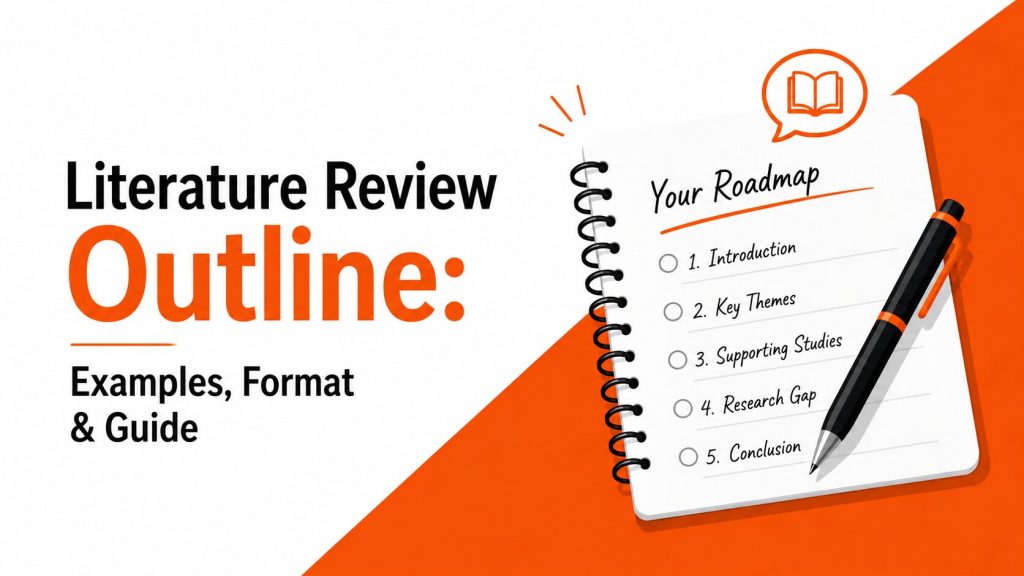
You’ve got fifteen tabs open, half of them PDFs you’ve skimmed twice, and a blank document titled “Lit Review Outline” that has been blank for forty minutes. You know roughly what all these sources say, but the second you try to arrange them into something that isn’t just a list of summaries, everything falls apart. Do you go chronological? Group by theme? What happens to the three papers that don’t fit cleanly into any category you’ve come up with?
This is the exact point where a lot of otherwise organized students stall out, not because they don’t understand their sources, but because nobody ever showed them what a literature review outline is actually supposed to look like before you start writing full sentences. That’s what this guide walks you through: structure, formatting, and the actual thinking behind it.
What a Literature Review Outline Actually Is
A literature review outline is the skeleton you build before you write a single paragraph of the actual review. It maps out which sources you’re discussing, in what order, and under which theme or argument each one falls, before you commit to full sentences. Skipping this step is exactly how you end up with a first draft that reads like a source by source book report, this study said X, this study said Y, with no real thread connecting them. An outline forces you to decide, upfront, what the actual story of your literature review is: where researchers agree, where they clash, and where the gap sits that your own research paper is stepping into.
Without it, you’re essentially trying to write and organize at the same time, which is exactly why so many drafts stall out around the third or fourth source, once the summaries start blurring together and you lose the thread of what you’re actually arguing. If you think of your literature review as one piece inside the larger process of writing a research paper, the outline is what keeps that one section from ballooning out of proportion with everything else you still need to write.
The Core Structure of a Literature Review Outline
Every literature review outline, regardless of subject or citation style, is built around four basic blocks. Getting these four right solves most of the structural confusion before it starts.
The introduction section of your outline should note your topic, the general scope of what you’re covering, and your organizing principle, meaning how you plan to group the studies inside your outline. You don’t need full sentences yet, just a note on what claim or theme your review is building toward.
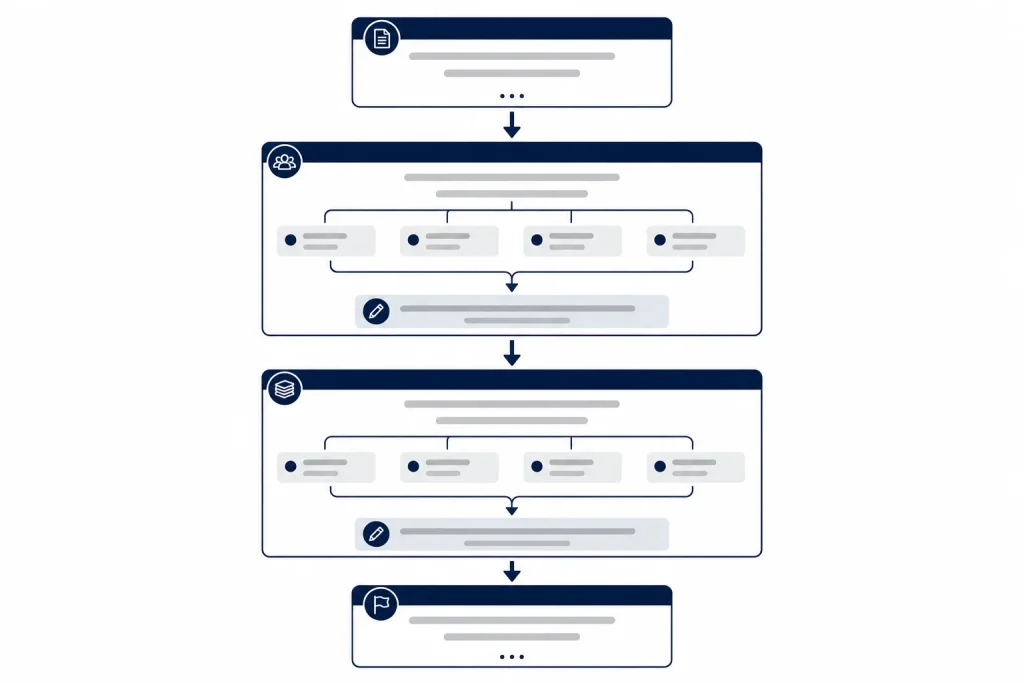
The body of a literature review outline is where the real decisions happen. Most reviews use one of two organizing structures. A thematic outline groups sources by shared idea or variable, so every study touching on, say, remote work productivity sits under one heading, regardless of publication year. A chronological outline instead tracks how understanding of a topic developed over time, useful when the field itself has shifted significantly, like research on a technology that changed rapidly. Some outlines blend both, organizing broadly by theme and chronologically within each theme.
Synthesis is the part most outlines skip, and it’s the part that actually matters most. Under each thematic heading, you’re not just listing which sources belong there, you’re noting, in a phrase or two, how they relate: do they agree, contradict, build on each other, or leave an open question. This synthesis note is what turns your eventual paragraph from a list of citations into actual analysis.
The conclusion section of your outline should point to the gap your own paper addresses. This is usually the shortest part of the outline itself, but it’s the section most closely tied to why you’re writing the literature review at all, since it’s what justifies your own research question.
Written out as a skeleton, a basic literature review outline looks something like: introduction and scope, theme one with supporting sources and synthesis notes, theme two with supporting sources and synthesis notes, continuing for each major theme, then a conclusion that ties the gap back to your research question.
Literature Review Outline in APA Format
If your literature review outline needs to follow APA format, the structural logic from the previous section doesn’t change. What changes is formatting: heading levels, in-outline citations, and how you label each section. This matters especially if your literature review sits inside a broader research paper outline that also needs to follow APA formatting consistently throughout.
APA style uses a strict heading hierarchy, and carrying that hierarchy into your outline early saves you from restructuring later. Level 1 headings are centered and bold, level 2 are left aligned and bold, level 3 are left aligned, bold, and italicized, and so on. Applying these levels in your outline, not just your final draft, means your outline and your paper’s actual document structure line up from the start, which is one less thing to fix during revision.
Citations inside an APA format outline are usually shorthand. Author last name and year is enough at the outline stage, full APA citations belong in the actual draft and reference list, not cluttering your outline. The point of the outline is to track which source goes where, not to format citations twice.
Here’s what a basic APA format literature review outline looks like in practice:
| Section | What Belongs Here |
| Title | Working title of your literature review, in APA title case, centered and bold |
| Introduction | Topic overview, scope, and your organizing principle (thematic or chronological) |
| Theme or subtopic headings (Level 2) | Sources grouped under each shared idea or variable |
| Synthesis notes (under each theme) | Brief note on agreement, contradiction, or gaps between sources in that theme |
| Conclusion | Summary of the overall gap in the literature and how it connects to your research question |
| References (separate page) | Full APA citations for every source used in the outline, alphabetized |
For the exact rules on heading levels, margins, and reference list formatting, the official APA Style guidelines are worth bookmarking directly, since APA updates specific formatting details between editions and it’s easy to work from an outdated example without realizing it.
One APA specific outline mistake worth flagging early: students often format their outline with in-text citations styled exactly like the final draft, using full parenthetical citations at the outline stage. That’s not wrong exactly, it’s just extra work you’ll redo anyway once you know your final source order, so shorthand at the outline stage is worth the time saved.
Common Pain Points When Outlining a Literature Review
A few frustrations come up constantly once students actually sit down to build the outline, not just write the review. Here’s what they actually look like, and what fixes each one.
You keep listing sources instead of grouping them
If your outline reads like “Source A found X, Source B found Y, Source C found Z” with no shared heading tying them together, you haven’t grouped by theme yet, you’ve just made a bibliography with extra steps. The fix is to ask, before adding a source to your outline, what broader question or variable it’s actually answering, and file it under that question rather than under its own name.
Your outline reads like a stack of summaries, not an argument
This happens when every bullet under a theme just restates what one study found, with nothing connecting them. Add one synthesis line per theme specifically noting how the sources relate to each other, agreement, contradiction, or an open question, and that line alone usually fixes the summary list problem.
You genuinely don’t know how much detail belongs in an outline versus the final draft
An outline needs enough detail that you could hand it to someone else and they’d understand your argument’s shape, source names, the point each makes, and how themes connect, but it doesn’t need full sentences or exact quotes. If you’re writing complete paragraphs inside your outline, you’ve essentially started your draft, which isn’t wrong, just worth knowing that’s what’s happening.
You lose track of which source supports which point once you pass 15 or 20 sources.
This is less an outlining skill issue and more a tracking issue. A simple two column running list, source and one line takeaway, kept separate from your actual outline document, solves this before it becomes a problem, since you can reference it while building your thematic groupings without re-reading full papers each time.
You realize three sources all say roughly the same thing, and you’re not sure if that’s redundant or worth keeping.
It’s rarely redundant. Multiple sources agreeing is itself a finding worth noting in your synthesis line, since it shows a point of consensus in the field, which matters as much as disagreement does. The mistake is dropping repetitive seeming sources instead of using them to show where the literature agrees.
If you’re building this outline as part of a larger capstone project, this is also the stage where getting a second set of eyes on your source grouping helps the most, and Essayshelper’s tutors work across every discipline specifically on this kind of structural feedback, catching thematic gaps before you’ve written full paragraphs around them.
Literature Review Outline Examples Across Disciplines
The core structure holds across every field, but what belongs inside that structure shifts depending on your discipline. A few patterns worth knowing before you start grouping your own sources:
STEM and natural sciences
Outlines in these fields tend to organize around methodology and findings rather than theory. Expect headings grouped by experimental approach or variable studied, with synthesis notes focused on where results replicate, conflict, or remain inconclusive across studies.
Social sciences and psychology
Outlines here often blend thematic and chronological structure, tracking how a concept, a specific cognitive bias or social phenomenon, has been studied and redefined over time, alongside grouping by the specific variable or population each study examined.
Humanities and arts
These reviews more often organize around theoretical framing or ongoing scholarly debate rather than empirical findings. Instead of grouping by variable, you’re often grouping by which theoretical lens or interpretive tradition each source uses, and your synthesis notes track where interpretations diverge.
Business and health sciences
These fields frequently expect a more applied structure, sources grouped by practical outcome or intervention type, with synthesis notes oriented toward what the literature suggests works, doesn’t work, or remains unclear for practitioners.
None of this changes the four core blocks from earlier, introduction, thematic body, synthesis, conclusion, it just changes what you’re grouping by and what your synthesis notes are actually tracking. If you’re unsure which pattern fits your specific assignment, checking a couple of recently published reviews in your own field’s journals is usually faster than guessing from a generic template.
Using a Literature Review Outline Generator or Template
Literature review outline generators and downloadable templates are useful as a starting scaffold, they’ll hand you a pre-built structure with placeholder headings so you’re not staring at a blank page. What they can’t do is know your sources, your field’s conventions, or where your specific themes actually sit, so treat the output as a shell you’re filling in deliberately, not a finished outline you just drop citations into.
Before trusting any template, check that it actually separates a synthesis section from a simple source listing section, a lot of free templates skip this distinction entirely and just give you a heading per source, which reintroduces the exact list of summaries problem covered earlier. Also check that it matches your required citation style, since a generic template built for one style rarely maps cleanly onto APA’s specific heading levels without some editing.
A generator can save you the blank page moment. It can’t make the thematic decisions that actually make a literature review outline useful.
Where the Literature Review Outline Fits Into Your Larger Research Paper
Once your literature review outline is solid, it’s usually just one section inside a much bigger paper, and it helps to see how it connects to everything else you’re writing. If you want the deeper mechanics of turning this outline into full paragraphs, how to write a literature review covers that step specifically, the rest of this section is about everything around it.
How to Write an Abstract
An abstract summarizes your entire paper, including your literature review’s core takeaway, your methodology, and your main finding, in roughly 150 to 250 words, written after the rest of your paper is done. It should stand alone, meaning someone reading only the abstract should understand your paper’s core argument without needing the full text. Write it last, since summarizing work you haven’t finished yet almost always means rewriting it once your actual conclusions are in place.
Research Paper Introduction
Your introduction sets up the research question your literature review is ultimately building toward, moving from general context down to your specific focus. It should preview the gap in existing research your paper addresses, the same gap your literature review outline’s conclusion section identified. Keep it focused on the destination, not a second literature review crammed into your opening paragraphs.
Research Paper Conclusion
Your conclusion restates your core finding and its significance without introducing new evidence at this late stage. It should explicitly connect back to the gap your literature review identified, showing how your research addressed it. A strong conclusion also notes limitations honestly and points toward what remains unanswered, rather than overstating what a single paper actually proves.
Research Paper Methodology
Your methodology section explains exactly how you gathered and analyzed your data, detailed enough that another researcher could replicate your approach. It should justify why your chosen method fits your specific research question, not just describe the steps mechanically. This section is where your literature review’s gap turns into an actual research design.
Research Paper Results Section
The results section reports what you found, without interpreting what it means yet, that interpretation belongs in your discussion section. Present findings clearly using tables or figures where they genuinely clarify the data, and stick closely to what the data actually shows rather than what you expected it to show.
Research Paper Discussion Section
Your discussion section is where you interpret your results and connect them back to the existing literature you outlined earlier, noting where your findings align with, contradict, or extend previous research. This is the section most directly in conversation with your literature review, so referencing specific sources by name here strengthens the connection.
How to Summarize a Research Paper
Summarizing a research paper means condensing its research question, method, key finding, and significance into a few sentences, without including your own opinion on the work. A useful test is whether someone who hasn’t read the paper could explain what it found and why it matters, based only on your summary. This is essentially what you’re doing at a smaller scale inside every source entry in your literature review outline.
Annotated Bibliography Basics
An annotated bibliography lists your sources in citation format, each followed by a short paragraph summarizing and evaluating that source. Unlike a literature review outline, it treats each source as a standalone entry rather than grouping them thematically, which makes it a useful intermediate step before you start building thematic groupings for your outline.
How to Write an Annotated Bibliography
Start with the full citation in your required style, then write a concise paragraph covering the source’s main argument or findings, its methodology if relevant, and a brief note on its credibility or relevance to your topic. Keep each entry to roughly 150 words, and resist the urge to summarize the entire source, focus on what’s actually useful for your project.
How to Write a Research Proposal
A research proposal outlines what you plan to study, why it matters, and how you intend to study it, essentially pitching your project before you’ve done the work. It typically includes a working title, a brief literature context, your research question, proposed methodology, and expected significance, all pointing toward why the project is worth doing.
Research Proposal Outline
A research proposal outline mirrors the shape of the proposal itself: introduction and problem statement, brief literature context, research question, methodology, and anticipated significance. It’s shorter than a full literature review outline since you’re previewing existing research rather than fully synthesizing it, usually just enough to show your project fills a real gap.
FAQs About Literature Review Outline
What does a basic literature review outline look like?
A basic literature review outline includes an introduction stating your topic and scope, several thematic or chronological sections grouping your sources, a synthesis note under each section explaining how those sources relate, and a conclusion identifying the gap your own research addresses. It is a skeleton, not full paragraphs.
How do I outline a literature review in APA format?
Follow the same thematic or chronological structure as any literature review outline, then apply APA heading levels, level 1 centered and bold, level 2 left aligned and bold, and so on, and use shorthand author-year citations rather than full APA references at the outline stage.
What is a good example of an APA style literature review outline?
A good example separates your outline into a title, introduction, theme based sections each with grouped sources and a synthesis note, and a conclusion, all following APA heading formatting. The table earlier in this guide shows exactly what belongs in each section.
Should I use a literature review outline generator, or write my own from scratch?
A generator is fine as a starting scaffold to avoid the blank page, but it cannot know your sources or your field’s conventions, so you will still need to fill in the thematic groupings and synthesis notes yourself before the outline is actually useful.
What should go in the introduction section of a literature review outline?
Your outline’s introduction should note your general topic, the scope of what you are covering, and your organizing principle, whether you are grouping sources thematically or chronologically. You do not need full sentences yet, just enough to guide the sections that follow.
How detailed should a literature review outline be before I start writing the full draft?
It should be detailed enough that someone else could understand your argument’s shape from it alone, source names, the point each makes, and how themes connect, but it does not need full sentences or direct quotes. If you are writing complete paragraphs, you have effectively started drafting.
Is a literature review outline different from a research paper outline?
Yes. A research paper outline covers your entire paper, introduction through conclusion, while a literature review outline focuses specifically on organizing and synthesizing your sources, and often becomes one section nested inside the larger research paper outline.
What makes a good literature review outline template I can reuse for future projects?
A reusable template clearly separates source grouping from synthesis notes, rather than just listing sources under headings, and it is flexible enough to match different heading styles, since APA, MLA, and other formats structure headings differently.
How many sources should I include when outlining a literature review?
There is no fixed number, it depends on your assignment and field, but once you are working with more than 15 or 20 sources, keeping a separate running list of each source’s one line takeaway alongside your outline makes the grouping process far more manageable.
Where can I find a sample literature review outline to model mine after?
Your university’s writing center or library guide is usually the most reliable source, since examples there are typically vetted for your specific citation style. This guide’s APA outline table is also a solid starting structure to adapt to your own topic.
Final Thoughts
A literature review outline isn’t extra work standing between you and your actual writing, it’s what keeps your actual writing from collapsing into a list of summaries once you’re several sources deep. Nail the four basics, introduction, grouped body sections, synthesis notes, and a conclusion pointing at your gap, and the format details, APA headings, generators, discipline specific patterns, become easy adjustments rather than starting over moments. The next time you’re staring at a stack of open tabs with no idea how to organize them, start with the outline first, decide what your sections are, what belongs under each, and how those sources actually relate to each other, before you write a single full paragraph. Everything downstream gets easier once that skeleton is in place.