
Writing a narrative essay sounds simple at first. You tell a story, add a few personal details, and submit it. But once students actually start writing, the confusion begins. Should it be in first person? Does it need a thesis statement? How many paragraphs should it have? What is the correct narrative essay format? And if your teacher asks for APA or MLA, how do you format a story like an academic paper?
That is where many students get stuck. They may have a strong personal experience to share, but they do not know how to organize it in a way that feels clear, focused, and suitable for school or college. A narrative essay is not just a diary entry. It is a structured piece of writing with a beginning, middle, and end. It also needs a clear point, lesson, or reflection.
This guide explains the narrative essay format in a simple way. You will learn how to create an outline for a narrative essay, how to format a personal narrative essay, how to use MLA format for a narrative essay, how APA format for narrative essay writing works, and how to format dialogue in a narrative essay without making it look messy.
If you are already feeling unsure about your essay structure, formatting, or citations, Essay Helper can also support students who need help understanding academic writing requirements. But first, let’s break the format down step by step.
What Is Narrative Essay Format?
Narrative essay format is the way your story is organized and presented on the page. It includes both the structure of the story and the academic formatting rules your teacher wants you to follow.
In simple words, a narrative essay format answers two questions:
- What order should my story follow?
- How should my essay look when I submit it?
The first part is about structure. A narrative essay usually includes an introduction, setting, characters, conflict, important events, climax, resolution, and reflection. This helps the reader follow your experience from the beginning to the end.
The second part is about presentation. Your teacher may ask you to use MLA, APA, or another academic format. This can affect your spacing, title, heading, page numbers, citations, and reference page.
A good narrative essay is personal, but it is still organized. It can describe a real experience, a meaningful event, a lesson learned, or a turning point in your life. According to Purdue OWL’s guide on narrative essays, narrative essays often tell a story based on personal experience, but they still need a clear purpose.
So, when students search for narrative essay format, they are usually looking for three things:
- How to structure the story
- How to format the paper
- How to make the essay sound academic but still personal
That combination is what makes narrative writing different from other essay types.
Why Narrative Essay Format Matters for Students
Many students lose marks not because their story is weak, but because the essay is poorly organized. The idea may be meaningful, but the writing jumps from one moment to another without a clear path. The result feels confusing.
A proper format helps your reader understand what happened, why it mattered, and what changed because of it.
Students often face these problems when writing narrative essays:
- They start the story too broadly.
- They include too many events.
- They forget to explain the lesson or reflection.
- They write the essay like a casual story instead of an academic assignment.
- They do not know where dialogue should go.
- They mix MLA and APA formatting.
- They submit a strong story with weak structure.
For example, a student might write about “the day I failed an exam,” but instead of focusing on one meaningful moment, they describe their whole school year. That makes the essay too broad. A better narrative essay would focus on one specific day, one conflict, and one lesson.
This is also why academic assignment support can be useful for students who understand their story but struggle to organize it according to a rubric. Narrative essays may feel creative, but they still need academic control.
A strong format gives your essay direction. It tells the reader, “This is where the story begins, this is the problem, this is the turning point, and this is what I learned.”
Basic Narrative Essay Format
The basic narrative essay format follows a story arc. It should not feel like a random collection of memories. It should move from one point to the next in a way that feels natural.
Here is the basic structure most students can follow:
| Narrative Essay Section | Purpose | What to Include | Student Tip |
| Introduction | Introduces the story | Hook, background, setting, main idea | Start with a moment, not a boring summary |
| Setting and characters | Helps the reader understand the scene | Time, place, people involved | Keep details relevant |
| Conflict or main event | Shows the problem or challenge | What happened and why it mattered | Focus on one central event |
| Rising action | Builds the story | Events leading to the turning point | Do not add unnecessary scenes |
| Climax | Shows the most important moment | Decision, realization, or emotional peak | Make this moment clear |
| Resolution | Explains what happened after | Outcome of the event | Do not end too suddenly |
| Reflection | Shows the meaning | Lesson learned or personal growth | Connect the story to a bigger idea |
A narrative essay does not always need five paragraphs. Some short essays may follow a five-paragraph structure, while longer essays may need more sections. The key is not the number of paragraphs. The key is flow.
If your essay has a clear beginning, middle, and end, the reader will understand your story more easily.
Narrative Essay Structure: Beginning, Middle, and End
A narrative essay is built around movement. Something changes between the first paragraph and the last paragraph. That change may be emotional, personal, academic, or social.
Beginning
The beginning introduces the situation. This is where you bring the reader into the story. You can start with a scene, a question, a surprising statement, or a moment of tension.
For example:
I stood outside the classroom with my assignment in one hand and an apology in the other.
This type of opening works better than:
This essay is about a time I learned responsibility.
The first example creates a scene. The second example explains the topic too directly. Narrative essays usually work better when you show the reader the moment before explaining the lesson.
If you need more ideas for starting essays strongly, learning about types of hooks can help you choose an opening that fits your story.
Middle
The middle develops the story. This is where you explain what happened, who was involved, what problem appeared, and how the situation became more serious.
The middle should not include every detail. It should include only the details that move the story forward.
For example, if your essay is about learning confidence during a class presentation, you do not need to describe every class you attended that semester. You need to describe the moments that connect directly to the presentation, your fear, your preparation, your mistake, and your final realization.
End
The ending resolves the story. It should explain what changed and why the event mattered.
A weak ending simply says:
That is why I learned a lesson.
A stronger ending shows the lesson through reflection:
I still feel nervous before speaking in public, but now I understand that confidence does not always come before action. Sometimes, it arrives after you decide to speak anyway.
That kind of ending gives meaning to the story.
Narrative Essay Outline Example
Here is a sample outline for a narrative essay topic:
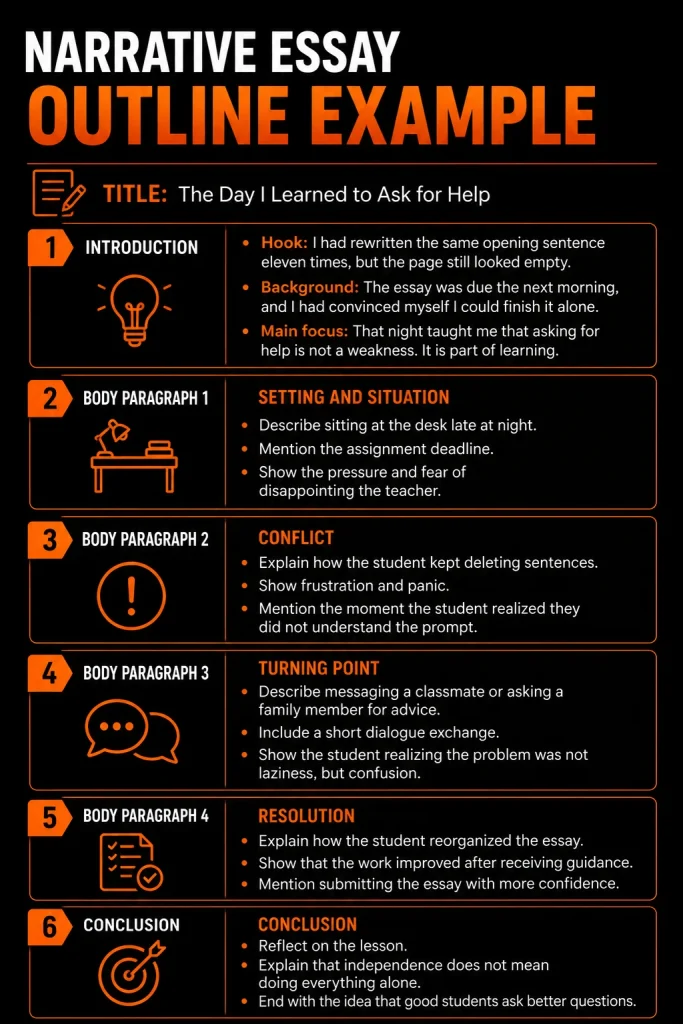
Title: The Day I Learned to Ask for Help
Introduction
Hook:
I had rewritten the same opening sentence eleven times, but the page still looked empty.
Background:
The essay was due the next morning, and I had convinced myself I could finish it alone.
Main focus:
That night taught me that asking for help is not a weakness. It is part of learning.
Body Paragraph 1: Setting and Situation
Describe sitting at the desk late at night.
Mention the assignment deadline.
Show the pressure and fear of disappointing the teacher.
Body Paragraph 2: Conflict
Explain how the student kept deleting sentences.
Show frustration and panic.
Mention the moment the student realized they did not understand the prompt.
Body Paragraph 3: Turning Point
Describe messaging a classmate or asking a family member for advice.
Include a short dialogue exchange.
Show the student realizing the problem was not laziness, but confusion.
Body Paragraph 4: Resolution
Explain how the student reorganized the essay.
Show that the work improved after receiving guidance.
Mention submitting the essay with more confidence.
Conclusion
Reflect on the lesson.
Explain that independence does not mean doing everything alone.
End with the idea that good students ask better questions.
This is a simple but strong outline because it focuses on one experience, one conflict, and one lesson. If you are still choosing a topic, reviewing different narrative essay topics can help you find a story that has enough depth for a full essay.
How to Format a Personal Narrative Essay
Many students search for how to format a personal narrative essay because this type of essay feels different from research-based writing. A personal narrative usually uses first person, which means you can use “I,” “me,” and “my.” However, it should still be clear, organized, and purposeful.
A personal narrative essay usually includes:
- A specific personal experience
- A clear setting
- Real people or characters involved
- A problem, challenge, or turning point
- Sensory details
- A reflective conclusion
- A meaningful lesson
The biggest mistake students make is writing a personal narrative like a diary entry. A diary entry can be private, emotional, and unstructured. A personal narrative essay is different. It uses personal experience to communicate a clear idea to the reader.
For example, instead of writing:
I was very nervous and then everything happened and I learned a lot.
You can write:
My hands shook as I unfolded the speech paper. I had practiced the first sentence all night, but when I looked at the room, the words disappeared.
The second version creates a scene. It helps the reader feel the moment.
Personal narrative essays can also vary depending on the type of story you are writing. Some are reflective. Some are descriptive. Some are focused on conflict. Some are about personal growth. Understanding the types of narrative writing can help you choose the right approach.
Narrative Essay Paragraph Format
Each paragraph in a narrative essay should move the story forward. Unlike argumentative essays, narrative paragraphs can be more flexible. Still, they should not feel random.
A strong narrative paragraph usually includes:
- A topic or scene focus
- Action or description
- Specific detail
- Emotion or thought
- A transition to the next moment
Here is an example of a weak paragraph:
I was late for school. It was raining. I forgot my homework. My teacher was angry. I felt bad.
This gives information, but it feels flat. Now compare it with a stronger narrative paragraph:
By the time I reached the school gate, rain had soaked through my sleeves and blurred the ink on my homework sheet. I pressed the paper against my chest, hoping somehow it would still look presentable. When I walked into class ten minutes late, my teacher stopped speaking and looked straight at me.
The second paragraph uses setting, action, and emotion. It creates a moment the reader can picture.
Transitions are also important. A narrative essay should not jump suddenly from one scene to another. You can use time transitions such as later, after a few minutes, by the next morning, or that evening. You can also use reflective transitions that show a change in thought.
If transitions confuse you, learning about understanding bridge in an essay can help you connect paragraphs smoothly.
How to Format Dialogue in a Narrative Essay
Dialogue can make a narrative essay more engaging, but only if it is formatted correctly. Many students lose marks because their dialogue looks confusing on the page.
Here are the basic rules for how to format dialogue in a narrative essay:
Use quotation marks around spoken words.
Start a new paragraph when a new person speaks.
Use commas, periods, question marks, and exclamation marks correctly.
Add speaker tags when needed.
Do not overuse dialogue.
Make sure the dialogue has a purpose.
Correct Dialogue Example
“I can’t do this,” I said, staring at the blank screen.
“You already started,” my sister replied. “Now you just need to keep going.”
Her words sounded simple, but they changed the way I looked at the assignment.
Incorrect Dialogue Example
“I can’t do this” I said. “You already started” my sister replied “Now you just need to keep going.”
The incorrect version is hard to read because punctuation and paragraph breaks are missing.
When Should You Use Dialogue?
Use dialogue when it reveals something important. It should show conflict, emotion, personality, or change. Do not add dialogue just to make the essay longer.
For example, this dialogue helps the story:
“You always wait until the last minute,” my brother said.
“I know,” I replied, “but this time I do not even know where to begin.”
This exchange shows tension and the student’s problem. That makes it useful.
If you are using published dialogue from a book, interview, film, or outside source, you may also need citations. In that case, follow the format your instructor requires.
MLA Format for a Narrative Essay
MLA format for a narrative essay is common in English, literature, and humanities classes. The good news is that MLA formatting is usually simple.
The MLA Style Center is the official resource for MLA style, and many schools also use university writing center guides for practical examples.
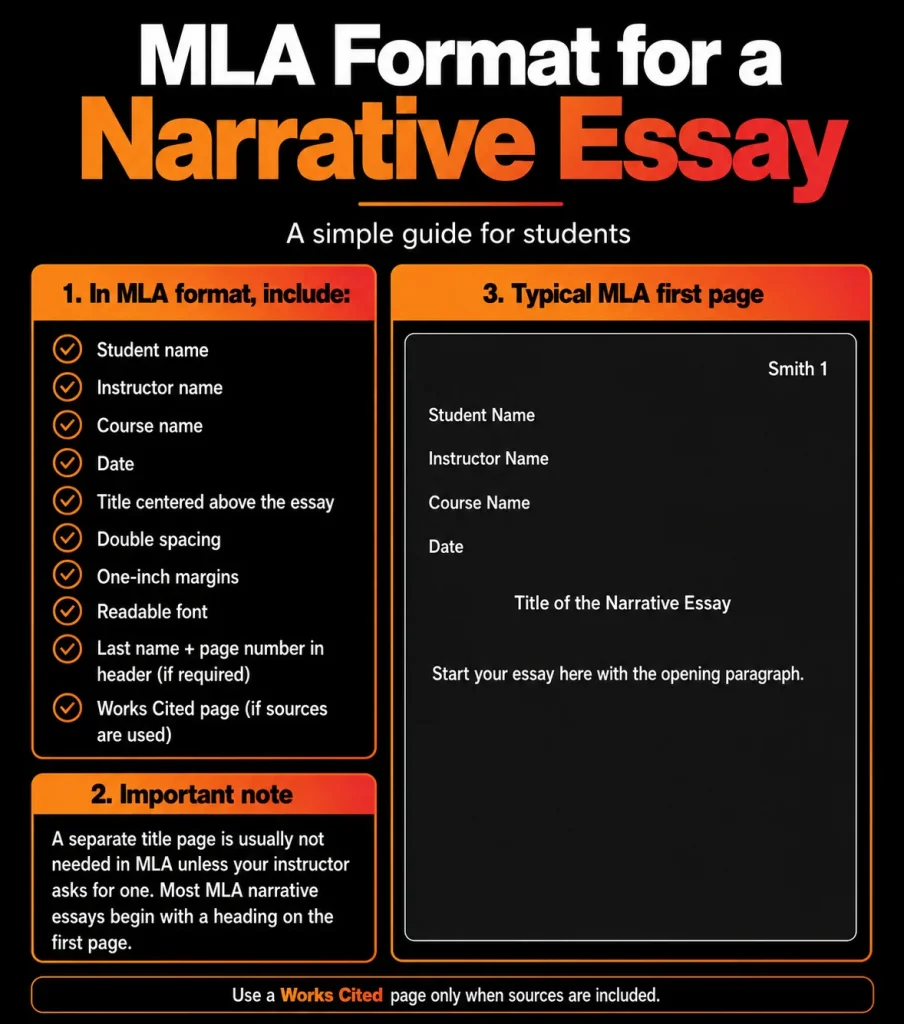
In MLA format, your narrative essay usually includes:
- Your name
- Your instructor’s name
- Course name
- Date
- Title centered above the essay
- Double spacing
- One-inch margins
- Readable font
- Last name and page number in the header if required
- Works Cited page if you use sources
A separate title page is usually not needed in MLA unless your instructor asks for one. Many MLA essays begin with a heading on the first page.
Here is the usual MLA first-page layout:
- Student Name
- Instructor Name
- Course Name
- Date
- Title of the Narrative Essay
Start your essay here with the opening paragraph.
For spacing, many instructors expect MLA essays to be double spaced. If you are unsure what that means, this guide on double spaced in essay can help you understand how spacing affects the final paper.
Sample Narrative Essay MLA Format
Here is a simple sample narrative essay MLA format layout:
Ava Thompson
Professor Carter
English 101
12 March 2026
The Morning I Learned to Slow Down
I used to think being busy meant being responsible. Every morning, I rushed through the same routine: alarm, shower, backpack, bus, class. I rarely stopped long enough to notice what I was forgetting. That changed on a cold Tuesday morning when I arrived at school with my presentation notes missing and my confidence almost gone.
This sample shows the standard MLA heading at the top left. The title is centered. The essay begins below the title. If the essay uses no outside sources, a Works Cited page may not be needed. But if the student quotes a book, article, website, interview, or class text, a Works Cited page should be included.
A common student mistake is adding APA-style title page details to an MLA essay. That can make the paper look inconsistent. Always check whether your teacher wants MLA, APA, or another style.
APA Format for Narrative Essay
APA format for narrative essay writing is often used in psychology, education, social sciences, nursing, and other academic fields. APA formatting is more detailed than MLA, especially when it comes to title pages and references.
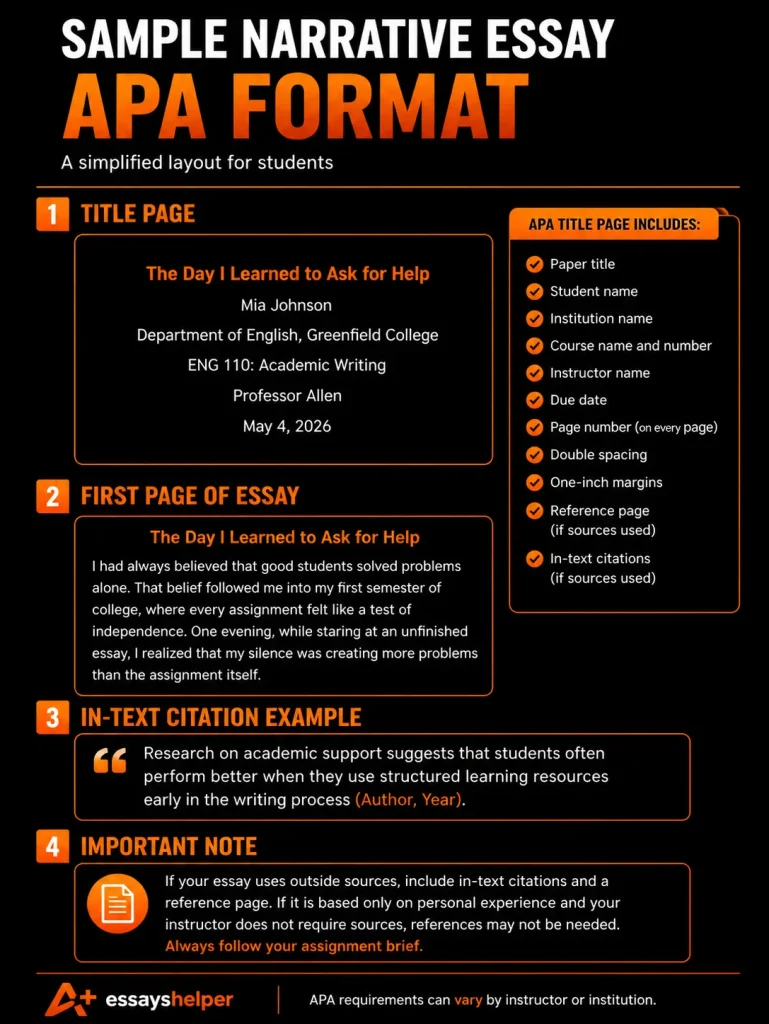
The official APA student title page guidance explains that a student title page usually includes the paper title, author name, author affiliation, course number and name, instructor name, due date, and page number. APA also provides a student paper setup guide for formatting the full paper.
In APA format, a narrative essay may include:
- Title page
- Page number
- Paper title
- Student name
- Institution name
- Course name and number
- Instructor name
- Due date
- Double spacing
- One-inch margins
- Reference page if sources are used
- In-text citations if outside sources are used
Student papers usually do not need a running head unless the instructor or institution asks for it. However, page numbers are commonly required.
APA narrative essays can still be personal, but they should look academically polished. If your essay includes personal reflection and outside research, citations become important.
For example, if you write a narrative essay about learning anxiety and include a source about student stress, you need an in-text citation and a reference entry.
Sample Narrative Essay APA Format
Here is a simplified sample narrative essay APA format layout:
Title Page:
The Day I Learned to Ask for Help
Mia Johnson
Department of English, Greenfield College
ENG 110: Academic Writing
Professor Allen
May 4, 2026
First Page of Essay:
The Day I Learned to Ask for Help
I had always believed that good students solved problems alone. That belief followed me into my first semester of college, where every assignment felt like a test of independence. One evening, while staring at an unfinished essay, I realized that my silence was creating more problems than the assignment itself.
If the essay includes outside sources, APA in-text citations may look like this:
Research on academic support suggests that students often perform better when they use structured learning resources early in the writing process (Author, Year).
The reference page would then include the full source details. If your narrative essay is based only on personal experience and your instructor does not require sources, you may not need references. Always follow your assignment brief.
Narrative Essay Format Example
Below is a short narrative essay format example. It shows a hook, setting, conflict, dialogue, turning point, and reflection.
The Moment I Realized Preparation Matters
I knew I was in trouble when the teacher called my name and I could not remember the first sentence of my presentation. The classroom was quiet, but my thoughts were louder than they had ever been. I stood up slowly, holding a note card that suddenly looked useless.
The presentation was supposed to be simple. We had been asked to speak for three minutes about a book that changed our thinking. I had chosen the book quickly, written a few notes the night before, and told myself I would “figure it out” while speaking. That plan seemed harmless until I was standing in front of thirty students with nothing but panic in my throat.
“You can begin when you’re ready,” my teacher said.
I nodded, but I was not ready. I looked at the note card again. The words were there, but they did not connect to anything in my mind. I started with the title of the book, then paused. Someone coughed near the back of the room. A few students looked down at their desks. I felt my face grow warm.
For the next two minutes, I spoke in broken sentences. I repeated the same idea twice. I forgot the author’s name. I ended by saying, “That’s all,” even though I had not explained the main reason the book mattered to me.
After class, I expected my teacher to criticize me. Instead, she handed back my note card and asked, “How much time did you spend preparing?”
I wanted to say enough, but that would not have been true.
“Not much,” I admitted.
She nodded. “You had something meaningful to say. You just did not give yourself enough time to find it.”
That sentence stayed with me longer than the embarrassment. I had always thought preparation was about avoiding mistakes. That day, I realized preparation was also about respecting my own ideas. When I rushed, I did not just risk a bad grade. I gave myself no chance to express what I actually thought.
The next time I had a presentation, I started three days early. I wrote an outline, practiced aloud, and changed the parts that sounded unclear. I was still nervous when I stood in front of the class, but this time my words had somewhere to go.
I did not become a perfect speaker that week. I still made small mistakes. But I learned that confidence is not something students magically have. Sometimes, confidence is built quietly the night before, one prepared sentence at a time.
Why This Narrative Essay Format Works
This example works because it follows a clear structure. The introduction begins with a tense moment. The body explains the background, conflict, and turning point. Dialogue is used briefly and meaningfully. The conclusion reflects on the lesson instead of simply ending the story.
The essay also stays focused on one experience. It does not try to describe the student’s entire academic life. That focus makes the message stronger.
Narrative Essay Format Checklist
Before submitting your narrative essay, use this checklist:
- Does the essay have a clear beginning, middle, and end?
- Does the introduction include a hook?
- Is the story focused on one main experience?
- Does each paragraph move the story forward?
- Is the setting clear?
- Are the characters or people involved easy to understand?
- Is the conflict or challenge clear?
- Is dialogue formatted correctly?
- Does the essay include reflection?
- Is the conclusion meaningful?
- Is the essay in MLA or APA if required?
- Is it double spaced if your instructor asked for it?
- Are sources cited if you used any?
- Did you proofread for grammar, spelling, and punctuation?
- Does the final draft match the assignment rubric?
This checklist can help you catch small mistakes before submission. Many students focus only on the story and forget the formatting. Both matter.
Common Narrative Essay Format Mistakes
Students often make similar mistakes when writing narrative essays. The good news is that most of these mistakes are easy to fix once you know what to look for.
Writing Without an Outline
A narrative essay can quickly become messy if you start writing without a plan. An outline helps you decide where the story begins, where the turning point happens, and how the essay ends.
Starting Too Broadly
Do not begin with a huge statement such as:
Everyone faces challenges in life.
This is too general. Start closer to the actual story.
Better example:
I was halfway to school when I realized my speech notes were still on my desk.
Adding Too Many Events
A narrative essay should usually focus on one main event. If you include too many experiences, the essay may feel rushed or confusing.
Forgetting Reflection
The reader should understand why the experience mattered. Reflection is what turns a story into a narrative essay.
Using Dialogue Incorrectly
Dialogue should be formatted clearly. Start a new paragraph for each speaker and use quotation marks properly.
Mixing APA and MLA Rules
Do not use an APA title page with an MLA heading unless your instructor specifically asks for a hybrid format. Choose the correct style and stay consistent.
Writing Too Casually
A narrative essay can use personal language, but it should still be polished. Avoid slang, unclear sentences, and overly casual phrasing unless it appears inside meaningful dialogue.
This is where academic writing support can help students who have a good story but need help improving structure, tone, grammar, and formatting. The tone of your essay matters too, so understanding different writing tones can help you keep your personal story suitable for academic submission.
How to Make a Narrative Essay More Engaging
A narrative essay should not only explain what happened. It should make the reader feel present in the moment. That does not mean adding drama for no reason. It means using details carefully.
Start With a Meaningful Moment
Instead of starting with background information, begin near the action.
Weak opening:
I am going to write about a time I learned responsibility.
Stronger opening:
The bus doors closed just as I reached the curb, and my assignment was still printing at home.
The stronger version creates tension immediately.
Use Sensory Details
Sensory details help the reader imagine the scene. You can describe what you saw, heard, felt, or noticed.
For example:
The hallway smelled like raincoats and wet paper.
This detail makes the setting more vivid.
Keep the Story Focused
Do not include every detail from the day. Include details that connect to the main lesson.
Use Dialogue Carefully
Dialogue can make a scene feel real, but too much dialogue can distract from the story. Use only the lines that reveal conflict, emotion, or change.
Show Emotions Through Actions
Instead of saying:
- I was nervous.
- You can write:
- I folded the corner of my paper again and again until it almost tore.
- This shows nervousness through action.
Connect the Story to a Lesson
A narrative essay should leave the reader with something to think about. The lesson does not need to be dramatic, but it should be clear.
Students who struggle to turn a personal experience into a structured essay can also use narrative essay writing help when they need guidance with planning, drafting, formatting, or editing.
Narrative Essay Format vs Other Essay Formats
Narrative essays are different from other essay types because they tell a story. However, they still need organization and purpose.
| Essay Type | Main Purpose | Format Style | Student Tip |
| Narrative essay | Tells a story with a lesson or reflection | Beginning, middle, end, reflection | Focus on one meaningful event |
| Personal essay | Explores a personal idea or experience | Flexible but reflective | Connect experience to insight |
| Argumentative essay | Proves a claim | Thesis, evidence, counterargument | Use logic and sources |
| Expository essay | Explains a topic | Clear sections and evidence | Stay objective |
| Reflective essay | Analyzes personal learning | Experience plus reflection | Explain how your thinking changed |
| Cause and effect essay | Explains reasons and results | Causes, effects, analysis | Keep relationships clear |
Narrative essays are more story-based than argumentative or expository essays. But that does not mean they are easier. A strong narrative essay still needs a clear structure, effective language, and careful editing.
If you are working on different kinds of assignments, essay writing help can support students with structure, research, editing, and formatting across multiple essay types. For longer academic projects, students may also need dissertation help when the writing requires deeper research, chapter planning, or advanced academic formatting.
When Should You Ask for Help with Narrative Essay Formatting?
It is normal to need help with narrative essay formatting, especially when your assignment brief is unclear. Students often understand the story they want to tell, but they struggle to turn that story into a polished academic essay.
You may need help if:
You do not understand the rubric.
- You are unsure whether to use APA or MLA.
- You do not know how to create an outline.
- Your essay feels more like a diary entry than an academic narrative.
- You are confused about dialogue formatting.
- You need help with citations.
- Your story has too many events.
- You are not sure how to write the reflection.
- You need editing before submission.
EssaysHelper can be useful for students who want guidance with narrative essay structure, formatting, proofreading, citations, and academic writing. The goal is not just to finish the essay, but to make sure the final draft is clear, organized, and suitable for the assignment.
If you are still planning your topic, you can also explore related academic writing resources such as guides on personal essays, hooks, and narrative topics. For example, students writing reflective stories may benefit from reading about writing a personal essay, while students preparing other speaking or writing assignments may find different narrative essay topics helpful.
FAQs About Narrative Essay Format
What is the correct narrative essay format?
The correct narrative essay format usually includes an introduction, setting, characters, conflict, climax, resolution, and reflection. Your teacher may also ask for APA, MLA, or another academic format, so always check the assignment brief.
How do I create an outline for a narrative essay?
Start by choosing one main experience. Then plan the hook, background, conflict, turning point, resolution, and lesson learned. A clear outline helps your story stay focused instead of turning into a list of memories.
What is the best way of outlining a narrative essay?
The best way is to organize the essay around a beginning, middle, and end. Begin with the situation, build toward the main problem or turning point, and end with reflection on what the experience taught you.
How do I use MLA format for a narrative essay?
In MLA format, you usually place your name, instructor’s name, course, and date at the top left of the first page. The title is centered, the essay is double spaced, and a Works Cited page is added only if sources are used.
How do I use APA format for narrative essay writing?
APA format usually includes a title page, page number, title, student name, institution, course, instructor, and due date. If you use outside sources, you also need in-text citations and a reference page.
What does a sample narrative essay APA format include?
A sample narrative essay APA format usually includes a title page, double-spaced text, page numbers, and a reference page if sources are used. The essay can still be personal, but the paper should follow APA presentation rules.
What does a sample narrative essay MLA format look like?
A sample narrative essay MLA format usually starts with a four-line heading on the first page, followed by a centered title and the essay text. It is normally double spaced and uses a header with the student’s last name and page number if required.
How do you format dialogue in a narrative essay?
Use quotation marks around spoken words and start a new paragraph each time a different person speaks. Keep punctuation inside the quotation marks and use speaker tags when the reader needs to know who is talking.
How do you format a personal narrative essay?
A personal narrative essay is usually written in first person and follows one meaningful experience. It should include a clear beginning, middle, and end, with reflection that explains why the experience mattered.
Does a narrative essay need citations?
A narrative essay does not always need citations if it is based only on personal experience. However, if you use outside sources, class readings, interviews, statistics, or published material, you should cite them in the required format.
Conclusion
The best narrative essay format helps you tell a focused story with a clear structure, meaningful details, and strong reflection. It is not enough to simply describe what happened. You need to show why the experience mattered and how it changed your thinking.
A strong narrative essay usually has a clear beginning, middle, and end. It introduces the setting, develops a conflict or challenge, builds toward a turning point, and ends with a lesson or insight. If your instructor asks for APA or MLA, your paper should also follow the correct formatting rules for headings, spacing, title pages, citations, and references.
Before submitting, always check your assignment brief. Different schools, courses, and professors may have different expectations. Once you understand the required format, your story becomes much easier to organize.
EssaysHelper can support students who need help with narrative essay writing, formatting, editing, citations, or academic guidance. Whether you are struggling with the outline, dialogue, APA format, MLA format, or the final reflection, the right support can help you turn your personal story into a clear and polished academic essay.