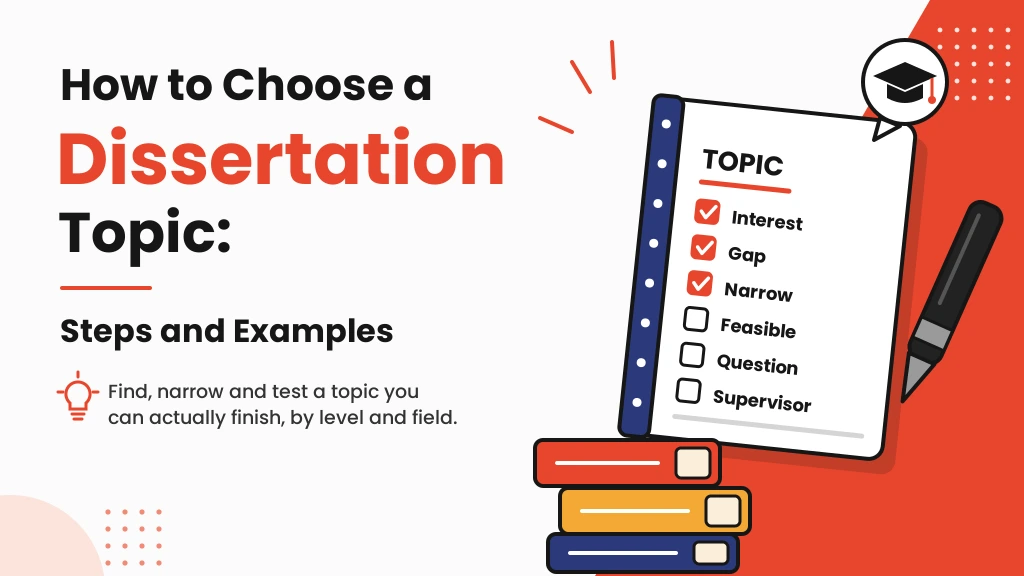
To choose a dissertation topic, start with a subject you genuinely care about, check what your course and recent research leave open, and narrow it to one focused question you can answer. Then test that you can get the data or sources within your time, word limit and ethics rules, and agree it with your supervisor. A good topic is interesting to you, relevant to your field, narrow enough to finish and feasible with the resources you have.
If you are planning the whole project, our guide on how to write a dissertation covers every stage. This guide on how to choose a dissertation topic focuses on the first and often hardest decision: what to research. You will get an eight step method, a topic scoring matrix, worked examples by field and level, and a plan for when you feel stuck.
Most students struggle in the same places. Some have no ideas at all. Others have too many and cannot choose. Many pick a topic that is far too broad, discover too late that the data is out of reach, or worry that their idea is boring. Each of these problems has a fix, and you will find them below.
What Makes a Good Dissertation Topic?
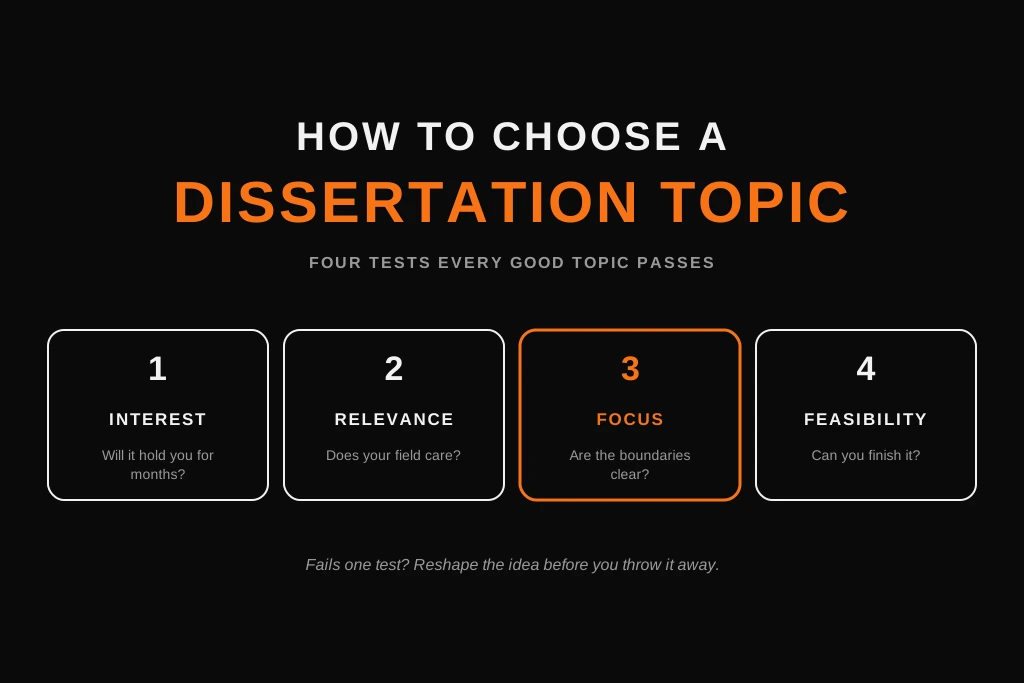
A good dissertation topic passes four tests. If it fails one, it usually needs reshaping rather than throwing away.
1. Interest
You will live with this topic for months, so it has to hold your attention. The University of Hull’s dissertation guide warns that students who choose what seems easy often end up bored by the work. Interest is what keeps you reading when the deadline is far away and the data is messy.
2. Relevance
The topic should sit clearly inside your subject and connect to debates, problems or practice that people in your field care about. A relevant topic is easier to justify, easier to find sources for and easier for your supervisor to support.
3. Focus
Being far too broad is the most common mistake, according to Edge Hill University’s guide to choosing a topic. A focused topic has clear boundaries: a defined group, place, period, text or variable. The University of Edinburgh’s taught MSc handbook puts it well, saying a research question must have a clear focus with definable boundaries.
4. Feasibility
Can you actually do it? Check the word count, the deadline, your other commitments, the equipment or software you need, access to people or archives, and whether the project needs ethics approval. A brilliant idea that cannot be finished in time is not a good dissertation topic.
Hull’s guide adds one more useful test: the topic should not be so narrow that there is nothing to say or no published work to draw on. You are aiming for the middle ground, where the question is small enough to answer well and big enough to matter.
Before You Choose: What Your Department Expects
Before you brainstorm, spend twenty minutes with your handbook. It saves weeks later, and it stops you falling for a topic your department would never approve. Look for five things.
Rules and deadlines
Find the word limit, the topic approval deadline, the proposal or form you must submit and any list of approved research areas. Some departments let you choose freely. Others give a list of themes, or match you to a supervisor first and expect the topic to fit that person’s expertise.
Ethics approval
If your project involves people, such as interviews, surveys or observation, you will usually need ethics approval before you collect data. Approval can take weeks, and some topics, such as those involving children or vulnerable groups, take longer or are not allowed at your level. Check early, because this one rule can decide whether a topic is realistic.
How the topic fits the chapters
Your topic has to fill a set of chapters within a fixed word count, from the background and research question through to the findings and what they mean. Our guide to dissertation structure shows how those chapters fit together. Keep that shape in mind as you choose, because a topic that cannot be split into a clear question, a method and a set of findings will be hard to write up.
Topic approval forms
Many departments ask you to submit a short form before you start: a working title, a research question, a sentence on method and a note on ethics. Find the form now and read the questions, because they tell you exactly what a finished topic should contain. If you can fill in every box, your topic is nearly ready.
Supervisor allocation
Some departments assign supervisors before topics are chosen, and others match supervisors to the topics students propose. If you are matched first, read your supervisor’s staff page and recent publications. A topic close to their expertise usually gets better guidance. If you propose first, choosing a topic that fits at least one member of staff makes approval easier.
Examples from your course
Edge Hill suggests looking at examples from your own course to see the expected scope. Many departments keep past dissertations in the library or online. Read the titles of ten recent ones. You will quickly see how narrow successful topics usually are.
Who does what
Your supervisor advises, but the topic is yours. Edinburgh’s handbook is direct about this: supervisors will not formulate research questions for you. Go to your first meeting with ideas, even rough ones.
How to Choose a Dissertation Topic, Step by Step
This eight step method takes you from a blank page to a topic you can defend. Most students need two to three weeks to work through it.
Step 1: List what interests you
Spend fifteen minutes writing down every module, lecture, reading, news story or real world problem from your subject that caught your attention. Do not judge the ideas yet. Hull’s guide suggests looking at things that make you distinct, such as a placement, part time job, study abroad or personal experience, because they often lead to more interesting projects.
It also helps to think about where you want to go next. A topic linked to a job you want, a master’s course you are applying for or a skill you want to build, such as interviewing or data analysis, gives the project value beyond the grade. Hull’s guide makes the same point about considering how a topic fits your future study or career. Keep this list somewhere you can add to it over the next week, because new ideas often appear once you start looking.
Step 2: Mine your course notes and best assignments
Look back at the essays and reports where you scored well or enjoyed the reading most. An assignment question you only had space to touch on can become a dissertation topic. You already know some of the sources, which gives you a head start. Feedback from markers is useful too: a comment such as this point deserves more space is often a ready made lead. Pull out three or four of these leads and add them to your list from Step 1, so you have a mix of personal interests and course based ideas to compare.
Step 3: Scan recent research for gaps
For your top three or four ideas, search your library databases for research from the last five to ten years. Your subject librarian can show you which databases suit your field. Edge Hill notes that an early look at published work shows the research context and where the gaps are. You are not writing your dissertation literature review yet. You are checking two things: that enough has been published to build on, and that something is still unclear, disputed, untested in a new setting or out of date.
Read the final sections of a few recent articles, where authors often suggest future research. Those suggestions are some of the best ready made gaps you will find.
Step 4: Brainstorm angles
For each idea, ask who, where, when and how. Who is affected? Where could you study it? Which period? Which method could answer it? Edge Hill suggests another trick: add a third area and look at where the areas meet. For example, social media plus mental health is huge, but social media plus mental health plus first year nursing students is far more workable.
Step 5: Narrow the topic
Define your key terms, narrow one or more of the variables and set a timeframe. Edge Hill also makes a reassuring point: you can hang your bigger ambitions on a more precise and specific topic. A small, sharp study often says more about a big issue than a broad survey ever could.
Step 6: Check feasibility
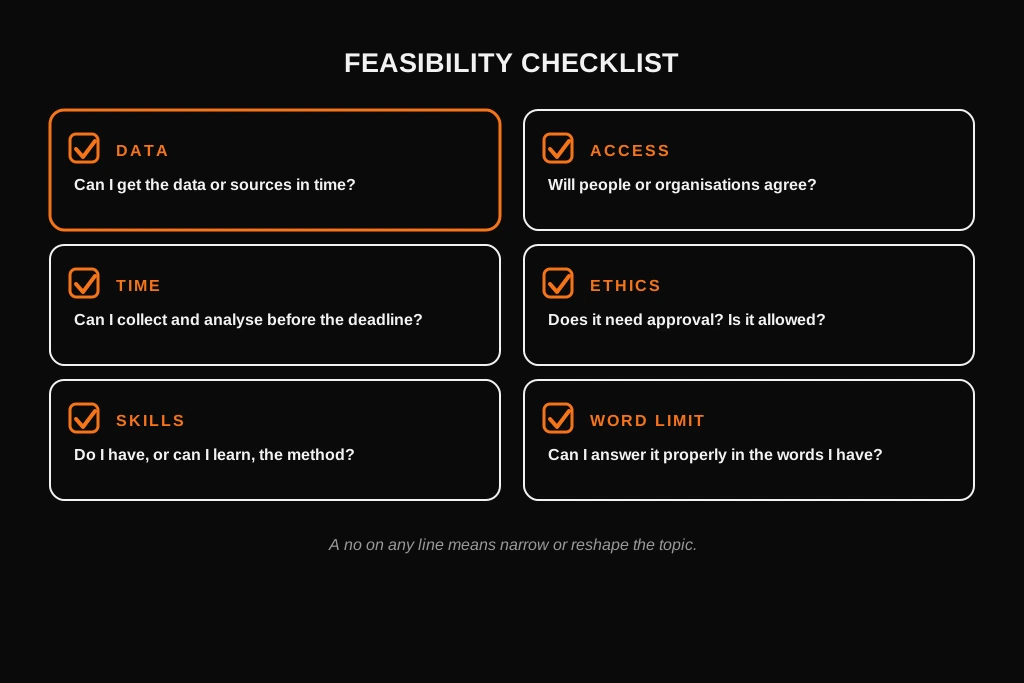
Use the checklist below for your best one or two options.
- Data: can you get the data, texts or archives, and in time?
- Access: will the people or organisations agree to take part?
- Time: can you collect and analyse everything before the deadline?
- Ethics: does it need approval, and is it allowed at your level?
- Skills: do you have, or can you learn, the method it needs?
- Word limit: can you answer the question properly in the words you have?
Step 7: Draft a research question
Turn the topic into one question. Hull’s guide says good questions are open, not yes or no, and should be clear, focused, answerable within the time frame and with the data available, relevant to your field and significant. If the main question is too big, split it into two or three sub-questions that together answer it.
Step 8: Get supervisor feedback
Take your best two or three options to your supervisor, each with a one line question and a note on how you would research it. A short email works well before a meeting. Something like this:
Dear [Name], I am choosing my dissertation topic and would value your view on three options. 1) [Topic and question]. 2) [Topic and question]. 3) [Topic and question]. For each I have checked that data or sources are available, and I lean towards option [number] because [reason]. Could we discuss which is most feasible at our next meeting? Thank you, [Your name]
A three week topic plan
If you have a deadline for topic approval, this pace works for most students.
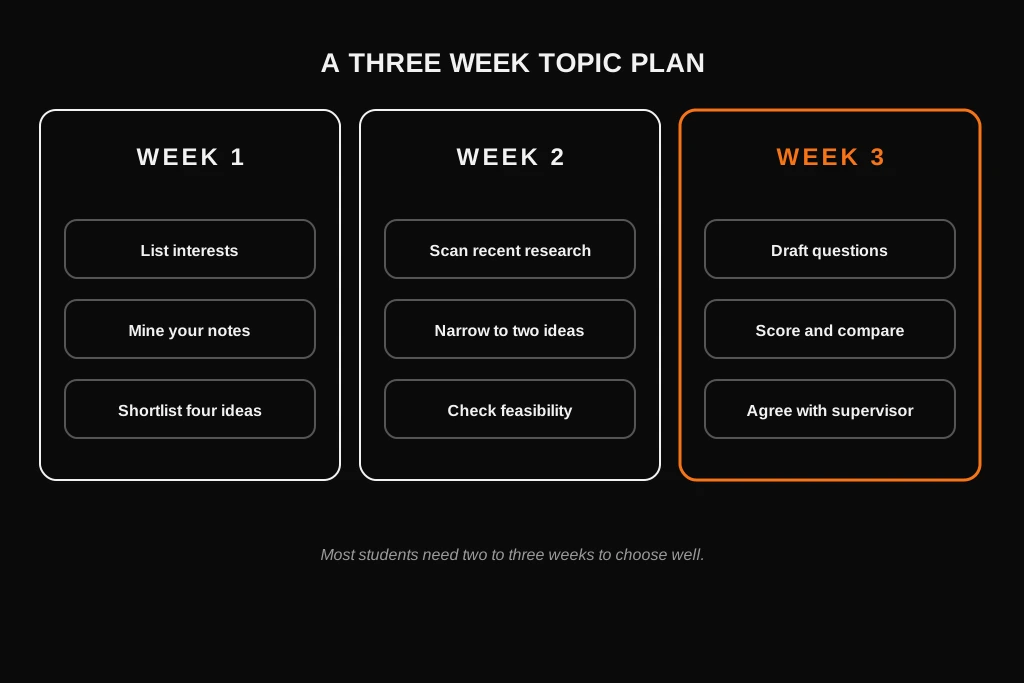
- Week 1: list interests, mine your notes and shortlist four ideas.
- Week 2: scan recent research, brainstorm angles, narrow to two ideas and run the feasibility checks.
- Week 3: draft a research question for each, score them, email your supervisor and decide.
From Broad Idea to Research Question
Most first ideas are subject areas, not topics. The table shows how four broad ideas narrow into questions a student could actually answer. All examples are invented for illustration.
| Field | Broad idea | Narrower topic | Researchable question |
|---|---|---|---|
| History | Women in the First World War | Women’s factory work in one British town, 1915 to 1918 | How did the local newspaper describe women munitions workers in [town] between 1915 and 1918? |
| Education | Homework | Homework feedback in lower secondary maths | How do Year 8 maths teachers in two schools decide what feedback to give on homework? |
| Psychology | Sleep and students | Sleep and exam stress in first year undergraduates | Is self reported sleep quality related to exam stress among first year students at one university? |
| Nursing | Nurse burnout | Burnout among newly qualified ward nurses | What do newly qualified nurses on medical wards describe as the main sources of stress in their first year? |
A worked example in prose
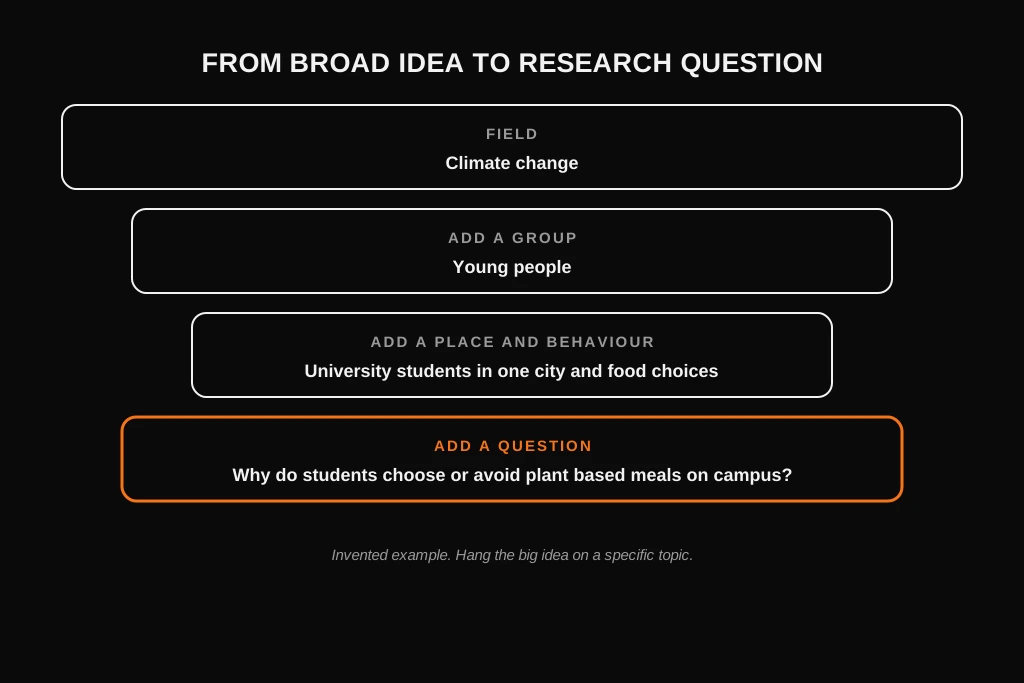
Imagine you start with “climate change”. That is a field, not a topic. Add a group: young people. Still huge. Add a place and a behaviour: university students in one city and their food choices. Now add a question: what reasons do students give for choosing or avoiding plant based meals on campus? You now have a topic with boundaries, a likely method (interviews or a short survey) and a clear link back to the big issue. That is exactly what Edge Hill means by hanging a big idea on a specific topic.
How to Compare Your Topic Ideas
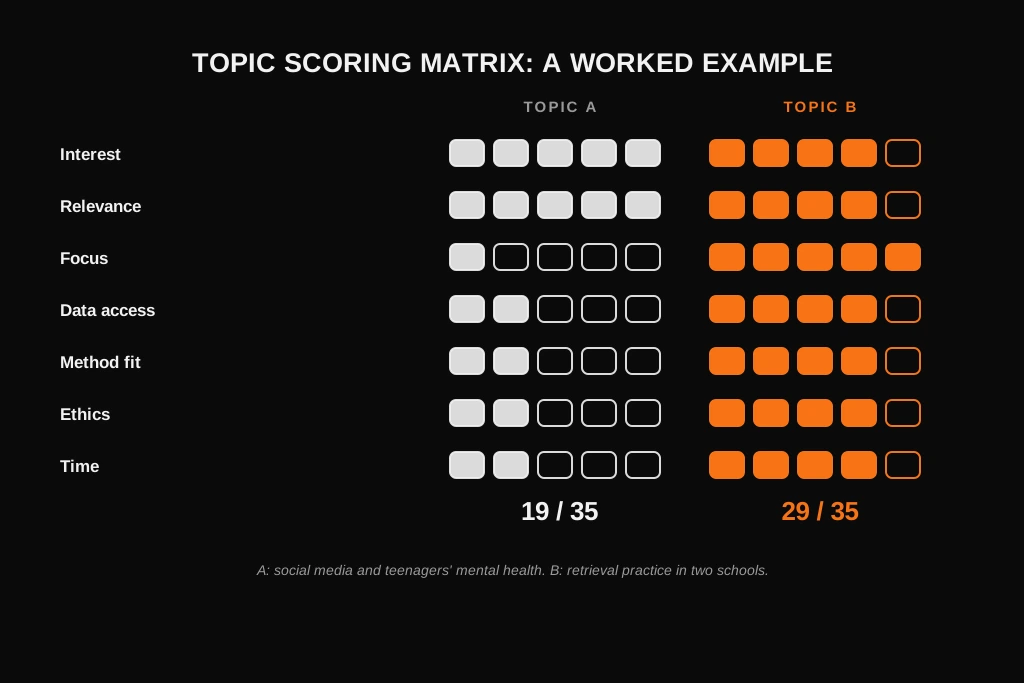
When you have two or three possible topics, a simple scoring matrix makes the choice less emotional. Score each idea from 1 (weak) to 5 (strong) on seven criteria, then total them. Here is a worked example with two invented topics: Topic A is “Social media and teenagers’ mental health” and Topic B is “How Year 10 teachers in two schools use retrieval practice”.
| Criterion | What to ask | Topic A | Topic B |
|---|---|---|---|
| Interest | Will I still care in six months? | 5 | 4 |
| Relevance | Does it connect to my field’s debates? | 5 | 4 |
| Focus | Are the boundaries clear? | 1 | 5 |
| Data access | Can I get the data in time? | 2 | 4 |
| Method fit | Do I have a method that can answer it? | 2 | 4 |
| Ethics | Can it be approved at my level? | 2 | 4 |
| Time | Can I finish before the deadline? | 2 | 4 |
| Total | Out of 35 | 19 | 29 |
Topic A scores higher on interest, but it is far too broad and involves under 18s, which raises ethics hurdles at many universities. Topic B is narrower, easier to access and easier to finish. A good compromise is often to keep the interest of Topic A and borrow the shape of Topic B, for example by studying how first year students describe their own social media use during exams.
Why method fit matters
A topic is only as good as the method that can answer it. If your question needs a large survey but you have six weeks and no participants, the topic will stall. If it needs archive visits you cannot afford, the same thing happens. When you score method fit, think ahead to your dissertation methodology: what kind of data you would collect, how you would analyse it, and whether you have the skills or time to learn. Choosing a topic and choosing a method are really one decision.
Choosing a Topic by Level
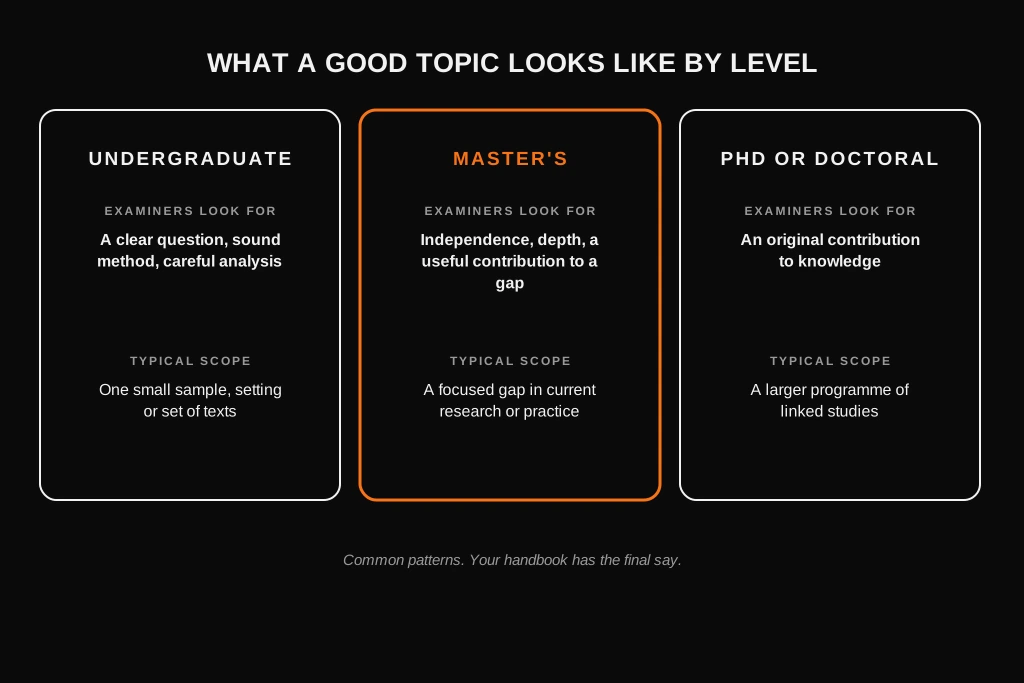
What counts as a good topic changes with the level of your degree. Your handbook and supervisor have the final say, but these patterns are common.
Choosing an undergraduate dissertation topic
At undergraduate level, a clear, well scoped project done carefully matters more than originality. Secondary data, a small survey, a set of interviews or a close reading of a few texts are all common. Pick a topic linked to a module you enjoyed, so you already know some of the reading.
Choosing a topic for a master’s dissertation
At master’s level you are expected to work more independently, engage more deeply with current research and say something useful about a gap. Edinburgh’s taught MSc handbook says the dissertation should not be purely descriptive or just a review of existing work. Many master’s students choose a topic linked to their work, placement or future career, which can help with access to data.
Choosing a PhD or doctoral dissertation topic
At doctoral level the topic must support an original contribution to knowledge and sustain several years of work. San Francisco State University’s tips on choosing a topic suggest asking whether you will still find it interesting in five to twenty years, whether it fits your department’s priorities, and whether you can fund it and reach the resources and participants you need. Doctoral topics are usually shaped in close discussion with a supervisor or committee.
| Level | What examiners usually look for | Typical topic scope |
|---|---|---|
| Undergraduate | A clear question, sound method, careful analysis | One small sample, setting or set of texts |
| Master’s | Independence, depth, a useful contribution to a gap | A focused gap in current research or practice |
| PhD or doctoral | An original contribution to knowledge | A larger programme of linked studies or chapters |
Undergraduate vs Masters Dissertation
An undergraduate dissertation is usually the first independent research project you complete, while a master’s dissertation is longer and expects more independence and depth. Length differs: one university handbook gives about 8,000 to 10,000 words for a 30 credit undergraduate dissertation, while Edinburgh’s school of social and political science sets 15,000 words for a 60 credit taught MSc. Originality expectations rise. Supervision tends to be lighter at master’s level. And the research usually engages more closely with current debates. Tip: if you are moving from one to the other, choose a topic one step narrower than you think you need, because the extra words go on depth, not breadth.
Choosing a Topic by Field
Every subject has its own habits. These short notes show what usually works, using invented examples.
Choosing a history dissertation topic
History topics depend on sources. Before you commit, check that you can reach the archive, digitised newspapers or collection you need, and that you can read the language and handwriting. A narrow period, a single place or a specific type of source, such as letters, court records or newspapers, keeps the project manageable.
Choosing an education dissertation topic
Education topics often involve schools, teachers or pupils, so ethics and access are the big hurdles. Talk to a school early if you need one. If access looks unlikely, consider teachers’ views through interviews, published policy documents or existing datasets instead of working directly with children.
Choosing a psychology dissertation topic
Psychology departments often have rules about which methods and populations students may use, and many expect a clear hypothesis or research question with a measurable outcome. Check which questionnaires or tasks your department allows and whether you can recruit enough participants. Replicating a well known study in a new setting is a common and respected choice.
Choosing a nursing dissertation topic
Nursing topics usually come from clinical practice, such as patient safety, communication or staff wellbeing. Many programmes ask students to do a structured review of published studies instead of collecting new patient data, because NHS or hospital ethics approval can take a long time. Check which format your programme expects before choosing.
Business, law, marketing and other social sciences
Business and marketing topics work best when tied to one organisation, sector or case, with data you can reach. Law topics usually centre on one legal problem, statute or line of cases, often with a comparison between two jurisdictions. Sociology, politics, economics and philosophy topics benefit from the same rule as everything else: one clear question, a defined boundary and sources you can access.
Scope, Word Count and Time
Your word limit is a hidden rule for your topic. A question that needs a national survey, three case studies and a historical overview cannot be answered well in 10,000 words. Before you settle on a topic, picture the finished project: how many pages of background, how many on the method, how many on findings. If the picture is crowded, narrow the topic.
Time works the same way. Count the weeks from topic approval to submission, then take off time for ethics approval, recruitment, analysis, writing and editing. Many students find they have only four to six weeks for collecting data. Choose a topic that fits that window.
How Long Should a Dissertation Be?
Dissertation length is the total word limit your department sets, and it varies by university, level and subject. Undergraduate dissertations in the UK are often around 8,000 to 10,000 words, and taught master’s dissertations are often longer, such as the 15,000 word limit noted above. Four points matter for topic choice. The limit decides how big a question you can answer. Check what counts toward it, since some handbooks include tables and footnotes. Penalties for going over can be strict. And a bigger limit should bring depth, not more breadth. Tip: before you agree a topic, sketch a rough word budget for each chapter, and narrow the topic if the budget will not fit.
Dissertation or Thesis?
Students often search for advice and find guides that use different words for the same thing. Knowing the difference helps you find the right guidance.
Dissertation vs Thesis
A dissertation and a thesis are both long pieces of independent research, but the names swap between countries. In the UK, Newcastle University’s academic skills guide describes a dissertation as an extended piece of writing usually done at the end of an undergraduate or master’s degree, and a thesis as a longer, in depth project, usually part of a PhD. In the US the terms are often reversed, as the University of Essex library guide notes.
Three points help. Check which word your university uses. Search with both terms when looking for examples. And follow your own handbook’s rules, whatever the name. Tip: when you read advice online, check which country and level it was written for before you apply it.
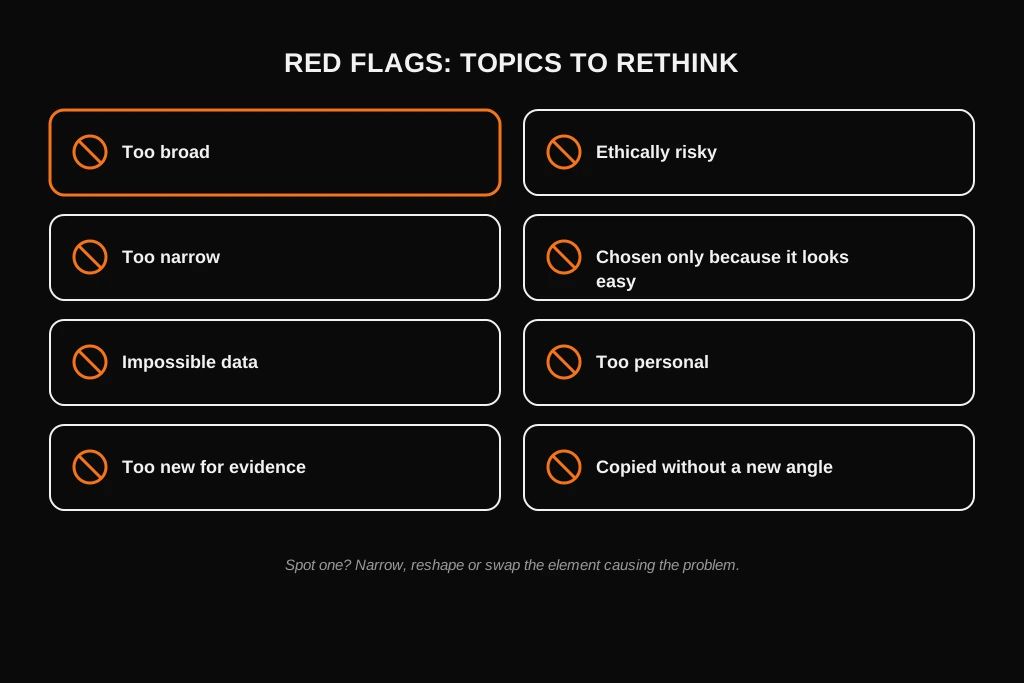
Topics to Avoid: Red Flags
Some topics look attractive but cause problems later. Watch for these warning signs.
- Too broad. If the topic could fill a book, narrow it by group, place, period or variable.
- Too narrow. If there is almost nothing published, you may have nothing to build on.
- Impossible data. Confidential records, hard to reach groups or archives you cannot visit.
- Too new. Events from the last few months may not have enough evidence yet.
- Ethically risky. Sensitive topics or vulnerable groups that need approval you cannot get in time.
- Chosen only because it looks easy. Easy topics often turn into boring ones, as Hull warns.
- Too personal. A topic that is very close to a painful experience can be hard to study with distance.
- Copied from someone else. Reusing a past dissertation’s question without a new angle adds little.
When You Are Stuck
Almost every student gets stuck at some point. Start with one quick test, then use the advice for the four most common situations.
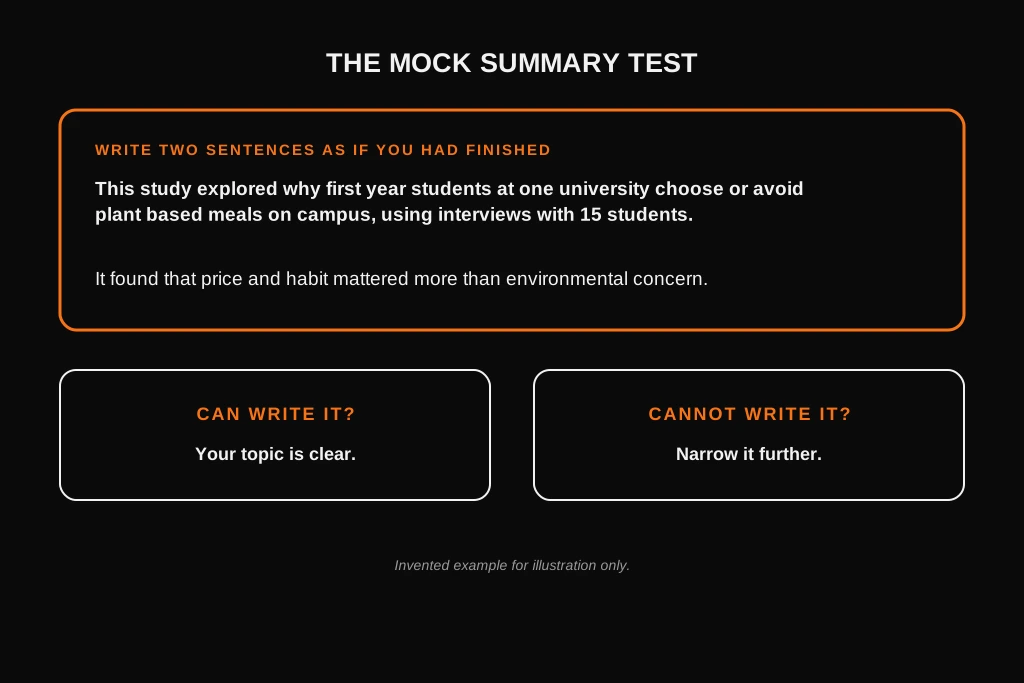
The mock summary test
Here is a quick test for any topic. Write two sentences as if your project were finished: what you studied, how, and what you found or expect to find. This is a rough first version of the short summary you will eventually write as your dissertation abstract. If you cannot write those two sentences, the topic is not clear yet. If you can, you have a topic you can explain to anyone, including your supervisor.
You have no ideas at all
Go back to Step 1 and lower the bar. Write down anything from your course that you found even slightly interesting, then read the future research suggestions at the end of three recent articles in that area. San Francisco State also suggests free writing, talking your ideas through out loud and recording them, or starting from a list of sources you would like to read. Talking to classmates and lecturers helps too, because a chance remark can spark a topic.
You have too many ideas
Run the scoring matrix. Then ask a simple question: which topic could you start researching tomorrow? The one with clear data access usually wins. Keep the others in a notes file, because they may become a later project or a section of this one. If two ideas still tie, choose the one your supervisor knows best, or the one where you already have a contact, a dataset or a set of sources. A small practical head start often decides which project gets finished comfortably.
Your topic stopped working
If data falls through or the question proves too big, do not panic. Usually you can keep the subject and change one element, such as the sample, the setting or the method. Talk to your supervisor as soon as you see the problem, not two weeks before the deadline. Bring one or two possible fixes with you, so the meeting is about choosing a way forward, not about the problem itself.
You want to change your topic
Changing topic is common, especially early on. Check your department’s rules and deadlines for changes, explain the reason to your supervisor, and reuse as much of your reading as you can. Edge Hill reminds students to be ready to change their initial ideas, because a focused topic is easier to manage.
From Topic to Proposal
Once you have a topic and a question, the next step is a working title and a short plan. A working title usually names the topic, the group or setting and sometimes the method, for example: “Feedback on maths homework: a study of Year 8 teachers in two schools”. It can change later. Keep it short, avoid jargon a general reader would not know, and make sure it names the boundaries of your study. A good working title is a promise you can keep: if the title says two schools, the study should cover two schools, not one.
Check your topic one last time
Before you write anything formal, run three final checks. First, say the research question out loud to a friend outside your subject. If they understand what you are asking, it is clear enough. Second, list three sources you already have that speak directly to the question. If you cannot, spend another day reading before you commit. Third, sketch the weeks between now and submission and mark when you will collect data. If the window is tight, cut the scope now, not later. Topics rarely fail because they are boring. They fail because they were too big, too vague or too hard to research in the time available.
Most departments then ask for a written plan before you start collecting data. Our guide on how to write a dissertation proposal walks you through that stage, from setting out your aims to planning your timeline. The work you did choosing your topic, especially the gap you found and the feasibility checks, will form the backbone of that document.
Keep a topic decision note
Write a short note, half a page at most, recording why you chose this topic, what gap it addresses, which options you rejected and why. It takes ten minutes, helps you explain your choice in supervision meetings and is useful later when you write about why the study matters.
How EssaysHelper Can Help You
Choosing a topic is a decision you have to own, but you do not have to make it alone. EssaysHelper can support you at this stage without taking over your work:
- Talking through your shortlist and helping you narrow it.
- Giving feedback on whether a research question is focused and answerable.
- Helping you check feasibility, scope and fit with your word limit.
- Reviewing a draft email or plan before you send it to your supervisor.
If you are stuck between ideas or running short of time, send us your options and your deadline, and we will point you to the quickest next step.
Frequently Asked Questions
How do I choose a dissertation topic?
Start with what interests you, check recent research for gaps, narrow the idea to one focused question, test that you can get the data in time, and agree it with your supervisor.
How do I know if my dissertation topic is too broad?
If it could fill a book, or you cannot name a specific group, place, period or variable, it is too broad. Narrow one element at a time until you can state a single answerable question.
How do I choose a dissertation topic for a master’s degree?
Pick a focused gap in current research or practice, ideally linked to your interests or career, and make sure you can reach the data. Master’s topics need more depth and independence than undergraduate ones.
How is choosing a PhD dissertation topic different?
A doctoral topic must support an original contribution and several years of work. It is usually shaped with a supervisor or committee, and funding and access matter much more.
What if I have no idea what to write my dissertation on?
List anything from your course that interested you, then read the future research suggestions in a few recent articles. Talking ideas through with classmates or a lecturer often sparks a topic.
Can I change my dissertation topic after I start?
Usually yes, especially early on, but check your department’s rules and deadlines. Often you can keep the subject and change just the sample, setting or method.
Will my supervisor choose my dissertation topic for me?
Usually not. Supervisors advise and help you refine ideas, but most expect you to bring your own options and to own the final question.
How do I choose a psychology or education dissertation topic?
Check which methods and participants your department allows, plan for ethics approval early, and choose a narrow question with an outcome you can measure or describe clearly.
How many topic ideas should I take to my supervisor?
Two or three is ideal. Give each a one line question and a note on how you would research it, and say which one you lean towards and why.
How do I turn a dissertation topic into a research question?
Add boundaries such as a group, place and period, then phrase it as an open question that cannot be answered with yes or no. Split it into sub-questions if it is still too big.
Final Thoughts
Learning how to choose a dissertation topic is really about balance. You need a subject that keeps you interested, a question narrow enough to finish and data you can actually reach. Start with your interests, look for a gap, narrow the idea, check it against your time and word limit, and test it with your supervisor. Do not wait for the perfect idea. A focused, feasible topic you can explain in two sentences is far better than a brilliant one you cannot finish, and it gives you a strong start on everything that follows.