
Dissertation methodology is the chapter that explains how and why you carried out your research. It covers your overall approach (qualitative, quantitative, mixed or desk-based), your sample or sources, how you collected and analyzed data, how you protected participants, and what limits your study has. A good methodology lets a reader judge whether your results can be trusted and repeat your steps.
If you are still planning the whole project, start with our guide on how to write a dissertation, then come back here for the detail. This post explains what the chapter is, what each part must say, and how to write it. It also gives you three original examples and a fill-in template, because most students want a model to copy the shape of.
Students usually get stuck in the same places. They confuse methodology with methods, they are unsure how much detail to give, they have no data to collect, or their department’s format looks nothing like the examples online. Each of those is covered below.
What Is Methodology in a Dissertation?
Methodology in a dissertation is the explanation of your research approach and the reasons behind it. It answers a simple question that every examiner asks: how do you know what you claim to know? It shows what you did, why you did it that way, and why that way suited your research question better than the alternatives.
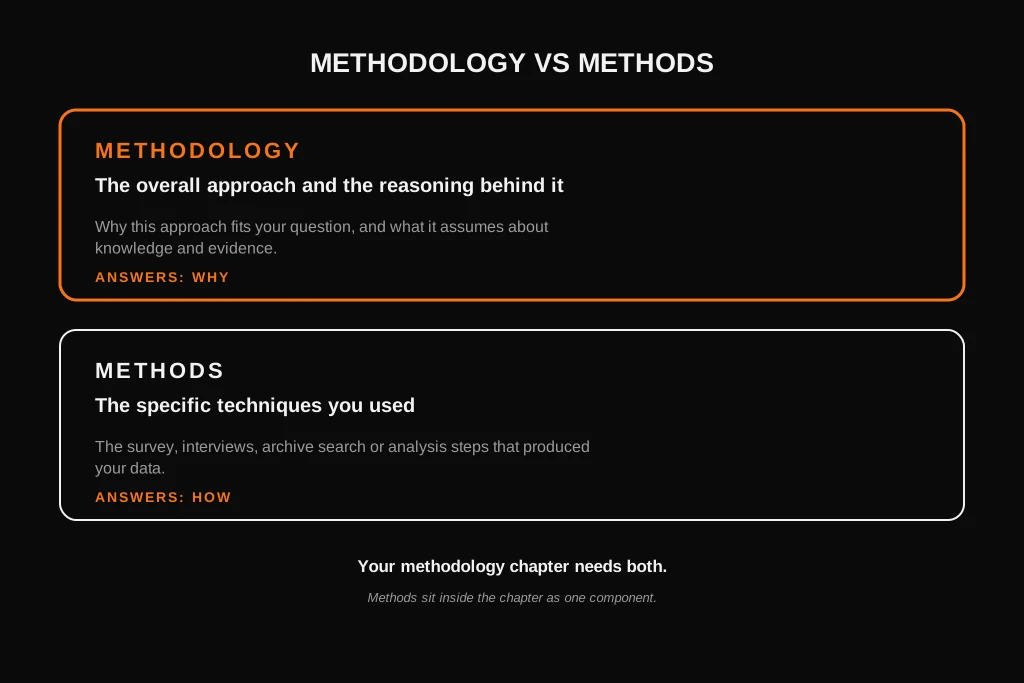
A useful way to separate the two terms is this. Methodology is the why. It covers the overall approach and the reasoning behind it. Methods are the how. They are the specific techniques you used, such as an online survey, a set of interviews or a systematic search of published studies. Your chapter needs both, and the methods sit inside it as one component. For example, “I used interviews” is a method. “I used interviews because the aim was to understand reasons, which a survey could not show” starts to explain the methodology.
The University of Westminster library guide to methodology for dissertations makes the same point in its suggested structure. It lists research philosophy, methods (the sources, approach and procedure), ethics, and a reflection on justification and limits as parts of one chapter, and it advises using that structure only if your department has not given its own.
This matters for marks. A chapter that only lists methods reads like a recipe. A chapter that explains the reasoning as well shows that you made choices on purpose, and that is what examiners reward.
Why the Methodology Matters for Your Marks
Examiners read the methodology to decide whether your findings can be trusted. A weak chapter can undermine strong findings, because if the reader doubts how the data was gathered, they doubt what it shows. A clear chapter does the opposite. It makes ordinary findings look careful and credible.
Most examiners are asking three questions as they read. Is the approach right for the question? Could someone repeat what you did? Did you treat people and data responsibly? If the chapter answers all three plainly, you are in a strong position.
Students most often lose marks for the same few reasons: they describe what they did without saying why, they leave out basic details such as how many participants or sources they used, or they forget the ethics note. None of these is hard to fix, and all of them are easy to see once you know to look. The sections below show how to avoid each one.
Compare two versions of the same sentence. Weak: “Data were collected by survey.” Stronger: “A survey was used because the question concerns how many students are affected, and it reached a larger group than interviews could.” The second sentence takes a few more words and adds a reason, a link to the question and an alternative. Repeat that habit across the chapter and the difference in marks is real. Strong chapters also stay in proportion. Routine procedures get a sentence, while unusual or risky choices get a paragraph, because that is where an examiner needs to be convinced.
Think of the chapter as the place where you earn the reader’s trust. Every sentence should give a detail they need or a reason they would otherwise ask for.
Where the Methodology Chapter Sits and How Long It Is
Where It Sits in the Dissertation
In most dissertations the methodology chapter comes straight after the literature review and before the findings. The review shows the gap, and the methodology explains how you will address it. Our guide to dissertation structure shows how the chapters fit together and how the order changes by discipline.
Some humanities dissertations fold the method into the introduction or into each argument chapter, and some science dissertations call the chapter “Methods”. Check your department’s template and a recent approved dissertation to see what your own looks like.
How Long Should a Dissertation Be?
The whole dissertation has a word limit set by your department, and it controls how much space the methodology can take. Commonly cited ranges are roughly 8,000 to 15,000 words for undergraduates, 12,000 to 50,000 for master’s students and 70,000 to 100,000 for doctoral dissertations, though this varies by university and field. One UK university’s dissertation handbook describes a 30-credit undergraduate dissertation as broadly an 8,000 to 10,000 word project and notes that the count normally excludes reference lists and appendices.
Tip: Find your limit and what it counts before you plan any chapter, then divide the words between chapters.
How Long Should the Methodology Be?
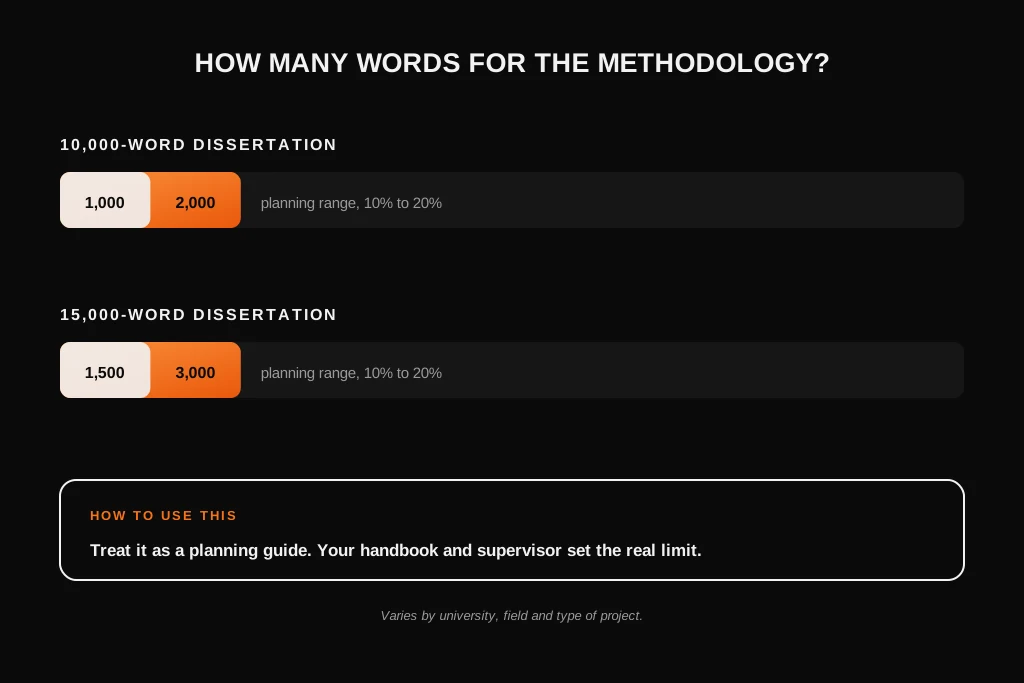
There is no universal rule, and your handbook comes first. As a planning guide, many students give the methodology roughly 10 to 20 percent of the total words. For a 10,000-word dissertation that is about 1,000 to 2,000 words, and for 15,000 words it is about 1,500 to 3,000. Laboratory and survey projects usually sit at the higher end because they need more detail on instruments and analysis. Library-based projects often sit lower, but they still need a clear search strategy.
If you are short of space, cut description before justification. Examiners can forgive a brief account of a standard procedure, but they cannot forgive a missing reason for choosing it.
Choosing Your Approach
How to Choose a Dissertation Topic
A dissertation topic is a narrow, researchable question in a subject you can sustain interest in for months. It matters here because the topic decides which methods are possible. A question about how people feel needs conversations. A question about how many needs numbers. A question about what the law or the literature says needs documents. If you cannot imagine how you would collect the evidence, the topic is not ready.
Check three things before committing: whether enough sources or participants exist, whether you can reach them within your time and ethics limits, and whether your supervisor can guide that kind of method.
Tip: Write your question, then write one sentence on how you would answer it. That sentence is the seed of your methodology.
Dissertation Literature Review
A literature review is a critical survey of existing research that ends by showing the gap your project fills. It shapes your methodology because it shows how earlier researchers worked. If most studies used surveys and none asked people for their reasons, interviews can be your justified choice. If a debate depends on a disputed measure, your method may need to address it directly.
The review also helps you defend your design. When you can point to earlier studies and show what they did and did not do, your choice looks informed instead of arbitrary, and examiners see that your method grows out of the field.
Tip: Note the methods used in every source as you read. That list becomes the evidence for your justification.
Qualitative, Quantitative, Mixed and Non-Empirical Approaches
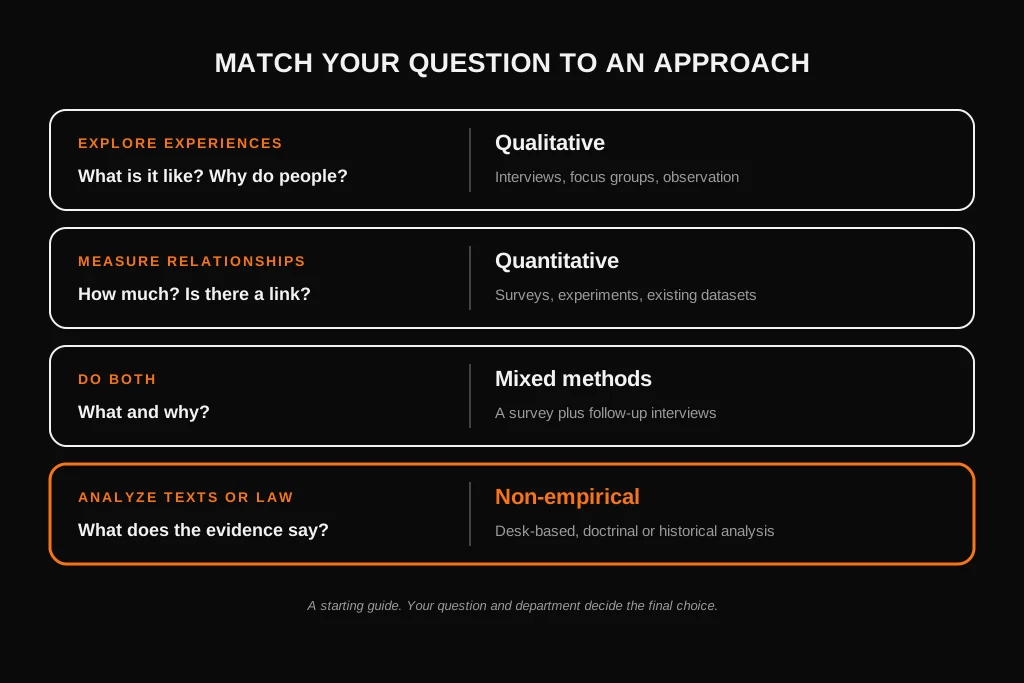
Most dissertations fall into one of four families. Qualitative work explores meaning, experience and reasons, usually through interviews, focus groups or observation. Quantitative work measures and tests relationships, usually through surveys, experiments or existing datasets. Mixed methods combine the two, for example a survey followed by interviews. Non-empirical work analyzes existing texts, law, history or published research without collecting new data. The table helps you match your question to a starting point.
| If your question asks | The usual approach | Why it fits |
| What is it like, or why do people act this way? | Qualitative | It captures meaning and reasons in participants’ own words |
| How much, how often, or is there a link? | Quantitative | It measures and tests patterns across many cases |
| Both what is happening and why? | Mixed methods | Numbers show the pattern and interviews explain it |
| What does the evidence, law or record say? | Non-empirical (desk-based) | It analyzes existing sources without collecting new data |
The Parts and Layout of a Methodology Chapter
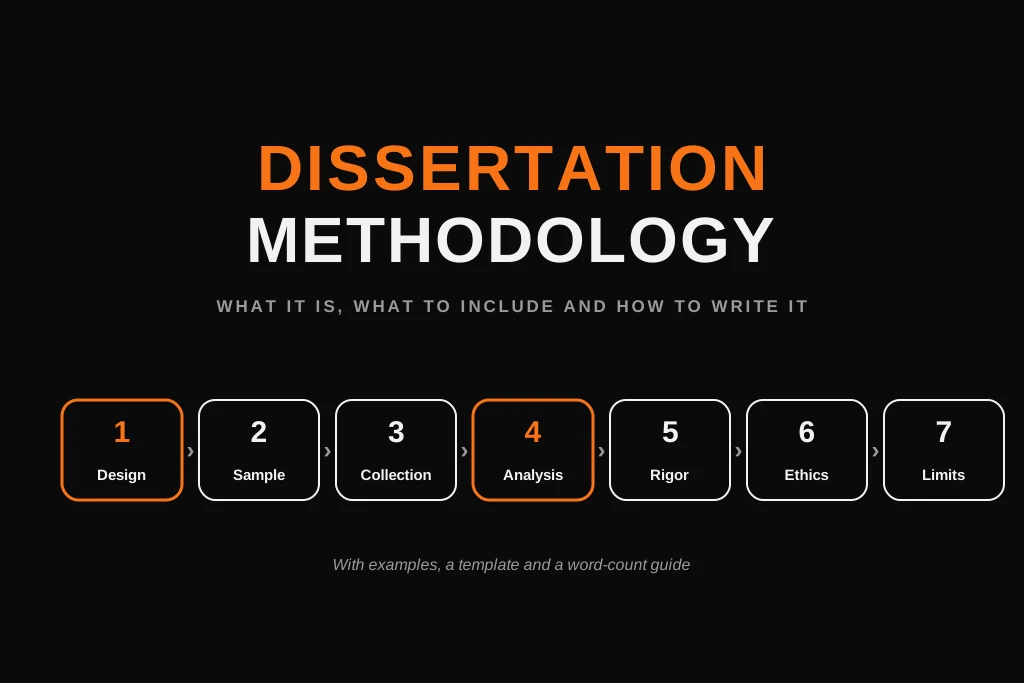
Departments differ, so treat the layout below as a checklist and match it to your own template. Most chapters open with a short introduction that restates the research question, then move through design, sample or sources, data collection, analysis, rigor, ethics and limitations, and close with a brief summary that hands over to the findings.
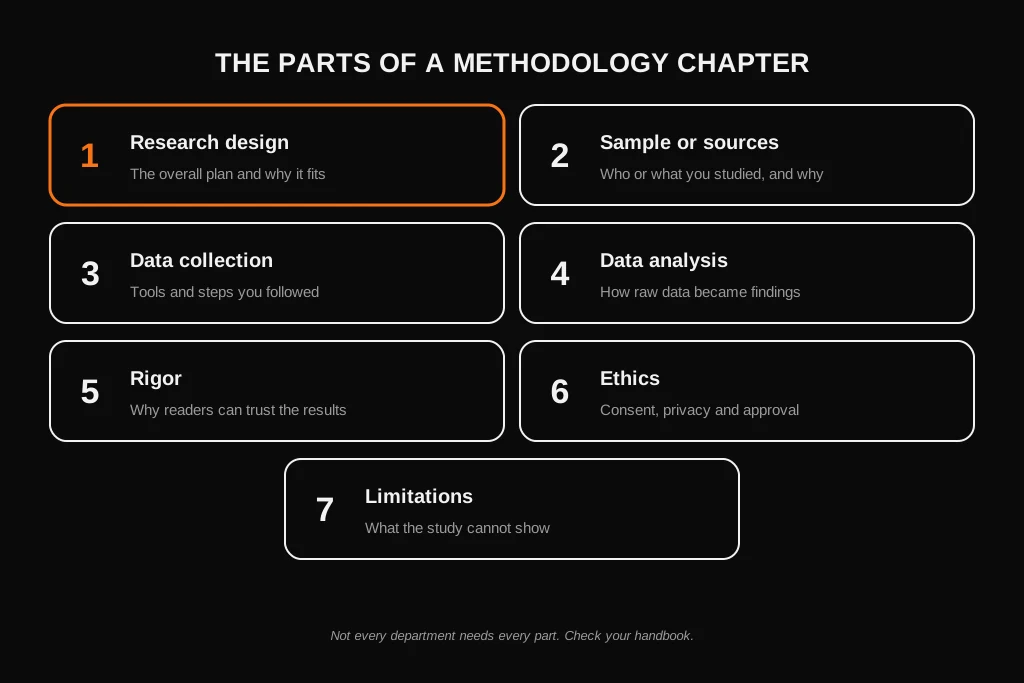
| Part | What to cover | Short sample sentence |
| Research design | Your approach and why it fits the question | A qualitative design was chosen because the aim was to understand reasons, not to measure frequency. |
| Sample or sources | Who or what you studied and how you chose them | Twelve students were selected through purposive sampling to include a range of courses. |
| Data collection | The tools and steps you followed | Each interview lasted about 40 minutes and was audio recorded. |
| Data analysis | How raw data became findings | Transcripts were coded and grouped into themes through repeated reading. |
| Rigor | Why a reader can trust the results | The scale was checked for reliability before the main analysis. |
| Ethics | Consent, privacy, storage and approval | Participants gave informed consent and were given pseudonyms. |
| Limitations | What the study cannot show | The sample came from one university, so the findings are not general. |
Research Design
Start by stating your overall approach and the reasoning behind it in two or three sentences. If your department expects a research philosophy, such as a positivist or interpretivist view, keep it brief and connect it to your question rather than listing theory for its own sake. Then say how the design answers your question.
Sample or Sources
Describe who or what you studied, how many, and how you chose them. Give reasons for the size and the selection method. For people, mention inclusion rules and recruitment. For documents, name the type of sources and the period they cover. A reader should be able to picture your data without seeing it.
Data Collection
Explain the tools and steps in the order you used them, with dates where relevant. Name any instrument, such as a questionnaire or interview guide, say where it came from and whether you tested it first. Put the full instrument in an appendix and refer to it in the text.
Data Analysis
Explain how raw data became findings. For numbers, name the statistical tests or software and the significance level. For interviews or documents, name the technique, such as thematic analysis, and describe how you coded and grouped the material. Say why the technique suits your data.
Validity, Reliability and Trustworthiness
Rigor means showing why a reader can trust your results. Quantitative studies talk about validity and reliability. Qualitative studies often use a parallel set of terms. The University of Connecticut research guide on trustworthiness pairs them as credibility, transferability, dependability and confirmability, and explains that these criteria depend on one another. The table gives a plain-English summary.
| Quantitative term | Qualitative term | What it asks |
| Internal validity | Credibility | Do the findings reflect reality or participants’ views? |
| External validity | Transferability | Could the findings apply in other settings? |
| Reliability | Dependability | Would the results hold if the study were repeated? |
| Objectivity | Confirmability | Do the findings come from the data, not the researcher’s bias? |
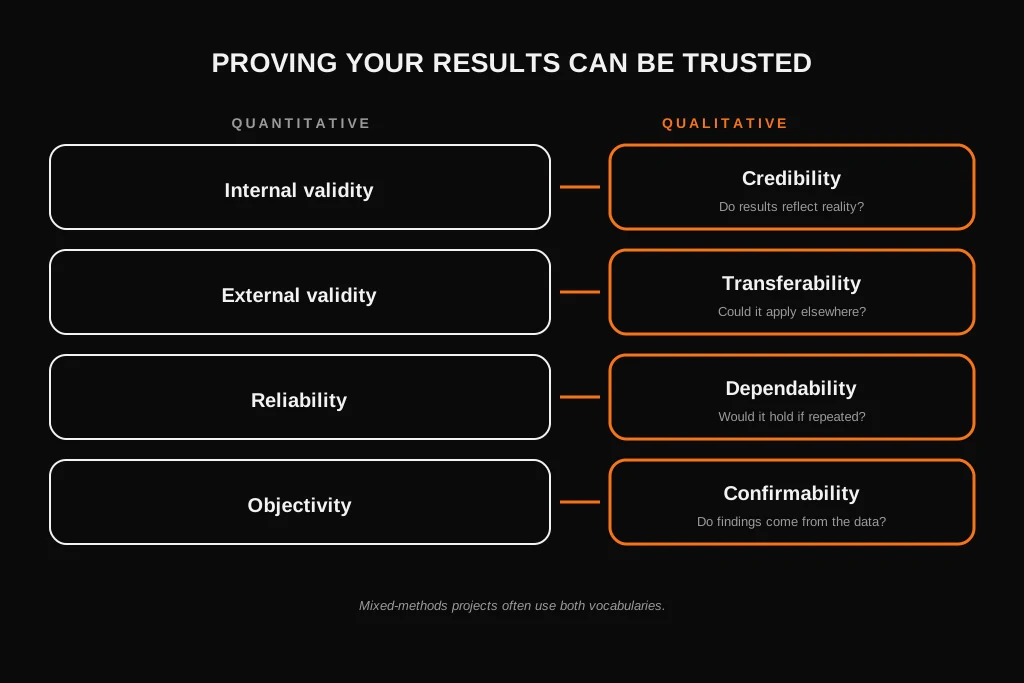
Pick the vocabulary that matches your approach, and say what you did to strengthen it. For example, you might pilot a questionnaire, check a scale for reliability, keep an audit trail of your decisions or ask participants to check your summary of their views.
Ethics
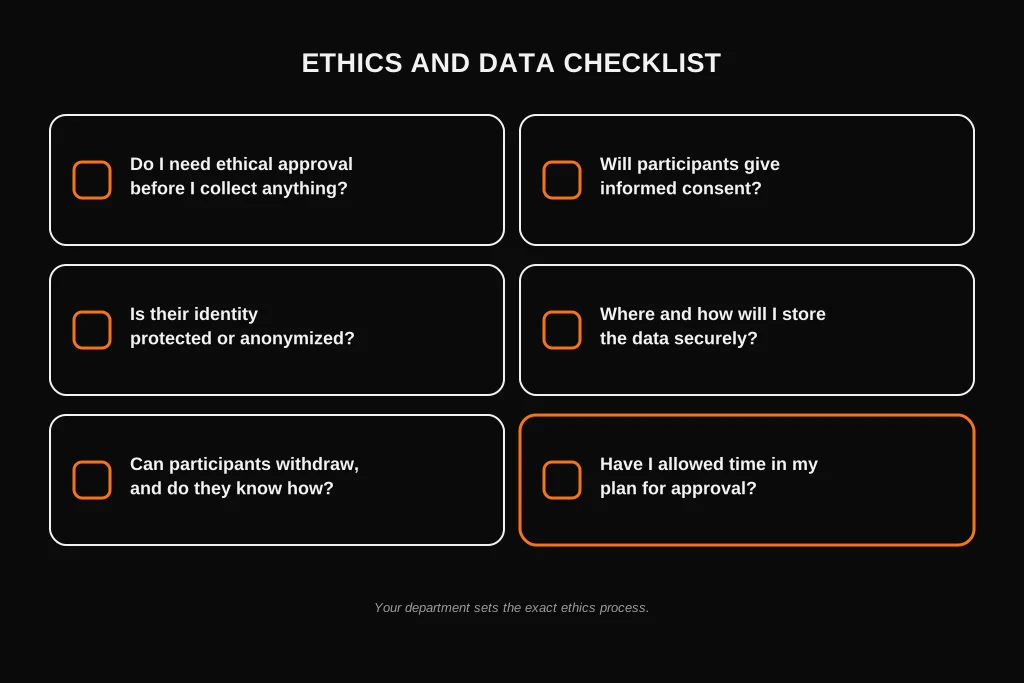
If your project involves people, you will usually need ethical approval before collecting any data. The University of Portsmouth guidance says to address consent, confidentiality and the right to withdraw and to get approval before collecting data. Even projects without participants may need a note about sensitive material or data protection.
Limitations Without Apology
Every study has limits, and naming them is a strength. Use a simple pattern: state the limit, say what it affects, and say what you did about it. For example, “The sample came from one university, so the findings may not apply elsewhere. This was addressed by describing the setting in detail so readers can judge transfer.” Avoid vague apologies such as “the study was limited by time”.
Dissertation Methodology Examples
The three examples below were written for this post to show the shape of a methodology. They are illustrative, not real research, and they are not based on any existing dissertation. Use them as models of structure and reasoning, never as text to copy, and always adapt the detail to your own study and your department’s rules.
Qualitative Methodology Example
This study used a qualitative, interpretivist design to explore how first-year undergraduates describe managing study time in their first term. Interviews were chosen over a survey because the aim was to understand students’ own explanations, not to measure how often behaviors occur. Twelve students were recruited through course announcements using purposive sampling to include a range of courses and living arrangements. Each took part in a semi-structured interview of about 40 minutes, which was audio recorded and transcribed. The transcripts were analyzed using thematic analysis, with codes refined through repeated reading. Participants gave informed consent, were given pseudonyms and could withdraw at any point, and data were stored on a password-protected drive. Ethical approval was obtained before recruitment began. A limitation is that the sample came from one university, so the findings are not intended to apply to all students.
- Sentences 1 and 2: state the design and justify it against a survey.
- Sentences 3 and 4: describe the sample and the data collection.
- Sentences 5 to 7: explain the analysis and the ethics.
- Final sentence: names a limitation and its effect.
Quantitative Methodology Example
This study used a quantitative, cross-sectional survey design to test whether weekly hours of paid work are associated with weekly hours of independent study among second-year students. A survey was chosen because the question concerns the size and direction of a relationship across many students. A random sample of 180 students was drawn from a department mailing list, and 121 responded. The questionnaire used closed questions and an established scale of study engagement that had been used in earlier research. Responses were collected online over three weeks. Data were analyzed in statistical software using descriptive statistics and a correlation test, with the significance level set at 0.05. The reliability of the scale was checked using Cronbach’s alpha. Responses were anonymous, and participants consented before starting. A limitation is that self-reported hours may be inaccurate.
- Sentences 1 and 2: state the design and why a survey fits a question about relationships.
- Sentences 3 and 4: give the sample, the response and the instrument.
- Sentences 5 to 7: cover collection, analysis and the reliability check.
- Final sentences: cover ethics and a limitation.
Library-Based Methodology Example
This dissertation used a desk-based design, analyzing published research to answer how peer feedback affects writing quality in higher education. No new data were collected, so the method was a structured review of existing studies. Searches were run in three databases using agreed keywords and combinations, and every search was recorded. Studies were included if they were peer-reviewed, published in English between 2015 and 2025, and involved university students. Studies of school pupils were excluded. After duplicates were removed, titles and abstracts were screened, followed by full texts. The remaining studies were compared in a table recording design, sample, findings and limitations, then grouped into themes. Because the sources were already published, no ethical approval was needed, but all sources are fully cited. A limitation is that restricting the search to English may have missed relevant studies. The choice of criteria follows the kind of inclusion and exclusion criteria that university library guides describe.
- Sentences 1 and 2: state the design and explain that no new data were collected.
- Sentences 3 to 6: give the search, the criteria and the screening steps.
- Sentences 7 to 9: cover analysis, ethics and a limitation.
A Fill-In Dissertation Methodology Template
Use this skeleton as a starting point and delete any part your department does not require. Replace every bracket with your own details, and keep each part in the order your template asks for.
- Introduction to the chapter: “This chapter explains how [research question] was investigated and why this approach was chosen.”
- Research design: “I adopted a [qualitative, quantitative, mixed or desk-based] design because [reason].”
- Sample or sources: “[Number] [participants or sources] were selected by [method] because [reason]. Inclusion criteria were [criteria].”
- Data collection: “Data were collected using [tool] between [dates]. [Describe the steps.]”
- Data analysis: “Data were analyzed using [technique] because [reason]. [Describe the steps.]”
- Rigor: “To strengthen [reliability, validity or credibility], I [action].”
- Ethics: “[Approval], [consent], [privacy] and [storage].”
- Limitations: “A limitation is [limit], which may affect [what]. I addressed this by [action].”
- Summary: “This chapter set out [summary]. The next chapter presents the findings.”
Justification is where most marks are won, so keep these five sentence frames handy. Each one follows the pattern of a choice, a reason and a rejected alternative.
- I chose [X] because [Y], rather than [Z].
- [Method] suited the question because it allows [benefit], whereas [alternative] would have [drawback].
- A sample of [number] was appropriate because [reason], although it limits [what].
- To reduce the risk of [problem], I [action].
- This approach cannot show [limit], so the findings should be read as [scope].
Methodology for Projects With No Data Collection
Many dissertations collect no new data. They are called desk-based, library-based, literature-based or secondary research, and the methodology is just as important. In fact it has to work harder, because you cannot lean on a sample or a survey to show rigor. The reader needs to see that your sources were chosen on purpose, not by chance.
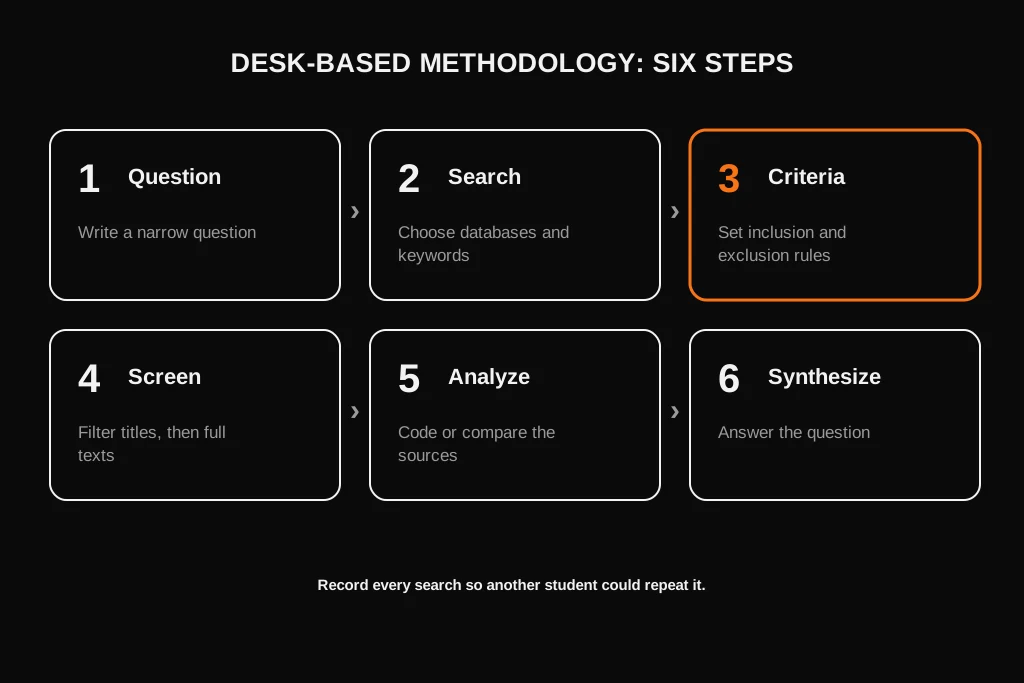
A strong desk-based methodology covers six things: a narrow question, the databases and keywords you searched, clear inclusion and exclusion criteria, how you screened the results, how you analyzed the sources, and how you combined them to answer the question. A University of Tennessee library guide lists time frame, geography, population, setting, source type and study design as common criteria, and warns that criteria should be chosen carefully to avoid bias.
Law and history projects follow the same logic with different tools. A doctrinal law methodology explains which cases, statutes and commentary you analyzed and the method of reasoning you used. A historical methodology explains which archives or published records you used and how you assessed their reliability. In every case, record your searches so another student could repeat them.
Tip: Keep a search log from day one with the date, database, keywords and number of results. It turns a vague claim into evidence.
Methodology by Level and Field
Undergraduate vs Masters Dissertation
An undergraduate methodology shows that you can plan and carry out a small, guided project. It is usually shorter, uses a standard method and needs less defense of alternatives. A master’s methodology expects a clearer justification, more careful sampling and some original data or analysis. If you are learning how to write a masters dissertation methodology, plan extra time for justifying each choice. Doctoral work goes further again, with a full account of the philosophy, design and rigor. In practice, the biggest difference is how much you must defend. An undergraduate may only need to show that a method is sensible, while a master’s student is expected to show why it beats the alternatives.
Tip: Ask for the marking criteria for your level and write the chapter against those descriptors.
Dissertation vs Thesis
The words dissertation and thesis switch meaning between countries. According to the University of Essex library, the UK usually uses dissertation for undergraduate and taught master’s work and thesis for doctoral research, and the US is the reverse. Some fields call the chapter “Methods” instead of “Methodology”. Use whichever label your department uses, and follow its template for the chapter. The content of the chapter is usually the same either way: approach, sample or sources, collection, analysis, ethics and limits. What changes is the depth, which is greatest in doctoral work, and the label on the title page. Copy the term your handbook uses when you email your supervisor, so there is no confusion about which project you mean.
Notes by Field
- Business and social sciences: expect a stated philosophy, a justified sample and a clear ethics section.
- Computer science and sciences: expect detail on design, tools, datasets, evaluation measures and how results can be reproduced.
- History: expect archives or published records, and an account of how you judged their reliability.
- Law: expect the sources of law, the cases analyzed and the method of legal reasoning.
- UK courses: often expect a short research philosophy and a reflective note on limits, so check your handbook.
Writing It Well: Starting, Tense and Justification
The hardest sentence is the first one. Open by restating your research question and saying what the chapter will do, for example, “This chapter explains how the study was designed and why.” Then move straight into your design. A short opener helps the reader, and it gives you a handover from the literature review.
Tense matters too. In a proposal you describe what you will do, so the verbs are in future tense. In the final dissertation you describe what you did, so use past tense for your own steps, such as “Data were collected” or “I interviewed twelve students”. Use present tense for general claims about a method, such as “Thematic analysis allows themes to emerge from the data”.
Justify as you go. Every choice should carry a reason, and the strongest reasons mention an alternative you rejected. Use plain language, define technical terms on first use and cite the sources that support your choices, in one style from start to finish.
Connecting the Methodology to the Rest of the Dissertation
Dissertation Introduction
The introduction tells the reader what the project is about, why it matters and how it is organized, and it is where your method is first previewed. A single sentence is enough, for example, “A qualitative design using interviews was used.” The chapter then explains it fully. Because the introduction is best finished last, check that its description of your method matches what the methodology chapter says.
Many students write a short placeholder early and rewrite it once the research is finished, which is a good habit. Whatever you draft first, update it at the end so that it describes the study you actually completed.
Tip: Use the same wording for your research question and your approach in the introduction and the methodology.
How to Write a Dissertation Abstract
A dissertation abstract is a short summary of the whole project that usually covers the question, the method, the main findings and the conclusion. It gives your method one sentence, such as “Twelve interviews were analyzed thematically.” Write it last, from the finished chapters, so the method it describes matches the chapter exactly. Keep it plain and specific, and avoid citations unless your department asks for them.
Because readers often judge a dissertation from its abstract, make the method sentence specific. Name the approach, the sample size and the analysis in a few words, so the reader knows at once what kind of study this is.
Tip: Check the word limit early, because abstracts are often capped at a few hundred words.
Dissertation Conclusion
The final chapter answers the research question, summarizes the findings and explains why they matter. It also refers back to the limits you named in the methodology. Say how those limits affect what can be claimed, then suggest realistic next steps, such as a larger sample or a different setting. This closes the loop between the method you chose and the conclusions you draw.
It also helps to restate the research question in the opening lines of the conclusion, so the reader sees that the method was built to answer it. A clear link from question to method to answer is what makes the whole dissertation feel like one argument.
Tip: Do not introduce new methods or evidence in the conclusion. If a point matters, it belongs in the methodology or findings.
Dissertation Acknowledgements
The acknowledgements are a short, personal note that thanks the people who helped you, usually near the front. If your project involved participants, thank them as a group without naming them, because naming people could break the confidentiality promised in your methodology. Thank your supervisor first, then advisers, funders and friends, and check whether any funder or ethics committee needs specific wording.
Keep the tone warm but professional, because the page becomes part of the permanent record of your work. Avoid private jokes that an examiner or a future reader would not understand.
Tip: Write the acknowledgements last, and keep to a single page in a warm, professional tone.
Common Methodology Mistakes and How to Fix Them
- Listing methods without reasons. Add a “because” to every choice and name the alternative you rejected.
- Confusing methodology and methods. Explain the approach and its reasoning, then the techniques.
- Too much description, too little justification. Cut routine detail and expand the reasons.
- Copying a template word for word. Use it as a skeleton and fill it with your own study.
- Ignoring limitations. State them early and say what you did about them.
- Mixing tenses. Use past tense for what you did, and check the proposal has not left future tense behind.
- Leaving out ethics. Even desk-based projects need a short note on sources and data protection.
Turning Your Proposal Plan Into the Final Chapter
If you wrote a method plan in your proposal, you already have the seed of this chapter. Our guide on how to write a dissertation proposal shows how that plan was written in future tense. To turn it into the final chapter, change the verbs to past tense, add the detail you could not know then, such as the real sample size and response rate, and explain any changes you made and why.
Tell your supervisor about any major change from the approved plan, and give the reason in the chapter. Examiners do not penalize a sensible change. They penalize a change that is hidden.
How EssaysHelper Can Help You
Writing a methodology can feel like guessing what examiners want. EssaysHelper can support you at each point without taking over your work:
- Reviewing your chapter against your department’s template and marking criteria.
- Giving feedback on whether each choice is justified and each part is complete.
- Helping you plan your word count and your ethics section.
- Editing drafts for clarity, tense and consistent formatting.
If you are stuck on a specific part, send us your question and your deadline and we will point you to the quickest next step.
Frequently Asked Questions
What is methodology in a dissertation?
Methodology in a dissertation is the chapter that explains how and why you did your research. It covers your approach, sample or sources, data collection, analysis, ethics and limits, so a reader can judge whether your results can be trusted.
How do I write a methodology for a dissertation?
Restate your research question, state your approach and justify it, describe your sample or sources, then explain how you collected and analyzed the data. Finish with ethics and limitations, and follow your department’s template.
How long should the methodology be in a dissertation?
Many students plan about 10 to 20 percent of the total words, so roughly 1,000 to 2,000 words in a 10,000-word dissertation. This is a planning guide only. Your handbook and supervisor set the real limit.
What is the difference between methodology and methods in a dissertation?
Methodology is the overall approach and the reasoning behind it. Methods are the specific techniques you used, such as a survey or interviews. Your chapter needs both, with the methods sitting inside it.
Can I use a dissertation methodology template?
Yes, as a skeleton. A template helps you remember each part, but you must fill it with your own choices, reasons and details. Copying one word for word risks poor marks and academic misconduct.
How do I start a methodology section of a dissertation?
Open by restating your research question and saying what the chapter will explain. One or two sentences are enough. Then move straight into your design and why it fits the question.
What tense should I use in a dissertation methodology?
Use past tense for what you did, such as “data were collected”. Use present tense for general statements about a method. A proposal uses future tense because the research has not happened yet.
How do I write a methodology if I do not collect data?
Describe a desk-based design: your question, the databases and keywords searched, the inclusion and exclusion criteria, how you screened sources, and how you analyzed and combined them. Keep a search log as evidence.
Do I need ethics in a methodology if I only use secondary sources?
Usually you need a short note rather than a full section. Say whether approval was needed, confirm that sources are cited and that any data is used according to its terms. Ask your department what applies.
Should I describe limitations in the methodology or the conclusion?
Both, in different ways. Name the main limits briefly in the methodology and say how you handled them. Then return to them in the conclusion to explain how they affect what you can claim.
Final Thoughts
Writing a strong dissertation methodology comes down to three habits: explain your approach, justify every choice, and be honest about limits. You do not need advanced theory. You need a clear reason for each decision and enough detail for a reader to follow your steps. Use the examples and template as a skeleton, match the chapter to your department’s guidelines, and check it against your research question one last time. If a reader can explain why you chose your approach, the chapter is doing its job.