

A dissertation literature review is a critical survey of the research on your topic. It shows what is already known, compares and connects the sources, and ends by pointing to the gap your own study will fill. It is not a list of summaries. Examiners read it to see whether you understand your field, can judge evidence, and have a good reason to run your study.
If you are still planning the whole project, start with our guide on how to write a dissertation, then return here for the detail on this chapter. Below you get a step-by-step method, four ways to organize your sources, three original annotated examples, a literature matrix, a gap formula and a four week plan.
Students usually get stuck in the same places: too much reading, no clear way to group it, paragraphs that read like a list, and no idea how many sources are enough. Each of those is covered below.
What Is a Literature Review in a Dissertation?
A literature review in a dissertation is the chapter where you survey the published research on your topic and use it to build a case for your own study. You read widely, group what you find, compare the claims, judge the quality of the evidence, and show what is still unanswered. That last step matters most, because the unanswered part is where your research question comes from.
What the chapter is for
The chapter does three jobs. First, it proves you know the field: the main ideas, the key debates and the current evidence. Second, it justifies your question, because a reader needs to see that nobody has already answered it. Third, it shapes your project, since the concepts and findings you review guide what you measure, ask or analyze later.
Review vs summary
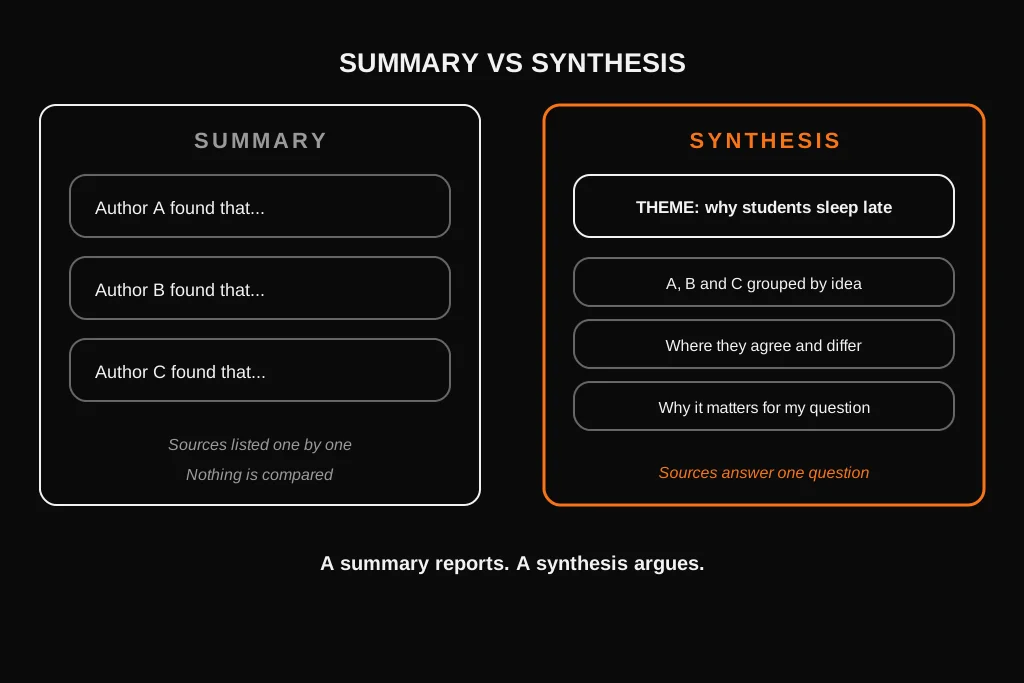
The biggest mistake is writing a summary and calling it a review. Duke University Libraries describe synthesis as analyzing sources and joining them into patterns and themes, while summary only restates each source one after another. A summary says what each author found. A review says what the authors found together, where they disagree, and what that means for your question.
What the chapter is not
It is not an annotated bibliography, where each source gets its own entry. It is not a textbook chapter that explains the topic from scratch. And it is not a record of everything you read. You include only what helps the reader understand the problem and see why your study is needed. A useful rule is that every source must earn its place by helping make a point.
Questions a good review answers
A quick way to test a draft is to see whether it answers five questions. What is known about the topic? Where do the sources agree, and where do they disagree? How strong is the evidence, and what are its limits? What is still missing? And why does that missing piece matter for your study? If a section answers none of these, it is probably description and can be cut or shortened.
Keeping your own voice
A common worry is that the review will sound like a patchwork of other people’s ideas. Your voice shows in the choices you make: which sources you group, how you compare them, and what you say about their strength. Write topic sentences in your own words, make judgments such as this evidence is limited because of the sample, and let the sources support those points rather than carry them. The review is not the place for your findings or for opinions with no evidence behind them. It is the place to show that your reading has led you to a clear position on what is known and what is not.
Where the Review Sits and How Long It Should Be
In most dissertations the review is the second chapter. The opening chapter says what you will study, the review shows what is known, and the method chapter explains how you will fill the gap. For the full chapter order and what each chapter does, see our guide to dissertation structure. Some humanities projects weave the literature through every chapter instead of using a separate review, so check your handbook first.
How Long Should a Dissertation Be, and How Long Is the Review?
Dissertation length is the total word limit set by your department, and it varies by university, level and field. As one UK example, a university handbook gives about 8,000 to 10,000 words for a 30 credit undergraduate dissertation, with references and appendices left out of the count. Four points matter here. The limit comes from your handbook, not from this guide. Check whether quotations, tables and footnotes count. Find out how far over or under you may go. And remember that the review’s share is your decision inside that limit. Tip: set a review budget before you start reading, so the chapter does not swallow the words your findings need.
A planning range for the review
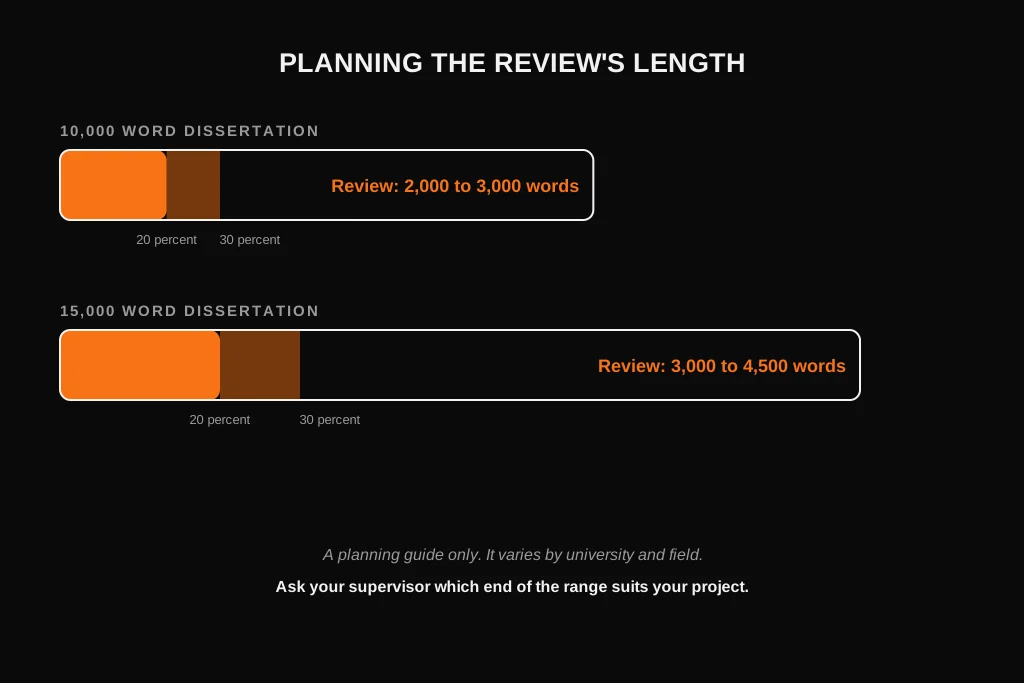
Many students plan the review at roughly 20 to 30 percent of the total words. Treat this as a planning guide, not a rule, because it varies by university and field. Heavily theoretical projects often need more, and projects built on new data often need less.
| Total words | Review at 20 percent | Review at 30 percent |
| 8,000 | 1,600 | 2,400 |
| 10,000 | 2,000 | 3,000 |
| 15,000 | 3,000 | 4,500 |
Ask your supervisor which end of the range suits your project, and write the figure at the top of your notes.
Before You Start: Topic, Search Plan and Sources
How to Choose a Dissertation Topic You Can Actually Review
Choosing a topic means narrowing a general interest into a question that existing research can inform and your project can answer. Four points help. Start with something you can stay interested in for months. Keep the scope small enough to finish. Make sure enough research exists to review. And check that your supervisor or department can support the area. Tip: run a quick search before you commit. If you find hundreds of near identical studies, narrow the topic. If you find almost nothing, widen it or change the angle. A topic you cannot review is a topic you cannot defend, so treat this early search as a trial run of the whole chapter.
Build a search plan
Searching without a plan is how students end up with 200 open tabs. Begin with the databases your library recommends for your subject, and add Google Scholar for wider coverage. List your main concepts, then write synonyms for each. Join the synonyms with OR and the concepts with AND, and use quotation marks for exact phrases. One search for the example topic used later might look like this: (“sleep quality” OR “sleep duration”) AND (“university students” OR undergraduates) AND (“social media” OR “screen time”).
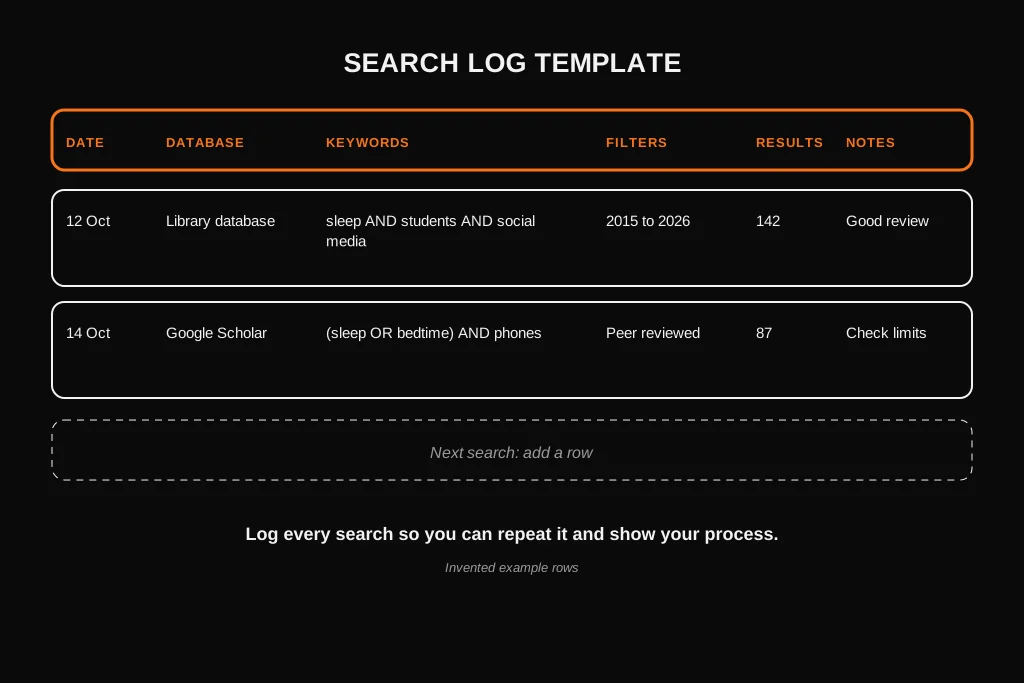
Keep a search log so you can repeat a search and show your process. Use these six columns:
- Date of the search.
- Database used.
- Keywords and combinations.
- Filters, such as years or language.
- Number of results.
- Notes on what was useful.
Decide what counts
Set simple rules for what goes in and what stays out. The University of Tennessee library suggests criteria such as time frame, geography, population, setting, source type and study design, and it warns that careless rules can add bias, for example by excluding every study that is not in English. Write your rules down. Then judge each source on relevance, the quality of its method, who published it and how recent it is. Older foundational works can stay when they shaped the field.
How to Write a Literature Review for a Dissertation, Step by Step
This method works whatever your topic. It also answers the question of how to do a literature review without drowning in reading.
- Read for the argument, not the facts. For each source, ask what it claims, how it knows, and how it relates to your question. Read abstracts and key sections first to decide what deserves a full read.
- Take structured notes. Record the aim, method, finding, limits and one useful quotation per source, along with the page number. Notes in your own words protect you from accidental copying later.
- Group the sources. Sort them by theme, debate or method, not by author. Aim for three to six groups, and give each a working label.
- Synthesize within each group. Write one sentence on what the sources agree on, one on where they differ, and one on why. That trio becomes the spine of each section.
- Draft theme by theme. Open each section with a clear point, bring in the sources as evidence, compare them, and close with a sentence that links back to your question.
- Revise for argument and gaps. Read only the first sentence of each paragraph. If they do not tell a story, the review is still a list. Then check that the gap is visible.
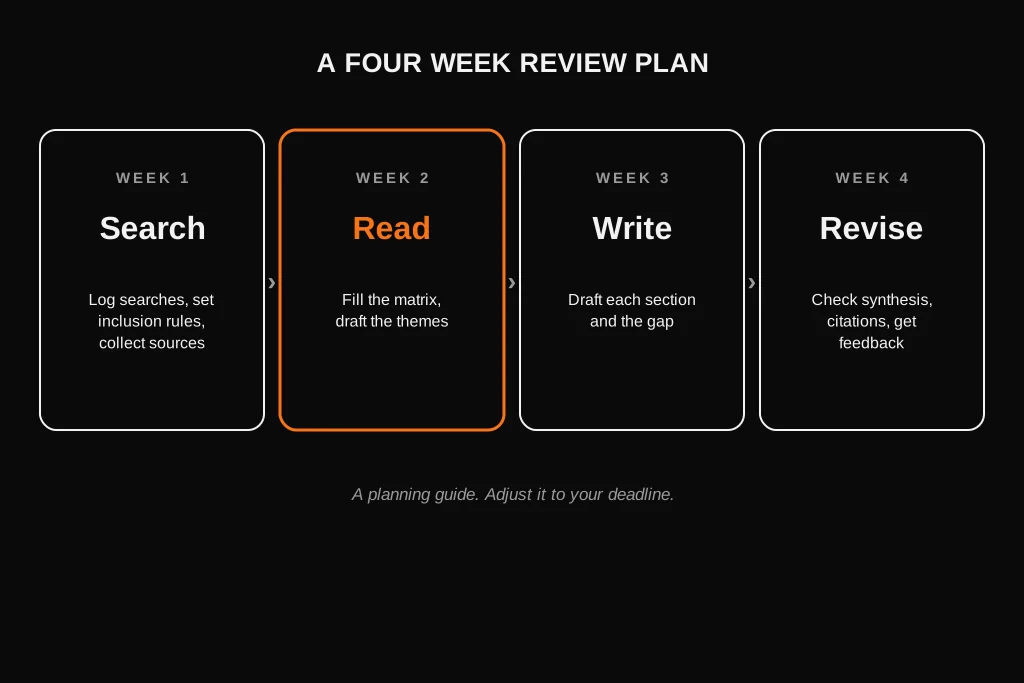
A four week review plan
Use this as a planning guide and adjust it to your deadline.
- Week 1: search, log and collect sources, and set your inclusion rules.
- Week 2: read and fill your literature matrix, then draft the themes.
- Week 3: write the sections and the gap.
- Week 4: revise for synthesis, check citations, and get supervisor feedback.
Structure of a Literature Review: Four Ways to Organize Your Sources
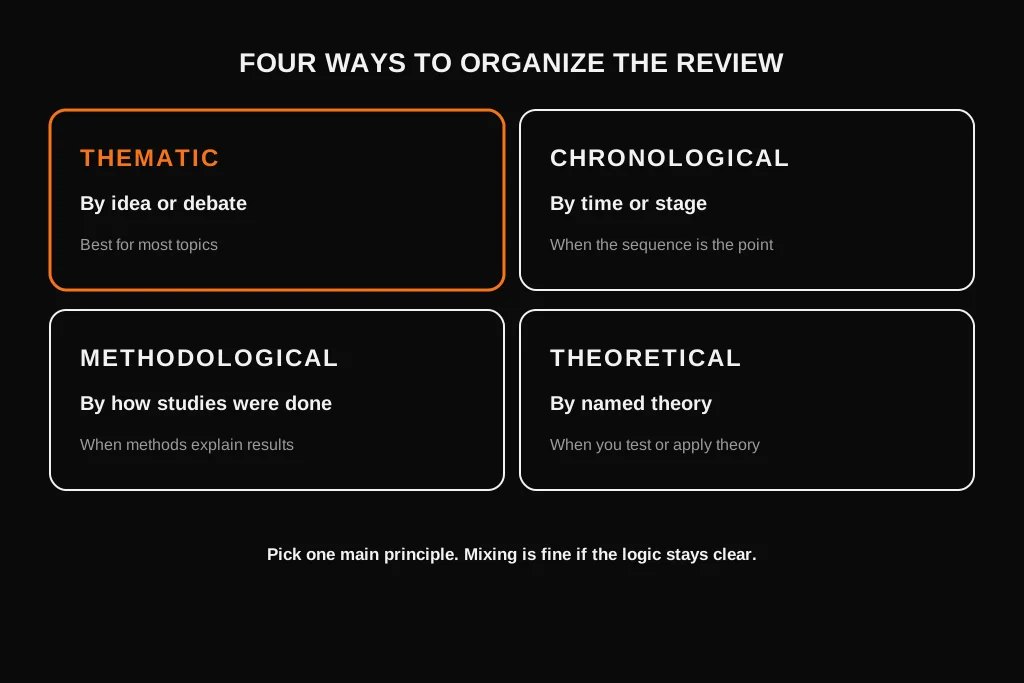
Pick one main organizing principle and stay with it. Stony Brook University Libraries describe three common approaches: chronological, thematic and methodological. Southern Utah University’s writing center guide adds general to specific, and notes that you can mix approaches in one review. The table shows when each works.
| Approach | Use it when | Main risk |
| Thematic | Your topic has several ideas or debates that cut across time. | Themes that overlap, so the same source appears everywhere. |
| Chronological | The field developed in stages and the sequence is the point. | Reading like a history lesson with no argument. |
| Methodological | Studies differ mainly by method, and the differences explain the results. | Focusing on how studies were done instead of what they found. |
| Theoretical | Your project tests or applies one or more named theories. | Describing theories without testing them against evidence. |
Most dissertations use a thematic review, because it keeps the focus on ideas and makes synthesis easier. A mixed approach is fine if the logic stays clear, such as a short chronological background followed by themes.
A typical layout for the chapter
Inside the chapter, a reliable layout has five parts. Open with a short paragraph that states the scope and tells the reader how the chapter is organized. Add any background the reader needs. Then give one section per theme or stage, each ending with a sentence that links to your question. Follow with a short section naming the gap. Finish by pointing the reader to the next chapter. Match this to your department’s rules where they differ.
Dissertation Literature Review Examples: Original and Annotated
These models were written for this guide to show the shape of good paragraphs. The topic (social media use and sleep in university students) is an example, and the citations are placeholders, not real studies. Copy the shape, never the words, and replace everything with your own sources.
Example 1: A thematic paragraph
Research on evening social media use and sleep tends to cluster around three explanations. The first is time displacement: the longer students spend on their phones at night, the later they go to bed (Author A, 2018; Author B, 2020). The second is arousal: emotionally charged content keeps the mind active even when sleep time is protected (Author C, 2019). The third is notification disruption, where alerts wake students during the night (Author D, 2021). These explanations are not rivals. Studies of time displacement explain late bedtimes well, while arousal and notification studies explain poor sleep quality that bedtime alone cannot. Taken together, they suggest that how students use their phones matters as much as how long they use them, a point most of the work reviewed here has not tested directly.
What it does: the first sentence names the theme and promises three groups. The next three sentences group sources by explanation. The comparison shows how the groups fit together, and the last sentence points toward a gap.
Example 2: Comparing conflicting studies
Studies disagree on whether heavy use harms sleep in the long run. Survey work reports a clear link between late night use and shorter sleep (Author E, 2017; Author F, 2019), but these studies measured both variables at one point in time and so cannot show which comes first. By contrast, a study that followed students across a semester found that poor sleep predicted later heavy use, not the other way around (Author G, 2022). The difference may lie in design rather than evidence: surveys capture a snapshot, while longitudinal work tracks change. Until more studies follow the same students over time, the direction of the relationship remains unsettled.
What it does: it states the disagreement, gives evidence on each side with its limits, offers a reason for the difference, and ends by saying exactly what remains unsettled.
Example 3: A paragraph that ends with the gap
Three patterns stand out across this work. First, nearly all studies rely on self reported sleep, which students tend to estimate imperfectly (Author H, 2020). Second, most samples come from a single institution, so results may not apply to students in other settings (Author I, 2021). Third, few studies ask students themselves why they keep using their phones at night. This study responds to the third gap. Rather than measuring hours, it uses interviews to explore the reasons students give for late use and how they weigh those reasons against sleep. The next chapter explains why an interview design suits that aim.
What it does: it sums up the limits of the field, chooses the gap that matters most, states the aim in one sentence, and hands the reader on to the method.
The same material, weak and strong
Here is the weak version of Example 1: “Author A (2018) found that students who use phones at night sleep less. Author C (2019) found that emotional content keeps people awake. Author D (2021) studied notifications and found they wake students.” Every sentence is accurate, yet nothing is grouped, compared or connected to a question. The strong version keeps the same sources but makes them answer one question together. That change from reporting to arguing is what examiners mean by critical.
The Literature Matrix: From Notes to Paragraphs
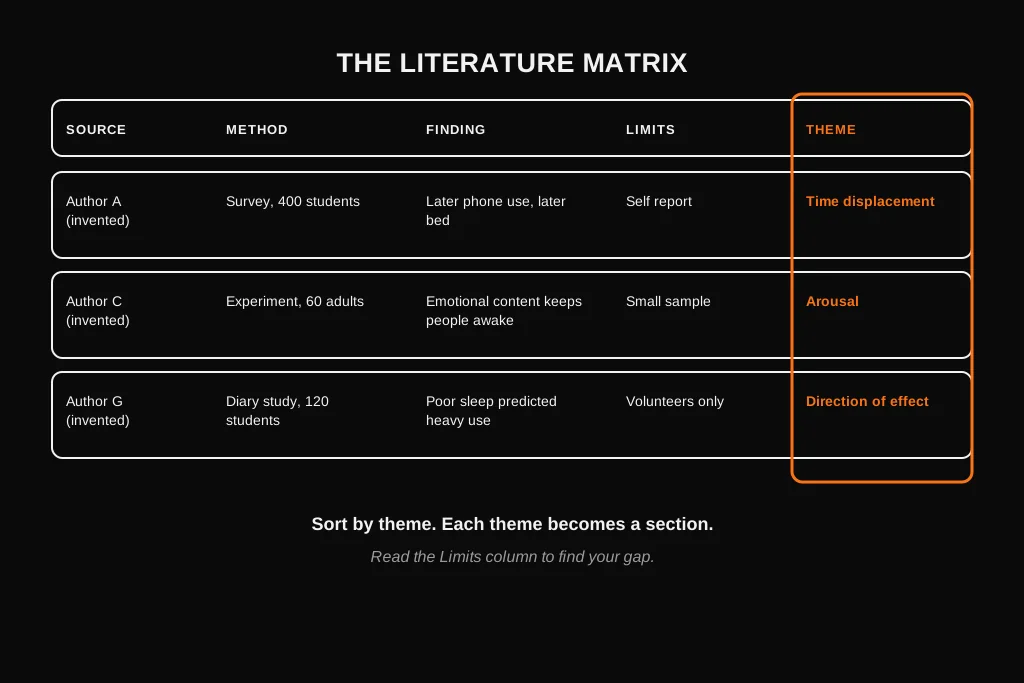
A literature matrix, also called a synthesis matrix, is a grid for comparing sources. Duke University Libraries describe one with ideas in the rows and sources in the columns. A simple version for a dissertation puts one source per row, with columns for aim and method, key finding, limits and theme. The two rows below are invented to show the format.
| Source | Aim and method | Key finding | Limits | Theme |
| Author A (2018), invented | Survey of 400 first year students on bedtime and phone use | Later phone use linked to later bedtime | Self report; one campus | Time displacement |
| Author G (2022), invented | Semester long diary study of 120 students | Poor sleep predicted later heavy use | Small sample; volunteers only | Direction of effect |
Fill a row for each source as you read, which takes a few minutes and prevents rereading. When the grid is full, sort by the theme column. Each theme becomes a section of the chapter. Then read the limits column from top to bottom: repeated limits, such as the same type of sample or measure, are often where your gap is hiding.
Finding and Writing the Gap
A research gap is something the existing work has not answered well enough. The Southern Utah University writing center advises noting what the research has not yet addressed, because those areas show where your study fits. Look in four places: the limits column of your matrix, the future research sections of recent articles, places where studies disagree, and groups, settings or methods that are missing.
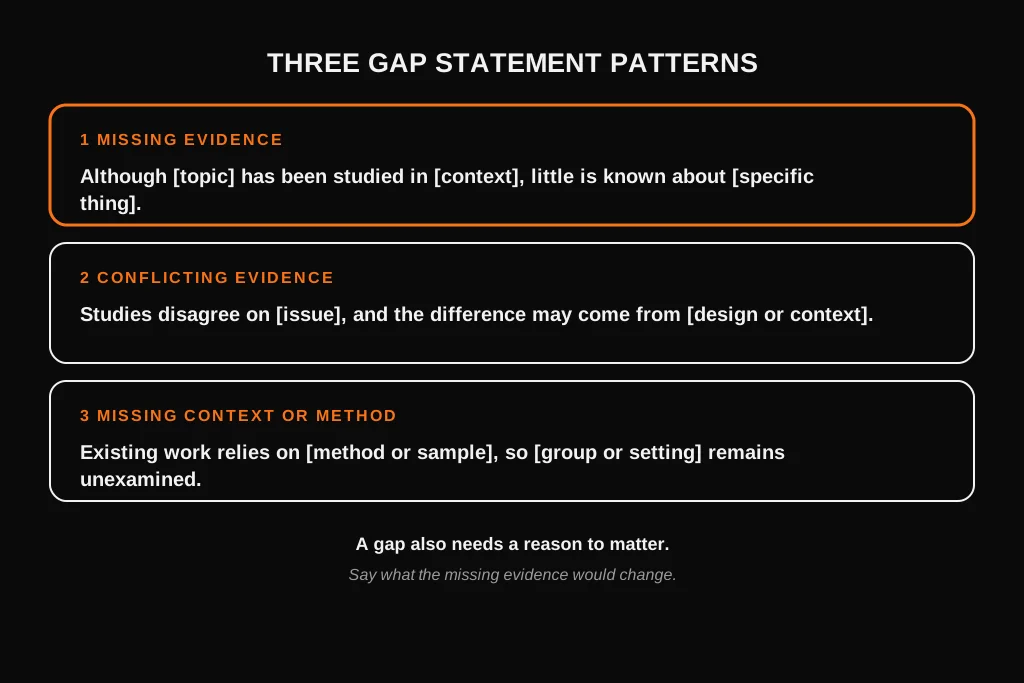
A gap needs a reason to matter. “Nobody has studied this” is rarely enough, so say what the missing evidence would change. Also check your search log first, so the gap is not simply a search you did not run. Three patterns cover most cases:
- Missing evidence: Although [topic] has been studied in [context], little is known about [specific thing]. Example: Although sleep and social media use have been studied in survey samples, little is known about how students explain their own late night use.
- Conflicting evidence: Studies disagree on [issue], and the difference may come from [design or context]. Example: Studies disagree on whether heavy use shortens sleep or poor sleep drives heavy use, and the difference may come from study design.
- Missing context or method: Existing work relies on [method or sample], so [group or setting] remains unexamined. Example: Existing work relies on self reported sleep from one university, so students in other settings remain unexamined.
Six sentence frames for synthesis
Use these to compare, contrast and group sources, and fill the brackets with your own content:
- Both [Author A] and [Author B] found [result], although they measured it differently.
- In contrast to [Author A], [Author B] reported [different result], possibly because [reason].
- Three studies point to [theme], but they differ on [issue].
- Most of this work assumes [assumption], which [Author C] questions.
- Taken together, these findings suggest [pattern], although [limit].
- What remains unclear is [gap], which this study addresses by [aim].
Systematic Literature Review for a Dissertation and Other Review Types
A systematic review is a different kind of project. Rutgers University Libraries explain that systematic reviews follow pre-specified methods, so the search can be repeated, and they are often protocol driven, team based and slow, taking months or even years. A standard literature review does not need a repeatable search and is often completed by one person in far less time.
For most dissertations, a standard (narrative) review is the right choice. A systematic literature review in a dissertation is possible when your department allows a review to be the whole project, and then the review becomes your method as well as your evidence. If you are considering that route, ask your supervisor first, write a protocol before searching, record every step of your search, apply inclusion rules consistently, and follow a recognized reporting guideline such as PRISMA. Some departments also accept scoping or integrative reviews, so check the options your handbook allows.
From Review to Method
The gap you name decides what you do next. If the gap is that nobody has explored reasons, interviews may suit. If it is that the link has never been measured, a survey may fit. If the gap is a missing viewpoint in published texts, a desk-based analysis may work. The chapter you write on this choice, and the reasoning behind it, belongs in your dissertation methodology. The two chapters should read as one argument: here is what is missing, and here is the method that fills it.
Review Expectations by Level and Field
Dissertation vs Thesis: What the Chapter Is Called
The terms dissertation and thesis swap meaning between countries. The University of Essex library notes that usage differs between the UK and the US, so a word that means a doctoral project in one place can mean a master’s project in another. For the review, three points follow. The chapter may be titled literature review, background or review of literature. Doctoral projects usually expect more depth than a bachelor’s or master’s project. And length and format rules come from your institution. Examiners judge your review against the standard for your own award, not against published articles. Tip: use your department’s own title for the chapter and its own word for the whole project, and read the definitions in your handbook on day one.
Undergraduate vs Masters Dissertation: What Changes in the Review
The level sets the depth. At undergraduate level, examiners mainly want to see that you can find relevant sources, understand them and organize them clearly. At master’s level, they expect critical comparison, a sharper gap and closer links to your method. At doctoral level, the review usually has to map the field and show a real contribution. The word limit changes too, so the same material has to be selected more strictly in a shorter chapter. Doctoral reviews are usually broader still and need their own plan. Tip: ask your supervisor for the marking criteria for the review and, if possible, a past example from your department.
Differences by field
Fields differ in habits. Science and health reviews often focus on recent empirical studies and a clear question. Social science reviews often combine empirical work with theory. Humanities reviews often follow debates and interpretations across longer periods, and may be woven through the argument. Look at two or three dissertations from your department to see what is normal there.
Connecting the Review to the Rest of Your Dissertation
The review should echo through the whole project. These four parts rely on it most.
Dissertation Introduction: Where the Gap First Appears
The opening chapter of a dissertation frames your topic, question and reason for the study. It previews the literature and names the gap, but leaves the detail to the review. Four points keep it clean: give only the key background, name the gap in a short paragraph, state your question and aims, and end with a brief map of what follows. Tip: draft this chapter after the review, so the gap you promise matches the gap you prove. If the opening chapter contains pages of citations, move them into the review. A reader should recognize the same gap in both places, but the review should show far more evidence for it.
How to Write a Dissertation Abstract From Your Review
An abstract is a short, stand-alone summary of the whole dissertation, usually one paragraph, with the word limit set by your department. It borrows from the review in one place: the first sentences. Give one sentence of background, one on the gap, then your aim, method, main findings and why they matter. Do not cite sources in detail or add new claims. Readers and databases often see the abstract before anything else, so it must make sense without the rest of the document. Tip: write the abstract last, and check that the gap sentence matches the one in your review. If you cannot state the gap in one sentence, the review probably has not made it clear yet.
Dissertation Conclusion: Returning to the Gap
The closing chapter answers your question and states what the study adds. It should return to the gap from the review. Restate the gap in one line, show how your findings fill, change or complicate it, and compare your results with the key studies you reviewed. Then note limits and suggest what future work could do. Tip: reread the gap section of your review before drafting. Do not bring in new sources here, because new evidence belongs earlier. Many examiners read this chapter right after the abstract, so make the link back to the review explicit. Keep it proportionate, because a short, confident chapter usually reads better than a long recap.
Dissertation Acknowledgements: Thanking the People Behind the Reading
Acknowledgements are a short, professional page thanking the people who helped you. Typical thanks go to your supervisor, participants, librarians who helped with searching, and family or friends. Check whether your department requires the page, keep it brief, and use a polite tone. You do not need to thank the authors you cited, since citations already credit them. Some institutions set a word limit or ask you not to name participants who were promised anonymity, so check the rules first. Tip: if a librarian taught you database searching, say so. That help sits behind your review. The page is a good place to be warm, but not informal.
Common Literature Review Mistakes and How to Fix Them
- Writing a list of summaries. Group by theme and compare. Use the first sentence test from step six.
- Using too few or outdated sources. Check your search log for gaps, and add recent work alongside the key older studies.
- Not finding a gap. Read the limits column and the future research sections, then use one of the three gap patterns.
- Describing too much. If a sentence does not support a point about your question, cut it.
- Copying phrasing by accident. Take notes in your own words, keep quotations short, and cite as you write.
- Not knowing how many sources are enough. There is no universal number. Ask your supervisor, and treat it as a sign you are close when new searches keep returning sources you already have.
- Starting to write too late. Draft each theme as soon as its matrix rows are full, and revise later.
How the Proposal’s Short Review Becomes the Chapter
Many proposals contain a one or two page review. If you wrote one following our guide on how to write a dissertation proposal, you already have a starting point. Keep its themes and gap, then expand each theme with fuller evidence and newer sources. Sharpen the gap with the patterns above, and revise any claim your later reading changed. Do not paste the old text and add pages. Rebuild it around the argument you can now make.
How EssaysHelper Can Help You
A review can feel endless when the reading never seems to stop. EssaysHelper can support you at each point without taking over your work:
- Reviewing your plan, search terms and inclusion rules.
- Giving feedback on whether your paragraphs synthesize or only summarize.
- Checking that your gap is clear and matches your question.
- Editing drafts for clarity, citations and consistent formatting.
If you are stuck on a specific part, send us your question and your deadline and we will point you to the quickest next step.
Frequently Asked Questions
What is a literature review for a dissertation?
It is the chapter that surveys the research on your topic, compares the sources and shows the gap your study fills. It is a critical argument built from sources, not a list of summaries.
How do you write a literature review for a dissertation?
Search with a plan, take structured notes, group sources by theme, synthesize within each group, draft theme by theme, and revise for argument. A literature matrix makes the middle steps much easier.
How long should a dissertation literature review be?
It depends on your word limit and department. As a planning guide, many students aim for 20 to 30 percent of the total, so 2,000 to 3,000 words in a 10,000 word dissertation. Confirm with your supervisor.
What is a good example of a literature review for a dissertation?
A good paragraph groups sources by an idea, compares them, and links the result to your question. The three annotated examples above show a thematic paragraph, a comparison of conflicting studies and a paragraph that ends with a gap.
How do I structure a literature review for a dissertation?
Choose one organizing principle: thematic, chronological, methodological or theoretical. Thematic works for most topics. Then use one section per theme, each ending with a link to your question.
How many sources do I need in my literature review?
There is no fixed number, because it varies by level, field and department. Ask your supervisor, and treat it as a good sign when new searches keep returning sources you already have.
What is the difference between a literature review and an annotated bibliography?
An annotated bibliography describes each source in its own entry. A literature review combines sources into an argument, grouping them by idea and comparing them to build a case for your study.
How do I find a gap if everything seems to be studied?
Check the limits of existing studies, look for disagreements, and look for missing groups, settings or methods. A gap can be a new context or a better method, not only a new topic.
What is a systematic literature review in a dissertation?
It is a review that follows a pre-set protocol and a repeatable search, usually with a team. It can be a whole dissertation in some departments, so ask your supervisor before choosing it.
Can I start writing before I finish reading?
Yes, and it often helps. Draft each theme as soon as its sources are in your matrix, then revise as you read more. Waiting until the reading feels finished usually means starting too late.
Final Thoughts
A strong dissertation literature review comes down to three habits: group sources by idea, compare them instead of listing them, and finish by showing the gap your study fills. You do not need to read everything. You need a plan for searching, a matrix for organizing, and a clear reason for each paragraph. Use the examples and frames as a starting shape, match the chapter to your department’s rules, and check it against your research question one last time. If a reader can say what is known, what is missing and why your study matters, the chapter is doing its job.