
Ethos, pathos and logos are the three ways of persuading an audience that Aristotle described. Ethos appeals to the speaker’s credibility and character, pathos appeals to the audience’s emotions, and logos appeals to logic, reasoning and evidence. For example, a doctor saying “in twenty years of practice” uses ethos, a story about a sick child uses pathos, and a statistic about recovery rates uses logos. A fourth idea, kairos, means choosing the right moment and context for your message.
That is the short answer. The rest of this guide explains each appeal in plain words, shows more than 30 original examples from ads, speeches, essays, social media and everyday life, and teaches you how to spot the appeals, use them in your own writing and write about them in an essay. There is also a table of common fallacies and a ten question practice quiz with answers at the end.
Students usually get stuck in the same places. The three appeals blur together, one sentence seems to use two of them at once, kairos is barely explained in class, and essays end up saying “the writer uses ethos” without explaining anything. Each of those problems is solved below.
What Are Ethos, Pathos and Logos?
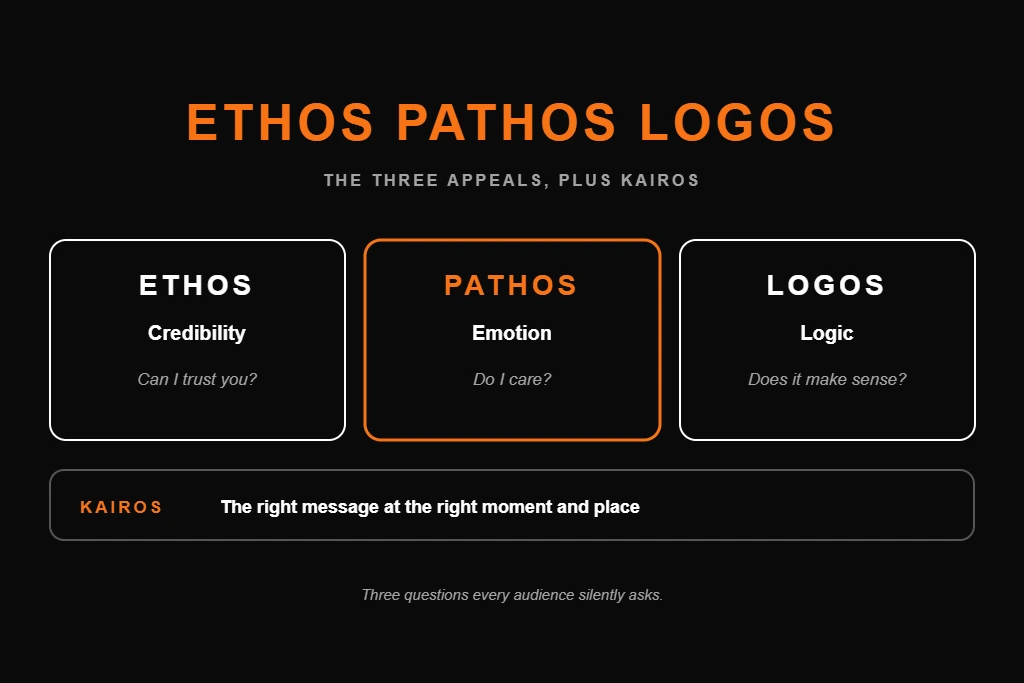
Ethos, pathos and logos are called the rhetorical appeals, or modes of persuasion. They describe the main ways a speaker or writer can move an audience to agree. At essays helper, we explain them to students as three questions an audience silently asks: Can I trust you? Do I care? Does this make sense?
Simple definitions
- Ethos (credibility): persuading through the speaker’s character, expertise and trustworthiness.
- Pathos (emotion): persuading by stirring the audience’s feelings, values or imagination.
- Logos (logic): persuading through reasons, facts, evidence and clear argument.
Why they matter
You meet these appeals everywhere: in adverts, political speeches, opinion pieces, college application essays and even text messages asking a friend for a favour. Knowing them helps in two ways. As a reader, you can see how someone is trying to persuade you and judge whether it is fair. As a writer, you can choose the right mix for your audience. In English classes, they are also the starting point for rhetorical analysis, where you explain how a text persuades.
How to pronounce them
Ethos is usually said “EE-thos”, pathos “PAY-thos” and logos “LOH-gos”, though pronunciations vary. The words come from Greek: ethos is connected to character, pathos to experience or emotion, and logos to word or reason.
Ethos: Definition and Examples
Ethos is the appeal to credibility. An audience is more likely to accept an argument when they trust the person making it. That trust can come from expertise, experience, reputation, honesty or simply showing that you care about the audience.
Aristotle’s three sources of credibility
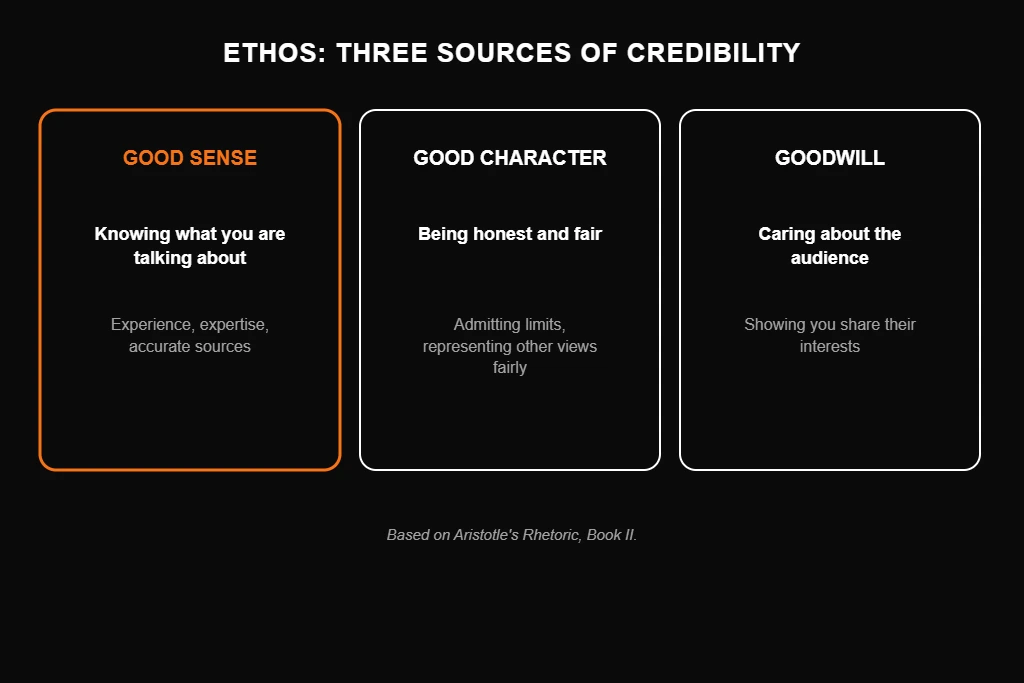
In Book II of the Rhetoric, Aristotle says three things inspire confidence in a speaker’s character: good sense, good moral character and goodwill. In modern terms, that means knowing what you are talking about, being honest and fair, and showing that you have the audience’s interests at heart. A speaker who has all three is hard to resist. A speaker who lacks any one of them, for example an expert who seems to look down on the audience, often loses them.
Ethos examples
- A dentist in an advert: “As a dentist for fifteen years, I recommend brushing twice a day.”
- A student council candidate: “I have organised three fundraisers this year, so I know what it takes.”
- A climate article that begins by noting the author’s work as a marine biologist.
- A coach who admits a past mistake before giving advice, which shows honesty.
- A product page displaying an independent safety certification.
How to build ethos in your own writing
You do not need a title or qualification to build ethos. Use credible sources and cite them properly. Represent opposing views fairly. Keep a calm, respectful tone. Show that you understand the audience’s concerns. Avoid exaggeration, because one overstated claim can undo the trust you have built.
Pathos: Definition and Examples
Pathos is the appeal to emotion. It persuades by making the audience feel something, such as sympathy, hope, fear, pride, anger or belonging, so that the argument matters to them personally. Pathos is often what moves people from agreeing to acting.
Emotions writers often target
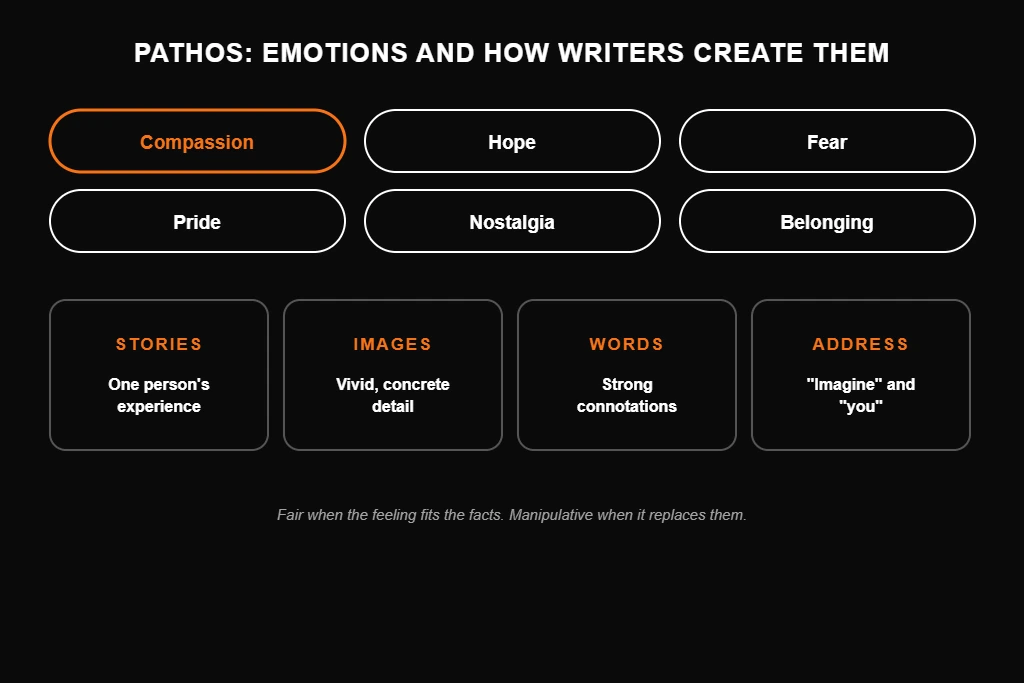
Common targets include compassion, hope, fear, guilt, pride, nostalgia, outrage and a sense of belonging. Writers create these feelings through stories, vivid images, word choice with strong connotations, personal examples and direct address to the reader.
Pathos examples
- A charity appeal that shows one child’s face and tells her story, rather than listing figures.
- A safety campaign describing the moment a family receives bad news after a crash.
- A coach’s pre-game speech reminding players of everyone who has supported them.
- An advert showing an old friend reuniting with another over a cup of coffee.
- A letter to a local council describing a park as “the only green space my grandmother can still walk to”.
Using pathos ethically
Pathos is powerful, which is why it can be misused. Emotional appeals are fair when the feeling fits the facts, for example sympathy for people who are genuinely affected. They become manipulative when they replace evidence, exaggerate a danger or target fear to shut down thinking. Pair pathos with logos, and keep the emotion proportionate to the issue.
Logos: Definition and Examples
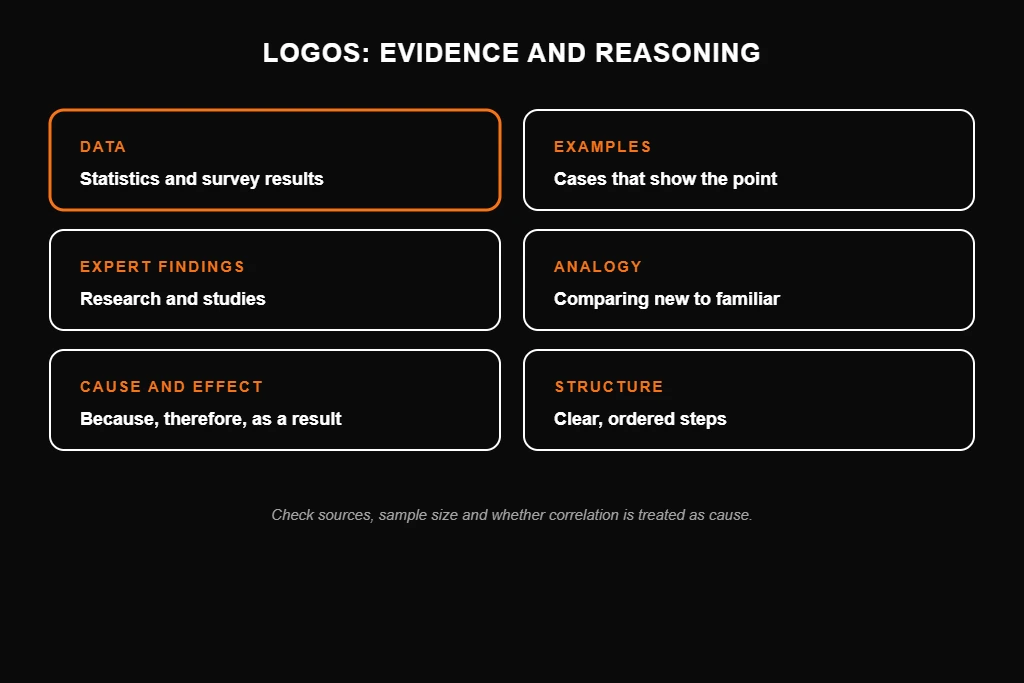
Logos is the appeal to logic. It persuades with reasons and evidence: facts, statistics, expert findings, examples, comparisons and clear cause and effect. A logical argument lets the audience follow the steps and reach the same answer themselves.
Types of evidence and reasoning
Logos can rely on data, such as statistics and survey results; on examples and case studies; on expert research; on analogies that compare a new idea to a familiar one; and on reasoning patterns, such as moving from a general rule to a specific case or from several examples to a general claim. Structure matters too. A well ordered argument is itself a logical appeal.
Logos examples
- “Students who sleep eight hours score higher on memory tests, so later start times could improve results.”
- An energy company comparing yearly costs of two heating systems in a simple table.
- “If each of the 600 students recycles one bottle a day, the school saves over 100,000 bottles a year.”
- A lawyer walking a jury through a timeline of events.
- A product review listing battery life, weight and price for three phones.
Weak spots in logical appeals
Logos can look strong while hiding problems. Watch for numbers with no source, small samples presented as proof, correlation treated as cause, and comparisons that leave out important differences. Checking these weak spots is a good habit both as a reader and as a writer.
Ethos vs Pathos vs Logos
This table shows the three appeals side by side, which helps when they start to blur together.
| Appeal | Appeals to | Typical tools | Example | Question to ask |
|---|---|---|---|---|
| Ethos | Trust in the speaker | Experience, credentials, fairness, tone | “As a nurse for twelve years…” | Why should I believe this person? |
| Pathos | The audience’s feelings | Stories, images, emotive words | A photo of a stray dog in the rain | How does this make me feel, and why? |
| Logos | Reason and evidence | Statistics, facts, examples, logic | “Prices rose 12 percent in a year” | Does the reasoning hold up? |
Most persuasive texts use all three. The difference is in the balance. A scientific report leans on logos, a charity appeal on pathos and a product endorsement on ethos, but each usually borrows a little from the others.
Where They Come From: Aristotle and the Rhetorical Triangle
The three appeals come from the Greek philosopher Aristotle, who wrote about persuasion in the fourth century BCE. In the Rhetoric, he explains that the modes of persuasion furnished by the spoken word are of three kinds: the first depends on the personal character of the speaker, the second on putting the audience into a certain frame of mind, and the third on the proof, or apparent proof, provided by the words of the speech itself. Those three became known as ethos, pathos and logos.
The rhetorical triangle
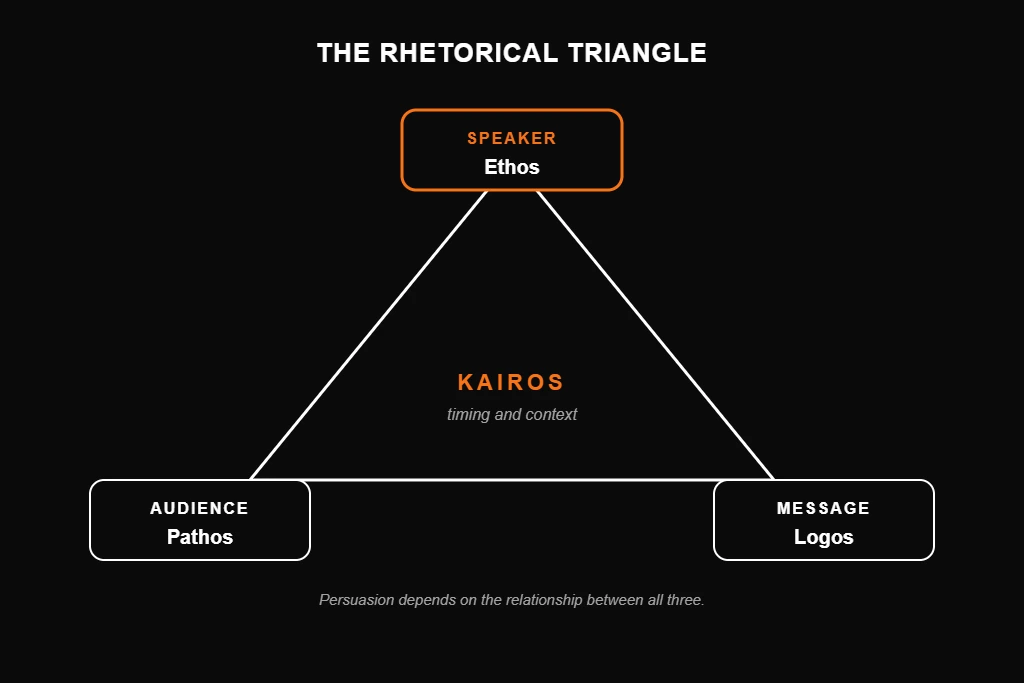
Teachers often draw the appeals as a triangle. Ethos sits at the speaker’s corner, pathos at the audience’s corner and logos at the message’s corner. Purdue OWL’s guide to Aristotle’s rhetorical situation describes logos as the content of a speech, ethos as the character of the speaker or author and pathos as what appeals to the audience’s sensibilities. The triangle reminds you that persuasion depends on the relationship between all three, not on any one alone.
Why it still matters
More than two thousand years later, the same three questions apply to a TikTok video, a cover letter or a presidential debate. The tools have changed, but audiences still ask whether they trust the speaker, whether they care and whether the argument makes sense.
Kairos: The Fourth Appeal
Kairos is about timing and context: saying the right thing, in the right way, at the right moment. Purdue OWL describes kairos as elements that acknowledge and draw support from the particular setting, time and place of a speech. Some teachers call it the fourth appeal. Others treat it as the setting that shapes how the other three work.
Kairos examples
- A sunscreen advert released at the start of summer, not in winter.
- A student asking for an extension right after showing strong effort, not on the morning of the deadline.
- A charity appeal launched days after a natural disaster, when people are paying attention.
- A speech that opens by mentioning an event the audience witnessed that morning.
How kairos changes the other appeals
The same message can succeed or fail depending on when and where it appears. A joke that builds ethos at a party can destroy it at a funeral. A statistic that persuades a committee can bore a crowd at a rally. When you analyze a text, always ask what was happening when it was written, because that context often explains why the writer chose a particular appeal.
Ethos, Pathos and Logos Examples by Context
Seeing the appeals in different settings is the fastest way to recognise them. All examples below are invented unless a source is given.
Advertisements and commercials
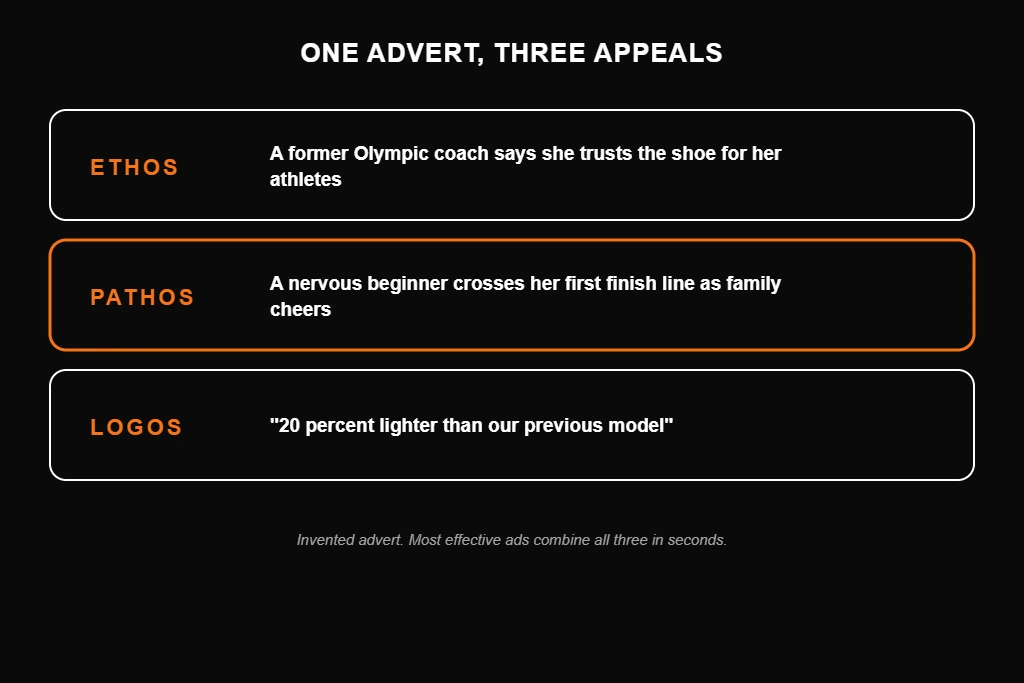
Advertising is the classic place to spot the appeals, because every second and every image is planned. Imagine a running shoe advert. A former Olympic coach says she trusts the shoe for her athletes: that is ethos. A slow motion shot shows a nervous beginner crossing her first finish line while her family cheers: that is pathos. A caption notes that the shoe weighs 20 percent less than the brand’s previous model: that is logos. Most effective adverts combine all three in a few seconds.
- Ethos in ads: experts, celebrities, awards, “trusted by” claims and certification badges.
- Pathos in ads: music, family scenes, humour, nostalgia, fear of missing out.
- Logos in ads: prices, comparisons, test results, percentages and guarantees.
Speeches
Speeches often move between all three appeals. In the Gettysburg Address, delivered in 1863 and held in several handwritten copies at the Library of Congress, Abraham Lincoln uses pathos by honouring those who “gave their lives that that nation might live”, ethos by speaking with humility about how little the living can add, and a logical structure that moves from the nation’s founding, to the present war, to a duty for the future. A graduation speaker who shares a personal failure before giving advice uses ethos and pathos together.
Essays and opinion pieces
In an op-ed arguing for free school meals, a writer might open with a story about a hungry student (pathos), cite a study linking breakfast to concentration (logos) and mention her years as a teacher (ethos). Strong opinion pieces usually use each appeal at a different stage: emotion to hook, evidence to convince and credibility to reassure.
Social media
Influencers rely heavily on ethos, built through follower counts, personal stories and consistency. Viral posts often run on pathos, especially outrage or humour. Logos appears in infographics and “thread” posts that walk through evidence step by step, although those numbers deserve careful checking.
Everyday life
You use the appeals without noticing. Telling your parents you have finished all your homework before asking to go out is ethos. Reminding them how much you have missed your friends is pathos. Pointing out that you will be home by ten and the venue is close is logos.
| Context | Ethos example | Pathos example | Logos example |
|---|---|---|---|
| Advert | Former Olympic coach recommends the shoe | Beginner crosses her first finish line | “20 percent lighter than our last model” |
| Speech | Speaker admits a past failure | Story of a family affected by the issue | Three clear reasons in a logical order |
| Op-ed | Author’s years as a teacher | A hungry student before morning lessons | Study linking breakfast and focus |
| Social media | Consistent creator with expertise | Moving personal video | Infographic with sourced data |
| Everyday | “I’ve already done my homework” | “I’ve really missed my friends” | “I’ll be home by ten, it’s nearby” |
How to Identify Each Appeal in a Text
Identifying the appeals is the first step in any analysis. If you are working toward a full essay, our guide on how to write a rhetorical analysis essay takes you from these notes to a finished draft. Here is a quick method that works on any text.
A four step method
- Read once for meaning, so you know what the writer wants the audience to think or do.
- Read again and mark anything about the writer’s experience, honesty or fairness (ethos), anything that creates a feeling (pathos) and anything that offers reasons or evidence (logos).
- Beside each mark, write the effect in a few words, such as “builds trust” or “makes the cost feel personal”.
- Ask which appeal dominates, and why it suits this audience and moment.
Signal words and clues
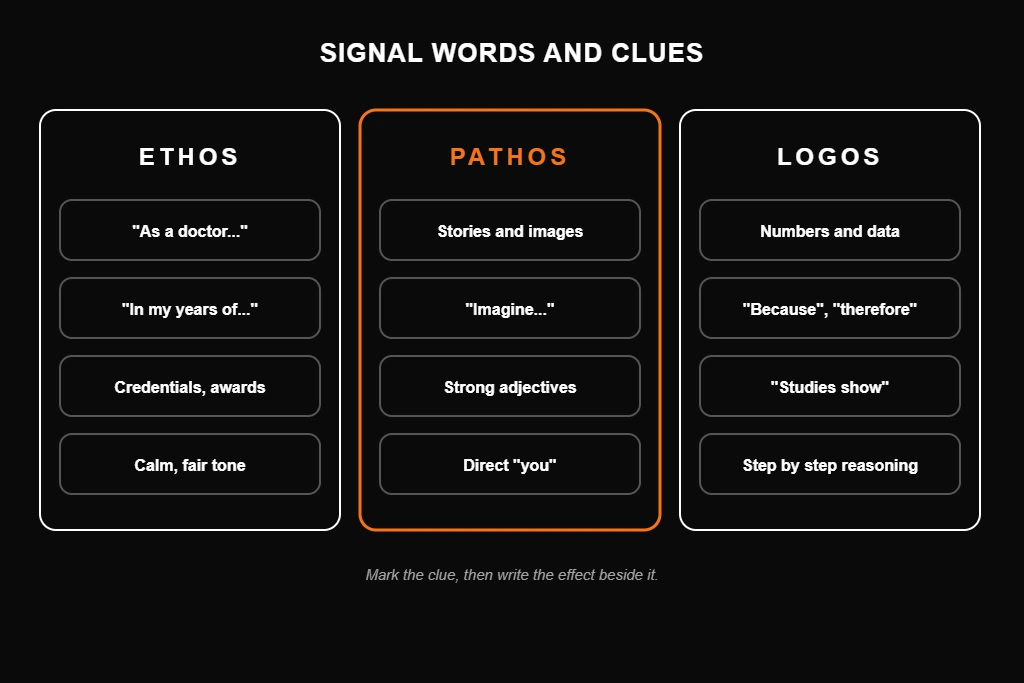
Ethos often shows up in phrases like “as a doctor”, “in my years of”, “experts agree” or a calm, fair tone. Pathos shows up in vivid images, stories, strong adjectives, direct address such as “imagine” or “you”, and words like heartbreaking, proud or afraid. Logos shows up in numbers, “because”, “therefore”, “studies show”, comparisons and step by step reasoning.
When a sentence uses more than one appeal
Many sentences do two jobs at once, and that is normal. “As an ICU nurse, I have held the hands of patients who could have been saved by a vaccine” uses ethos through the speaker’s role and pathos through the image. When this happens, name both and explain how they work together, for example how the speaker’s experience makes the emotional image more believable.
Common mix ups and how to sort them
Three confusions come up again and again. The first is experts. When a writer quotes a scientist, students often call it logos because it sounds factual. In fact, the expert’s authority is ethos, while the data the expert reports is logos. The second is statistics used for emotional effect. “Every hour, a child goes missing” is a number, but its purpose is to frighten, so it works mainly as pathos. The third is personal stories. A story is usually pathos, but if the story shows the writer’s first hand experience, it also builds ethos. When you are unsure, ask what the line is mainly trying to do to the audience: make them trust, make them feel or make them think.
Practise on short texts first
Start with adverts, social media posts and short letters before moving to long speeches. Short texts have fewer appeals, so you can see each one clearly. Try marking three adverts a day for a week, writing one sentence for each appeal you find. By the end of the week, you will spot the appeals almost automatically, which saves time in exams.
How to Use Ethos, Pathos and Logos in Your Own Writing
In persuasive and argumentative essays, the strongest writing balances all three appeals and fits them to the audience.
Know your audience
An audience of experts expects strong logos and may distrust heavy emotion. A general audience may need a story before the data. A skeptical audience needs ethos first: a fair tone and an honest admission of the other side. Decide who you are writing for before you choose your evidence.
Build each appeal on purpose
For ethos, cite credible sources, acknowledge counterarguments and keep your tone measured. For pathos, use one well chosen story or image rather than many. For logos, give clear reasons, accurate evidence and smooth transitions such as “because” and “as a result”.
Balancing the appeals
A persuasive essay rarely uses the appeals in equal amounts. Most strong arguments rest on logos, with ethos holding the reader’s trust throughout and pathos used at key moments, often at the start to hook attention and at the end to motivate. Too much pathos can make an essay feel manipulative, while too little can make it feel cold. Too much ethos can sound like boasting. Read your draft and ask which appeal is doing most of the work, and whether that suits your reader.
Adapting the mix to different assignments
In a research paper, ethos comes from your sources and careful citation, logos from data and analysis, and pathos is used sparingly. In a persuasive speech, pathos and kairos matter more, because listeners respond to stories and to the moment. In a personal statement or application essay, ethos and pathos dominate, since the reader wants to trust you and connect with your story, while logos appears through concrete achievements and results.
A worked paragraph that uses all three
As a peer tutor for two years, I have seen how much a quiet place to study matters. Last term, one student told me she had been doing her homework in a car park because her home was too crowded. Our library is already busy until closing, and a recent student survey found that most respondents would use it more if it opened later. Extending library hours by just two evenings a week would give students like her a safe place to learn.
The first sentence builds ethos through experience, the second creates pathos with a specific image and the third offers logos through evidence (in a real essay, you would cite the survey). The last sentence ties them to a clear proposal.
Writing about the appeals in an essay
When you analyze a text, the goal is to explain how the appeals work, not just to name them. Your rhetorical analysis thesis should name the specific choices a writer makes, such as a personal story or a striking statistic, rather than listing “ethos, pathos and logos”.
Writing About the Appeals in a Rhetorical Analysis
The most common mistake in essays is labelling the appeals without explaining them. Teachers and exam readers want to know what each choice does to the audience and why it serves the writer’s purpose.
Label vs analysis
Label: “The writer uses pathos to make the reader feel sad.” Analysis: “By describing a student studying in a car park, the writer turns an abstract question of opening hours into a concrete image of hardship, which makes the council’s decision feel personal.”
Label: “The speaker uses ethos.” Analysis: “Opening with her two years as a peer tutor, the speaker presents herself as someone who has seen the problem first hand, so the audience trusts her description.”
Name the choice, then the appeal
A useful habit is to describe the specific technique first, such as an anecdote, a statistic or a concession, and mention the appeal only if it helps explain the effect. Write “builds credibility by” instead of “uses ethos”, and “creates sympathy through” instead of “uses pathos”.
Use precise verbs
Strong analysis depends on verbs that describe an effect. Instead of “uses”, try establishes, reassures, evokes, dramatizes, humanizes, quantifies, reinforces or reframes. Each one forces you to say what the choice does. “The statistic quantifies the problem for skeptical readers” is far stronger than “the writer uses logos with a statistic”.
Explain how the appeals combine
The best essays show how appeals support each other. A speaker’s credibility can make an emotional story believable, and a vivid image can make a statistic feel real. Pointing out these relationships shows a deeper understanding of the text, and on exams such as AP Lang it is one way to move toward a more sophisticated analysis.
Always connect to the audience and purpose
An appeal is only effective in relation to a particular audience. Ask who the text is for, what they already believe and what the writer wants them to do. Then explain why a given appeal suits them. A story about a struggling student may move parents but not a budget committee, which might respond better to cost figures.
Sample analysis sentences
It helps to see the difference in practice. Weak: “The author uses pathos when talking about the flood.” Stronger: “By describing a mother wading through waist deep water with her child on her shoulders, the author makes the abstract cost of poor drainage feel personal, pressing readers who have never faced a flood to see the issue as urgent.” The stronger version names the choice, the appeal, the audience and the effect in one sentence.
Another pair. Weak: “The speaker has good ethos because she is a doctor.” Stronger: “The speaker opens by mentioning her twenty years in emergency medicine, which establishes her authority before she makes a controversial claim, so listeners are more willing to accept her warning.” Notice how the stronger sentence explains the timing of the appeal and why that timing matters.
Evaluate, do not just describe
Higher level analysis also asks whether an appeal works. Does the statistic actually support the claim? Could the emotional story alienate some readers? Is the speaker’s authority relevant to this topic? A short evaluative comment, backed by evidence from the text, shows the reader that you are thinking critically about the argument rather than simply listing its parts.
Plan before you write
Group your notes by choice, not by appeal, and plan two or three body paragraphs. Our rhetorical analysis essay outline guide gives a fill in template and a worked plan you can adapt.
When Appeals Go Wrong: Common Fallacies
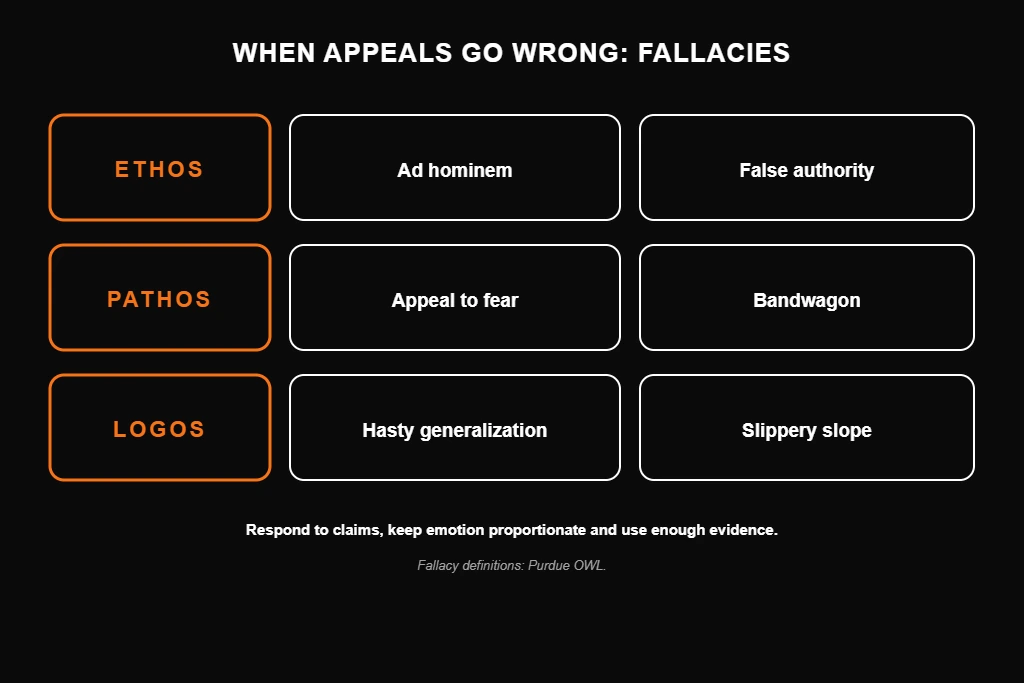
Each appeal has a dark side. A fallacy is a flaw in reasoning that can make an argument seem stronger than it is. Purdue OWL’s guide to logical fallacies defines many of them. The table groups common ones by the appeal they misuse.
| Appeal misused | Fallacy | What it looks like | How to fix it |
|---|---|---|---|
| Ethos | Ad hominem | Attacking the person instead of their argument | Respond to the claim, not the character |
| Ethos | False authority | Citing someone who is not an expert on this topic | Use sources with relevant expertise |
| Pathos | Appeal to fear | Exaggerating danger to scare people into agreeing | Keep the emotion proportionate to the evidence |
| Pathos | Bandwagon | “Everyone is doing it, so you should too” | Give reasons, not popularity |
| Logos | Hasty generalization | A broad claim from too little evidence | Use larger, representative evidence |
| Logos | Slippery slope | Claiming one step will lead to an extreme outcome | Show each step is actually likely |
Spotting these fallacies is part of reading critically, and avoiding them is part of writing honestly. An argument that relies on a fallacy may win a moment but usually loses trust over time.
Fallacies in advertising and politics
Adverts and campaign messages are full of near fallacies, because they need to persuade quickly. A celebrity endorsing a medicine is a common case of false authority. “Join millions of happy customers” is a bandwagon appeal. Warnings that one policy will lead to disaster can slide into slippery slope reasoning. Spotting these patterns does not mean every advert is dishonest, but it helps you separate good reasons from clever pressure.
A quick test for any argument
When you meet a persuasive claim, ask three questions. Is the source qualified on this specific topic? Is the emotion proportionate to the facts? Is there enough evidence for the size of the claim? If any answer is no, look closer before you accept the argument, and in your own writing, fix that weak point before your reader finds it.
Avoiding fallacies in your own essays
Before you submit, reread your strongest claims. Make sure every expert you cite is relevant, every statistic has a source and every emotional example is fair to the people it describes. Replace absolute words such as always and never unless you can prove them.
Fallacies and the three appeals
Each fallacy is really an appeal that has gone wrong. False authority and ad hominem distort ethos, because they rely on who is speaking rather than on what is true. Appeal to fear and bandwagon pressure distort pathos, because the feeling is out of proportion to the evidence. Hasty generalization and slippery slope distort logos, because the reasoning skips steps. Seeing fallacies this way makes them easier to remember, and it gives you a precise vocabulary when you criticize an argument in an analysis essay: you can say which appeal fails and explain why, rather than simply calling the argument weak.
Be careful not to overuse fallacy labels, though. A single emotional story is not automatically an appeal to fear, and quoting an expert is not false authority if the expert is qualified. Reserve the labels for clear cases and explain your reasoning.
A useful habit is to pair every fallacy label with the fix. If an argument relies on false authority, name the qualified source it should have used. If it leans on fear, point out the evidence that is missing. This shows the reader that you understand what a sound version of the argument would look like.
Practice Quiz: Identify the Appeal
Read each sentence and decide whether it mainly uses ethos, pathos or logos. Answers are below. For a full model of how these appeals are analyzed in an essay, see our annotated rhetorical analysis essay example.
- “As a firefighter for eighteen years, I can tell you that smoke alarms save lives.”
- “Picture your grandmother alone in the dark, unable to call for help.”
- “Homes with working smoke alarms report far fewer fire deaths in national data.”
- “Our product has been tested in three independent laboratories.”
- “Don’t let your children be the only ones without one.”
- “The new bus route cuts travel time from forty minutes to twenty five.”
- “I grew up in this neighbourhood, and I still shop on this street every week.”
- “Every bottle you skip saves a sea turtle from a plastic trap.”
- “If tuition rises by 8 percent each year, it will nearly double in nine years.”
- “Nine out of ten dentists we surveyed recommend this toothpaste.”
Answers
1 Ethos: the speaker’s experience. 2 Pathos: a vivid, frightening image. 3 Logos: evidence from data. 4 Ethos and logos: independent testing builds trust and offers evidence. 5 Pathos: fear of being left out. 6 Logos: a measurable comparison. 7 Ethos: belonging to the community builds trust. 8 Pathos: an emotional image linked to a small action. 9 Logos: a calculation. 10 Ethos and logos: expert endorsement presented as a statistic, though the sample may be small.
If you mixed up 4 and 10, that is a good sign. Real texts often blend appeals, and explaining the blend is exactly what strong analysis does.
Explaining your answers
If some answers surprised you, look again at the wording. Sentences that mention numbers but aim to shock are often pathos. Sentences that mention a person’s background are usually ethos, even if they also include a fact. Sentences that link a cause to a result, or compare two options with evidence, are logos. Several items could reasonably fit two appeals, and that is fine. In an essay, what matters most is that you can justify your choice with evidence from the text and explain the effect on the intended audience, so treat the answer key as a guide rather than the only possible reading.
Turn quiz answers into analysis
Once you have labeled a sentence, take it one step further. Pick item three, for example, and write two sentences: one naming the appeal and the specific words that create it, and one explaining how those words affect a particular reader. Repeat this for three or four items. You will quickly notice that the second sentence is harder to write, and that is exactly the skill teachers and exam readers look for. Labeling shows that you know the terms. Explaining shows that you understand how persuasion actually works on people, which is what earns the higher marks in a rhetorical analysis.
You can also reverse the exercise. Take a sentence that uses logos and rewrite it to rely on pathos, then on ethos. Comparing the three versions shows how much the choice of appeal changes the tone and the likely response from readers.
Keep practising
Turn the quiz into a habit. Each week, collect five persuasive sentences from adverts, news articles or speeches, label the main appeal and write one line explaining its effect. Swap lists with a classmate and compare answers. Disagreements are useful, because they usually reveal sentences that blend appeals, which are exactly the ones worth analyzing.
Make your own worksheet
If your teacher uses worksheets, you can build your own in minutes. Choose one advert, one short speech extract and one opinion paragraph. For each, draw three columns for ethos, pathos and logos, add the evidence you find and finish with a sentence on which appeal dominates and why. It is the same skill exam readers reward, practised in a format you can repeat.
How EssaysHelper Can Help You
Most students find that the appeals make sense quickly in class but become harder under exam pressure or in long essays. Recognising the appeals is one skill. Writing about them clearly, or using them well in your own arguments, is another. Our academic writing support can help without taking over your work:
- Reviewing your analysis so it explains effects rather than labels.
- Helping you balance ethos, pathos and logos in persuasive essays.
- Practising with real texts, ads and speeches before exams.
- Giving feedback on drafts for clarity, evidence and fair reasoning.
Send us your assignment and deadline, and we will point you to the quickest next step.
Frequently Asked Questions
What are ethos, pathos and logos in simple terms?
They are three ways to persuade: ethos uses the speaker’s credibility, pathos uses the audience’s emotions and logos uses logic and evidence. Together they explain why an argument works.
Can you give an example of ethos, pathos and logos in one sentence?
“As a nurse for ten years (ethos), I have seen families lose loved ones to preventable illness (pathos), and vaccination rates directly affect outbreak numbers (logos).”
What is the difference between ethos, pathos and logos?
Ethos is about trust in the speaker, pathos is about the audience’s feelings and logos is about the strength of the reasoning and evidence. Most texts mix all three.
Which appeal is the most persuasive?
None is always strongest. The best appeal depends on the audience and context. Experts respond to logos, general audiences often to pathos, and skeptical readers need ethos first.
What is kairos, and how is it different from the other appeals?
Kairos is about timing and context: the right message at the right moment. It is less a separate appeal than the setting that decides how well ethos, pathos and logos will work.
How do advertisements use ethos, pathos and logos?
Ads use experts, celebrities and badges for ethos, music, stories and humour for pathos, and prices, comparisons and test results for logos, often all in a few seconds.
Who came up with ethos, pathos and logos?
The Greek philosopher Aristotle described the three modes of persuasion in his work the Rhetoric, written in the fourth century BCE.
How do I identify ethos, pathos and logos in a text?
Look for clues: credentials and fair tone for ethos, stories and emotive words for pathos, and facts, numbers and “because” reasoning for logos. Then explain each one’s effect.
Can one sentence use more than one appeal?
Yes, and it is common. A nurse describing a patient she cared for uses ethos and pathos together. Name both and explain how they support each other.
How do I use ethos, pathos and logos in my own essay?
Cite credible sources and stay fair for ethos, add one well chosen story for pathos, and support claims with evidence and clear reasoning for logos, all fitted to your audience.
Final Thoughts
Ethos, pathos and logos are simple ideas with a long reach. Ethos asks whether the audience trusts you, pathos whether they care and logos whether the argument makes sense, while kairos reminds you that timing shapes all three. Learn to spot them in ads, speeches and essays, explain what each choice does rather than just naming it, and watch for fallacies that misuse them. Use them honestly in your own writing, and your arguments will be clearer, fairer and far more persuasive.