
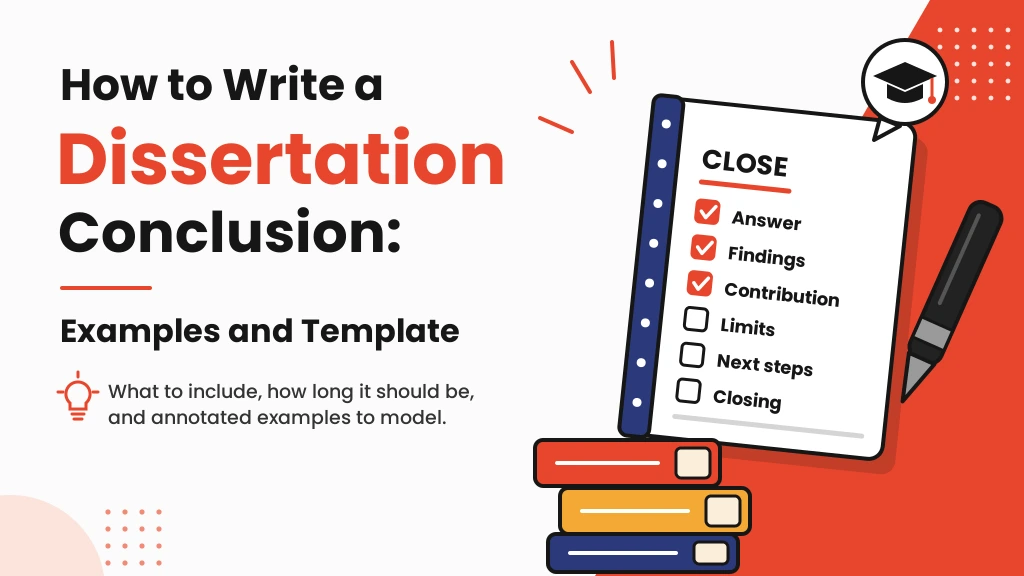
A dissertation conclusion is the closing chapter that answers your research question, draws your key findings together, states what your study adds, admits its limits, and suggests what should happen next. It adds no new evidence, and it is not a chapter by chapter summary. You write it after your findings are final, so that it matches what you actually found.
If you are still planning the whole project, start with our guide on how to write a dissertation, then return here for the detail on this chapter. Below you get the parts to include, a word budget, three original annotated examples, a research question answer map and a checklist.
Students usually get stuck in the same places: repeating every chapter, adding new material at the last minute, ending weakly, mixing up the discussion and the conclusion, and not knowing how long it should be. Each of those is covered below.
What Is a Conclusion in a Dissertation?
The conclusion of a dissertation is the final chapter of the main text, and a conclusion in a dissertation has a narrower job than most students expect. It looks back at the question you asked and tells the reader, clearly and briefly, what you found, what it means and what it leaves open. By the end, a reader should know your answer, why it matters and how far it can be trusted.
What the chapter is for
It does three jobs. It answers the question you set at the start. It shows what the study adds to the field, in theory, practice or method. And it points forward, by saying what remains unsolved and what could be done next. The University of Edinburgh’s guide to the final chapter says the same in other words: refer back to your argument, give an evaluation, and point forward to future research or action.
Who reads it, and what they decide
Examiners often read the opening and closing chapters first, so the conclusion shapes their view of the whole project. A clear one shows that the study delivered what it promised. A vague one makes them wonder whether the work answered its own question. Supervisors use it to check that the project hangs together.
What the chapter is not
It is not a tour of the chapters. The Edinburgh guide warns against writing a summary as your concluding chapter, and the Australian National University warns against listing or repeating findings chapter by chapter. It is also not the place for new evidence, new sources or new arguments. If something matters enough to include, it belongs in an earlier chapter where it can be tested.
Why it is harder than it looks
By the time you reach the last chapter you are tired, short of words and close to your deadline. That is when students either repeat everything or stop abruptly. Treat the chapter as a short, planned piece of writing with its own parts, not as an afterthought. Set aside time for it, and write it only after your findings are final.
Conclusion vs Discussion vs Summary
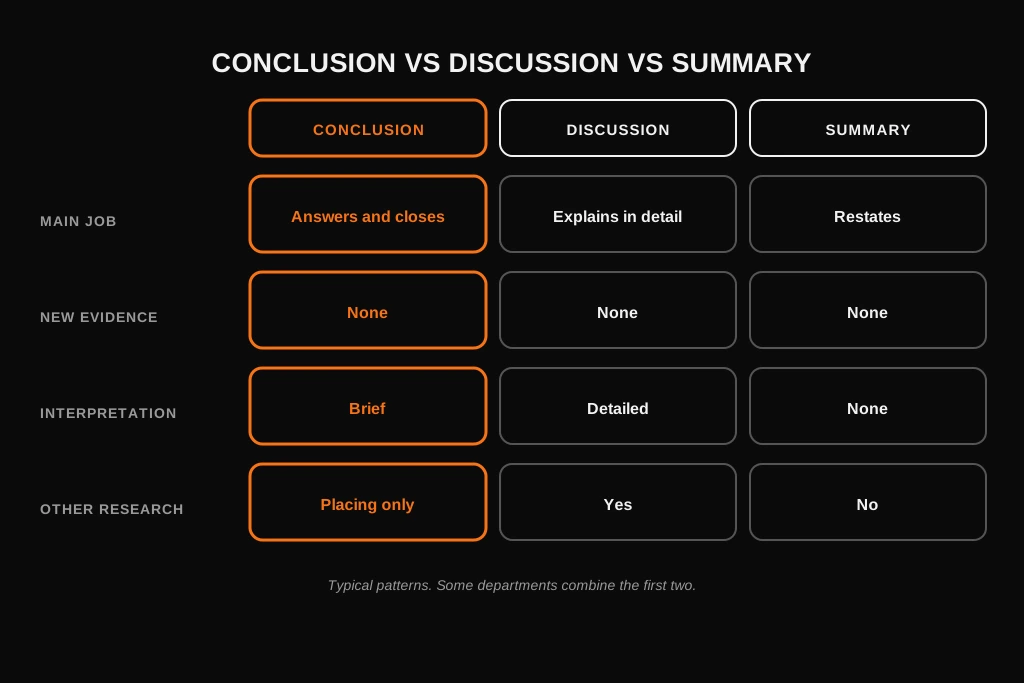
The most common confusion is between the discussion and the conclusion. The University of Southampton library explains that the discussion examines your findings in detail, answers your research questions and draws on other research to give the results context, while the conclusion briefly summarizes and synthesizes the main findings and closes the dissertation. They are usually separate chapters unless your supervisor says otherwise.
A summary is different again. It restates what was done without interpreting it. A good conclusion includes a short recap of the findings, but it also says what they mean, so it goes beyond a summary.
| Feature | Discussion | Conclusion | Summary |
|---|---|---|---|
| Main job | Explains the findings in detail | Answers the question and draws findings together | Restates what was done |
| Uses other research | Yes, to give results context | Only briefly, to place the contribution | No |
| New evidence | Interprets existing results | None | None |
| Interpretation | Detailed | Brief and big picture | None |
| Typical size | A full chapter | Shorter, varies by field | A few sentences |
Some departments combine the discussion and the conclusion in one chapter, so check your handbook before you plan.
Where the Conclusion Sits
The conclusion is the last chapter of the main text. It comes after the findings and the discussion, and before the references and appendices. For the full order of every part of the document, see our guide to dissertation structure. In some projects the discussion and conclusion are merged, and in others a short conclusion follows each major chapter as well as the final one.
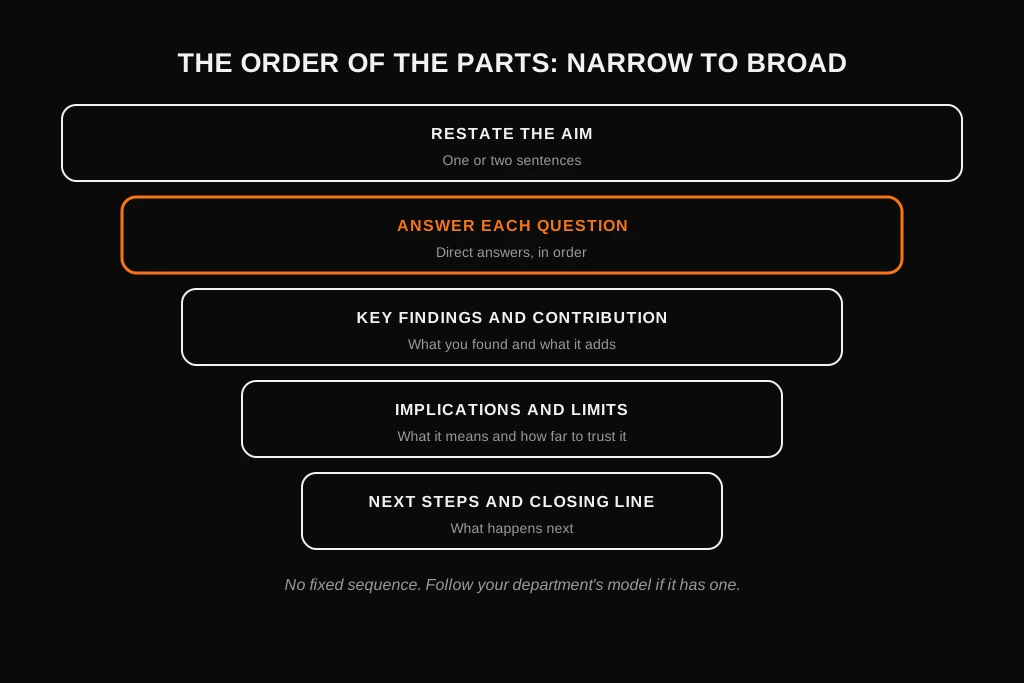
Inside the chapter, the order usually runs from narrow to broad. You begin with your aim and answer, move to what the answer means, then to its limits, and end with what comes next. The University of Edinburgh notes that there is no fixed sequence, so follow your department’s model if it gives one.
What to Include in a Dissertation Conclusion
Departments differ, but most expect these eight parts. Each is described by its job, so you can see what to keep if your word count is tight.
- Restate the aim and questions. Remind the reader what you set out to do, in one or two sentences, using the same wording as the opening chapter.
- Answer each question. Give a direct answer to every research question, in order.
- Key findings. Pull together the most important results, ranked by significance, and include any unexpected ones.
- Contribution. Say what the study adds: new evidence, a clearer theory, a better method or a practical lesson.
- Implications. Explain what the findings mean for practice, policy, theory or later research.
- Limitations. Name the main limits honestly and briefly.
- Recommendations and future research. Suggest a small number of concrete next steps.
- A closing line. End on the main point, not on a new idea.
The Australian National University adds that you should rank findings by significance to your objectives, and that you can note ways your design affected how you read the results. The University of Manchester’s dissertation guide gives a compact model: about two paragraphs summarizing the answers, one paragraph on limitations and one on future directions.
Handling unexpected or negative findings
Many students fear that a result that went against their hypothesis spoils the conclusion. It does not. A clear negative or mixed result is still an answer, and it is often useful to the field. State it plainly, say what it rules out, and offer one or two reasons it may have happened, such as the sample, the measure or the setting. Then say what it suggests for the next study. What weakens a conclusion is hiding the result or stretching the evidence to make it look like support. If the findings were mixed, rank them by significance and say which parts of your answer are firm and which are tentative.
A word budget for the parts
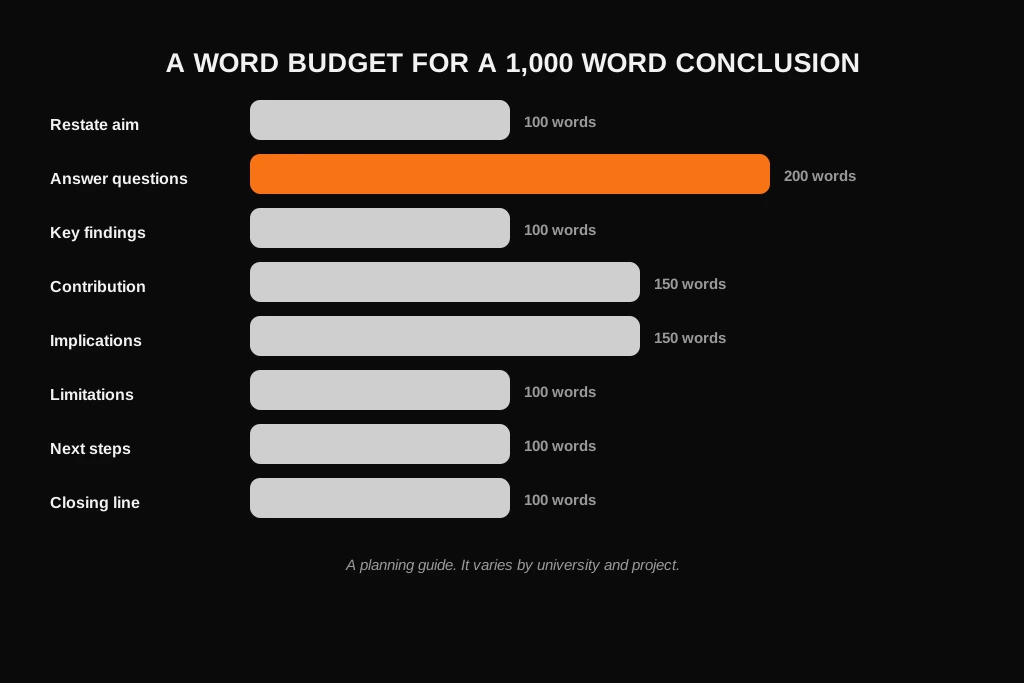
Use this table to plan how many words each part gets. It is a planning guide, not a rule, and it varies by university and project.
| Part | 600 words | 800 words | 1,000 words |
|---|---|---|---|
| Restate the aim and questions | 60 | 80 | 100 |
| Answer each question | 120 | 160 | 200 |
| Key findings | 60 | 80 | 100 |
| Contribution | 90 | 120 | 150 |
| Implications | 90 | 120 | 150 |
| Limitations | 60 | 80 | 100 |
| Recommendations and future research | 60 | 80 | 100 |
| Closing line | 60 | 80 | 100 |
How to Write a Conclusion for a Dissertation, Step by Step
This method answers the common question of how to write a conclusion for a dissertation without repeating your whole project.
- Wait until your findings are final. The conclusion reports what you found, so write it after the results and discussion are done.
- List your research questions. Copy them word for word from the opening chapter, because the conclusion must answer the same questions.
- Reread what you promised at the start. Look at the aims and questions you set when writing an introduction, and make sure each one gets a direct answer. If a question is no longer answered, change the question in the opening chapter, not the answer.
- Write one clear answer per question. Use one or two sentences each, with the key evidence in a clause, not a paragraph.
- Add the contribution and implications. Say what the answer adds and who should care.
- Add limits and next steps. Keep them honest, brief and concrete.
- Finish with a closing line, then cut. Remove anything that repeats a chapter, adds new evidence or hedges the answer.
A write-last plan
If you are short of time, use this order.
- After the findings: list the questions and your short answers.
- After the discussion: add contribution, implications and limits.
- Then draft the full chapter and cut to your word budget.
- Final week: read it side by side with the opening chapter and make sure they match.
Dissertation Conclusion Examples: Three Original Annotated Models
These models were written for this guide to show the shape of a good closing chapter in three fields. They are the closing chapters of three invented projects whose opening chapters asked the questions answered here. The topics, numbers and findings are invented, and there are no real authors or citations. Copy the shape, never the words, and replace everything with your own project.
Example 1: A science or health study
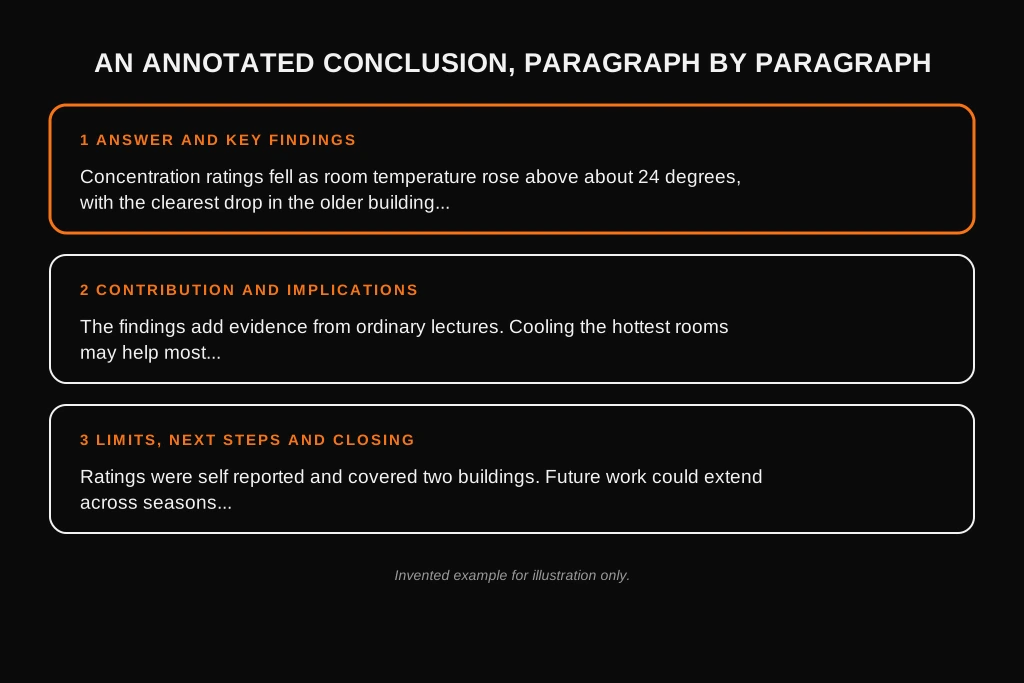
This study asked how classroom temperature relates to students’ self-rated concentration during 50 minute lectures. Across 40 lectures in two buildings, concentration ratings fell as room temperature rose above about 24 degrees, with the clearest drop in the older building. Temperature explained a modest share of the variation, so heat is one factor among several, not the main cause.
The findings add evidence from ordinary lectures to a field that has relied mostly on short laboratory tasks. For estates teams, they suggest that cooling the hottest rooms may help most, while lecturers can reduce the effect by adding breaks in warm rooms.
The study has limits. It used self-rated concentration, covered only two buildings in one season and could not control for lecture content, so the size of the effect should be read cautiously.
Future work could pair ratings with test results, extend the study across seasons and compare more buildings. Together, the results suggest that comfort in the room is a small but real part of learning, and one that universities can change.
What each paragraph does: the first answers the question and states the key findings. The second states the contribution and implications. The third names the limits. The fourth points forward and closes.
Example 2: A social science study
This study explored how first year engineering students decide whether to use peer mentoring. Interviews with 20 students produced three themes: mentoring is used when it feels low risk, when the mentor seems like a peer and not an assessor, and when a problem feels too small for staff but too big to ignore. Students who avoided mentoring mostly described it as unnecessary until they were already behind.
These findings add the students’ own reasoning to evaluations that mostly report satisfaction. They suggest that schemes work best when the first contact is easy, informal and early, and when mentors are introduced as peers.
The findings come from one university and from students who agreed to be interviewed, who may be more reflective than others. They show how decisions are described, not how common each pattern is.
Future studies could test the three themes in a survey across several institutions and follow students across the year. For now, the study shows that the design of the first contact matters as much as the quality of the scheme.
What each paragraph does: the same four moves. A qualitative conclusion answers with themes and reasons, not numbers, and it is careful to say what the findings cannot show.
Example 3: A humanities or desk-based study
This dissertation asked how readers’ letters in one regional newspaper framed the housing shortage between 1919 and 1925, and how those frames compared with editorial opinion. A close reading of 300 letters showed that tenants’ experience, such as damp, overcrowding and rent, appeared in letters about two years before editorials took it up. Editorials, by contrast, framed the shortage mainly as a problem of supply and cost to the town.
The argument challenges the view that the language of the housing debate moved from officials downward. It suggests instead that readers helped set the terms, and that local newspapers kept a record of public attitudes missing from official reports.
The study rests on one newspaper and on letters the editor chose to print, so it cannot show what unpublished readers thought.
Comparing other towns, and the letters that were rejected where records survive, would test how far the pattern holds. For now, the letters pages show that ordinary readers shaped how a housing crisis was talked about.
What each paragraph does: a humanities conclusion states its argument plainly and often spends more words on contribution than a science one does.
How to adapt an example to your own project
Use the models as a skeleton, not a script. Keep the four moves: answer and key findings, contribution and implications, limits, then next steps and a closing line. Replace each move with a sentence or two of your own, written from your answer map. Swap the topic words, keep your own numbers or themes, and use your department’s terms for the method. Then read your version aloud. If any sentence could appear in a different dissertation without changing, it is too generic, so add the specific finding or source type that makes it yours. Finally, check the length against your word budget and cut the weakest sentence in each paragraph.
The same closing, weak and strong
Here is a weak closing: “In conclusion, this dissertation looked at classroom temperature. Chapter 1 introduced the topic, Chapter 2 reviewed the literature and Chapter 3 explained the method. The topic is important and more research is needed.” Every sentence is safe, yet it never answers the question, names a finding or says what the study adds. The strong version, the first two paragraphs of Example 1, answers directly and says what the answer means.
The Research Question Answer Map
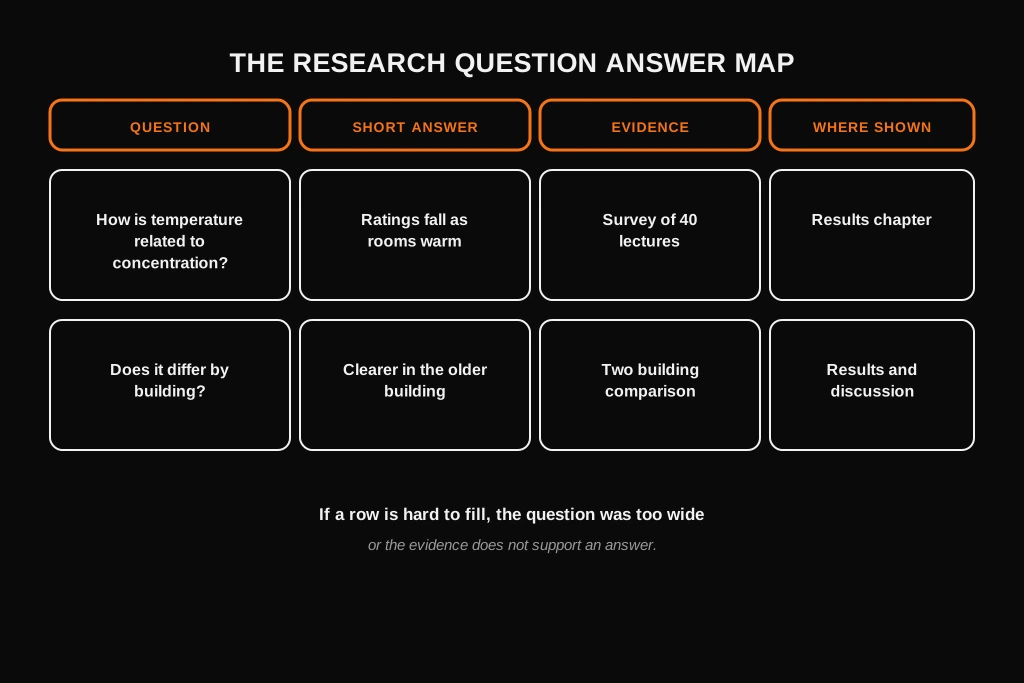
A simple way to make sure the conclusion delivers is to build an answer map before you write. For each research question, write the short answer, the evidence behind it and the chapter where you showed it. The map also reminds you to return to the gap you named in your dissertation literature review, and to say whether the findings fill, change or complicate it. Here is a map for Example 1, with invented content.
| Research question | Short answer | Evidence | Where shown |
|---|---|---|---|
| How is classroom temperature related to concentration? | Ratings fall as rooms get warmer | Survey across 40 lectures | Results chapter |
| Does the relationship differ by building? | The drop is clearer in the older building | Comparison of two buildings | Results and discussion chapters |
If a row is hard to fill, either the question was too wide or the evidence does not support an answer. Fix that before you write, not after.
Checking the answer map against your gap
Once the map is filled, check three things. First, does every row use the same words as the matching question in the opening chapter? Second, does the combined map answer the overall aim, not just the separate parts? Third, can you say in one sentence whether the study filled, narrowed or complicated the gap you identified earlier? If the answer to any of these is no, fix the gap before drafting. A conclusion built on a clean map is usually half written, because each row becomes a sentence and the last row becomes your closing line. Keep the map for your viva or defence too, since examiners often ask what the single most important finding was.
Limitations, Recommendations and Future Research
Students often worry that naming limits will lose marks. The reverse is usually true. The University of Manchester guide says that acknowledging limitations shows you are thinking critically about your research, and it advises against presenting them as failures. The Southampton library adds that you should not overstress them, and that you can put them in context, for example by comparing them with limits in other studies.
Recommendations work best in small numbers. Southampton warns that too many can leave the ending on a negative note, and suggests turning each limit into an action. If you have already given recommendations in the discussion, you do not need to repeat them in full in the conclusion. Check your department’s convention.
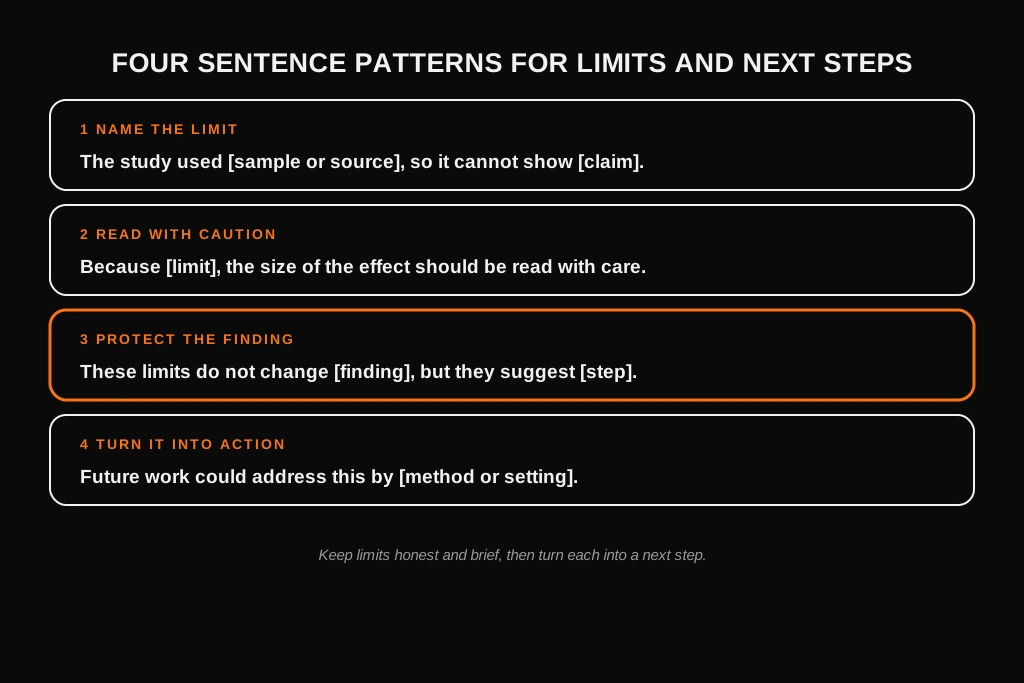
Four sentence patterns for limits and next steps
- The study used [sample or source], so it cannot show [what it cannot claim].
- Because [limit], the size of the effect should be read with caution.
- These limits do not change [main finding], but they do suggest [next step].
- Future work could address this by [method or setting].
A worked example: turning a limit into a next step
Suppose your study used self rated scores from two buildings. A weak version says only that the sample was small and results may not generalize. A stronger version says the study used self rated scores from two buildings in one season, so the size of the effect should be read with caution. It then adds that these limits do not change the main finding that warmer rooms went with lower ratings, but that adding test results and more seasons would show how large and how stable the effect is. The second version names the limit, protects the finding and gives the reader a clear next step, all in three sentences.
Wording, Tense, References and the First Person
Keep the wording confident but measured. The Australian National University advises grounding claims in your own findings and using tentative language, such as it seems or possibly, when you go beyond them. Say how your design shaped what you can claim, as explained in your dissertation methodology, so that readers know how far to trust the answer.
Tense and voice vary by field. A common practice is the past tense for what you did and found, and the present tense for what the results mean and what should happen next. Follow your handbook if it says otherwise.
On references, most closing chapters cite little or nothing, because the evidence has already been given. A few citations to place your contribution are usually acceptable, but check your department’s rule. On the first person, practice varies by field and department, so ask your supervisor.
Eight sentence starters
- This study set out to [aim], and the answer is [answer].
- The findings show that [finding].
- Taken together, these results suggest [meaning].
- The study adds [contribution] to [field or debate].
- For practice, this means [implication].
- The main limit is [limit], which means [what to read cautiously].
- Future work could [next step].
- Overall, [one sentence that sums up the answer and why it matters].
How Long Should a Dissertation Conclusion Be?
There is no single rule. The Australian National University gives no fixed percentage and says length depends on discipline and thesis type. It may be short if the discussion already drew things together, or longer if it develops each chapter’s conclusions in detail, and science conclusions tend to be shorter than those in humanities and social sciences. The Manchester guide, for a dissertation, suggests about two paragraphs for the answers and one each for limitations and future directions.
As a planning guide, many students aim for roughly 5 to 10 percent of the total word count. It varies by university and field, so confirm with your supervisor and look at past dissertations in your department. In practice that looks like this:
- 8,000 words in total: about 400 to 800 words for the conclusion.
- 10,000 words in total: about 500 to 1,000 words.
- 15,000 words in total: about 750 to 1,500 words.
- 20,000 words in total: about 1,000 to 2,000 words.
How Long Should a Dissertation Be? The Total Limit and the Conclusion’s Share
Dissertation length is the total word limit set by your department, and it varies by university, level and field. As one UK example, a university handbook gives about 8,000 to 10,000 words for a 30 credit undergraduate dissertation, with references and appendices left out of the count. Four points matter. Your handbook sets the limit. Check what counts toward it. Work out the share each chapter gets before you write. And remember that the conclusion’s share is small, so every sentence must earn its place. Tip: write the budget at the top of your plan, and cut the conclusion to fit it, not the other way around.
Conclusions by Level, Field and Project Type
Level
At undergraduate level, examiners mainly want a clear answer, a fair statement of limits and a sensible next step. At master’s level they expect a sharper contribution, clearer implications and tighter links to the method. At doctoral level the chapter usually has to show a real contribution to the field and place it in the wider debate. The University of Essex library notes that the words dissertation and thesis swap meaning between the UK and the US, so use your department’s own terms and check its marking criteria for this chapter.
If you are unsure how much weight to give each part, ask your supervisor which one examiners in your department look at first, and read the feedback you received on earlier chapters for hints about what they value.
Field
Fields have habits. Science and health conclusions are often short and move quickly from answer to limits. Social science conclusions often spend longer on implications. Humanities conclusions often restate an argument and say what it changes in a debate. Read two or three dissertations from your department to see what is normal there.
Project type
An empirical study answers its questions with data and states limits of the sample and measures. A desk-based or legal study answers with an argument and states limits of the sources. A systematic review answers with a synthesis of what the studies show and states limits of the evidence base. A practice-based project may need to reflect on the work as well, so confirm the format with your department.
What Comes After the Conclusion
After the closing chapter come the references and any appendices. They are not part of the argument, and they usually do not count toward your word limit, though that varies by university.
Dissertation Acknowledgements: The Last Page You Write
Acknowledgements are a short page thanking the people who helped you, and they sit in the front matter, before the first chapter, even though you write them last. Their order relative to the abstract and the contents list varies by university, so follow your handbook. Four points help: thank your supervisor, participants and librarians; keep the tone warm and brief; check any word limit; and keep thanks out of the closing chapter, which is for the argument. Tip: draft the page after the conclusion is done, when you remember who helped, and check that headings and page numbers match your template.
Connecting the conclusion to the abstract
The dissertation abstract borrows only the core of the conclusion: the headline answer and one implication. Write the abstract after the conclusion, reread the conclusion’s first paragraph, and make sure the two never disagree on a number or a claim. If they do, fix them together.
Common Dissertation Conclusion Mistakes and How to Fix Them
- Repeating every chapter. Answer the questions and rank the key findings instead of touring the chapters.
- Adding new evidence or sources. Move anything new to an earlier chapter where it can be tested.
- Not answering the question. Copy the questions and give each a direct answer.
- Overclaiming. Keep claims inside what your evidence shows, and use tentative language beyond it.
- Hiding the limits or overdoing them. Name the main ones briefly and turn each into a next step.
- Too many recommendations. Choose a few that follow directly from your findings.
- Ending weakly. Finish on the main point and why it matters, not on an apology or a new idea.
- Mixing it up with the discussion. Keep detailed interpretation in the discussion and keep the conclusion brief.
Three mistakes that appear in the last week
The first is rewriting the question. When the findings are disappointing, it is tempting to adjust the research question so that it matches the results. If the change is real, make it openly, explain it, and update the opening chapter as well, so that the two chapters match. The second is a late burst of new reading. A new source found at the end can seem to strengthen the closing chapter, but it belongs in an earlier chapter where it can be tested, or it should be left out. The third is a rushed ending. Students who run out of time often finish with a vague hope for future research. Reserve a fixed block of time for the closing line, and write two or three versions before choosing the one that states the main point most plainly.
A good habit is to keep a short list of every claim in the chapter and, beside each, the page where the evidence appears. If you cannot find the page, the claim is either too strong or in the wrong place. Fix it, or cut it.
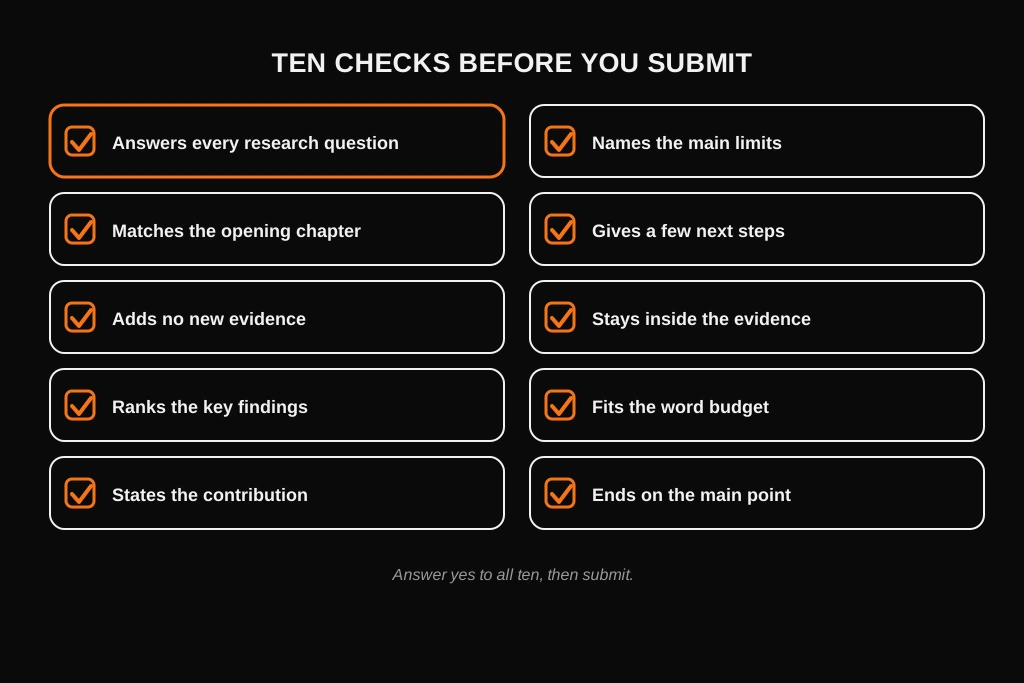
Ten checks before you submit
Run through these yes or no questions, and fix any no.
A final read-through plan
Leave a day between drafting and revising, then read the chapter three times for three different jobs. On the first read, check content: does each part appear, and is each answer direct? On the second read, check consistency: do the numbers, names and claims match the earlier chapters and the abstract? On the third read, check wording: cut filler such as in conclusion and it can be seen that, replace vague words with the specific finding, and shorten sentences that carry two ideas. If you have a reader you trust, ask them one question only: what are the main finding and the main contribution? If they cannot say, the chapter needs a clearer opening paragraph.
Matching the chapter to your marking criteria
Most departments publish marking criteria for the dissertation, and some name the conclusion directly. Look for phrases such as critical reflection, contribution to knowledge, awareness of limitations and clear recommendations. Turn each phrase into a question you can answer from your draft, and underline the sentence that answers it. If a criterion has no matching sentence, add one. This takes ten minutes and is one of the quickest ways to protect marks, because it shows the examiner exactly where each expectation is met.
From Proposal to Conclusion
If you wrote a proposal following our guide on how to write a dissertation proposal, you already described the outcomes you expected. Compare those with what you actually found. Where your results matched, say so plainly. Where they differed, say how and why, because an unexpected result is often the most interesting part of the conclusion. Do not hide a change of direction. Examiners value honest reflection more than a tidy story.
How EssaysHelper Can Help You
The closing chapter is read first and written last, which makes it hard. EssaysHelper can support you at each point without taking over your work:
- Reviewing your questions, answer map and plan.
- Giving feedback on whether each question gets a direct answer.
- Checking that your closing chapter and opening chapter match.
- Editing drafts for clarity, length and consistent formatting.
If you are stuck on a specific part, send us your question and your deadline and we will point you to the quickest next step.
Frequently Asked Questions
What is a conclusion in a dissertation?
It is the final chapter of the main text. It answers your research question, draws the key findings together, states what the study adds, names its limits and suggests next steps.
How do you write the conclusion of a dissertation?
Write it after your findings are final. List your research questions, give a direct answer to each, add the contribution and implications, name the limits and next steps, and end with a clear closing line.
What should a dissertation conclusion include?
Include the aim, direct answers to each question, the key findings, the contribution, the implications, the limitations, a few recommendations and a closing line. Leave out new evidence.
How long should a dissertation conclusion be?
There is no fixed rule. As a planning guide, many students use about 5 to 10 percent of the total word count, so 500 to 1,000 words in a 10,000 word dissertation. Check your handbook.
What is a good example of a conclusion for a dissertation?
A good one answers the question directly, states the contribution, names the limits and points forward. The three annotated examples above show a science, a social science and a humanities model.
What is the difference between the discussion and the conclusion?
The discussion examines the findings in detail and draws on other research. The conclusion briefly draws them together, answers the question and closes the project. Some departments combine them.
Can I add new information or sources in a dissertation conclusion?
No. New evidence belongs in an earlier chapter where it can be tested. The conclusion should only draw together and interpret what you have already shown.
Should a dissertation conclusion have references?
Usually few or none, because the evidence has already been cited. A citation or two to place your contribution is often fine, but check your department’s rule.
Can I use I in a dissertation conclusion?
It depends on your field and department. Some prefer the first person for your own choices and claims, while others expect an impersonal style. Ask your supervisor and follow your handbook.
How do I start a conclusion for a dissertation?
Start by restating your aim and research questions in the same words as the opening chapter, then go straight to the answers. Do not open with a phrase like in conclusion followed by a repeat of the topic.
Final Thoughts
The conclusion of a dissertation is short, but it is the part readers remember. A strong dissertation conclusion comes down to three habits: answer the question you asked, say what the answer adds, and be honest about its limits. You do not need to repeat every chapter or find a dramatic final line. You need a short, planned chapter that matches your opening chapter, stays inside your evidence and shows the reader what to take away. Use the examples and checklist as a starting shape, match the chapter to your department’s rules, and read it one last time against your opening chapter. If a reader can say what you found and why it matters, the chapter is doing its job.