
The first sentence of a college essay can feel harder to write than the rest of the paper.
You know that the opening should capture attention, but every idea may sound too predictable, dramatic, or forced. You might spend an hour rewriting one sentence while the rest of the page remains blank.
The good news is that effective college essay hooks do not need to be shocking. A strong hook simply gives the reader a clear reason to continue. It may introduce an interesting moment, question, conflict, observation, or idea that connects naturally to the rest of your essay.
The challenge is not merely attracting attention. Your opening must also sound like you, suit the purpose of the assignment, and lead somewhere meaningful.
This guide explains 17 creative ways to write college essay hooks, with practical examples for application essays and academic papers. You will also learn how to avoid common opening mistakes, connect your hook to the main point, and revise an introduction that does not yet feel right.
What Is a Hook in a College Essay?
A college essay hook is the opening sentence or short opening passage that captures the reader’s interest and introduces the direction of the essay. It can use a personal scene, question, observation, contrast, fact, or other technique, but it must remain relevant to the main topic.
A hook is not a decoration added to make your writing look creative. It has a practical role.
It should:
- Encourage the reader to continue
- Establish the subject or situation
- Introduce the appropriate tone
- Create curiosity without causing confusion
- Lead naturally to the main story, question, or argument
For example, a student writing about adapting to a new school could begin with:
“For three weeks, the only person who knew my name was the librarian.”
The line creates curiosity, but it also introduces loneliness, transition, and the beginning of a relationship that could shape the essay.
A weak hook might attract attention but have no meaningful connection to the paper. A good hook creates interest and prepares the reader for what follows.
Why Is Starting a College Essay So Difficult?
Many students struggle because they expect the first sentence to be perfect immediately.
You may also feel pressure to tell an extraordinary story. That pressure can lead to an exaggerated scene, an unrelated quotation, or a sentence that does not sound natural.
A more useful approach to starting a college essay is to begin with the clearest moment, idea, or problem connected to your topic. You can revise the opening after the rest of the essay is complete.
The blank-page problem can be especially difficult for students who have had limited access to application guidance. Some first generation college students may be navigating unfamiliar expectations without examples from family members who have completed the same process.
In that situation, remember that a strong essay does not depend on knowing secret admissions rules. It depends on clear reflection, specific evidence, and an opening that honestly introduces what you want the reader to understand.
Why Does the Opening Matter?
The opening shapes the reader’s first impression of your writing, but it does not determine the quality of the essay by itself.
A good hook can:
- Establish your voice
- Introduce a meaningful tension
- Signal what kind of essay the reader is entering
- Make a familiar topic feel more specific
- Create a smooth route into the main discussion
However, even the best college essay hooks cannot rescue an unfocused essay. The opening and the body must work together.
For US applications, the Common App provides broad prompts that encourage applicants to discuss identity, personal growth, challenges, gratitude, interests, and meaningful experiences. Your hook should therefore help introduce the reflection behind your chosen story rather than merely describing an event. The current Common App essay prompts continue to leave room for applicants to choose personally significant subjects.
For UK applications from the 2026 entry cycle onwards, the UCAS personal statement uses three structured questions rather than one continuous free-form statement. Applicants still need clear and engaging opening lines, but those lines should answer the relevant question directly and demonstrate interest in the proposed subject.
College Application Hooks vs Academic Essay Hooks
College application hooks and academic essay hooks serve different purposes.
Hooks for college application essays
A college application hook usually introduces a personal experience, value, interest, challenge, or moment of growth.
It should help the reader understand something meaningful about you.
Example:
“The first circuit I built did not light the bulb. It melted the wire.”
This could begin an essay about curiosity, persistence, engineering, or learning through failure.
Application writing often allows a personal and reflective voice. However, you still need to answer the prompt and explain why the experience matters.
Hooks for academic college essays
An academic hook introduces a question, debate, pattern, text, problem, or concept.
It should not sound like a movie trailer.
Example:
“A city can increase its housing supply while making affordable housing even harder to find.”
This opening introduces a tension suitable for an academic discussion of urban development.
Choosing between different writing tones helps you avoid using a highly emotional application-style opening in a formal research paper or an overly impersonal opening in a personal statement.
Students who understand this distinction can adapt their opening to the reader, purpose, and assignment instead of applying one formula everywhere.
What Makes a Good College Essay Hook?
Good college essay hooks are specific, relevant, clear, and natural.
Specific
A precise image is usually more interesting than a broad claim.
Broad: Helping people has always been important to me.
Specific: Every Thursday, I carried three grocery bags up the same apartment stairs for Mrs. Alvarez.
Relevant
The hook must connect to the central story or argument.
A dramatic line about a storm should not introduce an essay about learning algebra unless the storm genuinely matters to the story.
Clear
Curiosity is useful. Confusion is not.
The reader should not need to solve a puzzle before understanding the situation.
Natural
The sentence should sound like something you could reasonably write and explain.
Do not choose an opening simply because it sounds impressive in a sample essay.
Purposeful
A hook should move the essay forward. After reading it, the reader should be closer to understanding the subject, conflict, or main idea.
You can explore different hooks for essays to understand how openings change across narrative, persuasive, analytical, and descriptive writing.
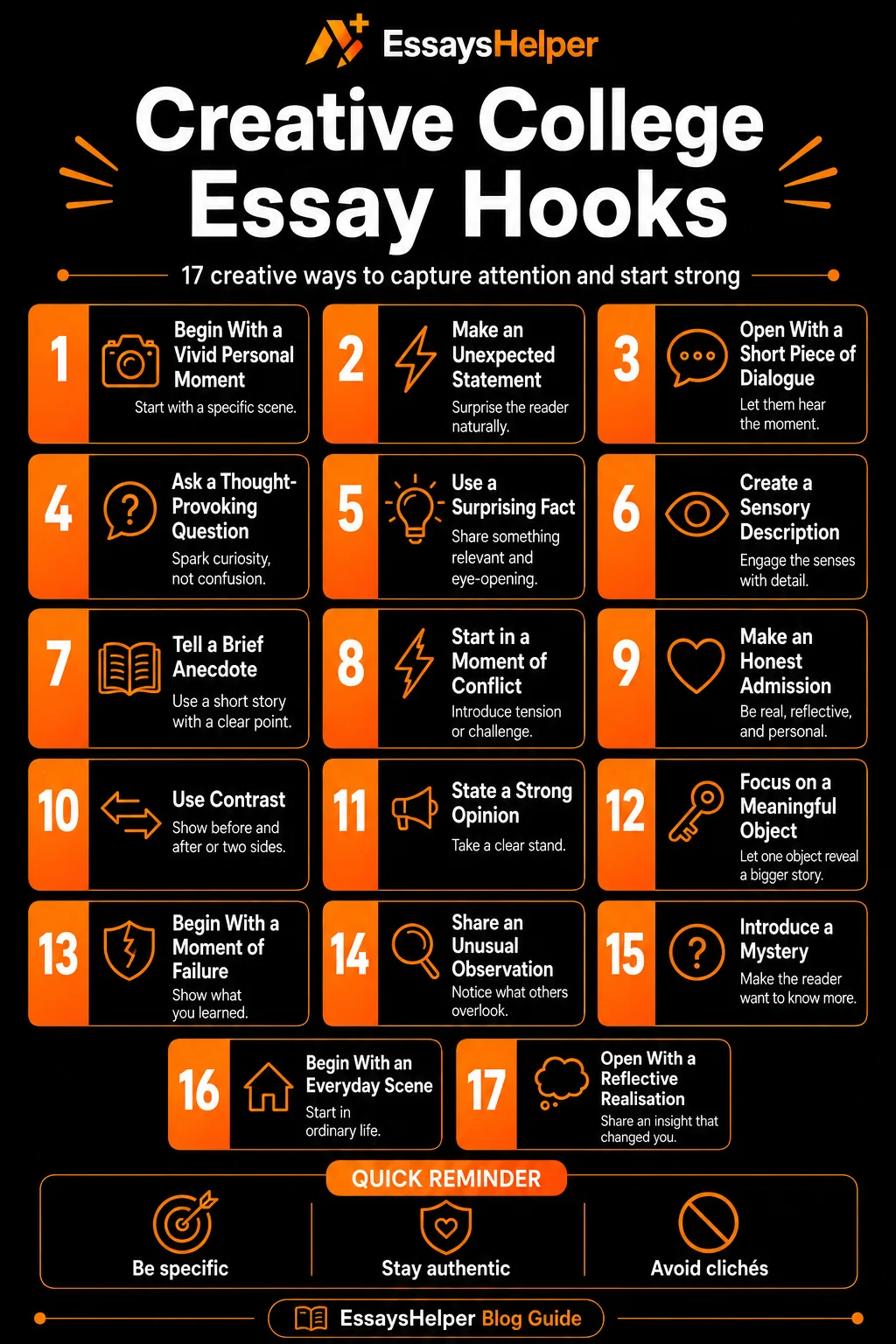
17 Creative Ways to Write College Essay Hooks
The following techniques can help you find an opening that suits your subject and voice. You do not need to use the most dramatic option. Choose the method that leads naturally into your essay.
1. Begin With a Vivid Personal Moment
A vivid personal moment places the reader inside a specific experience.
Example:
“My hands shook as I pressed the green button, sending my first radio message across the crowded emergency shelter.”
This type of hook works well when one event represents a larger change, interest, or lesson.
Do not spend an entire paragraph describing colours, sounds, and movements before explaining why the moment matters. Select only the details that support the story.
2. Make an Unexpected Statement
An unexpected statement challenges the reader’s first assumption.
Example:
“Failing chemistry made me more certain that I wanted to become a scientist.”
The apparent contradiction creates curiosity. The reader wants to know how failure strengthened the student’s interest.
This approach works best when the essay genuinely explains the surprising statement. Avoid making a shocking claim that you later cannot support.
3. Open With a Short Piece of Dialogue
Dialogue can bring the reader directly into an interaction.
Example:
“‘You ask too many questions,’ my grandfather said, handing the broken clock back to me.”
This line could introduce an essay about curiosity, family influence, mechanical engineering, or independent learning.
Keep dialogue short and easy to understand. Long conversations delay the main point, while unexplained dialogue can leave the reader confused about who is speaking.
4. Ask a Thought-Provoking Question
A question hook invites the reader to consider an issue.
Academic example:
“What happens when an algorithm can recommend a prison sentence but cannot explain its reasoning?”
The question introduces a clear ethical and legal concern.
Avoid questions with obvious answers, such as “Have you ever experienced a challenge?” A strong question should open a genuine area of inquiry rather than invite an automatic yes or no.
5. Use a Surprising Fact
A relevant fact can quickly establish the importance of a topic.
Example:
“A discarded plastic bottle may travel farther across the ocean than many people travel in a lifetime.”
This can introduce an environmental essay about waste movement, ocean currents, or international responsibility.
Verify every factual claim through a credible source. Do not invent a statistic or use a number simply because it appears impressive.
6. Create a Sensory Description
Sensory details help the reader see, hear, smell, taste, or feel a moment.
Example:
“The kitchen smelled of cardamom, burnt sugar, and the smoke from another failed attempt.”
This opening could lead into a story about family, experimentation, cultural identity, or persistence.
Use sensory writing selectively. Too many descriptive details can slow the introduction and make the sentence feel artificial.
7. Tell a Brief Anecdote
A short anecdote introduces a small event that represents a larger idea.
Example:
“At nine years old, I charged my neighbours fifty cents to attend science lessons in my garage.”
The anecdote could introduce an interest in teaching, entrepreneurship, or science communication.
The story should reveal something important. A pleasant memory is not automatically a meaningful essay opening.
8. Start in a Moment of Conflict
Conflict gives the reader an immediate problem to follow.
Example:
“Half the committee wanted to cancel the event, and the other half had stopped speaking.”
This could begin an essay about leadership, negotiation, or rebuilding trust.
You do not need a dramatic emergency. Everyday disagreement can be compelling when it requires you to make a decision or change your approach.
9. Make an Honest Admission
A measured confession can create trust and vulnerability.
Example:
“For most of my first semester, I avoided raising my hand even when I knew the answer.”
The line introduces insecurity while creating room for growth.
An admission should serve a reflective purpose. Do not include highly private material because you believe personal pain is required to impress the reader.
10. Use Contrast
Contrast places two opposing ideas, settings, or versions of yourself beside each other.
Example:
“At school, I spoke only when called on. At the community centre, I taught a room of twenty children.”
The contrast immediately introduces a question about confidence, identity, or belonging.
This hook works because the difference matters. Avoid contrasts that sound clever but do not connect to the essay’s central development.
11. State a Strong Opinion
A firm position can introduce an argumentative essay.
Example:
“A school library should never be treated as an optional expense.”
The reader immediately understands the writer’s position.
A strong opinion still needs nuance and evidence. Avoid language suggesting that anyone who disagrees is ignorant or immoral.
12. Focus on a Meaningful Object
An ordinary object can carry emotional or intellectual significance.
Example:
“The most important item on my desk is a notebook with only seven pages filled.”
The reader wants to know why an almost-empty notebook matters.
The object should reveal a larger story about your habits, relationships, interests, or development. Do not choose an object merely because it sounds symbolic.
13. Begin With a Moment of Failure
Failure can create a strong opening when the essay focuses on reflection rather than self-pity.
Example:
“My robot moved exactly four inches before collapsing in front of the judges.”
This line creates a clear scene and introduces a problem.
The rest of the essay should show what you learned, changed, questioned, or attempted next. Avoid claiming that every failure immediately became a success.
14. Share an Unusual Observation
An original observation can reveal how you think.
Example:
“People rarely notice public benches until they need somewhere safe to rest.”
This could introduce an essay about urban design, disability access, ageing, homelessness, or community planning.
The observation should be understandable and connected to the paper. Being unusual is not enough if the idea remains vague.
15. Introduce a Mystery
A small mystery encourages the reader to seek an explanation.
Example:
“Every morning for a month, a new paper crane appeared outside the classroom door.”
This line creates curiosity without relying on danger or exaggeration.
Reveal the answer gradually but do not withhold basic context for too long. A reader should feel intrigued, not manipulated.
16. Begin With an Everyday Scene
An ordinary moment can become meaningful through careful reflection.
Example:
“At 6:15 every morning, I translated the bus announcements for my mother.”
The event is simple, but it may introduce responsibility, language, immigration, family, or communication.
You do not need an international award or major tragedy to write a memorable essay. Specific everyday experiences can reveal character more effectively than a summary of achievements.
17. Open With a Reflective Realisation
A reflective statement begins with an insight developed through experience.
Example:
“I used to think leadership meant speaking first. Coaching younger students taught me that it often means listening longest.”
This hook gives the reader both the earlier belief and the later change.
Avoid writing a vague life lesson such as “Everything happens for a reason.” The realisation should be specific enough to guide the essay that follows.
College Essay Hooks Examples by Subject
Academic hooks should reflect the type of thinking valued in each discipline. They may introduce a contradiction, problem, case, debate, or significant pattern.
| Discipline | Hook example | Why it works |
| Business | “A company can increase its sales while steadily losing its most valuable customers.” | Introduces a business contradiction involving growth and retention. |
| Nursing | “The final medication instruction may be the first detail a frightened patient forgets.” | Connects communication with patient safety. |
| Psychology | “People often remember confidence more clearly than accuracy.” | Introduces a question about judgement and perception. |
| Education | “A student can attend every lesson and still remain absent from the learning process.” | Creates a contrast between physical presence and engagement. |
| Literature | “The most powerful character in the novel never speaks directly.” | Introduces an interpretive argument. |
| History | “Revolutions often begin long before the first public protest.” | Challenges a simplified view of historical change. |
| Sociology | “A neighbourhood can become wealthier while its residents become less secure.” | Introduces inequality and displacement. |
| Political science | “Voting gives citizens a voice, but not always an equal one.” | Opens a discussion of participation and representation. |
| Environmental science | “A flood barrier can protect one community by increasing the danger somewhere else.” | Introduces environmental trade-offs. |
| Computer science | “A highly accurate system can still make an unacceptable decision.” | Introduces algorithmic ethics and fairness. |
| Engineering | “The strongest material is not always the safest design choice.” | Creates a technical question about design criteria. |
| Law | “A legal decision can follow the rules and still produce an unjust result.” | Introduces tension between legality and justice. |
Students writing formal papers may also need help organising the introduction, evidence, and conclusion around the hook. Reliable academic assignment support can be useful when the difficulty extends beyond the first sentence and involves the complete structure of the task.
Weak vs Strong College Essay Hooks
A strong hook is not necessarily longer than a weak one. It is usually more specific and more closely connected to the essay.
| Weak hook | Why it is weak | Stronger hook |
| “Since the beginning of time, people have faced challenges.” | Extremely broad and overused | “My first challenge as team captain was convincing eight players not to quit.” |
| “Have you ever failed at something?” | Has an obvious answer | “My first business earned twelve dollars and cost my parents forty.” |
| “The dictionary defines leadership as…” | Delays the writer’s own idea | “I learned more about leadership from an empty chair than from being elected captain.” |
| “Education is very important in society.” | Vague and predictable | “A fifteen-minute bus delay caused three students in my class to miss breakfast every morning.” |
| “Albert Einstein once said…” | Relies on someone else’s voice | “I understood curiosity differently after spending six hours repairing a radio worth five dollars.” |
UCAS currently advises applicants to avoid quotations and clichés, remain relevant, produce several drafts, and ask trusted people for feedback. Those principles are useful beyond UK personal statements because they encourage original, specific writing rather than borrowed language.
How to Connect the Hook to the Introduction
A hook should not sit separately from the rest of the introduction.
After the opening, you need to help the reader understand:
- What is happening or being discussed
- Why the opening matters
- What the essay will explore
- Where the discussion is heading
Consider this hook:
- “My robot moved exactly four inches before collapsing in front of the judges.”
- A weak transition might immediately jump to:
- “Engineering is an important field with many career opportunities.”
- The connection is too broad.
A stronger continuation would be:
“While the other teams prepared for the next round, I began listing every assumption our group had made without testing. That failed design changed the way I approached engineering. I became less interested in producing the quickest solution and more interested in understanding why a solution worked.”
The paragraph moves from the event to its meaning.
The best essay format for students usually gives each part of the introduction a clear role. The hook attracts attention, the bridge provides context, and the thesis or controlling idea shows where the essay is going.
Use Sentence Variety Without Forcing It
The rhythm of your first paragraph affects how the opening feels.
Several long sentences can make the introduction difficult to follow. Several short sentences can make it sound abrupt.
Compare:
“The room went silent. I looked down. My notes were gone. I panicked.”
With:
“The room went silent as I reached for notes that were no longer on the table.”
The second version combines related information more smoothly.
Understanding the main types of sentences can help you vary your openings without creating fragments, run-on sentences, or unnecessarily complicated structures.
Sentence variety should support meaning. Do not change sentence lengths randomly in an attempt to sound more sophisticated.
Common College Essay Hook Mistakes
Starting too broadly
Openings about “society,” “human history,” or “the modern world” often delay the real subject.
Weak: Since the beginning of civilisation, communication has been important.
Better: The first time I interpreted for a patient, I translated every word except the one I did not understand.
Using a dictionary definition
A dictionary definition rarely reveals your thinking.
Begin with your own observation, case, argument, or experience instead.
Choosing an overused quotation
A famous quotation gives the first words of your essay to someone else.
It may also sound disconnected from your personal experience or academic argument.
Making the opening too dramatic
Do not describe a normal examination as “the battle that decided my destiny.”
Use language that fits the actual importance of the event.
Writing a hook unrelated to the essay
A dramatic sports scene does not belong in an essay about biology unless the connection is meaningful and developed.
Trying too hard to impress
Unusual vocabulary, philosophical claims, and complicated metaphors can hide the real point.
Clarity usually creates a stronger impression than complexity.
Using humour without context
Humour can work, but it is difficult to control. Avoid jokes that depend on sarcasm, cultural references, or making another person look foolish.
Revealing trauma for attention
You are not required to share your most painful experience.
A thoughtful essay about an everyday responsibility can be more revealing than a dramatic story you are not comfortable discussing.
Copying sample openings
Sample essays can teach you about structure, but copying their rhythm, imagery, or central idea can erase your own voice.
Letting AI replace your voice
AI-generated introductions often sound polished but generic. They may also invent dramatic details that do not belong to your experience.
Use tools to brainstorm questions or identify unclear wording, but keep the story, reflection, and final decisions your own.
Students who recognise these problems but still struggle to revise the full draft may benefit from professional essay help focused on clarity, structure, and feedback rather than replacing the student’s personal experience.
How to Write Your Own Hook Step by Step
Step 1: Finish a rough draft first
You do not always know the best opening before understanding the complete essay.
Write a temporary first sentence and continue.
Step 2: Identify the real centre of the essay
Ask:
- What changed?
- What did I realise?
- Which conflict matters most?
- What question does the paper answer?
- Which image or example represents the main idea?
Step 3: Draft several different openings
Write at least five versions.
Try a scene, contrast, admission, question, or observation. The purpose is not to create five polished hooks. It is to discover which direction feels most natural.
Step 4: Test the connection
Read the hook beside the final paragraph.
Do they belong to the same essay?
If the conclusion focuses on listening, but the hook focuses on winning an award, the opening may emphasise the wrong idea.
Step 5: Remove unnecessary explanation
Start as close as possible to the meaningful moment or idea.
Wordy: When I was twelve years old, I had an experience that would eventually change how I thought about responsibility.
Stronger: At twelve, I became responsible for closing my father’s shop every evening.
Step 6: Ask for focused feedback
Do not ask only, “Is this good?”
Ask:
- What do you expect the essay to be about?
- Which detail interests you?
- Where do you become confused?
- Does the opening sound natural?
- Does it connect to the rest of the essay?
Step 7: Revise after completing the essay
The best hook may come from a sentence already hidden in the third or fourth paragraph.
Move it, rewrite it, and use it as the opening.
Students seeking professional support for college essays should look for feedback that preserves their personal story and helps them improve the connection between the hook, reflection, and complete response.
How EssaysHelper Supports Students
A strong introduction is only one part of successful academic writing.
EssaysHelper provides guidance for students who need help interpreting a prompt, developing ideas, improving structure, or reviewing an existing draft. Through Essay Helper, students can explore support for essays, assignments, and capstone projects across different academic disciplines.
The aim of useful support should be to make your argument clearer and help you understand how to improve your own work. Your experience, evidence, and academic decisions should remain central to the final paper.
College Essay Hook Checklist
Before keeping your opening, ask:
- Does the hook connect directly to the essay?
- Is it specific rather than broad?
- Does it sound like my natural voice?
- Does it suit an application essay or academic paper?
- Does it create curiosity without causing confusion?
- Have I avoided clichés and borrowed quotations?
- Is every factual claim accurate?
- Does the next sentence build on the opening?
- Can I remove unnecessary words?
- Does the conclusion fulfil the expectation created by the hook?
You do not need to answer yes after the first draft. The checklist is meant to guide revision.
Conclusion
The best college essay hooks are not always the loudest, funniest, or most dramatic. They are the openings that introduce something relevant and make the reader want to understand it more fully.
A strong hook should be specific, clear, natural, and appropriate for the essay. It should also connect to the story, reflection, question, or argument that follows.
When you feel stuck, stop trying to create a perfect first sentence. Draft several possibilities, complete the essay, and return to the opening with a clearer understanding of what the paper is really about.
Your goal is not to trick the reader into continuing. It is to begin in a way that makes continuing feel worthwhile.
FAQs About College Essay Hooks
What is a good hook for a college essay?
A good hook introduces a specific moment, question, conflict, or observation that connects directly to the essay. It should create interest while still sounding natural and appropriate for the student’s voice.
How long should a college essay hook be?
A hook is usually one sentence or a brief opening passage of two to three sentences. It should be long enough to establish interest but short enough to move quickly into the context and main purpose.
Can I start a college essay with a question?
Yes, provided the question is thoughtful and relevant. Avoid broad questions with obvious answers, and make sure the following sentences begin exploring the issue rather than leaving the question unsupported.
Is it okay to use dialogue in a college application essay?
Yes. Short dialogue can place the reader inside a meaningful interaction and reveal personality or conflict. Make it clear who is speaking and avoid opening with a long conversation that delays the main point.
Should I begin my college essay with a quote?
Usually, your own words create a more original opening. A quotation can work when it is essential to the story, but famous quotations and clichés often take attention away from your experience or argument.
How do I write a hook if nothing dramatic has happened to me?
Focus on a specific everyday experience, responsibility, conversation, habit, or observation. Admissions essays do not require trauma or extraordinary achievements, and an ordinary moment can become meaningful through honest reflection.
Can humour be used in a college essay hook?
Yes, but it should feel natural and should not depend on insulting someone, exaggerating a serious issue, or using a reference the reader may not understand. The humour should support the essay rather than becoming its only purpose.
What college essay hooks should I avoid?
Avoid dictionary definitions, unrelated quotations, extremely broad claims, obvious questions, fake statistics, and dramatic language that does not match the event. You should also avoid copying the structure or wording of a sample essay.
How do I connect the hook to my main point?
Follow the hook with context that explains what is happening and why it matters. Then guide the reader towards the main reflection, argument, or controlling idea instead of jumping to an unrelated general statement.
Can I change my hook after writing the essay?
Yes. In fact, revising the hook after completing the essay is often easier because you understand the main point more clearly. You may discover that a sentence from the middle of your draft creates a stronger opening.