

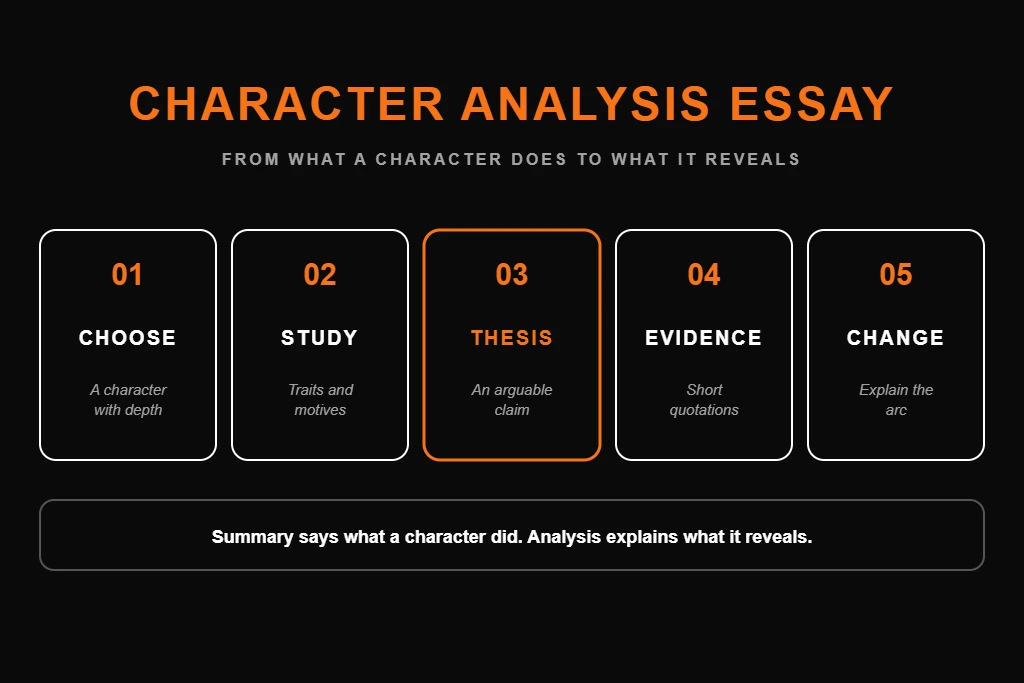
A character analysis essay examines one character in a story, play or film and argues what that character reveals about the work’s meaning. To write one, choose a character with depth, track what they say, think and do, identify how they change, write an arguable thesis about them, and support it with short quotations you explain in detail.
That is the quick answer. This guide covers everything else you need: how to pick the right character, how to study them, how to write a hook that grabs your reader, how to build a thesis, the standard format, and how to write body paragraphs that analyze instead of retell. You will also find a full character analysis essay example, five shorter examples on famous characters, a rubric breakdown and fixes for the mistakes students make most often.
If your last essay came back with “too much summary” or “go deeper into the character,” this guide was written for you. Both comments have simple, practical fixes, and you will find them below.
What Is a Character Analysis Essay?
A character analysis essay is an argument about who a character is, why they act the way they do and what they contribute to the story. Instead of describing what happens to the character, you explain how the author builds that person and what the character helps the work say about people, society or ideas.
At Essays Helper, we put it to students like this: a summary tells the reader what a character did, while a character analysis explains what those actions reveal. The goal is to show your reader something about the character they might not have noticed on their own.
What teachers want to see
Most teachers look for four things: a clear, arguable claim about the character, evidence from the text, analysis that explains how that evidence supports the claim, and a connection between the character and the larger meaning of the work. As Purdue OWL’s guide to writing about literature points out, a literature paper is essentially an argument, and a plot summary alone is not one.
Character types you should know
Knowing the vocabulary of character types helps you describe a character precisely. Here are the terms that come up most often in class and on exams.
| Type | What it means | Example |
|---|---|---|
| Protagonist | The main character the story follows | Elizabeth Bennet in Pride and Prejudice |
| Antagonist | The character or force opposing the protagonist | Claudius in Hamlet |
| Round | Complex, with several traits and inner conflict | Hamlet |
| Flat | Simple, defined by one or two traits | Mr Collins in Pride and Prejudice |
| Dynamic | Changes in an important way during the story | Ebenezer Scrooge |
| Static | Stays essentially the same throughout | Tiny Tim |
| Foil | Contrasts with another character to highlight their traits | Laertes as a foil to Hamlet |
These labels are a starting point, not an argument. Saying “Scrooge is a dynamic character” is a fact. Explaining why his change matters to the story’s message is analysis.
Character analysis vs character sketch
Some students confuse a character analysis with a character sketch. A sketch describes a person: their appearance, habits and personality, often in a creative or descriptive way. An analysis argues something about a character in a text, using evidence and explaining the author’s choices. If your assignment asks you to “analyze,” “examine” or “explain the significance of” a character, your teacher wants an argument, not a portrait.
Before You Write: Choose and Study Your Character
The strength of your essay depends on two early decisions: which character you pick and how carefully you study them. A little extra time here saves a lot of rewriting later.
How to choose a character with enough depth
If you get to choose, pick a character who changes, struggles with a decision or behaves in ways that surprise you. Round, dynamic characters give you far more to say than flat ones. Minor characters can also work well, especially when they act as a foil or reveal something about the main character, but make sure the text gives you enough evidence to build at least three paragraphs.
Direct and indirect characterization
Authors reveal characters in two ways. Direct characterization is when the narrator tells you what a character is like, such as calling someone “cruel” or “generous.” Indirect characterization is when you have to infer traits from what the character does and says. Indirect evidence is usually more interesting to analyze, because it requires interpretation.
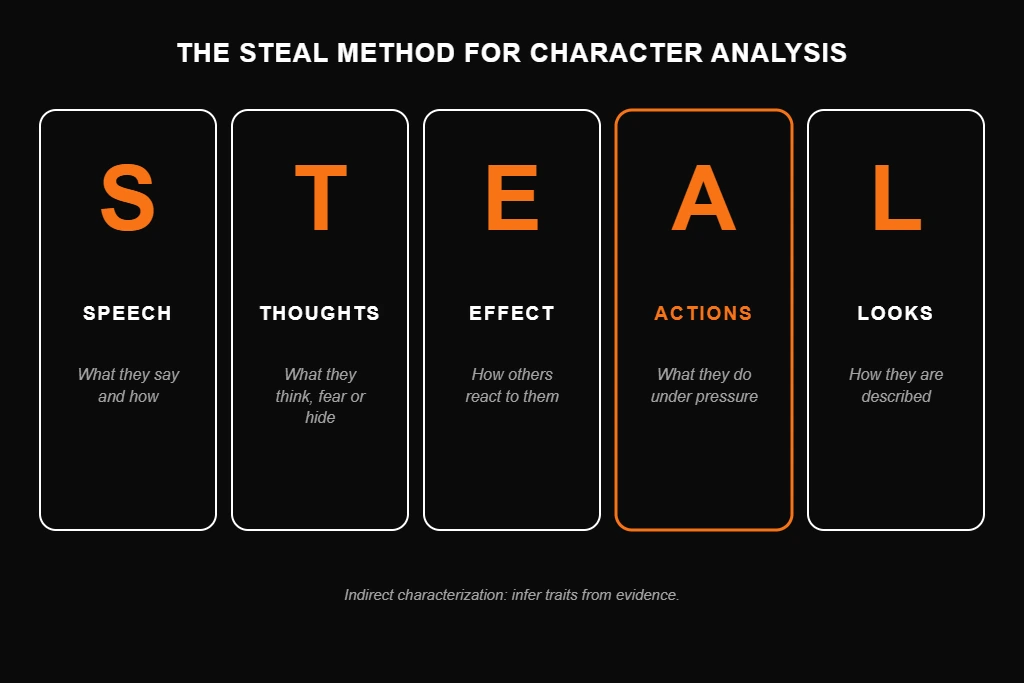
A simple way to track indirect characterization is the STEAL method:
- Speech: what the character says and how they say it.
- Thoughts: what they think, fear or hide.
- Effect on others: how other characters react to them.
- Actions: what they do, especially under pressure.
- Looks: how they are described, dressed or presented.
Questions to ask about any character
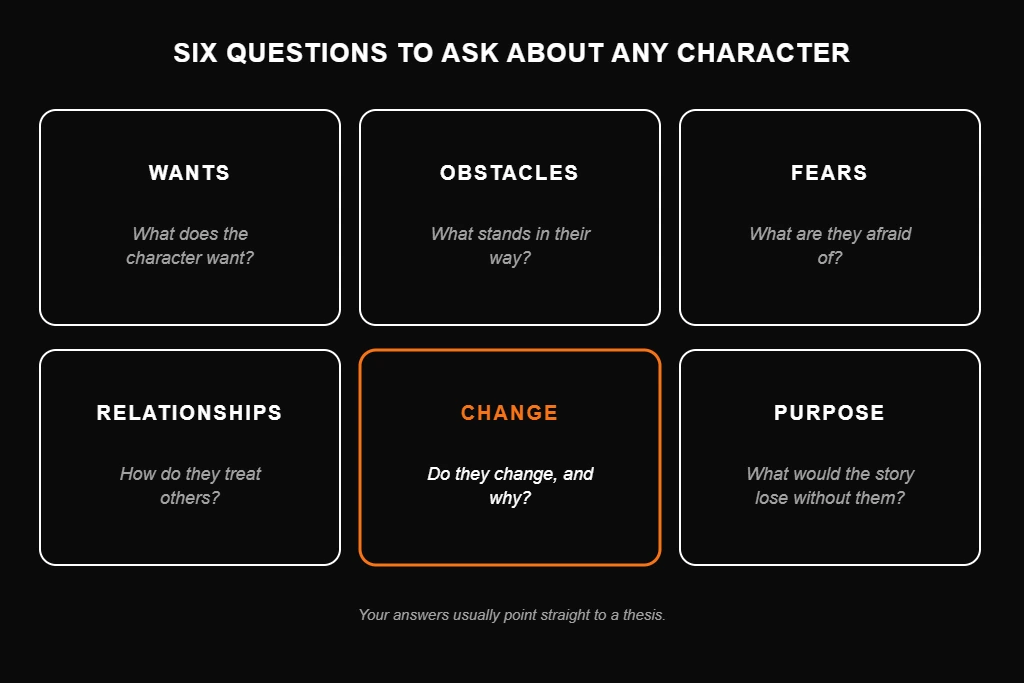
As you read, keep a running list of answers to a few key questions. What does this character want? What stands in their way? What do they fear? How do they treat people with less power? Do they change, and if so, what causes the change? What would the story lose without them? If you want a refresher on how literary essays work in general before you begin, our guide to understanding literary essay basics covers the foundations.
Keep an evidence log
Create a simple table with three columns: the quotation or moment, the page or line number, and what it shows about the character. Students who keep an evidence log while reading spend far less time searching for quotes later, and their essays tend to be more specific.
How to Write a Character Analysis Essay Step by Step
Here is the full process from first read to final draft. Follow the steps in order, because each one depends on the work you did before it.
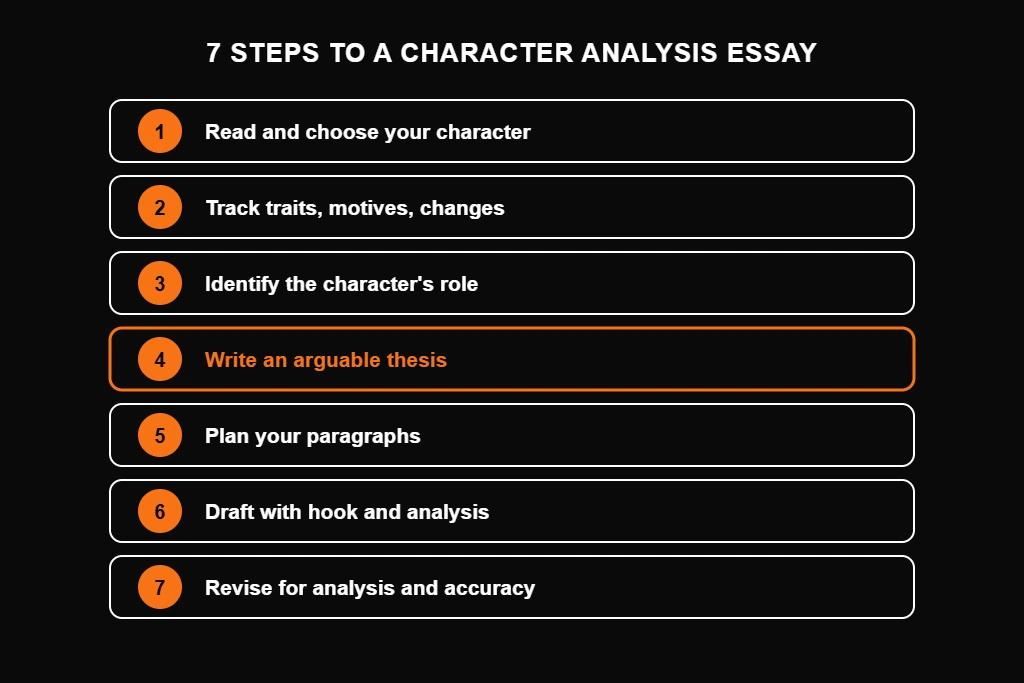
Step 1: Read the text and choose your character
Read the full text at least once before deciding. Note which characters you find most interesting, confusing or surprising, and choose the one you have the most to say about.
Step 2: Track traits, motivations and changes
Use STEAL to gather evidence. Pay special attention to turning points, the moments when the character makes a big decision or reveals something new.
Step 3: Identify the character’s role in the story
Ask what the character contributes. Do they drive the plot, represent an idea, highlight another character or carry a theme? This question usually leads straight to your thesis.
Step 4: Write an arguable thesis
Make a claim about the character that someone could reasonably disagree with, and connect it to a larger meaning. The thesis section below shows exactly how.
Step 5: Plan your paragraphs
Give each body paragraph one point about the character, such as a trait, a conflict or a change. Order them so the argument builds, often following the character’s development through the story.
Step 6: Draft with a hook, analysis and a strong finish
Open with a hook that sparks interest in your reading of the character, write body paragraphs that explain evidence in depth, and finish by showing why the character matters to the work as a whole.
Step 7: Revise for analysis and accuracy
Highlight every sentence that only retells the plot and turn most of them into analysis. Check quotations, page numbers, present tense and formatting before you submit.
Hooks for a Character Analysis Essay
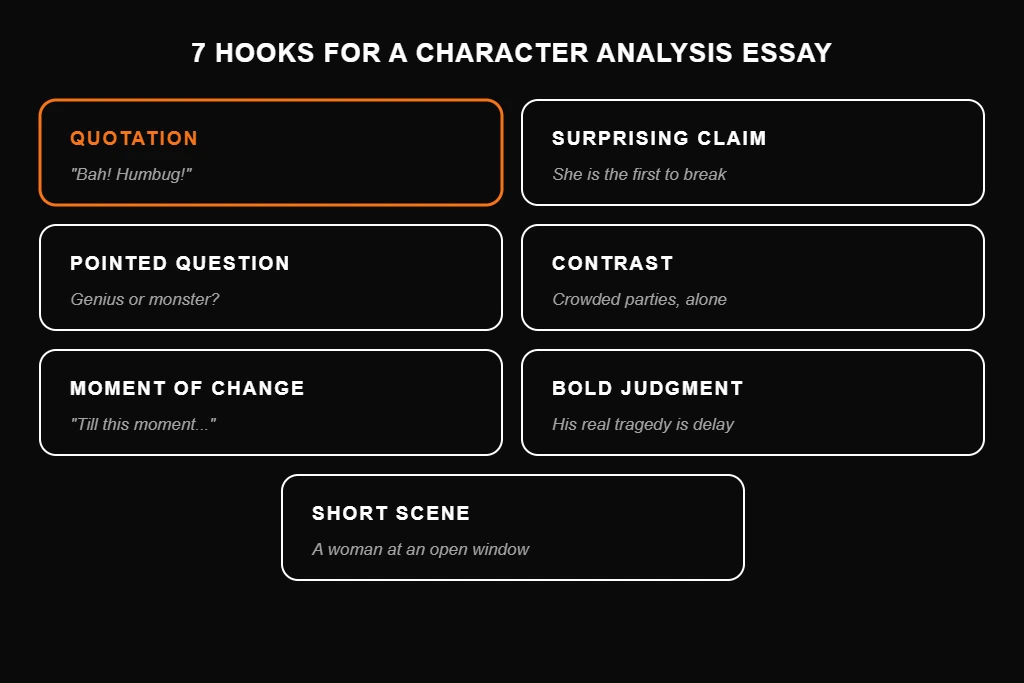
A good hook for a character analysis essay makes the reader curious about your view of the character, not just about the plot. The best hooks hint at a tension or contradiction in the character that your essay will explore. Here are seven hook types that work especially well, each with an example you can adapt.
1. Open with a revealing quotation
Choose a line that captures the character’s personality or inner conflict, then follow it with a sentence explaining why it matters.
“Bah! Humbug!” With two words, Ebenezer Scrooge dismisses the joy, generosity and human connection that his story will force him to rediscover.
2. Make a surprising claim
Challenge the obvious reading of the character to show your essay has something new to say.
Lady Macbeth is often remembered as the more ruthless half of her marriage, yet she is the first to break under the weight of what they have done.
3. Ask a pointed question
A focused question works well when your essay answers it directly. Avoid broad questions like “Have you ever been jealous?”
Is Victor Frankenstein a tragic genius or the true monster of Mary Shelley’s novel?
4. Highlight a contrast
Point out a gap between how the character appears and who they really are.
Jay Gatsby throws the most crowded parties on Long Island, yet he spends them standing alone.
5. Start at a moment of change
Begin with the turning point that defines the character’s journey, then step back to explain it.
When Elizabeth Bennet realizes, “Till this moment I never knew myself,” she admits that her famous judgment has been clouded by pride all along.
6. Offer a bold judgment
Take a clear position on the character in your first sentence.
Hamlet’s real tragedy is not his father’s murder but his own endless hesitation.
7. Set a short scene
Describe a brief, vivid moment in a sentence or two, then connect it to your argument.
A woman sits alone at an open window, whispering “Free! Body and soul free!” only an hour after hearing of her husband’s death. Kate Chopin’s Mrs Mallard reveals in a single moment how tightly her marriage confined her.
How to start a character analysis essay without summarizing
After your hook, give only the context the reader needs: the title, the author and one sentence about the character’s situation. Then move straight to your thesis. If you find yourself writing a third sentence of plot, stop and ask whether it supports your argument. Most of the time, it can be cut.
Choosing a title for a character analysis essay
A strong title names the character and hints at your argument. “Character Analysis of Macbeth” is clear but flat. “The Price of Ambition: Macbeth’s Descent Into Tyranny” tells the reader what to expect and sounds more confident. A short phrase, a colon and a specific focus is a reliable formula.
Hooks to avoid
Skip dictionary definitions, sweeping statements such as “Since the beginning of time, people have been greedy,” and rhetorical questions aimed at the reader’s personal life. They delay your argument and make the essay sound generic. Your hook should be about this character in this text.
How to Write a Thesis for a Character Analysis Essay
Your thesis is the most important sentence in the essay. It should state what you believe about the character and why it matters, in a way that a thoughtful reader could debate. A thesis that simply lists traits, such as “Scrooge is greedy, lonely and changes at the end,” is a description, not an argument.
Literary Analysis Thesis
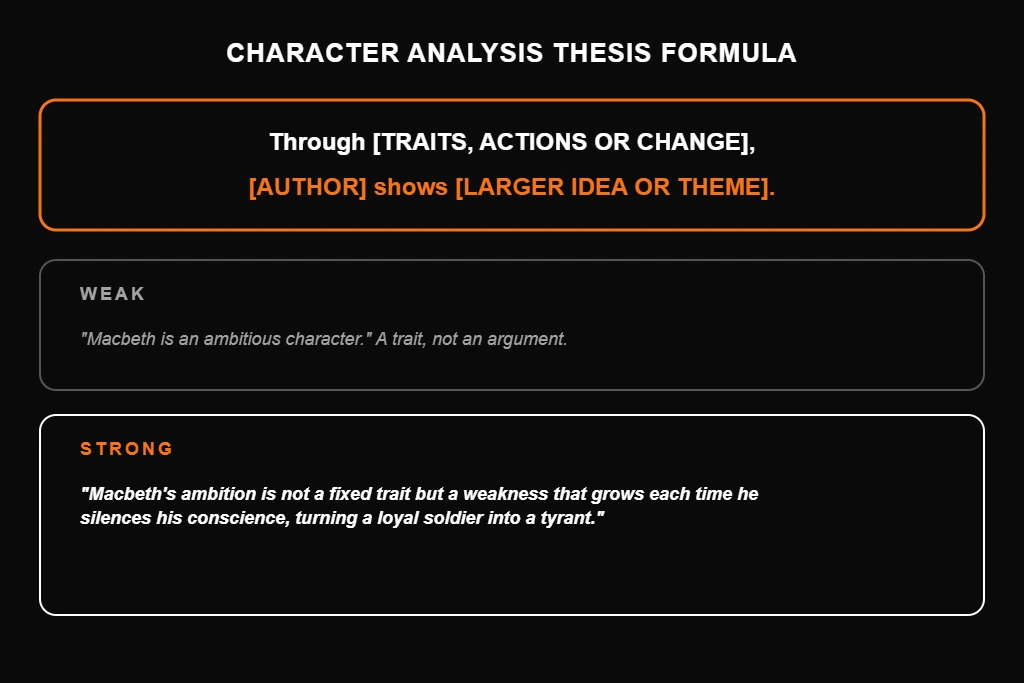
This kind of thesis makes an arguable claim about how a text creates meaning and previews how you will prove it. For a character essay, a dependable formula is: Through [character’s traits, actions or change], [author] shows [larger idea or theme]. The formula keeps your focus on what the character reveals rather than what happens to them. Make the claim specific enough to guide every body paragraph, and avoid vague words like “interesting” or “important” unless you explain them. A useful test is to ask whether someone could write an essay arguing the opposite. If they could not, your thesis needs a sharper claim.
Character analysis thesis examples
Here are five thesis statements on well known public domain characters. Notice how each one connects the character to a larger idea.
- Ebenezer Scrooge: Through Scrooge’s transformation from isolated miser to generous friend, Dickens argues that compassion is a choice anyone can make, no matter how late.
- Lady Macbeth: Lady Macbeth’s collapse into guilt reveals that the ambition she tries to command in others ultimately destroys her own mind.
- Jay Gatsby: Gatsby’s obsession with recreating the past exposes the emptiness at the heart of the American Dream as Fitzgerald portrays it.
- Victor Frankenstein: Victor’s refusal to take responsibility for his creation suggests that the real danger in Shelley’s novel is not science but the scientist’s pride.
- Elizabeth Bennet: Elizabeth’s growth from confident judge to self aware partner shows Austen’s belief that true understanding begins with admitting one’s own prejudice.
Notice that none of these examples simply lists traits. Each one names what the character does or becomes and connects it to an idea the author explores. You can adapt the same pattern to any character, from a classic novel to a modern film.
Turning a weak thesis into a strong one
Weak: “Macbeth is an ambitious character.”
Stronger: “Macbeth’s ambition is not a fixed trait but a weakness that grows each time he silences his conscience, turning a loyal soldier into a tyrant.”
The stronger version makes a claim about how the character develops, which gives the essay a clear direction for its body paragraphs.
Character Analysis Essay Format
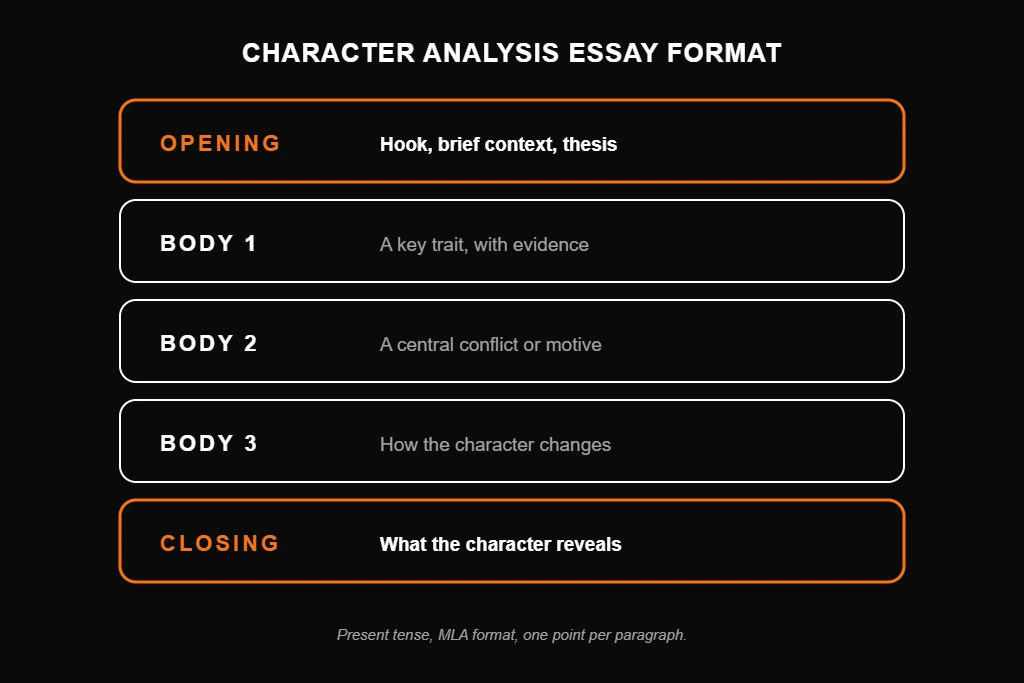
Most character analysis essays follow a simple, predictable structure, and using it helps teachers follow your argument. The standard format has an opening paragraph, several body paragraphs and a closing paragraph, written in present tense and formatted in MLA style unless your teacher says otherwise.
The paragraph by paragraph structure
The opening paragraph starts with a hook, gives brief context about the text and character, and ends with your thesis. Each body paragraph develops one point about the character: for example, the first might cover a key trait, the second a central conflict and the third how the character changes. The closing paragraph explains what the character ultimately reveals about the work, rather than repeating the thesis word for word.
Literary Analysis Essay Outline
Planning on paper maps your argument before you draft. For a five paragraph essay, list your thesis at the top, then write one claim for each of three body paragraphs, with two pieces of evidence and a short note on what each shows. Finish with one sentence describing the larger point your closing paragraph will make. For longer essays, group related points under each main claim and add a paragraph that responds to another reading of the character. Planning this way prevents repetition and keeps every paragraph tied to the thesis.
MLA formatting basics
Most English classes use MLA style. Use a readable 12 point font, double spacing and one inch margins, and include your name, instructor, course and date in the top left corner. Cite quotations with page numbers for novels, line numbers for poems, and act, scene and line numbers for plays. Purdue OWL’s page on MLA in-text citations shows the exact format for each.
Write in the present tense
Describe what characters do in the present tense: “Scrooge refuses to donate,” not “Scrooge refused.” Vanderbilt University’s Writing Studio explains that literary works exist in an “eternal present,” which is why its guide to literary present tense recommends it for all writing about a text’s events and characters.
How a character analysis fits into literary analysis
A character analysis is one type of literary analysis, focused on a single character instead of a theme, symbol or device. If your assignment asks for a broader reading of a text, our complete guide on how to write a literary analysis essay walks through that process step by step.
Writing Body Paragraphs About a Character
Body paragraphs are where you prove your thesis. Each one should make a single claim about the character, support it with evidence and explain how that evidence reveals something meaningful. The most common weakness is evidence without explanation.
Claim, evidence, analysis and link
Start with a topic sentence that makes one claim about the character. Add a short quotation or specific detail as evidence. Then spend two to four sentences analyzing it: which words reveal the trait, why the author chose them, and what they suggest. End with a sentence linking the point back to your thesis.
Analyze motivation, not just behavior
Readers already know what the character did. Your job is to explain why. Ask what the character wants at that moment and what fear, desire or belief drives their choice. Motivation is where character analysis becomes interesting, because it often reveals contradictions.
Track conflict and change
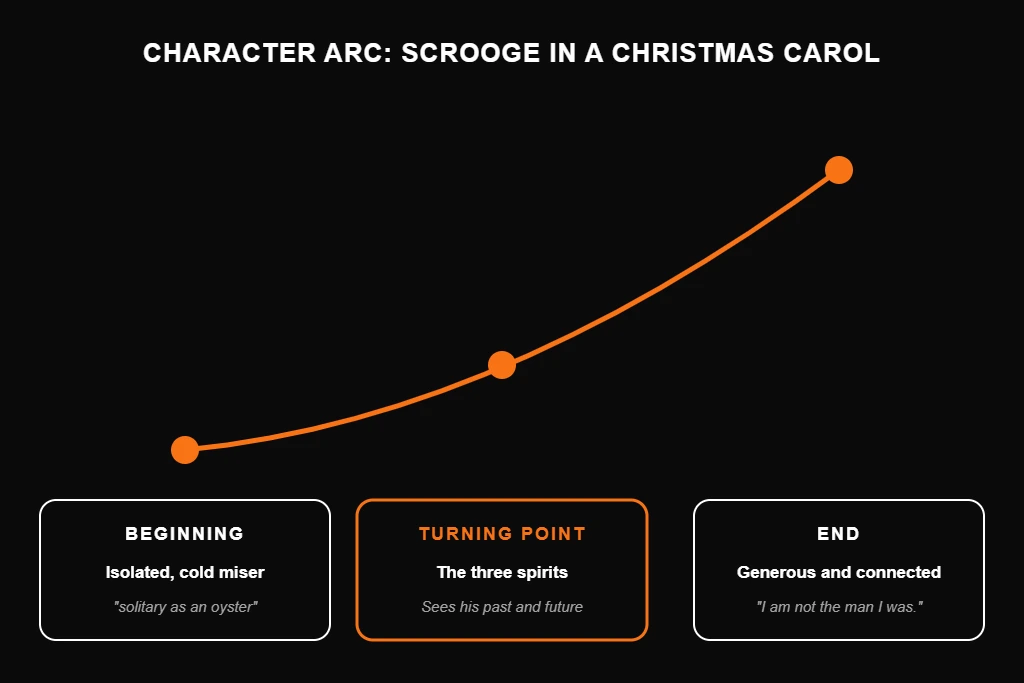
Characters are defined by the conflicts they face, whether with other people, society or themselves. Show how the character responds to pressure and whether they change as a result. If they do change, identify the turning point and explain what causes it. If they stay the same, explain why that stubbornness matters to the story.
Use relationships and foils
Characters often reveal themselves most clearly in contrast with others. Laertes, who rushes to avenge his father, highlights Hamlet’s hesitation. Comparing a character with a foil gives you strong evidence for traits that might otherwise be hard to prove.
A model body paragraph
Scrooge’s isolation is not just a habit but a choice he defends. When two gentlemen ask him to help the poor, he replies that if they would rather die, “they had better do it, and decrease the surplus population.” The cold, economic language of “surplus population” turns starving people into numbers, revealing how completely Scrooge has replaced human feeling with calculation. Dickens makes Scrooge’s coldness deliberate so that his later transformation feels like a real moral choice rather than a sudden change of mood.
Notice how the paragraph makes one claim, uses a short quotation, analyzes specific words and links the point to the character’s larger arc.
Character Analysis Essay Example
Here is a full character analysis essay example on Ebenezer Scrooge from Charles Dickens’s “A Christmas Carol,” which you can read free on Project Gutenberg. It shows a hook, a thesis, three focused body paragraphs and a closing paragraph that moves beyond summary.
Sample essay: Ebenezer Scrooge and the choice to change
“Bah! Humbug!” With two words, Ebenezer Scrooge rejects the joy and generosity of Christmas and, with them, the people around him. At the start of Charles Dickens’s “A Christmas Carol,” he is a wealthy, isolated businessman who values money above every human connection. By the end, he is a generous friend to the city that once feared him. Through Scrooge’s transformation, Dickens argues that compassion is a choice, and that it is never too late to make it.
Dickens first presents Scrooge as a man who has deliberately cut himself off from others. The narrator describes him as “solitary as an oyster” and “hard and sharp as flint,” images that suggest a closed shell and a cold, unbending surface. Scrooge’s isolation is not forced on him; he chooses it. He turns away his cheerful nephew’s dinner invitation and keeps his clerk, Bob Cratchit, working in a freezing office. These choices show a man who treats warmth, both literal and emotional, as a waste of money.
Scrooge’s coldness becomes most disturbing when it affects the poor. When asked to donate to those in need, he suggests that if they would rather die, “they had better do it, and decrease the surplus population.” By turning suffering people into a “surplus,” Scrooge reveals how fully he has replaced human feeling with economic calculation. Dickens later has the Ghost of Christmas Present throw these exact words back at him, forcing Scrooge to see that the “surplus population” includes a sick child he has come to care about, Tiny Tim.
The visits of the three spirits lead Scrooge to a genuine change of heart. Seeing his lonely past, the warmth of the Cratchit family and the image of his own unmourned death, he finally declares, “I am not the man I was.” The change is shown through action as well as words. He sends a prize turkey to the Cratchits, raises Bob’s salary and joins his nephew for Christmas dinner. By the final page, Dickens tells us that Scrooge became “as good a friend, as good a master, and as good a man, as the good old city knew.”
Scrooge’s journey from miser to benefactor gives “A Christmas Carol” its lasting power. Dickens does not suggest that people are simply good or bad. Instead, he shows that even a man as hardened as Scrooge can choose connection over isolation once he understands the cost of his choices. The story invites every reader to ask whether they, too, have shut out someone who needs them, and reminds them that it is not too late to change.
Why this example works
The hook uses a famous quotation and immediately connects it to an argument. The thesis makes a claim about what the character’s change means, not just that it happens. Each body paragraph covers one stage of Scrooge’s development, uses short quotations and explains specific words such as “oyster,” “flint” and “surplus.” The closing paragraph moves beyond summary to state what the character teaches readers, without repeating the thesis word for word.
More Character Analysis Examples
Different characters call for different angles. These short examples show how to build an argument around five classic characters, each with a thesis and a few lines of analysis you can learn from.
Lady Macbeth in Shakespeare’s Macbeth
Thesis: Lady Macbeth’s attempt to suppress her conscience ultimately destroys her. Early on, she calls on spirits to “unsex me here,” asking to be emptied of compassion. By the sleepwalking scene, her cry of “Out, damned spot!” shows that the guilt she denied has returned with overwhelming force. The full play is available on Project Gutenberg if you want to trace her lines yourself.
Hamlet in Shakespeare’s Hamlet
Thesis: Hamlet’s intelligence becomes his greatest obstacle. His famous question, “To be, or not to be,” shows a mind that weighs every option so carefully that it struggles to act. His delay allows the tragedy to spread to Ophelia, Polonius, Laertes and his mother.
Jay Gatsby in The Great Gatsby
Thesis: Gatsby’s dream is admirable in its hope but doomed by its focus on the past. When Nick warns that the past cannot be repeated, Gatsby insists, “Why of course you can!” His confidence shows both his determination and his refusal to accept reality, which makes his downfall feel inevitable.
Victor Frankenstein in Frankenstein
Thesis: Victor’s tragedy comes from abandoning responsibility rather than from ambition itself. After years of work, he flees the moment his creation opens its eyes, describing how “breathless horror and disgust” filled his heart. His rejection, not his science, sets the novel’s tragedies in motion.
Mathilde Loisel in “The Necklace”
Thesis: Mathilde’s desire to appear wealthy costs her the comfortable life she already had. Guy de Maupassant shows her dissatisfaction with her modest home and her borrowed necklace becoming a symbol of false appearances. The story’s twist ending turns her ten years of hardship into a lesson about pride and honesty.
Writing about commonly assigned modern characters
Many classes assign modern novels such as To Kill a Mockingbird, The Catcher in the Rye or The Hunger Games. The same approach works for characters like Atticus Finch, Holden Caulfield or Katniss Everdeen. With Atticus, for example, you might argue that his quiet courage defines the novel’s idea of moral heroism. With Holden, you might explore how his criticism of “phony” adults hides his own fear of growing up. Always quote from your own copy of the text and cite page numbers.
Analyzing Characters in Novels, Plays, Short Stories and Films
The basic method stays the same across forms, but each one gives you different kinds of evidence. Knowing what to look for saves time and leads to sharper analysis.
Characters in novels
Novels give you the most evidence, including narration, inner thoughts and long stretches of development. The challenge is selection: trace the character through three or four key moments rather than the whole book. Pay attention to the narrator, since a first person narrator may describe themselves unreliably.
Characters in plays
In drama, characters reveal themselves mostly through dialogue and action. Soliloquies are especially valuable because they show private thoughts, as in Macbeth’s “Is this a dagger which I see before me.” Consider stage directions and how other characters speak about them when they are offstage.
Shakespearean characters
Shakespeare’s characters reward close attention to language. Notice when a character shifts between verse and prose, since a change often signals a change in status, emotion or sanity. Lady Macbeth’s sleepwalking scene, for example, is written in prose, a sign of her broken state of mind. Asides and soliloquies let you compare what a character says publicly with what they reveal in private, which is often the heart of a strong argument.
Characters in short stories
Short stories develop characters quickly, so every detail counts. Look closely at the first description of the character and at the final scene, since short stories often build to a single revealing moment, like Mrs Mallard’s realization in “The Story of an Hour.”
Characters in films
For a film character analysis essay, treat visual choices as evidence. Costume, camera angles, lighting, music and an actor’s performance all reveal character. Cite scenes with timestamps when your teacher allows it, and describe what you see precisely rather than retelling the plot.
If you compare a film adaptation with the original book, focus on how changes to the character alter the story’s meaning. A director might soften a villain, cut a key scene or give a minor character more weight, and each choice is evidence for your argument.
Expectations by Level and What Rubrics Reward
Teachers at every level grade character analysis essays on similar qualities, but the standard rises as you move from middle school to college. Most rubrics focus on five areas.
| Rubric area | What earns top marks |
|---|---|
| Thesis | A specific, arguable claim about the character linked to a theme |
| Evidence | Short, relevant quotations with accurate citations |
| Analysis | Explains how evidence reveals traits, motives and change |
| Organization | One clear point per paragraph, logical order, smooth transitions |
| Style and conventions | Present tense, formal tone, correct grammar and MLA format |
Middle school
The main goal is moving from describing to explaining. A clear claim about a character trait, two or three quotations and a few sentences explaining each one will meet most middle school expectations.
High school
High school teachers expect an arguable thesis, smoothly integrated quotations and analysis of how the author develops the character. On the AP English Literature exam, the College Board’s exam description includes a prose fiction analysis and a literary argument among its three free response essays, and both often call for close reading of a character.
College
College essays reward original interpretations, attention to language and sometimes engagement with critics. You may be asked to read a character through a particular lens, such as gender, class or psychology, and to explain how your reading adds to existing discussions of the text.
Common Mistakes and Student Pain Points
Most weak character analysis essays make the same few mistakes. Here they are, with the quickest way to fix each one.
| Mistake | Why it hurts | How to fix it |
|---|---|---|
| Retelling the plot | Shows reading, not analysis | Limit plot to brief context and explain what actions reveal |
| Listing traits | Gives no argument to prove | Connect traits to a change, conflict or theme |
| Ignoring motivation | Analysis stays on the surface | Ask why the character acts, not just what they do |
| Quotes without comment | Leaves the reader to do the work | Explain each quotation in two to four sentences |
| Judging the character | Sounds like opinion, not analysis | Explain how the author shapes the character instead |
| Past tense narration | Breaks literary conventions | Write about the text in present tense |
“My character is boring”
Usually this means you have not found the character’s tension yet. Look for a contradiction: something they want but cannot have, a trait that helps and hurts them, or a moment when they act out of character. Even quiet, minor characters become interesting when you explain how they shape or reflect the main character.
“I keep summarizing”
Try this quick test. Read each sentence and ask, “Could someone learn this by reading a plot summary?” If the answer is yes, either cut the sentence or follow it with one that explains what the event reveals about the character. Over time, you will notice that strong paragraphs spend far more space on explanation than on events.
“I don’t know what motivates the character”
Return to the moments when the character makes a choice. Look at what they say just before and after, how they react to other characters and what they gain or lose. Motivation is rarely stated directly, so it is fine to propose an interpretation, as long as you support it with evidence.
“My essay is too short”
Short essays rarely need more plot. They need deeper analysis. Choose one quotation in each paragraph and explain it word by word: what each important word suggests, how it connects to other moments, and why it matters to your thesis. Adding a paragraph on a foil character or on the character’s final change also adds depth without padding.
“I disagree with how my class reads the character”
That can make an excellent essay. Acknowledge the common reading in a sentence, then argue your view with strong evidence. Teachers usually reward a well supported original interpretation more than a safe repetition of class discussion.
A final checklist before you submit
- Your hook connects to the character and your argument.
- Your thesis makes an arguable claim about the character’s meaning.
- Each body paragraph makes one point and explains its evidence.
- Quotations are short, accurate and cited correctly.
- The essay uses present tense and follows MLA format.
- Your closing paragraph explains why the character matters.
How EssaysHelper Can Help You
Character analysis takes careful reading, sharp thinking and clear writing, often under tight deadlines. If you are stuck choosing a character, struggling to move beyond summary or simply short on time, our essay support services can help you build a confident, well supported essay. Our writers work with students from middle school through graduate programs.
- Choosing a character and building an arguable thesis.
- Finding and explaining strong evidence from the text.
- Reviewing drafts to replace summary with analysis.
- Checking hooks, MLA formatting, citations and present tense.
Share your assignment, text and deadline, and we will suggest the fastest way forward.
Frequently Asked Questions
What is a good hook for a character analysis essay?
A good hook focuses on the character’s tension or contradiction, such as a revealing quotation, a surprising claim or a contrast between appearance and reality. Avoid generic openings like dictionary definitions.
How long should a character analysis essay be?
Most high school essays run five paragraphs or about 800 to 1,200 words, while college essays are often 1,200 to 2,500 words. Always follow your assignment’s word count first.
What should a character analysis essay include?
It should include a hook, brief context, an arguable thesis, body paragraphs that analyze traits, motivations and changes with evidence, and a closing paragraph explaining why the character matters.
Can I write a character analysis essay about a minor character?
Yes, as long as the text provides enough evidence. Minor characters often work well as foils, revealing something important about the main character or the story’s themes.
What is the difference between direct and indirect characterization?
Direct characterization is when the narrator states a trait outright. Indirect characterization shows traits through speech, thoughts, actions, looks and how others react, which you must interpret.
Should I write a character analysis essay in present tense?
Yes. Literary convention treats events in a text as always happening, so write “Gatsby reaches for the light,” not “reached.” Use past tense only for historical facts about the author or publication.
How many quotes should I use in a character analysis essay?
Two or three short quotations per body paragraph is usually enough. Focus on explaining each quote in depth rather than adding more evidence than you can analyze.
How is a character analysis different from a literary analysis?
A character analysis focuses on one character and what they reveal. A literary analysis can focus on any element, such as theme, symbolism, structure or language, across the whole text.
How do I choose the best character for my essay?
Choose a character who changes, faces a strong conflict or surprises you. Characters with contradictions give you more to analyze and make it easier to write an arguable thesis.
What do teachers look for when grading a character analysis essay?
Most rubrics reward a clear thesis, relevant evidence, analysis of traits and motivation, logical organization, and correct grammar, tense and citation format.
Final Thoughts
A strong character analysis essay goes beyond what a character does to explain who they are and why they matter. Choose a character with depth, track their speech, thoughts and actions, and build an arguable thesis that connects them to the story’s larger meaning. Open with a hook about their central tension, analyze short quotations in detail and show how the character changes or refuses to. With that approach, any character, from Scrooge to Gatsby, becomes a window into the whole work.