
A good rhetorical analysis essay example shows three things clearly. It opens with a thesis that names the writer’s purpose and main rhetorical choices. Its body paragraphs quote short pieces of evidence and explain how each choice affects the audience. And its closing paragraph shows how the choices work together. This guide gives you five annotated samples: a full AP Lang essay with an unofficial rubric breakdown, a college essay on Lincoln’s Gettysburg Address, and shorter examples analyzing an advertisement, a visual and an editorial.
Each sample comes with notes after every paragraph, so you can see not just what a strong essay says, but why it works. You will also find a weak versus strong comparison, a method for studying a sample without copying it, and quick format notes.
Students tend to run into the same problems with examples they find online. Many samples are far too long to be realistic in a timed exam, some are simply summaries with a few device names added, and almost none explain why they score well. Others make students nervous about plagiarism. The samples below are short, original and annotated, and the last sections show you how to learn from them safely.
What a Good Rhetorical Analysis Essay Example Shows
Before reading the samples, it helps to know what to look for. At essays helper, we ask students to check any example against five features. If a sample you find online is missing two or more, it is probably not worth modelling.
1. A thesis about choices, not the topic
The thesis names the writer, the purpose and the specific rhetorical choices, and says how they work on the audience. A thesis that only summarizes the topic or announces that the writer “uses ethos, pathos and logos” is a weak model.
2. Short, precise evidence
Strong examples quote phrases, not whole paragraphs, and build them into their own sentences. Long quotations take up space that should go to explanation.
3. Commentary that explains effect
This is the heart of every good sample. After each quotation, the writer explains how the choice affects the audience and why it serves the purpose. The commentary is usually longer than the quotation.
4. A clear line of reasoning
The paragraphs build on each other. Each one analyzes a choice or a section of the text, and the order makes sense. You could not shuffle them without losing something.
5. Attention to the rhetorical situation
The best samples keep the audience, occasion and purpose in view throughout. They explain why a choice suits this audience at this moment, which is also how AP Lang essays earn the sophistication point.
The Five Examples at a Glance
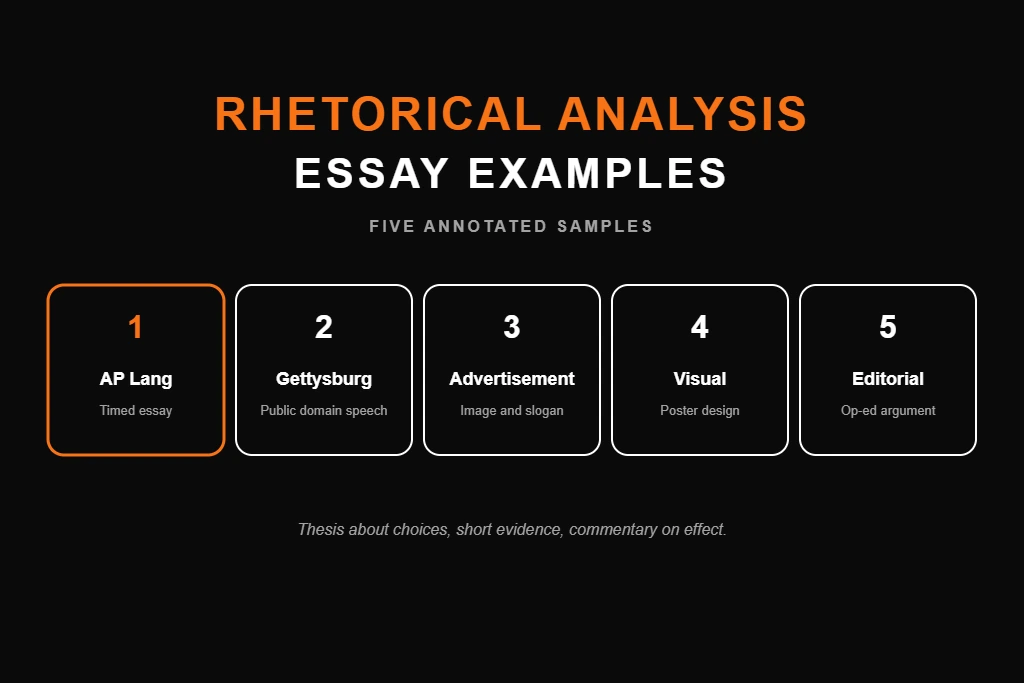
Here is a quick overview, so you can jump to the example that fits your assignment.
| Example | Text type | Level | Length | What it teaches |
|---|---|---|---|---|
| 1. AP Lang essay | Invented nonfiction passage | High school, AP | About 600 words | Timed structure and how the rubric rewards commentary |
| 2. Gettysburg Address | Public domain speech | College | About 750 words | Analyzing a real, historical text in depth |
| 3. Advertisement | Invented print ad | Any | About 350 words | Treating images, slogans and layout as choices |
| 4. Visual | Invented public health poster | Any | About 350 words | Analyzing colour, composition and text together |
| 5. Editorial | Invented op-ed | Any | About 350 words | Analyzing structure and tone in an argument |
Example 1: AP Lang Rhetorical Analysis Essay Example
The AP English Language and Composition exam includes a rhetorical analysis question in which you read a nonfiction passage and analyze how the writer’s choices achieve a purpose. The College Board’s AP Lang exam page gives 2 hours and 15 minutes for the three free response essays, including a 15 minute reading period, so each essay is usually written in about 40 minutes. That is why this sample is about 600 words, a realistic length for timed writing.
The passage (invented for this guide)
The prompt asks students to analyze the rhetorical choices a retired lighthouse keeper makes in a speech to a town council debating whether to close the old lighthouse and replace it with an automatic beacon.
“For thirty one winters I climbed those hundred and twelve steps, and I never once climbed them for myself. I climbed them for the fishing boat that lost its engine off the point in 1987, and for the ferry that ran aground in the fog the year my daughter was born. You will hear tonight that a machine can do my old job for less. That is true. A machine can turn a light on and off. But a machine cannot be seen from the harbour by a child, cannot be painted by the school every spring, cannot remind this town that someone, every night, is watching the water. Close the beacon if you must. Keep the lighthouse.”
The sample essay
When a town considers replacing its old lighthouse with an automatic beacon, the question seems purely practical. A retired lighthouse keeper, addressing the town council, refuses to let it stay that way. By grounding his authority in decades of service, conceding the economic argument, and then redefining the lighthouse as a symbol of shared care rather than a machine, he persuades councillors that closing the lighthouse would cost the town something no budget can measure.
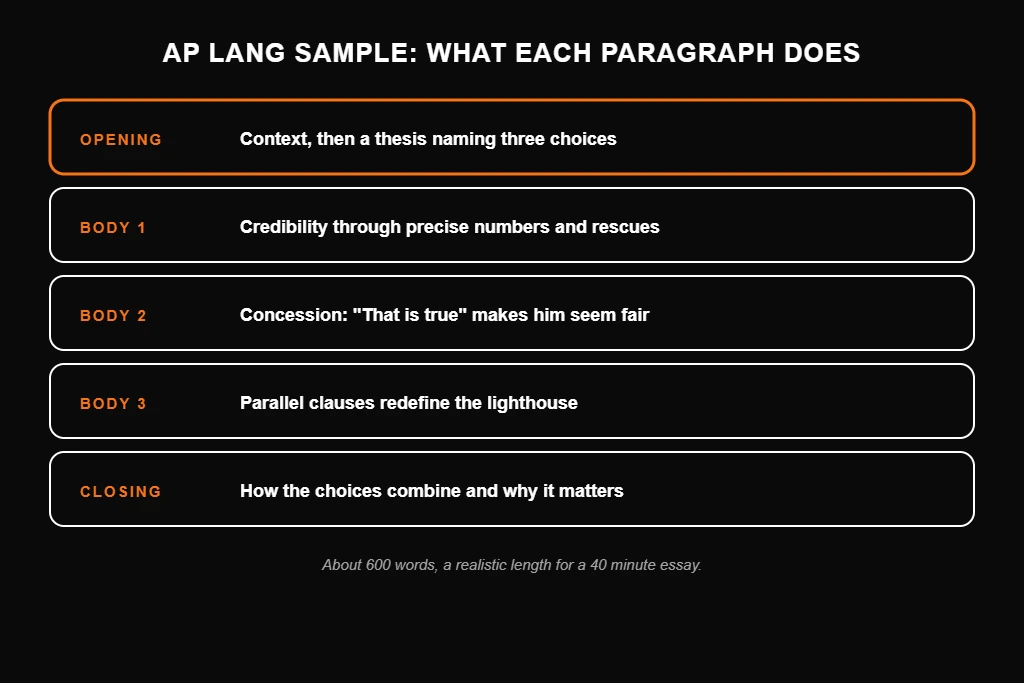
What this paragraph does: The opening paragraph gives brief context and ends with a defensible thesis naming three choices and the effect on the audience.
The keeper begins by establishing an authority no consultant could match. Opening with “thirty one winters” and “a hundred and twelve steps,” he lets precise numbers stand in for years of physical commitment. Crucially, he insists he “never once climbed them for myself,” which turns his experience into proof of service rather than nostalgia. He then names specific rescues, a fishing boat “off the point in 1987” and a ferry grounded “the year my daughter was born.” Linking a public emergency to a private milestone tells councillors that the lighthouse is woven into the town’s own history and into individual lives. By the time he reaches his argument, the audience already sees him as someone who has protected them, not someone protecting his job.
What this paragraph does: One choice, credibility through specific detail, is explained in depth. Every quotation is short and followed by commentary on its effect.
Next, the keeper disarms his opponents by agreeing with them. “You will hear tonight that a machine can do my old job for less. That is true.” This concession is strategic. Councillors expecting an emotional defence of tradition instead hear a speaker who accepts the facts, which makes him seem reasonable and makes his later claims harder to dismiss. The short, flat sentence “That is true” carries particular weight, because its plainness signals honesty. Having granted the economic point, he narrows it with “A machine can turn a light on and off,” reducing the beacon’s value to a single mechanical function and preparing the audience for everything the machine cannot do.
What this paragraph does: The writer analyzes a concession and the effect of sentence length, which shows control of syntax, not just appeals.
The speech’s turn comes in a series of parallel clauses that redefine what the lighthouse is. The repeated “cannot be seen,” “cannot be painted,” “cannot remind” builds a rhythm that grows with each item, moving from a child’s view, to a school tradition, to the whole town’s sense of being watched over. Each clause shifts the lighthouse further from a navigational tool toward a symbol of collective care. The final image, “someone, every night, is watching the water,” turns that symbol into a feeling of safety the councillors themselves share. The closing pair of sentences, “Close the beacon if you must. Keep the lighthouse,” then separates the function from the meaning, giving the council a compromise that lets them save money without seeming to abandon the town.
What this paragraph does: The paragraph explains how repetition builds toward a new definition, and how the final lines offer the audience a way to agree. This is where the line of reasoning comes together.
The keeper’s speech works because it never asks the council to choose between sense and sentiment. By earning trust through service, accepting the economic case and then showing what that case leaves out, he reframes the vote. Councillors are no longer deciding whether to keep an outdated machine, but whether to keep a promise the town has made to itself every night for generations.
What this paragraph does: The closing paragraph shows how the choices combine and why they matter for this audience, without repeating every device.
How this sample might score: an unofficial breakdown
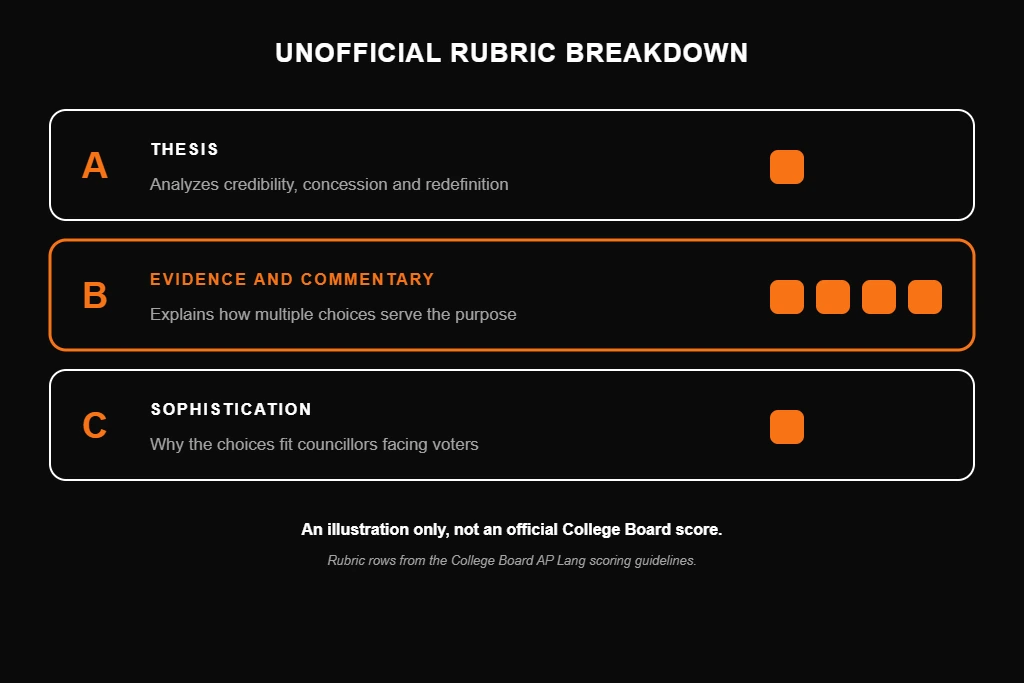
The College Board’s 2026 scoring guidelines score the rhetorical analysis out of six points across three rows. The table below estimates how this sample lines up with each row. It is an unofficial illustration, not an official score, and real readers may judge differently.
| Rubric row | Points available | How the sample addresses it |
|---|---|---|
| A: Thesis | 0 to 1 | A defensible thesis that analyzes the writer’s rhetorical choices: credibility, concession and redefinition |
| B: Evidence and commentary | 0 to 4 | Specific quotations support every claim, and commentary consistently explains how multiple choices serve the purpose |
| C: Sophistication | 0 to 1 | Explains why the choices fit this audience: councillors who must justify the decision to voters |
To see real student essays with official scores and commentary, read the College Board’s 2025 rhetorical analysis samples. Compare a high scoring and a low scoring response to the same passage, and you will see the same patterns this sample shows.
Example 2: College Rhetorical Analysis of the Gettysburg Address
This sample analyzes a real text. Abraham Lincoln delivered the Gettysburg Address on November 19, 1863, at the dedication of a national cemetery for soldiers killed at the Battle of Gettysburg. The speech is in the public domain, and the Library of Congress holds several handwritten copies, so you can read the full text there. The quotations below are short, as they should be in any analysis.
If you want the full method behind this sample, our guide on how to write a rhetorical analysis essay walks through each step, from mapping the rhetorical situation to writing body paragraphs.
The sample essay
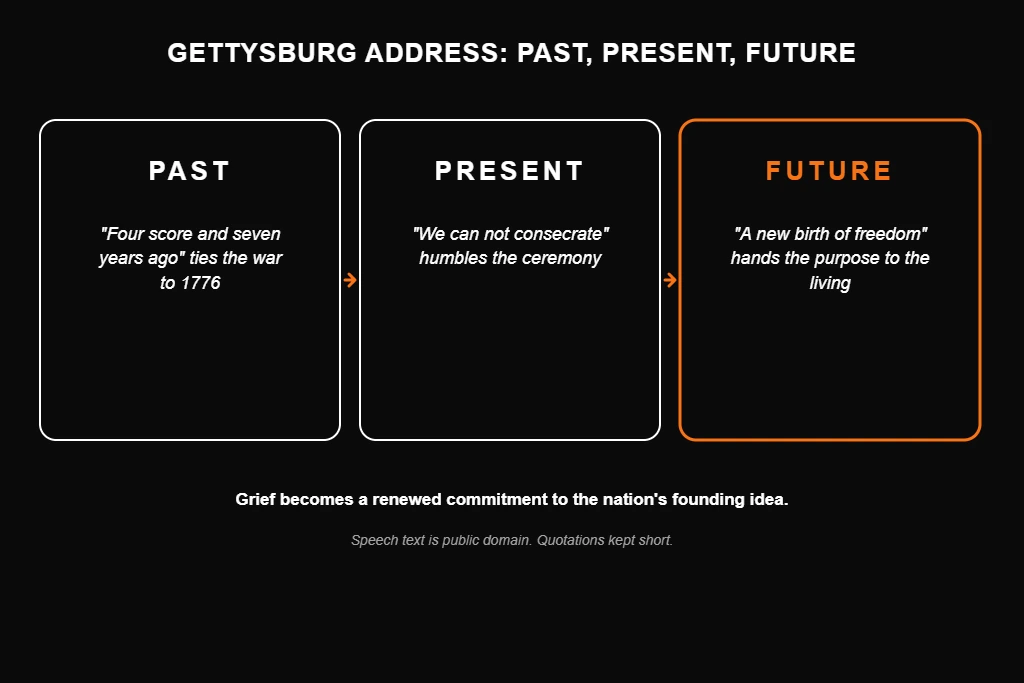
In November 1863, a crowd gathered at Gettysburg to dedicate a cemetery for soldiers who had died there only months earlier. The main speaker of the day delivered a long oration; Abraham Lincoln followed with remarks of only a few minutes. In that short space, Lincoln transforms a funeral into a statement of national purpose. By framing the war within the founding ideals of the nation, by declaring the living unable to honour the dead with words alone, and by ending with an expansive pledge to the future, he turns grief into a renewed commitment to the Union and to equality.
What this paragraph does: Context is brief and specific. The thesis names three choices and a clear effect: grief turned into commitment.
Lincoln opens not with the battle but with the nation’s birth. “Four score and seven years ago” echoes the formal language of scripture, lending the moment solemnity, while the date it points to, 1776, ties the cemetery to the Declaration of Independence. He describes the nation as “conceived in Liberty, and dedicated to the proposition that all men are created equal,” choosing words of birth and dedication that he will return to throughout. This framing tells his audience that the soldiers did not die for a single victory but for the founding idea itself, and it quietly places equality at the centre of what the war is for.
What this paragraph does: The paragraph explains allusion, diction and how an opening frame sets up the whole speech, with every quotation short.
Lincoln then makes a surprising move for a dedication speech: he claims the dedication is impossible. Stating that “we can not consecrate” and “we can not hallow” this ground, he uses repetition to build a sense of humility, conceding that the soldiers have already made the ground sacred “far above our poor power to add or detract.” The contrast becomes explicit when he observes that the world “will little note, nor long remember what we say here, but it can never forget what they did here.” By diminishing the importance of words, including his own, Lincoln honours the dead more powerfully than praise could, and he shifts attention from the ceremony to the action it demands.
What this paragraph does: The writer explains how humility and contrast work on an audience of mourners, which is analysis of tone, not just of appeals.
That shift sets up the speech’s real purpose. Lincoln redirects the dedication from the ground to the listeners: it is “for us the living,” he says, to be dedicated to “the unfinished work.” The repetition of “dedicate” transfers the verb from the cemetery to the audience, turning mourners into participants. His language also widens steadily, from this field, to the war, to “a new birth of freedom,” echoing the birth imagery of the opening. A speech that began with the nation’s past now insists that its future depends on the people standing in front of him.
What this paragraph does: One repeated word is traced across the speech to show how the purpose develops. This is the line of reasoning in action.
Lincoln’s closing phrase gathers all of these choices into a single rhythm. The tricolon “government of the people, by the people, for the people” repeats one word three times while changing the preposition, so that each repetition adds a new relationship between the government and its citizens. Placed at the end of a sentence about what “shall not perish from the earth,” it turns the war’s survival into a question about whether democracy itself can endure. For an audience grieving specific deaths, the phrase offers meaning on the largest possible scale.
What this paragraph does: The paragraph analyzes the most famous line precisely, through structure and placement, instead of simply praising it.
The Gettysburg Address works because it does so much in so little space. Lincoln roots the war in the nation’s founding promise, humbles the ceremony to honour the dead, and then hands the dead’s purpose to the living. By the time he finishes, his listeners are no longer simply mourners at a cemetery; they have been asked to finish what the soldiers began.
What this paragraph does: The closing paragraph shows how the three choices combine and why that mattered to this audience.
Example 3: Advertisement Rhetorical Analysis Example
Advertisements are popular rhetorical analysis assignments because every element is a deliberate choice. The trick is to treat images, colours, layout and slogans the same way you would treat words in a speech: identify the choice, explain the effect and connect it to the purpose.
The advertisement (invented for this guide)
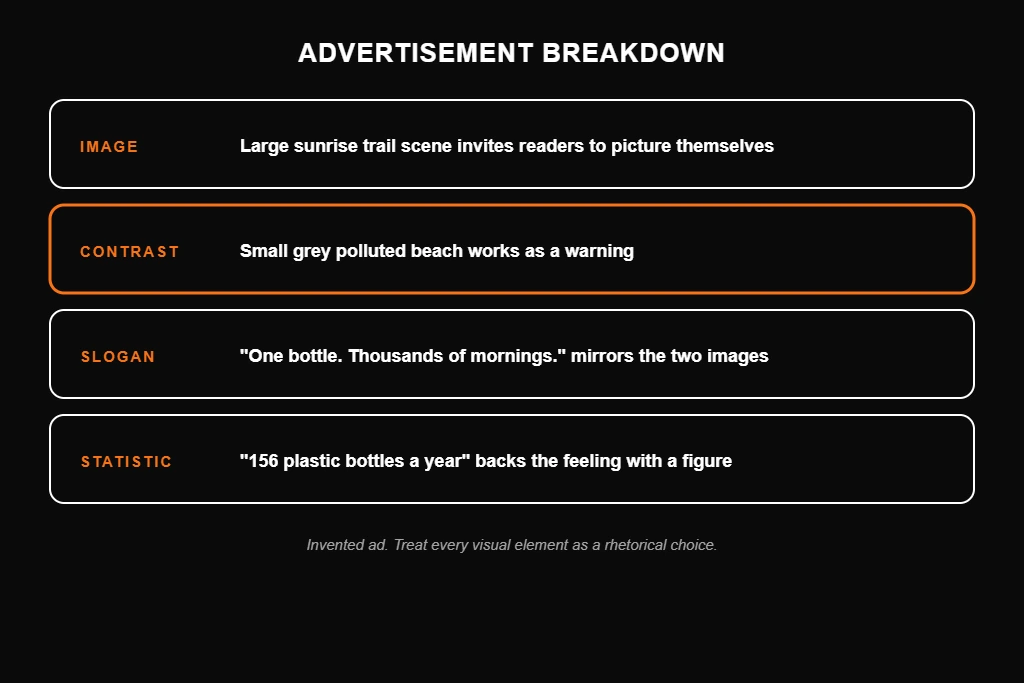
A full page magazine ad for a reusable water bottle brand called Riverline. The top two thirds show a teenager on a mountain trail at sunrise, holding the bottle, with a clear stream in the background. Below, a small grey photo shows a beach covered in plastic bottles. The slogan reads “One bottle. Thousands of mornings.” In the bottom corner: “Each Riverline bottle replaces an average of 156 plastic bottles a year.”
The sample analysis
Riverline’s advertisement persuades young, outdoor minded readers to buy its bottle by contrasting two images and compressing a lifetime of use into a short slogan, which makes a purchase feel like both an adventure and a small act of protection.
The ad’s layout does much of the persuading before a reader reads a word. The large, warm image of a teenager at sunrise occupies most of the page, inviting readers to picture themselves in it, while the small grey photo of a polluted beach sits below like a warning. The difference in size, colour and mood guides the eye from the life the product promises to the damage it claims to prevent, so the reader experiences the choice visually before the slogan names it.
The slogan “One bottle. Thousands of mornings.” then turns that contrast into a simple calculation. Its two fragments mirror the two images: one object set against countless future moments. The statistic in the corner, “156 plastic bottles a year,” gives the emotional message a measurable basis, reassuring readers that the feeling is backed by evidence. Together, image, slogan and figure make buying the bottle feel like a decision a thoughtful young person would be proud of.
What this paragraph does: The example treats layout, colour and image size as rhetorical choices, then shows how the slogan and statistic reinforce them.
Example 4: Visual Rhetorical Analysis Example
A visual rhetorical analysis looks at images, charts, posters or infographics. The same rules apply as for written texts, but your evidence is a description of what the viewer sees: colour, composition, scale, typography and the relationship between words and images.
The visual (invented for this guide)
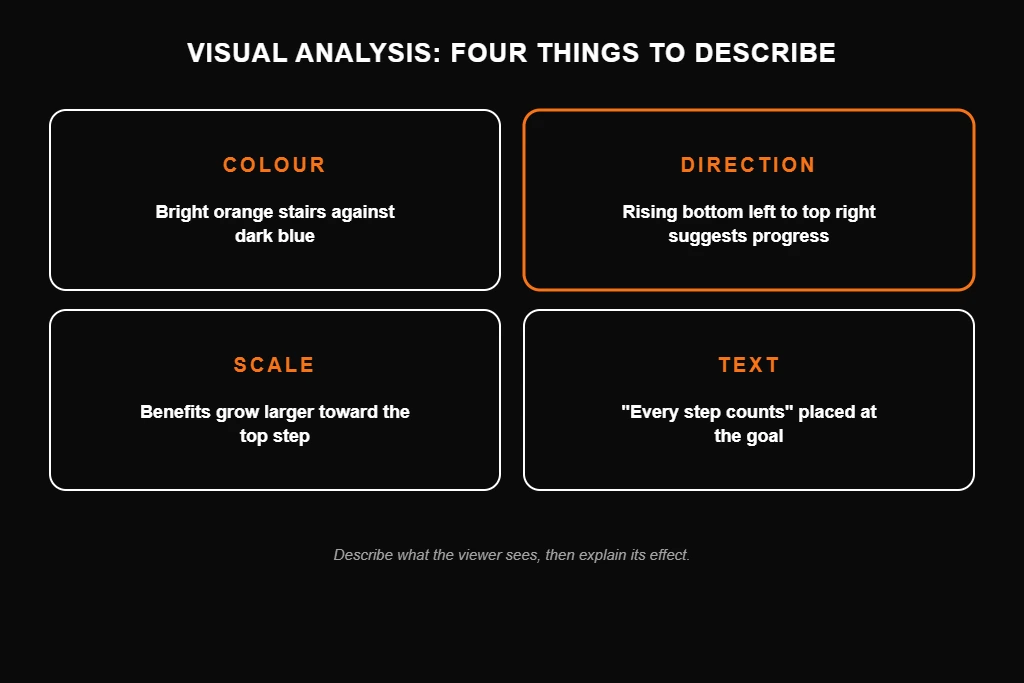
A city health department poster encouraging residents to take the stairs. A tall, narrow staircase is drawn in bright orange against a dark blue background, rising from the bottom left to the top right corner. Each step is labelled with a small benefit, such as “stronger heart” and “better sleep”, growing slightly larger toward the top. At the top step, in large white letters: “Every step counts. Take the stairs.” A small lift icon at the bottom is shown in grey.
The sample analysis
The health department’s poster encourages residents to choose the stairs over the lift by turning the staircase itself into a visual path of rewards, which makes a small daily habit feel like steady progress toward better health.
The poster’s composition does the persuading. The staircase rises diagonally from bottom left to top right, the direction viewers in left to right reading cultures tend to associate with progress, and the bright orange stands out sharply against the dark background. By placing benefits on each step and enlarging them toward the top, the designer makes climbing feel cumulative: every step adds something, and the rewards grow as you go. The grey lift icon, small and colourless, quietly presents the alternative as dull and unrewarding.
The text completes the visual argument. “Every step counts” works on two levels, as both a literal statement about stairs and a general reassurance that small efforts matter, which lowers the barrier for people who feel they are not active. Placing the instruction “Take the stairs” at the very top, in the largest type, makes reaching the message feel like reaching the goal. The poster turns a public health recommendation into an image viewers can almost climb.
What this paragraph does: The example describes visual evidence precisely and explains its effect, including how text and image work together. It also hedges a claim about viewers, which is good practice.
Example 5: Editorial or Article Rhetorical Analysis Example
Editorials and opinion articles are written arguments, so the analysis focuses on structure, tone and how the writer handles opposing views.
The editorial (invented for this guide)
A student newspaper op-ed titled “Let Us Eat Outside”, arguing that the school should open the courtyard for lunch. It opens with a short scene of a crowded, noisy cafeteria, admits that supervision would cost staff time, proposes a trial with student volunteers and closes by asking, “What are we really protecting by keeping the doors shut?”
The sample analysis
In her op-ed for the student newspaper, the writer persuades school leaders to open the courtyard at lunch by opening with a vivid scene, conceding the cost of supervision and offering a low risk trial, which makes her request seem practical rather than rebellious.
The editorial’s structure moves readers from feeling to solution. Its opening scene of a cramped, noisy cafeteria gives teachers and administrators a picture they will recognize, creating sympathy before any argument begins. Rather than dismissing objections, the writer names the real obstacle, supervision, and then answers it with a trial run staffed by student volunteers. This sequence matters for an audience of decision makers, who are more likely to agree to a small experiment than to a permanent change.
Her tone reinforces that strategy. By staying calm and specific, she avoids sounding like a student demanding privileges, and her closing question, “What are we really protecting by keeping the doors shut?”, shifts the burden of proof to the school. The question is gentle but pointed, leaving readers to justify the current rule rather than asking students to justify the change.
What this paragraph does: The example analyzes structure and tone as choices, and shows how a concession and a rhetorical question work on a specific audience.
Weak vs Strong: Body Paragraph Examples
The clearest way to see what makes a sample strong is to compare different versions of the same paragraph. The table uses one piece of evidence from the lighthouse speech and shows it written three ways.
| Version | Example | Why it scores the way it does |
|---|---|---|
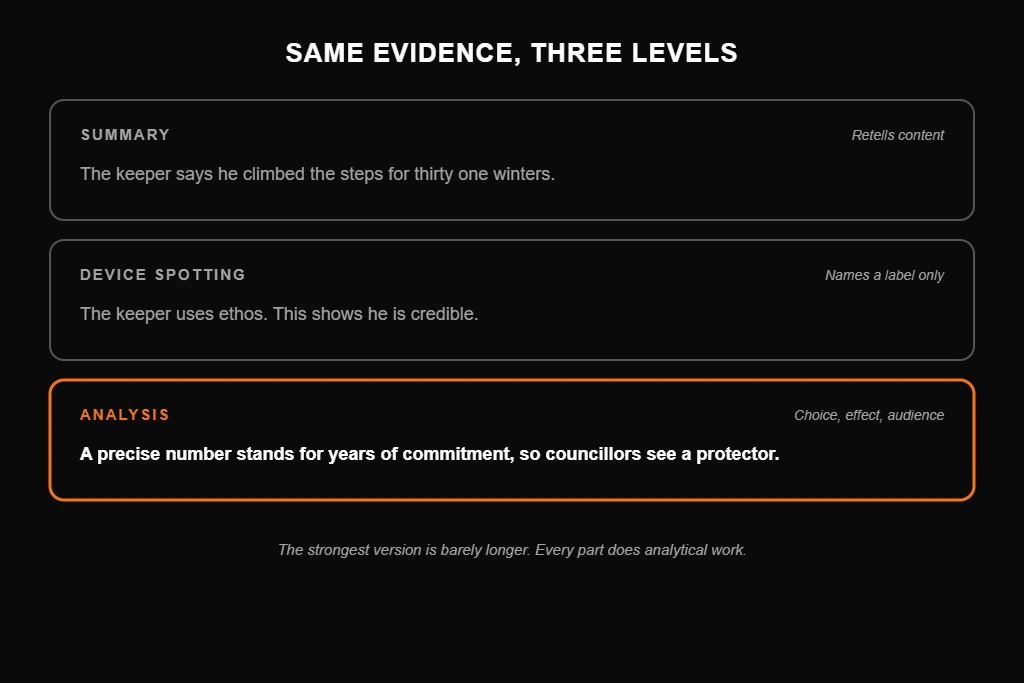
| Summary | The keeper says he climbed the steps for thirty one winters and helped a fishing boat in 1987. | Retells the content. No claim about a choice and no effect. |
| Device spotting | The keeper uses ethos when he says “thirty one winters.” This shows he is credible. | Names an appeal but explains nothing. “This shows” adds no analysis. |
| Analysis | By opening with “thirty one winters,” the keeper lets a precise number stand for years of commitment, so councillors see him as someone who protected them, not someone protecting his job. | Names a specific choice, explains its effect and ties it to the audience and purpose. |
Notice that the strongest version is not much longer. What changes is that every part of the sentence does analytical work. The same principle applies to thesis statements; our guide to the rhetorical analysis thesis shows weak and strong versions side by side, with 20 original examples.
Weak vs strong commentary verbs
Many weak paragraphs fail because of one verb. “Shows”, “uses” and “talks about” describe without explaining, so they leave the reader to do the analysis. Strong samples lean on verbs that name an effect: reframes, humanizes, disarms, invites, narrows, widens, heightens and implicates. Look back at Example 1. The keeper “disarms his opponents”, the parallel clauses “redefine” the lighthouse and the final lines “separate the function from the meaning”. Each verb tells the reader what is happening to the audience, which is exactly the job commentary has to do.
Common problems in examples you find online
Not every sample you find is a good model. Some are written by advanced writers with far more time than you will have, so they run to 1,500 words and are no use for a timed exam. Others are mostly summary, with a device named at the end of each paragraph. Some quote long passages and leave little room for analysis, while others argue with the writer instead of explaining how the writer persuades. The safest models are scored samples from the College Board, because the commentary tells you exactly why each essay earned its score.
Signs a paragraph is still summary
If most of your sentences begin with “The writer says” or “Then the speaker”, or if you could delete every quotation and still have the same paragraph, you are probably summarizing. Rewrite each sentence so it makes a claim about what a choice does, then use the quotation as proof. A quick test helps here. Cover the quotations with your hand and read only your own sentences. If what remains still explains how the writer persuades, you are analyzing. If what remains is a list of things the writer said, you are summarizing, and each of those sentences needs a claim about effect. Most students find that one or two rewritten sentences per paragraph are enough to move from summary to analysis, so this is a fast fix even in the final minutes of an exam.
How to Use an Example Without Copying It
Examples are most useful when you study how they are built, not what they say. Copying the wording of any sample, including the ones in this guide, is plagiarism. Copying the structure is exactly what examples are for. Think of a sample as a worked example in maths: you study the steps, then solve a new problem yourself. The four habits below turn reading into real improvement.
Read the sample twice
On the first reading, read the whole example of a rhetorical analysis for its argument, as a teacher would. On the second, read only the first and last sentence of each paragraph. Those sentences usually carry the claim and the link to purpose, so reading them in a row shows you the essay’s line of reasoning in under a minute. If that quick read does not make sense on its own, the sample’s structure is weak, however polished the sentences are. It also helps to note the length of each paragraph. In strong samples, body paragraphs are similar in size, because each choice gets a fair share of analysis, and the closing paragraph is noticeably shorter. Uneven paragraphs usually mean one choice was explained well and the others were rushed.
Map the sample’s structure
Take a sample and write one line for each paragraph: what choice it analyzes and what effect it claims. That reveals the skeleton you can reuse. If you want a full template and worked plan, our rhetorical analysis essay outline guide shows how to build one from scratch.
Mark the commentary
Highlight every sentence in a strong sample that explains an effect. In most good examples, those sentences take up more space than the quotations. Aim for the same balance in your own writing.
Test the pattern on a new text
Choose a different passage and try to write one paragraph that follows the same moves: claim, short quotation, effect, link to purpose. Then compare your paragraph with the sample. This builds skill far faster than rereading models.
A six point checklist for any example you find online
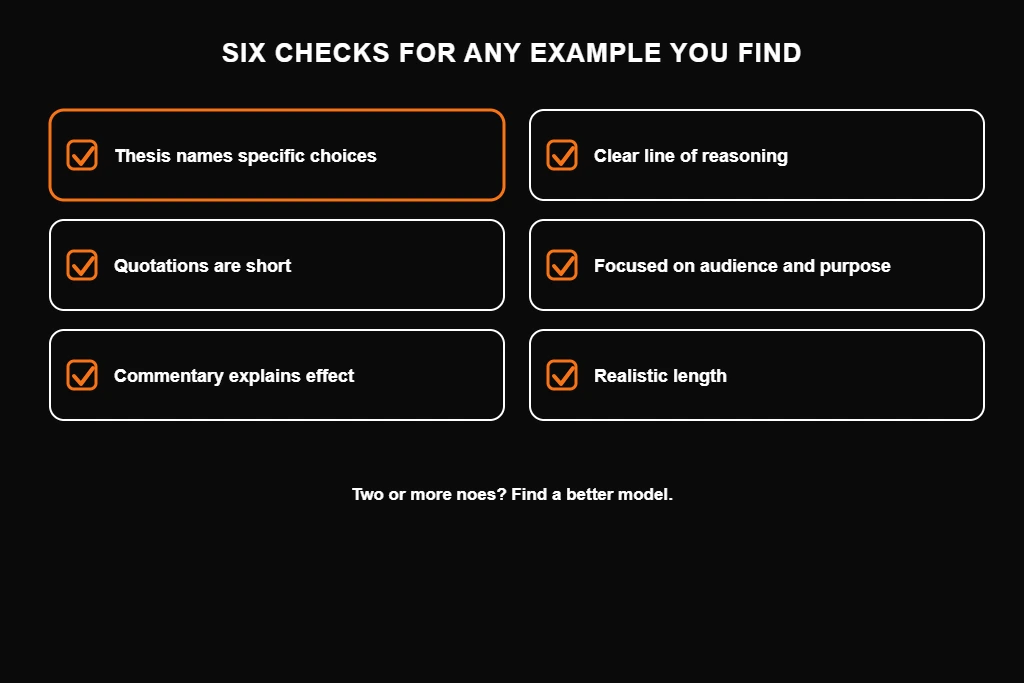
Before you trust a sample, check it. Does the thesis name specific choices? Are quotations short? Does commentary explain effects? Is there a clear line of reasoning? Does it stay focused on the audience and purpose? Is it a realistic length for your assignment? If the answer to two or more is no, find a better model.
Format Notes: MLA, Length and Titles
MLA format
Most rhetorical analysis assignments in English classes use MLA style. That usually means a heading with your name, instructor, course and date, a centred title, double spacing and in-text citations with the author’s name and a page number when the source has page numbers. Speeches and advertisements without page numbers are usually cited by author or title only. Always follow your instructor’s requirements, because many add their own rules.
How long should it be?
Timed AP essays are usually four or five paragraphs, often around 500 to 700 words, while college assignments typically set a word or page count. Length matters far less than depth. A shorter essay with strong commentary will beat a long one that summarizes.
Quoting speeches, ads and visuals
Quote speeches and articles directly, using short phrases woven into your sentences. For advertisements and visuals, your evidence is usually a precise description, such as the colour of a background or the position of a slogan, plus any words that appear on the page. Describe only what matters for your claim, and keep the description brief, so that most of the paragraph stays on effect.
Titles
If your assignment needs a title, name the text and your angle, for example “Redefining a Lighthouse: Concession and Symbol in a Keeper’s Plea”. A clear title tells your reader what you will argue before the first paragraph begins.
Appeals in Rhetorical Analysis Examples
Almost every sample above touches on the three classic appeals, but none of them simply labels them. Here is a quick reference for using them well.
Ethos Pathos Logos Examples
Ethos, pathos and logos are appeals to credibility, emotion and reason, which Texas A&M University’s Writing Center calls ethical, pathetic and logical appeals. An ethos example is the lighthouse keeper’s “thirty one winters”, which earns trust through experience. A pathos example is the ferry that ran aground “the year my daughter was born”, which ties public danger to private feeling. A logos example is Riverline’s “156 plastic bottles a year”, which gives the ad a measurable claim. Three points help. Name the specific choice behind the appeal. Explain its effect on this audience. And show how appeals support each other. Tip: write “earns trust by” instead of “uses ethos”, so you are forced to explain how.
Using the appeals in a timed essay
In a timed AP essay, it is tempting to organize every paragraph around one appeal. That can work for short, balanced texts, but it often leads to shallow paragraphs. A safer approach is to organize by specific choices, as Example 1 does, and mention the appeal inside the commentary when it helps explain the effect.
How EssaysHelper Can Help You
Reading examples is a good start, but feedback on your own writing is what improves scores. Our academic writing support can help you without taking over your work:
- Reviewing your draft against the features of a strong example.
- Helping you turn summary sentences into real analysis.
- Practising timed AP Lang essays with feedback on each rubric row.
- Advising on how to analyze ads, visuals and speeches for class assignments.
Send us your passage, your draft and your deadline, and we will point you to the quickest next step.
Frequently Asked Questions
What does a good rhetorical analysis essay example look like?
It opens with a thesis naming the writer’s purpose and specific choices, uses short quotations, explains how each choice affects the audience and ends by showing how the choices work together.
Where can I find AP Lang rhetorical analysis essay examples?
The College Board publishes real student responses with scores and commentary on AP Central for each exam year. This guide also includes an annotated AP style sample with an unofficial rubric breakdown.
How long should an AP Lang rhetorical analysis essay be?
There is no word limit, but most students write four or five paragraphs in about 40 minutes, often around 500 to 700 words. Depth of commentary matters more than length.
What makes a rhetorical analysis essay score high on AP Lang?
A defensible thesis about rhetorical choices, specific evidence for every claim and commentary that consistently explains how multiple choices serve the writer’s purpose. Sophistication comes from explaining why the choices fit the situation.
Can I use a rhetorical analysis example as a template?
Yes, for structure. Copy the pattern of claim, evidence, effect and link to purpose, but always write your own sentences about your own text.
How do you write a rhetorical analysis of an advertisement?
Treat every element as a choice: images, colours, layout, slogan and any statistics. Explain how each one affects the target audience and how they work together to persuade.
What is a visual rhetorical analysis example?
It is an analysis of an image, poster, chart or infographic. Instead of quotations, you describe what the viewer sees, such as colour, composition and scale, and explain the effect of each choice.
What should a rhetorical analysis body paragraph look like?
Start with a claim about one choice, add a short quotation or description as evidence, explain its effect on the audience in two or three sentences and link it back to the purpose.
Is it plagiarism to follow a rhetorical analysis essay example?
Following the structure is fine. Copying the wording, even with small changes, is plagiarism. Use examples to learn the moves, then write about your own text in your own words.
How do I format a rhetorical analysis essay in MLA?
Use an MLA heading, a centred title, double spacing and in-text citations with the author and page number where available. Check your instructor’s guidelines, as many add requirements.
Final Thoughts
Every strong rhetorical analysis essay example, whether it analyzes an AP passage, a historical speech or an advertisement, follows the same pattern. It makes a clear claim about the writer’s choices, supports it with short evidence and spends most of its words explaining how those choices move a specific audience. Use the five samples here to see that pattern from different angles, map the structure of the one closest to your assignment, then write your own analysis in your own words. With practice, the pattern becomes second nature.