

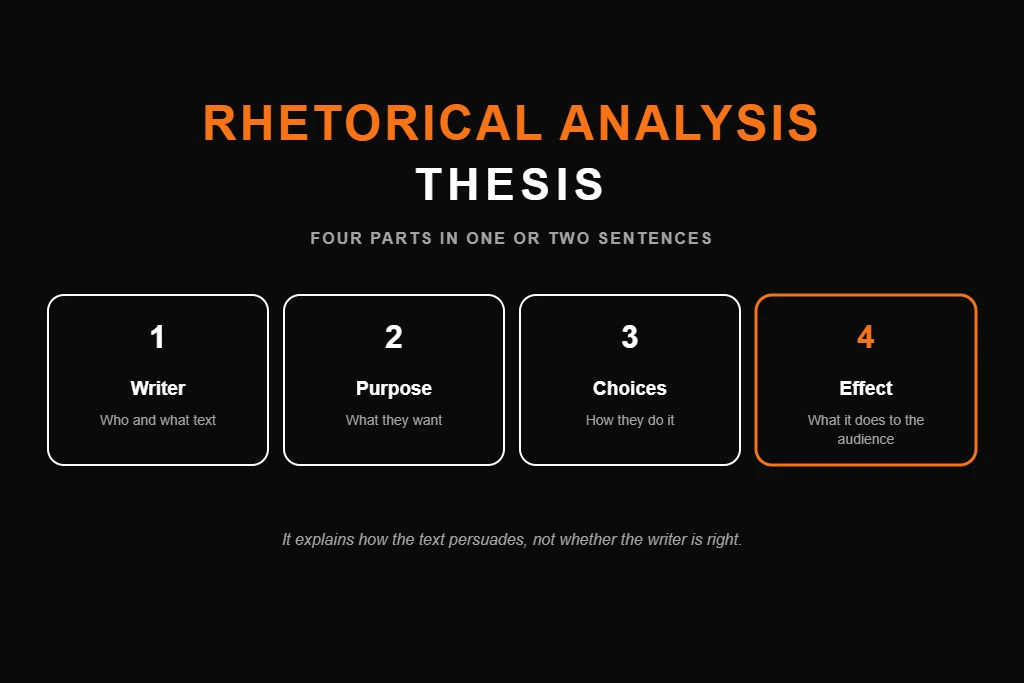
A rhetorical analysis thesis is one or two sentences that name the writer, the writer’s purpose, the main rhetorical choices and how those choices work on the audience. A simple template is: In [text], [writer] [purpose verb] by [choice 1] and [choice 2], which [effect on audience]. For example: “In her graduation speech, the principal urges new graduates to stay curious by recalling her own early failures and repeating the question ‘what if’, which turns fear of mistakes into permission to try.” It explains how the text persuades, not whether the writer is right.
Below you will find what makes a thesis strong, four templates you can fill in, a step by step method, about 20 original example theses across different kinds of texts, a weak to strong revision table and a full section on the AP Lang version. Every example text in this guide is invented, so you can borrow the patterns freely.
Most students struggle with the same problems: a thesis that only restates the prompt, a thesis that just lists ethos, pathos and logos, a thesis that argues with the writer instead of analyzing them, and a thesis so general it would fit any speech ever written. Each of those has a quick fix, and you will see them all below.
What Is a Rhetorical Analysis Thesis?
A rhetorical analysis thesis is the central claim of your essay. Instead of arguing about the topic, it makes a claim about how a writer tries to persuade a particular audience. At essays helper, we describe it to students as the one sentence that tells your reader what the writer is doing, how they are doing it and why it works on the people they are speaking to.
Every strong rhetorical analysis thesis statement has four parts. If one is missing, the thesis usually feels thin.
1. The writer and the text
Name who is speaking and what kind of text it is: a speech, a letter, an editorial or an advertisement. This sets the context in a few words.
2. The purpose
Say what the writer wants the audience to think, feel or do. Use a precise purpose verb such as urges, persuades, warns, challenges, reassures or celebrates, instead of a vague verb like talks about.
3. The rhetorical choices
Name the specific moves the writer makes, such as a personal story, a striking contrast, repetition, a shift in tone or a carefully chosen statistic. Specific choices are far stronger than general labels.
4. The effect on the audience
Explain what those choices do to the audience. This is the part most students leave out, and it is the part that turns a description into an analysis.
What Makes a Rhetorical Analysis Thesis Strong
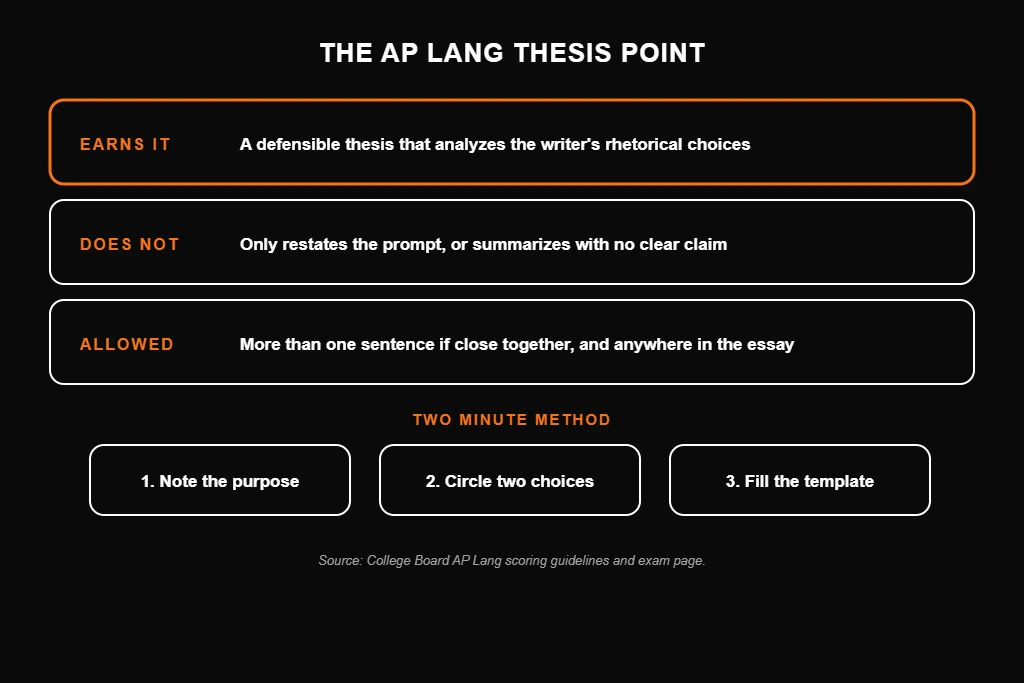
The College Board’s AP Lang scoring guidelines give a useful standard for any rhetorical analysis, not only the exam. To earn the thesis point, a response must respond to the prompt with a defensible thesis that analyzes the writer’s rhetorical choices. The guidelines say the point is not earned when the thesis only restates the prompt, summarizes the issue with no clear claim, or does not respond to the prompt.
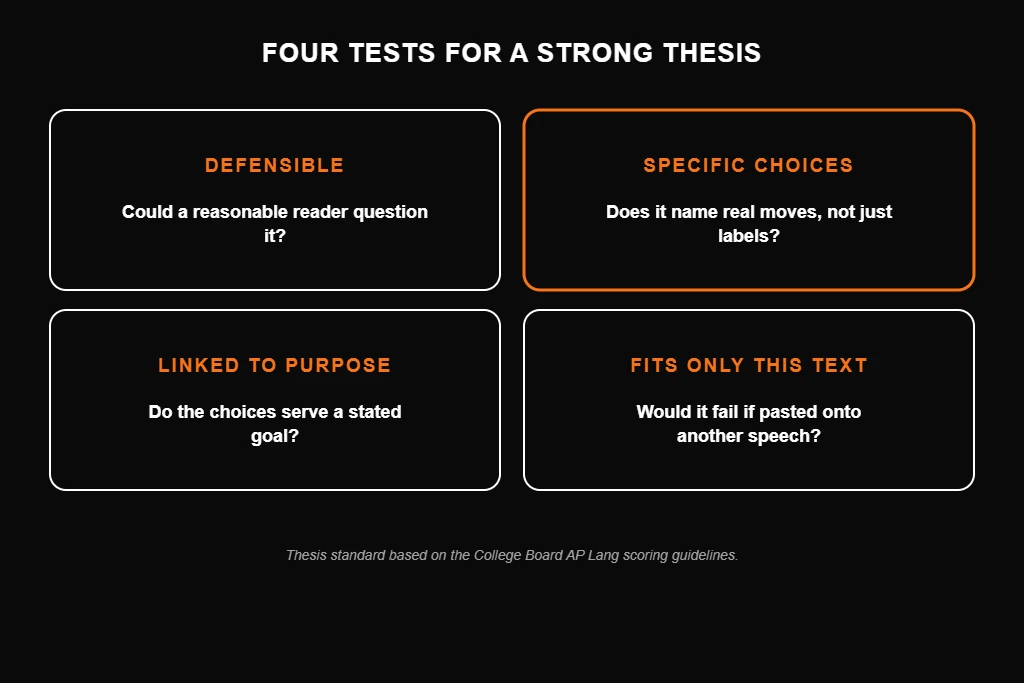
From that standard, you can build four simple tests for your own thesis.
Test 1: Is it defensible?
A defensible thesis is a claim a reasonable reader could question, supported by evidence in the text. “The speaker uses language” is not defensible, because nobody could disagree. “The speaker builds urgency through short, repeated warnings” is defensible, because you now have to prove it.
Test 2: Does it name specific choices?
Name what the writer actually does. “Ethos, pathos and logos” is a label, not an analysis. “Her years as a nurse and a story about one patient” names real choices you can quote and explain.
Test 3: Does it link the choices to the purpose?
The choices should serve a purpose you have named. A thesis that lists devices without saying what they achieve leaves the reader asking “so what?”
Test 4: Does it fit only this text?
If you could paste your thesis onto any other speech and it would still make sense, it is too general. Add one detail that belongs only to this text, such as the audience, the occasion or a distinctive image.
Rhetorical Analysis Thesis Template
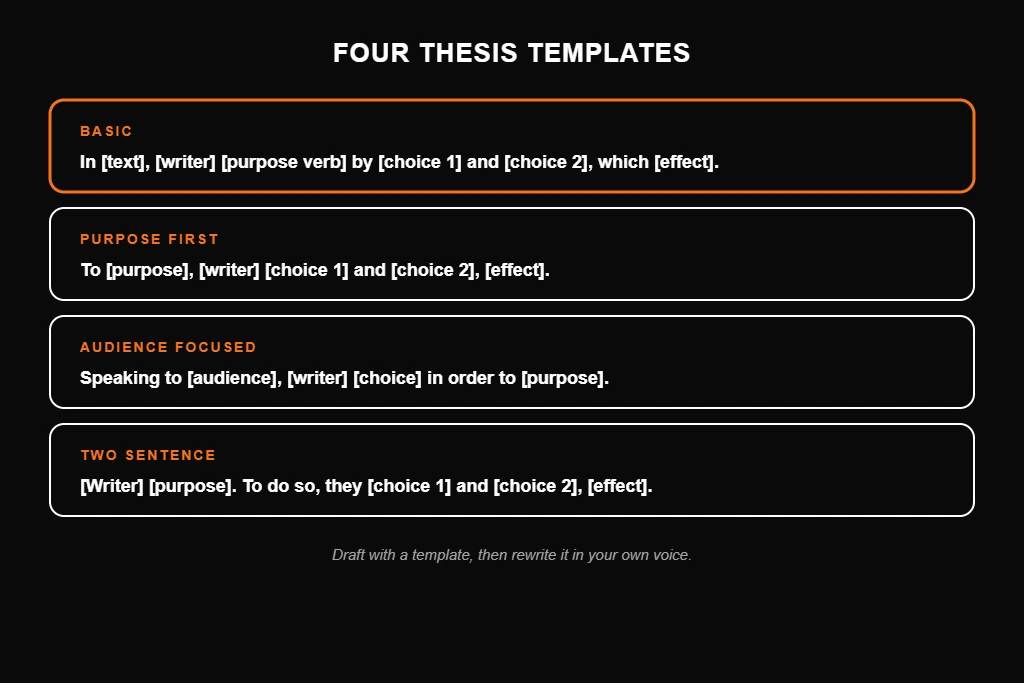
A template gives you a reliable starting shape. Use one to draft quickly, then adjust the wording so it sounds like you. Here are four formats that work for most texts.
| Template | Formula | Filled example |
|---|---|---|
| Basic | In [text], [writer] [purpose verb] by [choice 1] and [choice 2], which [effect]. | In his letter to residents, the mayor asks for patience during road repairs by admitting past delays and describing the finished street, which makes the inconvenience feel temporary and worthwhile. |
| Purpose first | To [purpose], [writer] [choice 1] and [choice 2], [effect]. | To persuade parents to support a later school start, the doctor pairs sleep research with a portrait of one exhausted student, giving the data a human face. |
| Audience focused | Speaking to [audience], [writer] [choice] in order to [purpose]. | Speaking to skeptical shareholders, the CEO opens with the company’s mistakes in order to earn trust before asking for more investment. |
| Two sentence | [Writer] [purpose]. To do so, [he/she/they] [choice 1] and [choice 2], [effect]. | The coach wants her team to forgive a painful loss. To do so, she recalls her own worst game and ends with a joke, turning shame into something the players can share. |
You do not need to follow a template word for word. Its job is to make sure all four parts are present. Once they are, rewrite it in your own voice.
Purpose verbs and effect verbs
The verb you choose does a lot of the work. Good purpose verbs include urges, persuades, warns, challenges, reassures, celebrates, defends, criticizes and calls on. Good effect verbs include builds, evokes, reframes, humanizes, sharpens, softens, implicates and unites. Swap “uses” and “shows” for one of these and your thesis will instantly sound more analytical.
How to Write a Rhetorical Analysis Thesis, Step by Step
If you are new to this kind of essay, our full guide on how to write a rhetorical analysis essay covers reading, annotating and body paragraphs. Here we focus on the thesis itself. Most students can draft a strong one in under ten minutes with these six steps.
Step 1: Map the rhetorical situation
Write one line each for the speaker, occasion, audience, purpose and subject. The purpose and audience lines matter most, because your thesis has to name both.
Step 2: Find two or three key choices
Look for the moves the writer makes most often or most powerfully. Check the opening, any turning points and the ending, because writers often place their strongest choices there.
Step 3: Write one effect for each choice
Beside each choice, write a few words on what it does to the audience, such as “builds trust”, “makes the loss feel real” or “puts the decision on them”. These notes become the end of your thesis.
Step 4: Choose a precise purpose verb
Replace “talks about” with a verb that captures the writer’s goal. Is the writer warning, urging, defending or celebrating? The right verb sharpens the whole sentence.
Step 5: Draft with a template
Drop your notes into one of the four templates above. Do not worry about style yet. Get all four parts into one or two sentences. Your first thesis statement is a draft, not a final answer.
Step 6: Test and revise
Run the four tests: defensible, specific, linked to purpose and fits only this text. If it fails one, fix that part. Then read it aloud. If it sounds natural and you could argue it for a page or more, you are ready.
Rhetorical Analysis Thesis Examples
Here are 20 original rhetorical analysis thesis examples, grouped by the kind of text. All the texts are invented for this guide. After each example, a short note explains why it works. Use them to see the pattern, then write your own for the text in front of you.
Speeches
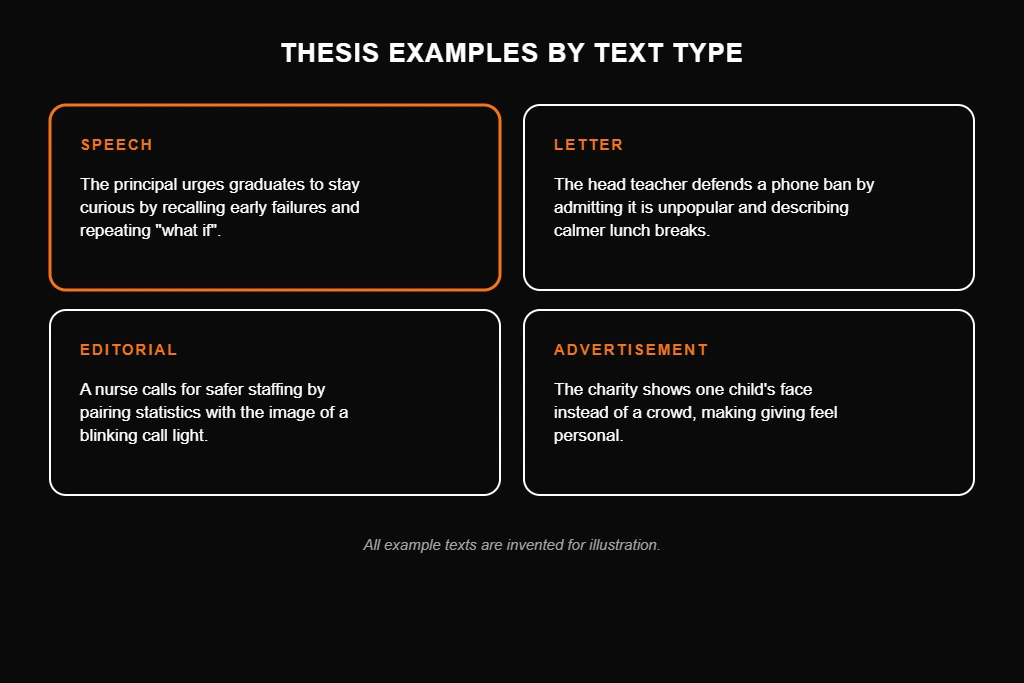
1. In her graduation speech, the principal urges new graduates to stay curious by recalling her own early failures and repeating the question “what if”, which turns fear of mistakes into permission to try.
Why it works: a specific purpose, two named choices and a clear effect on this audience.
2. Addressing a crowd after a flood, the governor reassures residents by listing the agencies already at work and promising to return in person, which replaces panic with a sense of order.
Why it works: it ties the choices to a precise emotional shift in the audience.
3. At a city council meeting, a cyclist argues for protected bike lanes by describing a near miss in vivid detail and then citing crash data, so that emotion opens the door and evidence walks through it.
Why it works: it explains how two choices work together, not just that they exist.
4. In his retirement speech, the factory manager thanks his workers by naming individual employees and telling short stories about each, which makes a formal goodbye feel personal and earned.
Why it works: the effect is specific to the occasion.
Letters
5. In her letter to parents, the head teacher defends a new phone ban by admitting it will be unpopular and then describing calmer lunch breaks, which disarms objections before they are raised.
Why it works: it names a strategy, conceding first, and its effect on resistant readers.
6. Writing to his younger brother, the soldier encourages him to finish school by contrasting the routine of training with the freedom of choice that education brings, making study look like a privilege rather than a chore.
Why it works: the contrast is named and its effect is explained.
7. In a letter to a landlord, the tenant requests urgent repairs by keeping a polite tone while listing dated complaints, which makes the request hard to ignore without seeming hostile.
Why it works: it analyzes tone as a choice, which many students forget.
Editorials and op-eds
8. In her editorial, the student journalist challenges the school’s grading policy by opening with a confused classmate’s question and closing with a simple proposal, guiding readers from frustration to a practical solution.
Why it works: it follows the structure of the piece from start to finish.
9. The columnist warns readers about rising rents by comparing his first apartment with a similar flat today, using a personal before and after to make abstract figures feel immediate.
Why it works: the comparison is named and its purpose is clear.
10. In an op-ed for a local paper, a nurse calls for safer staffing by pairing hospital statistics with the image of a call light left blinking, which makes a policy debate feel like a matter of personal safety.
Why it works: it explains how logic and emotion support each other.
Advertisements
11. The bank’s advertisement persuades young adults to start saving by showing a small daily coffee cost growing into a holiday fund, which turns a lecture about money into an appealing reward.
Why it works: it treats a visual sequence as a rhetorical choice.
12. In its campaign poster, the charity appeals for donations by showing one child’s face instead of a crowd and adding a single, specific cost, making giving feel personal and achievable.
Why it works: it analyzes the choice of one face over many.
13. The running shoe advertisement targets beginners by featuring ordinary runners and the line “you are already a runner”, which removes the fear of not being athletic enough.
Why it works: it connects casting and wording to the audience’s insecurity.
Personal essays
14. In her essay about learning to swim as an adult, the writer persuades readers that it is never too late to start by describing her fear honestly and ending with a small victory, inviting readers to see their own fears as temporary.
Why it works: it links honesty and structure to the reader’s response.
15. The essayist argues that boredom is valuable by moving from an irritated childhood memory to calm adult reflection, modelling the change of attitude he hopes readers will adopt.
Why it works: the structure itself is treated as persuasive.
16. Writing about her grandmother’s recipes, the author celebrates family memory by using sensory detail and short, rhythmic lists, which makes the past feel present on the page.
Why it works: it names style choices and their effect.
Historical style speeches
17. In his speech at the opening of a new public library in 1910, the town founder argues that books are a civic duty by addressing workers directly and comparing the library to the town’s factories, which gives reading the same dignity as labour.
Why it works: it reads the choices in light of the historical audience.
18. Speaking to volunteers before an election, the campaign organizer urges persistence by repeating “one more door” and recalling a past victory won by a handful of votes, turning tiring work into a meaningful mission.
Why it works: repetition and anecdote are tied to a clear motivational purpose.
19. In her farewell address to a nursing school, the matron honours graduates by contrasting the uncertainty of their first day with the confidence they now show, framing the ceremony as proof of their growth.
Why it works: the contrast is named and its effect on the graduates is explained.
20. Addressing a divided town meeting, the elder calls for unity by speaking in the plural “we”, recalling shared hardships and avoiding blame, which makes cooperation feel like the town’s natural state.
Why it works: it treats pronoun choice as a deliberate, persuasive move.
Weak vs Strong: How to Fix a Thesis
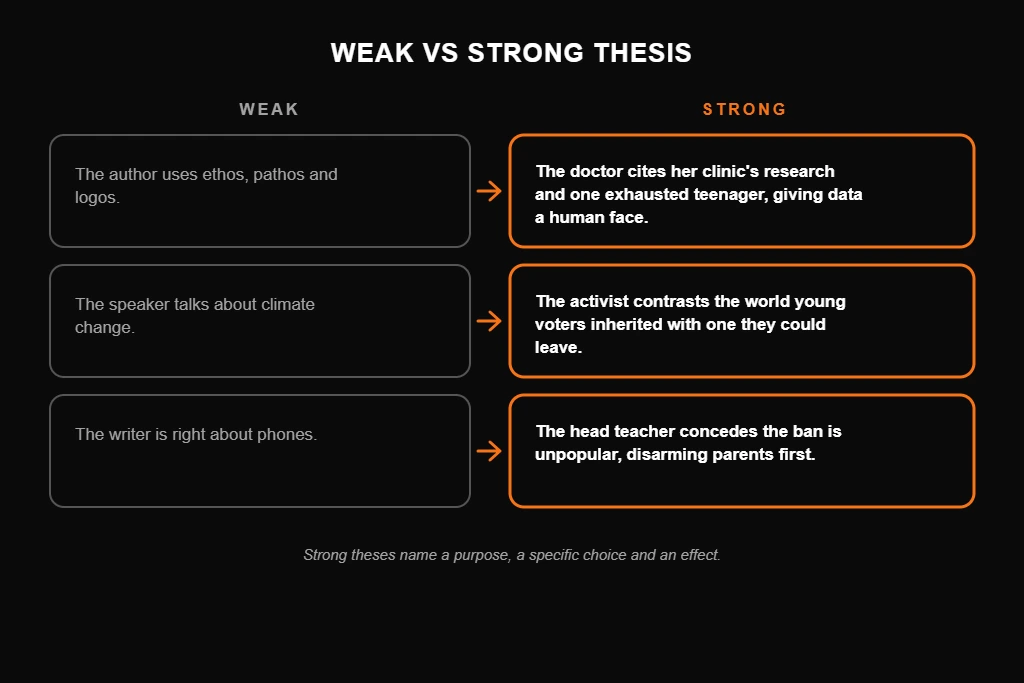
Most weak thesis statements fail in predictable ways. The table shows common problems and how to revise them.
| Weak thesis | Why it fails | Strong revision |
|---|---|---|
| The author uses ethos, pathos and logos to persuade the audience. | Labels only, no specific choices, fits any text | The doctor persuades parents by citing her clinic’s research and describing one exhausted teenager, giving the data a human face. |
| In this speech, the speaker talks about climate change. | Summary of the topic, no claim about choices | The activist urges young voters to act by contrasting the world they inherited with the one they could leave, turning anxiety into responsibility. |
| The writer is right that phones should be banned in schools. | Argues the issue instead of analyzing the writing | The head teacher defends the ban by conceding its unpopularity first, which disarms angry parents before she makes her case. |
| The speaker uses many rhetorical devices effectively. | Vague, no named choices or effect | The governor reassures residents by listing the agencies at work and promising to visit, replacing panic with a sense of order. |
| The advertisement uses imagery. | Names one device with no purpose or effect | The charity’s poster appeals for donations by showing one child’s face, which makes giving feel personal rather than overwhelming. |
| The letter is persuasive because it is well written. | Opinion, not analysis | The tenant keeps a polite tone while listing dated complaints, making the request hard to ignore without seeming hostile. |
Notice the pattern. Every revision names the writer’s purpose, at least one specific choice and the effect on a particular audience.
AP Lang Rhetorical Analysis Thesis
On the AP English Language and Composition exam, the rhetorical analysis is one of three free response essays. The College Board’s AP Lang exam page says the free response section lasts 2 hours and 15 minutes, including a 15 minute reading period, which leaves about 40 minutes per essay if you divide the writing time evenly. That means your thesis has to come quickly.
What earns the thesis point
According to the College Board scoring guidelines, the thesis point goes to a response that answers the prompt with a defensible thesis that analyzes the writer’s rhetorical choices. The guidelines add some helpful details. The thesis may be more than one sentence if the sentences are close together. It may appear anywhere in the response. And it can, but does not have to, set out the line of reasoning for the essay. A thesis that only restates the prompt, summarizes the topic without a claim or ignores the prompt does not earn the point.
A two minute thesis method
After you read and annotate the passage, take about two minutes. First, write the purpose in a few words. Second, circle your two strongest choices. Third, drop them into the basic template and add a short effect. You now have a thesis that meets the rubric’s standard, and you can polish it while you plan the body.
AP style thesis examples
A. In her commencement address, the scientist encourages graduates to embrace uncertainty by narrating a failed experiment and reframing it as a discovery, which teaches them to see setbacks as part of progress.
B. Writing to the readers of a farming magazine, the author defends small farms by blending practical cost figures with memories of his grandfather’s fields, so that economic arguments carry emotional weight.
C. In a speech to new teachers, the veteran educator prepares them for difficult first years by admitting her own struggles and repeating “you will get better”, which turns fear into realistic hope.
Each of these names a purpose, specific choices and an effect, which is exactly what the rubric’s thesis row looks for.
Going for sophistication
The sophistication point is earned across the whole essay, not in the thesis alone, but your thesis can set it up. The scoring guidelines list explaining the significance or relevance of the writer’s choices given the rhetorical situation as one way to earn it. A thesis that already notes why the choices fit this audience at this moment gives you a natural path to that kind of analysis.
How Your Thesis Shapes the Essay
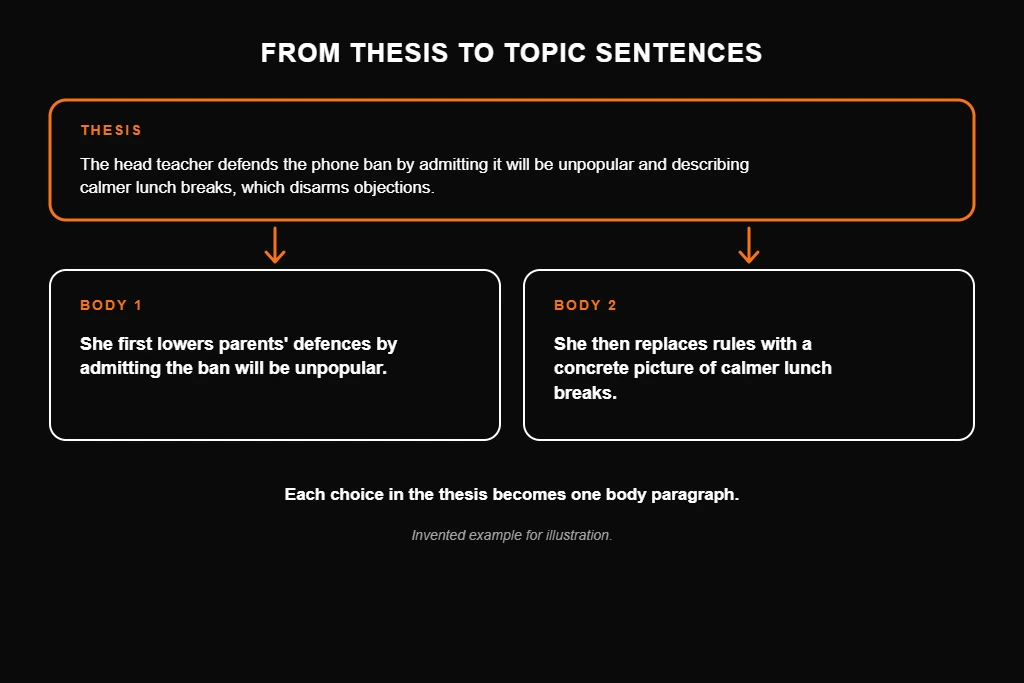
A good thesis is also a plan. The choices you name become the topics of your body paragraphs, and the effect you name becomes the thread that ties them together.
Where the thesis goes
Put your thesis statement at the end of the opening paragraph. Start with one or two sentences of context, such as the writer, the occasion and the audience, then state the thesis. On AP Lang it can technically appear anywhere, but placing it at the end of the opening paragraph makes it easy for readers to find and keeps your argument clear.
From thesis to topic sentences
Each choice in your thesis can become one body paragraph. Take example 5: the head teacher defends the phone ban by admitting it will be unpopular and describing calmer lunch breaks. Body paragraph one could begin: “The head teacher first lowers parents’ defences by admitting the ban will be unpopular.” Body paragraph two could begin: “She then replaces abstract rules with a concrete picture of calmer lunch breaks.” The thesis has already done the planning for you.
If you want a full plan of your paragraphs before you write, our rhetorical analysis essay outline guide gives templates and a worked example that start from a thesis like these.
Keep the thesis and body in agreement
If you change your mind while writing and analyze a choice you did not name, go back and adjust the thesis. A thesis that promises one thing and a body that delivers another is a common reason essays lose marks for line of reasoning.
Rhetorical Analysis Thesis vs Argumentative Thesis
Students who have written argumentative essays often bring the same habit to rhetorical analysis, and it costs them marks. The two kinds of thesis answer different questions.
| Feature | Rhetorical analysis thesis | Argumentative thesis |
|---|---|---|
| Main question | How does the writer persuade? | What do I believe about the issue? |
| Subject of the claim | The writer’s choices | The topic itself |
| Your opinion on the issue | Not needed | Central |
| Example | The nurse calls for safer staffing by pairing statistics with an image of a blinking call light. | Hospitals should be required by law to meet minimum nurse staffing levels. |
A quick check: if your thesis would still make sense without the writer’s name, it is probably an argumentative thesis. A rhetorical analysis thesis always keeps the writer and their choices at the centre.
Using Examples and Appeals in Your Thesis
Two related topics come up whenever students work on a thesis: full model essays and the three classic appeals. Here is how each one connects to your thesis.
Rhetorical Analysis Examples
Full essay models show how a thesis grows into a complete argument, which a single sentence cannot. The most useful ones are scored samples, such as the College Board’s 2025 student responses for the rhetorical analysis question, which come with scores and commentary. Three points help. Find the thesis in a high scoring sample and see how each body paragraph develops one of its choices. Compare it with a low scoring sample on the same passage. And notice how often strong responses return to the purpose. Tip: copy the shape of a strong sample’s thesis, not its words, and test it on a new passage.
Ethos Pathos Logos Examples
Credibility, emotion and reason are the three classic appeals, and Texas A&M University’s Writing Center describes them as ethical, pathetic and logical appeals. An ethos example is a nurse saying “in twelve years on the ward”, which builds trust. A pathos example is the image of a call light left blinking, which creates worry. A logos example is a figure showing how many patients each nurse covers, which adds proof. Three points help. In your thesis, name the specific choice, not just the appeal. Explain the effect. And show how appeals work together. Tip: write “builds credibility by” instead of “uses ethos”, because it forces you to say how.
Common Thesis Mistakes and Fixes
- Restating the prompt. Add your own claim about specific choices and their effect.
- Listing ethos, pathos and logos. Name the actual moves the writer makes instead.
- Arguing with the writer. Leave your opinion on the issue out and focus on how they persuade.
- Being too general. Add a detail that belongs only to this text, such as the audience or a key image.
- Missing the effect. End with what the choices do to the audience.
- Naming too many choices. Choose two or three you can explain in depth.
- Using weak verbs. Swap “uses” and “shows” for verbs like urges, reframes or humanizes.
- Writing it once and never checking. Reread it after drafting and make sure the body still matches.
A quick thesis checklist
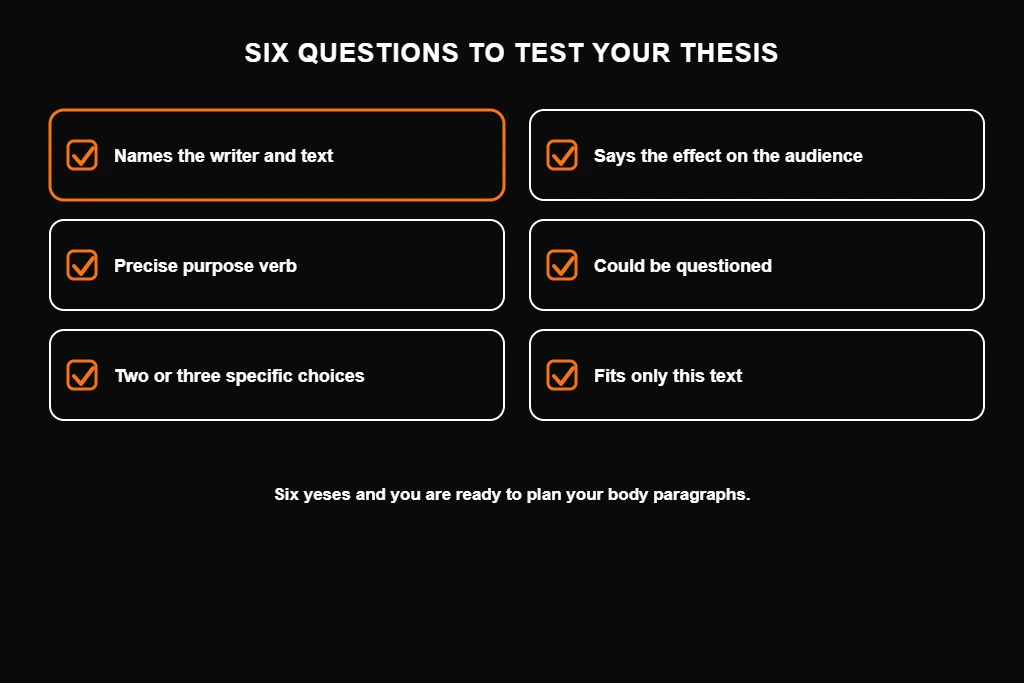
Before you move on, answer yes or no to each question. Does it name the writer and text? Does it state a purpose with a precise verb? Does it name two or three specific choices? Does it say how those choices affect the audience? Could someone reasonably question it? Does it fit only this text? Six yeses means you are ready to plan your body paragraphs.
How EssaysHelper Can Help You
A strong thesis makes the rest of a rhetorical analysis much easier, and feedback is the fastest way to improve it. Our academic writing support can help you without taking over your work:
- Reviewing your thesis against the four tests.
- Helping you find the strongest choices in a passage.
- Practising quick AP Lang theses under timed conditions.
- Giving feedback on drafts so your body paragraphs match your thesis.
Send us your passage, your draft thesis and your deadline, and we will point you to the quickest next step.
Frequently Asked Questions
What is a rhetorical analysis thesis?
It is the central claim of a rhetorical analysis essay. It names the writer, their purpose, the main rhetorical choices they make and how those choices affect the audience.
What should a rhetorical analysis thesis include?
Four parts: the writer and text, the purpose, two or three specific rhetorical choices, and the effect of those choices on the audience.
Can you show me an example of a rhetorical analysis thesis?
Here is one: In her letter to parents, the head teacher defends a phone ban by admitting it will be unpopular and describing calmer lunch breaks, which disarms objections before they are raised.
Is there a template for a rhetorical analysis thesis statement?
Yes. A simple one is: In [text], [writer] [purpose verb] by [choice 1] and [choice 2], which [effect on audience]. Adjust the wording so it sounds natural.
How long should a rhetorical analysis thesis be?
Usually one or two sentences. The AP Lang scoring guidelines allow more than one sentence as long as the sentences are close together.
Where does the thesis go in a rhetorical analysis essay?
Most writers put it at the end of the opening paragraph, after a sentence or two of context. That makes it easy for readers to find.
Should my thesis mention ethos, pathos and logos?
It is better to name the specific choices behind the appeals, such as a personal story or a statistic. The labels alone make a thesis vague.
How do I write a rhetorical analysis thesis for AP Lang?
Spend about two minutes after reading: note the purpose, pick two strong choices and use a template. Make sure it is defensible and analyzes rhetorical choices, not just the topic.
Does my thesis need to say whether the writer is right?
No. A rhetorical analysis explains how the writer persuades, not whether you agree. Keep your own opinion on the issue out of the thesis.
How is a rhetorical analysis thesis different from an argumentative thesis?
A rhetorical analysis thesis makes a claim about a writer’s choices. An argumentative thesis makes a claim about the issue itself and states your own position.
Final Thoughts
A strong rhetorical analysis thesis does four jobs in one or two sentences: it names the writer, states their purpose, identifies specific choices and explains how those choices work on the audience. Use a template to get all four parts down quickly, test it for being defensible and specific, and revise until it could only describe the text in front of you. Study the examples, practise with real passages, and your thesis will become the strongest and quickest part of every rhetorical analysis you write.