

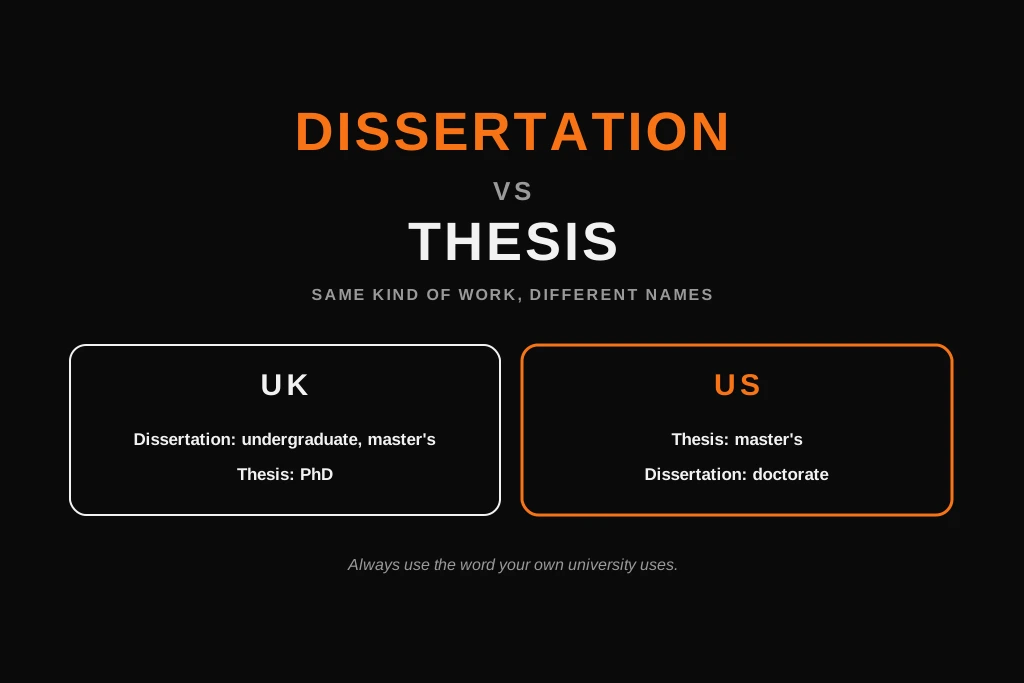
A dissertation and a thesis are the same kind of work: a long, independent research project written at the end of a degree. The difference is mostly in the name, and the names swap between countries. In the UK, a dissertation is usually written for an undergraduate or master’s degree, and a thesis for a PhD. In the US, a thesis is usually written for a master’s degree, and a dissertation for a doctorate. Whichever word you see, use the one your own university uses.
Dissertation vs Thesis: The Short Answer
If you have searched for thesis vs dissertation and found answers that seem to contradict each other, you are not imagining it. Most of the confusion comes from advice written for one country being read in another. A UK student reading a US guide, or the other way round, will find the two words used in opposite ways. Once you know which system a source is describing, the advice usually makes sense. If you are planning the project itself, our guide on how to write a dissertation covers every stage, whichever name your university uses.
Beyond the name, there are some real differences in level, length, originality and how the work is examined. Those differences depend far more on your degree than on the word. A PhD project is long and original whether it is called a thesis or a dissertation. An undergraduate project is shorter and less original whatever its label.
This guide covers what each word means, how the UK, US and some other countries use them, how the work changes by level, how length and examination compare, and how a dissertation or thesis differs from a capstone, a research paper and a thesis statement. It ends with practical advice on which word to use in emails, on your CV and when searching for examples.
What Is a Dissertation, and What Is a Thesis?
Both words describe an extended piece of independent research, written up in chapters, supervised by an academic and assessed at the end of a degree. Neither word on its own tells you the length or level of the work. You need to know the country and the degree as well.
What a dissertation means
In the UK, Newcastle University’s academic skills guide describes a dissertation as an extended piece of academic writing, usually completed at the end of an undergraduate or master’s degree, which can take several months. In the US, a dissertation usually means the large research project at the end of a doctorate. Missouri University of Science and Technology’s thesis and dissertation guide notes that a dissertation is mandatory for all of its doctoral programs.
What a thesis means
In the UK, Newcastle describes a thesis as usually part of a PhD: a longer project that tackles a question or problem in depth and can take years. In the US, Missouri S&T says a thesis is typically prepared for a master’s degree and is more focused and concise, and that it is optional in some master’s programs. So the same word points to a doctoral project in one country and a master’s project in the other.
Why the words swap
The University of Essex library guide notes that the two terms are often used the other way round in the US and the UK. There is no difference in quality or seriousness between them. It is simply a difference in custom, much like other differences between British and American academic vocabulary. The practical rule is the same everywhere: follow the word your university uses in its regulations.
Key Differences at a Glance
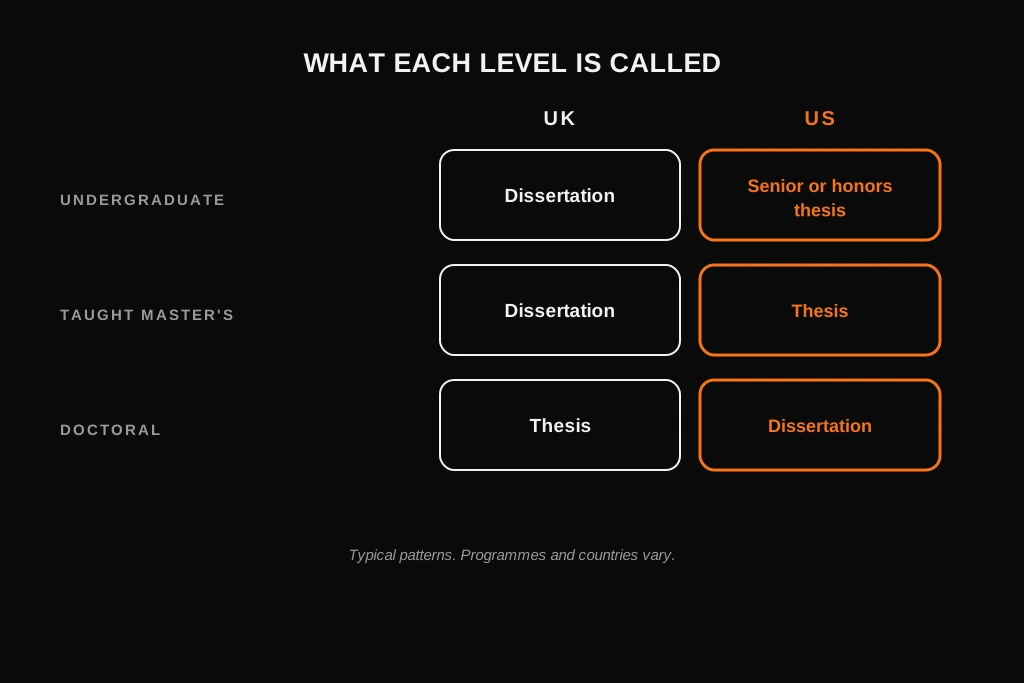
The table brings the main points together. It shows typical patterns, and individual universities and programmes can differ, so treat it as a map rather than a rule.
| Feature | UK | US |
|---|---|---|
| Undergraduate project | Dissertation | Senior or honors thesis, where offered |
| Taught master’s project | Dissertation | Thesis (optional in some programs) |
| Doctoral project | Thesis | Dissertation |
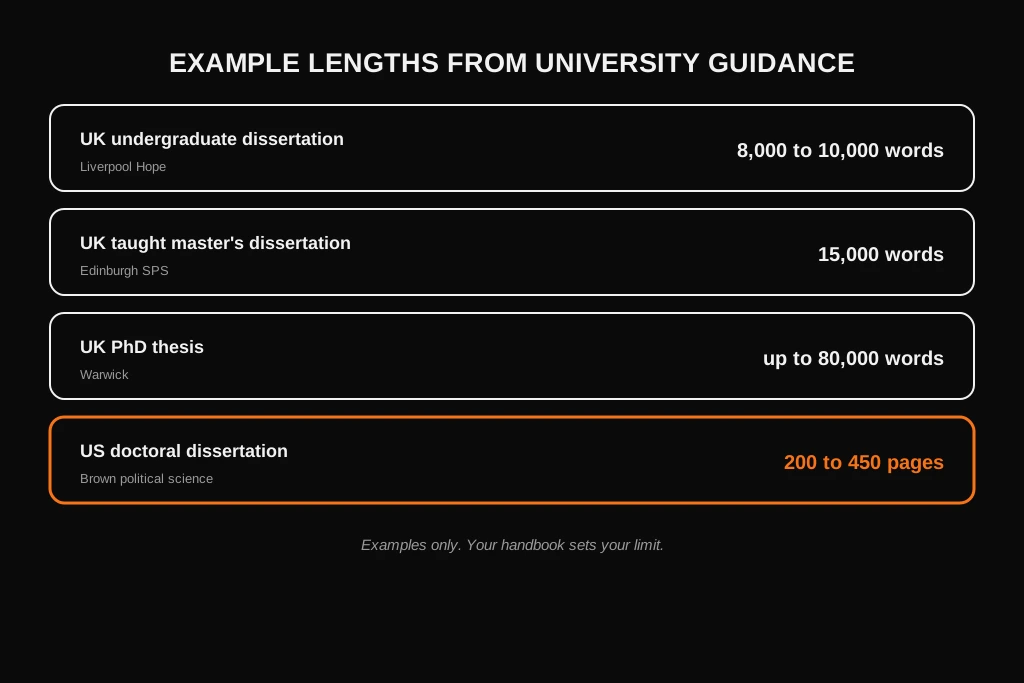
| Typical length, example | About 8,000 to 10,000 words undergraduate; 15,000 words taught master’s; up to 80,000 words PhD | Doctoral dissertations often 200 to 450 pages, varies by field |
| Originality expected | Rises with level; PhD must be original | Rises with level; doctoral work must be original |
| How the doctorate is examined | Private oral exam, the viva | Oral defense with a committee, often open to guests |
The UK length examples come from Liverpool Hope University’s undergraduate handbook, the University of Edinburgh’s taught MSc handbook and the University of Warwick’s research degree guide. The US page ranges come from department guidance at Brown and Columbia, covered in the length section below.
How the UK, US and Other Countries Use the Terms
Students who move between countries for study, or who read advice from abroad, feel the confusion most. Here is how the main systems use the words.
United Kingdom
In the UK, dissertation is the everyday word for the final project of a bachelor’s or taught master’s degree. Thesis is reserved for research degrees, especially the PhD and MPhil. A UK PhD student writes a thesis and defends it at a viva. A UK master’s student writes a dissertation, usually without an oral exam.
United States
In the US, the pattern is reversed. Master’s students who choose a research route write a thesis, and doctoral students write a dissertation and defend it in front of a committee. Many US undergraduates never write either, although some honors programmes and departments ask for a senior or honors thesis.
Canada and Australia
Other countries often lean towards thesis for doctoral work. At the University of Toronto, the School of Graduate Studies final oral examination guidelines mainly refer to the doctoral thesis, though the same page also uses the phrase doctoral dissertation. At the University of Melbourne, the examination overview describes the submitted doctoral work as a thesis, examined by experts from outside the university. Practice varies within each country, so always check your own university.
A translation guide for reading advice from another country
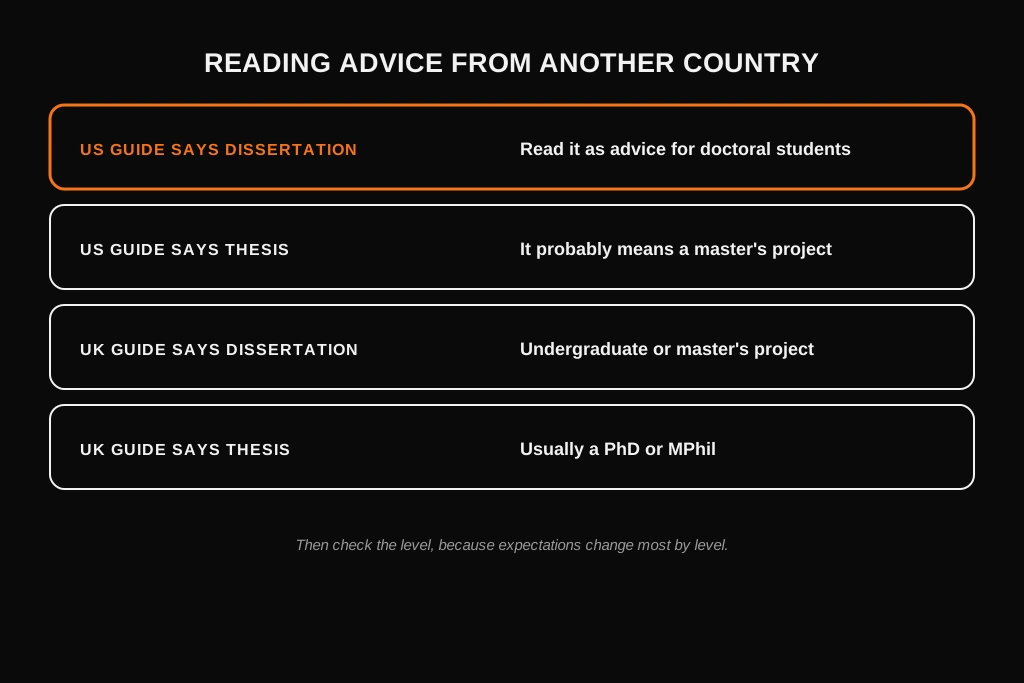
When you read a guide, first check where it was written. If it is a US guide and says dissertation, read it as advice for doctoral students. If it says thesis, it probably means a master’s project. If it is a UK guide and says dissertation, it probably means an undergraduate or master’s project, and thesis means a PhD. Then check the level the advice assumes, because length, originality and supervision expectations change far more by level than by name.
Dissertation vs Thesis by Level
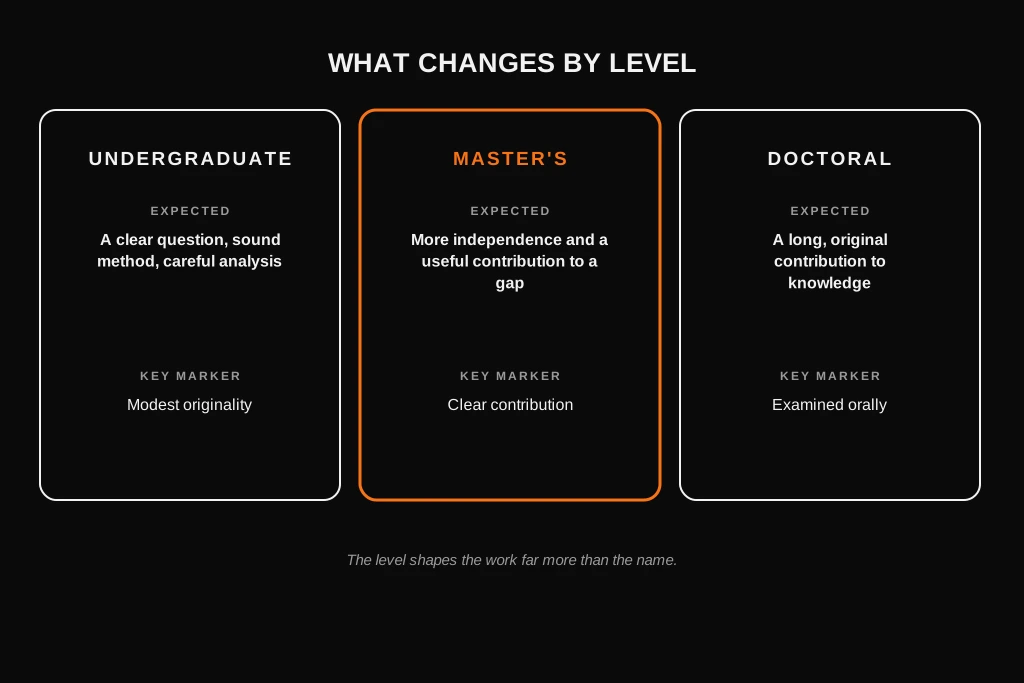
The level of your degree tells you more about the work than the word does. Here is what usually changes.
Undergraduate
At undergraduate level, the project is usually the first piece of independent research you complete. In the UK it is almost always called a dissertation. In the US it may be called a senior thesis or honors thesis, and it is often optional. At this level, examiners look for a clear question, a sound approach and careful analysis rather than a major new contribution. The originality expected is modest, which makes choosing a dissertation topic about finding a focused question you can answer well, not about breaking new ground.
Master’s
At master’s level, the UK usually says dissertation and the US usually says thesis. Either way, the project expects more independence, more critical reading and a clearer contribution to a gap in current research or practice than at undergraduate level. In some US programs the thesis is optional, and students can choose a capstone or extra courses instead, as Missouri S&T notes. Master’s thesis vs dissertation searches are really asking about this one level, described with two names.
Taught and research master’s degrees
Master’s degrees come in two broad kinds, and the name of the project often follows the kind. Taught master’s degrees, common in the UK, are mostly coursework with a dissertation at the end. Research master’s degrees, such as an MPhil or a research MSc, are built mainly around one long project, which UK universities often call a thesis. Warwick, for example, sets a 60,000 word limit for an MPhil thesis, far beyond a typical taught master’s dissertation. In the US, the thesis route in a master’s program plays a similar role.
PhD or doctoral
At doctoral level, the UK says thesis and the US says dissertation, but the work is the same in kind: a long, original contribution to knowledge, usually produced over several years and examined orally. A PhD thesis vs dissertation question is therefore mostly about vocabulary. Whatever the name, doctoral work is far longer and more original than master’s work, and it is judged by experts in the field.
Undergraduate vs Masters Dissertation
An undergraduate dissertation is usually a student’s first independent research project, while a master’s dissertation expects more independence and depth. The naming differs too: in the UK both are called dissertations, while in the US the master’s version is usually called a thesis and the undergraduate version, where it exists, a senior or honors thesis. Master’s projects engage more closely with current research. They usually justify their method more carefully. They often run longer. And they are expected to say something useful about a gap, not just describe a topic. Tip: if you are applying for a master’s abroad, check what your new university calls the project, because the name may change even if the work feels familiar.
Which Is Longer? Length and Scope
Students often ask whether a thesis or a dissertation is longer. The honest answer is that it depends on the country, because the longer document takes a different name in each one. In the UK, the thesis is longer, because it is the doctoral document. In the US, the dissertation is longer, for the same reason. What really decides length is the level of the degree.
Some real examples show the scale. Liverpool Hope gives about 8,000 to 10,000 words for a 30 credit undergraduate dissertation. Edinburgh’s School of Social and Political Science sets 15,000 words for a 60 credit taught MSc dissertation. Warwick sets a maximum of 80,000 words for a PhD thesis. In the US, Columbia University’s English department says a typical dissertation runs between 250 and 300 pages, and Brown University’s political science department describes dissertations as usually 200 to 450 double spaced pages.
US master’s theses are usually far shorter than doctoral dissertations, and length expectations vary widely by field. Departments in the humanities tend to expect more pages than those in the sciences, where figures and tables carry much of the evidence.
Where to find your own limit
Your handbook or graduate school regulations set your limit, and they also say what counts toward it, such as footnotes, tables and appendices. For word counts by level, a chapter budget and what usually counts, see our full guide on how long should a dissertation be. It also covers what happens if you go over or under the limit.
Purpose, Originality and Research Approach
The purpose of the work changes with level, not with the name. Lower level projects show that you can carry out research. Higher level projects must add something new. Knowing which kind of project you are writing helps you decide how much space to give to background, how ambitious your question should be and how much to claim in your findings. A common mistake at undergraduate level is to promise a major contribution the project cannot deliver, while a common mistake at doctoral level is to play it too safe.
Showing skill or adding knowledge
The University of Oregon’s graduate school explains the difference between a thesis and a terminal project in a useful way: a thesis aims to make a contribution to the current body of knowledge, while a terminal project is designed to show mastery of the skills and concepts learned on the programme. That distinction applies more widely. Undergraduate and many taught master’s projects are mainly about showing you can research well. Doctoral projects, and research master’s theses, are about adding knowledge. If your programme offers both routes, the choice usually depends on whether you want to go on to research or move into professional practice.
How original does it need to be?
At undergraduate level, a careful study of a small, well defined question is usually enough. At master’s level, you are expected to find and address a gap, even a modest one. At doctoral level, the work must make an original contribution that experts recognise. The originality bar rises with each level, whatever the project is called. Original does not have to mean dramatic. A new setting, a new group, a new combination of sources or a fresh test of an existing idea can all count, as long as you explain clearly what is new and why it matters. Ask your supervisor what counts as original enough at your level, because expectations differ between departments as well as between degrees.
What examiners look for at each level
At undergraduate level, examiners usually want to see that you can define a question, use a suitable method and analyse your evidence carefully. At master’s level, they look for a sharper engagement with current debates and a clearer sense of what your findings add. At doctoral level, they ask whether the work makes a real contribution, whether the claims are justified and whether you understand the field well enough to defend your choices. The same project, whatever its name, is judged against the expectations of its level.
Why the difference matters for your plans
If you are thinking about further study, the label on your current project matters less than what it shows. A strong undergraduate dissertation or master’s thesis is good evidence that you can carry out research, which is exactly what admissions panels for research degrees want to see. Describe it clearly in applications, including your question, method and main finding, so readers in another country understand what you did. A short, concrete description is far more useful to them than the label, and it shows that you understand your own research. Keep it to two or three sentences.
Research approach
The research itself is similar in kind at every level: a question, a review of earlier work, a method, findings and a discussion. What changes is scale and depth. A doctoral project may combine several studies, while an undergraduate project may use one small dataset. Whatever the level, the method has to fit the question, and your dissertation methodology chapter is where you explain and justify those choices. Examiners at every level look closely at whether the design can really answer the question you asked.
Ethics and approval
Any project involving people, at any level, usually needs ethics approval before data collection starts. The process is often more detailed for doctoral and research master’s projects, which may involve larger samples, longer fieldwork or sensitive topics. Check your university’s ethics process early, because approval can take weeks, and it applies whether your project is called a dissertation or a thesis. Build the approval time into your plan from the start, and ask your supervisor which forms your department uses, because a late application is one of the most common reasons projects fall behind schedule. Keep copies of every approval letter with your project files, since some universities ask to see them at submission.
Who supervises and how
Supervision also changes with level. Undergraduate students usually have regular meetings and a fixed timetable. Master’s students are expected to plan more themselves. Doctoral candidates work with a supervisor or committee over years, and the project is often shaped by the research culture of the department. If you are moving up a level, expect more independence and less hand holding, whatever the name of the project. In the US, doctoral candidates usually work with a committee of several faculty members who read drafts and sit on the defense, while in the UK a doctoral candidate often has one main supervisor and a second supervisor, with separate examiners appointed at the end. Knowing who reads your work, and when, helps you plan drafts and deadlines realistically.
Do They Look Different? Structure and Format
On the page, a dissertation and a thesis at the same level look much the same. Both usually open with front pages, move through an opening chapter, a review of earlier research, the method, the findings and a discussion, and end with a closing chapter, references and appendices. Examiners in both systems expect the same basic logic: a question, evidence that answers it and a discussion of what the answer means. If you have written a dissertation at one level, you already know the shape that a thesis at the next level will take, only longer and deeper.
Front pages and back matter
Both kinds of document usually begin with a title page, a declaration that the work is your own, a short summary, a contents list and often a page of thanks. They end with a reference list and appendices. Doctoral documents may add lists of figures, tables and abbreviations, and some graduate schools ask for a copyright page or a statement about previously published material. The order varies by university, so follow your template exactly.
Monograph or a set of papers
At doctoral level, some universities allow two formats. The traditional format is a single long document written as a continuous argument, often called a monograph. Another format, sometimes called a thesis by publication or an article based dissertation, combines several papers with linking chapters. Whether this is allowed, and how many papers are needed, varies by university and field, so check your regulations before you plan. The papers format can suit fields where journal articles are the main way of sharing research, while the monograph format is still common in the humanities. Talk to your supervisor about which format fits your project and your career plans.
The differences are mostly of scale. A doctoral document may have several findings chapters, or be built from a set of linked papers, while an undergraduate project usually has one findings chapter. Our guide to dissertation structure sets out the standard chapter order and how it changes for different kinds of project.
Formatting rules
Graduate schools, especially in the US, often publish detailed formatting manuals for theses and dissertations, covering margins, page numbering, front pages and how to submit. The University of Oregon notes that its theses must follow a formal structure set by its style manual and are published through ProQuest and its own repository, while terminal projects are more flexible. Check your graduate school’s manual before you format anything.
Publication
Doctoral work, and many master’s theses, are deposited in a university repository and become publicly available. Undergraduate and taught master’s dissertations are less often published. This matters for what you include, such as names of participants or organisations, and it is worth checking your university’s policy early.
Thesis Defense vs Dissertation Defense
The way the final work is examined differs more between countries than the documents themselves.
The UK viva
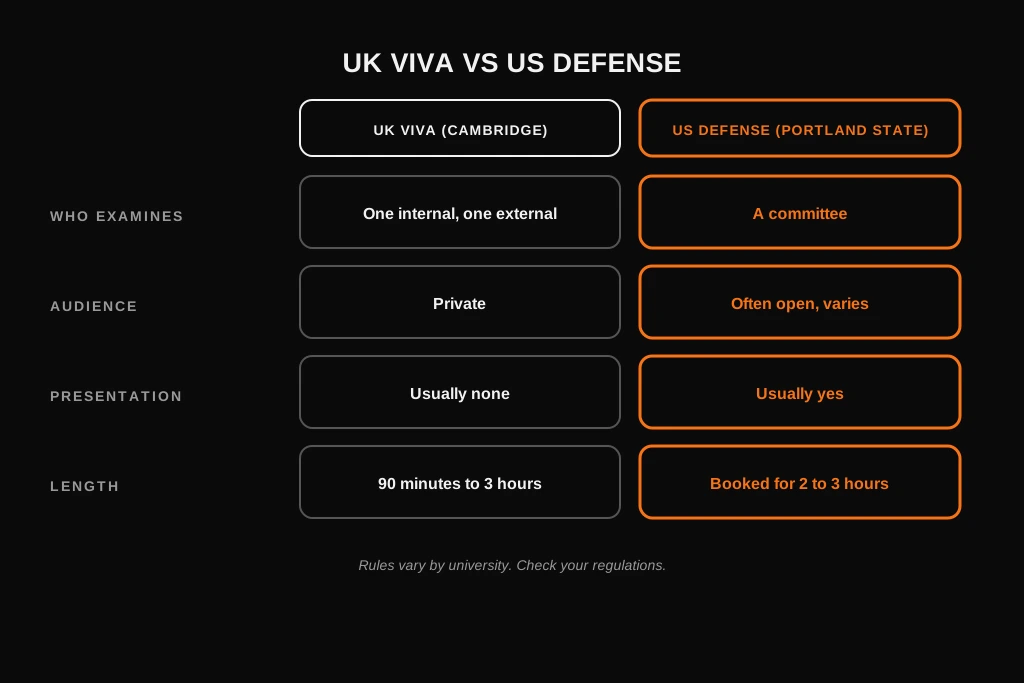
In the UK, a PhD thesis is examined at a viva, short for viva voce. The University of Cambridge’s guide to the oral examination describes it as a private oral exam, normally with one internal and one external examiner, in which you defend your thesis and clarify points raised by the examiners. It says the viva will normally last between 90 minutes and three hours. Outcomes range from a pass with no changes to a pass with corrections, a resubmission or, rarely, a fail. UK undergraduate and taught master’s dissertations usually have no oral exam at all.
The US defense
In the US, a doctoral dissertation is usually defended in front of a committee, often with a short presentation followed by questions. Portland State University’s graduate school books two to three hours for the defense and says the student’s presentation should not exceed 60 minutes, with a sample of 30 to 40 minutes. Florida International University’s history department notes that some committees want a 20 to 30 minute presentation, while others go straight to questions. Some master’s theses are defended too, usually more briefly.
Elsewhere
At the University of Toronto, the doctoral final oral examination has a committee of four to six voting members, and the candidate’s opening presentation is limited to twenty minutes. At the University of Melbourne, doctoral candidates who started from 2025 have a viva, where they discuss the thesis with two experts in the field. Rules vary, so check your own regulations.
| Feature | UK viva (Cambridge example) | US defense (Portland State example) |
|---|---|---|
| Who examines | Usually one internal and one external examiner | A committee chosen with your adviser |
| Audience | Private; supervisor does not attend | Often open, varies by program |
| Presentation | Usually none | Usually yes, up to about 60 minutes |
| Length | Normally 90 minutes to three hours | Booked for two to three hours |
Dissertation vs Thesis vs Capstone vs Research Paper
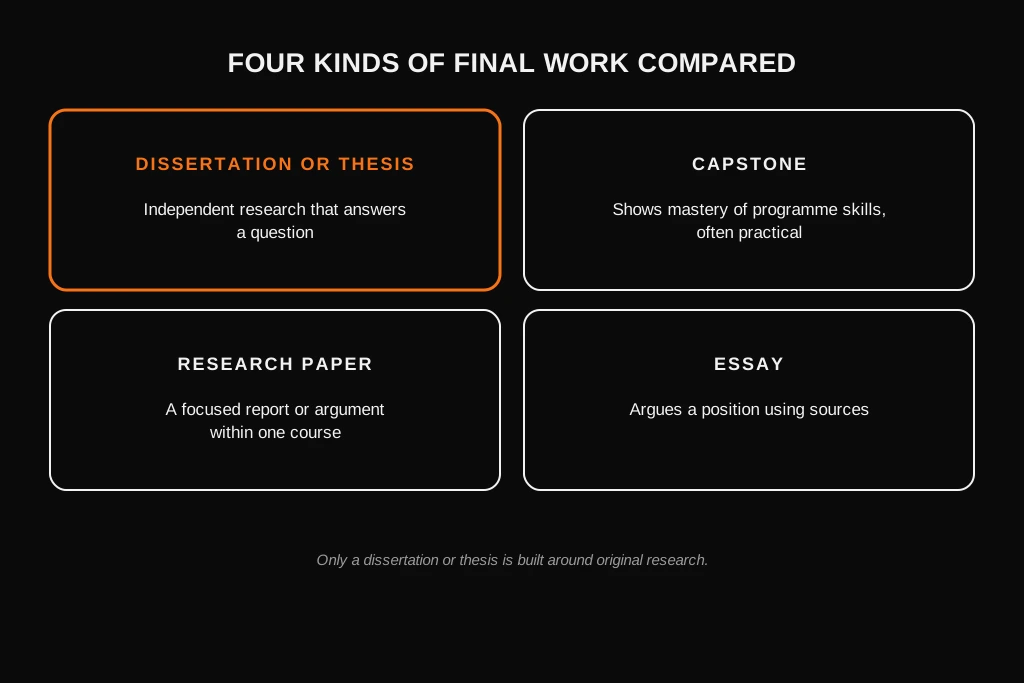
Students also mix up a thesis or dissertation with other final projects. Here is how they compare in typical use.
| Type | Main purpose | Typical level | Original research? |
|---|---|---|---|
| Dissertation or thesis | Independent research answering a question | Undergraduate to doctoral, depending on country | Yes, rising with level |
| Capstone or terminal project | Show mastery of programme skills, often applied | Undergraduate or professional master’s | Not always |
| Research paper | Report or argue from research on a focused question | Any course | Sometimes, usually small scale |
| Essay | Argue a position using sources | Any course | Rarely |
A capstone is often practical, such as a design, a consultancy report or a portfolio, and it may be done in a team. Oregon’s guidance captures the key point: a thesis aims to contribute to knowledge, while a terminal project shows mastery of what the programme taught. A research paper is usually shorter and set within one course. If your programme offers a choice, think about your plans: a thesis or dissertation is often the better preparation for further research, while a capstone may suit a professional career.
Thesis vs Thesis Statement: A Common Mix Up
The word thesis has a second meaning that confuses many students. In essays, a thesis is your main claim. The University of Wisconsin Madison’s Writing Center defines a thesis statement as a sentence that makes an assertion about a topic and predicts how the topic will be developed. That is a single sentence, not a research project.
So when an essay assignment asks for a clear thesis, it means a clear central argument. When a programme asks for a thesis, it means a long research project. If you are unsure which one is meant, look at the length and deadline. A thesis statement sits in the opening paragraph of an essay due in days or weeks. A thesis as a project runs to many thousands of words and months of work.
The two meanings are connected, which is part of why the word is used for both. A strong research project still has a central argument or answer, and it is often stated in a sentence or two near the start. If you can state your project’s main claim the way you would state an essay’s thesis, you understand your own work well.
Which Word Should You Use?
For most students the right word is simply the one in your university’s regulations. Here is how to apply that in practice.
In your writing and emails
Use your university’s term on the title page, in the front pages and in every email to staff. If you are unsure, check the handbook or the graduate school website, or ask. A short email works: “Dear [Name], could you confirm whether our final project should be called a dissertation or a thesis on the title page and in the forms? Thank you.” The same rule applies to the short summary at the front of the document, which follows its own format, as our guide to the dissertation abstract explains.
On your CV and LinkedIn
Use the term your university used, followed by the title, for example “Master’s dissertation: [title]” or “Doctoral thesis: [title]”. If you are applying abroad, you can add a short note for clarity, such as “Master’s dissertation (equivalent to a US master’s thesis)”. Employers and admissions staff care more about the topic, method and results than the label. If space allows, add one line on what you found, because that is the part a reader is most likely to remember. Keep the wording the same across your CV, LinkedIn and applications.
In applications and personal statements
When you apply for a master’s or doctoral programme abroad, describe your project in terms the reader will understand. Give the length, the level and what you did, for example a 10,000 word undergraduate dissertation using interviews with 12 teachers. Admissions staff can then judge the work on its merits, whatever it was called at your university.
When searching for examples
Search with both words, and add the level and country, for example “UK master’s dissertation examples” or “US doctoral dissertation repository”. University repositories and national collections are usually the best place to find real examples from your field.
If you are moving between systems
International students often bring one vocabulary and meet another. Make a quick note of the terms your new university uses for each level, and read its handbook rather than relying on what the words meant at home. The work you did before still counts as research experience, whatever it was called. If you are unsure how your previous project compares, look at its length, its level and whether it involved original data. Those three facts translate across systems far better than the name. When you meet a new supervisor, describe your earlier project in those terms, so they can see what you already know and where you may need support with the new expectations.
A quick checklist
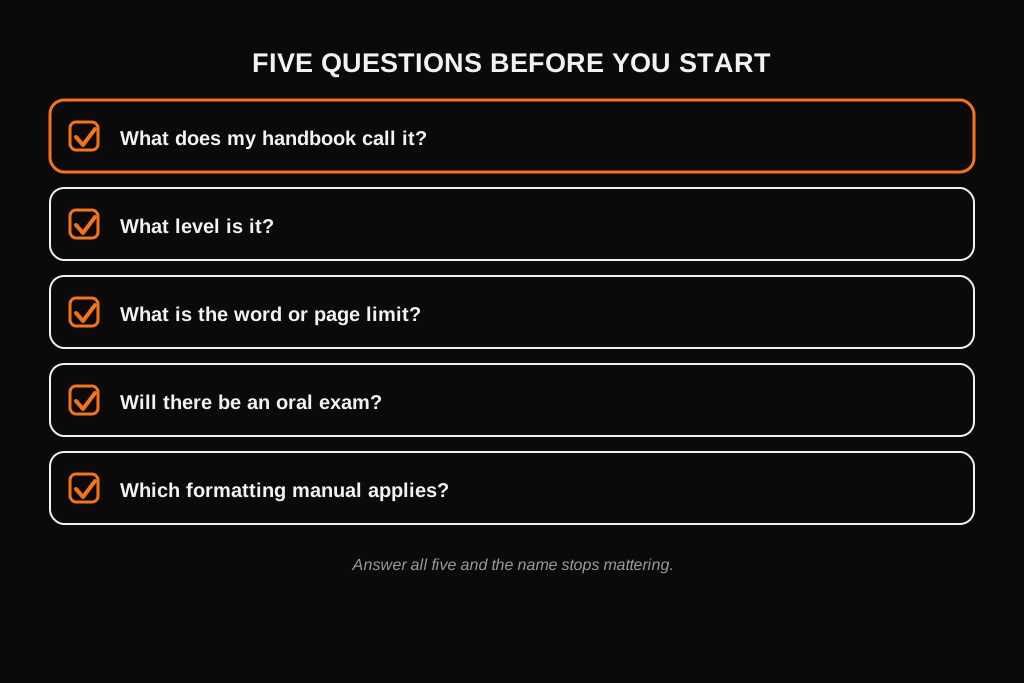
Before you start, answer these questions: What does my handbook call the project? What level is it? What is the word limit or page guidance? Will there be an oral exam? Which formatting manual applies? Once you can answer all five, the dissertation vs thesis question has done its job.
Before You Start Writing
Whichever word your university uses, the first steps are the same. Find the handbook and regulations, note the deadlines, check the word or page guidance, and look at two or three recent examples from your department. Then agree a focused question with your supervisor and plan your time backwards from the submission date.
Do not leave the front pages until the very end without planning them. Most universities expect a title page, a declaration, a short summary and a contents list, and many students add a page of thanks. These pages are usually outside the word count, but they still have rules on format and order.
Plan your time backwards
Start from the submission date and work back. Mark when the final draft must go to your supervisor, when data collection must finish and when ethics approval must be in place. Doctoral projects need years of planning, but even a short undergraduate dissertation benefits from a simple timeline with weekly targets. Leave at least a week at the end for formatting, checking references and preparing the front pages. Share the timeline with your supervisor early, so they can warn you about busy periods, such as marking seasons or summer breaks, when feedback may be slower.
The thank you page is the most personal part of the document and often the last one written. Our guide to dissertation acknowledgements explains who to thank, what order to use and how to keep it short, whatever your university calls the project.
How Essays Helper Can Help You
Whether your university calls it a dissertation or a thesis, the work is demanding. Essays Helper can support you without taking over your work:
- Explaining what your handbook expects at your level and in your country.
- Helping you plan the chapters, word budget and timeline.
- Giving feedback on drafts for clarity, structure and argument.
- Checking formatting against your graduate school’s manual.
If you are unsure where to start, send us your handbook details and deadline, and we will point you to the quickest next step.
Frequently Asked Questions
What is the difference between a dissertation and a thesis?
Both are long research projects at the end of a degree. In the UK a dissertation is usually undergraduate or master’s and a thesis is doctoral, while in the US the words are usually the other way round.
Is a PhD a thesis or a dissertation?
In the UK, Canada and Australia a PhD is usually called a thesis. In the US it is usually called a dissertation. The work is the same in kind: long, original and examined orally.
Is a master’s project a thesis or a dissertation?
In the UK a taught master’s project is usually a dissertation. In the US a research master’s project is usually a thesis, and some programs offer a capstone instead.
Are a dissertation and a thesis the same thing?
They are the same type of work, but the names refer to different degree levels depending on the country. Always use the term your own university uses.
Which is longer, a thesis or a dissertation?
Whichever is the doctoral document. In the UK that is the thesis, and in the US it is the dissertation. Length depends far more on level than on the word.
What is the difference between a thesis defense and a dissertation defense?
Both are oral examinations of your work. A US dissertation defense usually involves a committee and a presentation, while a UK PhD viva is usually private with two examiners and no formal presentation.
How is a capstone different from a thesis or dissertation?
A capstone usually shows mastery of a programme’s skills, often through a practical project, while a thesis or dissertation aims to answer a research question and add knowledge.
Is a thesis the same as a thesis statement?
No. A thesis statement is one sentence stating the main claim of an essay. A thesis as a project is a long piece of research written over months or years.
Do undergraduates write a thesis or a dissertation?
UK undergraduates usually write a dissertation. In the US, many undergraduates write neither, but honors programs and some departments ask for a senior or honors thesis.
Why do UK and US universities use the words differently?
It is a difference in academic custom, not quality. Both systems use the words for serious research, just at different levels, so follow your university’s regulations.
Final Thoughts
The dissertation vs thesis question is mostly about vocabulary. In the UK, dissertations are usually undergraduate or master’s projects and theses are doctoral. In the US, it is usually the other way round. What really shapes the work is your level: how long it is, how original it must be and how it is examined. So check what your university calls it, read advice with its country in mind, and focus on the expectations for your degree. Once you know those, the name matters far less than the quality of the research you put into it.