
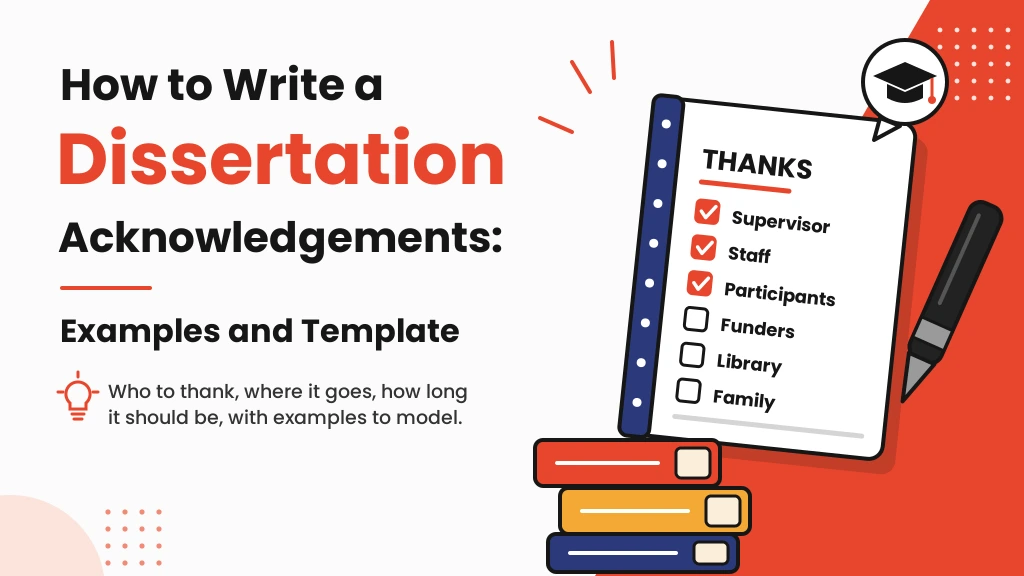
Dissertation acknowledgements are a short page that thanks the people and organisations who helped you complete your project. The page sits in the front matter, before the first chapter. To write it, thank your supervisor first, then others in order of how much they helped, and keep the tone warm, brief and specific. Write it last, once the rest of the dissertation is finished.
If you are still planning the whole project, start with our guide on how to write a dissertation, then come back here for this one small but surprisingly stressful page. Below you will find who to thank, what order to use, three original examples, a fill-in template and a final check.
Most students worry about the same things: not knowing who to thank, sounding too formal or too casual, forgetting someone important, and not knowing how long the page should be. Each of those is covered in the sections that follow.
What Are Acknowledgements in a Dissertation?
Acknowledgements in a dissertation are a personal note of thanks. They credit the people, groups and funders who supported your work but did not write it with you: your supervisor, participants, librarians, technicians, funders, friends and family. The spelling acknowledgments is also common, especially in the United States. Both mean the same thing.
What the page is for
The page does two jobs. It is good manners, because research is rarely done alone. It is also a record of support, since some funders and publishers expect to be named, and some universities ask you to state permission for reprinted material. Examiners do not mark it the way they mark a chapter, but a careful, sincere page leaves a good impression of you as a researcher.
What it is not
It is not part of your argument, and it is not the place to explain your findings or settle scores. It is also not a speech. Think of it as a polite, specific thank you note read by people you may never meet.
Acknowledgements or acknowledgments?
Use the spelling your university uses. British and Commonwealth handbooks usually prefer acknowledgements, while many American guides use acknowledgments. Whichever you pick, use it everywhere: in the heading, the contents list and the text.
Do You Have to Include Acknowledgements in a Dissertation?
Usually no, but it varies by university, so check your handbook. The graduate school at UNC-Chapel Hill states that you have an option to include a dedication, acknowledgements or a preface. The University of Utah also describes the acknowledgments page as optional. At the University of California, Irvine, however, the acknowledgments page is listed as a required page, although thanking professors and friends is optional and funding or published material statements apply only if relevant.
So the honest answer is that most universities treat personal thanks as optional, yet some require the page itself. Read the formatting rules for your degree, ask your supervisor if the handbook is silent, and look at one or two past dissertations from your department. If you did receive funding or reuse published material, include a short statement even when the page is otherwise optional.
Even when it is optional, most students include a few lines. A short page costs you almost nothing and can matter a great deal to the people named.
What if your handbook says nothing?
Some departments publish only a short formatting sheet that never mentions personal thanks. In that case, treat the page as optional and low risk. Ask your supervisor in one line whether past students in your department included one, then read two or three recent approved dissertations to see what they did. Look at the length, the tone, the order of the people thanked and whether the page is listed in the contents. Copying the pattern of a recently approved dissertation from your own department is the safest way to avoid a formatting query at submission.
Where Do Acknowledgements Go in a Dissertation?
Acknowledgements go in the front matter, before the first chapter. The full order of every page is covered in our guide to dissertation structure, but the short version is that the page comes early in the document even though you write it last.
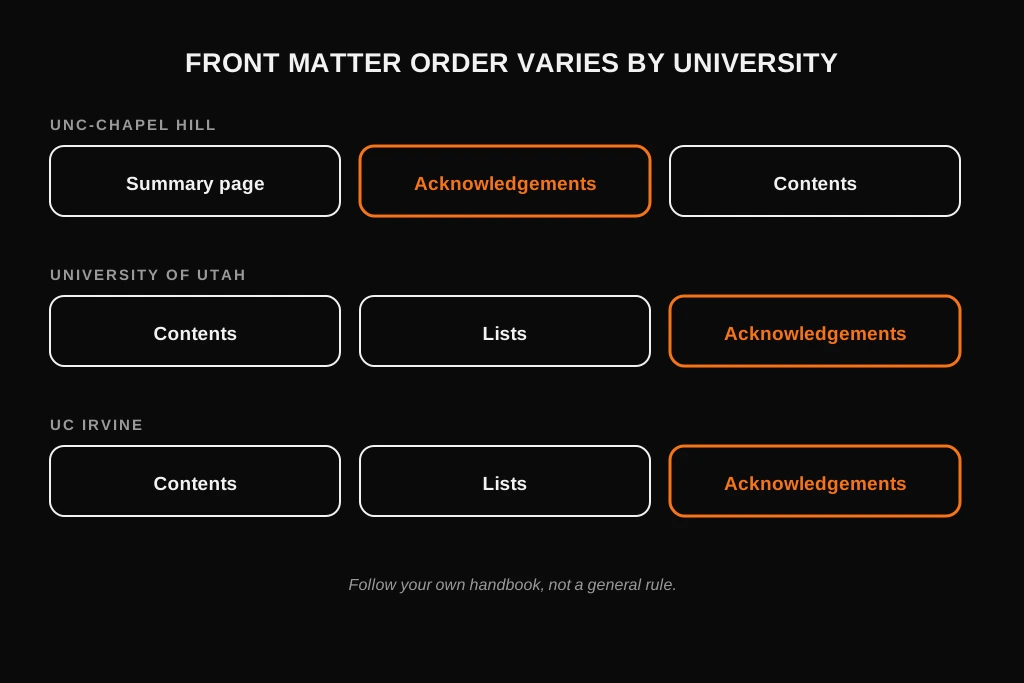
The exact position varies by university. The table below shows how three universities describe it, which is a good reminder to follow your own handbook, not a general rule.
| University guide | Is it optional? | Where it sits |
|---|---|---|
| UNC-Chapel Hill Graduate School | Yes, each of dedication, acknowledgements and preface is optional | After the opening summary page and before the table of contents |
| University of Utah Graduate School | Yes | Last among the preliminary pages, after the lists of tables, figures and abbreviations |
| University of California, Irvine | The page is required, personal thanks are optional | In the preliminary pages, after the lists and before the vita |
Notice that UNC places the page before the contents list, while Utah and UCI place it after the lists, near the end of the front pages. If your handbook gives no order, follow a recent approved dissertation from your department.
Page numbers and the contents list
Front matter pages are usually numbered with lowercase Roman numerals, and the formatting rules decide whether the acknowledgements heading appears in the contents list. Utah, for example, describes the first page as unnumbered and later pages in lowercase Roman numerals. Check your template before you format anything.
Acknowledgements vs Dedication vs Preface
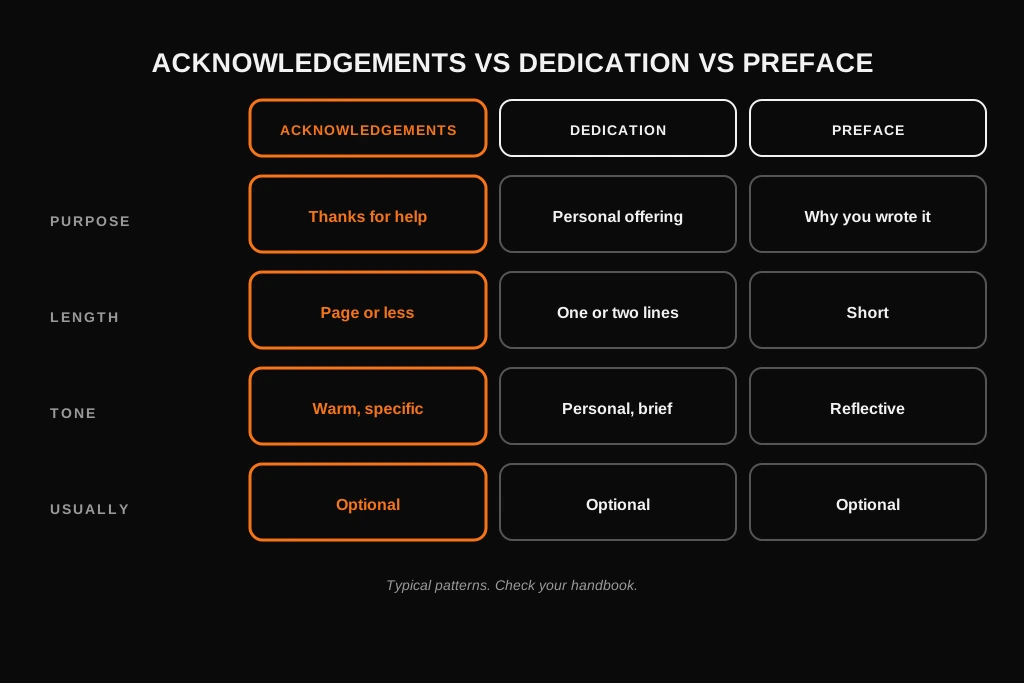
Students often mix these three pages up. They all sit in the front matter, but each has a different job and a different tone.
| Page | What it is | Typical length | Tone |
|---|---|---|---|
| Acknowledgements | Thanks to people and organisations who supported the work | One page or less in most cases, varies by university | Warm and specific |
| Dedication | A short offering to a person or cause | Often one or two lines | Personal and brief |
| Preface | A note on why you wrote the work, if your field uses one | Short, varies by field | Reflective |
Utah’s guide says a dedication is often only one or two lines, and UNC treats all three as optional. If you are unsure which page a sentence belongs on, ask yourself whether it is thanking someone for help (acknowledgements), honouring someone (dedication) or explaining the project (preface).
Who to Thank, and in What Order
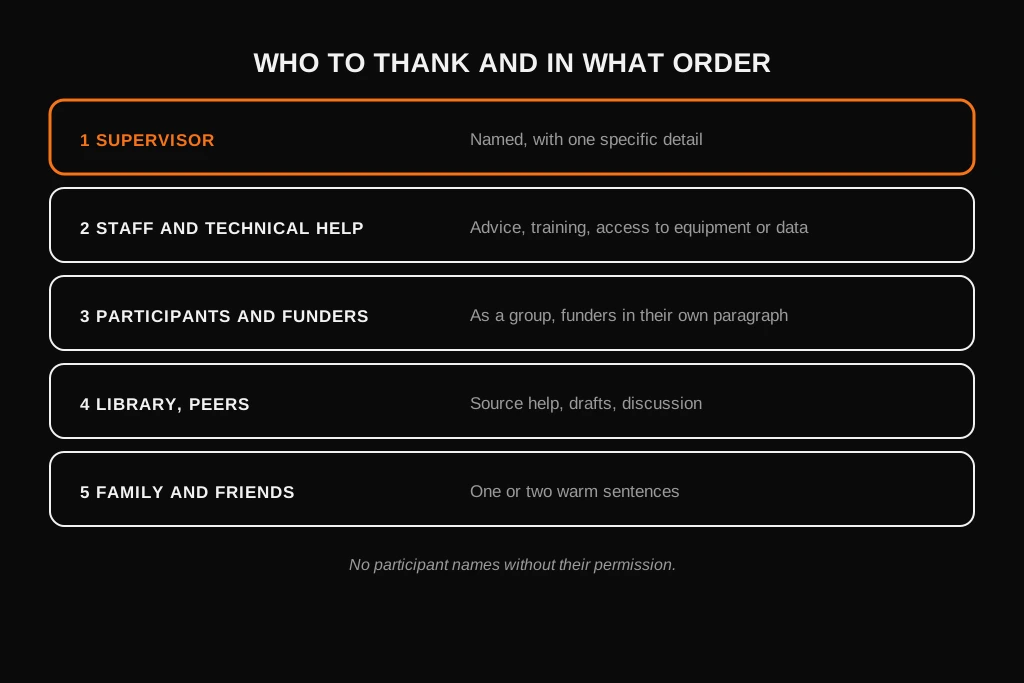
A simple rule is to thank people in the order of how much they helped your research, then move to personal support. Most pages follow the same pattern, though cultures and departments differ.
| Who | What to thank them for | Where in the page |
|---|---|---|
| Supervisor | Guidance, feedback and patience | First, named |
| Other academic or technical staff | Advice, equipment, training or data access | Next |
| Participants and organisations | Time, access and trust (no names without permission) | Next |
| Funders | Grants or scholarships | Often a separate paragraph |
| Librarians and support teams | Source access, learning support, writing help | Next |
| Peers and colleagues | Discussions, reading drafts, moral support | Next |
| Family and friends | Patience, encouragement and practical help | Last, kept short |
Thanking your supervisor
Name your supervisor and say something specific, such as feedback that sharpened your argument or the patience to read three drafts. A sentence with a concrete detail is warmer than a long list of adjectives. If you had more than one supervisor, name each in the order your department uses.
Thanking participants without naming them
Studies with people usually promise anonymity, so do not name participants or small organisations unless they agreed in writing. Instead, thank them as a group, for example, the interviewees who gave their time and trust. How participants were recruited and protected is explained in your dissertation methodology, so make sure the thanks match what you promised there.
Thanking funders and published material
If you had a grant, scholarship or sponsor, name it, and add the grant number if one exists. UCI’s guide asks for funding to be listed in a separate paragraph from the other thanks. If you reuse previously published or copyrighted material, UCI and Utah both say to include a statement acknowledging permission to reprint. Departments differ, so use the wording your graduate school gives.
Thanking editors and proofreaders
Be careful here. Utah’s guide says not to acknowledge people you employed to prepare the manuscript. Rules about proofreading and editing help vary by university, so check your academic integrity policy before naming anyone who helped with the text.
Thanking family and friends
Keep this section short and sincere. One or two sentences, naming the people who mattered most, is usually enough. Long lists tend to read as a roll call, and you risk forgetting someone, which is the worry students mention most often. A general line such as, to my friends and family, thank you for your patience, covers anyone you did not name.
Thanking an advisor outside your department
Many projects get help from someone who is not your official supervisor, such as a statistician in another department, an industry contact or a lecturer who answered a methods question. Name them with their role, and say what they did. A line such as, thank you to [Name] in the statistics support service for advice on my analysis, tells the reader exactly why the person is there, and it makes the page feel earned.
Thanking peers and colleagues
Classmates, lab mates and fellow students often give the most useful day to day help, such as reading a rough draft or explaining a method over coffee. Thank them as a group, for example, my classmates in the research seminar, and name only one or two who gave unusual help. Naming everyone makes the page long and makes it more likely that someone is left out.
Thanking people who helped in small ways
A technician who fixed a laptop, a receptionist who rebooked a meeting room, a stranger who answered an email within the hour: small acts matter, and a general line covers them. Something like, thank you to the library and administrative staff who answered my questions, is enough. You do not need a sentence for every favour.
Thanking someone who is no longer here
If someone who supported you has died, a short, respectful line is fine, and some students prefer to put it in a dedication instead. Keep it brief and sincere, and avoid long personal stories. If you are unsure which page suits it better, ask your supervisor.
How to Write Dissertation Acknowledgements, Step by Step
This method answers the common question of how to write an acknowledgement for a dissertation without panic.
- List everyone who helped. Brainstorm for ten minutes without editing: supervisors, staff, participants, funders, librarians, peers, family, friends.
- Group them. Use the order from the planner above: academic support first, then participants and funders, then peers, then personal support.
- Check permissions. Remove any participant names unless they agreed, and confirm anyone you plan to name is comfortable with it.
- Add one specific detail for your supervisor and one or two others. Specific beats flowery.
- Write it after the rest is done. Acknowledgements are written last, once you have finished writing an introduction and every other chapter, because only then do you know who really helped.
- Check the rules. Look at word limits, formatting, page numbers and whether the page appears in the contents list.
- Read it aloud, then cut anything that sounds like a speech or a complaint. Keep it warm, brief and true.
A write-last schedule
If you are short of time, use this order.
- Two weeks before submission: make the thank you list and check permissions.
- One week before: draft the page in one sitting, about 20 minutes.
- Three days before: ask your supervisor if the tone suits your department.
- Final day: check spelling of every name and title, and the formatting.
Dissertation Acknowledgement Examples: Three Original Models
These models were written for this guide. The projects, funders and names are invented and shown in square brackets, so replace everything with your own details. Copy the shape and the level of warmth, not the words.
Example 1: An undergraduate dissertation
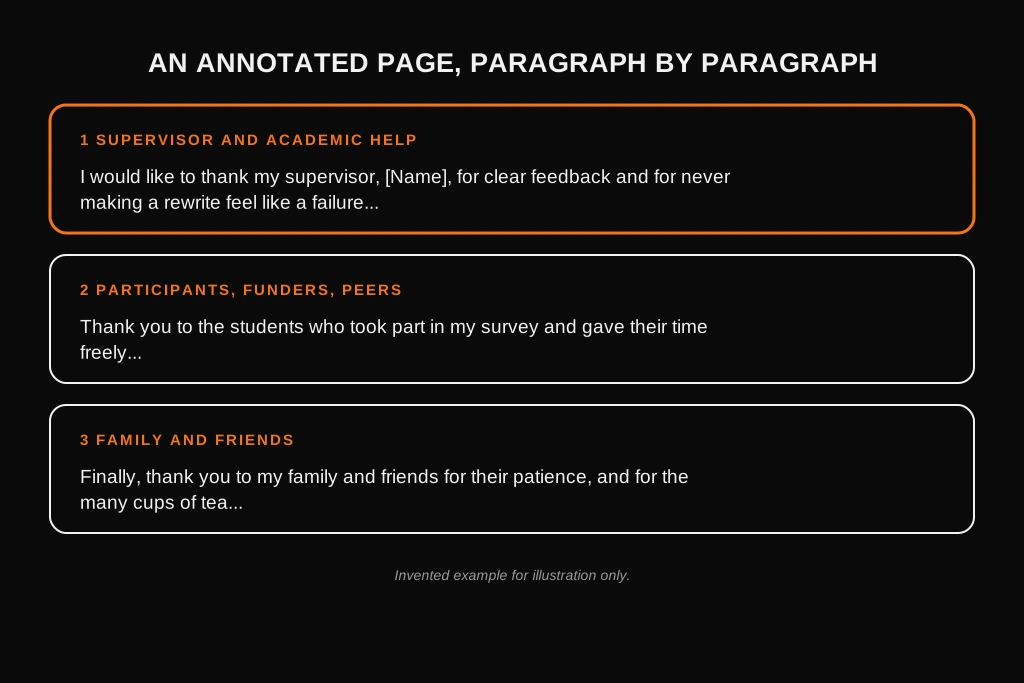
I would like to thank my supervisor, [Name], for clear feedback and for never making a rewrite feel like a failure. Your advice on narrowing my question changed the whole project. Thank you also to the staff in the library for helping me find sources, and to the students who took part in my survey and gave their time freely.
Finally, thank you to my family and friends for their patience, and for the many cups of tea during the final weeks.
Notes: the supervisor comes first with a specific detail. Participants are thanked as a group, not named. The family thanks are short and warm.
Example 2: A master’s dissertation
My sincere thanks go to my supervisor, [Name], whose careful reading and honest questions shaped this dissertation at every stage. I am grateful to [Name], who advised on the statistical analysis, and to the staff at [Organisation], who gave me access to their records and answered my questions with great patience.
I also thank my classmates for reading early drafts and for the conversations that kept me going. To my parents and my partner, thank you for believing in this project, even when I stopped believing in it myself.
Notes: academic and technical support appears before peers. The organisation is thanked without revealing anything the participants were promised to keep private.
Example 3: A PhD or research-heavy dissertation
First, I thank my supervisors, [Name] and [Name], for their guidance, challenge and generosity over four years. I am grateful to the members of my advisory panel for their constructive questions, and to the technical staff in [Department] for their patient help with equipment and data.
This research was supported by [Funder], grant number [Number]. Parts of Chapter 3 were previously published as [full citation], and I thank the publisher for permission to reprint that material.
Finally, my deepest thanks go to my family and friends, whose encouragement and practical help made it possible to finish.
Notes: funding and permission appear in their own paragraph, as UCI recommends. Personal thanks come last and stay short.
A weak version and a stronger one
Here is a weak version: “I would like to thank everyone who helped me with this dissertation. Without them it would not have been possible. Thank you all so much.” It is polite, but it names no one and says nothing real. The stronger version names your supervisor, gives one concrete detail and thanks participants as a group. Specific, short and sincere will always beat long and general.
A Template You Can Adapt
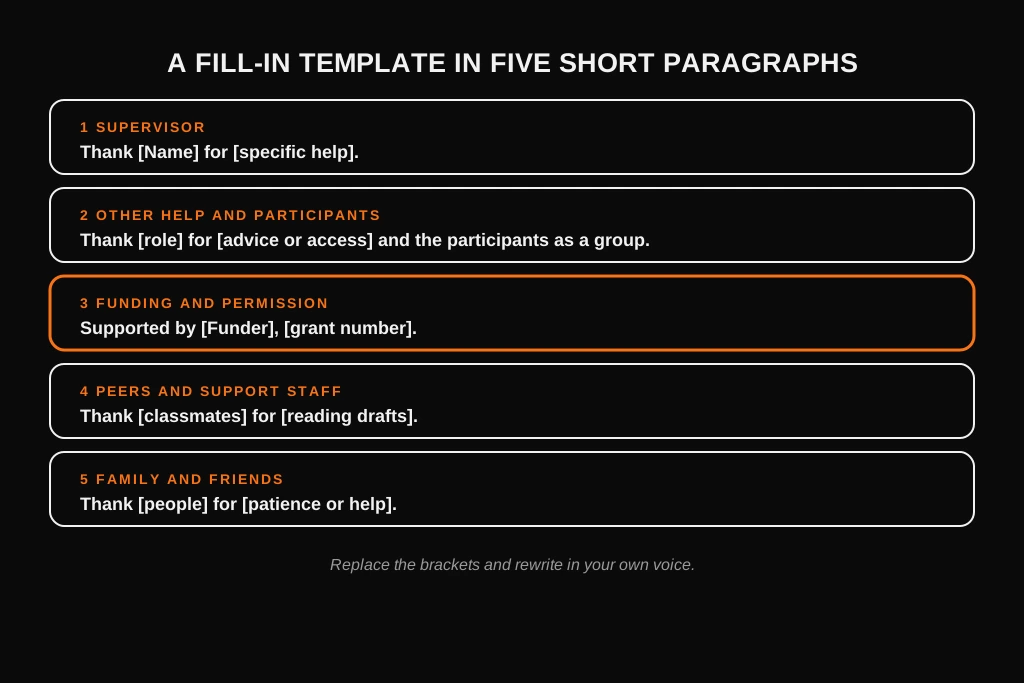
Use this fill-in-the-gaps template as a starting point. Replace the square brackets, delete any line that does not apply, and rewrite the sentences in your own voice.
I would like to thank my supervisor, [Name], for [specific help, such as clear feedback or careful reading]. [One sentence on what changed because of that help.]
I am also grateful to [Name or role] for [advice, training or access], and to the [participants or organisation] who gave their time and made this research possible.
This research was supported by [Funder], [grant number if any]. [Add a permission statement if you reused published material, using your graduate school’s wording.]
Thank you to my [classmates or colleagues] for [reading drafts or discussing ideas], and to the library and support staff for [help with sources or writing].
Finally, thank you to my [family and friends] for [patience, encouragement or practical help].
Tone and Wording: Formal, Warm or Funny?
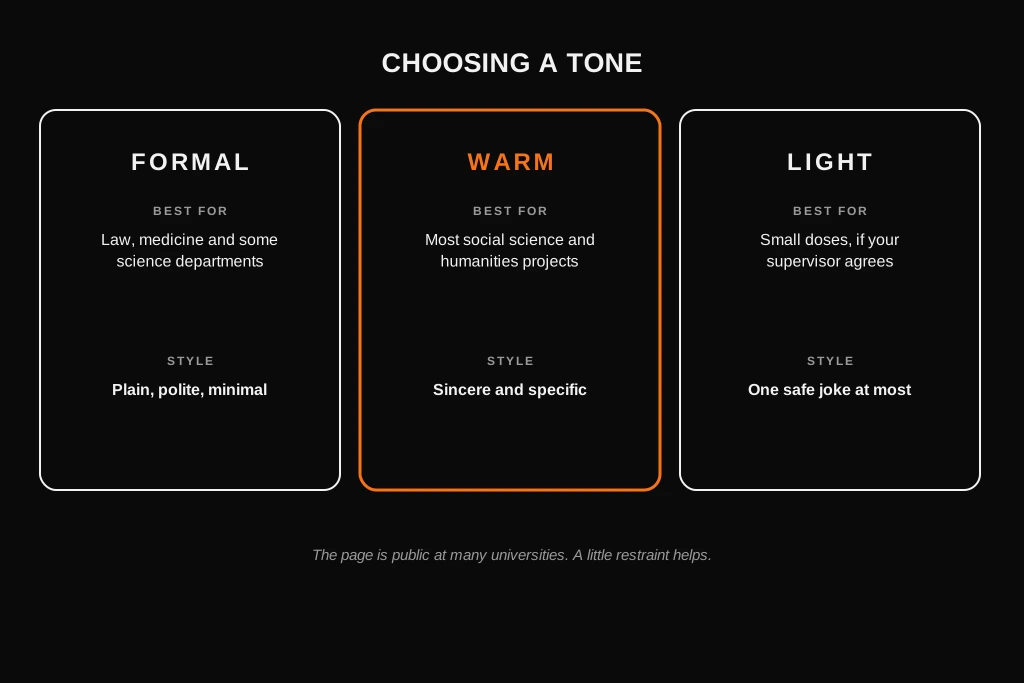
The right tone depends on your field and your relationship with the people you are thanking. Most pages sit between formal and warm: polite, plain and sincere.
Choosing a tone
A formal tone suits law, medicine and some science departments. A warm tone suits most social science and humanities projects. A light touch is fine in small doses, but remember that the page is read by examiners and kept in a repository for years. Show your draft to your supervisor if you are unsure.
Quotes in acknowledgements
A short quote can work if it says something real about your journey, but many students find that their own sentence is stronger. If you use one, keep it to a line, credit the source and make sure it does not take attention away from the people you are thanking.
Funny acknowledgements
A light joke about the library or the late nights is usually safe. Avoid private jokes that nobody else will understand, and avoid humour at someone’s expense. Because the page lives in a public repository at many universities, a little restraint goes a long way.
Thanking God or a faith community
Many students begin or end their page with thanks to God or their faith community, and this is common and generally acceptable. Keep it brief and sincere, place it where it feels natural, and check your handbook if your university gives guidance on personal or religious statements.
Useful sentence starters
- I would like to thank [Name] for [specific help].
- I am especially grateful to [Name], whose [quality] made [outcome] possible.
- Thank you to everyone who took part in this study.
- This research was supported by [Funder].
- To my family and friends, thank you for your patience.
If you want to check how your thanks match the sources you used, remember that library staff often help with finding material, which ties directly to the work you did on your dissertation literature review. Thank them by role, or by name if they agreed.
How Long Should Acknowledgements Be?
There is rarely a fixed limit. UCI, UNC and Utah do not give a word limit for the page in the guides described above, though a different handbook might. As a planning guide, many students keep the page to one page or less, often between 150 and 400 words. This figure is only a rule of thumb and varies by university, so confirm with your handbook and look at past dissertations from your department.
A longer page is not a better page. If you find yourself writing more than a page, cut the family and friends section first, because the supervisor, participants and funders matter most.
How Long Should a Dissertation Be?
Dissertation length is the total word limit your department sets, and it varies by university, level and subject. As one UK example, a university handbook gives about 8,000 to 10,000 words for a 30 credit undergraduate dissertation, with references and appendices left out of the count. Four points matter. Check the limit in your handbook. Check what counts toward it, since front matter is often excluded, though that varies. Plan a share for each chapter before you write. And leave a small buffer for editing. Tip: write the word budget at the top of your plan and track it weekly, so the limit never surprises you in the final days.
What to Leave Out, and Common Mistakes
A good page is as much about what you leave out as what you put in.
- Naming participants without permission. Thank them as a group unless they agreed to be named.
- Complaints or digs. Never use the page to criticise a person, a department or a process.
- A long speech. Keep it to a page or less, unless your handbook says otherwise.
- Private jokes. If only three people will understand it, cut it.
- Forgetting funding or permission statements. Add them if they apply, in a separate paragraph.
- Naming people who were paid to help with the text. Check your university’s rules first.
- Misspelling names or titles. Check every name and title against a reliable source.
- Writing it too early. You will forget someone who helped in the last stretch.
Worrying about leaving someone out
This is the most common fear. To reduce the risk, keep your list from step one, and add a general line, such as, thank you to everyone who helped along the way, for people you cannot name. If you realise later that you missed someone important, you can usually add a line before final submission.
Acknowledgements When You Used Data, Funding or Help from Others
Some projects need more than a page of personal thanks. If you used data from an organisation, a shared dataset or a lab, say so in plain words and name the source as agreed. If a company or charity gave you access, thank the organisation without revealing anything participants were promised to keep private.
When your work includes published articles
In research-heavy projects, parts of the dissertation may have been published already. UCI’s guide says to include a statement of permission and name the source, including the full citation and information about coauthors. Utah says to acknowledge permission to reprint copyrighted material. Use the wording your graduate school gives.
Thanking a research group or a company
If your project used a company, charity or public body, thank the organisation by name only if it agreed, and describe its help in plain words, such as access to records or time with staff. If your agreement says anything about how the organisation may be named, follow it exactly. When in doubt, thank the organisation by type, for example, a regional health charity, so that you do not reveal more than you promised.
Using shared datasets and tools
If you used a public dataset, a shared lab facility or a software tool developed by others, name it and its owner as the source requires. This is separate from your reference list, which credits the work you cite, because the page gives thanks for access and support. Check the licence or terms for any wording you are required to use.
Where to check before you submit
Before you finalise the page, look at the order of the front pages once more, including the dissertation abstract. Some universities place the acknowledgements before the summary page, some after, and the position varies. A quick look at your template and a recent approved dissertation will settle it.
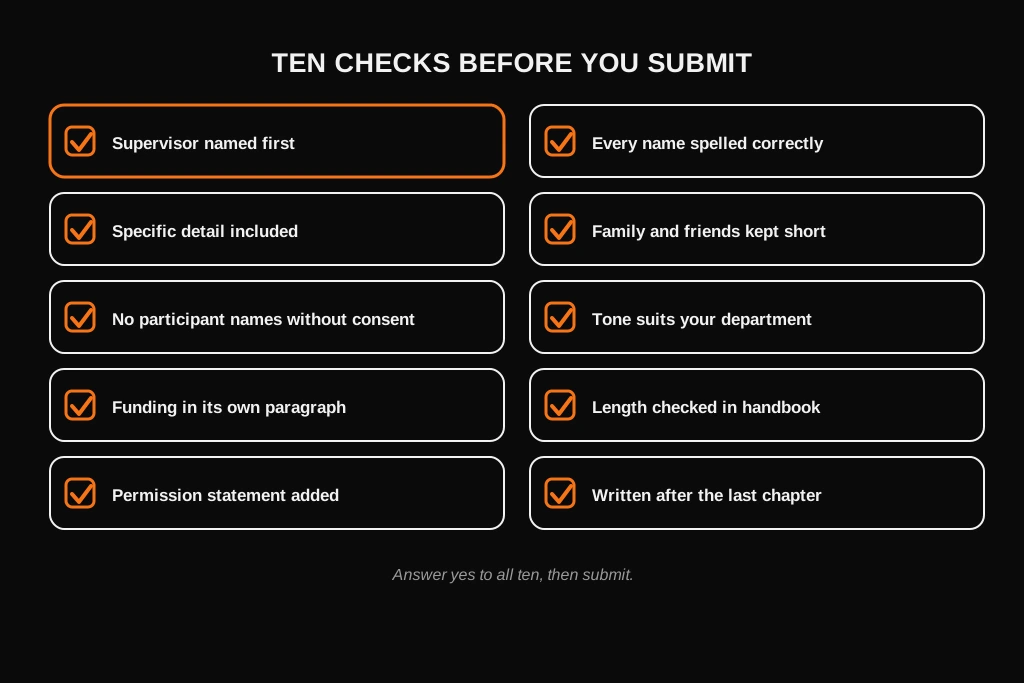
Final Check Before You Submit
Run through these yes or no questions, and fix any no.
Last day formatting checks
On the last day, check the heading style, the font, the line spacing and the page number format against your template. Make sure the heading matches the spelling you used elsewhere, and check whether the page should appear in the contents list. These small details are the ones that cause a rejected submission, and they take only a few minutes to check.
If your supervisor asks you to change it
Supervisors sometimes ask for small changes, such as moving a name or softening a line. Treat this as ordinary editing. Make the change, keep the thanks sincere, and remember that the page belongs to you, so you can still say what is true. If a request would make the page less honest, explain politely and offer a different wording.
Keep your thank you list
Save your list of helpers in a separate file, with dates and short notes about what each person did. It makes the writing faster, and it helps if you later publish an article from the dissertation, write a book or prepare a funding report, because you will need to thank many of the same people again.
Posting the page online
Many universities place submitted dissertations in an online repository, so your acknowledgements may be public for years. Think about whether each name should appear, and whether any private detail about family, health or workplaces should be left out. If you are unsure, ask the person you are thanking, or use a general phrase instead of a name.
Updating the page after corrections
If you are asked to make corrections after an examination, the page can usually be updated too, for example to add an examiner or a late funder. Check the rules for the final version, and keep the tone consistent with the first version so that the thanks still feel genuine.
Names, titles and spelling
Check every name against the person’s staff page or email signature, and use the title they use, such as Dr or Professor. Names from other languages can be easy to misspell or reorder, so ask the person if you are unsure. Use the same form each time, and check initials, accents and hyphens. A misspelt name on a page of thanks is a small error, but it is the one people notice.
A final read aloud
Read the page aloud once. If any sentence makes you wince, rewrite it. If any sentence sounds like a speech, cut it down. If you would be happy for each person named to read the page, it is ready to submit.
Submitting on a tight deadline
If you are close to the deadline, write the simplest honest version first: your supervisor, anyone who gave unusual help, your participants as a group, any funder, and a line for family and friends. You can polish the wording later if time allows. A short, correct page is always better than a long, rushed one, and it is better than no page when your university expects one.
If you wrote a plan early on, it is worth remembering that the support you needed often started there. Our guide on how to write a dissertation proposal explains how that first stage worked, and it is a good reminder of who helped you at the very beginning, so you can thank them properly.
How EssaysHelper Can Help You
The acknowledgements page is short, but it is easy to get wrong when you are tired at the end of a project. EssaysHelper can support you without taking over your work:
- Reviewing your thank you list and the order you chose.
- Giving feedback on tone, length and wording.
- Checking that your page follows your university’s formatting rules.
- Editing drafts for clarity and consistent spelling.
If you are stuck on a particular part, send us your question and your deadline and we will point you to the quickest next step.
Frequently Asked Questions
What are acknowledgements in a dissertation?
They are a short page that thanks the people and organisations who helped with your project, such as your supervisor, participants, funders and family. The page sits in the front matter.
How do you write an acknowledgement for a dissertation?
List everyone who helped, thank your supervisor first with one specific detail, then others in order of help, and end with family and friends. Keep it warm, brief and true, and write it last.
What should I put in dissertation acknowledgements?
Thank your supervisor, other academic or technical help, participants as a group, funders, librarians, peers and family. Add funding or permission statements if they apply.
Where do acknowledgements go in a dissertation?
They go in the front matter, before the first chapter. The exact position, such as before or after the opening summary page, varies by university, so follow your handbook.
Do you have to include acknowledgements in a dissertation?
Usually not, but it varies by university. Some guides, such as UNC’s, call it optional, while others, such as UCI’s, list the page as required. Check your handbook.
How long should dissertation acknowledgements be?
There is rarely a fixed limit. A page or less, roughly 150 to 400 words, is a common rule of thumb, but it varies by university and department.
Can I thank family and friends in dissertation acknowledgements?
Yes. Keep it to a sentence or two at the end, name the people who mattered most and add a general line for everyone else.
Is it okay to make dissertation acknowledgements funny?
A light touch is usually fine, but avoid private jokes and anything at someone’s expense. The page is public at many universities, so a little restraint helps.
What is the difference between a dedication and acknowledgements?
A dedication is a short personal offering, often one or two lines, while acknowledgements thank people who helped with the work. Both are usually optional.
Should I write acknowledgements first or last?
Write them last. By then you know who helped, who joined late and what funding or permission statements you need, so you are less likely to leave someone out.
Final Thoughts
Good dissertation acknowledgements are short, specific and sincere. Thank your supervisor first, name only the people who agreed to be named, add funding or permission statements if they apply, and keep family and friends to a line or two. Write the page last, check your handbook for order and length, and read it aloud once before you submit. You are not writing a speech. You are saying thank you to the people who made your work possible, and doing it clearly is all the page needs.