
A dissertation introduction is the opening chapter that sets the context for your project, names the problem or gap, states your aim and research question, and tells the reader what each later chapter will do. It is usually about a tenth of the total word count, and you write it after the main body so that it matches what you actually found.
If you are still planning the whole project, start with our guide on how to write a dissertation, then return here for the detail on this chapter. Below you get the parts to include, a word budget, three original annotated examples, a problem statement formula and a roadmap template.
Students usually get stuck in the same places: staring at a blank page, opening with a vague hook, not knowing what belongs here and what belongs in the review, and not knowing how long it should be. Each of those is covered below.
What Is an Introduction in a Dissertation?
An introduction in a dissertation is the first chapter of the main text. It moves the reader from a broad area of interest to the specific question your study answers. By the end, a reader should know what you are studying, why it is a problem worth studying, what exactly you will do about it, and how the rest of the document is arranged.
What the chapter is for
It does three jobs. It gives context, so a reader outside your narrow topic understands the setting. It makes the case for your study, by showing a problem or gap and why it matters. And it gives direction, by stating your aim and questions and previewing the chapters. Everything that does none of these three jobs can usually be moved or cut.
Who reads it, and what they decide
Examiners read it carefully, because it tells them what they should expect and how to judge the rest. A weak opening chapter makes them read the later chapters looking for problems, while a clear one makes them read looking for the promised answers. Supervisors use it to check that the project is focused. Later readers use it to decide whether your work is relevant to theirs.
Questions the chapter must answer
A quick test is to see whether a reader can answer six questions after reading it. What is this project about? Why does it matter? What is the problem or gap? What exactly will you do about it? How will you do it, in brief? And what comes next in the document? If any answer is missing, a part of the chapter is missing too.
What a strong opening chapter feels like
A strong chapter reads like a funnel. The first paragraph is concrete and broad, each paragraph after it narrows, and the final paragraphs state exactly what you will do and where the reader will find it. Nothing in it should surprise the examiner later, and nothing in the rest of the project should contradict it.
What the chapter is not
It is not a second literature review, because it needs only a few key sources. It is not a method chapter, because it gives only a brief rationale for your approach. It is not an abstract, because it argues for the project instead of summarizing it. And it is not a place for findings, which belong in the results. The Antioch University writing resources list the same pitfalls: overlapping with the review, overlapping with the method chapter, and writing too much.
Why it is harder than it looks
The opening chapter is read first but should be written last, which is why so many students struggle with it. Before the body exists, you do not know exactly what you will argue, so early drafts are vague. A placeholder version is useful for starting. The final version should be rewritten once your findings are in. Some students write the chapter first and never touch it again, and then the finished project argues something slightly different from the one promised. Examiners notice that mismatch.
The Introduction, the Abstract and the Review: How They Differ
Introduction vs abstract
The dissertation abstract and the opening chapter both name the problem and the aim, which is why students confuse them. The difference is purpose and length. The abstract reports the whole project, including findings, in one short paragraph. The opening chapter introduces the project and argues for it at length, but it does not report findings. If you paste sentences from one into the other, both get worse.
Introduction vs literature review
The opening chapter gives a short, selective picture of what is known, enough to show the gap. The review gives the full, critical survey. A useful test is that the opening chapter mentions a handful of key studies, while the review analyzes dozens and compares them. When the opening chapter starts comparing methods or listing minor studies, that material belongs in the review. It helps to think of the opening chapter as a doorway to the review, not a copy of it: it shows the reader why the survey is needed, and then the review delivers it.
Introduction vs method chapter
The method chapter gives the full detail of your design, sample, procedure and analysis. The opening chapter gives one or two sentences on the approach and why it suits your question. If you find yourself naming software, sample sizes or interview schedules in the first chapter, move that detail to the method chapter. A brief rationale is enough here.
A quick comparison
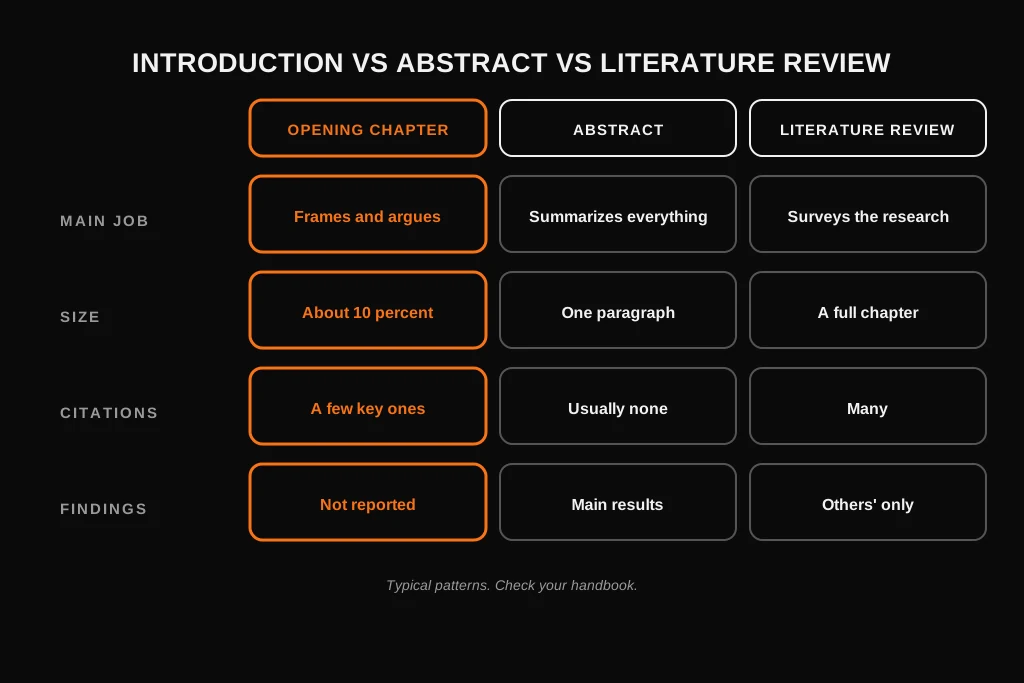
| Feature | Opening chapter | Abstract | Literature review |
|---|---|---|---|
| Main job | Frames and argues for the project | Summarizes the whole project | Surveys and synthesizes research |
| Typical size | About 10 percent of words, varies | One paragraph within a set limit | A full chapter, often the largest part |
| Citations | A few key sources | Usually none | Many |
| Findings | Previews the aim, not results | States the main results | None, only other people’s |
These are typical patterns, and they vary by university and field, so check your handbook.
A test you can run on any paragraph
Take a paragraph from your draft and ask where it would fit best. If it summarizes your whole project including results, it belongs in the abstract. If it compares many studies or critiques methods, it belongs in the review. If it describes procedures in detail, it belongs in the method chapter. Only a paragraph that frames the problem, states what you will do or points ahead belongs in the opening chapter. Run this test during your final read and move anything that fails it, so each part of the project does its own job and the chapter stays inside its word budget.
Where the Introduction Sits
The introduction is the first chapter of the main text. It comes after the front matter (the title page, the acknowledgements and the contents list) and before the review and the method. For the full order of every part of the document, see our guide to dissertation structure. Some departments fold the review into the opening chapter. The University of Sussex skills hub notes that, depending on your discipline, the review may be included here, so check what your handbook expects.
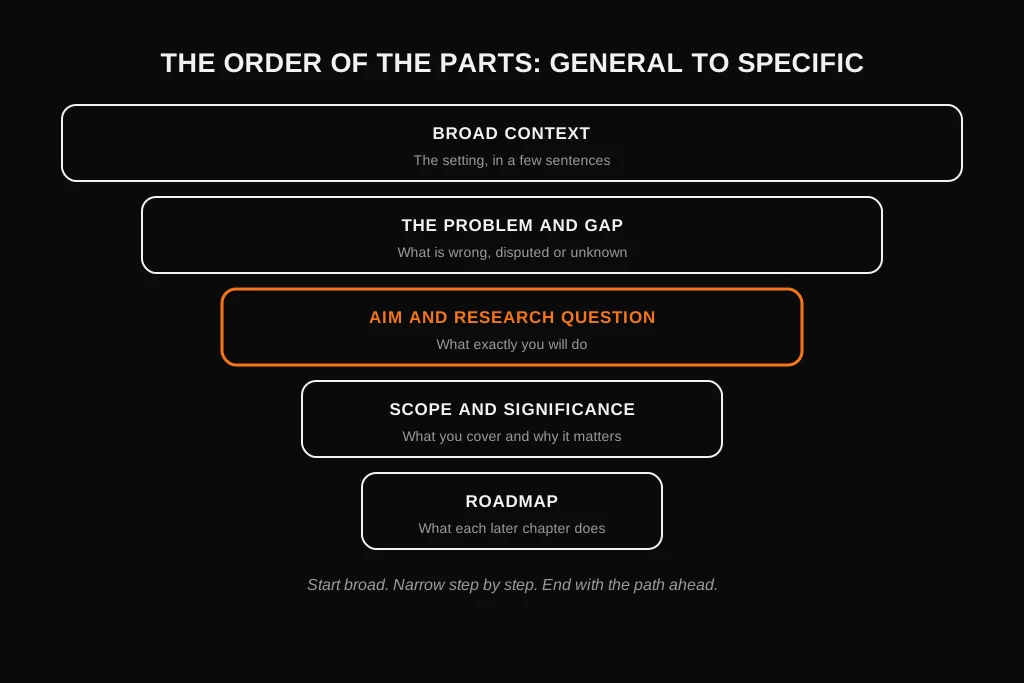
The order of the parts inside the chapter matters too. The usual direction is general to specific: broad context first, then the narrowing problem, then your exact aim. The Sussex guide gives the same advice, beginning with the overall theme and narrowing toward your topic.
What to Include in a Dissertation Introduction
Departments differ, but most expect these parts, in roughly this order. Each is described by its job, so you can see what to keep if your word count is tight.
- Context. The broad setting, in a few sentences, so a reader outside your topic can follow.
- Problem and gap. What is wrong, disputed or unknown, and why it still matters.
- Aim and research questions. What you set out to do, stated in one clear sentence, and the question or questions you ask.
- Scope and key terms. What your study covers and leaves out, and any term that needs a precise meaning.
- Significance. Who benefits from the answer and how it adds to the field.
- Method in brief. One or two sentences on your approach and why it suits the question.
- Roadmap. A short paragraph that says what each later chapter does.
The Antioch University tips add useful detail. They say to start with context, not with your research question, to explain the purpose and significance of the study, and to close with a chapter overview that guides the reader through the rest. They also say a strong research question is narrow, original in some way and answerable with your data.
A word budget for the parts
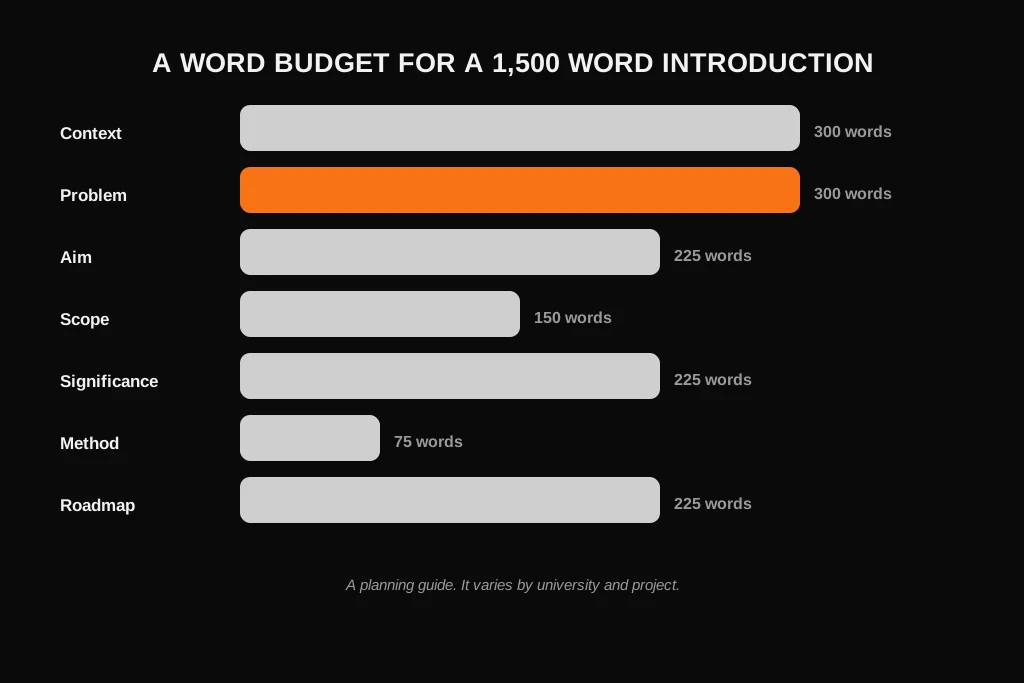
Use this table to plan how many words each part gets, depending on your total for the chapter. It is a planning guide, not a rule, and it varies by university and project.
| Part | 1,000 words | 1,500 words | 2,000 words |
|---|---|---|---|
| Context | 200 | 300 | 400 |
| Problem and gap | 200 | 300 | 400 |
| Aim and research questions | 150 | 225 | 300 |
| Scope and key terms | 100 | 150 | 200 |
| Significance | 150 | 225 | 300 |
| Method in brief | 50 | 75 | 100 |
| Roadmap | 150 | 225 | 300 |
Background vs Literature Review: Where to Draw the Line
Background is the most common overflow problem. Give the reader only what is needed to understand your problem: the key facts, the one or two main debates and a handful of important studies. Save the detailed comparison, the weaker studies and the critique of methods for the dissertation literature review, which exists to do exactly that. A simple rule is that if a source is there to prove you read widely, it belongs in the review. If it is there to help the reader see the problem, it can stay.
Antioch University advises using a few key sources and grouping several citations together with semicolons when they support one point. That keeps the opening chapter readable and stops it from turning into a review.
How to Write an Introduction for a Dissertation, Step by Step
This method answers the common question of how to write an introduction for a dissertation without starting from a blank page.
- Write a placeholder early. Draft a rough page with your topic, problem, aim and question. It will change, but it gives you a target.
- Check what your department expects. Look at the word limit, whether the review is included and whether a roadmap is required.
- Write the context. Start with the setting, not your research question. Two or three well chosen sentences are enough.
- State the problem and gap. Say what is wrong, disputed or unknown, and why it matters.
- State the aim and the research questions. Use one clear aim sentence, then the question or questions.
- Add scope, significance and the method in brief. Say what you cover, who benefits and why your approach suits the question.
- Finish the body, then rewrite. Draft the roadmap last, once chapter titles are final, and rewrite the whole chapter to match your actual findings.
A write-last plan
If you are short of time, use this order.
- Early in the project: a one page placeholder.
- While drafting the review: add the gap and the research question.
- After the findings: rewrite the context, significance and roadmap.
- Final week: read the chapter against the closing chapter and make sure they match.
Dissertation Introduction Examples: Three Original Annotated Models
These models were written for this guide to show the shape of a good opening chapter in three fields. They are shortened to the key paragraphs. The topics, numbers and findings are invented, and there are no real authors or citations. Copy the shape, never the words, and replace everything with your own project.
Example 1: A science or health study
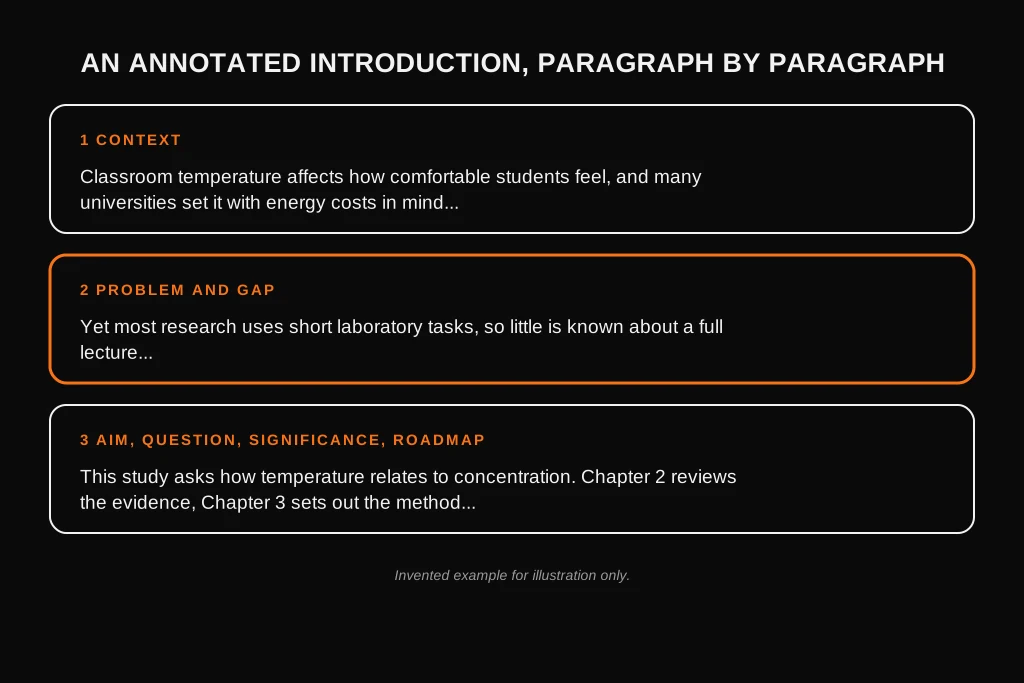
Classroom temperature affects how comfortable students feel, and many universities set it with energy costs in mind rather than learning. Surveys of students regularly list hot rooms among their complaints, and several building studies report rising indoor temperatures in older teaching blocks as summers warm.
Yet most research on heat and performance uses short laboratory tasks, so little is known about how ordinary classroom temperatures relate to concentration during a full lecture. Universities therefore lack evidence for deciding whether cooling older rooms is worth the cost.
This study asks one main question: how is classroom temperature related to students’ self-rated concentration during 50 minute lectures? A secondary question asks whether the relationship differs between older and newer buildings. The answers matter to estates teams planning upgrades and to lecturers who cannot change the room but can change the teaching. The study uses a repeated survey across 40 lectures in two buildings. Chapter 2 reviews the evidence on heat and cognition, Chapter 3 sets out the method, Chapter 4 reports the results, and Chapter 5 discusses what they mean for practice.
What each paragraph does: the first gives context and starts broad. The second names the problem and the gap. The third states the question, significance, method in brief and roadmap.
Example 2: A social science study
First year engineering students often report feeling overwhelmed by workload and unsure where to ask for help, and many institutions have responded with peer mentoring schemes in which older students support newcomers. These schemes are popular and cheap to run, so they are widely adopted.
However, most evaluations of mentoring report satisfaction scores, not whether the scheme changes what students do. We know little about how students themselves decide whether to use a mentor, or why some never do.
This study explores how first year engineering students describe their decisions to seek or avoid peer mentoring. It addresses two research questions: what makes mentoring feel worth using, and what makes it feel unnecessary or risky. The findings may help programs design schemes students actually use. The study uses semi-structured interviews with 20 students at one university. The next chapter reviews research on mentoring and help seeking, the third explains the interview design, the fourth presents three themes, and the fifth discusses their implications.
What each paragraph does: context, then the gap in how mentoring is evaluated, then aim, questions, significance, method and roadmap. A qualitative project asks how and why questions, not how much.
Example 3: A humanities or desk-based study
In the early 1920s many industrial towns faced a housing shortage, and local newspapers filled with arguments about who was to blame and what should be done. Historians have mined official reports and debates for these arguments, but the daily voice of ordinary readers has received less attention.
Letters to the editor offer a different view, because readers wrote them unprompted and often angrily. Yet they are rarely treated as a source in their own right, and it is unclear whether they reflect or challenge the positions taken by editors and officials.
This dissertation asks how readers’ letters in one regional newspaper framed the housing shortage between 1919 and 1925, and how those frames compared with editorial opinion. It argues that letters raised tenants’ experience far earlier than editorials did. The study matters because it adds a reader’s perspective to a debate told mainly from above. It rests on a close reading of 300 letters and the matching editorials. Chapter 2 surveys the historical debate, Chapter 3 describes the sources and the reading approach, Chapter 4 analyzes the letters, and Chapter 5 considers what the pattern shows.
What each paragraph does: the same three moves, with an argument stated early, which is common in humanities work.
The same opening, weak and strong
Here is a weak opening: “Since the beginning of time, humans have sought education. Education is very important in the world today. This dissertation will look at education.” Every sentence is safe, yet nothing is specific, and a reader learns nothing about the project. The strong version, the first paragraph of Example 1, starts with a concrete setting and signals the problem. Specific context, not a grand statement, earns an examiner’s attention.
Problem Statement and Research Question Formula
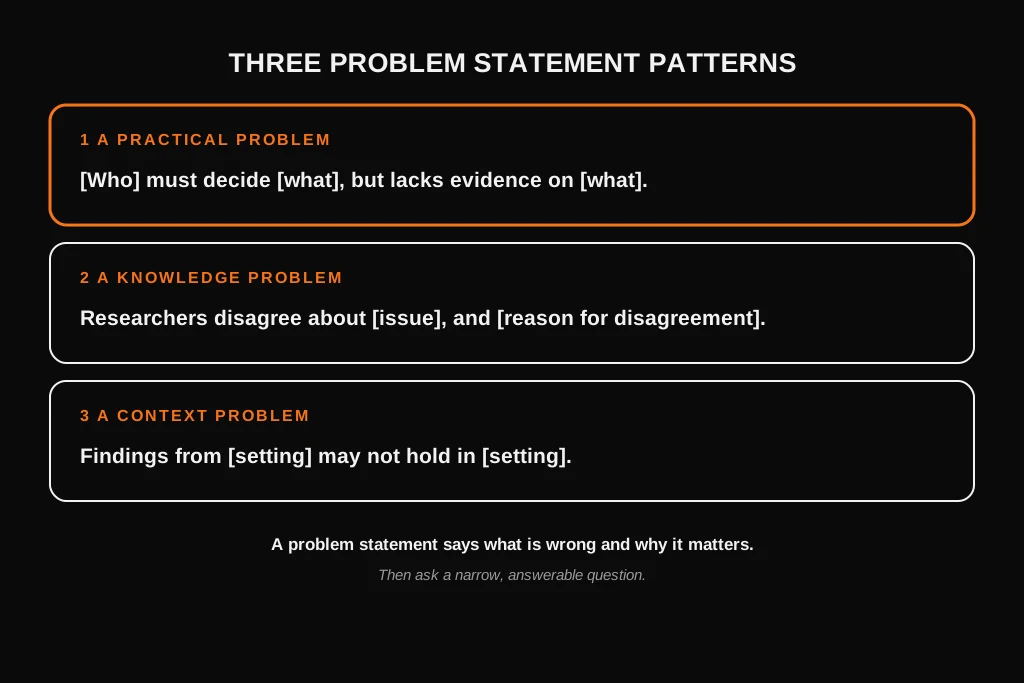
A problem statement says what is wrong or unknown and why it matters, usually in two or three sentences. Three patterns cover most projects:
- A practical problem: [Who] must decide [what], but lacks evidence on [what]. Example: Estates teams must decide whether to cool older classrooms, but lack evidence on how temperature relates to concentration in a full lecture.
- A knowledge problem: Researchers disagree about [issue], and [reason for disagreement]. Example: Studies disagree on whether mentoring changes behavior or only satisfaction, and most do not ask students why they use it.
- A context problem: Findings from [setting] may not hold in [setting]. Example: Findings from housing debates in national papers may not hold in regional papers, where readers wrote about their own streets.
A research question template
A strong question is narrow, original in some way and answerable with your data. Use this shape and fill the brackets: How [does or do] [factor] relate to [outcome] in [population or setting]? Variations replace how with what, why or to what extent, depending on whether your project is exploratory or measures a relationship. If you cannot answer your own question with the data you can reach, narrow it.
The Chapter Roadmap Paragraph
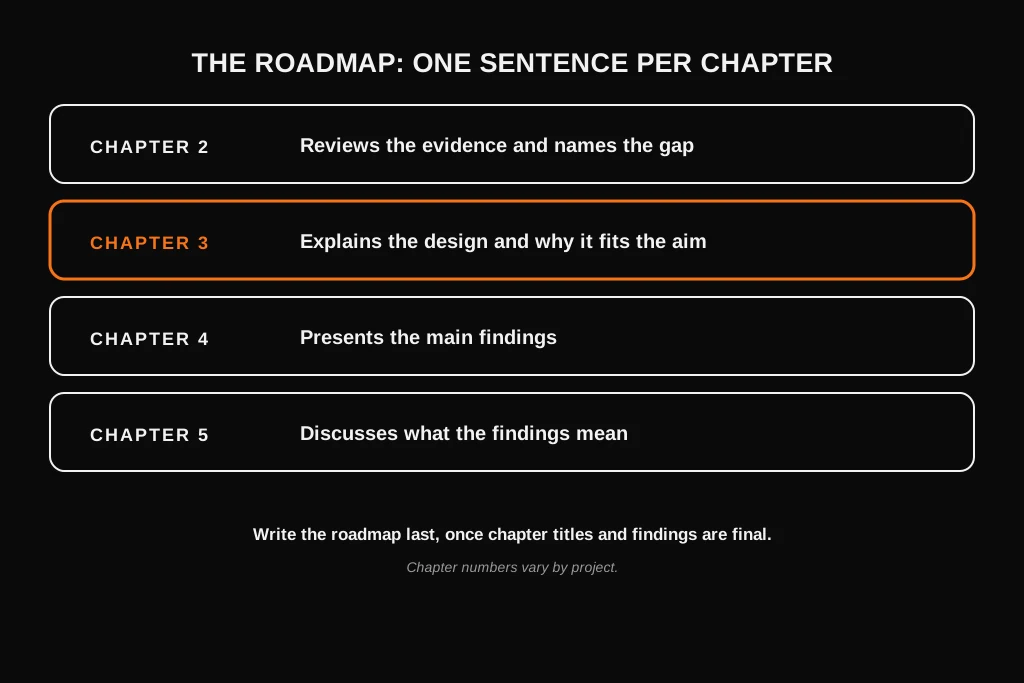
The roadmap is a short paragraph that tells the reader what each later chapter does. It should be one sentence per chapter. The method sentence needs care: name the approach and why it fits, and leave the detail for the dissertation methodology. Here is a fill-in version you can adapt:
Chapter 2 reviews [what the review covers] and identifies [the gap]. Chapter 3 explains [the design] and why it suits [the aim]. Chapter 4 presents [the main findings]. Chapter 5 discusses [what the findings mean] and [the implications].
Write the roadmap last, when your chapter titles and findings are final. A roadmap that names chapters or results you later changed is a common and avoidable mistake.
How Long Should the Introduction of a Dissertation Be?
The common guide is about 10 percent of the total word count. The Australian National University academic skills guide gives that figure and works it out for a master’s thesis of 15,000 to 20,000 words, which gives about 1,500 to 2,000 words. The Sussex guide also says about 10 percent. Longer introductions usually carry more background or an extended review, and ANU notes that the chapter can be shorter when a separate background or review chapter follows.
Length depends on your discipline and project, so ask your supervisor and look at past dissertations in your field. For context, the Antioch University tips suggest keeping the chapter focused and mention about 1,250 words, around five pages, for the dissertations they discuss.
A planning table
This table applies the 10 percent guide to common total word counts. It is a planning figure, and your handbook decides.
| Total words | Introduction at 10 percent |
|---|---|
| 8,000 | 800 |
| 10,000 | 1,000 |
| 15,000 | 1,500 |
| 20,000 | 2,000 |
How Long Should a Dissertation Be? The Total Limit and the Introduction’s Share
Dissertation length is the total word limit set by your department, and it varies by university, level and field. As one UK example, a university handbook gives about 8,000 to 10,000 words for a 30 credit undergraduate dissertation, with references and appendices left out of the count. Four points matter. Your handbook sets the limit. Check what counts toward it. Work out the share each chapter gets before you write. And remember that the opening chapter’s share is small, so every sentence must earn its place. Also check whether tables, quotations and footnotes count, and whether a margin over the limit is allowed. A short chapter is fine if it does its three jobs. Tip: write the budget at the top of your plan.
Introduction Expectations by Level and Field
Dissertation vs Thesis: What the Opening Chapter Is Called
The terms dissertation and thesis swap meaning between countries. The University of Essex library notes that usage differs between the UK and the US, so a word that means a doctoral project in one place can mean a master’s project in another. For this chapter, three points follow. It may be called introduction, background or simply chapter one. Doctoral projects usually expect a fuller chapter with a clearer contribution. Examiners judge the chapter against the standard for your own award, so your department’s rules are the ones that count. If your university also puts the review in this chapter, it may need to be longer, so confirm that early. And your department sets the format. Tip: use your department’s own chapter title and read its marking criteria for this chapter first.
Undergraduate vs Masters Dissertation: What Changes in the Introduction
Level changes the depth. At undergraduate level, examiners mainly want a clear topic, a focused question and a sensible roadmap. At master’s level they expect a sharper gap, a clearer reason the study matters and tighter links to the method. At doctoral level the chapter usually has to place the work in a wider field and state a contribution. The word limit changes too, so the same ideas must be stated more briefly in a shorter project. Whatever the level, keep the chapter proportionate to the project, because a short, honest chapter beats an inflated claim. Check also whether your department requires a hypothesis. Tip: ask your supervisor for a past example from your level and department.
Differences by field
Fields have habits. Science and health chapters are often short and move quickly from the problem to the question. Social science chapters often spend longer on context and theory. Humanities chapters often state an argument early and place the work in a long debate. Read two or three dissertations from your department to see what is normal there.
Connecting the Introduction to the Rest of Your Dissertation
The opening chapter makes promises, and the rest of the project keeps them. These three connections come up most often.
Dissertation Conclusion: Answering the Question the Introduction Asked
The closing chapter answers the question you asked at the start and says what the study adds. The two chapters must match. Four points help: use the same wording for the aim and the questions, answer each question in order, return to the problem and show what changed, and keep promises realistic. Tip: reread the opening chapter before drafting the closing one. If a question is no longer answered, change the question in the opening chapter, not the answer. Do not bring in new sources, because new evidence belongs earlier. Many examiners compare the two chapters directly, so a mismatch is easy to spot. If the closing chapter ends with a long list of recommendations, choose the one that follows most directly from your findings.
Dissertation Acknowledgements: Front Matter Before the First Chapter
Acknowledgements are a short page thanking the people who helped you, and they sit in the front matter, before the first chapter. Their order relative to the abstract and the contents list varies by university, so follow your handbook. Keep the page warm and brief. Do not put aims, questions or any argument there, because the opening chapter does that job. Typical thanks go to your supervisor, participants and librarians who helped with searching. Check whether your department requires the page and whether it limits the length or the names you may include. Tip: draft the page last, when you remember who helped, and check that headings and page numbers match your template. Some templates format the page differently from the main text, so copy the pattern exactly.
How to Choose a Dissertation Topic You Can State in One Sentence
Choosing a topic means narrowing an interest into a question you can answer within your time and word limit. A useful test is the opening chapter. Can you state the problem in two sentences and the question in one? If not, the topic is not ready. Four points help: pick something you can stay interested in, keep the scope small, make sure enough research exists, and check that your department can supervise it. Tip: write the first page of the opening chapter before you commit, because gaps in the topic show up quickly. Do this early and often, because a first draft of the opening paragraph is a cheap way to find flaws that would otherwise cost you weeks.
Common Dissertation Introduction Mistakes and How to Fix Them
- Opening with a grand statement. Start with a concrete setting, not a claim about all of history.
- Opening with the research question. Give context first so the question makes sense.
- Turning it into a literature review. Keep only the key sources and move the rest to the review.
- Describing the method in detail. Give a brief rationale and leave the detail for the method chapter.
- Writing it first and never revising. Rewrite after the findings so the promises match the results.
- Making promises the project does not keep. Check each aim and question against the closing chapter.
- Writing too much. Aim for about a tenth of the total, and cut sentences that do not support the problem, aim or roadmap.
- Copying the abstract. Rewrite instead of pasting. The two readers need different things.
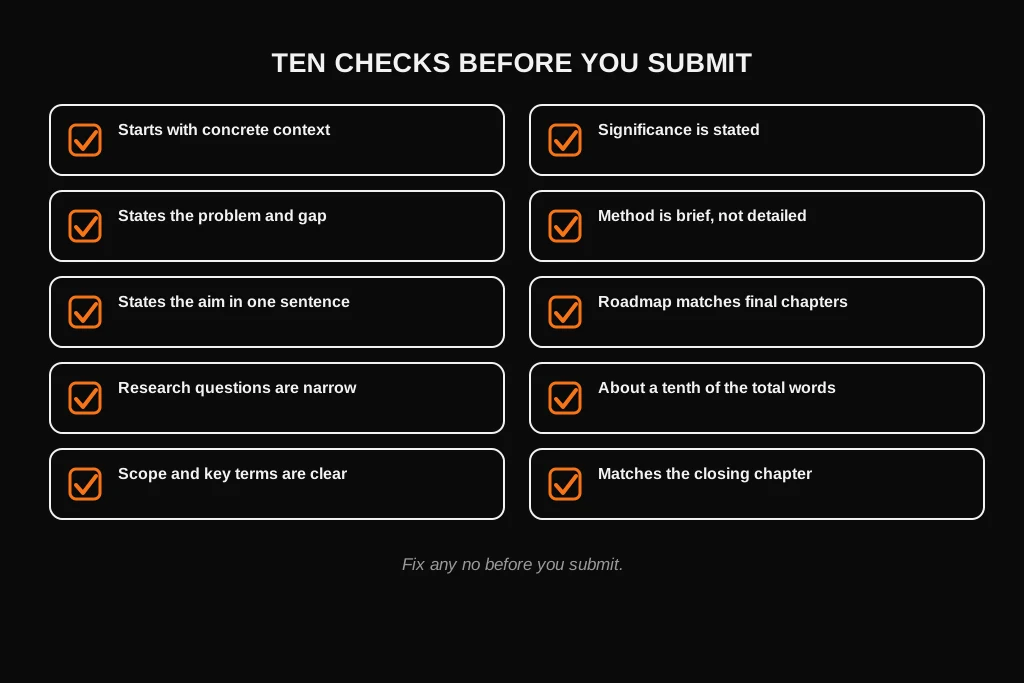
Ten checks before you submit
Run through these yes or no questions, and fix any no.
How the Proposal’s Opening Becomes the Chapter
Most proposals start with a short opening section that states the topic, problem and aim. If you wrote one following our guide on how to write a dissertation proposal, you already have a starting point. Keep the problem and the aim if they still hold, then expand the context, add the significance and scope, and write a roadmap for the real chapters. Revise any claim your later reading changed, and rewrite the whole chapter once your findings are in. Do not paste the old text and add pages.
How EssaysHelper Can Help You
The opening chapter is read first and written last, which makes it hard. EssaysHelper can support you at each point without taking over your work:
- Reviewing your plan, problem statement and research questions.
- Giving feedback on whether your context, gap and aim are clear and consistent.
- Checking that the opening chapter and the closing chapter match.
- Editing drafts for clarity, length and consistent formatting.
If you are stuck on a specific part, send us your question and your deadline and we will point you to the quickest next step.
Frequently Asked Questions
What is a dissertation introduction?
It is the opening chapter of your dissertation. It sets the context, names the problem or gap, states your aim and research question, and tells the reader what each later chapter does.
How do I write an introduction for a dissertation?
Start with context, state the problem and gap, then your aim and questions, scope, significance and a roadmap. Draft a placeholder early and rewrite it after your findings are final.
What should I include in a dissertation introduction?
Include context, the problem and gap, your aim and research questions, scope and key terms, significance, a brief method rationale and a chapter roadmap. Leave detailed sources and findings for later chapters.
How long should a dissertation introduction be?
A common guide is about 10 percent of the total word count, which is 1,000 words in a 10,000 word dissertation. It varies by university and field, so check your handbook and ask your supervisor.
What is a good example of an introduction for a dissertation?
A good one starts with a concrete setting, names a problem and gap, then states the aim, questions and roadmap. The three annotated examples above show a science, a social science and a humanities model.
When should I write my dissertation introduction?
Draft a short placeholder early, then rewrite the full chapter after your findings are final. Writing it last helps the promises you make match the project you actually completed.
Should I include a literature review in my introduction?
Only a short, selective background. The full critical review belongs in its own chapter unless your department folds the two together, so check your handbook.
How is a dissertation introduction different from an abstract?
The opening chapter argues for the project at length and previews it without findings. The abstract is a short stand-alone summary that includes the main findings.
Should I start my introduction with the research question?
Usually not. Start with context so the question makes sense, then narrow to the problem and state the question once the reader understands why it matters.
Do I need a roadmap at the end of the introduction?
Most departments expect one. It is a short paragraph with one sentence per chapter. Write it last so it matches your final chapter titles and results.
Final Thoughts
A strong dissertation introduction comes down to three habits: start with concrete context, state a clear problem and aim, and rewrite the chapter once your findings are final. You do not need a clever hook. You need a focused path from the broad setting to your exact question, in about a tenth of your words. Use the examples and templates as a starting shape, match the chapter to your department’s rules, and read it one last time against your closing chapter. If a reader can say what you studied, why it matters and what to expect, the chapter is doing its job.