
A dissertation abstract is a short, stand-alone summary of your whole project. It states the problem, your aim, your method, your main findings and why they matter, usually in one paragraph and within a word limit set by your department. You write it last, once you know your results, and a reader should understand your project from the abstract alone.
If you are still planning the full project, start with our guide on how to write a dissertation, then return here for the detail on this one page. Below you get a seven part formula, a sentence budget, three original annotated examples, a fill-in template and a trimming guide.
Students usually get stuck in the same places: not knowing what to include, not knowing when to write it, sounding vague, and going over the word limit. Each of those is covered below.
What Is an Abstract in a Dissertation?
An abstract in a dissertation is a self-contained statement that describes the larger work. The UNC Writing Center guide to abstracts explains that it is not a review and does not judge the work. It is an original piece of writing that borrows key terms from the project, and it exists to help readers decide whether to read on and to help databases index the work.
Who reads your abstract
Three groups read it, and they want different things. Examiners use it to get a first picture of your project before they open the chapters. Other students and researchers use it to decide whether your work is relevant to theirs. Library catalogues and repositories use its words to index your work, so it is often the only part a stranger ever sees. Texas A&M’s writing center puts it plainly: readers often decide whether to read the full document on the basis of the abstract alone.
Questions the abstract must answer
A good abstract answers six quick questions in order. What problem are you tackling? Why is it still unresolved? What did you set out to do? How did you do it? What did you find? And why does that matter? If any answer is missing, a reader will have to guess, and examiners rarely guess in your favor.
Abstract vs summary
The two words are often used as if they mean the same thing, but they are not identical. A summary is any shorter version of a text, and it can be informal or depend on the text beside it. An abstract is a formal, stand-alone piece with a word limit, a conventional order of parts and a place in the front matter. Because it stands alone, it must define its own terms and make sense without the chapters. That is why you cannot simply shrink a chapter and call it an abstract.
What the abstract is not
It is not a teaser that hides your results. It is not a table of contents in sentence form, where each sentence says what a chapter discusses. It is not the opening chapter squeezed down, because that chapter argues for your project at length while the abstract reports it briefly. And it is not the place for new material, since everything in it must appear in the dissertation itself.
Because so many people see only this page, it also works as your project’s shop window. Anything you want remembered, such as your sample, your main result or your contribution, needs to be in it.
Why it matters for your marks
The abstract is short, so every weakness shows. Vague wording, a missing finding or a gap that does not match your aim signals that the project may be unfocused. A precise abstract does the opposite: it shows an examiner, in under a minute, that you know what you did and why it matters. That first impression often shapes how the rest is read.
The one minute test
Give your abstract to a friend outside your field and ask them to explain your project back to you after one minute. If they can name the problem, what you did and what you found, the abstract works. If they hesitate on any of those three, that is exactly the sentence to rewrite.
Where the Abstract Sits and How Long It Should Be
The abstract belongs to the front matter, the pages before the first chapter. For the full order of every part of the document, see our guide to dissertation structure. The exact position varies by university. For example, the UT Dallas graduate school’s formatting guide places the abstract after the acknowledgements and before the table of contents, while other universities order the pages differently, so follow your own handbook.
How Long Should a Dissertation Be, and How Long Is the Abstract?
Dissertation length is the total word limit set by your department, and it varies by university, level and field. The abstract has its own, much smaller limit. As examples, Texas A&M allows up to 150 words for a master’s thesis abstract and up to 350 for a dissertation, while UT Dallas sets a maximum of 500 words for both. Four points matter. Your handbook sets both limits. Check whether the abstract counts toward the total, because one Australian university includes the preliminary pages in its thesis word limit. A longer dissertation does not automatically earn a longer abstract. And never go over the limit, even by a few words. Tip: write at your maximum first, then trim.
A word limit table
These limits are examples from two US universities, not rules. Your department decides.
| Source | Document | Abstract limit |
| Texas A&M writing center | Master’s thesis | Up to 150 words |
| Texas A&M writing center | Dissertation | Up to 350 words |
| UT Dallas graduate school | Master’s thesis and doctoral dissertation | Not more than 500 words |
If your handbook gives no limit, ask your supervisor, and look at two or three recent abstracts from your department to see what is normal.
Types of Abstract: Informative, Descriptive and Structured
Before you write, find out which type your department expects, because the types contain different things.
- Informative: reports the main findings as well as the aim and method. This is the most common type and the one most dissertations need. Texas A&M asks for an informative abstract for its theses and dissertations.
- Descriptive: explains the purpose and scope without giving results. It is usually very short, often 100 words or less according to the UNC guide.
- Structured: an informative abstract split under labels such as background, methods, results and discussion. It is common in health and some science fields. Use it only if your department asks for it.
When in doubt, ask your supervisor or check your handbook. A rough rule is that a 100 word limit suggests a descriptive abstract and a limit of 250 words or more suggests an informative one.
How to Write an Abstract for a Dissertation, Step by Step
This method works for any field and answers the common question of how to write an abstract for a dissertation without starting from a blank page.
- Wait until your findings are final. The abstract reports what you found, so write it after the closing chapter is drafted.
- Check your limit and type. Find the word limit, the paragraph rules and whether the abstract must be structured.
- Pull one to two sentences from each chapter. Copy the sentence that states the problem, the aim, the method, each main finding and the main implication into one document.
- Rewrite them as a single flow. Join the sentences, remove repetition, and make sure each part leads to the next.
- Draft long, then trim. Aim for about 10 percent over the limit, then cut using the trimming guide below.
- Check it against the dissertation. Every claim must appear in your chapters, and every main finding must appear in the abstract.
- Read it as a stranger. Ask whether someone who reads only this page understands what you did and found.
The seven parts of a strong abstract
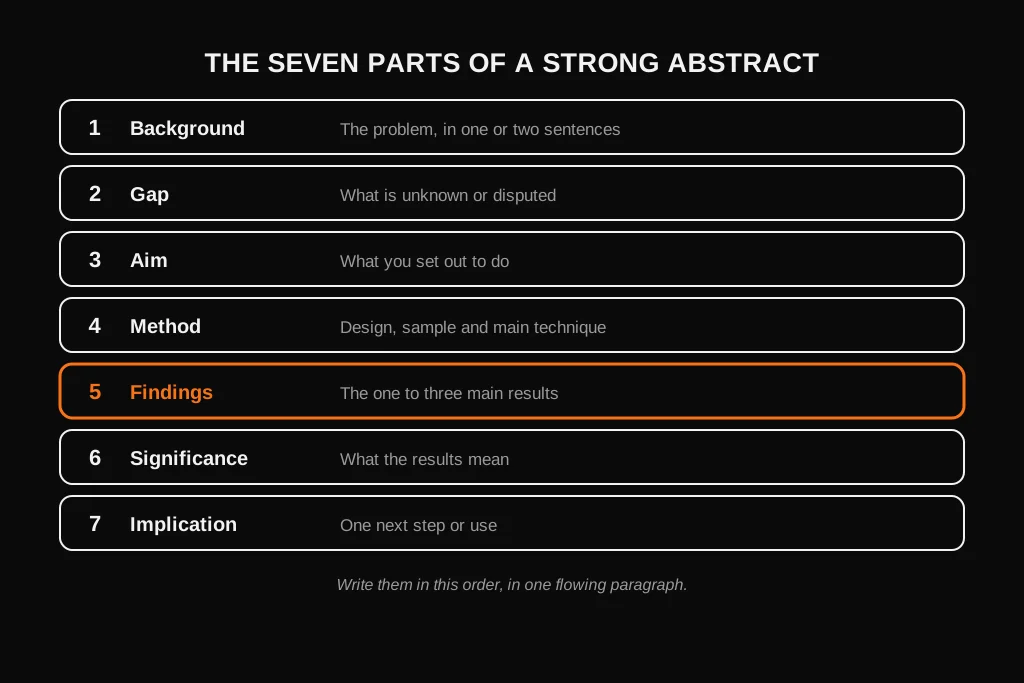
A reliable formula has seven parts, in this order. The background sets the problem in one or two sentences. The gap says what is unknown or disputed, and it should match the one in your review (see the dissertation literature review post for how to find it). The aim states what you set out to do. The method gives the design and sample in one or two sentences. The findings give the one to three main results. The significance says what they mean. And the final sentence gives an implication or next step.
Sentence starters for each part
If you freeze on the first word of a sentence, use these starters and rewrite them in your own words:
- Background: [Topic] is widely used in [setting], and [one fact about it].
- Gap: However, little is known about [issue], or studies disagree on [issue].
- Aim: This study aims to [verb] [what], in [who or where].
- Method: A [design] was used with [sample], and data were [collected or analyzed] by [technique].
- Findings: The results show that [finding], and [second finding].
- Significance: These findings suggest that [meaning for the field].
- Implication: Future work could [next step], or practice could [change].
A sentence budget by word limit
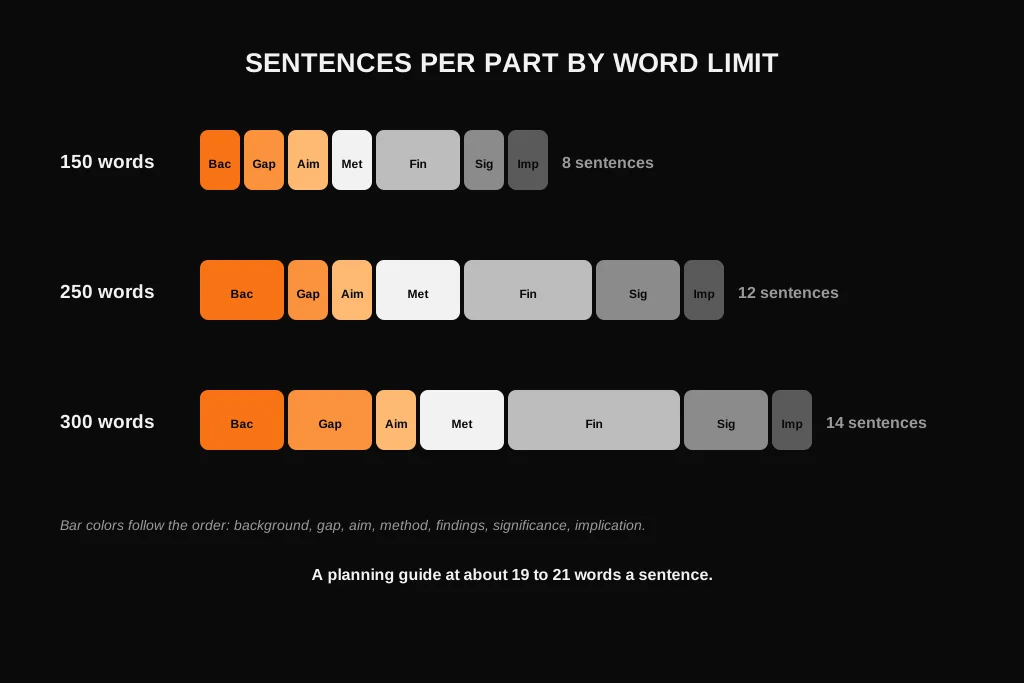
Use this table to plan how many sentences each part gets, assuming about 19 to 21 words per sentence. It is a planning guide, and your word limit decides the rest.
| Part | 150 words | 250 words | 300 words |
| Background | 1 | 2 | 2 |
| Gap | 1 | 1 | 2 |
| Aim | 1 | 1 | 1 |
| Method | 1 | 2 | 2 |
| Findings | 2 | 3 | 4 |
| Significance | 1 | 2 | 2 |
| Implication | 1 | 1 | 1 |
| Total sentences | 8 | 12 | 14 |
Dissertation Abstract Examples: Three Original Annotated Models
These models were written for this guide to show the shape of a good abstract in three fields. The topics, numbers and findings are invented, and there are no real authors or citations. Copy the shape, never the words, and replace everything with your own project.
Example 1: A science or health study
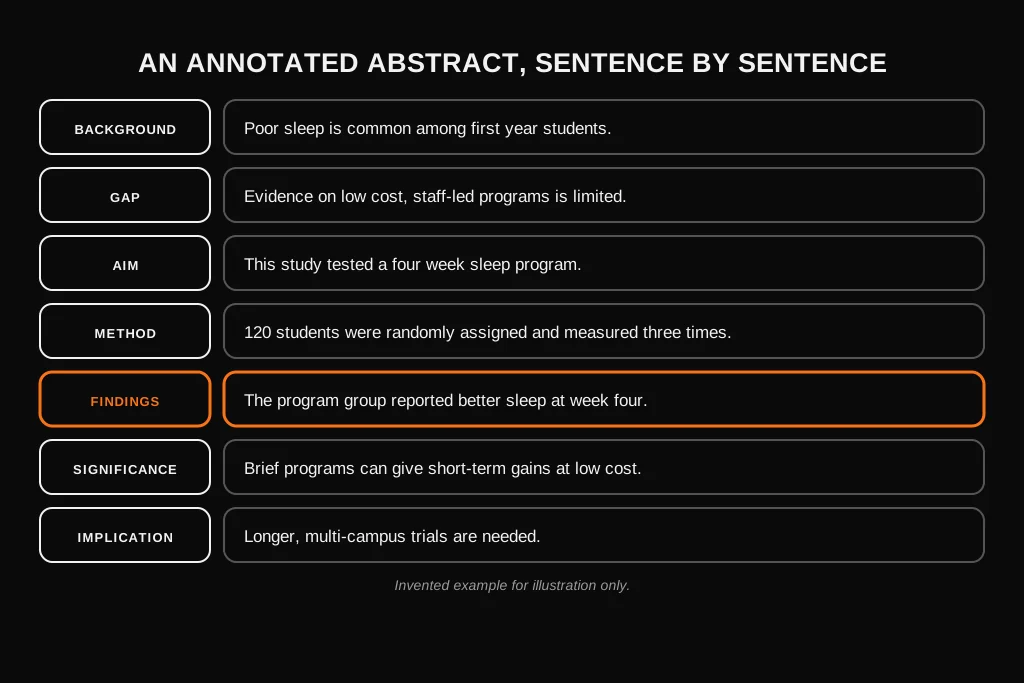
Poor sleep is common among first year university students and is linked to lower attention and mood. Evidence on low cost programs delivered by existing campus staff is limited, especially outside a single institution. This study tested whether a four week, nurse-led sleep program improves sleep quality in first year students. A total of 120 students were randomly assigned to the program or to usual care, and sleep quality was measured with a validated self-report scale at baseline, week four and week twelve. Students in the program group reported significantly better sleep quality at week four than the comparison group, and about half of this difference remained at week twelve. Effects on daytime sleepiness were smaller and not statistically significant. The results suggest that brief, staff-led programs can produce short-term gains at low cost. Longer follow up and trials across several campuses are needed to test whether the gains last.
What each sentence does: 1 background, 2 gap, 3 aim, 4 method, 5 and 6 findings, 7 significance, 8 implication. Note that the findings are stated, including one result that was not significant.
Example 2: A social science study
Commuter students make up a large share of many university populations, yet campus engagement programs are usually designed around students who live on site. Existing research counts attendance but rarely asks commuters to explain their choices. This study explores the reasons commuter students give for attending or avoiding campus events. Semi-structured interviews were held with 18 commuter students at one university and analyzed using reflexive thematic analysis. Three themes were developed: time as a currency, events that feel designed for someone else, and the cost of being visible when others already have friends. Participants described attendance as a trade-off against paid work, caring duties and travel time, not as a lack of interest. The findings suggest that timing, format and early personal contact matter more than the number of events offered. Universities could pilot short daytime events and test whether attendance changes.
What each sentence does: 1 background, 2 gap, 3 aim, 4 method, 5 and 6 findings, 7 significance, 8 implication. A qualitative abstract reports themes and what participants said, not numbers.
Example 3: A humanities or desk-based study
Public libraries opened across industrial cities in the late nineteenth century, and historians usually explain them as tools of working class improvement. Less attention has been paid to how local newspapers described the libraries to their own readers. This dissertation examines how one city’s newspapers framed the public library between 1880 and 1910. A close reading was carried out on 240 articles, editorials and letters, coded for recurring metaphors, assumed readers and claims about benefit. The analysis shows that coverage moved from praising the library as moral uplift to presenting it as a civic amenity for all ratepayers, with the shift appearing first in readers’ letters and only later in editorials. This challenges the view that the improvement message simply spread from elites downward. The study also shows that letters to the editor can reveal public attitudes that official reports leave out.
What each sentence does: 1 background, 2 gap, 3 aim, 4 method, 5 findings, 6 and 7 significance. It has no implication sentence, which is fine when the limit is tight.
The same abstract, weak and strong
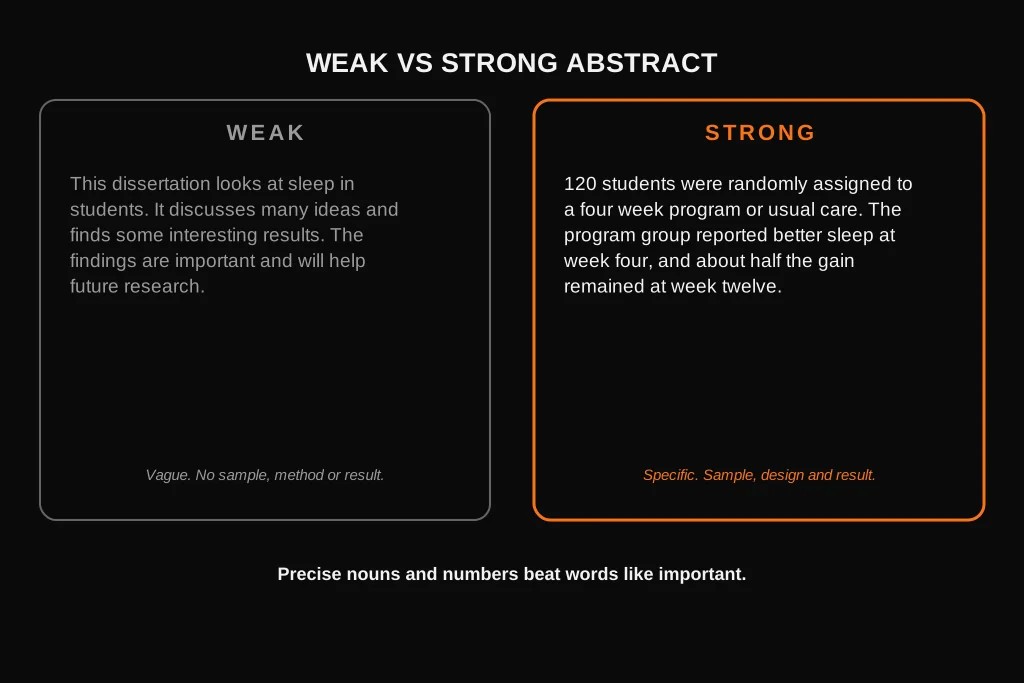
Here is a weak version: “This dissertation looks at sleep in students. It discusses many ideas and finds some interesting results. The findings are important and will help future research.” Every sentence is true, yet a reader learns nothing about the aim, the method or the result. The strong version, Example 1, names the sample, the design, the main result and its limit. Precise nouns and numbers do the work that words such as interesting and important cannot.
A Fill-In Dissertation Abstract Template
Use this as a starting skeleton, then rewrite it in your own voice. Replace each bracket with your own content.
[Topic] is [common or important], and [one background fact]. However, [what is unknown or disputed]. This study aims to [one clear verb and aim]. A [design or approach] was used with [sample or sources], and data were [collected or analyzed] using [method]. The results show that [main finding one] and [main finding two]. These findings suggest [what they mean for the field]. [One implication or next step].
If a bracket is hard to fill, that tells you where your dissertation itself is unclear. Fix the project, not just the sentence.
From Chapters to Sentences
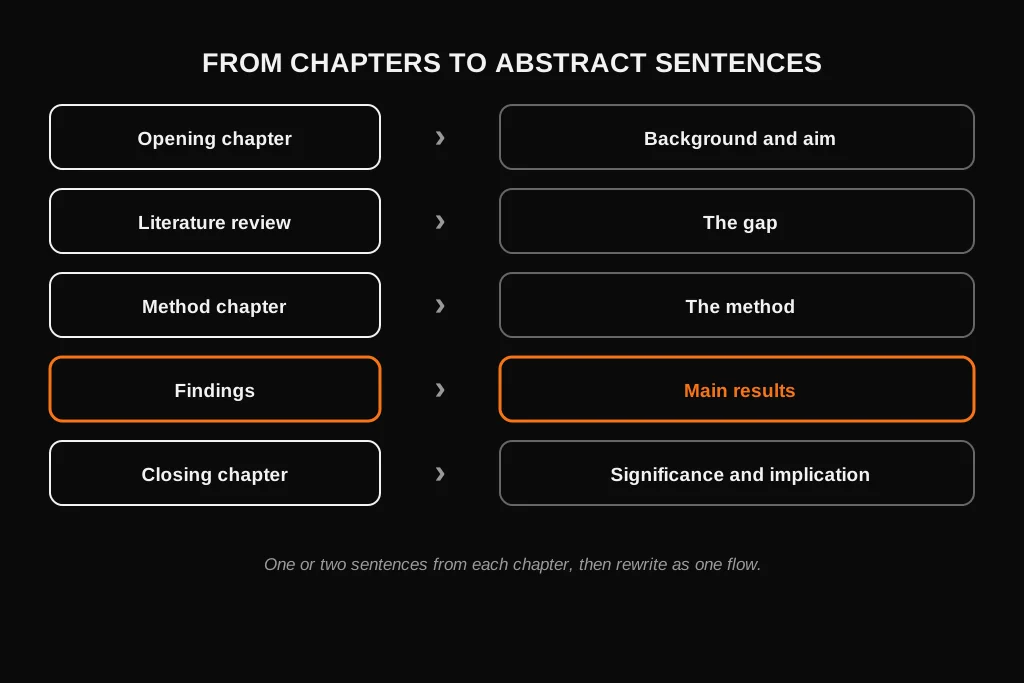
Each part of the abstract should come from a specific part of the dissertation. This is why writing it last is easier: the sentences already exist, and your job is to compress them.
| Chapter | What to take | What to leave out |
| Opening chapter | The problem and the aim, one sentence each | History, definitions and a long rationale |
| Literature review | The gap, in one sentence | Author names and lists of studies |
| Method chapter | Design, sample and main technique | Tools, software and step-by-step procedure |
| Findings | The one to three main results | Tables and secondary results |
| Closing chapter | What the results mean and one implication | Limits in detail and long recommendations |
The method sentence deserves special care. Give the design, the sample and the main technique, and no more. The reasoning behind those choices belongs in your dissertation methodology, not in the abstract. If your project is purely desk-based, say what kind of sources you analyzed and how many.
Tense, Voice, Keywords and Wording
Tense and voice vary by field and by university. Texas A&M advises checking the requirements of the target publisher or department because some specify one tense only. A common practice is the past tense for what you did and found, and the present tense for what the results mean, but follow your handbook and recent abstracts from your department.
Use full sentences, plain words and the technical terms of your field. Avoid undefined abbreviations, quotations and heavy citation, since Texas A&M notes that some journals discourage references in abstracts. Include only information that appears in the dissertation, and state each point once.
Abbreviations, numbers and technical terms
Spell out an abbreviation once, then use it only if it appears again. Use numerals for sample sizes and results, because they are easier to scan. Keep technical terms that your field uses, since examiners expect them, but avoid jargon that only your own group would know. Every term should be one a reader in your wider field would recognize.
Choosing keywords
Many departments and repositories ask for a short list of keywords after the abstract, and the number varies. Because the UNC guide notes that abstracts help databases index a work, choose the terms a stranger would type to find it. Include your main topic, your population or setting, and your method. Do not just repeat the words of your title, and add synonyms that searchers use.
Cutting an Abstract to the Word Limit
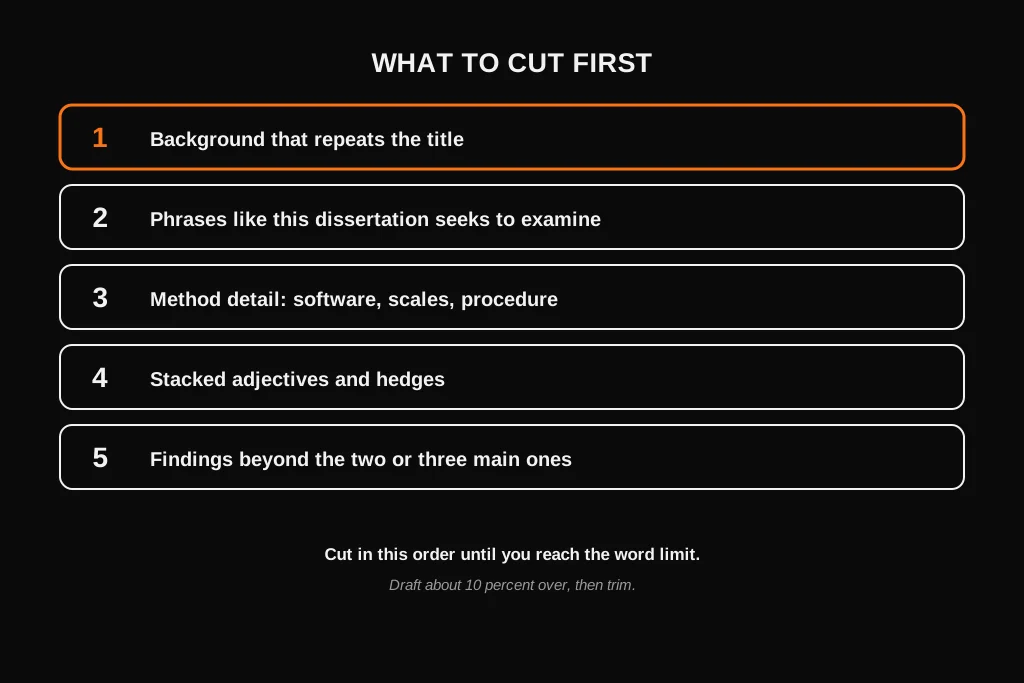
Almost every first draft is too long, so trimming is a normal step. Cut in this order. Remove background that only repeats the title. Replace phrases such as this dissertation seeks to examine with a direct verb. Remove method detail such as software versions and scale names. Delete stacked adjectives and hedges. And keep only the two or three main findings.
Here is a before and after. Before (29 words): “In this dissertation, an attempt is made to examine the extent to which first year students who took part in the program reported improvements in their quality of sleep.” After (12 words): “The study measured whether first year students sleep better after the program.”
Abstract Expectations by Level and Field
Dissertation vs Thesis: What Changes for the Abstract
The terms dissertation and thesis swap meaning between countries. The University of Essex library notes that usage differs between the UK and the US, so a word that means a doctoral project in one place can mean a master’s project in another. For the abstract, three points follow. The word limit can differ by document type. Repositories and databases may set their own rules, and one US graduate school notes that ProQuest truncates abstracts over 500 words in its print indexes. And your own department decides the format. Examiners compare your abstract with the standard for your own award, so the rules of your department are the ones that count. Tip: use your department’s word for the project and confirm the abstract limit before you draft.
Undergraduate vs Masters Dissertation: What Changes in the Abstract
Level sets the depth. At undergraduate level, check first whether your department requires an abstract at all, then aim for a clear, accurate summary of the question, method and main result. At master’s level, expect a tighter word limit, sharper findings and a clearer link to the gap. At doctoral level, the abstract usually has to state a contribution to the field and may be published in databases, so precision matters even more. Tip: ask your supervisor for the marking criteria for the abstract and one recent example from your department. Whatever the level, keep the abstract proportionate to the project, because a short, honest summary beats an inflated claim.
Differences by project type
The project type changes the content too. An empirical study reports a sample, a method and results. A desk-based or legal study reports the sources, the approach and the argument. A systematic review reports the question, the search and the synthesis. A practice-based or creative project may need an abstract that describes the work and the reflection on it, so confirm the format with your department.
Differences by field
Fields have habits. Science and health abstracts often report numbers and may use labelled sections. Social science abstracts often name a design and the main themes or relationships. Humanities abstracts often state an argument and the sources it rests on. Read three recent abstracts from your department to see what is normal there.
The Abstract and the Rest of Your Dissertation
The abstract touches almost every other part of the document. These four connections come up most often.
How to Choose a Dissertation Topic With a Working Abstract
Choosing a topic means narrowing an interest into a question you can answer in the time and word limit you have. A working abstract is a useful test. Write five sentences: the problem, the gap, your aim, your planned method and the value of the answer. If you cannot write the gap or method sentence, the topic is not ready. Show the draft to your supervisor, because it makes problems visible in minutes. Tip: keep the draft and revise it as the project develops. By the end it should look very like your final abstract, with findings replacing your expectations. Do this early and often, because a working abstract is a cheap way to find flaws that would otherwise cost you weeks.
Dissertation Introduction: How It Differs From the Abstract
The opening chapter of a dissertation frames your topic, question and reason for the study, and it argues for them with citations and background. The abstract only reports them. Four points keep them apart: the opening chapter explains and persuades, the abstract summarizes and states results; it cites sources, the abstract rarely does; it leaves findings to later chapters, the abstract must give them; and it may take pages, while the abstract takes a paragraph. Tip: never paste sentences from the opening chapter into the abstract. Rewrite each one, because the two readers need different things. A quick test: if a sentence contains a citation you had to look up, it probably belongs in the opening chapter, not the abstract.
Dissertation Conclusion: What the Abstract Borrows From It
The closing chapter answers your question, states what the study adds and notes its limits. The abstract borrows only its core: the main answer and one implication. Four points help: lift the headline finding, not every result; give the single most important implication; leave detailed limits and long recommendations in the chapter; and make sure the two never contradict each other. Tip: finish the closing chapter first, reread its first paragraph, and write the last two sentences of the abstract from it. If they disagree on a number or a claim, fix them together. If the closing chapter ends with a long list of recommendations, choose the one that follows most directly from your findings.
Dissertation Acknowledgements: Where They Sit Next to the Abstract
Acknowledgements are a short page thanking the people who helped you, and they are separate from the abstract. Their order varies. The UT Dallas guide puts them before the abstract, while other universities may order them differently, so follow your handbook. Keep the acknowledgements warm and brief, and keep the abstract strictly factual. Do not thank anyone in the abstract, and do not put results in the acknowledgements. Tip: draft the acknowledgements last of all, when you remember who helped, and check that the page numbers and headings match your template. Some templates format the two pages differently, with different headings and page numbering, so copy the pattern exactly.
Common Dissertation Abstract Mistakes and How to Fix Them
- Writing it too early. Wait until your findings are final, then check every number again.
- Being vague. Replace words such as interesting and important with the sample, the method and the result.
- Describing chapters instead of reporting. Sentences like Chapter 3 discusses the results tell readers nothing. State the results.
- Hiding the findings. An abstract that ends with results are discussed has failed. Give the main result.
- Too much background. Keep it to one or two sentences and move to the gap.
- Adding new information. Everything must appear in the dissertation. Check each claim against your chapters.
- Copying sentences from the opening chapter. Rewrite them as a summary of results, not an argument.
- Going over the limit. Cut using the trimming order, and count words with a tool.
Ten checks before you submit
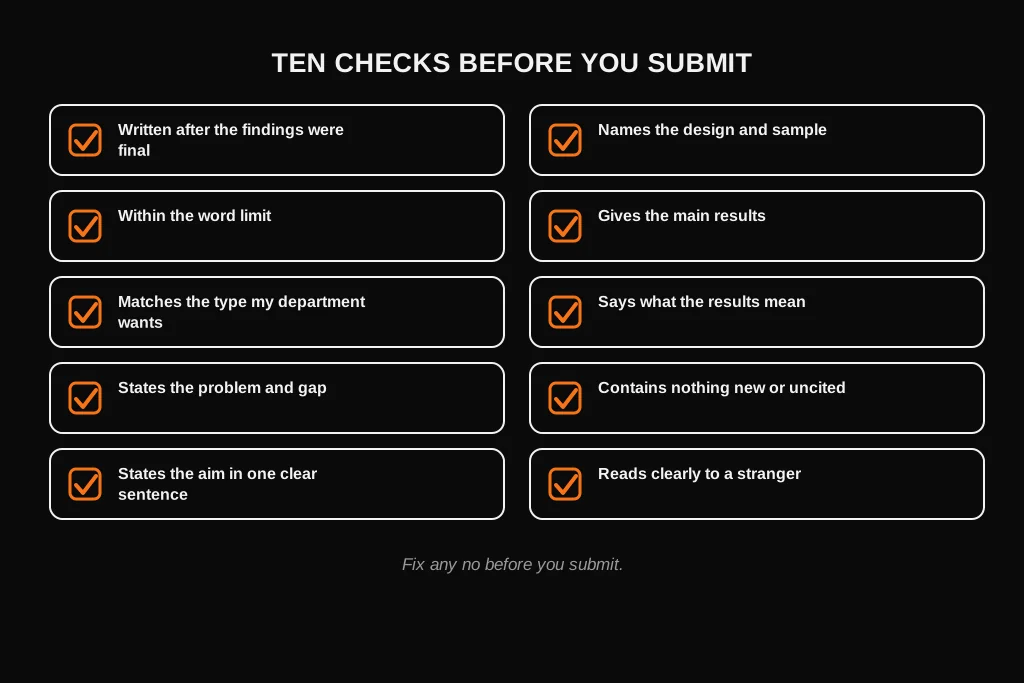
Run through these yes or no questions, and fix any no.
Proposal Abstract vs Dissertation Abstract
Some departments ask for a short abstract in the proposal as well. If you followed our guide on how to write a dissertation proposal, you may already have one. The difference is simple: a proposal abstract describes a planned study, so it usually states the problem, aim and intended method but has no findings, while the dissertation abstract reports a completed one. Do not reuse the old text. Keep the background and gap if they still hold, then rebuild the rest around what you actually did and found.
How EssaysHelper Can Help You
Squeezing a whole project into one paragraph is harder than it looks. EssaysHelper can support you at each point without taking over your work:
- Reviewing your draft against the seven part formula.
- Giving feedback on whether your findings are precise and your gap matches your aim.
- Helping you trim to the word limit without losing key points.
- Editing for clarity, tense and consistent formatting.
If you are stuck on a specific part, send us your question and your deadline and we will point you to the quickest next step.
Frequently Asked Questions
What is an abstract in a dissertation?
It is a short, stand-alone summary of your whole project. It states the problem, aim, method, main findings and significance so a reader understands the work without opening the chapters.
How do you write an abstract for a dissertation?
Write it last. Pull one or two sentences from each chapter, join them into one flow using the seven part formula, trim to your word limit and check every claim against the dissertation.
How long should a dissertation abstract be?
It depends on your university. Texas A&M allows up to 150 words for a master’s thesis and 350 for a dissertation, while UT Dallas allows up to 500. Always check your own handbook.
What is a good example of an abstract for a dissertation?
A good one names the problem, the gap, the aim, the method and the main result in precise terms. The three annotated examples above show a science study, a social science study and a humanities study.
What should a dissertation abstract include?
Include the background, the gap, your aim, the method, the main findings, their significance and, space permitting, one implication. Leave out citations, quotations and new information.
When should I write my dissertation abstract?
Write it after your findings are final and the closing chapter is drafted. A short working abstract at the start of the project is useful, but the final version should reflect your actual results.
Should a dissertation abstract have citations?
Usually not. Texas A&M notes that some journals discourage references in abstracts, and most dissertation abstracts do not need them. If you must refer to a source, cite it fully and check your handbook.
What tense should a dissertation abstract be in?
It varies by field and university. A common practice is past tense for what you did and found, and present tense for what the results mean. Check your handbook and recent abstracts from your department.
Is an abstract the same as a summary?
They are close, but an abstract is a formal, stand-alone summary with a word limit and set parts, and it is read separately from the document. A summary can be informal and depends on the text beside it.
Do I need keywords with my dissertation abstract?
Many departments and repositories ask for them. Because abstracts help databases index your work, choose terms a stranger would search for, including your topic, setting and method.
Final Thoughts
A strong dissertation abstract comes down to three habits: write it last, say something precise about each of the seven parts, and check every claim against your chapters. You do not need fancy language. You need the problem, the gap, the aim, the method, the main findings and why they matter, in a form a stranger can follow. Use the template and examples as a starting shape, match the page to your department’s word limit and format, and read it one last time as someone who has never seen your project. If they could explain what you did and found, the abstract is doing its job.