
Many students know how to write sentences, but they still get confused when a teacher asks them to identify the types of sentences. Is it declarative or imperative? Is it simple or compound? Is a complex sentence the same as a long sentence? And what about conditional sentences?
These questions are common because sentence types can be grouped in more than one way. Some types of sentences are based on purpose, such as statements, questions, commands, and exclamations. Others are based on structure, such as simple, compound, complex, and compound-complex sentences. There are also types of conditional sentences, which show possible situations and results.
Understanding sentence types is not just a grammar exercise. It helps you write clearer essays, avoid punctuation mistakes, improve academic tone, and make your paragraphs sound less repetitive. If you are working on essays, assignments, or grammar-heavy coursework, Essay Helper can also support students with writing, proofreading, and academic guidance.
This guide explains the different types of sentences with easy examples, tables, practice questions, a short quiz, and a worksheet-style section you can use for revision.
What Are the Different Types of Sentences?
The different types of sentences can be classified in three main ways: by function, by structure, and by condition.
When people ask about the 4 types of sentences, they usually mean sentence function. These are declarative, interrogative, imperative, and exclamatory sentences. However, when teachers talk about simple, compound, complex, and compound-complex sentences, they are talking about sentence structure.
Here is a simple overview:
| Category | Types | What It Means | Example |
| By function | Declarative, interrogative, imperative, exclamatory | What the sentence does | “The essay is clear.” |
| By structure | Simple, compound, complex, compound-complex | How clauses are arranged | “Although it was late, I revised the essay.” |
| By condition | Zero, first, second, third, mixed conditional | How a condition and result are connected | “If students practise grammar, they improve.” |
So, when someone asks, “what are the different types of sentences?” the best answer is that sentence types depend on what you are classifying. A sentence can be declarative by function and complex by structure at the same time.
For example:
“Although the topic was difficult, the student completed the assignment.”
This sentence is declarative because it makes a statement. It is also complex because it has one dependent clause and one independent clause.
Why Sentence Types Matter in Academic Writing
Sentence types matter because they affect how clearly your ideas are communicated. In academic writing, students often lose marks not because their ideas are bad, but because their sentences are unclear, repetitive, or poorly punctuated.
If every sentence is short and simple, the paragraph may sound basic. If every sentence is long and complicated, the reader may struggle to follow the argument. Good academic writing uses sentence variety. That means mixing sentence lengths and structures so the writing sounds natural and controlled.
Learning sentence types can help you:
- Understand grammar more clearly
- Improve punctuation
- Avoid run-on sentences
- Avoid sentence fragments
- Write stronger essays
- Create better paragraph flow
- Prepare for grammar tests and exams
- Make your academic tone more mature
Students often need academic assignment support when their ideas are strong but their grammar and sentence structure make the work difficult to read. Once you understand sentence types, it becomes easier to revise your own writing.
The Purdue OWL sentence types guide also explains that sentence variety helps writers add complexity and variation to their work. In simple terms, sentence variety makes your writing less boring and more effective.
The Types of Sentences by Function
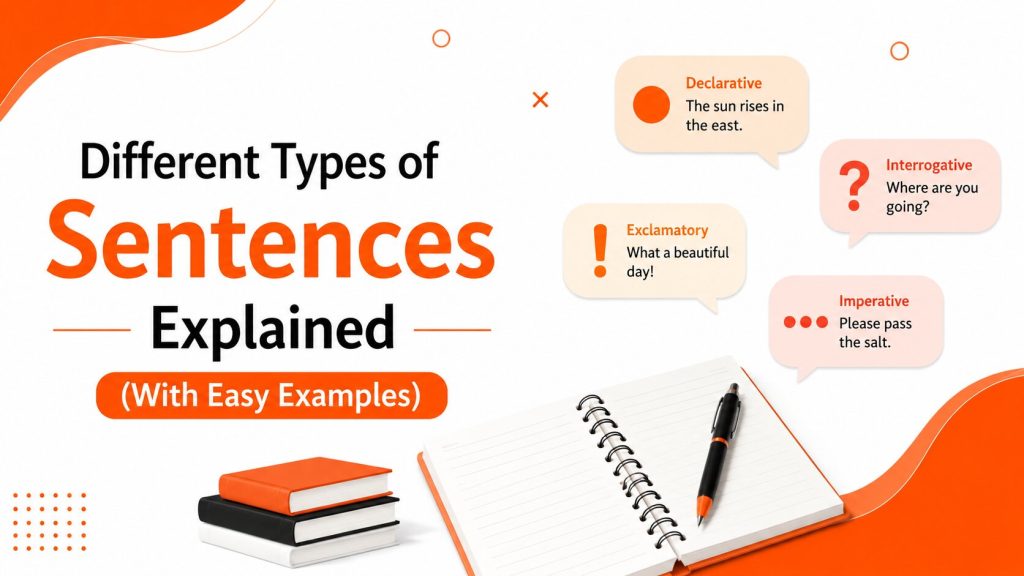
The 4 types of sentences by function are declarative, interrogative, imperative, and exclamatory. These sentence types are based on what the sentence is doing.
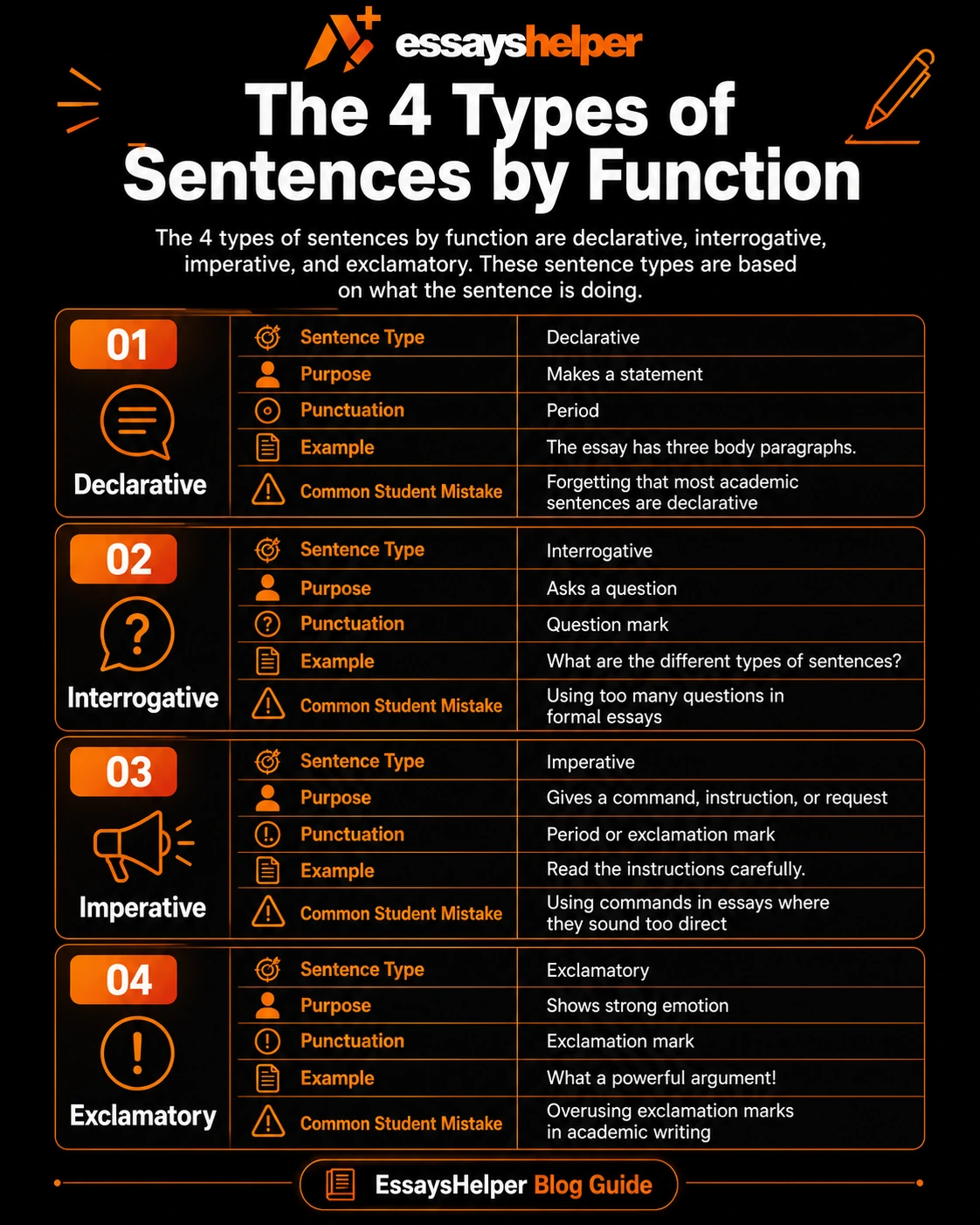
These are the four types of sentences students usually learn first. They are easy to understand once you focus on purpose.
Declarative Sentences
A declarative sentence makes a statement. It gives information, explains an idea, or states a fact or opinion. Most sentences in essays are declarative because academic writing usually explains, analyses, or argues.
Examples:
- The research supports the main argument.
- Students often improve their essays by using varied sentence structure.
- This assignment requires careful planning.
- The conclusion summarises the main point.
- Grammar improves with regular practice.
Declarative sentences usually end with a period. They are useful in essays because they allow you to make clear points.
For example:
“Complex sentences help students explain relationships between ideas.”
This is a strong academic sentence because it makes a clear statement. You can then support it with examples or explanation.
Declarative sentences are especially important in essays because they help you present claims, topic sentences, evidence, and analysis.
Interrogative Sentences
An interrogative sentence asks a question. It usually begins with words like what, why, how, when, where, who, or does. It ends with a question mark.
Examples:
- What are the different types of sentences?
- How does sentence structure affect essay clarity?
- Why is punctuation important?
- Can sentence variety improve academic writing?
- What is the difference between a compound and complex sentence?
Interrogative sentences are useful in learning, discussion, and reflective writing. They can also work in essay introductions when used carefully.
For example:
“Why do some essays sound clear while others feel difficult to follow?”
This could be used as a hook in a student-friendly essay. If you want more help with opening lines, you can explore different hooks for essay.
However, formal academic essays should not rely too much on questions. If every paragraph begins with a question, the writing may sound informal or weak. Use questions only when they help your reader think about the topic.
Imperative Sentences
An imperative sentence gives a command, instruction, warning, or request. It often starts with a verb. The subject is usually understood as “you,” even if it is not written.
Examples:
- Read the question carefully.
- Check your punctuation before submitting.
- Revise each paragraph for clarity.
- Use a comma before the coordinating conjunction.
- Avoid overusing exclamation marks.
Imperative sentences are common in instructions, worksheets, grammar guides, recipes, and study tips. They are also useful when writing advice.
For example:
“Check every sentence for a subject and a verb.”
This is an imperative sentence because it gives an instruction.
In formal essays, imperative sentences are less common. You usually do not want to command the reader. However, they can be useful in instructional writing, exam guides, and practical academic advice.
Exclamatory Sentences
An exclamatory sentence shows strong emotion, surprise, excitement, or emphasis. It usually ends with an exclamation mark.
Examples:
- What a powerful argument!
- That was an unexpected result!
- How clearly the writer explains the issue!
- What an interesting conclusion!
- That is a serious mistake!
Exclamatory sentences are common in creative writing, dialogue, speeches, and informal writing. They are usually not common in formal academic essays unless you are quoting someone or analysing tone.
For example, this would sound too emotional for most essays:
- “This argument is amazing!”
- A stronger academic version would be:
“This argument is effective because it uses clear evidence and logical reasoning.”
This is why students need to understand formal and informal writing. A sentence can be grammatically correct but still unsuitable for academic work.
Examples of the Four Types of Sentences
Here are examples of the four types of sentences by function.
| Declarative | Interrogative | Imperative | Exclamatory |
| The student revised the essay. | Did the student revise the essay? | Revise the essay carefully. | What a strong essay! |
| Grammar improves with practice. | How does grammar improve? | Practice grammar daily. | How useful this lesson is! |
| The introduction needs a clear thesis. | Does the introduction need a thesis? | Add a clear thesis. | What a clear introduction! |
| Sentence variety improves flow. | Why does sentence variety matter? | Vary your sentence structure. | That paragraph flows beautifully! |
| The conclusion restates the main idea. | What does the conclusion do? | Restate the main idea. | What an effective conclusion! |
A quick way to identify these sentence types is to ask what the sentence is doing.
- Is it making a statement? Declarative.
- Is it asking a question? Interrogative.
- Is it giving a command or instruction? Imperative.
- Is it showing strong emotion? Exclamatory.
Types of Sentences by Structure
Now let’s look at types of sentences by structure. This is where many students get confused because structure is different from function.
Sentence structure depends on clauses. A clause is a group of words with a subject and a verb.
An independent clause can stand alone as a complete sentence.
Example:
“The student revised the essay.”
This has a subject, “the student,” and a verb, “revised.” It expresses a complete thought.
A dependent clause has a subject and a verb, but it does not express a complete thought.
Example:
“Although the student revised the essay”
This feels unfinished. We need more information.
According to the Purdue OWL guide to independent and dependent clauses, recognising clauses is important for avoiding fragments and punctuation mistakes.
The main types of sentences by structure are:
Simple sentences
Compound sentences
Complex sentences
Compound-complex sentences
This is what teachers often mean when they discuss the type of sentences: simple compound and complex sentences.
Simple Sentences
A simple sentence has one independent clause. It contains a complete idea. It may be short, but it does not have to be childish or basic.
Examples:
- The student revised the essay.
- Grammar improves with practice.
- The conclusion summarises the argument.
- The teacher explained the assignment.
- Clear sentences improve academic writing.
- A simple sentence can still include extra details.
Example:
“The student carefully revised the final essay before submission.”
This is still a simple sentence because it has one independent clause. The sentence has more detail, but it still expresses one complete thought.
Simple sentences are useful when you want clarity. In essays, they can help you make strong points without confusing the reader.
For example:
“Sentence variety improves readability.”
This is direct, clear, and effective.
Compound Sentences
A compound sentence has two or more independent clauses. These clauses are usually joined by a coordinating conjunction or a semicolon.
The main coordinating conjunctions are often remembered with FANBOYS:
- For
- And
- Nor
- But
- Or
- Yet
- So
Examples:
- The essay was clear, but the conclusion needed more detail.
- The student revised the draft, and the final version improved.
- The topic was difficult, so the student asked for help.
- The paragraph had strong evidence, yet the analysis was weak.
- The assignment was complete; the formatting still needed work.
- Each side of a compound sentence could stand alone as a complete sentence.
Example:
- “The essay was clear.”
- “The conclusion needed more detail.”
When joined correctly, they become:
“The essay was clear, but the conclusion needed more detail.”
Compound sentences are useful when you want to connect two equal ideas. They help your writing flow without making every idea a separate short sentence.
Students often make punctuation mistakes with compound sentences. If two complete sentences are joined only with a comma, that is called a comma splice.
Incorrect:
“The essay was clear, the conclusion needed more detail.”
Correct:
“The essay was clear, but the conclusion needed more detail.”
Correct:
“The essay was clear; the conclusion needed more detail.”
If you struggle with punctuation and structure, essay writing help can support you with improving clarity and academic flow.
Complex Sentences
A complex sentence has one independent clause and at least one dependent clause. Complex sentences are useful because they show relationships between ideas, such as cause, contrast, time, or condition.
Examples:
Although the essay was well researched, the thesis needed improvement.
Because the student used varied sentences, the paragraph sounded more natural.
When students practise grammar, their writing becomes clearer.
If the introduction is weak, the reader may lose interest.
Since the assignment had strict rules, the student checked the format carefully.
A complex sentence usually uses a subordinating conjunction, such as:
- Although
- Because
- When
- If
- Since
- While
- Before
- After
- Unless
Complex sentences are especially useful in academic writing because they help students explain relationships.
For example:
“Although the evidence is useful, it needs stronger analysis.”
This sentence shows contrast. It tells the reader that the evidence has value, but it also has a weakness.
Complex sentences can make writing sound more mature, but they should be clear. A long sentence is not automatically a good sentence.
Compound-Complex Sentences
A compound-complex sentence has at least two independent clauses and at least one dependent clause. This structure combines compound and complex sentence features.
Examples:
Although the essay was well researched, the introduction was weak, and the conclusion needed revision.
When students practise sentence variety, their writing becomes clearer, and their essays sound more mature.
Because the assignment was difficult, the student created an outline, and the final essay became easier to write.
Although the paragraph included evidence, the analysis was limited, so the argument felt incomplete.
When the teacher returned the draft, the student corrected the punctuation, and the essay improved.
Compound-complex sentences can be powerful, but they can also become confusing if they are too long. Use them when you need to connect several related ideas, but do not force them into every paragraph.
A common mistake is thinking long sentences are always more academic. That is not true. Good academic writing uses a mix of simple, compound, complex, and compound-complex sentences.
Simple vs Compound vs Complex vs Compound-Complex Sentences
Here is a simple comparison of sentence structures.
| Sentence Structure | Clause Pattern | Example | Best Use | Common Mistake |
| Simple | One independent clause | The essay needs revision. | Clear, direct points | Thinking simple means weak |
| Compound | Two or more independent clauses | The essay was clear, but the conclusion was weak. | Connecting equal ideas | Creating comma splices |
| Complex | One independent clause plus one dependent clause | Although the essay was clear, the conclusion was weak. | Showing cause, contrast, time, or condition | Leaving a dependent clause as a fragment |
| Compound-complex | Two or more independent clauses plus one dependent clause | Although the essay was clear, the conclusion was weak, and the formatting needed work. | Connecting several related ideas | Making sentences too long |
Sentence variety improves essay flow. If you use only simple sentences, your writing may sound choppy. If you use only complex sentences, your writing may become difficult to read.
For example, a paragraph with only simple sentences may sound like this:
“Grammar is important. Students need clear sentences. Essays need structure. Sentence variety improves writing.”
An improved version would be:
“Grammar is important because clear sentences help readers follow the argument. Students need sentence variety, and essays become stronger when ideas are connected smoothly.”
If you struggle to begin sentences in different ways, essay sentence starters can help you create smoother transitions between ideas.
Types of Conditional Sentences
Conditional sentences explain a condition and a result. They often use “if.” The main types of conditional sentences are zero, first, second, third, and mixed conditionals.
The British Council conditionals guide explains common conditional forms with practical examples. Here is a student-friendly table:
| Conditional Type | Structure | Meaning | Example |
| Zero conditional | If + present simple, present simple | General truth or fact | If water reaches 100°C, it boils. |
| First conditional | If + present simple, will + verb | Real future possibility | If students practise grammar, their writing will improve. |
| Second conditional | If + past simple, would + verb | Imaginary or unlikely present/future situation | If I had more time, I would revise the essay again. |
| Third conditional | If + past perfect, would have + past participle | Imaginary past situation | If the student had checked the instructions, they would have avoided the mistake. |
| Mixed conditional | Mix of past and present result | Past condition with present result, or present condition with past result | If she had studied grammar earlier, she would write more confidently now. |
Conditional sentences are useful in essays when discussing causes, possibilities, consequences, and hypothetical situations.
For example:
“If students ignore punctuation, their ideas may become harder to understand.”
This sentence shows a real possibility. It is useful in academic writing because it connects an action with a result.
Sentence Types in Essays: How to Use Them Correctly
Different sentence types have different roles in essays.
Declarative sentences are best for claims, explanations, and analysis.
Example:
“Sentence variety helps readers follow the argument more easily.”
Interrogative sentences can work in introductions, especially as hooks, but they should not be overused.
Example:
“Why do some essays sound more polished than others?”
Imperative sentences are useful in guides and instructions, but they are rare in formal essays.
Example:
“Check each paragraph for a clear topic sentence.”
Exclamatory sentences are usually avoided in academic essays because they can sound too emotional.
Example:
“What a strong argument!”
This might work in creative writing, but not in most academic analysis.
Simple sentences add clarity. Compound sentences connect equal ideas. Complex sentences show relationships between ideas. Compound-complex sentences add maturity when controlled.
Understanding the difference between formal and informal sentence use matters. For academic work, students should usually avoid overly emotional or conversational sentences unless the assignment allows them.
How Sentence Variety Improves Academic Writing
Sentence variety makes writing more interesting and easier to read. If every sentence starts the same way or follows the same pattern, your essay may sound repetitive.
Weak paragraph:
“Students need grammar. Students need sentence variety. Students need punctuation. Students need clear paragraphs. Students need revision.”
This paragraph is easy to understand, but it sounds repetitive and basic.
Improved paragraph:
“Students need grammar because clear sentences help readers follow the argument. Sentence variety also matters, as repeated structures can make an essay sound flat. When students revise their punctuation and paragraph flow, their writing becomes more polished and academic.”
The improved paragraph uses different sentence structures. It includes simple, compound, and complex ideas. It sounds more natural and mature.
Stronger academic writing also depends on word choice. If you want to improve your expression, an academic vocabulary list can help you choose clearer and more formal words.
Common Sentence Mistakes Students Make
Many grammar problems come from not understanding sentence structure. Here are the most common mistakes.
Run-on sentences
A run-on sentence joins complete ideas without correct punctuation.
Incorrect:
“The essay was interesting it needed more evidence.”
Correct:
“The essay was interesting, but it needed more evidence.”
Comma splices
A comma splice joins two complete sentences with only a comma.
Incorrect:
“The student revised the essay, the conclusion improved.”
Correct:
“The student revised the essay, and the conclusion improved.”
Correct:
“The student revised the essay; the conclusion improved.”
Sentence fragments
A fragment is an incomplete sentence.
Incorrect:
“Because the essay was difficult.”
Correct:
“Because the essay was difficult, the student created an outline.”
Overlong sentences
Some students think long sentences sound smarter, but overlong sentences can confuse the reader.
Weak:
“The essay had many ideas and the student tried to explain them all in one paragraph because the topic was difficult and the deadline was close and there was not enough time to revise the structure properly.”
Better:
“The essay had many ideas, but the paragraph was overloaded. Because the deadline was close, the student did not have enough time to revise the structure properly.”
Too many simple sentences
Too many simple sentences can make writing sound choppy.
Weak:
“The topic is important. Students need grammar. Essays need structure. Teachers expect clarity.”
Better:
“The topic is important because students need grammar and structure to write clearly.”
Overusing exclamation marks
Exclamation marks are rarely suitable in academic essays.
Weak:
“This proves the argument is very important!”
Better:
“This supports the argument by showing why the issue deserves attention.”
Some sentence problems also connect to common essay format mistakes, especially when punctuation, paragraphing, and structure affect the final presentation.
How to Identify the Type of Sentence Quickly
To identify the type of sentence, use a simple method.
First, look at the punctuation and purpose. If the sentence asks a question, it is interrogative. If it gives a command, it is imperative. If it shows strong emotion, it is exclamatory. If it makes a statement, it is declarative.
Second, find the subject and verb. This helps you identify clauses.
Third, count independent clauses. If there is one complete thought, it may be simple. If there are two complete thoughts joined correctly, it may be compound.
Fourth, look for dependent clauses. Words like although, because, when, if, and since often introduce dependent clauses.
Fifth, decide whether you are classifying by function or structure.
Example:
“Although the essay was short, it answered the question clearly.”
Function: declarative, because it makes a statement.
Structure: complex, because it has one dependent clause and one independent clause.
Example:
“Did the student check the punctuation?”
Function: interrogative, because it asks a question.
Structure: simple, because it has one independent clause.
This is why a sentence can have more than one label.
Types of Sentences Practice
Identify whether each sentence is declarative, interrogative, imperative, or exclamatory.
- The assignment is due on Friday.
- Did you check the instructions?
- Revise the introduction before submitting.
- What an excellent paragraph!
- Grammar helps students write more clearly.
- Why is sentence structure important?
- Use a comma before the conjunction.
- That was a surprising result!
- The conclusion needs more detail.
- How can students improve their writing?
- Read the question twice.
- The essay includes three main arguments.
- What a clear explanation!
- Does this sentence need a comma?
- Avoid sentence fragments in formal writing.
Answer Key
- Declarative
- Interrogative
- Imperative
- Exclamatory
- Declarative
- Interrogative
- Imperative
- Exclamatory
- Declarative
- Interrogative
- Imperative
- Declarative
- Exclamatory
- Interrogative
- Imperative
Simple, Compound, Complex Sentence Practice
Identify whether each sentence is simple, compound, complex, or compound-complex.
- The student revised the essay.
- The essay was clear, but the conclusion was weak.
- Although the essay was clear, the conclusion was weak.
- Although the essay was clear, the conclusion was weak, and the formatting needed work.
- Grammar improves with practice.
- The student studied grammar, and the test score improved.
- Because the sentence was too long, the teacher suggested revision.
- When the student finished the draft, she proofread it, and she corrected the punctuation.
- The paragraph included evidence.
- The paragraph included evidence, but it needed more analysis.
- Since the topic was difficult, the student asked for help.
- The student asked for help, and the tutor explained the grammar.
- If students practise sentence variety, their writing becomes stronger.
- The essay was submitted on time, but the references were incomplete.
- Although the student understood the topic, the essay lacked structure, and the conclusion felt rushed.
Answer Key
- Simple
- Compound
- Complex
- Compound-complex
- Simple
- Compound
- Complex
- Compound-complex
- Simple
- Compound
- Complex
- Compound
- Complex
- Compound
- Compound-complex
Types of Sentences Quiz
Use this types of sentences quiz to test your understanding.
1. Which sentence type makes a statement?
- Interrogative
B. Declarative
C. Imperative
D. Exclamatory
Answer: B. Declarative
2. Which sentence type asks a question?
- Interrogative
B. Compound
C. Declarative
D. Complex
Answer: A. Interrogative
3. Which sentence is imperative?
- The essay is clear.
B. Did you revise the essay?
C. Revise the essay carefully.
D. What a strong essay!
Answer: C. Revise the essay carefully.
4. Which sentence is exclamatory?
- The paragraph is clear.
B. What a clear paragraph!
C. Is the paragraph clear?
D. Check the paragraph.
Answer: B. What a clear paragraph!
5. Which sentence is simple?
- The student revised the essay.
B. The student revised the essay, and the teacher gave feedback.
C. Although the essay was strong, the conclusion needed work.
D. Although the essay was strong, the conclusion needed work, and the references were incomplete.
Answer: A. The student revised the essay.
6. Which sentence is compound?
- Grammar matters.
B. Grammar matters, and punctuation matters too.
C. Because grammar matters, students should practise.
D. Although grammar matters, students ignore it, and their writing suffers.
Answer: B. Grammar matters, and punctuation matters too.
7. Which sentence is complex?
- The assignment was difficult.
B. The assignment was difficult, so the student asked for help.
C. Because the assignment was difficult, the student asked for help.
D. The student asked for help, and the tutor replied.
Answer: C. Because the assignment was difficult, the student asked for help.
8. Which sentence is compound-complex?
- The essay was clear.
B. The essay was clear, but the conclusion was weak.
C. Although the essay was clear, the conclusion was weak.
D. Although the essay was clear, the conclusion was weak, and the formatting needed work.
Answer: D. Although the essay was clear, the conclusion was weak, and the formatting needed work.
9. Which conditional sentence shows a general truth?
- Zero conditional
B. First conditional
C. Second conditional
D. Third conditional
Answer: A. Zero conditional
10. Which sentence is a first conditional?
- If water freezes, it becomes ice.
B. If I study tonight, I will pass the quiz.
C. If I had more time, I would revise again.
D. If I had studied, I would have passed.
Answer: B. If I study tonight, I will pass the quiz.
This kind of quiz is useful for revision before grammar tests. For broader study planning, these exam preparation tips can help students prepare more effectively.
4 Types of Sentences Worksheet
Use this 4 types of sentences worksheet for quick practice.
Part A: Identify the Sentence Type
Write declarative, interrogative, imperative, or exclamatory.
- The lesson explains sentence types.
- What is a compound sentence?
- Check your answer carefully.
- How amazing that result is!
- The student improved the paragraph.
Part B: Rewrite the Sentence
Rewrite each sentence as the type shown.
- Declarative to interrogative:
“The essay has a clear thesis.” - Interrogative to declarative:
“Does the paragraph need more evidence?” - Declarative to imperative:
“The student should check the punctuation.” - Declarative to exclamatory:
“The argument is very powerful.”
Part C: Create Your Own Examples
Write one sentence for each type:
- Declarative:
- Interrogative:
- Imperative:
- Exclamatory:
Part D: Fix the Punctuation
- What a helpful lesson
- Did you revise the conclusion
- The essay was submitted on time
- Check the citation style
- How clearly the student explains the idea
Worksheet Answer Key
Part A:
- Declarative
- Interrogative
- Imperative
- Exclamatory
- Declarative
Part B sample answers:
- Does the essay have a clear thesis?
- The paragraph needs more evidence.
- Check the punctuation.
- What a powerful argument!
Part D:
- What a helpful lesson!
- Did you revise the conclusion?
- The essay was submitted on time.
- Check the citation style.
- How clearly the student explains the idea!
How to Improve Sentence Structure in Essays
Improving sentence structure takes practice, but it does not have to be complicated. Start by reading your paragraph aloud. If you run out of breath, the sentence may be too long. If every sentence sounds the same, you may need more variety.
Try these practical tips:
- Read your paragraph aloud.
- Highlight sentence beginnings.
- Mix short and long sentences.
- Check punctuation carefully.
- Avoid run-on sentences.
- Use complex sentences for analysis.
- Use simple sentences for clarity.
- Revise weak or repetitive sentences.
- Remove unnecessary words.
- Ask for feedback when needed.
Using tools can also help, but students should use them responsibly. For example, using chatgpt for essay may help with brainstorming, checking clarity, or understanding grammar, but it should not replace your own thinking or writing.
For longer academic projects, sentence structure becomes even more important because unclear writing can affect entire chapters. Students working on larger research tasks may benefit from dissertation help when they need support with clarity, organisation, and academic presentation.
Good sentence structure is not about writing the longest sentence possible. It is about choosing the right sentence for the idea.
FAQs About Types of Sentences
What are the 4 types of sentences?
The 4 types of sentences are declarative, interrogative, imperative, and exclamatory. They are based on function, which means what the sentence does.
What are the different types of sentences?
Different types of sentences can be grouped by function, structure, and condition. Function includes declarative, interrogative, imperative, and exclamatory, while structure includes simple, compound, complex, and compound-complex.
What are examples of the four types of sentences?
Declarative: “The essay is clear.” Interrogative: “Is the essay clear?” Imperative: “Make the essay clearer.” Exclamatory: “What a clear essay!”
What is a simple sentence?
A simple sentence has one independent clause. For example, “The student revised the essay” is simple because it expresses one complete thought.
What is a compound sentence?
A compound sentence has two or more independent clauses joined correctly. For example, “The essay was clear, but the conclusion was weak” is a compound sentence.
What is a complex sentence?
A complex sentence has one independent clause and at least one dependent clause. For example, “Although the essay was clear, the conclusion was weak” is complex.
What is a compound-complex sentence?
A compound-complex sentence has at least two independent clauses and at least one dependent clause. It connects multiple ideas in one sentence.
What are the types of conditional sentences?
The main types of conditional sentences are zero, first, second, third, and mixed conditionals. They show conditions and results, such as facts, possibilities, or imaginary situations.
How can I practise types of sentences?
You can practise by identifying sentence function, counting clauses, rewriting sentences, and completing quizzes or worksheets. Start with simple examples before moving to longer academic sentences.
Why are sentence types important in essays?
Sentence types help essays sound clearer, smoother, and more academic. They also help students avoid grammar mistakes, improve punctuation, and create better paragraph flow.
Conclusion
Understanding the types of sentences helps students write more clearly and confidently. Sentences can be classified by function, structure, and condition. By function, the 4 types of sentences are declarative, interrogative, imperative, and exclamatory. By structure, the main types are simple, compound, complex, and compound-complex. Conditional sentences add another layer by showing how conditions and results connect.
When students understand these sentence types, they can improve grammar, avoid punctuation mistakes, and make essays sound more polished. The goal is not to use complicated sentences all the time. The goal is to choose the right sentence structure for the idea.
EssaysHelper can support students who need help with grammar, essays, assignments, proofreading, sentence structure, or academic writing at any level or subject.