
A rhetorical analysis essay can feel confusing at first because students often think they are supposed to explain what a text is about. But that is only part of the task. A rhetorical analysis essay is not just a summary, and it is not just your personal opinion about whether you liked the text. It is an essay that explains how a writer, speaker, or creator uses language, structure, tone, evidence, and rhetorical strategies to influence an audience.
That is where many students get stuck. They understand the article, speech, advertisement, or passage, but they do not know how to analyse it. They list devices like ethos, pathos, logos, repetition, or imagery, but they forget to explain why those choices matter. They write what the author says, but not how the author persuades.
This guide will walk you through what a rhetorical analysis essay is, how to write one, how to start it, how to create a rhetorical analysis essay outline, how to write a thesis, and how to build stronger body paragraphs. You will also find a rhetorical analysis essay example, AP Lang guidance, rubric explanation, topic ideas, templates, and common mistakes to avoid.
If you need help understanding rhetorical analysis, planning your paper, or improving the final draft, Essay Helper can support students with academic writing, essay structure, editing, and subject-based guidance.
What Is a Rhetorical Analysis Essay?
A rhetorical analysis essay examines how a writer or speaker communicates a message to a specific audience. Instead of simply asking, “What is the author saying?” you ask, “How is the author trying to persuade, inform, or influence the audience?”
For example, if you are analysing a speech about climate change, a summary would explain the speaker’s main points about climate change. A rhetorical analysis would explain how the speaker uses emotional examples, scientific evidence, urgent tone, repetition, and direct audience address to make the audience care and act.
A simple definition is this:
A rhetorical analysis essay is an academic essay that analyses how a text uses rhetorical choices to achieve a purpose for a particular audience.
This means your job is to study the writer’s choices. These choices may include tone, word choice, structure, examples, appeals to emotion, appeals to credibility, logic, contrast, repetition, imagery, and references to shared values.
Texas A&M University’s writing center explains rhetorical analysis as a way of breaking a work into parts and explaining how those parts work together to create an effect on the audience. That is the key idea. You are not just reading for meaning. You are reading for method.
What Does a Rhetorical Analysis Essay Look Like?
A rhetorical analysis essay usually looks like a standard academic essay, but its focus is specific. Every paragraph should connect back to how the author uses rhetorical choices to influence the audience.
A typical rhetorical analysis essay includes an introduction, a thesis statement, body paragraphs, evidence from the text, analysis of rhetorical choices, and a conclusion.
| Section | Purpose | What to Include | Common Student Mistake |
| Introduction | Introduce the text and argument | Author, title, context, audience, purpose, thesis | Starting with a vague hook and no clear thesis |
| Thesis statement | Present your main analytical claim | Main rhetorical choices and their effect | Saying only that the author uses ethos, pathos, and logos |
| Body paragraph 1 | Analyse first rhetorical choice | Topic sentence, evidence, explanation, audience effect | Summarising the text instead of analysing it |
| Body paragraph 2 | Analyse second rhetorical choice | Specific example and commentary | Listing devices without explaining purpose |
| Body paragraph 3 | Analyse third rhetorical choice | Evidence and link to thesis | Forgetting the audience |
| Conclusion | Close the analysis | Restate insight and explain importance | Repeating the introduction word for word |
A strong rhetorical analysis essay should feel focused. The reader should understand not only what the writer did, but why those choices helped achieve the writer’s purpose.
Students often need academic assignment support when they understand the text but struggle to turn their notes into a clear academic structure. That is normal because rhetorical analysis requires both reading skills and analytical writing skills.
Rhetorical Analysis Essay vs Summary: What Is the Difference?
The most common mistake in a rhetorical analysis essay is writing a summary. A summary explains the content of a text. A rhetorical analysis explains the strategy behind the text.
| Summary | Rhetorical Analysis |
| Explains what the text says | Explains how the text works |
| Focuses on main ideas | Focuses on rhetorical choices |
| Retells the message | Analyses persuasion, tone, structure, and audience effect |
| Uses phrases like “the author says” | Uses phrases like “the author uses” and “this choice encourages the audience to” |
| May be useful for understanding the text | Is required for the essay argument |
For example, summary might say:
The speaker argues that students should reduce plastic use because it harms the environment.
Rhetorical analysis would say:
The speaker uses urgent language, direct address, and images of polluted oceans to make students feel personally responsible for reducing plastic use.
The second version is better because it explains how the speaker builds influence. A rhetorical analysis essay is not asking whether you agree with the message. It is asking how the message is delivered.
Key Concepts You Must Understand Before Writing
Before writing a rhetorical analysis essay, you need to understand a few key concepts. These ideas help you move beyond summary and into real analysis.
Rhetorical situation
The rhetorical situation is the context in which communication happens. Purdue OWL explains that understanding rhetorical situations can help writers create audience-focused and organised writing. In analysis, it helps you understand why the author made certain choices.
The rhetorical situation usually includes:
- The speaker or writer
- The audience
- The purpose
- The context
- The message
- The genre or form
For example, a graduation speech, a political speech, a newspaper editorial, and a charity advertisement all have different rhetorical situations. The writer’s choices depend on who they are speaking to and what they want the audience to think, feel, or do.
Speaker or writer
Ask who created the text. What is their role? Are they a politician, journalist, student, activist, scientist, or public figure? Their identity can affect credibility and tone.
Audience
Ask who the text is meant for. A speech for teenagers will sound different from a speech for university researchers. Audience matters because rhetorical choices are designed to affect specific readers or listeners.
Purpose
Purpose means what the author wants to achieve. The purpose may be to persuade, inform, warn, inspire, criticise, entertain, or call people to action.
Tone
Tone is the writer’s attitude. It may be urgent, hopeful, angry, reflective, formal, humorous, disappointed, or serious. Understanding formal and informal writing can help students describe tone more accurately.
Ethos, pathos, and logos
Ethos appeals to credibility. The writer may show expertise, honesty, authority, or moral character.
Pathos appeals to emotion. The writer may use stories, vivid images, fear, hope, sympathy, or anger.
Logos appeals to logic. The writer may use facts, statistics, examples, cause and effect, or reasoning.
Purdue OWL connects ethos, pathos, and logos to Aristotle’s rhetorical concepts, but students should remember that rhetorical analysis is not only about naming these appeals. You must explain how the choice works.
Rhetorical choices
In AP Lang especially, it is better to discuss rhetorical choices rather than simply list rhetorical devices. A rhetorical choice is a deliberate decision the writer makes to affect the audience.
Examples include:
- Using personal stories to build trust
- Opening with a shocking fact to create urgency
- Repeating a phrase to make a message memorable
- Using contrast to show a problem clearly
- Addressing the audience directly to create responsibility
How to Write a Rhetorical Analysis Essay Step by Step
If you are wondering how to write a rhetorical analysis essay, the process becomes easier when you break it into steps.
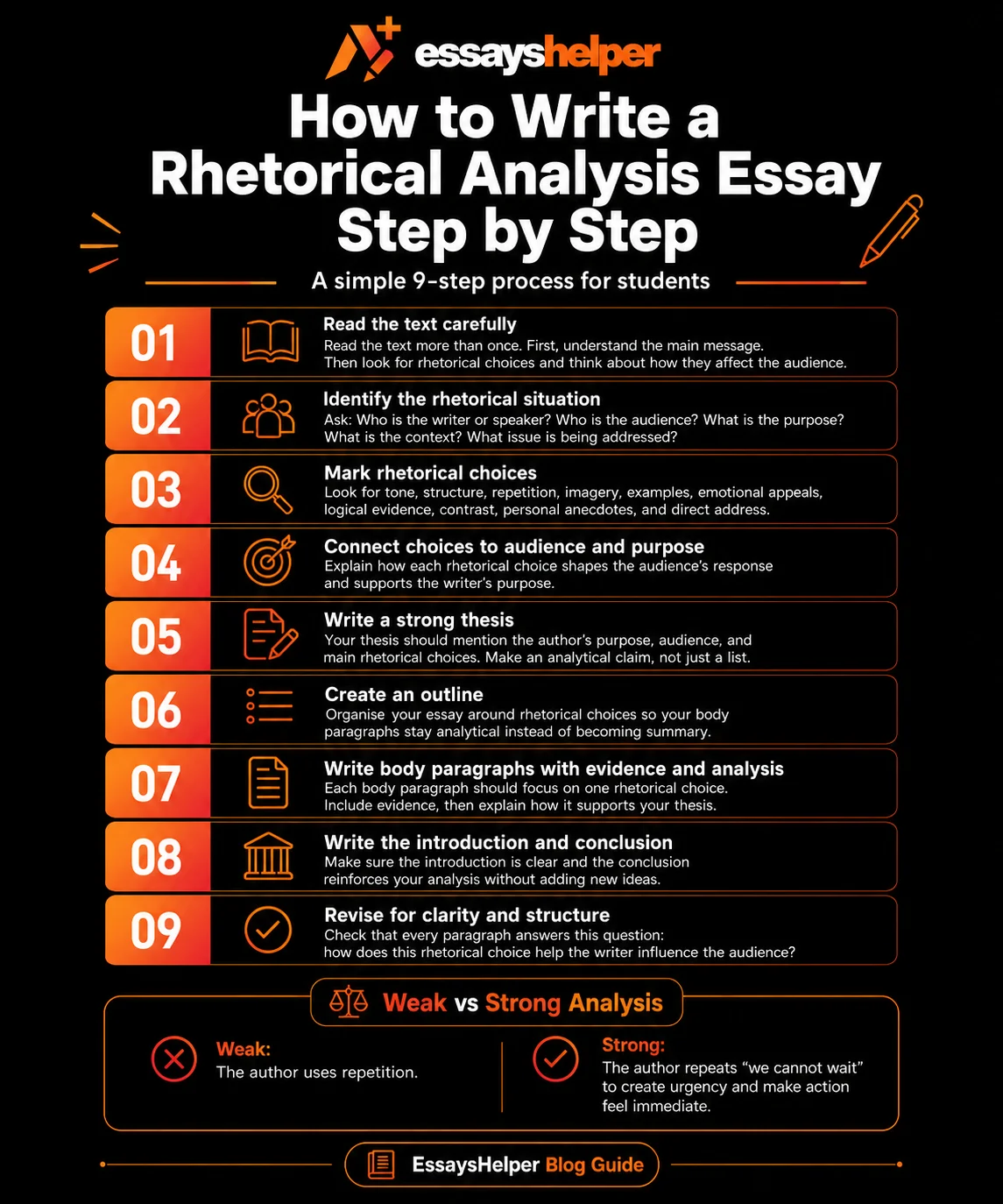
Step 1: Read the text carefully
Read the text more than once. The first time, understand the basic message. The second time, look for rhetorical choices. The third time, think about how those choices affect the audience.
Do not start writing too early. Many weak essays happen because students begin before they understand the rhetorical situation.
Step 2: Identify the rhetorical situation
Before analysing devices, answer these questions:
- Who is the writer or speaker?
- Who is the audience?
- What is the purpose?
- What is the context?
- What problem or issue is being addressed?
- What does the writer want the audience to believe, feel, or do?
These answers will guide your thesis and body paragraphs.
Step 3: Mark rhetorical choices
Look for choices such as tone, structure, repetition, imagery, examples, emotional appeals, logical evidence, contrast, personal anecdotes, and direct address.
Do not choose a device just because you can name it. Choose it because it clearly helps the author achieve a purpose.
Step 4: Connect each choice to audience and purpose
This is the heart of rhetorical analysis. You need to explain how the rhetorical choice affects the audience.
Weak analysis:
The author uses repetition.
Strong analysis:
The author repeats the phrase “we cannot wait” to create urgency and pressure the audience to see action as immediate rather than optional.
The strong version explains the effect.
Step 5: Write a strong thesis
Your thesis should mention the author’s purpose, audience, and main rhetorical choices. It should make an analytical claim, not just list devices.
Step 6: Create an outline
A rhetorical analysis essay outline helps you organise body paragraphs around rhetorical choices. This prevents you from drifting into summary.
Step 7: Write body paragraphs with evidence and analysis
Each body paragraph should focus on one main rhetorical choice. Include evidence from the text, then explain how that evidence supports your thesis.
Step 8: Write the introduction and conclusion
Some students write the introduction first. Others write it after drafting the body paragraphs. Either approach is fine as long as the final introduction is clear.
Step 9: Revise for clarity and structure
Check whether every paragraph answers the question: how does this rhetorical choice help the writer influence the audience?
If you feel stuck, essay writing can help students with planning, structure, editing, and improving clarity without replacing their own understanding.
How to Start a Rhetorical Analysis Essay
Many students struggle with how to start a rhetorical analysis essay because they either begin too broadly or jump into analysis without context.
A strong introduction should include:
- The author or speaker
- The title or type of text
- The context
- The audience
- The purpose
- The main rhetorical choices
- A clear thesis statement
A useful formula is:
In [text/speech/article], [author] addresses [topic] for [audience] by using [rhetorical choices] to [purpose].
Here is an example:
In her speech to high school graduates, the speaker addresses the uncertainty students face after graduation by using personal anecdotes, hopeful tone, and direct audience address to encourage resilience and confidence.
You can start with a hook, but keep it relevant. A rhetorical analysis does not need a dramatic opening. If you do use one, make sure it leads directly into the text you are analysing. If you need ideas, different hooks for essay can help you choose an opening that matches academic writing.
Rhetorical analysis essay introduction example
In Martin Luther King Jr.’s “I Have a Dream” speech, King addresses Americans during a period of racial injustice and calls for equality, justice, and national unity. Speaking to both civil rights supporters and the broader American public, he uses biblical references, repetition, and patriotic imagery to connect the struggle for civil rights with shared moral and national values. Through these rhetorical choices, King presents equality not as a distant political demand, but as an urgent promise that America must fulfil.
This introduction works because it gives context, identifies the audience, names rhetorical choices, and ends with an analytical thesis.
Rhetorical Analysis Essay Thesis
The thesis is one of the most important parts of a rhetorical analysis essay. It tells the reader what you will argue about the author’s rhetorical choices.
A good rhetorical analysis essay thesis should identify:
- The author or speaker
- The purpose
- The audience
- The main rhetorical choices
- The effect of those choices
Avoid writing a thesis that only says:
The author uses ethos, pathos, and logos.
That is too basic. It names appeals but does not explain what the author achieves with them.
| Weak Thesis | Problem | Strong Thesis | Why It Works |
| The author uses ethos, pathos, and logos. | Too vague and generic | The author builds credibility through expert evidence, uses emotional examples to create concern, and presents logical comparisons to convince parents that school nutrition policies need reform. | It explains choices, audience, and purpose |
| The speech is persuasive. | Does not explain how | The speaker uses repetition and urgent tone to make the audience feel that delaying action would be irresponsible. | It connects method to effect |
| The writer talks about climate change. | Summary, not analysis | The writer uses scientific evidence and vivid imagery to make climate change feel both factual and immediate. | It focuses on rhetorical strategy |
| The article has many rhetorical devices. | Too broad | The article combines personal anecdote, contrast, and direct address to make readers see homelessness as a human issue rather than a distant statistic. | It shows specific choices and purpose |
A strong thesis gives your essay direction. Every body paragraph should support it.
Rhetorical Analysis Essay Outline
A rhetorical analysis essay outline helps students avoid the biggest problem: summarising the text instead of analysing it. Your outline should be organised around rhetorical choices, not the order of the original text.
Basic rhetorical analysis essay outline
Introduction
Body Paragraph 1: First rhetorical choice
Body Paragraph 2: Second rhetorical choice
Body Paragraph 3: Third rhetorical choice
Conclusion
Detailed outline for rhetorical analysis essay
Introduction
Introduce the text, author, context, and audience.
Briefly explain the author’s purpose.
End with a thesis that identifies the main rhetorical choices and their effect.
Body Paragraph 1: First rhetorical choice
Start with a topic sentence naming the rhetorical choice.
Give evidence from the text.
Explain how the choice works.
Connect the choice to audience and purpose.
Link back to the thesis.
Body Paragraph 2: Second rhetorical choice
Introduce the second choice.
Use specific evidence.
Explain the audience effect.
Show how it supports the writer’s overall purpose.
Body Paragraph 3: Third rhetorical choice
Introduce the third choice.
Give evidence.
Analyse its impact.
Explain why it matters in the text as a whole.
Conclusion
Restate the thesis in fresh wording.
Summarise the main rhetorical choices.
Explain why the writer’s strategy is effective or meaningful.
For AP Lang, this outline may be shorter because students write under timed conditions. For college essays, it may be more detailed and include more evidence.
Rhetorical Analysis Essay Structure and Format
A rhetorical analysis essay structure should be clear and logical. Most essays follow an introduction, body, and conclusion format, but your instructor may have specific requirements.
A strong body paragraph usually follows this structure:
- Topic sentence
- Evidence from the text
- Analysis of rhetorical choice
- Connection to audience
- Connection to purpose
- Link back to thesis
For example:
The speaker uses repetition to create urgency. By repeating the phrase “now is the time,” the speaker makes action feel immediate rather than optional. This repetition pressures the audience to see delay as a moral failure. Because the speech is directed at citizens who have the power to support change, the repeated phrase turns a political message into a personal responsibility.
This paragraph works because it does not just identify repetition. It explains how repetition affects the audience.
Formatting depends on your assignment. Some teachers may ask for MLA format, while others may prefer APA or a school-specific format. Always check the assignment brief. Students often lose marks because of common essay format mistakes, such as missing titles, inconsistent spacing, incorrect citations, or weak paragraph layout.
Rhetorical Analysis Essay Template
A rhetorical analysis essay template can help you start, but do not follow it too mechanically. Use it as a guide, then adapt it to your own text and assignment.
Introduction template
In [title/type of text], [author/speaker] addresses [topic] in order to [purpose]. Writing or speaking to [audience], the author uses [rhetorical choice 1], [rhetorical choice 2], and [rhetorical choice 3] to [effect on audience].
Thesis template
Through [rhetorical choice 1], [rhetorical choice 2], and [rhetorical choice 3], [author] encourages [audience] to [think/feel/do something] by [larger purpose].
Body paragraph template
[Author] uses [rhetorical choice] to [effect]. For example, [evidence from text]. This choice works because [analysis]. It affects the audience by [audience response]. Therefore, the choice supports the author’s purpose of [purpose].
Evidence sentence template
This can be seen when the author states, “[short evidence].”
Analysis sentence template
This choice suggests that…
This language encourages the audience to…
The effect of this structure is…
This matters because…
If you need more academic phrasing, this guide to essay sentence starters can help you build smoother analysis.
Conclusion template
Overall, [author] uses [main rhetorical choices] to [purpose]. These choices are effective because they [audience effect]. Rather than simply presenting information, the text persuades the audience by [final insight].
Rhetorical Analysis Essay Example
Below is a sample rhetorical analysis essay based on a fictional public service speech. This avoids copyright issues while still showing how the structure works.
Sample text being analysed
A school principal gives a speech to students about reducing phone use during study hours. The principal argues that students should create phone-free study routines to improve focus, confidence, and academic performance.
Sample rhetorical analysis essay
In her speech about phone-free study routines, Principal Harris addresses students who struggle to focus in a distraction-heavy learning environment. Rather than presenting phone use as a personal failure, she frames it as a shared challenge that students can manage through practical choices. Harris uses direct address, relatable examples, and contrast between distraction and progress to encourage students to take control of their study habits.
Harris first uses direct address to make the speech feel personal and immediate. She repeatedly speaks to students using phrases such as “you already know how this feels” and “you have the power to change the first ten minutes of your study session.” This direct language reduces distance between the speaker and the audience. Instead of sounding like an authority figure giving orders, Harris sounds like someone who understands the students’ daily experience. This choice is effective because the audience is more likely to listen when they feel recognised rather than blamed.
The principal also uses relatable examples to make the problem easy to understand. She describes a student who opens a textbook, checks one notification, replies to a message, watches a short video, and then realises that twenty minutes have passed. This example works because it reflects a situation many students have experienced. By using a familiar scenario, Harris makes the issue concrete instead of abstract. The audience does not have to imagine what distraction means because the speech shows it through a realistic moment. This helps students see their own habits without feeling directly attacked.
In addition, Harris uses contrast to show the difference between distracted study and focused study. She compares “twenty minutes of half-attention” with “ten minutes of real concentration.” This contrast challenges the audience to rethink the value of time. The comparison suggests that effective studying is not only about spending more hours at a desk, but about protecting the quality of attention. This rhetorical choice supports the speaker’s purpose because it makes the solution feel achievable. Students may feel overwhelmed by the idea of studying for hours, but ten focused minutes sounds realistic.
Harris’s tone also strengthens her message. Her speech is serious but encouraging. She does not shame students for using phones, nor does she claim that technology is always harmful. Instead, she recognises that phones are part of everyday life while still arguing that students need boundaries. This balanced tone makes the speech more persuasive because it avoids exaggeration. Students are more likely to accept the argument when it feels fair and practical.
Overall, Harris uses direct address, relatable examples, contrast, and encouraging tone to persuade students to build phone-free study routines. Her speech is effective because it treats students as capable decision-makers rather than as careless technology users. By connecting the problem to real student habits and offering a realistic solution, Harris makes focused studying feel possible and worthwhile.
Why this rhetorical analysis essay example works
This example works because it does not simply summarise the speech. It explains how the principal’s rhetorical choices affect the student audience. Each body paragraph focuses on one choice, gives evidence, explains the effect, and connects back to the speaker’s purpose.
The essay also avoids overusing ethos, pathos, and logos as labels. Instead, it explains specific choices like direct address, relatable examples, contrast, and tone.
AP Lang Rhetorical Analysis Essay
The AP Lang rhetorical analysis essay asks students to analyse how a writer or speaker uses rhetorical choices to develop an argument or achieve a purpose. AP Lang students often struggle because the exam is timed, so they do not have much space for long planning.
In AP Language and Composition rhetorical analysis, you should focus on rhetorical choices. Do not just list devices. The College Board’s AP English Language and Composition rubric focuses on thesis, evidence and commentary, and sophistication. This means students need a defensible thesis, relevant evidence, and explanation of how the evidence supports the argument.
How to write a rhetorical analysis essay AP Lang style
Read the prompt carefully.
Identify the speaker, audience, context, and purpose.
Look for major rhetorical choices.
Choose two or three choices you can explain well.
Write a defensible thesis.
Use evidence from the passage.
Explain how each choice supports the speaker’s purpose.
Avoid long summary.
Manage your time.
For example, an AP Lang rhetorical analysis essay prompt may ask you to analyse how a speaker uses rhetorical choices to persuade an audience about education reform. You should not spend the whole essay explaining education reform. You should analyse how the speaker’s language, evidence, tone, and structure persuade the audience.
Students preparing for timed essays can benefit from exam preparation tips because AP Lang success depends not only on knowledge, but also on reading speed, planning, and time control.
AP Lang Rhetorical Analysis Essay Rubric
The AP Lang rhetorical analysis essay rubric is usually explained through three broad areas: thesis, evidence and commentary, and sophistication. Always follow the official College Board guidance and your teacher’s instructions, but the table below gives a student-friendly explanation.
| Rubric Area | What It Means | How to Improve | Common Mistake |
| Thesis | You make a defensible claim about rhetorical choices | Mention purpose, audience, and key choices | Writing only “the author uses ethos, pathos, and logos” |
| Evidence and commentary | You use passage evidence and explain how it supports your claim | Use specific references and explain the effect | Quoting without analysis |
| Sophistication | You show complexity, nuance, or deeper understanding | Connect choices to broader context or tensions in the text | Adding fancy words without deeper thinking |
The most important part for many students is commentary. Commentary means your explanation. It is where you show how the rhetorical choice works.
Weak commentary:
This quote shows pathos.
Stronger commentary:
This emotional image encourages the audience to view the issue as urgent and personal, which supports the speaker’s call for immediate action.
The second version is stronger because it explains the effect on the audience.
How to Write a Good Rhetorical Analysis Essay
A good rhetorical analysis essay is specific, organised, and analytical. It does not simply name devices. It explains how choices work.
Strong rhetorical analysis usually includes:
- A clear thesis
- Specific rhetorical choices
- Evidence from the text
- Explanation of audience effect
- Connection to purpose
- Strong paragraph structure
- Academic tone
- Accurate vocabulary
- A conclusion that adds final insight
One useful rule is to ask “so what?” after every piece of evidence. If you write, “The author uses repetition,” ask yourself, so what? Why does that repetition matter? What does it make the audience feel, believe, or understand?
Better academic vocabulary can also improve your analysis. Instead of saying “the author makes the reader feel bad,” you might say “the author creates sympathy,” “builds urgency,” or “encourages moral responsibility.” An academic vocabulary list can help students find more precise wording.
Rhetorical Analysis Essay Topics and Ideas
Choosing the right text is important. A good rhetorical analysis essay topic should involve a text that clearly tries to persuade, inform, inspire, criticise, or influence an audience.
| Topic Idea | Possible Text Type | Rhetorical Focus | Best For |
| A famous political speech | Speech | Repetition, tone, patriotism | AP Lang or college writing |
| A climate change campaign | Advertisement or article | Imagery, urgency, evidence | High school or college |
| A public health message | Poster or video | Fear appeal, credibility, direct address | Visual rhetoric |
| A graduation speech | Speech | Personal anecdote, encouragement | Student-friendly analysis |
| A newspaper opinion article | Article | Logic, counterargument, tone | Argument analysis |
| A charity advertisement | Advertisement | Pathos, visual rhetoric, audience responsibility | Short essay |
| A TED Talk | Speech | Storytelling, humour, structure | Presentation analysis |
| A historical letter | Letter | Tone, audience, moral appeal | Advanced analysis |
| A university campaign | Webpage or poster | Audience targeting, credibility | Practical analysis |
| A social justice speech | Speech | Repetition, contrast, emotional appeal | AP Lang or college |
Good rhetorical analysis essay ideas often come from texts with a clear audience and purpose. If the text is too neutral, it may be harder to analyse.
How to Title a Rhetorical Analysis Essay
Students often ask how to title a rhetorical analysis essay. The title should be clear, specific, and connected to your analysis.
Avoid titles like:
Rhetorical Analysis Essay
My Essay
Analysis Paper
Better titles include:
- A Rhetorical Analysis of Martin Luther King Jr.’s “I Have a Dream”
- Urgency and Hope in a Climate Change Speech
- How Direct Address Persuades Students to Change Study Habits
- Ethos and Emotional Appeal in a Public Health Campaign
- The Power of Repetition in Political Speech
A good title tells the reader what text or strategy you are analysing. It does not need to be overly creative, but it should not be vague.
How Long Should a Rhetorical Analysis Essay Be?
The length depends on the assignment.
An AP Lang rhetorical analysis essay is usually shorter because it is written under exam conditions. It may be only a few paragraphs, but it still needs a thesis, evidence, and commentary.
A high school rhetorical analysis essay may be around 800 to 1200 words.
A college rhetorical analysis essay may be 1200 to 2000 words or more.
A longer academic paper may require more detailed research, formal citations, and deeper analysis.
Always follow your assignment brief. If your teacher asks for 1000 words, do not write 2500 just because you have more to say. If your professor asks for specific formatting, follow that carefully. Ignoring instructions is one of the most common essay formatting mistakes.
How to Conclude a Rhetorical Analysis Essay
A conclusion should not introduce new evidence. It should restate your main argument in fresh words and explain why your analysis matters.
A rhetorical analysis essay conclusion should:
- Restate the thesis in new wording
- Summarise the main rhetorical choices
- Explain how those choices support the purpose
- End with a final insight about the text’s effectiveness
Basic conclusion example
Overall, the speaker uses emotional examples, repetition, and direct address to persuade students to take study habits more seriously. These rhetorical choices make the message feel personal and urgent. By connecting the issue to students’ everyday experiences, the speaker makes the argument easier to understand and more convincing.
Stronger analytical conclusion example
Ultimately, the speaker’s argument is effective because it does not simply warn students about distraction. Instead, it uses relatable examples, direct address, and hopeful tone to present focus as a realistic choice within students’ control. These rhetorical choices help transform a common academic problem into a practical call for self-discipline and confidence.
The stronger conclusion works better because it gives a final insight instead of just repeating the body paragraphs.
Common Mistakes Students Make in Rhetorical Analysis Essays
Many students lose marks because they understand the text but do not analyse it properly. Here are the most common mistakes.
Summarising instead of analysing
This is the biggest mistake. Do not retell the whole text. Explain how the writer’s choices influence the audience.
Listing devices without explaining effect
Writing “the author uses ethos, pathos, and logos” is not enough. You need to explain how those appeals work.
Forgetting audience and purpose
Every rhetorical choice should connect to the audience and the author’s goal. If you ignore audience and purpose, the analysis becomes shallow.
Writing a vague thesis
A weak thesis gives the essay no direction. Be specific about the author’s choices and their effect.
Using weak evidence
Choose evidence that clearly shows the rhetorical choice. Do not use random quotes just to fill space.
Overusing ethos, pathos, and logos
These appeals are useful, but rhetorical analysis includes more than three labels. Discuss tone, structure, contrast, diction, imagery, examples, and context too.
Making personal opinion the focus
Your opinion about the topic is not the main point. The essay should analyse the writer’s strategy.
Poor paragraph structure
Each paragraph should focus on one main rhetorical choice. If one paragraph discusses too many ideas, it becomes confusing.
Weak conclusion
Do not end with “that is why this essay is important.” Give a final analytical insight.
Students who need help turning observations into structured analysis can use analytical essay support to improve argument, paragraph flow, and academic clarity.
Rhetorical Analysis Essay Checklist
Before submitting your rhetorical analysis essay, use this checklist.
- Have I identified the speaker or writer?
- Have I identified the audience?
- Have I explained the purpose?
- Have I described the context?
- Have I chosen specific rhetorical choices?
- Have I included evidence from the text?
- Have I explained how each choice works?
- Have I connected each choice to audience and purpose?
- Have I avoided summary?
- Have I written a clear thesis?
- Have I used academic tone?
- Have I checked formatting and citations?
- Have I proofread the final draft?
Some students use AI tools to brainstorm or understand essay structure, but you should always follow your school’s academic integrity rules. If you are using ChatGPT for essay support, use it responsibly for learning, planning, or checking clarity, not for submitting work you do not understand.
For final editing, check whether your essay sounds clear, specific, and analytical. A rhetorical analysis essay should show that you understand not only the text, but also how persuasion works.
FAQs About Rhetorical Analysis Essays
What is a rhetorical analysis essay?
A rhetorical analysis essay explains how a writer or speaker uses language, structure, tone, evidence, and rhetorical choices to influence an audience. It is not just a summary of the text.
How do you write a rhetorical analysis essay?
Start by identifying the speaker, audience, purpose, and context. Then choose key rhetorical choices, write a clear thesis, use evidence from the text, and explain how each choice affects the audience.
How do you start a rhetorical analysis essay?
Start with the text, author, context, audience, and purpose. Then introduce the main rhetorical choices and end the introduction with a focused thesis statement.
What is a good rhetorical analysis essay thesis?
A good thesis identifies the author’s purpose, audience, and main rhetorical choices. It should explain how those choices help the author persuade, inform, or influence the audience.
What is a rhetorical analysis essay outline?
A rhetorical analysis essay outline usually includes an introduction, body paragraphs focused on rhetorical choices, evidence and analysis, and a conclusion. Each body paragraph should connect back to the thesis.
What should a rhetorical analysis essay include?
It should include the rhetorical situation, a thesis, analysis of rhetorical choices, evidence from the text, explanation of audience effect, and a conclusion that summarises the overall strategy.
How do you write an AP Lang rhetorical analysis essay?
For AP Lang, read the prompt carefully, identify the rhetorical situation, choose strong rhetorical choices, write a defensible thesis, use evidence, and explain how the choices support the speaker’s purpose.
How do you conclude a rhetorical analysis essay?
Restate your main argument in fresh words, summarise the key rhetorical choices, and explain why the author’s strategy matters. Do not introduce new evidence in the conclusion.
What are good rhetorical analysis essay topics?
Good topics include speeches, opinion articles, advertisements, public service campaigns, letters, TED Talks, political speeches, and visual texts with a clear audience and purpose.
What is the biggest mistake in a rhetorical analysis essay?
The biggest mistake is summarising instead of analysing. Students should explain how the writer persuades the audience, not just repeat what the text says.
Conclusion
A rhetorical analysis essay is about explaining how a writer or speaker persuades, informs, or influences an audience through rhetorical choices. It is not enough to summarise the text or list devices. You need to connect language, tone, structure, evidence, and strategy to the author’s purpose.
The strongest rhetorical analysis essays have a clear thesis, specific evidence, strong commentary, and a steady focus on audience and purpose. Whether you are writing for high school, college, or AP Lang, the goal is to show how the text works.
EssaysHelper can support students who need help planning, writing, editing, or improving rhetorical analysis essays, especially when they struggle with structure, thesis development, examples, or academic tone.