
You attend a lecture, complete a group project, read an interesting book, or finish your first clinical placement. Then your instructor asks you to write a reflection paper.
At first, the assignment sounds simple. You only need to explain what happened and how you felt about it, right?
Not exactly.
Many students struggle with reflection papers because they either summarize the entire experience or write something that sounds like a private diary. A strong reflection paper requires more than describing an event. You must examine your response, connect the experience with academic ideas, explain what you learned, and show how the lesson may influence your future actions.
So, how do you write a reflection paper?
To write a reflection paper, identify one meaningful experience or idea, describe it briefly, analyze your thoughts and reactions, connect your learning with relevant concepts or evidence, and explain how your understanding or future behavior has changed. Organize these ideas into an introduction, focused body paragraphs, and a meaningful conclusion.
This guide explains the complete process, including the correct reflection paper format, an adaptable outline, a detailed reflection paper example, APA guidance, topic ideas, templates, and solutions to common writing problems.
Students who need further academic guidance can also explore resources from Essay Helper while developing their own ideas and maintaining academic integrity.
What Is a Reflection Paper?
A reflection paper is an academic assignment in which you examine your response to an experience, reading, event, course, project, or idea. It combines personal observation with analysis.
Unlike a summary, a reflection does not simply report what happened. It explores questions such as:
- What did I think or feel?
- Why did I respond that way?
- Which assumptions influenced my reaction?
- What did the experience teach me?
- How does it connect with a theory, reading, or course concept?
- What would I do differently in the future?
A reflection paper is personal because it includes your perspective. However, it is still an academic paper. Your ideas should be organized, relevant, clearly explained, and connected with the purpose of the assignment.
The University of Edinburgh describes reflection as a conscious examination of experiences, thoughts, choices, and ways of working. The purpose is not just to look backward but to identify learning that can guide present and future actions.
That distinction is important. A sentence such as “The presentation was difficult, but I learned a lot” gives the reader very little information. A reflective version explains what was difficult, why it was difficult, what the student discovered, and how that discovery will change the student’s approach next time.
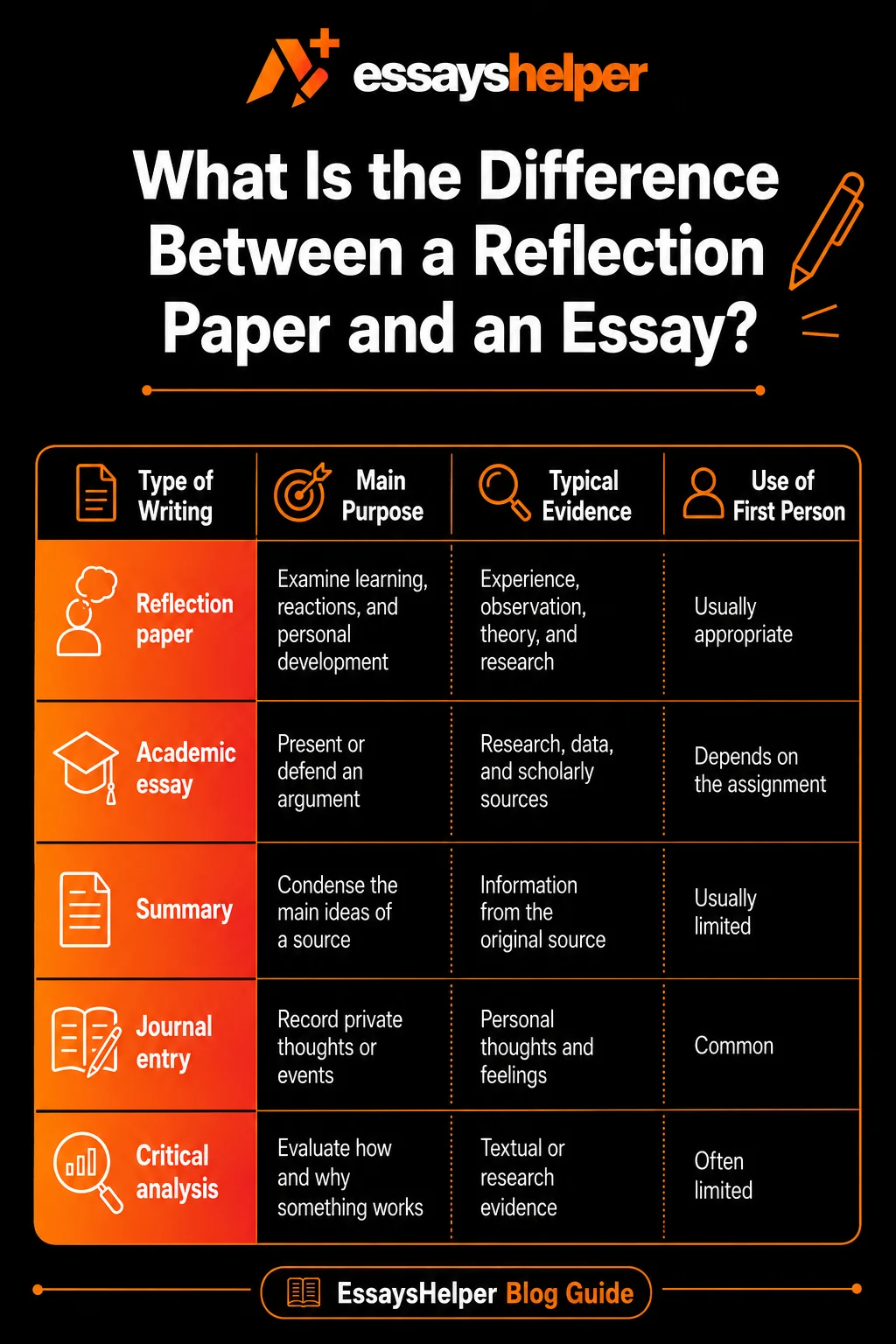
It may describe a personal experience, but description is only the starting point. You must interpret the experience and explain its significance.
Purdue University’s guidance on critical reflection warns that reflective assignments can lose their structure and become disconnected personal thoughts when writers focus only on themselves or the past. Effective reflection therefore requires organization, analysis, and a clear connection between experience and learning.
Common Types of Reflection Papers
The exact content of your paper depends on the assignment. Here are some of the most common types.
Experiential Reflection
An experiential reflection examines something you personally experienced. It could involve a presentation, volunteer activity, laboratory exercise, field visit, internship, or workplace situation.
You might explain how you responded to the event, what challenged your expectations, and what you learned from your actions.
Reading Reflection
A reading reflection focuses on a book, article, chapter, or other text.
Rather than summarizing every argument, you select the ideas that affected your thinking. You may discuss whether the author confirmed, challenged, or complicated your previous beliefs.
Course Reflection
A course reflection considers what you learned during a module, semester, workshop, or training program.
It may address your academic development, difficult concepts, changes in your thinking, and skills you plan to use in future courses.
Clinical Reflection
Clinical reflections are common in nursing, medicine, social work, occupational therapy, and other healthcare subjects.
Students may reflect on communication, patient dignity, ethical decision-making, teamwork, professional boundaries, or the application of clinical knowledge.
Patient confidentiality must always be protected. Avoid including names or details that could identify a patient.
Internship or Placement Reflection
An internship reflection connects workplace experience with academic learning.
You might evaluate how you handled a professional responsibility, communicated with colleagues, solved a problem, or applied classroom knowledge in a real organization.
Group Project Reflection
This type of paper evaluates your role in a collaborative task.
It can explore leadership, workload distribution, conflict, decision-making, communication, accountability, and the quality of the final outcome.
Research Reflection
A research reflection examines your experience of planning or conducting research.
You may discuss difficulties with topic selection, source evaluation, data collection, ethics, methodology, analysis, or unexpected findings.
Critical Reflection
Critical reflection goes beyond evaluating personal performance. It considers how social, cultural, institutional, professional, or ethical factors influenced an experience.
For example, a student might examine how power differences affected participation in a group discussion or how an organizational policy influenced the treatment of clients.
Reflection Paper Format
There is no single reflection paper format used by every school, department, or instructor. Always check the assignment brief before following general guidance.
Most reflection papers contain four basic elements:
- A title
- An introduction
- Several body paragraphs
- A conclusion
References may also be required if you use theories, course readings, research studies, policies, or other sources.
| Element | What to include |
| Title | A specific title that reflects the experience or central lesson |
| Introduction | Context, subject, and main reflective insight |
| Body | Description, reaction, analysis, theory, learning, and future application |
| Conclusion | Main lesson, development, and intended future action |
| References | Full details of cited sources when required |
Unless your instructor provides different instructions, use a readable font, consistent spacing, standard margins, page numbers, and clear paragraphs.
A reflection paper is flexible, but it should not look disorganized. Reviewing the best essay format for students can help you understand basic academic presentation before adapting it to reflective writing.
How Long Should a Reflection Paper Be?
The required length varies significantly.
A short classroom reflection may be 300 to 500 words. A more detailed university reflection might be 1,000 to 2,000 words. Clinical, placement, or professional reflections may be longer and may require a specific reflective model.
Do not add unnecessary events simply to reach the word count. A focused analysis of one meaningful moment is often stronger than a shallow discussion of an entire semester.
Reflection Paper Outline
Creating a reflection paper outline helps you decide what to describe, what to analyze, and where to place each idea.
Your outline does not need to be complicated.
Introduction
Your introduction should:
- Identify the experience, reading, course, or issue
- Provide only the context the reader needs
- Explain why the subject matters
- Present your main insight or reflective thesis
A reflective thesis is the main lesson or change in understanding that your paper will explore.
For example:
My first group presentation showed me that effective teamwork depends less on dividing tasks equally and more on communicating expectations, reviewing progress, and addressing problems before they affect the final result.
This sentence establishes a clear focus. The paper can now explain how the student reached that conclusion.
Body Paragraphs
A useful body paragraph structure is:
- Introduce one moment, reaction, or issue.
- Describe what happened briefly.
- Explain what you thought or felt.
- Analyze why you responded that way.
- Connect the experience with a theory, reading, or professional principle.
- Explain what you learned.
- State how the lesson will influence future action.
Reflection papers do not always have to follow the rigid structure of a five paragraph essay. The number of paragraphs should depend on the assignment length and the number of ideas you need to develop.
Conclusion
The conclusion should bring your learning together.
It should:
- Return to the central insight
- Explain how your understanding changed
- Identify the most important lesson
- State how you will apply the lesson
- Avoid introducing a completely new experience
Fill-in-the-Blank Reflection Paper Outline
Introduction
Before this experience, I believed that __________. The experience involved __________. Although I initially expected __________, I discovered that __________. This reflection examines how the experience changed my understanding of __________.
Body Paragraph 1
The most significant moment occurred when __________. At the time, I thought or felt __________ because __________. Looking back, my response was influenced by __________.
Body Paragraph 2
This experience relates to __________, which explains that __________. Applying this idea helped me understand that __________. The situation was therefore important because __________.
Body Paragraph 3
If I faced a similar situation again, I would __________. This approach would be more effective because __________. I will apply this lesson by __________.
Conclusion
Overall, the experience changed my understanding of __________. The most important lesson was __________. In future, I will __________.
How to Start a Reflection Paper
Students frequently ask how to start a reflection paper because the first sentence can feel awkward.
You do not need to begin with a dramatic quotation or a dictionary definition. Start with the moment, expectation, problem, or realization that drives your reflection.
Start With a Realization
I entered the presentation believing that careful preparation would prevent every problem, but I left understanding that adaptability is just as important as planning.
Start With a Meaningful Moment
When two members of our group presented conflicting figures, the silence that followed revealed how little we had communicated during the project.
Start With an Expectation
Before beginning my clinical placement, I expected technical knowledge to be my greatest challenge. Instead, communicating with anxious patients required the most adjustment.
Start With a Question
Why did I remain silent when I knew the group was making the wrong decision?
A question can work when the rest of the introduction answers or explores it. Do not use a question only to sound interesting.
Start With a Contrast
At the beginning of the semester, I treated feedback as a judgment of my ability. By the final assignment, I had begun to see it as information I could use.
Students can also review different hooks to understand how openings create interest. However, the hook must remain relevant to the reflection.
Weak and Improved Openings
Weak opening:
In this paper, I am going to reflect on my group project.
Improved opening:
Our group completed the project on time, but the final week exposed weaknesses in our communication that had been present from the beginning.
The improved version introduces a problem and gives the paper a direction.
Weak opening:
Teamwork is very important in life.
Improved opening:
I had always assumed that good teamwork meant avoiding disagreement, but our project showed me that respectful disagreement can prevent larger problems.
The second sentence is more specific, personal, and analytical.
How to Write a Reflection Paper Step by Step
The following process can help when you are wondering, “How can I write a reflection paper without simply retelling the experience?”
Step 1: Understand the Assignment
Read the instructions carefully before choosing what to discuss.
Identify:
- The required subject
- The word count
- The deadline
- The intended audience
- Whether sources are required
- The required citation style
- Whether a reflective model must be used
- The assessment criteria
- Any questions you must answer
Pay attention to instruction words such as reflect, analyze, evaluate, discuss, connect, compare, and apply.
If the brief asks you to evaluate your contribution to a group project, do not spend most of the paper discussing what other members did. If it asks you to connect experience with theory, personal feelings alone will not meet the requirement.
Students who struggle to interpret complex instructions may benefit from appropriate academic assignment support before drafting.
Step 2: Choose One Main Experience or Idea
Do not try to include every event.
Select a moment that:
- Challenged an assumption
- Created a problem
- Changed your understanding
- Revealed a strength or weakness
- Connected clearly with course material
- Influenced a later decision
For a semester reflection, you may discuss several moments, but they should support one overall message.
Step 3: Record Your Initial Reactions
Before organizing the paper, write honest notes.
Ask yourself:
- What happened?
- What did I expect?
- What surprised me?
- What made me uncomfortable?
- What went well?
- What went wrong?
- What did I avoid?
- What did I misunderstand?
- How did other people respond?
- What do I think about the event now?
These notes are for planning. You do not need to include every feeling in the final paper.
Step 4: Identify the Main Lesson
Move from “what happened” to “what it meant.”
Suppose your group submitted a strong project, but one student completed most of the work. The lesson may not simply be that the project was successful. A deeper lesson could be that a good final grade does not always prove that a team worked effectively.
Your central insight might be:
The project taught me that avoiding difficult conversations can create an appearance of cooperation while allowing unfair workload patterns to continue.
That is a focused reflective argument.
Step 5: Connect the Experience With Academic Learning
Personal experience provides the subject, but academic concepts can help you explain it.
Depending on the discipline, you might connect the experience with:
- A communication theory
- A leadership model
- A psychological concept
- A professional code
- A clinical guideline
- An ethical principle
- A course reading
- A research finding
- An organizational policy
Do not add a theory only because you need a citation. Use it to interpret the experience.
A weak connection says:
This relates to leadership theory.
A stronger connection says:
The experience challenged my assumption that leadership depends on giving instructions. The course model of shared leadership helped me recognize that leadership can also involve creating opportunities for others to contribute to decisions.
Step 6: Prepare the Outline
Arrange your notes into sections.
A simple plan may look like this:
- Introduction: My initial belief about teamwork
- Body 1: The communication problem
- Body 2: Why I avoided addressing it
- Body 3: Connection with conflict-management theory
- Body 4: What I would do differently
- Conclusion: How my understanding of leadership changed
This structure prevents repetition.
Step 7: Write the First Draft
Write the first draft without trying to make every sentence perfect.
Keep the description brief. Give the reader enough information to understand the situation, then spend more space analyzing it.
Instead of writing three paragraphs about everything that happened during a presentation, identify the moment that produced your main learning.
Step 8: Add Evidence Where Needed
You may need citations when you:
- Define a theory
- Explain a reflective model
- Refer to a research finding
- Discuss a professional standard
- Paraphrase a course reading
- Quote another author
- Use factual information that is not common knowledge
You normally do not need a source to state how you personally felt. However, you may use research or theory to analyze why you felt that way.
Step 9: Revise for Reflective Depth
During revision, ask:
- Have I explained why the experience mattered?
- Have I analyzed my response?
- Have I challenged my assumptions?
- Have I connected experience with learning?
- Have I acknowledged another possible interpretation?
- Have I explained what changed?
- Have I identified a realistic future action?
Replace vague statements.
Vague:
I learned that communication is important.
Specific:
I learned that sending task instructions is not the same as confirming shared understanding. In future projects, I will ask each member to restate their responsibilities and raise concerns before work begins.
Step 10: Edit and Proofread
Check the paper at paragraph and sentence level.
Look for:
- Repeated ideas
- Long background sections
- Informal expressions
- Unsupported claims
- Unclear pronouns
- Sudden changes in tense
- Missing citations
- Overly long sentences
- Grammar and punctuation errors
Using a deliberate mixture of simple, compound, and complex types of sentences can make the reflection sound natural without reducing clarity.
A Simple Reflective Writing Framework
One of the easiest ways to organize reflection is:
What?
What happened?
Describe the experience, but include only the details the reader needs.
So What?
Why did it matter?
Examine your reaction, assumptions, decisions, strengths, mistakes, and the connection with relevant knowledge.
Now What?
What will you do next?
Explain how the learning will influence your future actions, study, practice, or decision-making.
This framework is useful because it prevents the paper from ending immediately after the description.
Established Reflective Models
Some instructors require students to use a specific model. A model provides questions and stages, but it should not control your writing so rigidly that every reflection sounds mechanical.
Gibbs’ Reflective Cycle
Gibbs’ Reflective Cycle contains six stages:
- Description
- Feelings
- Evaluation
- Analysis
- Conclusion
- Action plan
The model was developed to help learners examine experiences systematically and use the learning to approach future situations. The University of Edinburgh’s explanation of Gibbs’ Reflective Cycle provides guiding questions for each stage.
Gibbs can be useful for placements, practical activities, teamwork, and repeated professional experiences.
Kolb’s Experiential Learning Cycle
Kolb’s cycle focuses on learning through experience. It moves through:
- Concrete experience
- Reflective observation
- Abstract conceptualization
- Active experimentation
In simple terms, you experience something, examine it, develop an explanation, and test your new understanding through later action. The Open University provides an accessible overview of Kolb’s experiential learning cycle.
Schön’s Reflective Practice
Schön distinguishes between reflection-in-action and reflection-on-action.
Reflection-in-action happens while the situation is unfolding. For example, a teacher notices that students are confused and changes the explanation immediately.
Reflection-on-action happens afterward, when the teacher considers why the original explanation failed and how future teaching could improve. This distinction is explained in the Open University’s material on becoming a reflective practitioner.
You do not need to use every reflective model. Follow the model stated in your assignment, or choose the one that best suits the experience.
How Much Description and Analysis Should You Include?
One of the most common problems in reflection paper examples is excessive description.
There is no universal percentage that applies to every paper. However, analysis and learning should normally receive more attention than background information.
| Descriptive writing | Reflective writing |
| Explains what happened | Explains why it mattered |
| Reports actions | Evaluates actions |
| States feelings | Examines the cause of feelings |
| Lists difficulties | Analyzes why difficulties occurred |
| Describes an outcome | Connects the outcome with learning |
| Looks backward | Uses the past to guide future action |
Consider this sentence:
I became nervous when the instructor asked me a question.
It reports a feeling but does not analyze it.
A stronger version is:
I became nervous when the instructor questioned my recommendation because I had prepared to explain the final answer but not the reasoning behind it. This exposed my tendency to memorize conclusions instead of developing a defensible understanding of the evidence.
The improved version identifies the reaction, its cause, and the lesson.
Finding the Right Reflective Voice
Reflective writing can use “I,” but that does not mean every sentence should begin with it.
Compare:
I attended the workshop. I found the first activity difficult. I did not understand the instructions. I asked another student for help.
With:
The first workshop activity was difficult because I interpreted the instructions too narrowly. After discussing them with another student, I recognized that the task allowed several valid approaches.
The second version remains personal but is smoother and more analytical.
Developing a personal style for writing can help your reflection sound genuine. Authentic writing does not require slang, excessive emotion, or casual language. It means expressing your actual reasoning instead of relying on generic claims.
The appropriate tone is personal, thoughtful, specific, and academically responsible. Learning about different writing tones can help you avoid sounding either too informal or unnecessarily distant.
Complete Reflection Paper Example
The following reflection paper sample is based on a university group presentation. It demonstrates how personal experience, analysis, course learning, and future action can work together.
Learning to Address Conflict in Group Work
Before beginning our marketing presentation, I believed that good teamwork depended on maintaining harmony. I assumed that disagreement would slow our progress and create unnecessary tension. As a result, I often accepted decisions even when I had concerns about them. The project eventually showed me that avoiding disagreement does not remove conflict. It allows problems to remain unspoken until they become more difficult to solve. My experience taught me that effective teamwork requires respectful communication, clear accountability, and a willingness to address concerns early.
Our group consisted of five students, and we had four weeks to produce a market-entry presentation. During our first meeting, we divided the work into research, competitor analysis, financial estimates, slide preparation, and presentation delivery. The arrangement appeared fair, so we did not discuss how the sections would be combined or how progress would be reviewed. We created a shared folder and agreed to upload our work three days before the deadline.
At first, the project seemed to progress well. Each member reported that their section was under control. However, one week before the presentation, only two sections had been uploaded. I had completed the competitor analysis and could see that some of its findings affected the proposed market-entry strategy. I wanted to organize another meeting, but two members said they were busy and would upload their work later. I accepted this response because I did not want to appear controlling.
Looking back, my decision was influenced by my belief that questioning another student’s progress would damage the group relationship. I treated politeness and silence as the same thing. I also assumed that every group member understood the urgency in the same way. These assumptions prevented me from asking direct questions about incomplete tasks.
The missing sections arrived the evening before the presentation. When we combined them, we discovered that the financial estimates were based on a different target market from the competitor analysis. The presentation therefore contained two conflicting recommendations. We spent several hours changing the slides and did not have enough time to rehearse properly.
During the presentation, the lack of rehearsal became clear. Two members repeated the same information, and another struggled to explain how the financial estimates supported our recommendation. Although we received a satisfactory grade, the instructor commented that the presentation appeared to have been assembled from separate pieces rather than developed as one argument.
My first reaction was frustration. I blamed the late submissions and believed that the outcome would have been stronger if everyone had completed their tasks earlier. That explanation was partly accurate, but it allowed me to ignore my own responsibility. I had recognized the risk one week before the deadline and chose not to address it.
The experience changed how I understood conflict in group work. I had previously viewed conflict as an argument between people. I now recognize that conflict can also involve competing interpretations, priorities, assumptions, and working methods. Discussing these differences early may feel uncomfortable, but it can protect the group from more serious tension later.
I also learned that dividing tasks is not enough to create accountability. Our group had assigned responsibilities, but we had not established review dates, quality expectations, or a process for resolving inconsistencies. We focused on individual completion rather than collective coordination. This approach allowed each person to work independently, but it did not ensure that the sections supported the same conclusion.
If I completed a similar project again, I would suggest three changes during the first meeting. First, the group would agree on the central argument before dividing the work. Second, we would establish internal deadlines at least one week before the submission date. Third, we would hold a short progress meeting in which every member presents their findings and explains how they support the overall recommendation.
I would also respond differently if a deadline were missed. Instead of saying, “No problem, upload it when you can,” I would ask what prevented completion, whether the student needed support, and how the delay might affect other tasks. This response would remain respectful while making the consequences visible.
The experience also revealed a personal development need. I need to become more comfortable expressing concerns when the purpose is to improve the work rather than criticize another person. Respectful disagreement does not require aggression. It can involve asking for clarification, identifying a risk, or proposing an alternative.
Overall, the project taught me that harmony is not created by avoiding difficult conversations. Strong teamwork depends on making expectations clear and creating opportunities to identify problems before they affect the final outcome. In future group assignments, I will treat communication as a continuing process rather than something completed during the first meeting. I will also raise concerns earlier, explain why they matter, and invite the group to solve them collectively.
Why This Reflection Paper Example Works
This example works because it does not merely describe the presentation.
It:
- Establishes an initial belief
- Focuses on one central problem
- Acknowledges personal responsibility
- Examines the assumptions behind the student’s behavior
- Identifies a change in understanding
- Proposes specific future actions
- Ends by returning to the main lesson
The paper also avoids portraying other group members as the only cause of the problem. Reflective writing becomes stronger when students examine their own choices honestly.
Reflection Paper Sample Paragraphs by Discipline
Nursing Reflection Sample
During the interaction, I concentrated so heavily on completing the assessment questions that I failed to notice how uncomfortable the patient had become. When the patient began giving shorter answers, I initially interpreted the behavior as unwillingness to cooperate. After discussing the situation with my supervisor, I recognized that my rapid questioning may have made the conversation feel procedural rather than supportive. In future assessments, I will pause more frequently, explain why sensitive questions are necessary, and check whether the patient needs additional time.
Business Reflection Sample
I entered the negotiation believing that a successful outcome required defending our proposed price. However, the other team’s questions revealed that delivery time was more important to them than a small price reduction. This showed me that I had focused on our priorities without investigating theirs. In future negotiations, I will ask exploratory questions before presenting a fixed solution.
Education Reflection Sample
I assumed that the students were disengaged because they did not answer my questions. After observing my lesson recording, I noticed that I usually waited less than two seconds before answering the questions myself. Their silence may therefore have reflected insufficient thinking time rather than lack of knowledge. During my next lesson, I will allow a longer pause and give students an opportunity to discuss the question in pairs.
Psychology Reflection Sample
My interpretation of the case was shaped by the first symptom described in the scenario. I then gave greater attention to details that supported my initial view and overlooked evidence that suggested another explanation. Recognizing this pattern helped me understand how confirmation bias can affect judgment. I will use a structured evidence table in future case analyses so that alternative explanations are considered before reaching a conclusion.
Internship Reflection Sample
I delayed asking my supervisor for clarification because I believed that independent employees should solve problems alone. The delay resulted in several hours of unnecessary work. I now understand that independence includes knowing when a question can prevent greater inefficiency. Before requesting help in future, I will identify what I have tried, explain where I am stuck, and ask a focused question.
APA Reflection Paper Format
An APA reflection paper generally follows the same basic formatting rules as other APA Style student papers, unless your instructor states otherwise.
According to the current APA Style student paper setup guide, a student paper typically uses:
- One-inch margins on all sides
- Double spacing throughout
- A legible and consistent font
- Left-aligned paragraphs with a ragged right margin
- A 0.5-inch first-line paragraph indent
- Page numbers in the top-right corner
Acceptable font examples include 12-point Times New Roman, 11-point Arial, 11-point Calibri, 11-point Georgia, and other accessible fonts. APA does not require every student to use the same font.
APA Student Title Page
A student title page normally includes:
- Paper title
- Student name
- Institutional affiliation
- Course number and name
- Instructor name
- Assignment due date
- Page number
The paper title should be bold, centered, and placed in the upper portion of the page. Student papers generally need only the page number in the header unless the instructor requires a running head.
Can You Use “I” in an APA Reflection Paper?
Yes.
APA Style permits first-person pronouns when writers describe their own actions, views, or personal reactions. For a paper written by one student, “I” is clearer than referring to yourself as “the author” or “the researcher.”
However, your instructor may set a different rule for a particular assignment. Always follow the assignment instructions.
APA In-Text Citation Example
When paraphrasing a source:
Reflective learning involves examining experience and using the resulting understanding to guide future action (Gibbs, 1988).
When naming the author in the sentence:
Gibbs (1988) presents reflection as a cycle that moves from description toward analysis and future planning.
APA Reference Example
Gibbs, G. (1988). Learning by doing: A guide to teaching and learning methods. Further Education Unit.
Only include sources you actually cited in the paper.
Reflection Paper Template
Use this reflection paper template as a planning tool rather than copying every sentence exactly.
Title
Choose a title that reflects the central lesson.
Example: Rethinking Communication During My Clinical Placement
Introduction
- What experience or source are you reflecting on?
- What did you believe before it happened?
- What became important or surprising?
- What main lesson will the paper explore?
Context
- What happened?
- Who was involved?
- What was your role?
- Which details are necessary to understand the situation?
Reaction
- What did you think?
- What did you feel?
- How did you respond?
- What assumptions influenced your reaction?
Analysis
- Why did the situation develop this way?
- What did you do effectively?
- What could you have done differently?
- Which theory, reading, or principle helps explain it?
- Is there another possible interpretation?
Learning
- What changed in your understanding?
- What strength or weakness did you identify?
- Why is the lesson important?
Future Application
- What will you do differently?
- How will you prepare?
- How will you know whether you have improved?
Conclusion
- What is the main insight?
- How have you developed?
- How will the learning influence your next experience?
Reflection Paper Topics by Discipline
Choosing the right subject can make the writing process much easier. The best reflection paper topics involve an experience or idea that produced genuine learning.
Nursing and Healthcare Topics
- A difficult conversation with a patient
- Protecting patient dignity during routine care
- Learning from a medication error or near miss
- Communicating with an anxious patient
- Working with a multidisciplinary healthcare team
- Responding to feedback from a clinical supervisor
- Managing emotions during a first clinical placement
- Recognizing unconscious assumptions in patient care
- Applying evidence-based practice in a clinical setting
- Balancing efficiency with compassionate communication
Business and Management Topics
- Leading a university group project
- Learning from an unsuccessful presentation
- Managing conflict between team members
- Participating in a business simulation
- Making a decision with incomplete information
- Negotiating with another student group
- Receiving critical workplace feedback
- Observing leadership during an internship
- Managing competing project deadlines
- Recognizing the importance of organizational culture
Education Topics
- Teaching a lesson for the first time
- Responding when students do not participate
- Learning from classroom observation
- Adapting an activity for different learning needs
- Managing disruptive classroom behavior
- Giving constructive feedback to a student
- Receiving feedback on a lesson plan
- Using technology during teaching
- Supporting an inclusive classroom
- Rethinking personal assumptions about student ability
Psychology Topics
- Recognizing confirmation bias in decision-making
- Applying a psychological theory to daily behavior
- Reflecting on a case-study interpretation
- Learning about ethical psychological research
- Understanding stress during examinations
- Observing group behavior in a shared task
- Challenging an assumption about mental health
- Reflecting on active listening skills
- Examining how memory affects personal accounts
- Recognizing the effect of social pressure
Social Science Topics
- A discussion that challenged a political belief
- Recognizing privilege in an everyday setting
- Learning from a community volunteering project
- Observing inequality in access to services
- Rethinking a cultural assumption
- Understanding the effect of media framing
- Participating in a debate about public policy
- Reflecting on social identity
- Examining power within a group
- Learning from an interview with a community member
Literature and Humanities Topics
- A novel that changed your view of a social issue
- Reinterpreting a character after class discussion
- Responding emotionally to a historical account
- Comparing a text with personal experience
- Understanding an unfamiliar cultural perspective
- Changing your interpretation after close reading
- Reflecting on an ethical conflict in literature
- Learning from a museum or historical site visit
- Examining the reliability of a narrator
- Reflecting on how language shapes meaning
Engineering and Technology Topics
- Learning from a failed design
- Working within technical constraints
- Recognizing an ethical risk in technology
- Testing a prototype that did not perform as expected
- Communicating technical information to a nontechnical audience
- Managing responsibilities in an engineering team
- Responding to unexpected software errors
- Balancing cost, safety, and performance
- Learning a new programming tool
- Reflecting on sustainability in design decisions
Law and Criminal Justice Topics
- Observing a courtroom proceeding
- Reflecting on fairness in legal decision-making
- Examining personal assumptions about criminal behavior
- Learning from a legal case study
- Considering rehabilitation and punishment
- Recognizing bias in evidence interpretation
- Reflecting on professional legal ethics
- Discussing access to justice
- Evaluating communication during a mock trial
- Understanding the effect of legal rules on real people
Common Problems Students Face When Writing Reflection Papers
“Nothing Important Happened”
An experience does not need to be dramatic to support reflection.
Focus on a small moment that revealed an assumption, weakness, or change in understanding. A brief misunderstanding during a meeting may produce more meaningful analysis than an entire semester described broadly.
“I Am Only Summarizing”
After every descriptive sentence, ask, “Why does this detail matter?”
Move from:
We divided the assignment into five sections.
To:
Dividing the assignment into five sections appeared efficient, but it encouraged us to treat the sections as separate tasks rather than parts of one argument.
“My Experience Does Not Sound Academic”
Academic value comes from the analysis, not from how impressive the event sounds.
A routine conversation can become academically relevant when connected with communication, ethics, psychology, leadership, professional practice, or another course concept.
“I Cannot Connect My Experience With Theory”
Begin with the experience rather than searching randomly for a theory.
Identify the issue first. Was it about motivation, communication, conflict, bias, leadership, memory, ethics, or decision-making? Then review the theories covered in your course that address that issue.
“I Keep Repeating the Same Lesson”
Give each paragraph a distinct purpose.
For example:
- Paragraph 1: What went wrong
- Paragraph 2: Why you responded as you did
- Paragraph 3: How theory changed your interpretation
- Paragraph 4: What you will do differently
“The Paper Sounds Too Emotional”
Feelings can be relevant, but they need interpretation.
Do not remove every emotional response. Explain what caused it, how it influenced your actions, and what it revealed.
“The Paper Sounds Too Informal”
Replace conversational filler with precise language.
Too informal:
I was really annoyed because nobody was doing anything.
Improved:
I became frustrated when the agreed tasks remained incomplete, but I did not communicate that concern directly.
“I Am Afraid to Use ‘I’”
First person is normally appropriate when the assignment asks for personal reflection.
Use it when necessary, but vary your sentence structure. The goal is not to remove yourself from the paper. It is to express your thinking clearly.
“I Do Not Have a Thesis”
Ask what changed.
Complete this sentence:
Before the experience, I believed __________, but I now understand __________.
Your answer can become the foundation of your reflective thesis.
“I Do Not Know Whether I Need Citations”
You need citations when you use material from another source.
Your own feelings do not require references, but theories, research findings, professional standards, quotations, and paraphrased ideas usually do.
Common Reflection Paper Mistakes
Retelling the Entire Experience
The reader does not need a complete timeline. Include only the details necessary for your analysis.
Using Empty Statements
Avoid conclusions such as:
I learned many valuable things.
Name the exact lesson and show how you reached it.
Blaming Other People
You can discuss another person’s behavior, but the reflection should examine your own interpretation, response, and learning.
Including Irrelevant Personal Information
Personal information should contribute directly to the reflection. Do not include private details merely to make the paper appear emotional or authentic.
Ignoring Alternative Perspectives
Your first interpretation may not be the only one.
Ask how another person might understand the same event and whether your assumptions affected your judgment.
Treating the Future Action as an Afterthought
A vague statement such as “I will communicate better next time” is not a strong action plan.
Explain what you will do, when you will do it, and how it addresses the problem.
How to Make a Reflection Paper More Analytical
Analytical reflection explains connections and causes.
Use questions such as:
- Why did I interpret the event this way?
- Which belief influenced my response?
- What evidence supports my interpretation?
- What evidence challenges it?
- How might another person interpret the situation?
- Which course concept explains what occurred?
- What did I overlook?
- What were the consequences of my action?
- What would have happened if I had responded differently?
- How can I apply the lesson in another context?
Compare these examples.
Basic reflection:
I did not speak much during the seminar because I was nervous.
More analytical reflection:
I attributed my silence to nervousness, but preparation also influenced my participation. I had written complete answers before the seminar and became uncertain when the discussion moved in an unexpected direction. This showed me that I had prepared to deliver information rather than respond to other people’s ideas.
Basic reflection:
My supervisor gave me useful feedback.
More analytical reflection:
My supervisor’s feedback showed that my report contained accurate information but did not distinguish between description and recommendation. I had assumed that readers would infer the implications from the evidence. I now recognize that professional writing requires the writer to make the reasoning visible.
Reflection Paper Writing Checklist
Before submitting your paper, check that:
- I followed the assignment instructions.
- I selected a clear and focused experience.
- My introduction presents a central insight.
- I included enough context but avoided excessive description.
- I explained my thoughts and reactions.
- I examined the assumptions behind my response.
- I connected the experience with relevant learning.
- I used evidence or citations where required.
- Each paragraph has a distinct purpose.
- I identified a specific future action.
- My conclusion returns to the main lesson.
- My formatting follows the required style.
- I checked grammar, punctuation, and references.
- I protected confidential information.
- The reflection represents my own experience and thinking.
When Additional Academic Support May Help
Reflection papers can become difficult when students must combine personal experience, academic theory, evidence, and formal formatting within a limited word count. Larger tasks, including dissertations and capstone projects, may involve even more complex planning.
EssaysHelper provides guidance and professional essay help for students who need support understanding academic requirements, organizing ideas, revising drafts, or managing capstone project work across different disciplines. Any support should be used responsibly, with the student remaining actively involved in the learning and writing process.
Frequently Asked Questions
1. How can I write a reflection paper if nothing important happened?
Choose a small moment that changed your understanding, revealed a weakness, or made you question an assumption. Reflection depends on the quality of your analysis, not the size of the event.
2. How do I start a reflection paper without sounding boring?
Begin with a realization, meaningful moment, unexpected problem, or contrast between what you believed before and what you understand now. Avoid generic openings that only announce the assignment.
3. Can I use “I” in an APA reflection paper?
Yes, first-person language is generally appropriate when discussing your own actions and reactions. However, follow any different instructions provided by your instructor.
4. What is the correct reflection paper format for college?
Most college reflection papers include a title, introduction, body paragraphs, conclusion, and references when sources are used. Formatting requirements depend on the assignment and citation style.
5. How long should a reflection paper be?
A short reflection may be 300 to 500 words, while a detailed university paper may be 1,000 words or more. Always follow the word count stated in the assignment brief.
6. Does a reflection paper need a thesis statement?
A strong reflection usually needs a central insight or reflective thesis. It should explain the main lesson, change in understanding, or issue that the paper will examine.
7. What is the difference between a reflection paper and a summary?
A summary reports the main content of a source or event. A reflection explains your response, analyzes its meaning, connects it with learning, and considers future application.
8. Do I need references in a reflection paper?
References are required when you use theories, research, readings, policies, or ideas from other sources. Personal experiences and feelings do not normally require citations.
9. What are some easy reflection paper topics for students?
Useful topics include a group project, presentation, course reading, internship task, challenging discussion, volunteer activity, feedback experience, or lesson learned from a mistake.
10. How do I make my reflection paper more analytical?
Explain why events occurred, question your assumptions, consider alternative perspectives, connect the experience with theory, and identify specific changes you will make in the future.
Conclusion
Learning how to write a reflection paper involves more than remembering an experience and describing your feelings. A meaningful reflection identifies what happened, examines why it mattered, connects the experience with relevant learning, and explains how that learning will influence future behavior.
Begin with a focused experience, create a clear outline, keep description brief, and give more attention to analysis. Be honest about your reactions, but do not stop at emotion. Explore the assumptions behind your response and use academic ideas where they genuinely help you interpret the situation.
Most importantly, end with a practical lesson. A reflection paper becomes valuable when it shows not only what you experienced, but also how that experience changed the way you understand, decide, study, or act.