

Formatting an essay in MLA style can feel confusing at first, especially when small details seem to matter so much. The truth is that MLA format follows a clear structure. Once you understand the logic behind it, formatting becomes a routine rather than a struggle.
This guide walks you through MLA formatting in a practical, student friendly way. Instead of overwhelming rules, you will learn how to format your essay step by step and avoid common mistakes.
Why MLA formatting matters for students
MLA style is widely used in subjects like English, literature, history, cultural studies, and other humanities based courses. Lecturers use it to keep academic writing consistent and easy to review. A correctly formatted essay shows that you followed academic instructions and paid attention to detail.
With millions of students submitting essays every year, formatting standards help instructors assess work efficiently. According to data from the National Center for Education Statistics, more than 25 million students were enrolled in postsecondary education in the United States in 2023 to 2024, which explains why standardized formatting like MLA is so important.
If you are working across multiple subjects, it is also useful to understand how MLA fits into the bigger picture of academic formatting. A good starting point is mastering essay formats, which explains when and why different styles are used.
What MLA format actually is
MLA stands for Modern Language Association. It is a set of rules that governs how your essay looks and how sources are credited. MLA focuses on page layout, text formatting, citations within the essay, and the Works Cited page at the end.
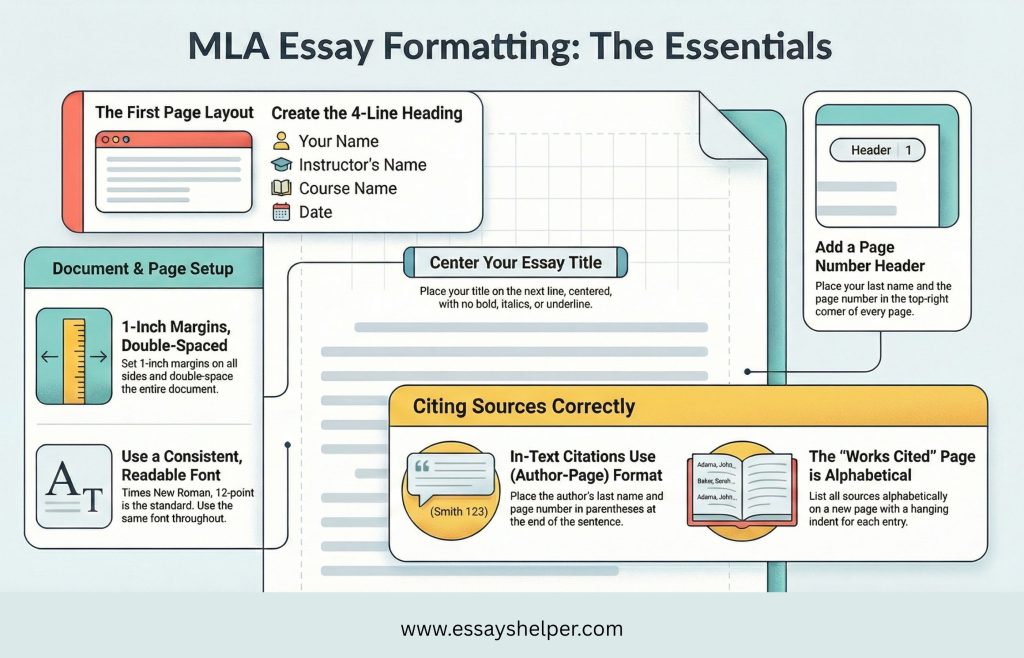
Unlike some styles, MLA is relatively straightforward. It does not require a title page for most assignments, and the citation system is simple once you understand the pattern.
Tip 1: Set up your document before you start writing
One of the biggest mistakes students make is writing the entire essay and worrying about formatting later. Instead, set up your document first. Use one inch margins on all sides, double space the entire document, and keep the text left aligned. Make sure there is no extra spacing between paragraphs.
Starting with the correct layout ensures you do not have to reformat everything at the last minute.
Tip 2: Use a readable font and keep it consistent
MLA guidelines recommend using a clear, readable font. Times New Roman at 12 point size is the most common choice and is accepted almost everywhere. Whatever font you choose, use it consistently throughout the essay, including headings and the Works Cited page.
Switching fonts or sizes, even accidentally, can make your essay look unprofessional.
Tip 3: Format the MLA header correctly
Every page of an MLA essay should include a header in the top right corner. This header contains your last name followed by the page number. The header starts on the first page and continues throughout the document.
Using your word processor’s automatic page numbering feature helps prevent numbering errors.
Tip 4: Follow the MLA first page structure
The first page of an MLA essay follows a specific structure. In the top left corner, list your name, your instructor’s name, the course title, and the date on separate lines. After this, center your essay title on a new line. The title should not be bold, underlined, or italicised unless required.
After the title, begin your introduction on the next line with a standard paragraph indent. This simple structure is often where students lose marks, so getting it right is important.
Tip 5: Write a clear title without extra styling
MLA titles are plain but purposeful. A good title reflects your topic or argument without unnecessary decoration. Avoid using all capital letters or adding formatting effects. A clean title looks academic and professional.
Tip 6: Keep paragraph formatting uniform
Every paragraph in an MLA essay should be indented by half an inch on the first line. The entire essay remains double spaced, and there should be no extra blank lines between paragraphs.
If your essay looks uneven or spaced out, check your paragraph settings rather than manually pressing enter.
If you are unsure whether MLA is the best choice for your assignment, this guide on best essay format can help you decide based on your subject and assessment type.
Tip 7: Use headings only when they add clarity
Short MLA essays usually do not require headings, but longer or research based papers can benefit from them. Headings help readers follow your argument and understand the structure of your paper.
When you use headings, keep them consistent in style and formatting. Avoid over formatting or using multiple fonts. Simple, clear headings work best.
Tip 8: Understand MLA in text citations
MLA in text citations typically include the author’s last name and a page number in parentheses. This citation usually appears at the end of the sentence before the full stop.
If the author’s name is already mentioned in the sentence, only the page number is needed in parentheses. If there is no author, use a shortened version of the title instead. These citations must match the entries on your Works Cited page.
Tip 9: Quote carefully and format long quotes correctly
Quotations should support your argument, not replace it. Short quotations can be included within the text using quotation marks. Longer quotations should be formatted as block quotes.
A block quote starts on a new line, is indented from the left margin, and does not use quotation marks. The citation appears after the punctuation. Overusing block quotes can weaken your essay, so use them sparingly.
Tip 10: Create a clean and accurate Works Cited page
The Works Cited page appears at the end of your essay on a new page. The title “Works Cited” should be centered at the top. All entries are double spaced and use a hanging indent.
Entries are arranged alphabetically by the author’s last name or by the title if no author is available. Every source cited in the essay must appear on the Works Cited page, and every Works Cited entry must be referenced in the text.
If you have worked with other citation systems, you may find it helpful to compare MLA with styles such as APA essay format, as the differences often cause confusion.
Tip 11: Proofread specifically for MLA formatting
Before submitting your essay, do a final formatting check. Look for consistent spacing, correct headers, proper indentation, and matching citations. Many MLA errors are small but noticeable, and a quick review can significantly improve your presentation.
Students often mix rules from different formats. Comparing MLA with alternatives like Chicago style essay format or Harvard essay format style can help you avoid blending styles unintentionally.
Common MLA mistakes students should avoid
Some of the most frequent MLA errors include adding a title page when it is not required, forgetting to double space the Works Cited page, placing page numbers incorrectly, or listing sources that are never cited in the essay.
If you want a detailed breakdown of errors and how to fix them, this guide on essay format mistakes is a useful reference.
When professional help can save time
Formatting should not take more time than writing the essay itself. If MLA rules are slowing you down or causing stress, getting expert support can help you focus on your ideas instead. Professional assistance with editing, formatting, and citations is available through essay writing services.
For ongoing academic support and writing resources, visiting EssaysHelper can make managing multiple assignments much easier.
FAQs about MLA format essays
Does MLA require a title page?
Most MLA essays do not use a title page. The first page includes your details and the essay title unless your instructor specifically asks for a separate title page.
Should the Works Cited page be double spaced?
Yes, the Works Cited page follows the same double spacing rules as the rest of the essay.
Where do page numbers go in MLA format?
Page numbers appear in the header at the top right corner, alongside your last name.
What if my source does not have an author?
If no author is listed, use a shortened version of the title for both the in text citation and the Works Cited entry.
Are headings mandatory in MLA essays?
Headings are optional and usually only needed for longer or more complex papers.
How do I format long quotations in MLA?
Long quotations should be formatted as block quotes with indentation and no quotation marks.
What is the most common MLA mistake?
The most common mistake is inconsistency between in text citations and the Works Cited page.
Can I use MLA format for all subjects?
MLA is mainly used in humanities and language based subjects. Always check your course guidelines before choosing a format.