
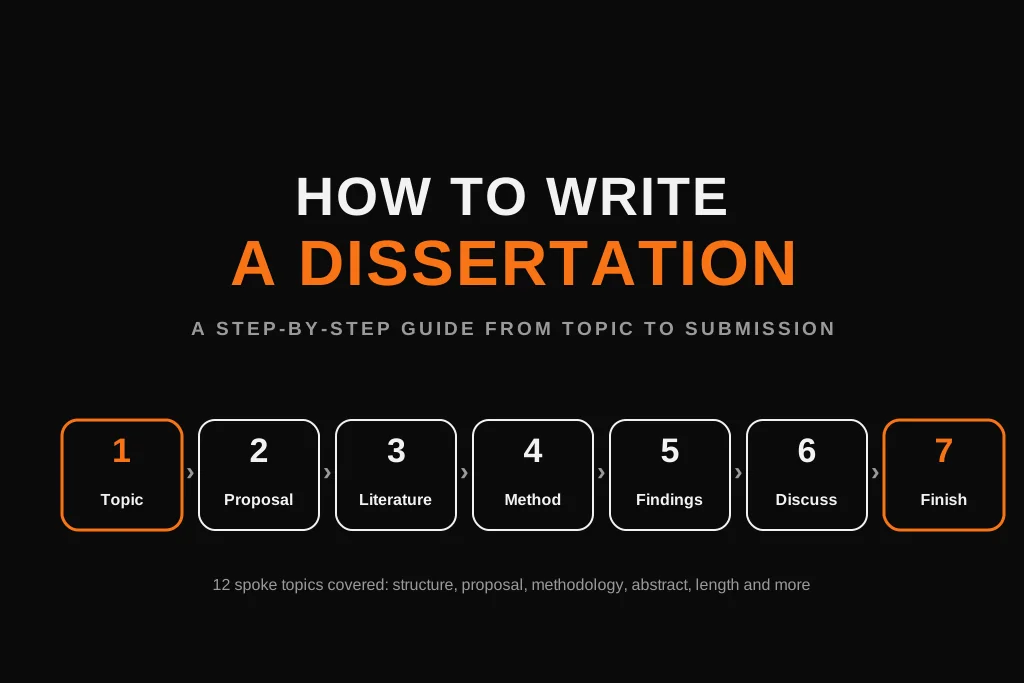
A dissertation is a long, independent research project that answers one focused question. To write one, choose a narrow topic, get a proposal approved, review the existing research, explain your method, present your findings, discuss what they mean, and finish with the front and back sections. Most students need 12 to 16 weeks of steady work for a master’s dissertation, and longer for a doctorate.
That sounds simple on paper. In practice, a dissertation is the first piece of writing many students have done that runs past 10,000 words, has no single assignment sheet to follow, and depends on one person (your supervisor) for feedback. The size is what makes it hard, not the ideas.
This guide gives you the full route in one place: the chapter map, a word budget you can adjust to your own limit, a 16-week plan, and a short section on each part of the dissertation so you know what to expect before you start. Where a part needs a deeper walkthrough, you will see exactly what it is for and what to watch out for.
What Is a Dissertation?
A dissertation is a piece of extended academic writing based on your own research. You pick a question, collect and examine evidence, and argue for an answer. Depending on your course, the evidence might come from books and journals, interviews, surveys, experiments or archives.
If you have written a term paper before, a dissertation uses the same skills at a much larger scale. A short how to write a research paper refresher is useful before you begin, because the habits are the same: a clear question, credible sources, and an argument that holds together from start to finish.
Three things set a dissertation apart from ordinary coursework:
- You own the question. Nobody hands you a prompt. You design the project.
- You work with a supervisor. Guidance comes in meetings and short feedback rounds, not weekly lectures.
- It is assessed as one connected argument. Chapters must build on each other, not stand alone.
Dissertation Structure: The Chapter Map
A dissertation structure is the order of sections that guides a reader from your question to your conclusion. Most programs follow a version of the same map, although names and order change by department and subject. As the University College Dublin Writing Centre notes in its guidance, you should always check your own school’s rubric and your supervisor’s advice before fixing a structure.
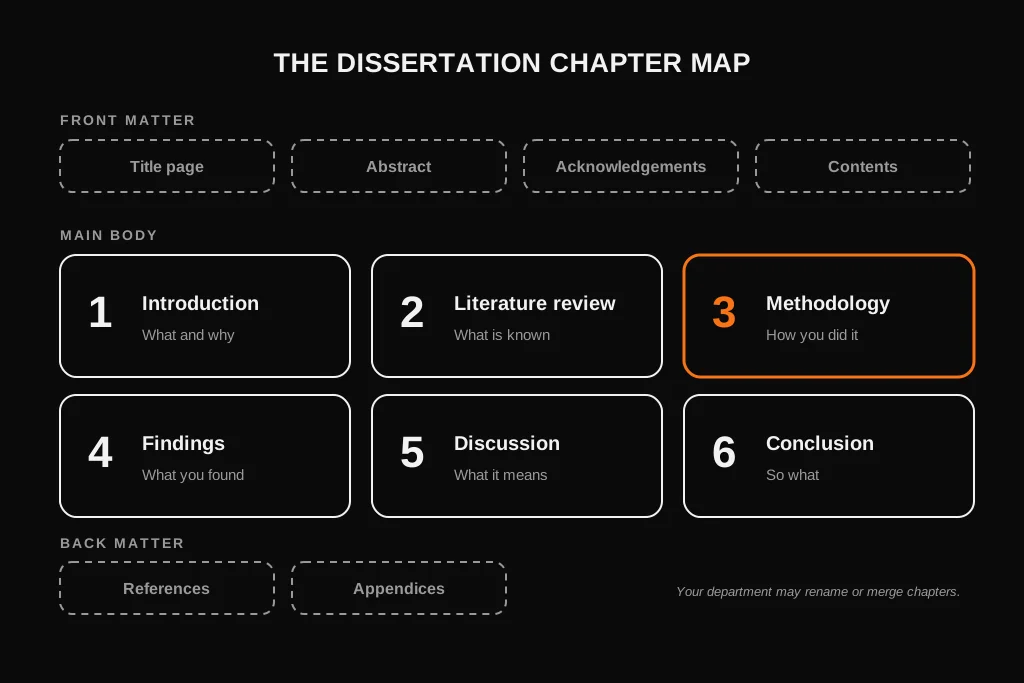
- Front matter: title page, abstract, acknowledgements and contents list.
- Main body: introduction, literature review, methodology, findings, discussion and conclusion.
- Back matter: references and appendices.
- Humanities dissertations often replace findings and discussion with several argument chapters organized by theme.
Tip: Open two or three past dissertations from your department and write down their chapter titles. That list is your real structure, and it is more reliable than any general template. The UCD Writing Centre guidance on master’s dissertation structure is a helpful comparison.
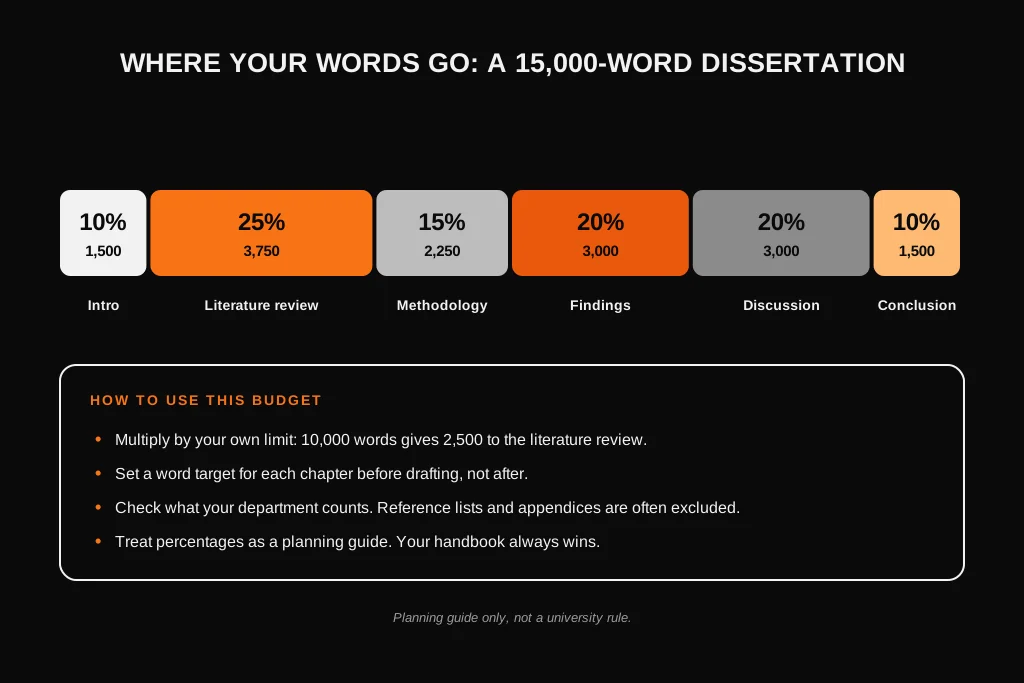
The table below turns the chapter map into a word budget. The percentages are a planning guide, not a university rule, so adjust them to your subject. A science dissertation may spend more on methodology, and a literature-based one may spend more on the review.
| Chapter | Job of the chapter | Share | 10,000 words | 15,000 words | 20,000 words |
| Introduction | State the question and why it matters | 10% | 1,000 | 1,500 | 2,000 |
| Literature review | Show what is known and where the gap is | 25% | 2,500 | 3,750 | 5,000 |
| Methodology | Explain and justify how you did the research | 15% | 1,500 | 2,250 | 3,000 |
| Findings | Present the results without interpretation | 20% | 2,000 | 3,000 | 4,000 |
| Discussion | Explain what the findings mean | 20% | 2,000 | 3,000 | 4,000 |
| Conclusion | Answer the question and state the limits | 10% | 1,000 | 1,500 | 2,000 |
How to Write a Dissertation Step by Step
The ten steps below follow the order in which most students actually work. Notice that the introduction comes late. You write it after you know what your dissertation really argues.
Step 1: How to Choose a Dissertation Topic
A dissertation topic is a narrow, researchable question inside a subject you can sustain interest in for several months. It is not a broad area like “social media” but a question like “How does short-form video affect study habits among first-year students?”
- Start with modules you enjoyed and assignments you did well in.
- Check that enough sources exist. A topic with no research behind it is a risk.
- Make sure you can collect the evidence within your time and ethics limits.
- Narrow until the question could be answered in your word limit.
A good topic also shapes every later decision. It decides which sources you read, which method you use and how much data you must collect. Students who rush this step often spend the middle of the project narrowing the question again, which costs weeks they do not have.
Tip: Write three possible research questions in one sentence each, then pick the one you can find the most sources for in a single afternoon of searching.
Step 2: How to Write a Dissertation Proposal
A dissertation proposal is a short plan, usually a few pages, that tells your supervisor or committee what you will study, why, and how. It is a contract with yourself as much as a request for approval.
- Working title and research question.
- A short background that shows the gap you plan to fill.
- The method you will use and why it suits the question.
- A realistic timeline and a list of key sources.
- Any ethical considerations, if people are involved.
Most departments approve proposals in one round, but supervisors often ask for a narrower question or a clearer method. Treat that request as help, not rejection. A proposal that is specific about its sources, sample and dates is far easier to approve than one that stays general, and it becomes your checklist when the project starts to feel large.
Tip: Treat the proposal as your first rough draft of the introduction and methodology. Anything you write now saves time later.
Step 3: The Dissertation Literature Review
A dissertation literature review is a critical survey of the research that already exists on your topic. It does not just list sources. It shows what is agreed, what is disputed and where your project fits.
- Search databases with a set of keywords and record every search.
- Group sources by theme, not by author or date.
- Compare studies and point out strengths, limits and gaps.
- End by stating the gap your research will address.
- Keep a running reference list from day one.
A strong review also shapes your methodology. If most past studies used surveys, you might justify interviews as a way to fill the gap. If a debate remains unresolved, your research question can sit inside it. Write a short summary of each source in your own words as you read, so you never face a pile of unread PDFs at the end.
Tip: Stop reading when new sources keep repeating points you already have. That is a sign you have covered the main debate.
Step 4: Dissertation Methodology
Your dissertation methodology explains how you carried out the research and why that approach was the right one. A reader should be able to follow your steps and judge whether your results can be trusted.
- State your approach: qualitative, quantitative or mixed.
- Describe your sample, materials, tools or sources.
- Explain how you collected and analyzed the data.
- Justify each choice against the alternatives.
- Acknowledge limitations and any ethical approval you obtained.
Different fields expect different detail. Scientific and social science dissertations describe participants, instruments and statistical tests. Humanities dissertations may explain the theory, texts and analytical lens instead. Either way, a reader should see that your approach follows from your research question, not from convenience. If people are involved, explain consent, privacy and how you stored the data, and ask your department whether ethics approval is required before you collect anything, because approval can take weeks.
Tip: Write in past tense and aim for enough detail that another student could repeat your study.
Step 5: Do the Research, Then Write Findings and Discussion
This is the longest stage. Collect your data or complete your close reading, then write up the findings chapter first. Report what you found without explaining it yet. Then write the discussion, where you interpret the findings, connect them to your literature review and answer your research question.
If your data does not match your expectations, report it as it is. A surprising result, honestly explained, is worth more marks than a neat result that was forced. Keep a research log with the date, what you did and what you found, because it makes the methodology chapter far easier to write later.
Step 6: Dissertation Introduction
A dissertation introduction tells the reader what the project is about, why it matters and how the rest of the dissertation is organized. It is the reader’s map.
- Open with the topic and its importance.
- Give brief background, not a full literature review.
- State your research question and aims clearly.
- Preview the chapters in a short outline paragraph.
- Define any key terms the reader needs before they continue.
Many students write a warm-up introduction early to get started and then rewrite it. That is a good habit. The final version should match your chapters exactly, including their order. Keep it focused and do not turn it into a second literature review. Check that your research question appears in the same words in the introduction, the methodology and the conclusion, so the reader never wonders whether the question changed.
Tip: Write the introduction after the discussion. You will describe the project you actually finished, not the one you planned.
Step 7: Dissertation Conclusion
A dissertation conclusion answers your research question, summarizes the main findings and explains why they matter. It brings the argument to rest.
- Restate the question and give the direct answer in a sentence.
- Summarize the key findings chapter by chapter.
- Explain the contribution to the field.
- Name the limits and suggest realistic future research.
- Close on one clear sentence about why the answer matters.
A strong conclusion also shows judgement. Say what your study could not do, whether because of sample size, time or access, and explain how that limit affects the answer. Then suggest one or two realistic next studies rather than a long wish list. Many readers go straight from the abstract to the conclusion, so make sure it makes sense on its own, and finish on your contribution rather than an apology.
Tip: Do not add new evidence here. If a point matters, it belongs in the discussion.
Step 8: Dissertation Abstract
A dissertation abstract is a short summary of the whole project, usually one paragraph or a page, that lets a reader decide quickly whether to read on. Many universities give a maximum word count, so check yours.
- Say what the project investigates and why.
- Name the method in one sentence.
- Give the main findings.
- End with the conclusion or main contribution.
- Leave out quotations, tables and detailed references.
Abstracts are read more than any other part of a dissertation, so every sentence has to earn its place. Use plain language, avoid citations unless your department requires them, and do not promise results you do not report. If your department also asks for keywords, choose terms a researcher would actually search for, and ask early what the maximum length is.
Tip: Write it last, from your finished chapters, one sentence per chapter, then trim.
Step 9: Dissertation Acknowledgements
The dissertation acknowledgements are a short, personal note that thanks the people who helped you. They are normally placed near the front and are not marked as part of the argument.
- Thank your supervisor first.
- Mention participants, advisors, librarians or funders who helped.
- Add friends and family briefly, if you wish.
- Keep a warm, plain tone and stay within a page.
- Leave out jokes or private details you would not want an examiner to read.
Acknowledgements are the one place where your voice can be personal, but they still go into a bound or archived document, so keep them professional. Name people the way they would like to be named and double check spelling. Write them last, when you remember who actually helped, and read them aloud once to catch awkward phrasing.
Tip: Check whether your institution requires specific wording for funding bodies or research participants.
Step 10: Revise, Format and Submit
Set aside the final week for editing, not drafting. Read the whole dissertation start to finish for flow, then check references, headings, page numbers, captions and the contents list against your department’s style guide. Get one person outside your subject to read the introduction and abstract. If they can say what your dissertation argues, you are ready. Finally, save a backup copy in two places and export a PDF to check that your formatting survives.
How Long Should a Dissertation Be?
The length of a dissertation is the word count your department sets for your level and subject. It is almost always given as a target or a maximum, and some universities count footnotes but not the reference list, appendices or bibliography.
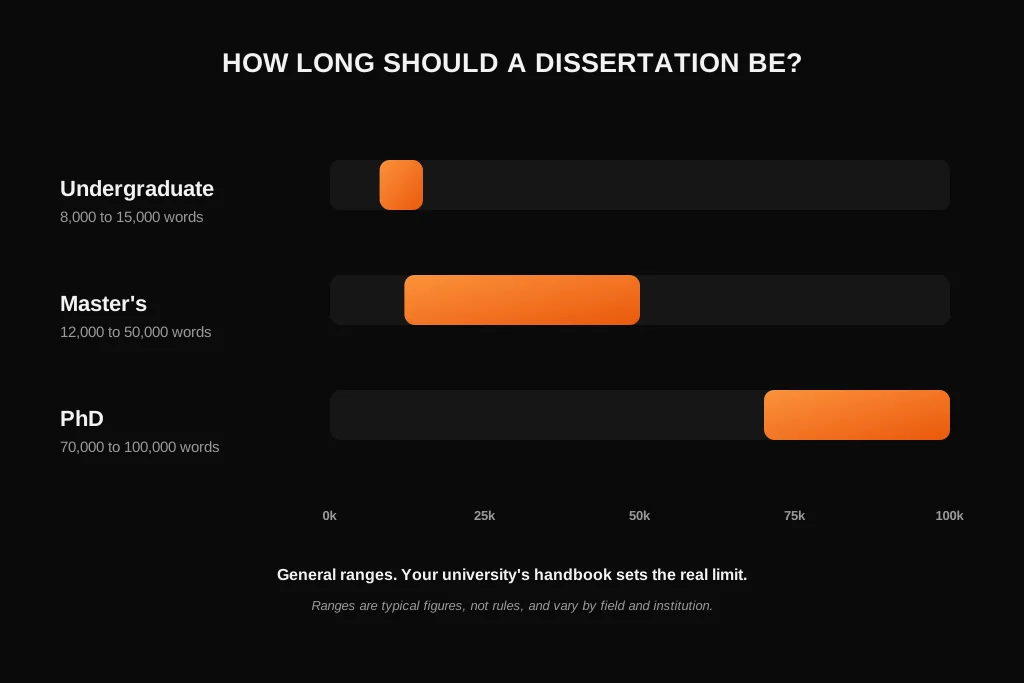
- Undergraduate dissertations are commonly cited at roughly 8,000 to 15,000 words.
- Master’s dissertations vary widely, from about 12,000 to 50,000 words.
- Doctoral dissertations are book-length, often around 70,000 to 100,000 words.
- One UK university’s handbook describes a 30-credit undergraduate dissertation as broadly the effort of an 8,000 to 10,000 word project.
Tip: Never guess your limit. Read the dissertation handbook for your course, note what is included in the count, and plan your chapters against that number.
| Level | Commonly cited length | What it usually looks like |
| Undergraduate | About 8,000 to 15,000 words | One focused question, mostly existing sources |
| Master’s | About 12,000 to 50,000 words | Deeper review and original data or analysis |
| PhD / doctoral | About 70,000 to 100,000 words | Original contribution, book-length argument |
How Long Does It Take to Write a Dissertation?
Most students underestimate the time. Writing the words is only part of the work. Reading, collecting data, waiting for feedback and revising take as long as drafting.
- Undergraduate: usually one or two semesters, often alongside other modules.
- Master’s: from a single term to a full year, depending on whether the course is taught or research-based.
- PhD or doctoral: several years, varying by country and program.
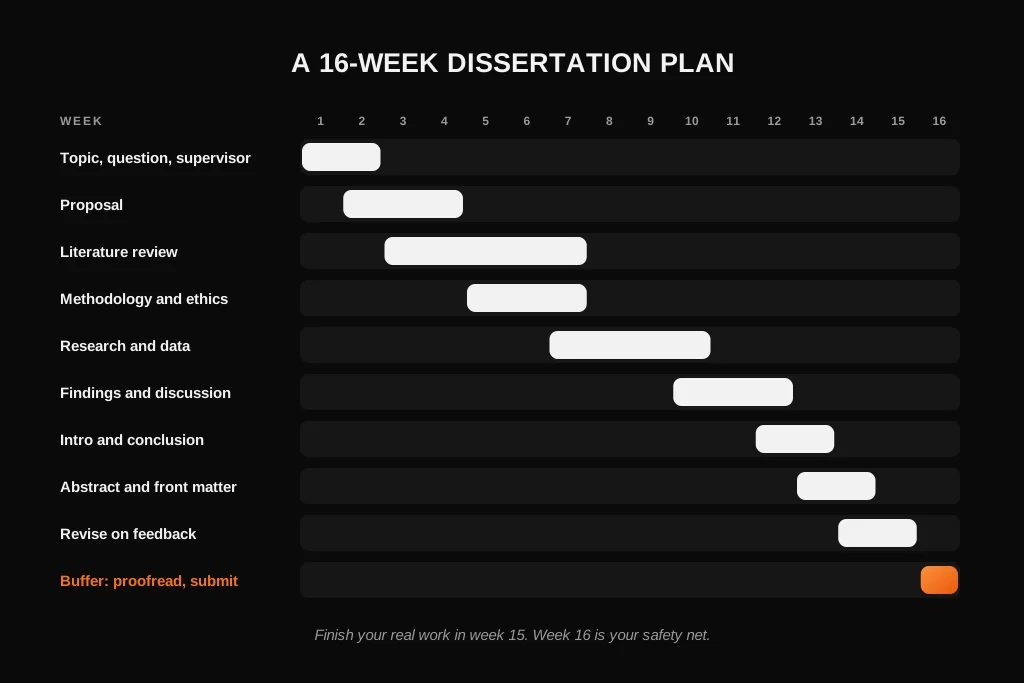
These are general patterns and your program may differ, so use them to plan, not to promise. A backwards schedule is the safest way to avoid a last-minute rush. Start from your submission date, subtract one week for a buffer, and divide the rest into stages. The table below uses 16 weeks as a worked example.
| Weeks | Task | Output |
| 1 to 2 | Choose topic and research question; meet supervisor | Topic agreed |
| 2 to 4 | Write proposal | Approved proposal |
| 3 to 7 | Read and write literature review | Review draft |
| 5 to 7 | Design methodology and apply for ethics approval if needed | Method plan |
| 7 to 10 | Collect and analyze data or complete close reading | Raw findings |
| 10 to 12 | Write findings and discussion | Core chapters |
| 12 to 13 | Write introduction and conclusion | Full first draft |
| 13 to 14 | Abstract, acknowledgements, references, formatting | Complete document |
| 14 to 15 | Revise using supervisor feedback | Final draft |
| 16 | Buffer: proofread, fix, submit | Submitted |
If your real deadline is a fixed date, set your own deadline one week earlier. Week 16 is the safety net that absorbs illness, late feedback and printer problems.
Dissertation vs Thesis
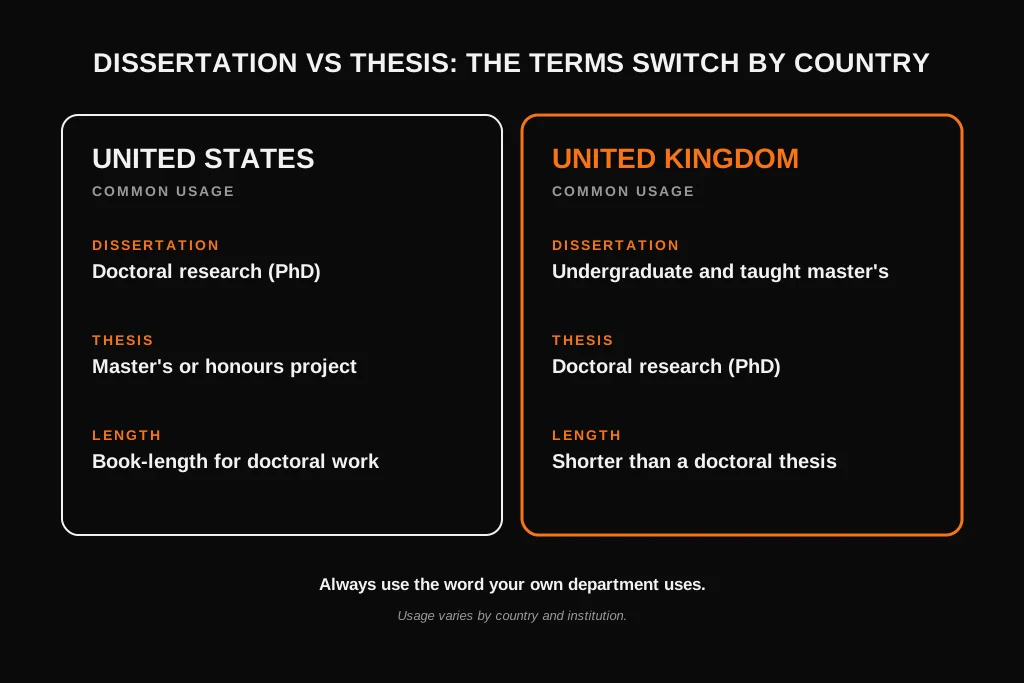
Dissertation vs thesis is a common source of confusion because the two words swap meaning between countries. According to the University of Essex library, the terms are often used interchangeably, and in the UK a dissertation usually means undergraduate or taught master’s work while a thesis means doctoral research. The Essex library explanation adds that usage in the United States is the reverse.
Use this as a quick guide:
- United States: dissertation usually means doctoral work, and thesis often means a master’s or honours project.
- United Kingdom: dissertation usually means undergraduate or taught master’s work, and thesis means doctoral research.
- Other countries follow either pattern, so ask your department.
- Length differs too: doctoral work is far longer than undergraduate or taught master’s work, whichever word is used.
Tip: In emails to your supervisor, use the term printed in your course handbook. It avoids confusion and shows that you know your program’s expectations.
Undergraduate vs Masters Dissertation
An undergraduate dissertation shows that you can run a small, guided research project. A master’s dissertation shows that you can design and defend one with more independence and deeper analysis.
- Scope: undergraduate projects are narrower, while master’s projects expect a clearer gap in the literature.
- Sources: undergraduates often rely on existing research, while master’s students are usually expected to add original data or a new analysis.
- Independence: expect more guidance as an undergraduate and more self-direction at master’s level.
- Criticality: master’s work is judged on how well you question sources, not just summarize them.
If you are working on how to write a master’s dissertation after a first degree, plan extra time for the literature review and methodology. For a doctoral dissertation, which is a larger and longer project written over several years, your supervisor and department will set the structure, length and review process.
Tip: Ask your supervisor for the marking criteria for your level and write each chapter with those descriptors beside you.
A Simple Weekly Writing Routine
Students who finish on time rarely write in long bursts. They protect small, regular blocks. If you need a way to keep moving, try this weekly pattern and adjust it to your timetable:
- Two reading sessions: 90 minutes each, with notes in your own words.
- Three writing sessions: 60 to 90 minutes each, aiming for a fixed word target such as 500 words.
- One planning session: 30 minutes to list next week’s targets and update your schedule.
- One day off: Rest is part of the plan, not a reward for finishing.
Write rough first drafts without editing as you go. A messy page can be improved. A blank page cannot. If a section is hard, write a bracketed note such as [add evidence here] and keep going so you do not lose momentum.
Common Dissertation Mistakes and How to Fix Them
- A question that is too broad. Narrow it until you can answer it in your word limit.
- Writing the introduction first and never updating it. Rewrite it after the discussion.
- A literature review that lists sources. Group by theme and compare the studies.
- Methodology without justification. Say why you chose each method, not only what you did.
- Findings mixed with discussion. Keep results and interpretation in their own chapters, unless your discipline combines them.
- No buffer week. Finish a week before the deadline.
- Waiting for perfection. Send rough drafts to your supervisor early. Feedback on a messy draft is more useful than silence.
Make Every Supervisor Meeting Count
Supervisor guidance is limited. One UK university handbook says students should normally expect about four formally recorded supervisor meetings between the start of formal work and submission, and that feedback is often limited to one draft per chapter. Check your own handbook for the real numbers. If your meetings are scarce, bring a clear agenda every time.
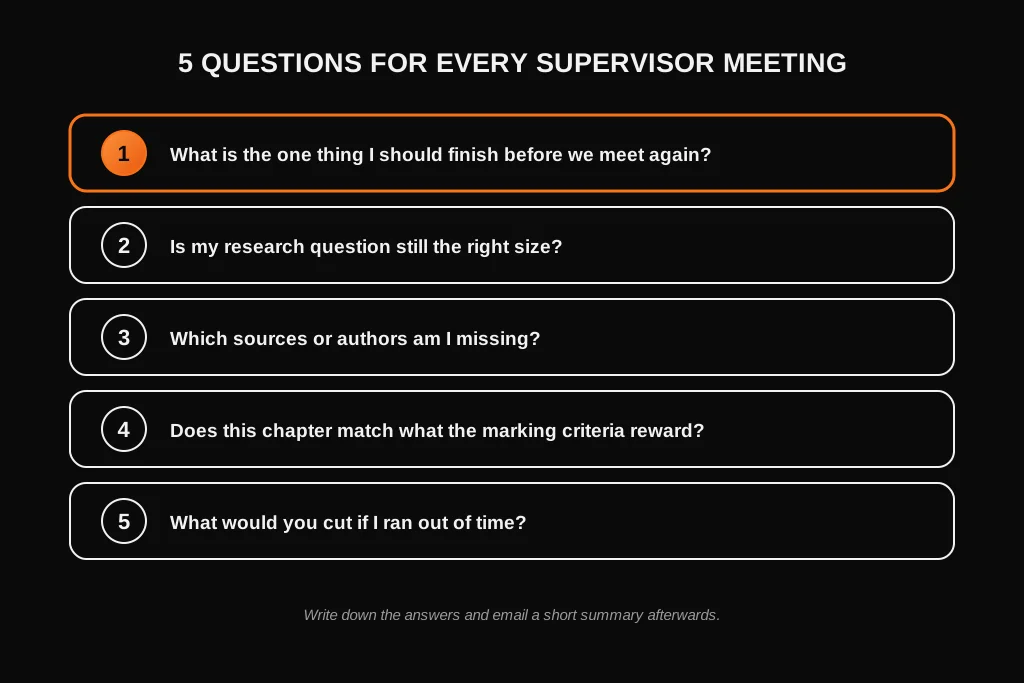
Bring these five questions to each meeting:
- What is the one thing I should finish before we meet again?
- Is my research question still the right size?
- Which sources or authors am I missing?
- Does this chapter match what the marking criteria reward?
- What would you cut if I ran out of time?
Write down the answers and email a short summary afterwards. It creates a record, and your supervisor can correct any misunderstanding at once.
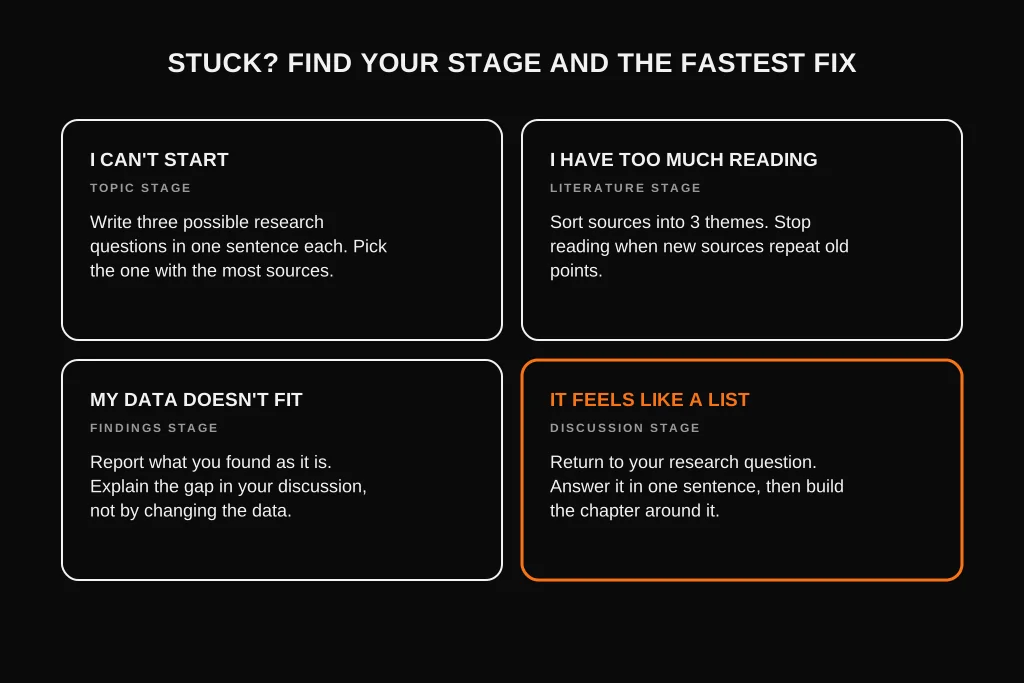
Where Students Get Stuck, and the Fastest Fix
Almost everyone stalls at some point. Find your stage in the list below and try the fix before you lose a week.
- “I can’t start” (topic stage). Write three possible research questions in one sentence each and pick the one with the most sources.
- “I have too much reading” (literature stage). Sort sources into three themes and stop when new sources repeat old points.
- “My data doesn’t fit” (findings stage). Report what you found as it is, and explain the gap in your discussion.
- “It feels like a list” (discussion stage). Return to your research question, answer it in one sentence, and build the chapter around that sentence.
Using AI Tools Responsibly
Many students ask whether they can use ChatGPT to write a dissertation. The honest answer is that it depends on your university’s policy, and policies differ. Submitting work you did not write is academic misconduct almost everywhere. If your institution allows AI support, it is usually for limited tasks such as brainstorming search terms or checking grammar, with the use declared. Read your policy first, ask your supervisor if it is unclear, and keep the thinking, the analysis and the final writing your own.
How EssaysHelper Can Help You
A dissertation is a long project, and even strong students sometimes need a second pair of eyes. EssaysHelper supports students at each stage in ways that keep your work yours:
- Feedback on a draft proposal, literature review or methodology chapter.
- Help structuring chapters and building a realistic schedule.
- Editing and proofreading for clarity, flow and consistent formatting.
- Guidance on citing sources in your required style.
If you are stuck at a particular stage, send us your question and your deadline and we will point you to the quickest next step.
Frequently Asked Questions
How do I start writing a dissertation?
Start with your topic, not your first sentence. Write three possible research questions, check that each has enough sources, and discuss your favorite with your supervisor. Once the question is agreed, write a short proposal. Drafting chapters comes after you know what you are asking and how you will answer it.
How long does it take to write a dissertation?
It depends on your level and program. Undergraduate dissertations often take one or two semesters, master’s projects range from one term to a year, and doctorates take several years. A 16-week plan with a one-week buffer works well for many master’s students.
Can I write a dissertation in a month?
It is possible only if you already have a clear question, access to sources and no other heavy deadlines. Most students need more time for reading and revision. If you must work fast, shrink the scope, set daily word targets and send chapters to your supervisor as you finish them.
How many words should a dissertation be?
Your department sets the limit. Commonly cited ranges are about 8,000 to 15,000 words for undergraduates, 12,000 to 50,000 for master’s students and 70,000 to 100,000 for doctoral dissertations. Check your handbook, and ask what the count includes before you plan your chapters.
Is a dissertation harder than a thesis?
Neither word has a fixed difficulty because the meaning changes by country. In the UK a dissertation is usually undergraduate or master’s work and a thesis is doctoral, while in the US it is often the reverse. Difficulty depends on your level, not the label.
What order should I write my dissertation in?
A common order is proposal, literature review, methodology, findings, discussion, introduction, conclusion, then abstract. Writing the introduction and abstract late means they describe the dissertation you actually finished. Your supervisor may suggest a different order, so confirm it early and ask whether your department expects drafts in a set sequence.
How hard is it to write a dissertation?
It is demanding mainly because of its size and independence. The skills are the same as in coursework, but you manage a long project with limited guidance. Breaking it into stages, setting weekly targets and meeting your supervisor regularly makes it far more manageable for most students.
Can I use ChatGPT to write my dissertation?
Check your university’s AI policy first. Most institutions do not allow AI-written work to be submitted as your own. Some allow limited help, such as brainstorming or grammar checks, if you declare it clearly. The analysis, argument and final writing should come from you.
How many chapters does a dissertation have?
Many dissertations have five or six main chapters: introduction, literature review, methodology, findings, discussion and conclusion. Humanities dissertations often use several thematic chapters instead. Your department’s guidelines decide the final structure, so compare them with past examples from your own department.
How often should I meet my supervisor?
It varies. Some programs formally expect around four recorded meetings, while others allow more. Meet at key points: after the proposal, after the literature review, after the first findings and before the final draft. Always bring a short agenda and a draft to discuss.
Final Thoughts
Learning how to write a dissertation comes down to three habits: narrow the question, work in stages, and keep your supervisor in the loop. You do not have to write 10,000 words at once. You have to write one decent paragraph, then another. Use the chapter map to know where you are, the word budget to stay in proportion, and the 16-week plan to protect your deadline. When a stage feels heavy, go back to your research question and ask what the next small step is.