
You may understand your research topic and still feel unsure about how to organise the paper. Should background information go in the introduction or literature review? Should you explain a result immediately or save the interpretation for the discussion? How much detail belongs in the methodology?
These questions can cause students to repeat information, mix findings with opinions, or place important details in the wrong section.
The solution is to understand the purpose of each part before you begin writing. If you’re learning how to write a research paper, understanding the role of each section can make the process easier to plan, draft, and revise.
What Are the Parts of a Research Paper?
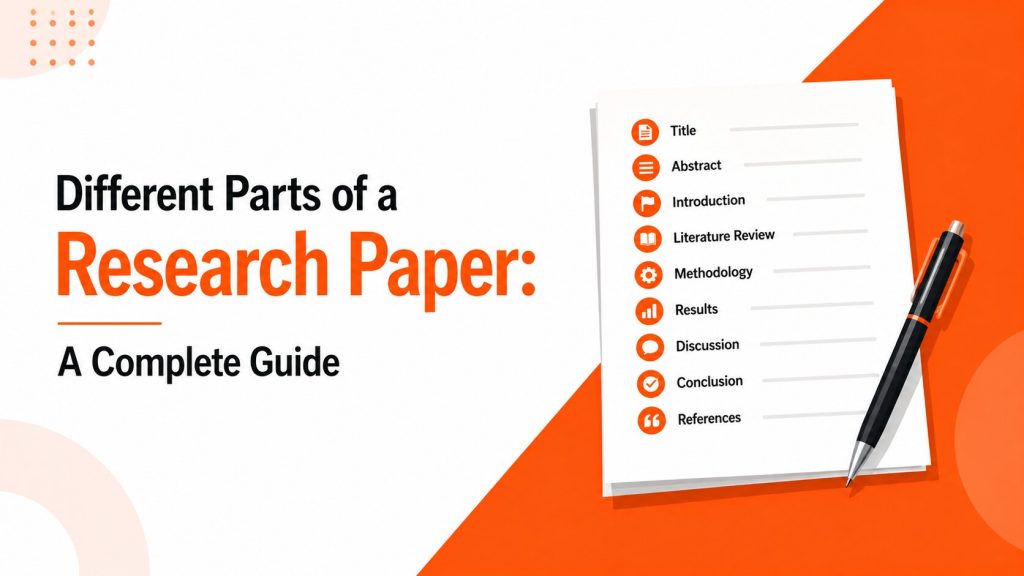
The main parts of a research paper usually include the title page, abstract, introduction, literature review, research questions or hypotheses, methods, results, discussion, conclusion, references, and appendices. However, the exact structure depends on the discipline, assignment brief, research design, and required citation style.
Scientific and social science papers often follow the IMRaD structure, which stands for Introduction, Methods, Results, and Discussion. Humanities papers may instead organise the discussion around themes, texts, periods, or arguments.
Research Paper Structure at a Glance
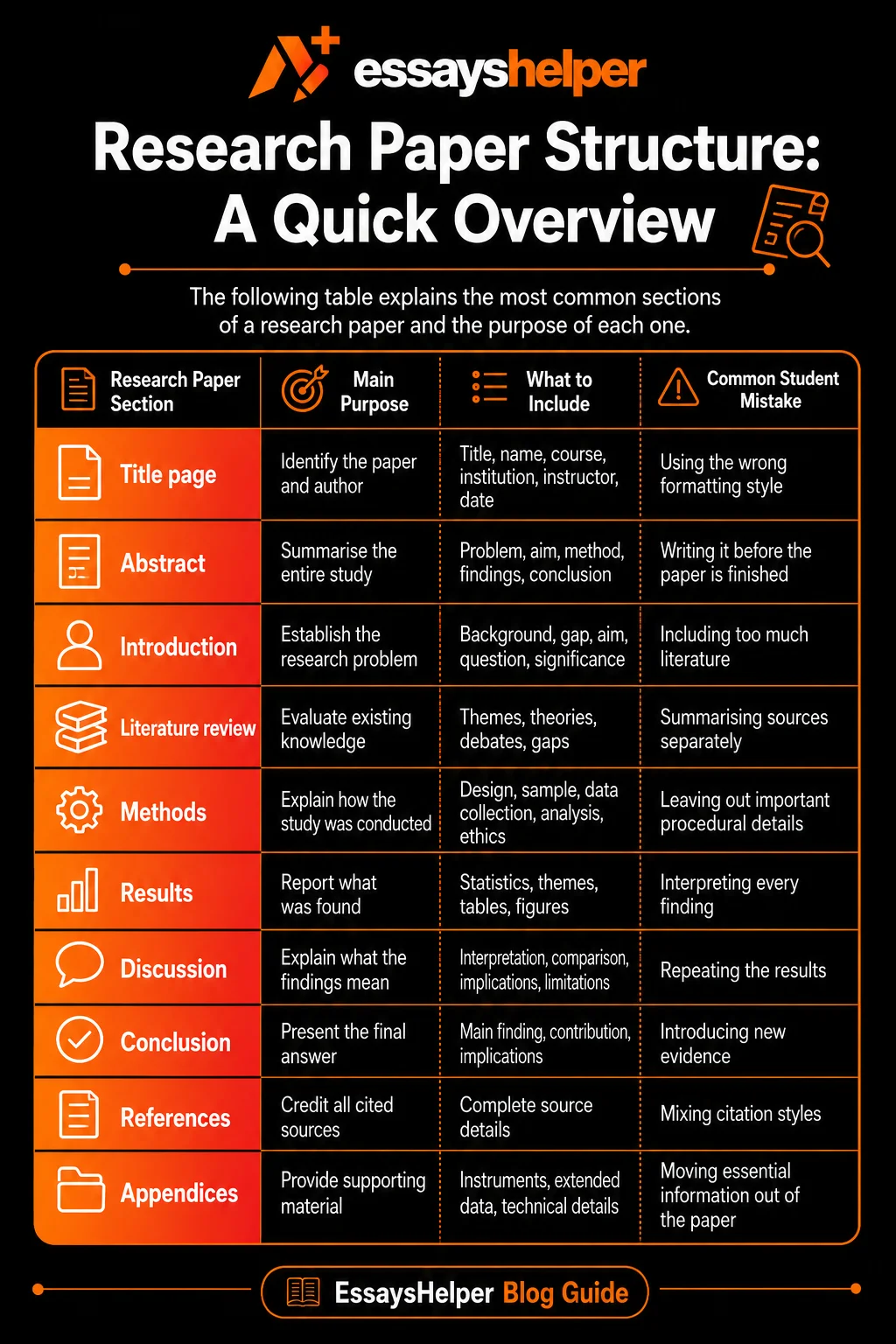
This is a common structure rather than a fixed rule. Purdue OWL notes that papers using APA-style experimental reporting commonly contain a title page, abstract, introduction, method, results, discussion, references, and appendices where necessary. Students should still follow their assignment or journal guidelines.
A research paper is also different from a short essay. Although the best essay format for students often includes an introduction, body, and conclusion, an original research project usually needs separate sections for methods, findings, and interpretation.
1. Title Page
The title page identifies the paper and provides the administrative details required by your institution.
It commonly includes:
- The full research paper title
- Your name
- Your university or institution
- Course or module name
- Instructor or supervisor
- Submission date
- Student identification number, where required
Your title should accurately describe the study without becoming unnecessarily long. A useful research title often identifies the central topic, population, context, or relationship being examined.
For example:
Too broad: Social Media and Students
More focused: The Relationship Between Social Media Use and Study Concentration Among First-Year University Students
Formatting varies between APA, MLA, Chicago, Harvard, and university-specific systems. Do not assume that the title page from one module will meet the requirements of another.
2. Abstract
An abstract is a short, self-contained summary of the entire research paper. It allows readers to understand the purpose, approach, main findings, and significance of the study without reading the full paper first.
A research abstract commonly covers:
- The background or research problem
- The aim or research question
- The method or research design
- The main results
- The conclusion or significance
An informative abstract can briefly move through the background, methods, results, and conclusion of a study. For a more detailed explanation, read our guide on how to write an abstract.
Although the abstract appears near the beginning, it is normally easier to write it after completing the paper. Writing it too early may cause the abstract to describe what you planned to find rather than what the research actually found.
Avoid adding citations, long explanations, undefined abbreviations, or information that does not appear in the main paper.
3. Introduction
The introduction explains what the study is about, why the problem matters, and what the research will investigate.
A strong introduction usually moves from the broad subject towards the specific research problem. This is sometimes described as a funnel structure.
It may include:
- Brief background information
- The practical or academic problem
- Relevant existing knowledge
- The gap in current research
- The study aim
- The research question or hypothesis
- The significance of the study
- A brief overview of the paper
The CARS model recommends that research introductions establish the importance of the topic, identify a gap or unresolved issue, and explain how the current paper addresses it. For a more detailed explanation, read our guide on how to write an introduction for a research paper.
An engaging opening can help establish relevance, but a research introduction does not need to sound dramatic. Review examples of different hooks if you need help opening the paper without relying on dictionary definitions, exaggerated statements, or unrelated quotations.
Introduction or literature review?
The introduction establishes the problem and guides the reader towards the study. The literature review provides a deeper evaluation of the research already published about that problem.
In a short paper, the literature review may appear within the introduction. In a dissertation, thesis, or extended research project, it is usually a separate section or chapter.
4. Literature Review
The literature review explains what researchers already know, where they disagree, and what remains unanswered.
It should not read like this:
“Smith studied student stress. Jones studied online learning. Brown studied exam performance.”
That approach describes sources individually without showing how they relate.
Instead, organise the literature around:
- Major themes
- Competing theories
- Methodological approaches
- Areas of agreement
- Contradictory findings
- Changes over time
- Weaknesses in existing studies
- Gaps your research will address
A literature review synthesises and evaluates what other researchers have already contributed, helping establish the foundation for a new argument, perspective, or research question. For a more detailed explanation, read our guide on how to write a literature review.
For example, a literature review about remote learning might compare research under themes such as student engagement, accessibility, assessment, instructor presence, and digital inequality.
Your academic voice also matters here. Developing a clear personal style for writing can help you compare sources confidently instead of filling the section with quotations or repetitive phrases such as “the author says.”
5. Research Aim, Questions, Objectives, and Hypotheses
These terms are related, but they are not interchangeable.
Research aim: The broad purpose of the study.
To investigate how remote work affects collaboration among software-development teams.
Research objective: A specific action required to achieve the aim.
To compare the frequency of collaborative communication in remote and office-based teams.
Research question: The exact question the study will answer.
How does remote work influence collaboration among software-development teams?
Hypothesis: A testable prediction, commonly used in quantitative research.
Software-development teams working fully remotely will report lower levels of spontaneous collaboration than hybrid teams.
Thesis statement: The central argument or position developed in some research papers, particularly analytical or humanities-based work.
Remote work does not automatically weaken collaboration, but it requires more deliberate communication structures than office-based work.
A paper may use several of these elements, depending on its purpose and methodology.
6. Methods Part of a Research Paper
The methods part of a research paper explains exactly how the study was designed and conducted. Its purpose is to make the research process transparent enough for readers to evaluate the quality of the evidence.
The section may cover:
- Research philosophy or approach
- Research design
- Study setting
- Population and sample
- Sampling method
- Inclusion and exclusion criteria
- Data sources
- Materials or instruments
- Data-collection procedure
- Variables or measures
- Data-analysis techniques
- Ethical considerations
- Methodological limitations
APA’s Journal Article Reporting Standards provide separate guidance for quantitative, qualitative, and mixed-methods research. These standards are intended to improve transparency, methodological integrity, and reproducibility.
Purdue OWL similarly explains that the method section should provide a detailed account of how the research was carried out.
Quantitative methods example
A quantitative study might explain:
- How many participants were included
- How they were selected
- Which variables were measured
- Which questionnaire or dataset was used
- How missing data were handled
- Which statistical tests were performed
Qualitative methods example
A qualitative study might explain:
- Why interviews or focus groups were appropriate
- How participants were recruited
- How interview questions were developed
- How interviews were recorded and transcribed
- How themes were coded
- What steps improved credibility or reflexivity
Write this section precisely. Reviewing different types of sentences can help you explain multi-stage procedures without creating fragments, run-on sentences, or confusing instructions.
A common mistake is to report only what was done without explaining why the chosen method was suitable. Connect major methodological decisions to the research question.
7. Results or Findings
The results section reports what the analysis found.
In quantitative research, this may include:
- Descriptive statistics
- Test results
- Effect sizes
- Confidence intervals
- Significant and non-significant findings
- Tables and figures
In qualitative research, it may include:
- Themes
- Subthemes
- Participant patterns
- Short supporting quotations
- Contradictory or unusual cases
Do not hide negative or unexpected findings simply because they do not support the original hypothesis. They are still part of the research outcome.
You should also avoid repeating every value from a table. Use the surrounding text to identify the most important pattern, comparison, or result.
Example of a results sentence
Students receiving weekly formative feedback submitted an average of 18 percent more draft revisions than students receiving feedback only at the end of the module.
This sentence reports the finding. It does not yet explain why the difference occurred or what it means.
8. Discussion Part of a Research Paper
The discussion part of a research paper explains the meaning and importance of the findings.
Students often struggle here because they either repeat the results or make claims that go beyond the evidence. The discussion should interpret the findings while staying connected to the research question and literature review.
How to write the discussion part of a research paper
Follow these steps:
1. Begin with the main finding
Briefly remind the reader of the most important result.
The study found that students receiving regular formative feedback revised their drafts more frequently.
Do not repeat the entire results section.
2. Explain what the finding means
Interpret the pattern in relation to the research problem.
This suggests that frequent feedback may encourage students to view writing as an ongoing process rather than a one-time submission task.
3. Connect it to the research question
Make it clear how the result helps answer the original question.
4. Compare it with previous research
Explain whether your finding supports, extends, or contradicts earlier studies.
Avoid simply stating that results are “similar” or “different.” Explain why the relationship matters.
5. Discuss unexpected results
Consider possible reasons for findings that you did not predict.
These reasons might include:
- Characteristics of the sample
- Measurement limitations
- Contextual factors
- Implementation problems
- Alternative explanations
6. Explain the implications
Show how the findings may affect:
- Theory
- Policy
- Professional practice
- Future research
- Teaching
- System or product design
7. Acknowledge limitations
Discuss genuine weaknesses without making the entire study sound worthless.
For example, a small sample may limit generalisability, but it does not necessarily make the findings meaningless.
8. Recommend future research
Future research suggestions should follow directly from the limitations, unanswered questions, or new patterns identified in the study.
Results vs discussion
Results sentence:
Interview analysis produced three themes: workload uncertainty, limited supervisor access, and reduced peer contact.
Discussion sentence:
These themes indicate that remote working difficulties were connected less to physical distance itself than to weak organisational communication and unclear support structures.
The first sentence reports what was found. The second explains what that finding may mean.
Purdue OWL describes the results section as the place to report findings and the discussion as the place to interpret their significance, connect them with previous research, and consider broader implications.
9. Conclusion
The conclusion presents the final answer produced by the research.
It should:
- Return to the research question
- Summarise the main finding
- State the overall contribution
- Identify important implications
- Leave the reader with a clear final insight
A conclusion is not simply a shorter copy of the discussion. It should bring the argument together and show what can reasonably be concluded from the evidence.
Do not introduce new studies, data, themes, or arguments at this point. UNC’s guidance on conclusions emphasises their role in helping readers understand the significance and overall experience of the paper.
10. References or Bibliography
The references section provides full publication details for the sources cited in the paper.
A reference list usually contains only works cited directly. A bibliography may also include relevant works consulted but not cited, depending on the required style.
Common systems include:
- APA
- MLA
- Harvard
- Chicago
- Vancouver
Use one style consistently. Check punctuation, capitalisation, italics, author order, dates, and digital object identifiers carefully.
Reference-management tools can help, but they still make errors. Review every entry against the official style guide.
11. Appendices
Appendices contain useful supporting material that would interrupt the flow of the main paper.
They may include:
- Survey questionnaires
- Interview schedules
- Consent documents
- Extended statistical tables
- Coding frameworks
- Technical calculations
- Additional figures
- Sample computer code
- Detailed system specifications
Each appendix should have a label and descriptive title, such as Appendix A: Interview Questions.
Do not move essential explanations into an appendix simply to reduce the main word count. Readers should be able to understand your research design and findings without constantly leaving the paper.
How Research Paper Structure Changes by Discipline
There is no single structure that works for every subject.
| Discipline | Common structural features |
| Social sciences | Literature review, theoretical framework, methods, results, discussion |
| Nursing and healthcare | Clinical background, ethics, participants, interventions, outcomes, implications |
| Psychology | Hypotheses, participants, measures, procedure, statistical results, discussion |
| Business and management | Conceptual framework, case study or organisational data, findings, recommendations |
| Humanities | Argument-led sections organised by theme, text, period, concept, or debate |
| Science and engineering | Technical methods, variables, experiments, results, figures, reproducibility |
| Computer science | System architecture, datasets, algorithms, implementation, evaluation metrics, limitations |
Scientific and technical reports frequently use an ordered sequence of methods, results, discussion, conclusions, references, and appendices, although the exact order should still be adapted to the audience and task.
Humanities papers are less likely to use a separate methods or results section. A history paper, for instance, may organise its main argument chronologically or thematically.
The appropriate different writing tones may also vary. A reflective healthcare assignment may permit carefully controlled first-person writing, while a technical engineering report usually prioritises direct, objective explanation.
Do not force a dissertation or research project into a five paragraph essay structure. Longer research papers need enough sections to develop the literature, method, evidence, and interpretation properly.
Common Research Paper Problems and Practical Solutions
Problem: The introduction becomes a literature review
Solution: Use the introduction to establish the problem and significance. Move detailed comparisons of theories and studies into the literature review.
Problem: The literature review describes one source at a time
Solution: Group studies by themes, debates, methods, or findings. Compare several sources within the same paragraph.
Problem: The methodology is too vague
Solution: Explain who or what was studied, how data were collected, what tools were used, and how the analysis was conducted.
Problem: Results and discussion are mixed together
Solution: First report the evidence. Then interpret it. Where your discipline combines the sections, maintain this order within each theme.
Problem: The same information appears in several sections
Solution: Give each idea one main location. Refer back briefly instead of copying full explanations.
Problem: The discussion does not answer the research question
Solution: Use the research question as a checklist. Each major discussion subsection should help answer part of it.
Problem: The paper uses inconsistent citations
Solution: Select the required style at the beginning and review every in-text citation and reference entry before submission.
Students who are unsure how to apply a brief, organise a capstone project, or connect research questions with methodology may benefit from structured academic assignment support.
For more extensive drafting or revision difficulties, professional essay help can provide guidance on academic structure, argument development, clarity, and citation consistency.
Final Research Paper Checklist
Before submitting, check that:
- The title accurately represents the study.
- The abstract reflects the completed paper.
- The introduction identifies a clear problem and purpose.
- The literature review synthesises rather than lists sources.
- The research questions match the method.
- The methods section contains enough procedural detail.
- The results report all important findings.
- The discussion interprets rather than repeats the results.
- The conclusion answers the research question.
- Every in-text citation appears in the references.
- Tables and figures are numbered and discussed in the text.
- Appendices contain only supplementary material.
- Headings follow a logical hierarchy.
- The paper uses one citation style consistently.
Conclusion
Understanding the different parts of a research paper makes a complex assignment more manageable. Each section has a specific purpose, from establishing the research problem and reviewing existing knowledge to explaining the method, reporting findings, and interpreting their significance.
Always begin with the assignment brief because structural expectations differ across subjects and institutions. Keep results separate from interpretation unless your required format combines them, and make sure every section contributes to answering the research question.
Finally, review the paper as one complete argument. The sections should connect logically rather than reading like separate assignments placed in the same document.
Frequently Asked Questions
What are the main parts of a research paper in order?
A common order is title page, abstract, introduction, literature review, research questions, methods, results, discussion, conclusion, references, and appendices. The exact order may change depending on your discipline and assignment requirements.
What is the most important part of a research paper?
No single section works independently, but the research question is central because it guides the literature, method, analysis, and discussion. A strong paper keeps every section connected to that question.
What should be included in the methods part of a research paper?
The methods section should explain the research design, sample, data sources, instruments, data-collection process, analysis, and ethical considerations. Include enough detail for readers to understand exactly how the findings were produced.
How do I write the discussion part of a research paper?
Begin with the main finding, explain what it means, connect it to the research question, and compare it with earlier research. Then discuss implications, limitations, unexpected results, and useful directions for future studies.
What is the difference between results and discussion?
The results section reports what the study found, while the discussion interprets those findings. Results present evidence such as statistics or themes, whereas the discussion explains their meaning and significance.
Does every research paper need a literature review?
Most research papers engage with previous scholarship, but not every assignment requires a separately titled literature review. Short papers may integrate the relevant literature into the introduction or main discussion.
How long should each section of a research paper be?
There is no universal percentage for every section. Length depends on the word count, discipline, method, and marking criteria, so use the assignment brief and model papers from your subject as guides.
Can the results and discussion be combined?
Yes, some disciplines and journals use a combined results and discussion section. Report each finding first and then interpret it clearly so that readers can still distinguish evidence from explanation.
What information belongs in an appendix?
Appendices may contain questionnaires, interview guides, extended tables, consent forms, coding frameworks, technical calculations, or supplementary figures. Essential information needed to understand the study should remain in the main paper.
Should I write the abstract first or last?
Write the abstract after completing the main paper. This allows you to summarise the final method, actual findings, and conclusion accurately rather than describing an early research plan.