
Many students understand the story they are reading, but they get stuck when the teacher asks them to write a theme statement. You may know that a text is about love, friendship, power, fear, identity, or courage, but turning that idea into a clear sentence can feel confusing.
That is because a theme statement is not just one word. It is also not a summary of the plot. A theme statement is a complete sentence that explains the deeper message of a story, poem, play, film, or essay. It tells the reader what the text suggests about life, people, society, choices, relationships, or human experience.
For example, “friendship” is not a theme statement. It is only a topic. A stronger theme statement would be: “True friendship is tested when people must choose between loyalty and honesty.”
This guide will explain what a theme statement means, how to write one, how it differs from a topic or thesis statement, and what good theme statement examples look like. You will also find sample theme statements, templates, sentence starters, and common mistakes to avoid.
If you are working on a literature essay and need extra guidance with structure, analysis, or academic writing, Essay Helper can support students who want clearer, more confident academic work.
What Is a Theme Statement?
A theme statement is a complete sentence that explains the central message or deeper meaning of a text. It answers the question: what does this story, poem, play, or film suggest about life or human behavior?
A theme statement usually focuses on a universal idea. This means it should connect to more than one character, one scene, or one event. It should say something broader about people, society, emotions, choices, power, justice, love, identity, fear, or another major idea.
For example:
Topic: Ambition
Theme statement: Ambition can motivate people to succeed, but it can also destroy them when it becomes more important than morality.
Topic: Fear
Theme statement: Fear often controls people when they allow uncertainty to replace reason.
Topic: Identity
Theme statement: A person’s identity is shaped by personal choices as much as by family, culture, and society.
A good theme statement is not just about what happens in the story. It is about what the story means.
Students often confuse theme statements with plot summaries. A plot summary tells what happened. A theme statement explains what the events reveal.
Plot summary:
A character lies to protect a friend, but the lie creates bigger problems.
Theme statement:
Loyalty loses its value when it depends on dishonesty.
The second sentence is stronger because it gives a deeper message.
Theme Statement Definition in Simple Words
The simplest theme statement definition is this:
A theme statement is a sentence that expresses the message, lesson, or insight a text gives about a broad topic.
The theme is the general subject. The theme statement is what the text says about that subject.
For example:
| Broad Topic | Theme Statement |
| Love | Love can bring comfort, but it can also make people vulnerable to pain. |
| Power | Power becomes dangerous when it is not balanced by responsibility. |
| Courage | Courage is not the absence of fear, but the choice to act despite fear. |
| Family | Family relationships can shape a person’s identity, values, and sense of belonging. |
This is the easiest way to understand theme statement meaning. A topic is usually one word or a short phrase. A theme statement is a full idea.
Students often write weak theme statements because they stop at the topic. For example, “The theme is friendship” is too basic. It does not explain what the text says about friendship.
A better sentence would be:
Friendship becomes meaningful when people support each other during moments of difficulty, not only during easy times.
That is a complete idea. It can be discussed, explained, and supported with evidence from the text.
Theme vs Thematic Statement: Are They the Same?
Many students ask about theme vs thematic statement because teachers sometimes use these words differently. In most classroom situations, a theme statement and a thematic statement mean almost the same thing. Both refer to a complete sentence that explains the central message of a text.
However, there is a small difference in how the terms are often used.
| Term | Meaning | Example |
| Theme | The broad idea or subject in a text | Power |
| Thematic statement | A complete sentence explaining what the text says about that idea | Power can corrupt people when they use it without responsibility. |
| Theme statement | Another common name for a thematic statement | Power can corrupt people when they use it without responsibility. |
So, if your teacher asks for a thematic statement, they probably do not want one word like “power.” They want a complete sentence about power.
The same applies when your teacher asks for a theme statement. You should write a full sentence that explains the message of the text.
Theme Statement vs Topic vs Main Idea vs Thesis Statement
Theme statements are often confused with topics, main ideas, and thesis statements. This confusion is normal because all of these terms deal with meaning, but they are not the same.
| Term | What It Means | Example |
| Topic | The broad subject | Friendship |
| Main idea | What a paragraph or text is mostly about | The story shows two friends facing a difficult choice. |
| Theme | A broad message or central idea | Friendship and loyalty |
| Theme statement | A complete sentence about the deeper message | True friendship requires honesty, even when the truth is difficult. |
| Thesis statement | The main argument of your essay | In the story, the author uses conflict and dialogue to show that friendship depends on honesty. |
The main difference is that a theme statement explains the message in the text, while a thesis statement explains the argument of your essay.
For example, this is a theme statement:
True courage appears when people choose what is right even when they are afraid.
This is a thesis statement:
In the novel, the author uses the protagonist’s choices, conflicts, and relationships to show that true courage requires moral responsibility.
The thesis is more specific to the essay. It tells the reader what the essay will argue. The theme statement is the broader message that the essay may discuss.
Understanding this difference helps students write stronger essays. If you are unsure how to organize your essay after identifying a theme, this guide on the best essay format for students can help you structure your ideas more clearly.
Why Theme Statements Matter in Essays
Theme statements matter because they show that you understand more than the surface-level story. Teachers do not only want to know what happened in a text. They want to see whether you understand why it matters.
A strong theme statement helps you move from summary to analysis.
Summary tells the reader:
The character becomes jealous and makes poor decisions.
Analysis explains:
The character’s jealousy shows how insecurity can damage relationships and lead people to act against their own values.
That second sentence is more useful in an essay because it explains meaning.
Theme statements help students:
- Understand the deeper message of a text.
- Write stronger introductions.
- Build clearer body paragraphs.
- Connect evidence to analysis.
- Avoid simply retelling the plot.
- Create stronger thesis statements.
When students struggle with literature assignments, the issue is often not reading. It is explaining the meaning of what they read. This is where academic assignment support can help students turn basic ideas into clearer academic arguments.
A strong theme statement also gives your essay direction. Once you know the message you want to discuss, it becomes easier to choose evidence, explain quotes, and connect paragraphs.
How to Write a Theme Statement Step by Step
If you are wondering how to write a theme statement, start with the text, not the sentence. A strong theme statement comes from understanding the story, poem, or play first.
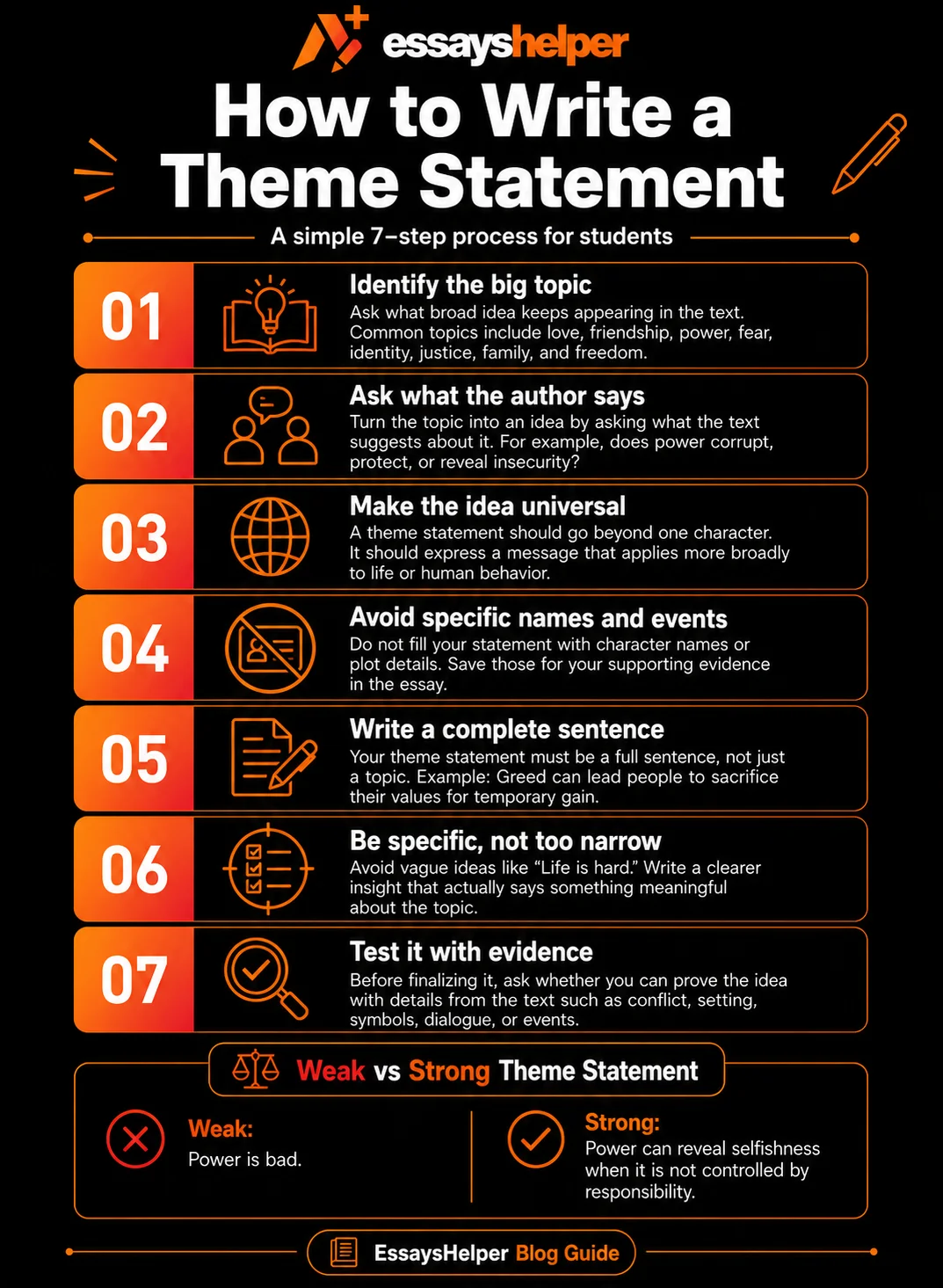
Step 1: Identify the big topic
Start by asking: what broad idea appears again and again in the text?
Common topics include:
- Love
- Friendship
- Power
- Ambition
- Fear
- Identity
- Justice
- Family
- Freedom
- Loneliness
- Coming of age
For example, if a story shows a character trying to gain control over others, the topic may be power.
Step 2: Ask what the author says about that topic
Now ask: what does the text suggest about power?
Does it show that power corrupts people?
Does it show that power can protect others?
Does it show that people misuse power when they feel insecure?
This step turns a topic into an idea.
Step 3: Make the idea universal
A theme statement should not only apply to one character. It should express a message that can apply more broadly.
Weak: Jack becomes cruel when he gets power.
Stronger: Power can reveal a person’s selfishness when it is not controlled by responsibility.
The stronger version is universal because it applies beyond one character.
Step 4: Avoid naming specific characters or plot events
A theme statement should usually not mention character names or specific scenes. Save those details for your evidence.
Weak: When Anna leaves her town, she learns that freedom matters.
Stronger: Freedom often requires people to leave behind the places and expectations that limit them.
Step 5: Write it as a complete sentence
A theme statement must be a full sentence.
Weak: The danger of greed.
Stronger: Greed can lead people to sacrifice their values for temporary gain.
Step 6: Make it specific, but not too narrow
A vague theme statement does not say much.
Too vague:
- Life is hard.
- Better:
- Hardship can reveal a person’s strength, but it can also expose the support systems they lack.
- The better sentence gives a clearer insight.
Step 7: Test it with evidence
Before finalizing your theme statement, ask: can I prove this with examples from the text?
If you cannot support it with characters, conflict, setting, symbols, dialogue, or events, the statement may not fit the text.
Theme Statement Formula Students Can Use
A theme statement formula can make the process easier, especially when you are stuck. However, the formula should guide your thinking, not make every sentence sound robotic.
Here are simple formulas you can use:
Formula 1:
Through [topic], the author shows that [universal message].
Example:
Through ambition, the author shows that the desire for success can become destructive when it is not guided by morality.
Formula 2:
The text suggests that [topic] can [reveal, challenge, create, destroy, shape, or expose] [deeper idea].
Example:
The text suggests that fear can control people when they allow uncertainty to replace reason.
Formula 3:
A story about [topic] may reveal that [universal insight].
Example:
A story about courage may reveal that bravery is not the absence of fear, but the decision to act despite it.
Formula 4:
The author uses [conflict, character, setting, or symbol] to show that [theme statement].
Example:
The author uses conflict to show that loyalty becomes complicated when honesty and protection are in conflict.
These formulas are especially useful when you are writing your first draft. Once you have a basic sentence, revise it so it sounds natural.
How to Start a Theme Statement
Many students know the message they want to explain, but they do not know how to start a theme statement. Sentence starters can help you begin.
Useful theme statement starters include:
- The text suggests that…
- The story shows that…
- The author reveals that…
- Through the conflict, the text explores how…
- One possible theme is that…
- The poem suggests that…
- The novel reveals that…
- The play shows how…
For example:
- The text suggests that people often discover their values during moments of pressure.
- The story shows that ambition can become harmful when it is stronger than empathy.
- The author reveals that social pressure can make individuals hide their true identity.
- Through the conflict, the text explores how fear can divide communities.
- Do not use the same starter every time. Choose one that fits your assignment and writing style.
If you are using your theme statement in an essay introduction, you may also need a strong opening sentence. Learning different hooks can help you introduce your theme in a more engaging way.
Good Theme Statements: What Makes Them Strong?
Good theme statements have a few clear qualities. They are complete, meaningful, universal, and specific enough to guide analysis.
A strong theme statement should be:
- A complete sentence.
- Focused on a universal idea.
- Clear enough to understand.
- Specific enough to analyze.
- Connected to the text.
- Supported by evidence.
- Not just a plot summary.
- Not just one word.
- Not a cliché.
- Not a moral lecture.
Here are some weak and strong examples:
| Weak Theme Statement | Strong Theme Statement |
| Love is important. | Love can give people strength, but it can also make them vulnerable to loss. |
| The story is about revenge. | Revenge can consume a person so deeply that it destroys their sense of justice. |
| Friendship matters. | True friendship requires honesty, trust, and the courage to challenge each other. |
| Power is bad. | Power becomes dangerous when people use it to control others instead of taking responsibility. |
| People change. | Personal growth often begins when people are forced to question what they once believed. |
The strong examples work better because they explain a deeper idea. They are not too simple, but they are still clear.
Theme Statement Examples for Students
The easiest way to learn theme statements is to study examples. Below are theme statement examples based on common topics students see in literature and essays.
Love
- Love can help people heal from pain, but it can also make them afraid of loss.
- Love becomes stronger when it is based on respect rather than control.
- The desire to be loved can lead people to sacrifice their own needs.
Friendship
- True friendship is tested when honesty becomes difficult.
- Friendship can help people survive challenges they could not face alone.
- Loyalty loses its meaning when it requires someone to ignore the truth.
Power
- Power can reveal a person’s character more clearly than weakness.
- When power is not balanced by responsibility, it can lead to corruption.
- People who fear losing power may become cruel in order to protect it.
Ambition
- Ambition can inspire success, but it can also become destructive when it replaces morality.
- The pursuit of achievement can isolate people when they value success more than relationships.
- Ambition becomes dangerous when people are willing to harm others to reach their goals.
Identity
- Identity is shaped by both personal choices and the expectations of society.
- People often discover who they are when they challenge the roles others expect them to follow.
- A person’s identity can become stronger when they stop hiding parts of themselves.
Courage
- Courage is not the absence of fear, but the decision to act despite fear.
- True bravery often appears in quiet choices, not only dramatic actions.
- People show courage when they defend their values under pressure.
Fear
- Fear can protect people from danger, but it can also prevent them from living fully.
- Fear becomes powerful when people allow it to control their decisions.
- Communities can become divided when fear replaces understanding.
Family
- Family can provide belonging, but it can also create pressure to follow expectations.
- Family relationships shape how people understand loyalty, identity, and responsibility.
- A person may need to question family expectations in order to grow.
Justice
- Justice becomes fragile when people value revenge more than truth.
- A fair society depends on people who are willing to challenge injustice.
- Justice requires courage because doing what is right is not always easy.
Freedom
- Freedom often requires responsibility, sacrifice, and difficult choices.
- People may not value freedom until they experience control or oppression.
- True freedom means more than escaping limits. It also means choosing a meaningful path.
- These examples are meant to guide you. Do not copy them blindly. Adapt them to your text, assignment question, and evidence.
Sample Theme Statements for Literature Essays
Here are sample theme statements students can adapt for literature essays. These are general enough to apply to many texts, but you should always connect them to your assigned reading.
- Fear can control people when they allow uncertainty to replace reason.
- Identity is often shaped by both personal choices and social expectations.
- Justice becomes fragile when people value revenge more than truth.
- Love can help people endure hardship, but it can also expose them to emotional pain.
- Power can corrupt individuals when they use it without responsibility.
- Friendship becomes meaningful when it survives honesty, conflict, and change.
- Ambition can lead to growth when it is guided by purpose, but it can become destructive when it ignores morality.
- Freedom often requires people to challenge the systems, beliefs, or relationships that limit them.
- Loss can teach people what they value most, but it can also force them to change.
- Social pressure can make people hide their true beliefs, values, or identity.
- Coming of age often involves realizing that the world is more complicated than it first appeared.
- Silence can protect people temporarily, but it can also allow injustice to continue.
- A good literature essay does not just state a theme. It explains how the author develops that theme through characters, conflict, setting, imagery, symbols, and language.
If you need support turning theme ideas into a full essay, professional essay help can help with structure, clarity, and academic analysis.
Examples of Theme Statements in Literature
Theme statements are especially important in literature because stories often communicate meaning indirectly. Authors may not state the message clearly. Instead, they reveal it through conflict, character choices, symbols, dialogue, and consequences.
For example, a tragedy may suggest that unchecked ambition leads to moral collapse. This kind of theme statement works because many tragic characters are destroyed by their own desires.
A coming-of-age novel may suggest that maturity comes from accepting responsibility. This works because many coming-of-age stories show characters learning from mistakes, loss, independence, or difficult choices.
A dystopian story may suggest that freedom is easily lost when people stop questioning authority. This theme statement works because many dystopian texts explore control, obedience, surveillance, and resistance.
A family drama may suggest that love alone cannot repair relationships without honesty and accountability. This works because many stories show that emotional bonds still require truth and effort.
A war story may suggest that survival often changes a person’s understanding of morality. This works because conflict can place characters in situations where simple ideas of right and wrong become complicated.
When using theme statements in literature essays, always connect the statement to evidence. A theme statement without evidence is only a claim. Your essay needs examples from the text to prove it.
The Purdue OWL writing in literature guide is also a useful resource for students learning how to analyze literature instead of only summarizing it.
Universal Theme Statements
Universal theme statements apply beyond one character, one story, or one situation. They speak to wider human experience.
For example:
- People often discover their strength during moments of loss.
- Social pressure can force individuals to hide parts of their identity.
- True courage appears when a person chooses what is right despite personal risk.
- Power can change people when they are not prepared to use it responsibly.
- Justice requires action, not only belief.
- Universal does not mean vague. A weak universal theme statement would be:
- People have problems.
- This is universal, but it is too broad to be useful.
A stronger version would be:
People often grow when they face problems that force them to question their beliefs.
This statement is still universal, but it gives a clearer message.
Universal theme statements are helpful because they allow you to connect a text to bigger ideas about life, society, and human behavior. That is why teachers often prefer them over statements that only describe one character.
Theme Statement Template You Can Copy
A theme statement template can help you organize your thoughts before writing your final sentence.
Use this template:
- Topic:
- What the text says about the topic:
- Theme statement:
- Evidence from the text:
- Why it matters:
Here is a completed example:
Topic: Courage
What the text says about the topic: Courage means acting even when someone feels afraid.
Theme statement: Courage is not the absence of fear, but the choice to act according to one’s values despite fear.
Evidence from the text: A character speaks the truth even though they may face punishment.
Why it matters: The text shows that bravery is often moral, not just physical.
Here is another example:
Topic: Power
What the text says about the topic: Power can change how people treat others.
Theme statement: Power becomes dangerous when people use it to control others rather than protect them.
Evidence from the text: A leader begins with good intentions but becomes cruel when challenged.
Why it matters: The text warns that authority needs responsibility and accountability.
This template is useful before writing a paragraph, essay introduction, or thesis statement.
Theme Statement Ideas by Category
The original idea of dividing this topic by discipline does not fit perfectly because theme statements are most common in literature and English assignments. However, theme statement ideas can still be organized by assignment type or academic category.
Literature and English Essays
In literature essays, theme statements usually focus on character development, conflict, symbols, setting, or the author’s message.
Theme statement ideas:
- Personal growth often begins when a character is forced to face uncomfortable truths.
- Love can become harmful when it depends on control rather than respect.
- Fear can make people accept injustice when they believe resistance is impossible.
- These ideas work well for novels, short stories, plays, poems, and literary analysis essays.
Personal Reflection Essays
In personal reflection writing, theme statements may connect personal experience to a broader lesson.
Theme statement ideas:
- Failure can teach people lessons that success often hides.
- Confidence grows when people learn to accept discomfort as part of progress.
- Personal identity becomes clearer when people reflect on the experiences that shaped them.
If your teacher asks for reflective writing, your theme may come from your own experience rather than a fictional text. In this case, your personal style for writing matters because the essay should still sound like you while staying clear and focused.
Social Issues Essays
Social issues essays may use theme-like statements to express messages about society, justice, inequality, education, identity, or responsibility.
Theme statement ideas:
- A society becomes stronger when it listens to the experiences of people who are often ignored.
- Injustice continues when people choose comfort over accountability.
- Social change requires both awareness and action.
- These ideas can work for essays about inequality, education, discrimination, poverty, media, or community issues.
History and Society Essays
In history or society-based essays, theme statements may focus on power, leadership, conflict, change, or human behavior.
Theme statement ideas:
History often shows that unchecked power can damage both leaders and the people they control.
Social progress usually requires people to question traditions that no longer serve justice.
Conflict can reveal the values, fears, and weaknesses of a society.
These statements can help students connect historical events to broader lessons.
Psychology and Human Behavior Essays
In psychology-related writing, theme statements may focus on identity, fear, motivation, relationships, behavior, or decision-making.
Theme statement ideas:
People often make harmful choices when fear overwhelms reason.
Belonging can shape behavior because people are deeply influenced by the need for acceptance.
Personal growth often requires people to recognize patterns they once ignored.
These ideas can be useful in essays about characters, behavior, motivation, or mental conflict.
Capstone and Research Projects
Theme statements are not always used in capstone projects the same way they are used in literature essays. However, capstone projects still need a clear central idea. Students often need to explain what their project reveals about a problem, audience, field, or solution.
Theme-like central ideas for capstone projects may include:
Effective solutions require understanding the real needs of the people affected by the problem.
Research becomes meaningful when it connects evidence to practical improvement.
A strong project does not only describe a problem. It explains why the problem matters and how it can be addressed.
EssaysHelper can support students who need capstone project support across disciplines, especially when they need help organizing ideas, explaining evidence, or improving academic clarity.
Theme Statement List for Quick Inspiration
Here is a theme statement list for quick inspiration. Use these as starting points, not final answers. Your final theme statement should match your text and assignment.
- Fear can limit people more than the actual danger they face.
- Power reveals a person’s values when they are no longer forced to obey others.
- True friendship requires honesty, patience, and trust.
- Love can heal emotional pain, but it can also create vulnerability.
- Revenge often harms the person seeking it as much as the person receiving it.
- Identity becomes stronger when people stop living only for others’ approval.
- Freedom requires responsibility as well as independence.
- Loss can force people to understand what truly matters to them.
- Courage appears when people act according to their values despite fear.
- Ambition becomes dangerous when success matters more than morality.
- Justice depends on people who are willing to speak against wrongdoing.
- Family can provide support, but it can also create expectations that limit growth.
- Social pressure can make people hide their beliefs, identity, or emotions.
- Personal growth often begins with failure, discomfort, or change.
- Silence can protect people in the short term, but it may allow harm to continue.
- Hope can help people survive difficult situations, even when the outcome is uncertain.
- Trust is difficult to rebuild once it has been broken.
- People often discover their strength when they are forced to face hardship.
- A society becomes weaker when people stop questioning unfair rules.
- Responsibility is often the difference between power that protects and power that harms.
Common Mistakes Students Make When Writing Theme Statements
Students often make the same mistakes when writing theme statements. The good news is that most of these mistakes are easy to fix.
The first mistake is writing only one word.
Weak: Love.
Better: Love can give people strength, but it can also make them vulnerable to loss.
Another mistake is writing a plot summary instead of a theme statement.
Weak: The main character leaves home and learns many lessons.
Better: Personal growth often begins when people leave familiar places and face new responsibilities.
Some students make the theme statement too specific to one character.
Weak: Sarah learns not to lie to her brother.
Better: Dishonesty can damage relationships even when it begins as an attempt to protect someone.
Another common mistake is making the sentence too broad.
Weak: Life is difficult.
Better: Hardship can reveal both a person’s inner strength and their need for support.
Students also use clichés.
Weak: Never give up.
Better: Persistence becomes meaningful when people continue working toward a goal despite failure and uncertainty.
A theme statement should also match the tone of academic writing. If it sounds too casual, too dramatic, or too moralizing, revise it. Reading about different writing tones can help you choose a tone that fits school and college assignments.
Sentence structure also matters. If your theme statement is too long or confusing, the idea may get lost. Reviewing types of sentences can help you write clearer, stronger sentences.
How to Use a Theme Statement in an Essay
A theme statement can appear in different places depending on your assignment. Sometimes it is part of your brainstorming. Sometimes it becomes part of your thesis. Sometimes it guides a body paragraph.
In a literature essay, your theme statement may appear in the introduction as part of your main argument.
For example:
The story suggests that ambition can become destructive when it is not guided by morality. Through the protagonist’s choices, relationships, and final downfall, the author shows how the desire for success can lead to isolation and guilt.
The first sentence is the theme statement. The second sentence begins to turn it into an essay argument.
You can also use a theme statement at the start of a body paragraph.
For example:
One major theme in the story is that fear can make people act against their own values. This appears when the character refuses to defend someone they know is innocent.
Then the paragraph would explain the evidence.
Theme statements also help with essay structure. If you are writing a five paragraph essay, your theme can guide your introduction, three body paragraphs, and conclusion. Each body paragraph can explore one way the author develops the theme.
For example:
- Body paragraph 1: The character’s fear
- Body paragraph 2: The conflict caused by fear
- Body paragraph 3: The lesson learned from fear
This helps your essay stay focused instead of becoming a plot summary.
Final Checklist Before Submitting Your Theme Statement
Before you submit your theme statement, check it carefully.
Ask yourself:
- Is it a complete sentence?
- Does it express a message, not just a topic?
- Is it universal enough to apply beyond one character?
- Is it specific enough to analyze?
- Can I support it with evidence from the text?
- Does it avoid simply summarizing the plot?
- Does it avoid clichés?
- Does it avoid vague words like “things” or “stuff”?
- Does it connect to the assignment question?
- Does it sound clear and academic?
If the answer is yes, your theme statement is probably strong enough to use in your essay.
FAQs About Theme Statements
What is a theme statement?
A theme statement is a complete sentence that explains the deeper message of a text. It tells what the story, poem, play, or essay suggests about life, people, society, or human behavior.
What is a theme statement definition?
A simple theme statement definition is a sentence that expresses the central message or universal idea in a text. It is not just a topic like love or courage. It explains what the text says about that topic.
How do I write a theme statement?
To write a theme statement, identify the big topic, ask what the text says about that topic, and turn the answer into a complete sentence. Make sure it is universal, clear, and supported by evidence.
What is a good theme statement example?
A good theme statement example is: “Courage is not the absence of fear, but the decision to act according to one’s values despite fear.” It is strong because it gives a complete message and can be supported with evidence.
What is the difference between theme and thematic statement?
A theme is usually the broad idea, such as power or friendship. A thematic statement, also called a theme statement, is a full sentence that explains what the text says about that idea.
How do you start a theme statement?
You can start a theme statement with phrases like “The text suggests that,” “The author reveals that,” or “The story shows that.” These starters help you move from a topic to a complete message.
What is a theme statement formula?
A useful theme statement formula is: “Through [topic], the author shows that [universal message].” For example: “Through ambition, the author shows that success can become destructive when morality is ignored.”
What are universal theme statements?
Universal theme statements express ideas that apply beyond one character or one story. For example: “People often discover their strength during moments of hardship.” It connects to wider human experience.
Can a theme statement be one word?
No, a theme statement should not be one word. A word like “friendship” is only a topic. A theme statement must be a complete sentence that explains what the text says about friendship.
How do I use a theme statement in an essay?
You can use a theme statement in your introduction, thesis, or body paragraph. After stating it, support it with evidence from the text and explain how the author develops that message.
Conclusion
A theme statement is a complete sentence that explains the deeper message of a text. It is not just a topic, summary, or simple moral lesson. A strong theme statement is clear, universal, specific, and supported by evidence.
The easiest way to write one is to start with a broad topic, ask what the text says about that topic, and then turn that idea into a meaningful sentence. Once you understand this process, literature essays become much easier because you can move beyond summary and focus on analysis.
If you need help with essays, literature assignments, academic writing, or capstone project support across disciplines, EssaysHelper can guide you in building clearer ideas, stronger structure, and more confident academic work.