
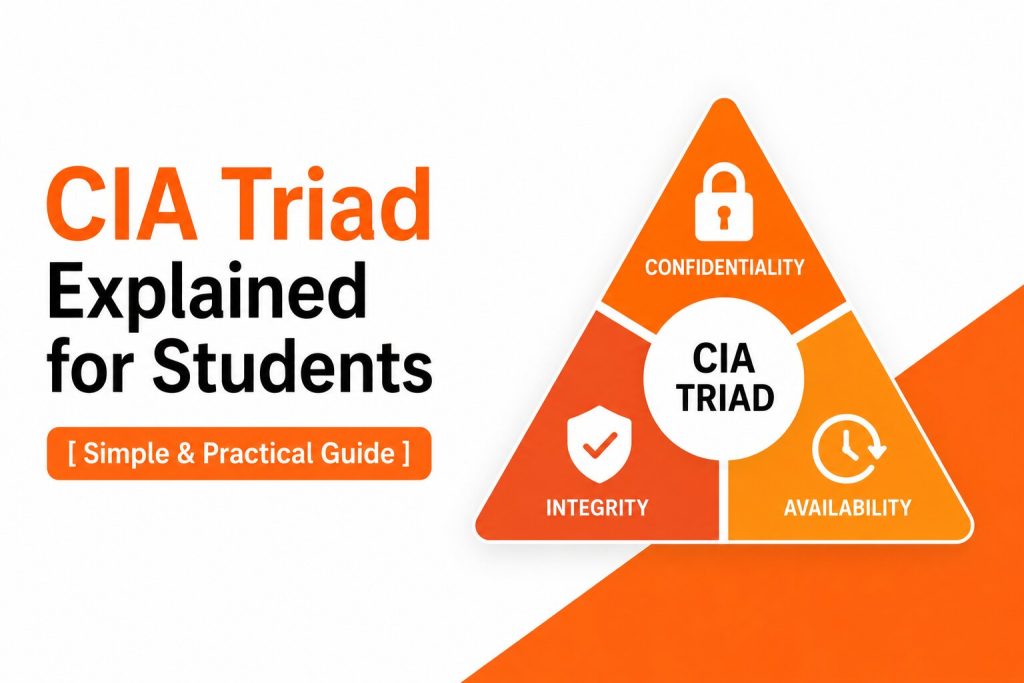
If you are studying cyber security, information security, computer science, digital forensics, or IT, you have probably seen the term CIA Triad in lecture slides, assignment briefs, or exam questions.
At first, it can sound more complicated than it really is. Many students see “confidentiality, integrity, and availability” and understand the definitions separately, but then struggle to apply them in real examples, case studies, or academic writing.
The good news is that the CIA Triad is actually one of the easiest cyber security models to understand once you connect it with real life.
In simple words, the CIA Triad is a cyber security model used to protect information and systems. It focuses on three main goals: keeping data private, keeping data accurate, and making sure systems are available when people need them.
These three goals are:
| CIA Principle | Simple Meaning |
| Confidentiality | Only the right people can access the information |
| Integrity | The information stays accurate and unchanged unless authorised |
| Availability | The information or system is accessible when needed |
Cyber security is not only about stopping hackers. It is also about protecting trust. A university portal, hospital system, online banking app, cloud storage account, or e-commerce website must protect data from unauthorised access, prevent unauthorised changes, and stay available for users.
That is why the CIA Triad is still one of the most important cyber security fundamentals students need to understand. NIST identifies CIA as confidentiality, integrity, and availability, while CISA explains cyber security as protecting networks, devices, and data while ensuring these three principles. (NIST Computer Security Resource Center)
This guide explains the CIA Triad in a simple, practical, and student-friendly way, with real examples, assignment guidance, tables, and a mini case study.
If you are building your cyber security basics from scratch, you may also find this guide on basic cyber security awareness for students helpful alongside this article.
What Is the CIA Triad in Cyber Security?
The CIA Triad in cyber security is a model used to guide how organisations protect information, systems, networks, and digital services.
CIA stands for:
Confidentiality, Integrity, and Availability.
These are the three main objectives of information security. Whenever an organisation designs a security policy, responds to a cyber attack, protects customer data, or manages risk, it usually needs to think about these three areas.
A simple way to understand the CIA Triad is this:
- Confidentiality asks: Who is allowed to see the data?
- Integrity asks: Can we trust that the data is correct?
- Availability asks: Can authorised users access the system when they need it?
For example, imagine a university student portal.
If another student can see your grades, confidentiality has failed.
If someone changes your marks without authorisation, integrity has failed.
If the portal crashes on the assignment deadline, availability has failed.
This is why the CIA Triad is not just a theory. It applies to daily digital life, academic systems, business operations, healthcare, banking, cloud computing, and almost every online platform.
Why Is the CIA Triad Important for Students?
Students often learn the CIA Triad early in cyber security courses because it gives them a simple framework for understanding many bigger topics.
Once you understand confidentiality, integrity, and availability, it becomes easier to understand:
| Cyber Security Topic | How the CIA Triad Helps |
| Phishing | Explains how attackers steal confidential data |
| Ransomware | Shows how attacks damage availability and sometimes confidentiality |
| Data breaches | Helps analyse what information was exposed |
| Risk management | Helps identify what could go wrong and what impact it may have |
| Access control | Helps explain who should access what data |
| Encryption | Helps protect confidentiality |
| Backups | Help restore availability and integrity |
| Digital forensics | Helps investigate what data was accessed, changed, or disrupted |
For students, the CIA Triad is especially useful because it helps you write better assignment answers. Instead of only saying “this attack is dangerous,” you can explain which security principle was affected and why.
For example, a weak answer might say:
“The ransomware attack was serious because it stopped users from accessing files.”
A stronger academic answer would say:
“The ransomware attack affected availability because authorised users could no longer access files and systems. It may also have affected confidentiality if the attackers copied sensitive data before encrypting it.”
That second answer is more specific, more analytical, and more suitable for university-level cyber security writing.
If you are working on a cyber security essay, report, or case study and need structured academic guidance, Essay Helper can support students with clearer explanations, examples, and assignment planning.
The Three Parts of the CIA Triad
The CIA Triad becomes easier when you separate the three principles first, then bring them together later.
| Principle | Simple Meaning | Student Example | Cyber Security Example |
| Confidentiality | Keeping information private | Only you and your tutor can see your marks | Encrypting customer records |
| Integrity | Keeping information accurate | Your submitted assignment is not changed after upload | Hashing files to detect tampering |
| Availability | Keeping systems accessible | The university portal works before the deadline | Using backup servers to prevent downtime |
Each principle protects a different part of security. A secure system should not only keep data secret. It should also keep data correct and accessible.
This is a common student mistake. Many students think cyber security is mainly about confidentiality, but availability and integrity can be just as important.
A hospital system, for example, must protect patient data from unauthorised access, but it must also make sure the patient records are accurate and available to doctors during emergencies.
Confidentiality Explained Simply
Confidentiality means protecting information from unauthorised access.
In simple words, confidentiality is about privacy. It makes sure that only approved people, systems, or organisations can view sensitive information.
Examples of confidential information include:
Student grades, medical records, passwords, bank details, customer data, employee files, private emails, business contracts, and research data.
Confidentiality is important because personal and sensitive information can be misused if it falls into the wrong hands. For example, if a hacker steals login details, they may access private accounts. If medical records are leaked, patients may suffer privacy harm. If bank card details are exposed, customers may face financial fraud.
Common methods used to protect confidentiality include:
| Security Control | How It Protects Confidentiality |
| Passwords | Prevent unauthorised account access |
| Multi-factor authentication | Adds another verification step |
| Encryption | Makes data unreadable without the correct key |
| Access control | Limits data access to approved users |
| User permissions | Gives people only the access they need |
| Data masking | Hides sensitive parts of data |
| Security awareness training | Helps users avoid phishing and social engineering |
A simple student example is your university account. Your username and password help protect your personal details, grades, coursework submissions, and emails. If another student gets your password and logs into your account, confidentiality is broken.
A cyber security example is encryption. When a website uses HTTPS, the data moving between your browser and the website is protected from easy interception. That helps maintain confidentiality during online communication.
Confidentiality is also closely linked to data protection laws and privacy expectations. Organisations need to protect personal data, not just because it is good practice, but because failure can lead to legal, financial, and reputational consequences.
IBM’s 2025 Cost of a Data Breach Report estimated the global average cost of a data breach at USD 4.44 million, showing why protecting confidential data remains a major organisational priority. (Baker Donelson)
Integrity Explained Simply
Integrity means keeping information accurate, complete, and trustworthy.
In simple words, integrity makes sure that data has not been changed in an unauthorised or accidental way.
If confidentiality is about “who can see the data,” integrity is about “can we trust the data?”
Imagine your university grade is 72, but a system error changes it to 27. Even if no one else saw your grade, the data is now wrong. That is an integrity problem.
Integrity is important because decisions depend on accurate data. Doctors rely on accurate medical records. Banks rely on accurate transaction records. Universities rely on accurate student results. Businesses rely on accurate customer and financial data.
Common methods used to protect integrity include:
| Security Control | How It Protects Integrity |
| Hashing | Detects whether data has changed |
| Digital signatures | Confirms authenticity and detects tampering |
| Access permissions | Prevents unauthorised editing |
| Version control | Tracks changes to files or code |
| Audit logs | Records who changed what and when |
| Input validation | Prevents invalid or harmful data entry |
| Backups | Restores correct data after corruption |
A student example is uploading an assignment to a university portal. Once submitted, the file should not be changed by someone else. If a malicious user edits your work or deletes sections, the integrity of your submission has been damaged.
A cyber security example is a banking transaction. If you transfer $100, the system must record $100, not $1,000 or $10. If an attacker changes the transaction amount, the integrity of the banking system is compromised.
Integrity is also important in digital evidence. In digital forensics, investigators must prove that evidence has not been altered. If evidence integrity cannot be trusted, it may lose value in an investigation.
This is why integrity is not only about data being “correct.” It is about trust.
Availability Explained Simply
Availability means making sure that information, systems, and services are accessible to authorised users when needed.
In simple words, availability is about keeping systems working.
A system can have strong confidentiality and integrity, but if users cannot access it, it still fails from a security perspective.
For example, if your university learning platform goes offline one hour before an assignment deadline, availability is affected. If a hospital system crashes during an emergency, availability becomes a serious safety issue. If online banking is unavailable for several hours, customers may not be able to make urgent payments.
Common methods used to protect availability include:
| Security Control | How It Protects Availability |
| Backups | Restore data after loss or damage |
| Disaster recovery plans | Help systems recover after major incidents |
| Redundant servers | Keep services running if one server fails |
| Load balancing | Distributes traffic across systems |
| DDoS protection | Helps defend against traffic overload attacks |
| Regular updates | Reduces crashes and security weaknesses |
| Monitoring | Detects system problems early |
Availability is often affected by attacks such as ransomware and distributed denial-of-service attacks.
A ransomware attack may encrypt files and stop users from accessing systems. A DDoS attack may flood a website with traffic until real users cannot access it. Both attacks affect availability, even if they work in different ways.
Verizon’s 2025 DBIR analysed more than 22,000 security incidents and over 12,000 confirmed breaches, showing how cyber incidents continue to affect organisations at scale. (Verizon)
For students, availability is sometimes the easiest principle to understand because everyone has experienced a website, app, or online system being down. But in cyber security, downtime is more than an inconvenience. It can affect money, safety, education, healthcare, and public trust.
CIA Triad Examples in Real Life
The CIA Triad is not limited to technical systems. You can see confidentiality, integrity, and availability in everyday digital life.
Example 1: University Student Portal
A university portal stores student names, course details, grades, payment records, and assignment submissions.
Confidentiality means only authorised students and staff can access the correct records.
Integrity means grades, submissions, and feedback cannot be changed without permission.
Availability means students and staff can access the portal when needed, especially during deadlines and exam periods.
Example 2: Online Banking App
An online banking app must protect personal and financial data.
Confidentiality means your account details are not visible to unauthorised people.
Integrity means your balance and transactions are accurate.
Availability means you can access your account when you need to transfer money or check payments.
Example 3: Healthcare System
A hospital system stores patient records, prescriptions, test results, and appointment details.
Confidentiality means patient records are private.
Integrity means medical data is accurate and not changed incorrectly.
Availability means doctors and nurses can access patient information during treatment.
This example is especially important because a cyber security failure in healthcare can affect patient safety, not just data privacy.
Example 4: Cloud Storage
Cloud services like Google Drive, OneDrive, and Dropbox are common among students.
Confidentiality means private files are protected from unauthorised users.
Integrity means files are not corrupted or changed without permission.
Availability means students can access documents when they need them.
If you are revising cyber security basics, these examples are useful because they show how the CIA Triad applies to normal student life, not just large organisations.
CIA Triad and Common Cyber Attacks
Different cyber attacks affect different parts of the CIA Triad. Some attacks affect one principle mainly, while others affect all three.
| Cyber Attack | Main CIA Principle Affected | Explanation |
| Phishing | Confidentiality | Attackers trick users into revealing passwords or sensitive data |
| Ransomware | Availability | Files or systems become inaccessible after encryption |
| Data breach | Confidentiality | Sensitive data is exposed or stolen |
| Malware | Integrity and availability | Malware can change files, damage systems, or disrupt services |
| DDoS attack | Availability | Systems are flooded with traffic and become unavailable |
| Insider threat | Confidentiality and integrity | An employee or trusted user may steal or change data |
| Man-in-the-middle attack | Confidentiality and integrity | Attackers may intercept or alter communication |
| SQL injection | Confidentiality and integrity | Attackers may access, modify, or delete database records |
Let’s look at a few examples more clearly.
A phishing email may pretend to be from your university IT team. If you enter your password into a fake login page, the attacker may access your account. This affects confidentiality because private information may be exposed.
A ransomware attack may lock a company’s files and demand payment. This affects availability because users cannot access their own systems. It may also affect confidentiality if attackers steal data before encrypting it.
A DDoS attack may make a website unavailable by overwhelming it with traffic. This mainly affects availability because real users cannot access the service.
A database attack may change customer records or delete information. This affects integrity because the data can no longer be trusted.
Verizon’s 2025 DBIR reported ransomware in 44% of breaches according to summaries of the report, which shows why students should understand how one attack can affect more than one CIA principle. (Keepnet Labs)
CIA Triad Case Study for Students
Let’s use a simple university case study.
Imagine a university uses an online learning platform where students can access lecture slides, submit assignments, check grades, and communicate with tutors.
One day, attackers send phishing emails to students and staff. The email says:
“Your university account will be suspended. Click here to verify your login.”
Some users click the link and enter their passwords on a fake website. The attackers then use those passwords to access the learning platform.
How Confidentiality Is Affected
Confidentiality is affected because attackers can now access private student and staff information. This may include names, email addresses, grades, feedback, uploaded assignments, and personal details.
If attackers download this data, the university may face a data breach.
How Integrity Is Affected
Integrity may be affected if attackers change grades, delete assignment submissions, edit feedback, or modify course materials.
Even if only a few records are changed, students and staff may lose trust in the system because they cannot be sure what information is accurate.
How Availability Is Affected
Availability may be affected if the attackers lock accounts, delete files, overload the system, or install ransomware.
If students cannot access lecture materials or submit assignments, the learning process is disrupted.
What Security Controls Could Help?
The university could reduce risk by using multi-factor authentication, stronger password policies, phishing awareness training, access controls, audit logs, regular backups, and incident response planning.
This case study is useful for assignments because it shows that one incident can affect all three parts of the CIA Triad. It also gives you a structure for analysis: describe the incident, identify the affected CIA principles, explain the impact, and recommend controls.
Students who need help turning this kind of analysis into a structured report can use academic assignment support to improve clarity, structure, and academic presentation.
CIA Triad in Risk Management
The CIA Triad is closely connected to risk management.
Risk management is about identifying possible threats, understanding their impact, and choosing controls to reduce harm.
The CIA Triad helps by giving a simple way to ask:
- What could expose confidential data?
- What could damage data integrity?
- What could make systems unavailable?
For example, a company may identify phishing as a risk. The possible impact could include stolen passwords, unauthorised access, and data exposure. This connects mainly to confidentiality.
Another company may identify ransomware as a risk. The possible impact could include system downtime, lost access to files, and business disruption. This connects strongly to availability.
A bank may identify database tampering as a risk. The possible impact could include incorrect balances, false transactions, and loss of customer trust. This connects strongly to integrity.
A basic CIA-based risk table may look like this:
| Risk | CIA Principle | Possible Impact | Control |
| Phishing | Confidentiality | Stolen login details | MFA and awareness training |
| Ransomware | Availability | Systems become inaccessible | Backups and endpoint protection |
| Database tampering | Integrity | Incorrect records | Access control and audit logs |
| DDoS attack | Availability | Website downtime | DDoS protection and load balancing |
| Weak passwords | Confidentiality | Account compromise | Password policy and MFA |
This is why the CIA Triad is useful in cyber security assignments. It helps students move from basic description to structured analysis.
Instead of writing general points, you can connect each threat to a security objective and then recommend suitable controls.
CIA Triad and Data Protection
The CIA Triad also supports data protection.
Data protection is about keeping personal and sensitive data safe from misuse, loss, unauthorised access, and damage.
Confidentiality supports data protection by limiting who can access personal information.
Integrity supports data protection by making sure records are accurate and reliable.
Availability supports data protection by ensuring authorised users can access data when there is a valid need.
For example, a healthcare organisation must protect patient confidentiality, but it must also keep patient records accurate and available to medical staff. If patient records are private but unavailable during treatment, the organisation still has a serious problem.
Similarly, a university must protect student records from unauthorised access, but it must also ensure grades are accurate and accessible to authorised staff and students.
This is why students should avoid explaining data protection only as “keeping data private.” Privacy is important, but full information security also requires accuracy and availability.
CIA Triad vs Other Cyber Security Concepts
Students sometimes confuse the CIA Triad with other cyber security concepts. The CIA Triad is not the same as authentication, authorisation, privacy, or non-repudiation, although these ideas are connected.
| Concept | Meaning | Connection to CIA Triad |
| Authentication | Proving who someone is | Supports confidentiality |
| Authorisation | Deciding what someone can access | Supports confidentiality and integrity |
| Privacy | Protecting personal information | Closely linked to confidentiality |
| Non-repudiation | Preventing someone from denying an action | Supports accountability and integrity |
| Risk management | Identifying and reducing risks | Uses CIA principles to assess impact |
| Encryption | Making data unreadable without a key | Protects confidentiality |
| Backups | Copies of data for recovery | Protect availability and integrity |
For example, authentication checks your identity when you log in. Authorisation decides what you can access after logging in. Together, they help protect confidentiality and integrity.
Encryption protects confidentiality because it prevents unauthorised people from reading data.
Backups support availability because they help restore systems after data loss, ransomware, or technical failure.
Non-repudiation is slightly different. It means someone cannot easily deny that they performed an action. For example, a digital signature can help prove that a message or transaction came from a specific sender.
The CIA Triad is best understood as a foundation. Other cyber security concepts often support one or more parts of it.
How Students Can Use the CIA Triad in Assignments and Essays
Many students understand the CIA Triad but struggle to write about it academically. The problem is usually not the definition. The problem is the application.
A basic assignment answer defines the CIA Triad.
A stronger assignment answer explains the CIA Triad, applies it to examples, links it to threats, evaluates impact, and recommends controls.
Here is a simple structure you can use in assignments.
1. Start With a Clear Definition
Begin by explaining that the CIA Triad is a foundational information security model based on confidentiality, integrity, and availability.
Keep the definition clear and direct.
2. Explain Each Principle Separately
Use one paragraph each for confidentiality, integrity, and availability.
Do not merge them too quickly. Show that you understand the difference.
3. Add Practical Examples
- Examples make your answer stronger.
- For confidentiality, you might discuss encrypted student records.
- For integrity, you might discuss grade accuracy or transaction records.
- For availability, you might discuss university portals, hospital systems, or online banking access.
4. Apply the CIA Triad to a Case Study
If your assignment includes a cyber attack scenario, identify which CIA principles were affected.
For example:
- A phishing attack may affect confidentiality.
- A ransomware attack may affect availability.
- A database manipulation attack may affect integrity.
Some attacks affect all three.
5. Recommend Security Controls
Do not stop at explaining the problem. Suggest controls.
You could mention multi-factor authentication, encryption, access control, backups, logging, staff training, incident response, patching, and disaster recovery planning.
6. Add Critical Analysis
Higher-level assignments often need more than description.
You can add critical analysis by explaining trade-offs.
For example, strong access controls may improve confidentiality but may also reduce usability if they are too restrictive. High availability may require extra infrastructure, which can increase cost. Strong integrity controls may require monitoring and auditing.
This shows that you understand cyber security as a balance between protection, usability, cost, and risk.
Students looking for more advanced topics can explore research topic ideas for cyber security to connect the CIA Triad with areas like cloud security, ransomware, AI security, digital forensics, and risk management.
Example Assignment Paragraph on the CIA Triad
Here is a student-friendly example paragraph:
The CIA Triad is a core information security model that focuses on confidentiality, integrity, and availability. Confidentiality ensures that sensitive data is accessed only by authorised users, such as protecting student records through passwords and encryption. Integrity ensures that data remains accurate and cannot be changed without permission, such as preventing unauthorised changes to grades or financial transactions. Availability ensures that systems and information are accessible when needed, such as keeping a university portal online during assignment deadlines. In a ransomware attack, availability is usually the most affected principle because users may be unable to access files or systems. However, confidentiality may also be affected if attackers steal data before encrypting it.
This type of paragraph works well because it defines the model, explains each part, gives examples, and applies the concept to a cyber attack.
Common Mistakes Students Make When Explaining the CIA Triad
Many students lose marks not because they do not know the CIA Triad, but because their explanation is too general.
Here are common mistakes to avoid.
Mistake 1: Mixing Up Confidentiality and Integrity
Confidentiality is about preventing unauthorised access.
Integrity is about preventing unauthorised changes.
For example, if someone views your private grades, that is a confidentiality issue. If someone changes your grades, that is an integrity issue.
Mistake 2: Ignoring Availability
Students often focus heavily on confidentiality because data breaches are easy to understand. However, availability is equally important.
A system that is secure but unavailable is still failing its users.
Mistake 3: Giving Vague Examples
Avoid examples like “protecting data” without explaining how.
Instead, write specific examples such as “using encryption to protect customer payment information” or “using backups to restore access after ransomware.”
Mistake 4: Only Defining the Terms
University assignments usually need application. Do not only define confidentiality, integrity, and availability. Apply them to real systems, threats, and controls.
Mistake 5: Not Linking the CIA Triad to Cyber Attacks
The CIA Triad becomes more useful when connected to attacks like phishing, ransomware, malware, DDoS, insider threats, and data breaches.
Mistake 6: Forgetting Security Controls
After explaining which CIA principle is affected, recommend controls. This makes your answer more practical and complete.
Mistake 7: Overusing Technical Language
Simple and accurate writing is better than complicated wording. A clear explanation with relevant examples usually performs better than a paragraph full of jargon.
If you need more practical writing support for cyber security coursework, cyber security assignment help can guide students through difficult concepts, real-world examples, and academic structure.
CIA Triad in Different Sectors
The CIA Triad applies differently depending on the sector. This is useful for students because assignments often ask for industry-specific examples.
| Sector | Confidentiality Example | Integrity Example | Availability Example |
| Education | Protecting student records | Keeping grades accurate | Keeping learning portals online |
| Healthcare | Protecting patient data | Ensuring correct prescriptions | Keeping hospital systems accessible |
| Banking | Protecting account details | Ensuring transaction accuracy | Keeping payment systems working |
| E-commerce | Protecting customer information | Keeping order details correct | Keeping website checkout available |
| Government | Protecting citizen data | Maintaining accurate records | Keeping public services online |
| Cloud computing | Protecting stored files | Preventing unauthorised file changes | Maintaining service uptime |
For example, in education, confidentiality protects student records, integrity protects grades and submissions, and availability protects learning platforms.
In banking, confidentiality protects customer account details, integrity protects balances and transactions, and availability allows customers to access services when needed.
In healthcare, all three are critical because cyber security failures can affect patient care.
CIA Triad and Student Cyber Security Awareness
Understanding the CIA Triad can also help students improve their own cyber security habits.
For confidentiality, students should use strong passwords, enable multi-factor authentication, avoid sharing login details, and be careful with phishing emails.
For integrity, students should save backup copies of assignments, check file versions, avoid suspicious downloads, and protect devices from malware.
For availability, students should back up important files, use reliable cloud storage, update devices, and avoid leaving submissions until the last minute in case systems fail.
This is where theory becomes practical. The CIA Triad is not just for organisations. It also applies to students’ daily academic life.
For more everyday protection advice, students can read these practical tips for students to reduce common risks such as phishing, weak passwords, and unsafe browsing.
CIA Triad and Modern Cyber Security Careers
If you are considering a cyber security career, the CIA Triad is one of the first frameworks you should understand properly.
Security analysts use CIA principles when reviewing alerts and incidents.
Risk managers use them to assess business impact.
Digital forensic investigators use them to understand whether data was accessed, changed, or disrupted.
Cloud security professionals use them to design secure and reliable systems.
Penetration testers use them to explain the potential impact of vulnerabilities.
For example, if a penetration tester finds a vulnerability that allows unauthorised database access, they may explain the impact in terms of confidentiality. If the vulnerability allows data modification, it affects integrity. If it allows system shutdown, it affects availability.
Students considering masters in cyber security? should learn the CIA Triad well because it appears across many areas of advanced study, including risk management, secure systems design, network security, cloud security, and incident response.
Quick CIA Triad Revision Summary
Here is a simple revision table you can use before exams or assignments.
| CIA Principle | Key Question | Simple Example | Common Controls |
| Confidentiality | Who can access the data? | Protecting student records | Encryption, passwords, MFA, access control |
| Integrity | Can we trust the data? | Preventing grade changes | Hashing, audit logs, permissions, validation |
| Availability | Can users access it when needed? | Keeping a portal online | Backups, redundancy, monitoring, disaster recovery |
A quick way to remember the CIA Triad is:
- Confidentiality protects privacy.
- Integrity protects accuracy.
- Availability protects access.
FAQs About the CIA Triad
What is the CIA Triad in simple words?
The CIA Triad is a cyber security model based on confidentiality, integrity, and availability. In simple words, it means keeping data private, accurate, and accessible to authorised users.
Why is the CIA Triad important in cyber security?
The CIA Triad is important because it helps organisations protect information and systems from different types of risks. It gives students and professionals a clear way to analyse cyber attacks, data breaches, and security controls.
What are examples of confidentiality, integrity, and availability?
Confidentiality is protecting passwords or student records. Integrity is making sure grades or bank transactions are accurate. Availability is keeping a university portal, hospital system, or banking app accessible when users need it.
How do students explain the CIA Triad in assignments?
Students should define the CIA Triad, explain each principle, give real-world examples, apply it to a cyber attack or case study, and recommend suitable security controls. This makes the answer more analytical and practical.
What is confidentiality in the CIA Triad?
Confidentiality means preventing unauthorised access to sensitive information. Examples include using passwords, encryption, access controls, and multi-factor authentication to protect private data.
What is integrity in the CIA Triad?
Integrity means keeping information accurate, complete, and trustworthy. It prevents unauthorised changes to data, such as edited grades, modified transactions, or altered medical records.
What is availability in the CIA Triad?
Availability means making sure systems, data, and services are accessible when authorised users need them. Backups, monitoring, redundant servers, and disaster recovery plans help protect availability.
How does ransomware affect the CIA Triad?
Ransomware mainly affects availability because it locks users out of files or systems. It can also affect confidentiality if attackers steal data, and integrity if files or records are changed or damaged.
Is the CIA Triad still relevant today?
Yes, the CIA Triad is still relevant because modern cyber security still depends on protecting data privacy, accuracy, and access. It remains a useful foundation for analysing threats, risks, and controls.
What is the easiest way to remember the CIA Triad?
The easiest way to remember the CIA Triad is: confidentiality means privacy, integrity means accuracy, and availability means access. If you remember these three words, the model becomes much easier to explain.
Conclusion
The CIA Triad is one of the most important cyber security models for students because it explains the three main goals of information security: confidentiality, integrity, and availability.
Confidentiality protects information from unauthorised access. Integrity keeps information accurate and trustworthy. Availability makes sure systems and data are accessible when authorised users need them.
For students, the CIA Triad is more than a definition to memorise. It is a practical framework you can use in assignments, essays, case studies, exams, and real-world cyber security analysis.
The best way to understand it is to apply it to real examples. Ask yourself: Was private data exposed? Was the information changed? Was a system made unavailable?
Once you can answer those questions clearly, you can explain the CIA Triad with confidence.