

Essay Writing Mistakes Students Must Avoid in 2026
Essay writing is still one of the main ways universities assess critical thinking, academic maturity, and subject understanding. Yet many students struggle to write essays that meet university-level standards. A 2024 survey by the National Association of Scholars reported that around 68% of college students find academic writing difficult, especially essay writing.
In 2026, essay writing mistakes carry more consequences than before. With stricter academic integrity policies and widespread AI use, markers are quicker to spot generic writing, unclear arguments, and inconsistent tone. Small issues that once cost a few marks can now trigger deeper scrutiny, lower grades, or integrity concerns.
This guide breaks down the most common essay writing mistakes students make in 2026 and shows you how to fix them using practical, repeatable strategies. If you want a wider framework first, this essay writing guide for students can help you understand the complete structure before you start fixing specific mistakes.
Why essay writing mistakes matter more in 2026
Markers today read essays with a sharper eye because they see a mix of human writing, AI-assisted drafts, and sometimes fully generated content. That reality has made tutors more alert to predictable warning signs such as generic arguments, circular structure, and paragraphs that sound polished but say very little.
Universities are also tightening academic integrity rules. Misusing AI tools, copying from online samples, or relying on paraphrasing sites can lead to misconduct cases rather than “just” a low grade. The good news is that most of the mistakes that lead to weak grades or suspicion are common, easy to spot, and fixable.
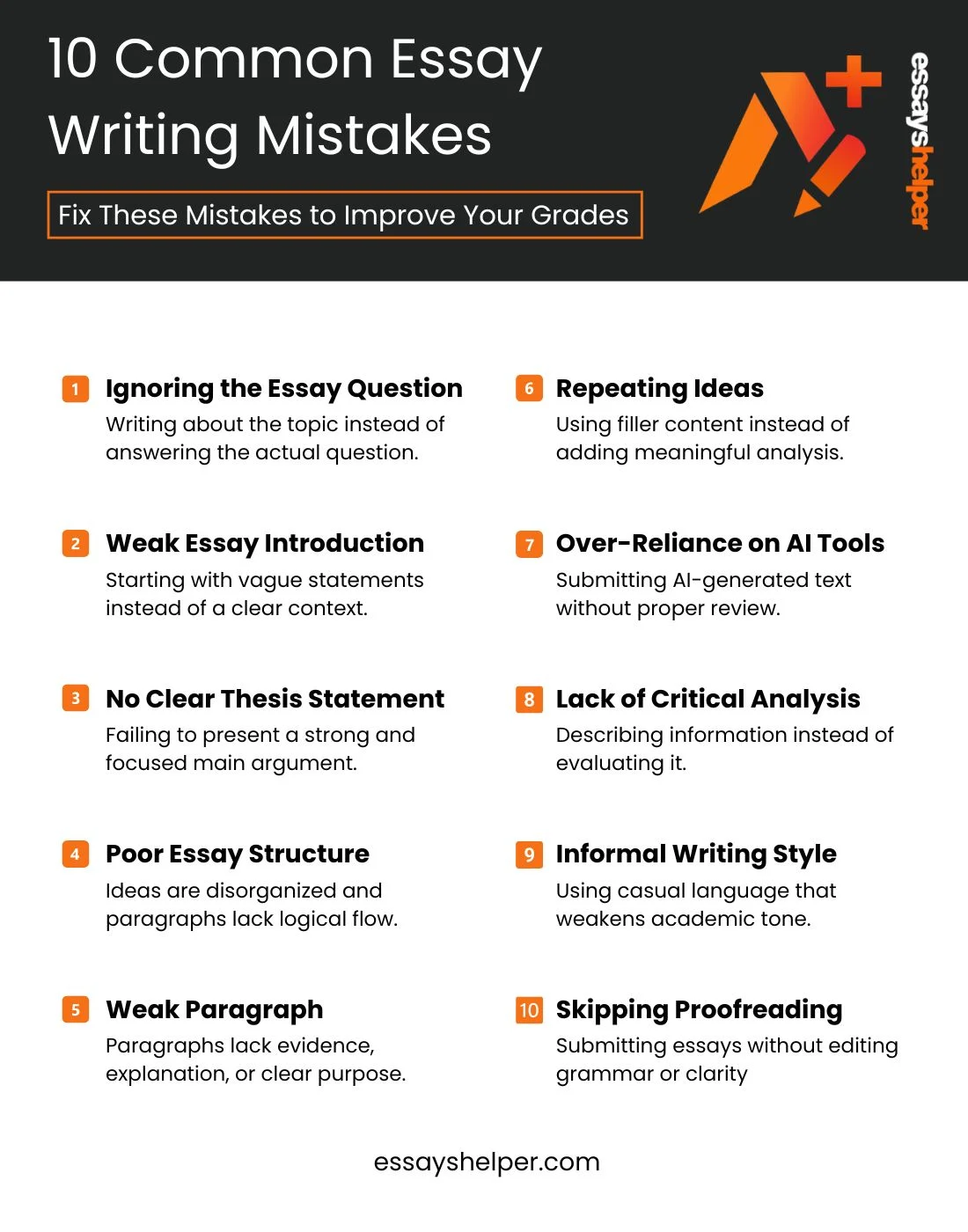
Let’s go through the biggest essay writing mistakes students must avoid in 2026.
Mistake 1: Ignoring the essay question and marking criteria
One of the most common academic writing mistakes is writing about the general topic instead of answering the exact question. Students often spend hours researching and writing, but the final essay does not match what the task words require.
This usually happens when students skip the rubric and start drafting too quickly. You might think you are being productive, but you are actually building an essay that may not match the marking scheme.
How to fix it (without overcomplicating it):
Start by separating the topic words from the instruction words. Then rewrite the question in your own words in one clean sentence. Open your marking criteria and identify what a high-grade response looks like under each category. Finally, plan each body paragraph around a specific marking requirement so every paragraph earns marks.
Mistake 2: Weak or vague essay introductions
A weak introduction can damage your essay before your argument even begins. In many low-grade essays, introductions are too broad, filled with dictionary definitions, or unclear about what the essay will argue.
A strong essay introduction does not need to be dramatic. It needs to be purposeful. Your marker should quickly understand what debate you are addressing, what position you are taking, and how your essay will develop that argument.
What a strong introduction should do in 2026:
It gives brief context without turning into a mini textbook. It defines the specific issue the essay will address. It clearly signals your argument, and it previews the structure so the reader knows what is coming next.
For a practical breakdown with examples, here is a dedicated guide on how to write an essay introduction.
Mistake 3: No clear thesis statement
In 2026, markers expect a thesis statement that is focused and arguable, especially in analytical and argumentative essays. Without a thesis, your writing often reads like a chain of observations rather than a logical argument.
A weak thesis sounds like a topic announcement. A strong thesis sounds like a claim you can prove.
Quick self-test:
If someone asked you to underline one sentence that represents your main argument, could you do it instantly? If not, your thesis is still unclear.
If you want a simple formula and examples, read this guide on how to write a strong thesis statement.
Mistake 4: Writing without a structured essay process
Many students treat essay writing as one big task: “I need to write my essay.” In reality, strong writing comes from a sequence of smaller steps. When students skip the process, they often repeat points, miss key evidence, place arguments in the wrong order, and end up panicking about word count near the deadline.
A simple process is enough to raise grades quickly. Start by analysing the question and rubric, then brainstorm points and group them into themes. Build a basic outline, draft quickly, and edit in layers: structure first, style second, technical issues last.
If you want a clear process you can follow for any subject, use this full walkthrough: how to write an essay.
Mistake 5: Paragraphs that lack focus and purpose
Paragraph structure is one of the biggest grade separators. Weak paragraphs usually try to cover too many ideas, include evidence without explanation, or end without linking back to the thesis.
A strong academic paragraph should feel like a complete unit of meaning. It starts with a clear topic sentence, explains the point, supports it with evidence, and finishes by showing how it strengthens the overall argument. When you reread your draft, you should be able to summarise each paragraph in one sentence. If you cannot, the paragraph is probably doing too much and needs restructuring.
To make this more practical, a helpful method is to check your essay by reading only the first sentence of every paragraph in order. If those topic sentences do not form a logical argument on their own, your structure needs revision.
Mistake 6: Underdeveloped or mechanical conclusions
Many students write their conclusion in the final minutes before submission, so the conclusion becomes repetitive, vague, or suddenly introduces new ideas that belong in the main body.
A strong conclusion should answer the essay question directly, summarise the core argument without copying earlier sentences, and show how your key points connect as a whole. In some essays, it can briefly mention implications or limitations, but it should never feel like an afterthought.
Here is a practical guide on how to write an essay conclusion.
Mistake 7: Over-dependence on AI and paraphrasing tools
AI tools are part of student life in 2026, but misuse creates real academic risk. The biggest issue is not only discipline for obvious misuse. It is that over-reliance weakens your ability to build an argument, explain evidence, and write in your own academic voice.
Common red flags include copying AI-generated text with minimal edits, letting AI decide the structure, using paraphrasing tools to disguise borrowed content, or accepting fabricated citations. These patterns often result in inconsistent tone and shallow analysis, and they can trigger suspicion because the writing does not match how a student communicates in class.
A safer and smarter approach is to use tools for brainstorming, generating practice questions, or checking grammar, but keep the argument and final wording under your control. Always verify sources manually and make sure you could explain every paragraph in a discussion with your tutor.
Mistake 8: Weak evidence and minimal critical analysis
One of the most common essay writing mistakes is staying descriptive. Students summarise what sources say but never explain why the evidence matters or how it answers the question.
Critical analysis is not about attacking every author. It is about weighing evidence, comparing viewpoints, judging how convincing a claim is, and building a justified position. A simple way to upgrade your analysis is to ask three questions each time you use a source:
What is the author claiming?
What evidence supports it, and how strong is it?
Why does it matter for this essay question?
When you consistently answer those questions in your writing, your essay stops sounding like a summary and starts sounding like an argument.
Mistake 9: Informal language and inconsistent academic style
Even when your ideas are strong, informal language can drag your grade down. Common issues include casual phrases, repeated “I think,” vague wording, overly long sentences, or switching between formal and conversational tones.
To improve academic tone, choose precise verbs such as “argues,” “suggests,” “demonstrates,” and “indicates.” Cut filler words that add length but not meaning. If your sentences feel dense, split them. Clear writing reads as confident writing.
Mistake 10: Skipping editing and proofreading
Many lost marks are sitting inside the first draft. When students submit without editing, tutors see unclear structure, weak explanation, repetition, grammar errors, and referencing mistakes that could have been fixed with a simple routine.
A practical editing routine works best in layers. First, check structure: does every paragraph support the thesis, and is the sequence logical? Then check the argument: are you analysing rather than describing, and is your evidence explained? Next, check style: academic tone, clarity, and removal of repetition. Finally, check technical issues: grammar, punctuation, spelling, and referencing format. Reading your work aloud or using text-to-speech often reveals errors your eyes miss.
When and how to seek expert help ethically
Sometimes you understand the content but struggle to express it clearly in academic writing. In that case, ethical help can make a real difference, as long as it is skills-focused support rather than shortcuts.
Good options include tutor office hours, study skills workshops, or external feedback that focuses on planning, clarity, and improving your own draft. Reputable essay writing services focus on tutoring, feedback, and editing rather than selling pre-written assignments.
For pricing and what is included, visit: https://essayshelper.com/pricing/
To learn more about the platform overall, you can also refer to essayshelper.
Summary
In 2026, the most damaging essay writing mistakes are predictable. Students lose marks when they ignore the question, write vague introductions, skip thesis clarity, rely on weak paragraph structure, and submit without editing. There are also newer risks tied to AI dependence, shallow analysis, and inconsistent academic voice.
The strongest essays follow a repeatable process. They begin with the rubric, present a precise thesis, build logically arranged paragraphs, integrate evidence with explanation and evaluation, and end with a confident conclusion. When you treat essay writing as a skill you can train, not a talent you either have or do not have, your grades usually improve faster than you expect.
FAQs
What is the most common essay writing mistake students make in 2026?
The most common mistake is starting to write without fully understanding the question and the rubric. Students often produce detailed content that does not directly meet the task requirements.
How important is a thesis statement for my overall grade?
A clear thesis is central because it gives your essay direction and tells the marker exactly what you are arguing. Without it, paragraphs often feel disconnected.
Can I use AI tools when writing essays?
Often yes, depending on your institution’s policy. Use AI for brainstorming or grammar support, but avoid copying AI-generated text directly, and always verify sources and references manually.
How can I quickly improve my essay structure?
Create a brief outline before writing. Decide main points, place them in a logical order, and assign evidence to each paragraph so your argument develops clearly.
What is the difference between descriptive and critical writing?
Descriptive writing reports information. Critical writing evaluates it by comparing viewpoints, assessing evidence quality, and explaining why it matters for the question.
How formal should my language be in university essays?
Your writing should be clear, precise, and professional. Avoid slang and overly casual phrases, and use academic verbs that reflect analysis rather than personal opinion.
What is the best way to proofread my essay?
Proofread after revising content. Read slowly, ideally aloud, and check one error type at a time. A short break between drafting and proofreading helps you spot mistakes.